Home Blog Page 2926

PM Imran Khan’s address to Sri Lankan parliament cancelled

ISLAMABAD, FEB 17 (DNA) – Sri Lankan government officials cite ‘COVID-19 constraints’ for the decision In what appears to be a last-minute decision ahead of Pakistan Prime Minister Imran Khan’s coming visit to Sri Lanka, Colombo has cancelled his Parliament address scheduled next week.

Senior government officials have cited “COVID-19 constraints” for the decision, even as the itinerary issued by the Department of Government Information — dated February 16, 2021 – listed “arrival at Parliament” on February 24, along with Imran Khan’s scheduled participation in a ‘Trade and Investment Conference’, and the inauguration of a Sports Institute the same day.

Amid a surge of infections in the country, Sri Lanka began a vaccination drive for parliamentarians on Tuesday. The Pakistan Prime Minister, who is the first Head of Government to visit Sri Lanka after the pandemic hit the world last year, is expected to arrive on February 23.

The last foreign leader to address Sri Lankan Parliament was Indian Prime Minister Narendra Modi, during his visit to the island nation in 2015. Pakistani leaders, including Presidents Mohamed Ayub Khan, Zulfikar Ali Bhutto, had addressed the Sri Lankan Parliament in 1963 and 1975.

British Prime Minister Margaret Thatcher and Thai PMs Thaksin Shinawatra and Yingluck Shinawatra also spoke at the House.

Prime Ministers Jawaharlal Nehru, Indira Gandhi and Moraji Desai were accorded the honour earlier, in 1962, 1973, and 1979 respectively. = DNA

====================

Chairman NAB assures affectees of Lasani chicks about recovering looted amount

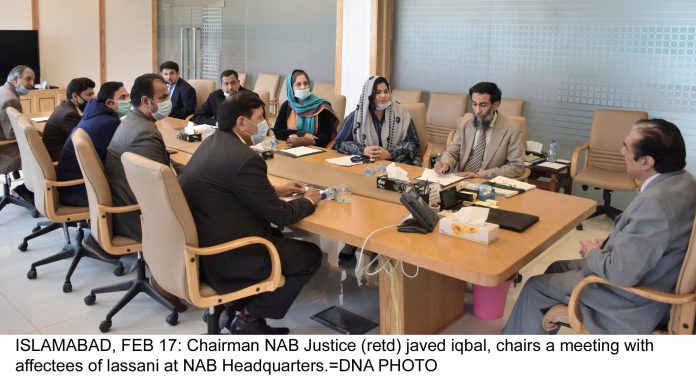
ISLAMABAD, FEB 17: Chairman NAB Justice (retd) javed iqbal, chairs a meeting with affectees of lassani at NAB Headquarters.=DNA PHOTO

ISLAMABAD, FEB 17 (DNA) – A delegation of the affectees of Lasani chicken and chicks and lasani oil traders met with the National Accountability Bureau Chairman Mr. Justice Javed Iqbal at NAB Headquarters.

The Chairman NAB was informed by the affectees that chief executive officer Lasani chicks and Lasani oil Anees ur Rehman and others had looted approximately  Rs. 80 billion from 46,000 affectees of the countrywide by promising inflated returns to their investments. They money is not being returned to affectees but the management of Lasani chicks and Lasani oil has vanished and their offices have been closed and telephone connections were severed.

The Chairman NAB took notice of the biggest scandal of looting the people and directed  DG NAB Lahore to take legal action against the looters of Rs 80 billion as per law. The culprits no matter how powerful and well connected must not be escaped and they should be brought to justice so that they should be punished as per law. The Chairman NAB directed DG NAB Lahore to establish special cell in NAB Lahore for conduct of probe about the above said biggest scandal as per law. The chairman NAB will himself supervise the operation to return the looted amount to the affectees.

Chairman NAB said that the NAB has made notorious Double Shah as Single Shah after recovering about Rs. Rs 7 billion recovered from Double Shah had been returned all to the affectees of Double Shah.

Furthermore, the investors of Fazaia Housing Society, Karachi had been returned Rs 14 billion, which is great success of NAB Karachi.

The accountability court Islamabad had imposed Rs 9 billion fine to Mufti Ehsan and others of Mudarba scam.

He said NAB is making sincere efforts to eradicate the menace of corruption from society. NAB has recovered Rs 487 billion directly and directly from corrupt elements during the tenure of incumbent management and deposited the recovered amount in the national exchequer.

Justice Javed assured the affectees of Lasani chicks and Lasani oil to utilise all available resources to take recover the looted amount and taking the case to logical conclusion. The culprits of looting people’s Rs 80 billion would be punished besides recovering the looted money from them.

The delegation thanked the chairman for giving them patient hearing and lauded the services rendered by the bureau for eradication of corruption which were also lauded by reputed national and international institutions.=DNA

======================

Long march to go ahead on March 26, vows Maryam

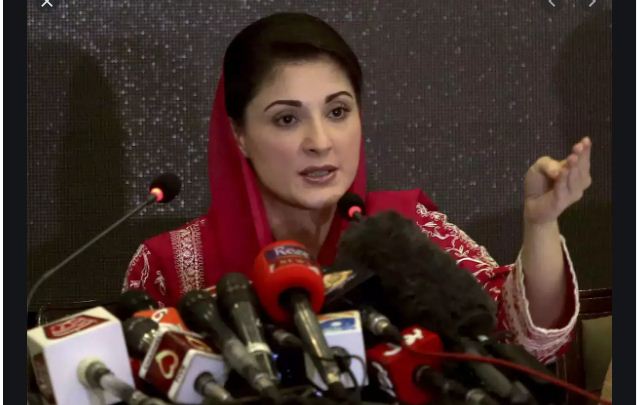
ISLAMABAD, FEB 17 (DNA) – Pakistan Muslim League-Nawaz (PML-N) Vice-President Maryam Nawaz said on Wednesday that the PDM’s long march will go ahead on March 26.

In an exclusive chat with a private television channel in Islamabad, Maryam said “We will Insha’Allah reach D-Chowk on March 26.”

The PML-N vice-president told the government “Resort to shelling or lathi-charge or kill us – we will not back down from striving for the rights of the masses.”

Earlier, Maryam Nawaz said she did not have the words to express her grief and sorrow for those who had been whisked away by the authorities in Balochistan and elsewhere in Pakistan.

Speaking to the relatives of missing persons protesting in Islamabad, Maryam, while addressing Prime Minister Imran Khan, said, “Despite the fact that you are a ‘selected’ prime minister, but at least you can tell these protesters the whereabouts of their loved ones, if you cannot order their recovery.” She also appealed to the country’s agencies to at least tell the relatives of missing persons the place where they had been kept.

“I appeal to the chief of army staff and the DG ISI to look into complaints of these people,” she said, and added what was the use of forming a commission on missing persons when its findings were not to be implemented.

“Imran, you are not accountable to these agencies, but to Allah (The Almighty). Please, at least, do not say these words that I will not be blackmailed by placing corpses on roads,” the PML-N vice-president said in a reference to the protest by members of the Hazara community against the killings of miners belonging to their community in January this year.

“Look into the eyes of these protesters. They are as good as dead,” she asked PM Imran, and said, “One of your ministers, while commenting on the use of expired tear gas on protesters, had said this was done just for the sake of an experiment.

“At least do not rub salt into the wounds of these people,” she implored.  She said she had come there to express solidarity with the protesters.

“There is no point in remaining in the office if a government is to remain indifferent to these people’s plight,” she said categorically.  She expressed surprise that why these missing persons were not produced in courts when they had been created precisely for the same purpose.

“If you have limitations, then at least share grief of these protesters who are yearning for the safe return of their relatives,” she beseeched. Maryam said when Amina Janjua’s husband had been picked up, the FIR had been registered on behalf of the prime minister of that time.  “At least, you can do this favour to them,” she concluded. = DNA

====================

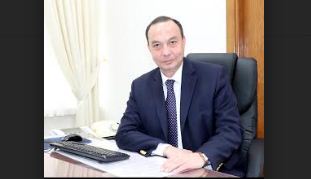
Director of ISRS Eldor Aripov: “Mazar-i-Sharif – Peshawar: a corridor to the new future of Central and South Asia”

On February 2, Tashkent hosted a landmark event for the future of Afghanistan and the entire region. It was the first trilateral meeting of Uzbekistan, Afghanistan and Pakistan on the implementation of the project for the construction of the Mazar-i-Sharif-Kabul-Peshawar railway.

The exceptional importance of this meeting is due to many reasons. First of all, a solid trilateral consensus was reached on the need to build a trans-Afghan highway. Moreover, a joint Action Plan (“Road Map”) for the construction of the Mazar-i-Sharif – Kabul – Peshawar railway was developed and signed. In March it is planned to start carrying out geodetic, hydrogeological and topographic studies along the route of the road. By May, the parties expect to prepare a feasibility study and develop mechanisms for financing the construction of the highway. In other words, an important step forward has been made towards the implementation of the “project of the century” for the region, as many media have already called it.

Russia, China and the United States expressed support for the project. Representatives of the World Bank, ADB, EBRD, EIB, IDB, AIIB, International Development Finance Corporation have shown interest in building a railway in the Peshawar direction. In this situation, the question of the source of funding should not become an insurmountable problem.

The meeting in Tashkent and its results actually mark the launch of an absolutely new paradigm of regional development. Afghanistan, a connecting link between Central and South Asia, is becoming a symbol not of the next stage of military confrontation, but of mutually beneficial interregional cooperation.

Afghanistan, which for many years played the role of a buffer, a watershed in the global confrontation between global powers and regional centers of power, is now trying on a new consolidating mission, bringing the positions of different players closer together on the basis of common trade, economic, transport and communication interests.

This trend is just beginning to gain momentum. Peace in Afghanistan is not yet a fait accompli, but it no longer seems unattainable.

In these conditions, it is important to recognize in time the new strategic opportunities that are opening up, not to miss the chance to use them, to intensify dialogue on them with all interested regional countries and external forces.

From the standpoint of the Central Asian countries, the Trans-Afghan corridor will open a completely new and shortest path to the promising markets of South Asia.

The vast opportunities for economic engagement with South Asia are driven by the region’s macroeconomic performance and growth dynamics. With a combined population of 1.9 billion people (¼ of the world) and a GDP of 3.5 trillion dollars, South Asia is the fastest growing region in the world (up 7.5% per year).

Today, the region’s contribution to global growth is 15%, and by 2040 it may increase to over 30%. While maintaining the outstripping growth dynamics, South Asia should become the new locomotive of the global economy.

That is why it is absolutely incorrect to compare the Mazar-i-Sharif-Peshawar project with the Mazar-i-Sharif-Herat route. Corridors in the direction of Iranian ports, more precisely the port of Bandar Abbas, already exist, and transportation along them has been established. Today, Uzbekistan’s foreign trade cargo is delivered to Bandar Abbas (in the future and to Chabahar) via three rail and two road routes.

Last year, despite the coronavirus pandemic, transit in the Iranian direction increased by 5%, and by rail – by 31%.

Unlike the highway to Peshawar, which will provide a completely new transport and transit vector for Central Asia, the road to Herat with a further exit to Chabahar will only expand the available opportunities.

The construction of the trans-Afghan corridor will also diversify transport flows in Central Asia. Since the arsenal of the countries of the region will already have two routes to the southern seas. On the one hand, there are already existing corridors to the ports of Chabahar and Bandar Abbas, on the other – “Mazar-i-Sharif – Kabul – Peshawar” with subsequent access to the ports of Karachi and Gwadar.

This alignment will contribute to the formation of a more flexible pricing policy in Iran and Pakistan. This, in turn, will also significantly reduce export and import costs.

From the position of the South Asian countries, the commissioning of the Mazar-i-Sharif – Kabul – Peshawar railway route will significantly reduce the delivery time of goods to Central Asia, the CIS and Europe.

For example, if the project is fully implemented, the transportation of goods from Pakistan to Uzbekistan will have to spend not 35 days, but only 3-5 days. Instead of a journey of almost a month, the journey will take less than a week. The difference is enormous, to say the least.

In turn, shortening the route means reducing the cost of transporting goods, which means saving money. According to preliminary calculations, laying the route will reduce the cost of transporting one 20-pound container by almost 3 times.

The more attractive cost of cargo transportation is also what distinguishes the Pakistani route from the Iranian one. According to preliminary expert estimates, the cost of transporting a container from Tashkent to Karachi will be approximately US $1400-1600, while on the Tashkent-Bandar-Abbas route – US $2600-3000. That is almost 1.5-2 times less.

But that’s not all. Continuing this logical chain, we can already predict that an increase in the profitability of transportation will automatically contribute to an increase in freight traffic, and hence trade.

The provision through Uzbekistan of transit of goods from India and Pakistan to the CIS countries and Europe is estimated at 3-4 million tons per year.

The launch of the Mazar-i-Sharif-Peshawar railway will also create a powerful platform for achieving inclusive economic development in Central and South Asia.

The multiplicative socio-economic effect will be expressed in the creation of new jobs, the construction of roadside infrastructure, the creation of conditions for the development of rich mineral resources along the railway route. Only during the construction of the track itself, it is planned to additionally build 264 bridges, 7 tunnels, 641 culverts.

The Mazar-i-Sharif-Peshawar project will also contribute to the expansion of the transport and communication network within Afghanistan.

Moreover, the Mazar-i-Sharif-Peshawar line will become part of the broader infrastructure connectivity of Central and South Asia.

The highway between Mazar-i-Sharif and Kabul already passes along this route, power lines from Uzbekistan and Tajikistan are stretched, leading to the capital of Afghanistan.

In addition, the CASA-1000 power line will also be extended along this corridor, which will connect Central Asia with the energy markets of Pakistan and India.

The availability of the existing infrastructure and proven routes is another advantage of the Mazar-i-Sharif-Peshawar project over the railway route to Herat. Since the railway line in the Iranian direction will have to be drawn through the completely undeveloped territory of Afghanistan, where there are absolutely no communications.

At the same time, the assessment of the project’s prospects only from an economic point of view is not entirely correct. The construction of the Trans-Afghan highway should be seen as part of efforts to bring peace to Afghanistan.

Large economic and infrastructure projects, such as the construction of the Mazar-i-Sharif-Peshawar road, can act as a rallying point for all parties interested in a peaceful settlement of the Afghan crisis.

The implementation of such projects and the receipt of economic benefits from them will increase the interest of both the participants in the inter-Afghan conflict and external forces in a peaceful settlement of the Afghan crisis and an early stabilization of the situation. And with financial benefits, you will come to the realization that trading is much more profitable than fighting. A regional consensus built on this truth will be far stronger than any political agreement or geopolitical deal.

Therefore, by supporting the establishment of Afghanistan as a bridge connecting Central and South Asia, we are solving not only socio-economic and transport-communication problems, but also making a significant contribution to ensuring regional security and stability of these regions.

INSTITUTE FOR STRATEGIC AND REGIONAL STUDIES (ISRS) UNDER THE PRESIDENT OF THE REPUBLIC OF UZBEKISTAN

WhatsApp Can Be Used To ‘Blackmail’ You, Warns FIA

ISLAMABAD – Federal Investigation Agency’s Cyber Crime Wing has warned WhatsApp users that they could be “blackmailed” through the app.

The Cyber Crime Wing, in a tweet, said that messages sent on WhatsApp could be recovered later, even after they were deleted.

“Avoid sending messages that you will want to delete later,” the FIA cautioned the messaging app’s users.

The information comes to light just as users are already switching to Signal and Telegram following WhatsApp’s privacy terms fiasco.

FM Qureshi meets Egyptian businessmen and investors in Cairo

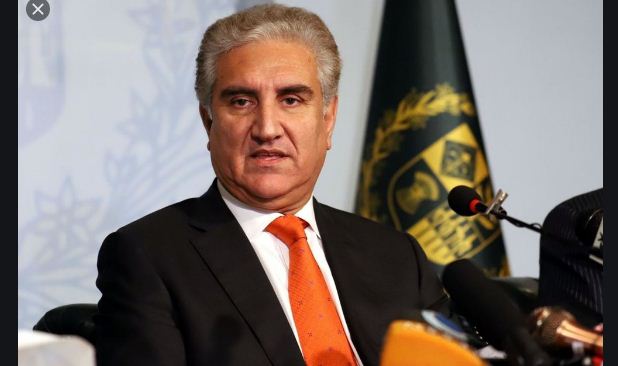
CAIRO, Egypt: Upon his arrival in Cairo for a three-day visit, the Foreign Minister Shah Mahmood Qureshi met leading Egyptian businessmen and investors at a dinner on February 16.

While talking to them, the foreign minister outlined the government’s focus on Economic Diplomacy and the steps taken to create a favorable business and investment climate in Pakistan.

The foreign minister underscored the opportunities existing in diverse areas in Pakistan for Egyptian businessmen and investors, in particular in the energy, construction, pharmaceutical, tourism, Informational Technology, and logistics sectors.

Qureshi stressed that leading multinational companies were consistently showing higher profits in Pakistan, as compared to their global average.

The minister emphasized the importance of enhanced collaboration between business communities of the two Countries. He accorded priority to the revival of the Pakistan-Egypt Joint Business Council (JBC).

The Egyptian businessmen and investors shared their perspectives on various opportunities and suggested ways to enhance bilateral cooperation in trade and investment.

The delegation comprised key Egyptian investors including El Sewedy Electric, which is keen on investing in Pakistan’s power distribution sector; and the tech-startup Swvl.

Other businessmen included the Secretary-General of Federation of Egyptian Chambers of Commerce, Chairman of Foreign Trade Association, and Chairman Expolink.

Separately, the President and CEO of El-Sewedy Electric Ahmed El Sewedy also met the Foreign Minister Shah Mahmood Qureshi.

In the meeting, he briefed the foreign minister about the company’s investment strategy and aspirations in Pakistan.

The CEO El-Sewedy Electric said that a team of experts would soon visit Pakistan to identify priority areas for investment.

The Economic Diplomacy remains a priority for the Foreign Minister Shah Mahmood Qureshi during his ongoing visit to Egypt from February 16-18, 2021.

Sindh Forest Department dedicates part of Island to Tahir Qureshi

Nazir Siyal / DNA

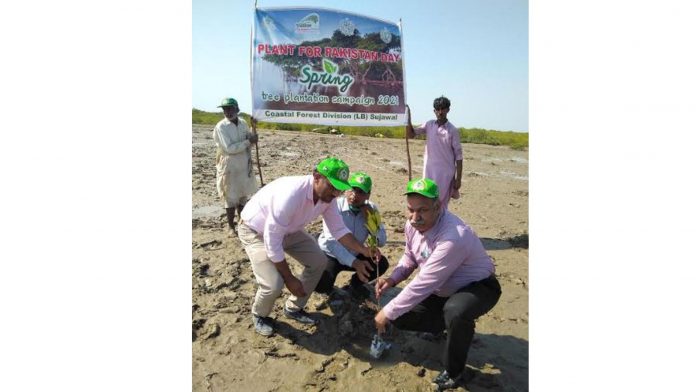
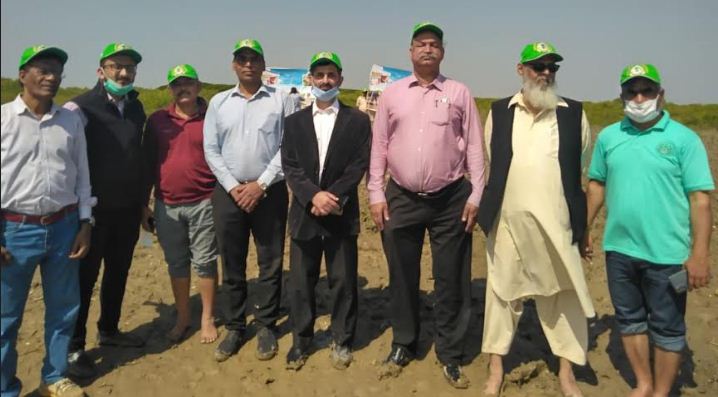
KARACHI: The Sindh Forest Department, Government of Sindh, organized an event at Shah Bander to dedicate an island to Tahir Qureshi – Baba-e-Mangroves (Father of Mangroves) in recognition of his services rendered towards conservation of mangroves along the Pakistan coast.  The event was attended by a large number of Forest Department officials, IUCN staff members, admirers and family members of Tahir Qureshi.

Tahir Qureshi, a forester by profession, having worked in Sindh Forest Department and then at IUCN, dedicated his entire life to the conservation of mangroves in Pakistan. He was later known as the ‘father of mangroves’. He passed away recently on December 29, 2020 in Karachi.

000

Speaking on the occasion, Mr. Riaz Ahmad Wagan, Chief Conservator Forest described Tahir Qureshi as a “true conservator who worked for conservation of mangroves as his religious duty. He was instrumental in planning millions of mangroves during his career.” He said that the Sindh Forest Department in recognition of his services for conserving the mangroves is dedicating a part of the Island as Tahir Qureshi Garden.He further said that the services of Tahir Qureshi will always be remembered. Tahir Qureshi’s commitment to conserving Pakistan’s mangroves will always be an example for others to follow who are engaged in the area of conservation.

Mr. Qureshi, presented the idea to the Government of Sindh to compete in the Guinness World Records by planting most mangroves in a day. He also takes the credit for data gathering of technical information for seven of the Ramsar Sites in 2000.Shahzad Sadiq, Divisional Forest Officer said that Tahir Qureshi is an excellent example for experts who are engaged in the field of conservation and sustainable development.

Mahmood Akthar Cheema, IUCN Country Representative said that Tahir Qureshi was a pioneering mangrove expert of Pakistan and had been engaged with their plantation since 1987 through numerous projects implemented by the Forest Department, and later through IUCN and other partners.He was also instrumental in expanding the mangroves forests from three to ten geographical locations along the coast of Balochistan. 

He has been the driving force in re-introducing two mangroves species – Rhizophora mucronata and Aegiceras corniculatum – that had ceased to exist in this habitat.He also provided technical assistance in raising protective plantations as a first line of defense in Thailand and Sri Lanka after the devastating Tsunami of 2004.He also provided his expertise and services to Persian Gulf and Red Sea Mangrove Rehabilitation Projects in Saudi Arabia under UNDP-UNESCO, Regional Mangroves Project and Islamic Development Bank.

Qureshi authored several research papers including “Management Plan of Mangrove Forest in Indus Delta,” published jointly by the Government of Sindh and the Government of Pakistan. Also authored a chapter in the World Atlas of Mangroves – published by the (ISME) and (ITTO). Mahmood Akhtar Cheema further said that it is a due recognition by the Sindh Forest Department of the services rendered by Tahir Qureshi for the mangroves of this country.Family Members of Tahir Qureshi thanked Sindh Forest Department for dedication of Tahir Qureshi Park in recognition of his services.

Leading airlines commit to helping UNICEF in transporting vaccines around the world

COPENHAGEN, FEB 17 (DNA) – UNICEF is today launching the Humanitarian Airfreight Initiative. Under this landmark initiative, over 10 leading airlines are signing agreements with UNICEF to support the prioritization of delivery of COVID-19 vaccines, essential medicines, medical devices and other critical supplies to respond to the pandemic. The Initiative will also act as a global logistics preparedness mechanism for other humanitarian and health crises over the longer term.

“Delivery of these life-saving vaccines is a monumental and complex undertaking, considering the sheer volumes that need to be transported, the cold chain requirements, the number of expected deliveries and the diversity of routes” said Etleva Kadilli, Director of UNICEF Supply Division. “We are grateful to these airlines for joining forces with the UNICEF Humanitarian Airfreight Initiative to support the roll-out of COVID-19 vaccines.”

The UNICEF Humanitarian Airfreight Initiative brings together the airlines covering routes to over 100 countries, in support of the COVAX Facility – the global effort aimed at equitable access to COVID-19 vaccines. Based on the COVAX Facility’s indicative distribution and first round allocation plan, 145 countries will receive doses to immunize around three per cent of their population, on average, starting in the first half of 2021, subject to all requirements being met and final allocation plans.

In addition to prioritizing shipments of these life-saving supplies, the airlines will take measures such as temperature control and security, while also adding freight capacity to routes where needed. Their commitments are critical to the timely and secure delivery of vaccines and critical supplies.

Safe, timely and efficient transportation of life-saving supplies is critical to supporting access to essential services for children and families. COVAX deliveries and the subsequent vaccination of frontline workers will support health and social care systems to safely resume these critical services.=DNA

==============

FM Qureshi meets Egyptian president, voices desire to further strengthen bilateral ties

DNA

ISLAMABAD, FEB 17: Foreign Minister Shah Mahmood Qureshi has arrived in Cairo, Egypt on a two-day visit. During his ongoing visit to Cairo, Foreign Minister Makhdoom Shah Mahmood Qureshi called on the President of Egypt, Abdel Fattah Al Sisi, on Wednesday.

The Foreign Minister conveyed warm greetings of Pakistan’s leadership to the Egyptian President. He appreciated the stability and progress achieved by Egypt under his able leadership.

Foreign Minister Qureshi briefed the President on Pakistan’s shifting focus from geo-politics to geo-economics. He stressed that the vision of “Naya Pakistan” was predicated on economic connectivity and ensuring peace within and beyond our borders. He said Pakistan would always look to be a partner in peace and progress.

Recalling the decades old warm bilateral ties between the two countries, Foreign Minister Qureshi expressed Pakistan’s desire to further strengthen and diversify bilateral ties. Foreign Minister said his visit indicated Pakistan’s keenness to reinvigorate traditional bilateral relationship rooted in shared faith, culture and values. He briefed the President on various opportunities to strengthen mutual ties, in bilateral and multilateral arena. Expressing satisfaction at the growing bilateral defense ties, the Foreign Minister said that the two countries could also share their experience in countering terrorism and extremism.

The Foreign Minister briefed the President on the situation in Pakistan’s neighborhood, in particular Pakistan’s efforts to facilitate the Afghan Peace Process, the ongoing human rights violations in the Indian Illegally Occupied Jammu and Kashmir (IIOJK), and continued denial of the Kashmiri people’s legitimate right to self-determination.

Stressing that Pakistan always supported resolution of differences through dialogue and diplomacy, the Foreign Minister appreciated Egypt’s recent efforts in the region.

The President welcomed the Foreign Minister and reciprocated the warm feelings of the Pakistani leadership. He fondly recalled his recent interactions with Prime Minister Imran Khan. President Sisi expressed hope that the visit of Foreign Minister Qureshi would pave the way for enhanced bilateral ties and dynamic multilateral cooperation.

The Foreign Minister presented the invitation of President Arif Alvi to the Egyptian President to visit Pakistan. President Sisi graciously accepted the invitation and promised to visit at the earliest opportunity.

HEC renews education transformation agreement with Microsoft

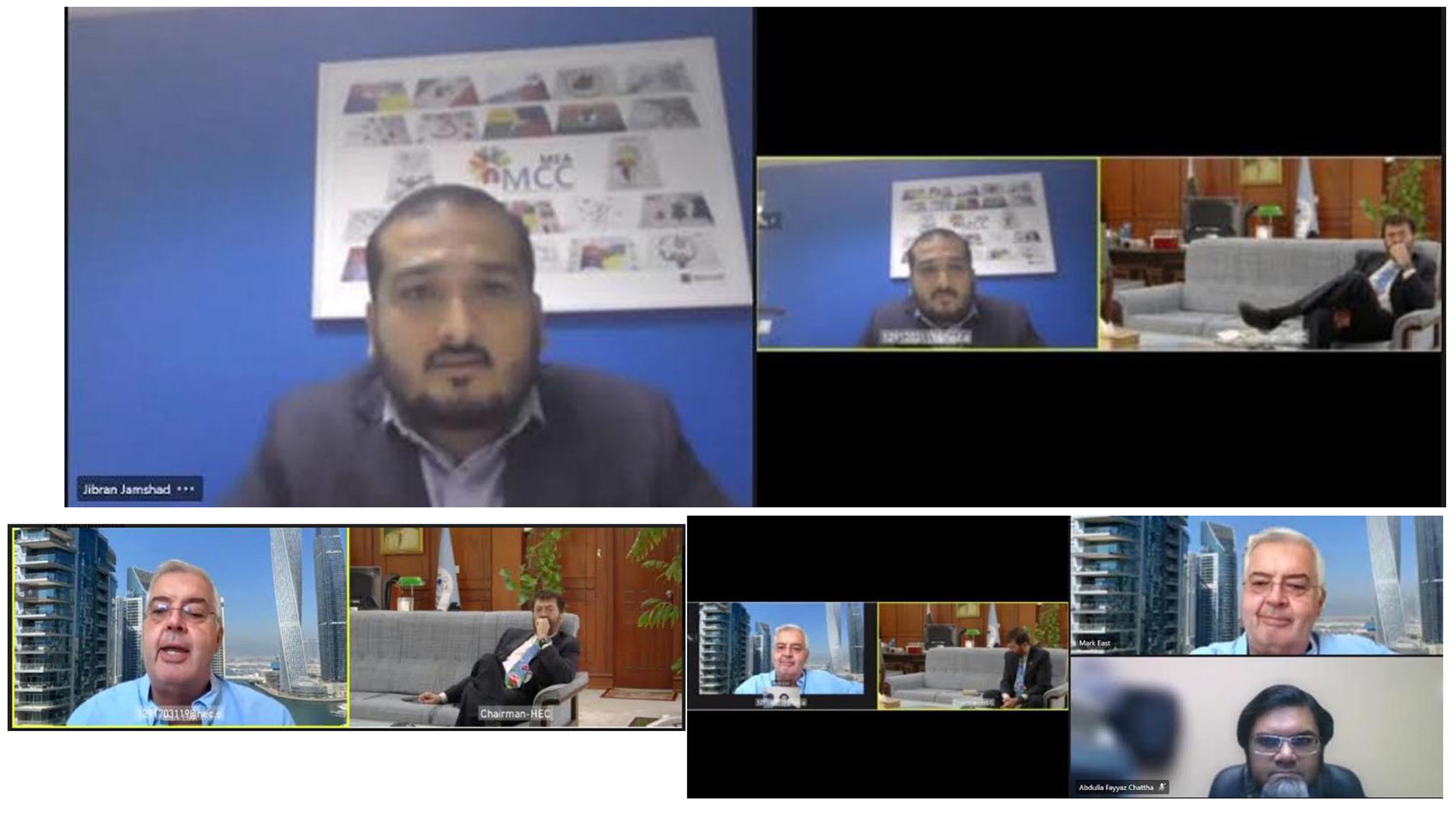
ISLAMABAD, FEB 17 (DNA) – Microsoft Pakistan and Higher education commission (HEC) has signed an Education Transformation Agreement (ETA) at a virtual meeting held between Dr. Tariq Banuri, Chairman, HEC, Mark East, Vice President Education, Microsoft, Europe Middle East & Africa and other key executives from both sides to help academic institutions leverage new technologies in the learning process.

Under the ETA framework, Microsoft collaborates with Universities helping them in their digital transformation journey through a strategic technology framework implementation that helps them build a secure and connected campus, promotes teaching and learning activities, creates opportunities for academic research and increases chances of student success through easy access to knowledge and latest tools.

There are multiple programs that are part of this framework impacting student and faculties’ academic lifecycle. Programs such as the Student Hackathon, focused Technology boot camps, Imagine Cup and multiple online training sessions for 200+ institutions across the country directly help with technology adoption and help build the workforce for the future.

During Pandemic, HEC has been providing remote learning solutions to drive continuity for academic activities in universities. To support the same initiative, Microsoft collaborated with HEC to bring more than 100 universities and 500,000 plus students to a digital hub of Microsoft Teams  that brings conversations content, assignments, and apps together at one place, letting educators create vibrant learning environments.

Microsoft Teams platform also works well with Moodle, which most universities use as their Learning Management System. Microsoft Teams has also recently introduced new features that allow the faculty to take online exams in a secure environment enabling teaching faculty to conduct online assessments and create quizzes with ease to minimize chances of errors.

Through this agreement, Microsoft’s cloud computing platform, Azure, will be  accessible to the Universities and will provide the ability to transform their IT infrastructure with the latest cloud offerings, manage their cyber security through cloud-native SIEM, build their high performance research clusters that are resilient and scale when needed, host their learning management solutions and innovate their on-premise applications using the platform’s easy-to-use Artificial Intelligence & Machine Learning capabilities.

Microsoft will also provide consultancy to universities to adopt Microsoft Dynamics 365 platform for their Finance & Operations and Campus Management solution requirements. It is a robust, feature-rich platform to help universities, colleges, and educational organizations in to moving their core administrative & IT functions to the next generation Microsoft technologies ensuring the best outcomes for students with a 360-degree view of students and activities by providing the right services and support at the right time.

DNA 17-6

Dr. Tariq Banuri, Chairman HEC, shared his thoughts during virtual session “COVID Pandemic has brought many challenges for Educational sector in Pakistan but with the help of Microsoft we have successfully turn them into Opportunity and embark on the journey to transform education system through digitalization. ETA with Microsoft depicts our commitments to gearing towards revolutionizing the learning process with number of initiatives. These interventions will introduce modern technological tools to enhance faculty to student interaction at all level and provide easy access to knowledge. This cooperation has long way to go till the fulfillment of Digital Pakistan vision.”

“We have seen how this new normal has completely changed the way we interact with technology. We are witnessing the rise of remote and blended learning solutions by integrating technology in way we teach and educate. “says Jibran Jamshad, Education Lead for Microsoft Pakistan “With Microsoft 365, Azure and our productivity suite including Microsoft Teams, institutions can keep up with the rapid pace of innovation and design classrooms that foster innovation and inspire students to achieve more”, Jibran added.=DNA

==================

Stay Connected

64FansLike
60FollowersFollow

Latest Reviews

Exchange Rates

USD - United States Dollar
EUR
1.14
GBP
1.33
AUD
0.69
CAD
0.70