Home Blog Page 2731

FAROOQ QASIR REMEMBERED AT PNCA

DNA

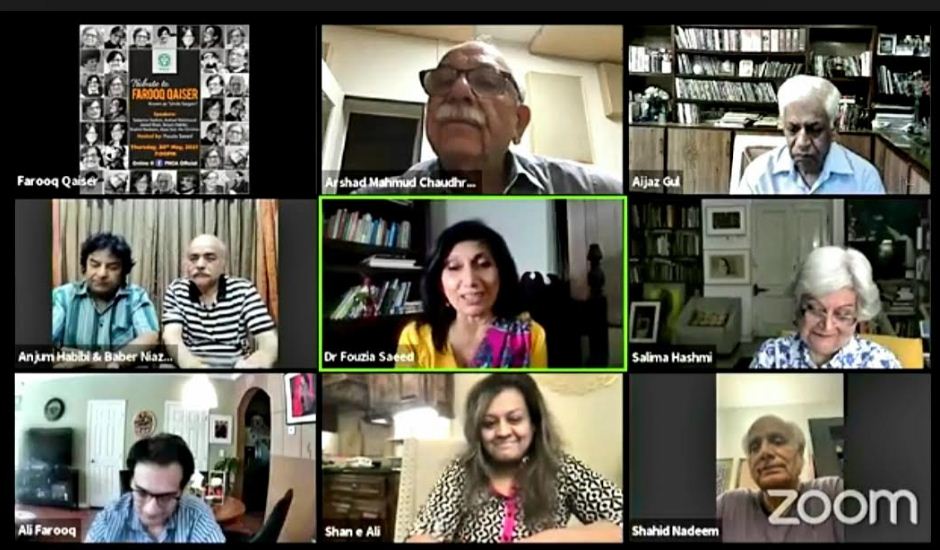
ISLAMABAD, MAY 21 – The one the only Farooq Qasir was remembered in an on-line reference arranged by Pakistan National Council of the Arts. The session hosted by DG, PNCA Dr. Fouzia Saeed a close friend and fan of Farooq was attended by Uncle sargum friends and family members. In her opening remarks Dr. Fouzia Saeed eulogized his contribution towards art and humanity. These days we lost a large number of grate names of the art world but Farooq Qasir departure is felt differently. He was unique in his writing, acting, friendship and love for the oppressed. “Though we are saying good by to you but you are with us and will remain all the time” she added.

I think it’s not possible for any one to forget him. He not only worked with his team but lived with them and shared the good and bade of life. The whole society have reflected their love and respect for him. Arshed Mehmood Ch. One of his colleague said that sweetness of Farooq is unmatchable and unforgettable. Actually, I was the uncle sargum because it was my skitch and I was to compose music for it thus the character was named uncle sargam. He was a great writer and was spontaneous in all segments of his life. Salema Hashami paid tribute to Farooq Qasir. She said basically he was a great humanist and he wrote and work for the welfare of the people. He never dares to portray the follies of ruling elites.

 His medium of expression was so attractive and digestive that everyone acknowledged and enjoyed it. Shahid Mehmood Nadeem writer and director expressed his love and attachment and said we wrote for the common people to educate them about their issues and to highlight the wrong doings and exploitation of the ruling class. His art was to convey a message in a very simple way. Ajaz Gul, Film critic said that Farooq Qasir was a great artist. We both were in NCA.

 He films and was having great knowledge about the film worked. His daughter Shan and sun Ali remembered their caring fathers love. His love for the children and young generation can never be expressed in words. He used to consider children as the best teacher. His only moto was to educate society. Babar Naizi and Anjum Habib both narrated their story of interaction with the great artist. He was a great teacher. What we are today is because of him. we lived like family members. They shared their daily life routine and great moments of their life with the listeners. 

Our daily late setting with him was a source of learning. Tina Sani her massage said I have work with him and I have sung a lot of his songs for her children. He will remain with us for a long. The participants highlighted the life and contribution of uncle sargam and said he was the only and one and there may not be another Farooq Qasir in centuries ahead.

ICCI HAILS CDA FOR CARRYING OUT DEVELOPMENT WORKS

ISLAMABAD, MAY 21 (DNA) – The Islamabad Chamber of Commerce & Industry (ICCI) has lauded the efforts of the Capital Development Authority (CDA) for carrying out development works in markets and industrial areas of Islamabad that would uplift the look of the federal capital and facilitate the growth of business activities.

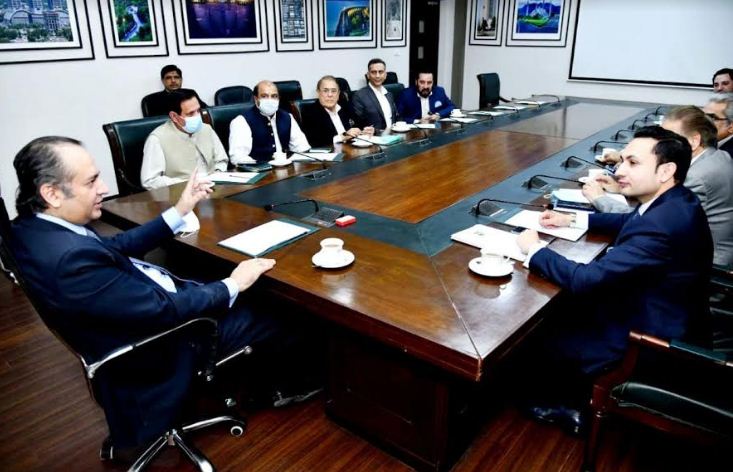
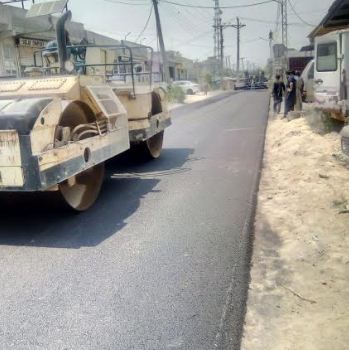
Sardar Yasir Ilyas Khan, President, Islamabad Chamber of Commerce & Industry said that he along with Amir Ali Ahmed, Chairman CDA had visited various markets of Islamabad including F-6 Markaz, G-6 Melody Market, Blue Area, Aabpara Market, F-10, F-11 and G-11 Markaz for needs assessment of development works and highlighted the areas that needed urgent attention of CDA for addressing issues. Consequent upon those visits, CDA has now started the development works in markets and industrial areas including carpeting of roads, repair of footpaths and restoration of street lights which was laudable.

He expressed thanks to the Chairman CDA and his team for fulfilling their commitments based on meetings of both sides and joint visits of commercial areas and hoped that in the coming days, people will see more development works in the rest of markets and industrial areas. He said that the role of CDA was very important in the better development of the federal capital and appreciated the cooperative approach of Chairman CDA for taking initiatives to address the demands of the business community.

ICCI President said that Kahuta Industrial Triangle housed many important industries including pharmaceutical manufacturing units while with the efforts of ICCI, CDA has also allocated development budget for this industrial area.

He, therefore, emphasized that CDA should start the development works in Kahuta Industrial Triangle as soon as possible including carpeting of roads, development of footpaths & well-functioning sewerage system, restoration of streetlights, renovation of water system and other required works as due to lack of development works in this industrial area since long, industrial units were facing great problems in production processes.

He assured that ICCI would extend all possible cooperation and support to CDA in addressing the other key issues of the business community including removal of encroachments so that with collective efforts, Islamabad could be developed as a role model city for the country.=DNA

================

A LOOK BACK AT ANWAR’S HISTORIC 194-RUN KNOCK AGAINST INDIA

On this day, former Pakistan opener Saeed Anwar registered then highest individual score in an ODI by hitting 194 off 146 balls against India.

He scored 22 boundaries and five maximums in his marathon innings in Chennai in the sixth ODI of the Independence Cup.

Anwar was an exquisite stroke player who could score boundaries on any part of the ground. He did not rely on strength but played with instincts and placed the ball in the gaps.

He scored 4,052 test and 8,824 ODI runs during his career.

Pakistan were able to score a mammoth total of 328/5 in the fixture thanks to Anwar’s contribution.

India managed 292 on the board and lost the match by 35 runs.

ARJUN KAPOOR SPEAKS ABOUT PAKISTAN, RELATIONSHIP WITH GRANDPARENTS

NEW DELHI – Bollywood actor Arjun Kapoor said that he worked in the film Sardar Ka Grandson because of his grandparents’ history with Pakistan.

The Ishaqzaade star, speaking with Outlook India, said that the project was a “personal journey” for him.

“I related to the film because I was a partner in crime with all my grandparents both paternal and maternal side,” he said. “They have always pampered me and spoilt me and there is a history of my grandparents hailing from Pakistan too.

“So, there was a definite connection that drew me to the film from Prithviraj Kapoor’s time and I literally felt that I am travelling with the time. It was like a personal journey.”

The 35-year-old added that his grandfather wanted to visit his home in Pakistan but could not do so as he was serving in the Indian Army.

In an interview with Bollywood Hungama, Arjun actor thanked Pakistan for supporting India during the coronavirus pandemic, calling for their ties to improve.

“Today, the obstacles are more; I hope some obstacles get eradicated. I can just hope and pray that the distance and vacuum that has been created go away and we are able to co-exist with peace. You should not forget that in the time of need there was a helping hand and that should be respected in the bigger picture,” the 35-year-old added as quoted by the Daily Times.  

The actor, who will be seen in the upcoming film Bhoot Police, said that the content from both Pakistan and India is still connecting people on both sides of the border and that deteriorating diplomatic relations have not affected entertainment consumption.

“This is one such time where today emotions have resonated and people are coming together and leaving aside borders and whatever the political scenario might have been one or two years back,” he said.

IDE-JETRO AND PIDE HELD THE FIRST ONLINE WORKSHOP ON MAY 17, 2021

ISLAMABAD, MAY 21 (DNA) – Developing intellectual exchange between two countries by facilitating exchange of sophisticated information and various perspectives through experts will contribute to mutual understanding. From this viewpoint, the Embassy of Japan has always been committed to promoting think-tank cooperation between Japan and Pakistan.

In this context, we welcome that the Institute of Developing Economies (IDE-JETRO) in Japan and the Pakistan Institute of Development Economics (PIDE) held the first online workshop on May 17, 2021. Starting from the opening remarks and mutual introductions by FUKAO Kyoji, the President of IDE-JETRO and Nadeem Ul Haque, the Vice-Chancellor of PIDE, experts from both sides have made presentations and discussed about topics such as Labor Force Participation of Women, Reform Agenda for Accelerated and Sustained Growth, Geographical Simulation Model of IDE, and Tax Policy Design and Options for Reform.

MATSUDA Kuninori, Ambassador of Japan is very pleased with the development of cooperation between two institutions. “Although it is not easy to arrange physical people to people exchange between two countries under current COVID-19 situation, it is remarkable that two institutions have taken initiatives to realize this mile-stone event. The Embassy of Japan will continue to support think-tank cooperation towards the 70th anniversary of the establishment of the diplomatic relationship between Japan and Pakistan in 2022”, he said.=DNA

=================

EDUCATION FOR ALL

By Muhammad Omar Iftikhar

One of the pillars assuring success to an individual and a nation is education. Enough stress has been given to the children and the youth to gain an education. Unfortunately, the state of affairs in Pakistan needs to be addressed at the earliest. Even in today’s age, education is not easily available to the children who belong from the lower-middle or lower classes of the population.

Parents belonging to the middle class do their best to send their children to private schools and colleges of repute. However, this luxury is not available for all. Indeed, education has become a luxury that must be a necessity and available for all. While the state of affairs of education in cities and especially in the metropolis is not that bleak, the situation in villages and remote areas shows a distressing picture.

Children living in villages have no access to proper education. Even if they can study in schools, they do not have proper colleges. They need to relocate themselves to the nearest city to get admission to a university. That too is a rarity as such students, because of their financial shortcomings, cannot pursue higher education in private universities that charge hefty fees. The concerned authorities in the Ministry of Education must allocate some budget that allows children from the underprivileged sector to complete their primary education.

They can at least complete their graduation to earn a job. Once they are employed, they can fund their higher education themselves. Furthermore, the Ministry can have some model to facilitate portions of their higher education. Indeed this process would strictly be on merit or need-based model with proper scrutiny and research conducted before providing the students with some form of financial assistance. It must be easier if students from the underprivileged sector can gain access to education in state-owned educational institutions and complete their studies to add value to the country’s economy.

NUCLEAR TECH TO ACHIEVE SUSTAINABLE DEVELOPMENT GOALS

Dr. Syed Javaid Khurshid

In 2015, 195 nations of the world agreed under the auspices of the United Nations(UN) to set out seventeen sustainable development goals to be achieved by 2030. If these goals are achieved it would have a lasting impact on the reduction of poverty &making health and education facilities more accessible for the common people in the less developed countries. All the countries agreed to adopt these goals that would improve the lives of their citizens through Agenda 2030. These countries have to work devotedly to achieve the goals as there is no plan B.

Global challenges have now become more complex after the outbreak of COVID-19. Working for sustainable development goals was being done effectively by many countries before the COVID-19 pandemic, but after this crisis, the targets are disturbed and seem difficult to be achieved by many countries by 2030. Many states have made commitments to achieve them at the national level. In 2015, Pakistan Planning Commission incorporated these SDGs in its national economic planning. The action plans and policies at the national level will play a fundamental role in countries’ development by translating these SDGs into workable actions, In Pakistan, national planning and incorporating the use of nuclear technology has played a significant role in achieving SDGs. It is good to remind ourselves on the 28thof May that nuclear energy has also been used for the betterment of the lives of Pakistanis and not only for making nuclear weapons.

It was recognized from the beginning by the planners in Pakistan that SDGs can be more easily achieved by involving science and scientific communities and adopting innovative technologies such as nuclear technology. Nuclear technology is guided and supported by the International Atomic Energy Agency (IAEA) internationally and the Pakistan Atomic Energy Commission (PAEC) nationally, which ensures it is safe for use.

Pakistan as a developing country is one of the largest recipients of technical and financial help from IAEA. Pakistan also has achieved considerable expertise in the application of nuclear technology for peaceful purposes and also using Nuclear technology in achieving 9 of 17 sustainable development goals. These goals are to Eradication of Hunger and Malnutrition, Provision of Good Health and Well-Being, Access to Clean Water and Sanitation facilities, Provision of Affordable and Clean Energy, Increase Industry Innovation and Infrastructure, Mitigation of Climate Change, Sustain Life Below Water, Sustain Life on Land, and Strengthening Partnerships for the achieving Sustainable Goals. These goals are in discussed in detail as below.

Eradication of Hunger and Malnutrition: In 2050, it is expected that the world population will grow to nearly 9.7 billion thus increasing our need for more food by 60% compared to the present. Currently, about 842 million people remain hungry every day and roughly about 1 billion people in the world are food insecure. There is, therefore, an urgent need to increase food production by atleast  60% to meet global needs. The Food and Agriculture Organization (FAO)has underscored that there is very little additional land available to grow more food crops. It requires that we must produce new varieties of crops which should be high-yielding, disease-resistant, drought and salt-tolerant and are suited to insect pest management.

In Pakistan, three institutes working under PAEC are using nuclear techniques to develop high-yielding varieties. Until now they have developed about 115 new varieties of different cash crops of national importance by radiation mutation. These crops at present cover about 35-40% of cultivable area, contributing about 10% to crop productivity. These are commendable achievements, but we need to continue our efforts to meet the ever-rising future requirements. Radiation sterilization technique such as Male Sterilization is also used for insect pest management to protect crops such as sugarcane crop in Sindh. Pakistan is also developing mutant varieties rich in iron and zinc micronutrients. A commercial irradiation facility in Lahore is helping to increase the shelf life of perishable food items by removing harmful bacteria and unwanted insects. Pakistan is also using stable isotopes to monitor body composition, food intake and absorption of various nutrients to understand the problems of malnutrition in the country.

Provision of Good Health and Well Being:People should be healthy so that they can work and support themselves and their families as well as contribute to the national economy. A healthy nation would be essential to achieve sustainable development goals. Nuclear techniques are most important in cancer treatment and management of some other fatal diseases using nuclear medicine, radiation oncology, radiation treatment and radiation diagnosis modalities. International Agency for Research in Cancer, estimates that about 150 million people are suffering from cancer globally.  At present,Pakistan has about 30 cancer treatment facilities, whereas, 10 out of these have either diagnostic or treatment facilities. These facilities are catering to about 14,50,000 patients/year, Pakistan Atomic Energy Commission and Shaukat Khanum Hospital are playing a key role in cancer treatment in the country. In 2015, it was suggested by me to Planning Commission to establish a Cancer Control Program at the national level to achieve tertiary health care targets in the country. The program needs to be implemented in two phases and both phases should be implemented simultaneously. A very large number of cancer patients cannot be treated as they reach the hospital when the disease is already in an advanced stage. An early diagnosis of cancer patients would help the treatment and recovery of more patients afflicted by this malady. The allocation of funds for early diagnosis of cancer, therefore, is very important in controlling the disease. More importantly, cancer treatment facilities need to be doubled in the country. For this purpose, we need cancer diagnosis facilities after every 50 miles and treatment facilities after every 100 miles. Other than cancer diagnosis and radiation treatment, nuclear techniques are in use in the precise diagnosis of cardiovascular disease, tuberculosis, and in the diagnosis of many other infectious diseases. Nuclear techniques are also helping to detect and control outbreaks of animal diseases.

Access to Clean Drinking Water and Sanitation:Water is essential for life on the planet. Pakistan is already placed among the water-stressed countries. Besides access to clean water, the efficient use of water is also very important for the country and thus groundwater management and water conversation are needed. To achieve this goal Pakistan is utilizing nuclear isotopic techniques for collecting information such as age, amount and quality of groundwater which is very useful in integrated management of water resources and water ecosystem. Nuclear technology is also being used to make water bacteria-free.

Provision of Affordable and Clean Energy: Producing sufficient energy at an affordable cost without emitting greenhouse gases is a very important SDG. The energy production choices will have huge consequences for health, economy and climate change. World energy mix at present shows 65% fossil fuel, 16% Hydropower, 13% Nuclear power and 6-7% renewable energy. Besides Hydel, renewable and nuclear are the clean sources of energy. The most important thing is that nuclear energy is an uninterrupted clean source of energy. Recognizing the importance of nuclear energy first commercial nuclear power plant of the world was connected to grid in in 1956 at Calder Hall, England. At present, 31 countries are operating about 449 nuclear plants for electricity generation, whereas about 67 are under construction in 16 different countries.  Pakistan recognized the importance of nuclear power from the beginning and built its first commercial power plant in 1971, K-1 of 137MW at Karachi. At present Pakistan is producing about 6% of its energy mix by 5 nuclear plants, which is going to increase upto 12% this year after K-2 in May and K-3 in October 2021 start operation at Karachi, Nuclear power is the answer to Pakistan’s future development, safety and security. Pakistan Atomic Energy Commission has already given a 40 years plan to the Government of Pakistan, of achieving a target of 8800 MW by 2030, and of 40,000 MW by 2048. The target of affordable and clean energy can only be achieved through nuclear energy, by installing more nuclear power projects on a Build Operate and Transfer (BOT) basis.

Sustainable Industry Innovation and Infrastructure: An excellent infrastructure and cutting-edge technologies are required to sustain and increase industrial growth. Nuclear technologies are contributing to achieving the indicators of this SDG by using Non-destructive X-ray techniques for quality testing of the products, such as welds, building and bridges and irradiation of wires, cables pipes and tyres to improve their quality and durability. Irradiation is also used to remove bacteria from medical products, sterilizing surgical instruments, and increasing the shelf life of food products such as onions potatoes, spices and mangoes.  Pakistan has done a lot of research work in this direction and the first commercial irradiator was established in the country in 1987 at Lahore. At present two irradiators are working in Pakistan, one for single-use products and the other for food products, whereas another Electron Beam sterilization plant is coming up at Lahore. Here I would like to suggest to the government of Pakistan that we should install two Electron Beam irradiators at Gawader and one each at Gilgit and Karachi, their use will add value to our products and will increase our exports.

Mitigation of Climate Change: Temperature plays a very important role in food production and thus in the economy of the country which is affected by the release of greenhouse gases mainly carbon dioxide. All the leading nuclear think tanks and the research groups working on “nuclear for climate” programs in different countries agree that nuclear energy is the key in the fight against climate change. It is one of the leading reasons for considering an increase of nuclear power share in the country’s energy mix. As mentioned earlier Pakistan has chalked out an ambitious program to increase its nuclear energy production and thus help mitigate climate change.

Sustainability of Life Below Water: Protecting sea life is a significant SDG as marine life is one of the biggest and the cheapest sources of nutritious food for human beings. Marine life can be studied by using the powerful method of isotopic techniques. The isotopic techniques can help scientists to understand, monitor and control pollutants and protect marine health.

Sustainability of Life on Land: Land erosion is the biggest problem being faced the world over. About 1.5 million acres of soil is under erosion and degradation globally affecting the economy of several countries. Many countries are contributing to help control this menace by using nuclear and isotopic techniques. Nuclear techniques help to determine soil erosion rates. Based on these calculations remedial measures can be undertaken to restore soil, ecosystem and biodiversity. IAEA is supporting many countries in this field. Pakistan’s two research institutes are using these techniques in controlling the saline land which makes about 30% of the country’s cropping area.

Strengthening Partnership for achieving SDGs:To achieve SDGs partnerships have to be developed with international organizations such as UN, WHO,FAO and IAEA. In order to help achieve SDGs, the government of Pakistan should further strengthen the partnership between IAEA and PAEC.

Pakistans’ challenge is to achieve SDGs for the prosperity of the country. Nuclear techniques have played an important role in making progress on many fronts for achieving these goals. Pakistan is lucky to have scientific know-how and trained manpower in the field of nuclear technology. This advantage has been quite helpful in making steady progress in several areas as noted before. This should be further enhanced by IAEA’s support. Pakistan is already the highest recipient of financial and technical know-how from IAEA in Asia. There is a need to develop the political will to coherently move with the UN and IAEA for utilizing nuclear techniques to achieve sustainable development goals in the country by 2030.

Dr. Syed Javaid Khurshid is a  Senior Research Fellow Centre of International Strategic Studies, Islamabad

KOREA TO PROVIDE $ 4 MN TO PRESERVE BUDDIST HERITAGE

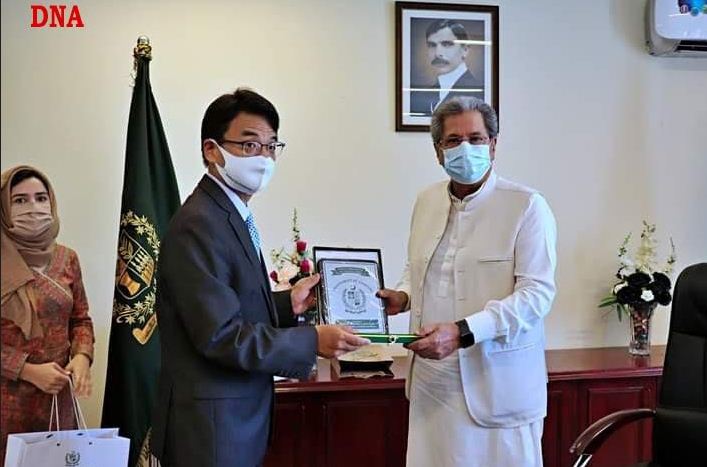
The Ambassador of the Republic of Korea, Suh Sangpyo meets Minister Shafqat Mahmood; both sides discuss enhancement of mutual cooperation as well

Saifullah

ISLAMABAD: The Ambassador of the Republic of Korea, Suh Sangpyo called upon the Federal Minister for National Heritage and Culture Division, and for Federal Education and Professional Training Shafqat Mahmood in Islamabad.

Shafqat Mahmood was accompanied by his core teams from both of the Ministries under his portfolio. Suh Sangpyo discussed with Shafqat Mahmood the rich Buddhist heritage that exists in Pakistan and the need for its preservation and promot ion to the world.

Ambassador Suh Sangpyo stated that through the interest and commitment of the Government of the Republic of Korea, the National Cultural Heritage Administration of the Republic of Korea is in the process of signing a Memorandum of Understanding with the National Heritage and Cultural Division of the Government of Pakistan for an initial grant of USD 4 Million that will focus upon the preservation of Gandhara Buddist Heritage.

Suh Sangpyo also shared with Shafqat Mahmood that only 1500 Pakistani graduate students are currently studying in the Republic of Korea and he sees this as an opportunity to increase the educational collaboration and student to student exchanges between both countries in the fields of IT, engineering and similar skills based educational programs that can ultimately benefit Pakistan and increase further avenues for employment for its youth.

The Ambassador of the Republic of Korea hoped that this meeting would prove to be instrumental in further enhancing cultural and educational cooperation between the Government of Korea and the Government of Pakistan.

MOROCCO WHOLE-HEARTEDLY SUPPORTS PALESTINIANS

Foreign Minister Nasser Bourita says His Majesty the King firmly opposes any attempt to change the legal and historic status of Al-Quds and Al-Aqsa Mosque and to undermine the tranquility of the populations of the holy places, in addition to the illegal eviction of residents of the Sheikh Jarrah neighborhood

News Desk

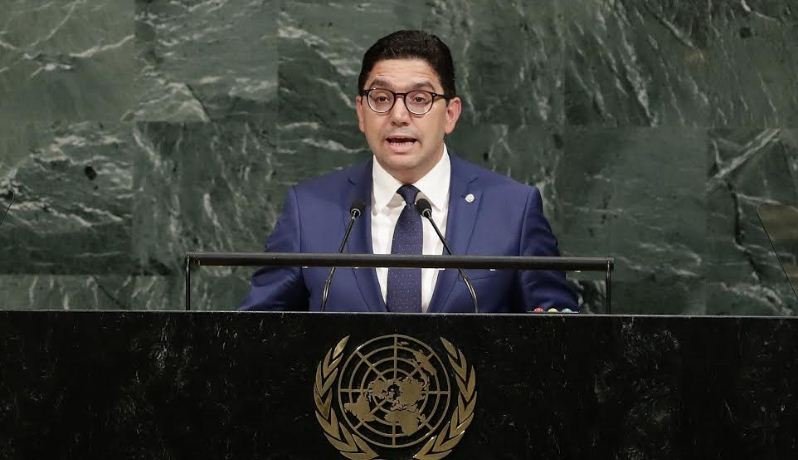
NEW YORK: Minister of Foreign Affairs, African Cooperation and Moroccans Expatriates, Nasser Bourita, reaffirmed at a meeting of the General Assembly of the United Nations, the unwavering commitment of His Majesty King Mohammed VI, Chairman of Al-Quds Committee, to the Palestinian cause and to peace and stability in the Middle East.

His Majesty the King firmly opposes any attempt to change the legal and historic status of Al-Quds and Al-Aqsa Mosque and to undermine the tranquility of the populations of the holy places, in addition to the illegal eviction of residents of the Sheikh Jarrah neighborhood, said Bourita in an address on this occasion.

Bourita stressed that His Majesty King Mohammed VI has always insisted on the imperative to refrain from any act likely to precipitate the region towards more tensions, given that the persistence of unilateral measures and acts contrary to legality and international law only widen the gap between the two parties and jeopardize the chances of peace in the region.

In this regard, the minister recalled that His Mjesty King Mohammed VI underlines the need to preserve the Holy City as a common legacy of humanity, a land of encounter and a symbol of peaceful coexistence for the followers of the three monotheistic religions.

Mr. Bourita mentioned in this context Al-Quds Call, which was signed by His Majesty the King and His Holiness Pope Francis in Rabat on March 30, 2019. Referring to the current escalation, the minister deplored that “once again, and for the same reasons, serious acts of violence have been committed”, which claimed several lives, destroyed civilian installations and triggered more suffering, which threatens regional and international peace and security.

“The escalation of fighting and violence we are witnessing is the inevitable result of the stalemate in the peace process in the region, exacerbated by the repeated violations against the Palestinian people, and the proliferation of hate speech by ‘extremist organizations’,” Mr. Bourita said.

The minister recalled that Morocco reaffirms its full support for a just and fair peace based on international legality and the two-State solution approved by the international community, as there is no other alternative to a political solution favoring the creation of an independent, sovereign and viable Palestinian state within the borders of June 4, 1967 and with Al-Quds-East as its capital.

To this end, the Kingdom urges the international community, in particular the Security Council and the Quartet, to engage in stopping the escalation, to act actively to break the cycle of violence and to initiate intense diplomatic action in view of a peaceful settlement, in accordance with resolutions based on international legality, Mr. Bourita pointed out. The minister also stressed the urgent need for intervention by the international community to help the Palestinian people in the West Bank, Al Quds and the Gaza Strip, in order to overcome the impact of this tragic situation.

Bourita recalled that the Kingdom, following the High Instructions of His Majesty King Mohammed VI, took the initiative to send emergency humanitarian aid to the Palestinian population in the West Bank and Gaza Strip, which includes basic food products, emergency medicine and blankets. “This royal decision is part of the Kingdom’s unwavering support for the just Palestinian cause and its permanent solidarity with the brotherly Palestinian people.

It is also part of the continuation of His Majesty the King’s action, in his capacity as chairman of Al-Quds Committee, at the political and diplomatic levels but also on the ground, in particular through the Bayt Mal Al Quds Agency, for the benefit of the people of the Holy City, in order to provide them with decent means of subsistence and to support their capacities and resilience,” Bourita said.

Firmly attached to peace and stability in the Middle East, Morocco is sparing no effort to fully contribute to international efforts aimed at ending the escalation of violence and fostering a constructive dynamic for peace in the region, the minister concluded.

Roadside bomb blast kills nine in Afghanistan

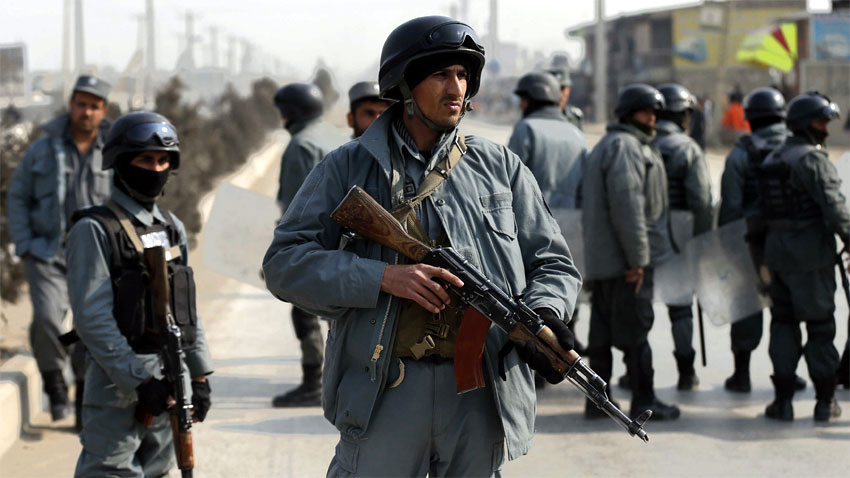
HELMAND: In Afghanistan, nine people including women and children were killed in a roadside bomb blast in the southern province of Helmand on Thursday.

Stay Connected

64FansLike
60FollowersFollow

Latest Reviews

Exchange Rates

USD - United States Dollar
EUR
1.14
GBP
1.34
AUD
0.70
CAD
0.71