Home Blog Page 2545

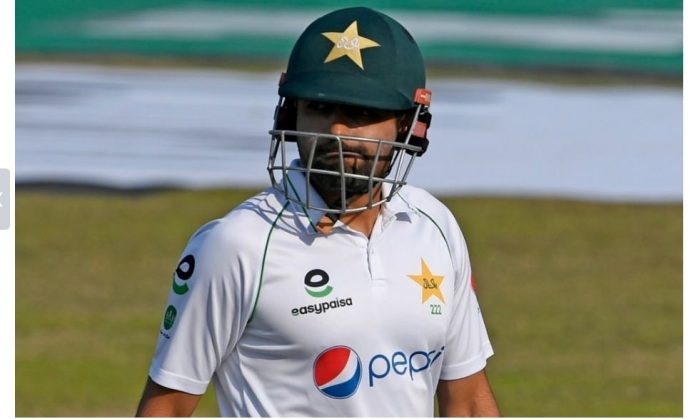
BABAR AZAM CHALLENGES DECISION TO REGISTER CASE AGAINST HIM IN LHC

LAHORE, MAR 20 – Pakistan captain Babar Azam moved the Lahore High Court (LHC) on Saturday against the decision to allow the Federal Investigation Agency (FIA) to lodge a case against him under the cybercrime law.

The directives were issued by a Lahore sessions court on the petition of a woman, Hamiza Mukhtar, on Wednesday.

The FIA in its report filed with the court had said the cricketer did not appear before the investigating officer. However, his elder brother appeared and sought time on behalf of his younger brother for recording his statement.

Mukhtar had alleged that Azam and others sent her life threatening messages on Whatsapp through different mobile numbers. The petitioner had said she was continuously blackmailed that the suspects would upload fake pictures of her on social media if she did not accept their demands.

She had said that the FIA’s cybercrime wing had completed its inquiry and had asked the court to order the agency to register a criminal case against the suspects.

In his petition, Azam named Mukhtar, the station house office of the FIA’s Cyber Crime Circle and the judge of the lower court as respondents.

The petition argued that Azam is an international cricketer and the captain of the national cricket team in all three formats. It also detailed his achievements as a batsman. It contended that the order passed by the sessions court was an “unreasoned, non-speaking order”.

“The direction to lodge and FIR without application of judicial mind is against the dictates of the law. Further, the impugned order does not even consider the fact that no cognizable offence is made out and the instant complaint is the third complaint filed in an attempt to blackmail, harass and intimidate the petitioner to pay extortion money.”

It said that the Justice of Peace is not bound to issue directions to the police in each and every case, to record the statement of the complainant, if apparently no cognizable offence is made out or the complaint is tainted with malice and ulterior motives.

It added that the impugned order was in violation of the Prevention of Electronic Crimes and Investigation Rules 2018, while the direction to register an FIR was in violation of rule seven of the same.

“That the impugned order [was passed] without hearing the petitioner is also a violation of the fundamental rights of the petitioner as guaranteed in the Constitution,” the petition said, adding that Azam reserved the right to raise further grounds at the time of hearing.

The petition urged the LHC to accept the writ petition and set aside the order issued by the lower court. “It is further prayed that during the pendency of the writ petition, operation of the impugned order may kindly be suspended,” it said.

Earlier this year, the LHC had suspended the operation of an order passed by a sessions court to the Naseerabad police to register a case against Azam on Mukhtar’s complaint.

Mukhtar had previously accused Azam of deceitfully maintaining sexual relations and making false promises of marriage. She had also alleged that she got pregnant in 2015 with his baby but was forced to go through an abortion.

Kazakhstan, Canada foreign ministries hold political consultations

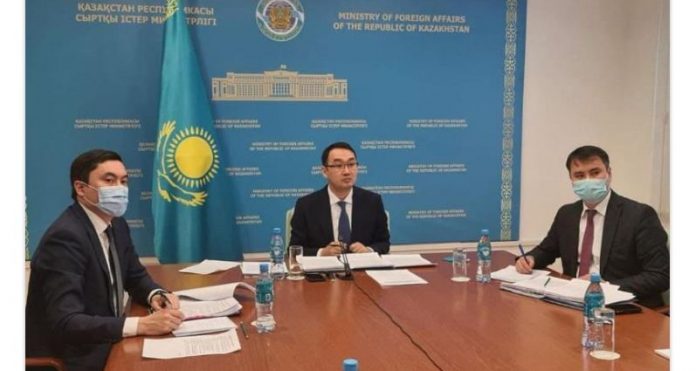
Kazakhstan and Canada foreign ministries held political consultations via a videoconferencing, the Kazakh MFA’s press service informs

The Kazakh delegation was led by Deputy FM Yerzhan Ashikbayev, Sandra McCardell, the Assistant Deputy Minister, Europe, Arctic, Middle East, headed the Canadian delegation.

The parties exchanged views on regional and international agenda and expressed the need for further widening of bilateral cooperation, results of the 4th meeting of Kazakhstan – Canada Business Council held in 2020 online. The sides confirmed readiness to actively work through all agreements achieved at the council meeting. They also paid attention to multilateral cooperation, COVID-19 response, climate change, expanding economic rights and women’s opportunities, strengthening of business ties.

The political consultations held confirmed mutual interest in further strengthening of Kazakhstan –Canada bilateral and multilateral cooperation.

KYRGYZSTAN THANKS CHINA FOR FREE VACCINE

A batch of China’s Sinopharm vaccine was delivered to Kyrgyzstan on Friday, and a donation ceremony was held at the Manas International Airport, the Chinese embassy in Kyrgyzstan said in a press release, Trend reports citing Xinhua.

On behalf of the Kyrgyz government, Prime Minister Ulukbek Maripov thanked the Chinese government for helping Kyrgyzstan, stressing that China, having overcome its difficulties, became one of the first countries to provide Kyrgyzstan with COVID-19 vaccine.

Maripov said that the vaccine from China has received wide recognition in the international community, and the vaccine will greatly help the Kyrgyz republic in the fight against the pandemic.

“Kyrgyzstan is ready to further intensify cooperation and work together with China in the fight against the epidemic,” he said.

Chinese Ambassador Du Dewen noted that China continues to provide assistance to Kyrgyzstan in the fight against the pandemic, and the friendship between the two countries has further strengthened in anti-epidemic cooperation,

“In the context of huge domestic demand for a new vaccine, China’s free aid to Kyrgyzstan fully demonstrates the deep friendship of the Chinese government and people toward the government and people of Kyrgyzstan and reflects the high level of comprehensive strategic partnership between the two countries,” the ambassador said.

Du expressed the hope that the vaccine will play an active role in combating the epidemic in Kyrgyzstan, as well as protecting the health and safety of the country’s residents. The ambassador also stressed that China, being one of the first countries in the world to have successfully developed vaccines, is actively pursuing international cooperation in this area.

“China is ready to continue to fight the epidemic side by side with Kyrgyzstan, to help build a Chinese-Kyrgyz health community and deepen cooperation in various fields in the joint construction of Belt and Road in order to benefit the peoples of the two countries,” the Chinese diplomat said.

Earlier, the Ministry of Health of Kyrgyzstan reported that the first stage of vaccination in the country will begin in late March or early April.

EDUCATION KEY TO PROMOTE INCLUSIVITY IN MULTI-FAITH SOCIETIES: EXECUTIVE DIRECTOR HEC

DNA

Islamabad, MAR 20 – Education is the key to ensure inclusivity, social cohesion, and peaceful coexistence in a multicultural society. This was stated by Executive Director Higher Education Commission (HEC), Pakistan, Dr. Shaista Sohail while addressing the closing ceremony of a three-day series of webinars entitled, “Nurturing Peaceful, Respectful and Inclusive Societies in Pakistan: Seerat counters hate speech through decisive action,” jointly organised by HEC and the United Nations Office on Genocide Prevention and the Responsibility to Protect.

Twenty four speakers from three continents, i.e., Asia, America, and Europe, including representatives of minorities and youth, expressed their views in six different sessions on Seerat and Global Peace; Perspectives of Diverse Religious Communities of Pakistan; Global and Local Perspectives; Youth, and Concluding Recommendations for Manual.

The webinars aimed at encouraging peaceful, inclusive, and empathetic communities in Pakistan through tools like active and continuous intersectional participations, dialogue, and collaboration. These events also aimed to contribute to achieving the Sustainable Development Goals (SDGs), in particular SDG16 on building peaceful, inclusive and just societies.

She hoped that the webinars would prove to be a stepping stone towards achieving the goal of giving an end to hate speech, violence, persecution, marginalizedation, and stigmatisation of specific groups. The manual of the webinars, being prepared on the basis of the thoughts shared by speakers, will be a rich contribution to inspiring the youth to move towards a more tolerant society.

She expressed a confidence that the future would witness the gaps and deficiencies in the way of mutual cohesion shrinking. “We have to ensure our children are encouraged to mix up with minorities, empathize with them like the last Prophet (PBUH) did, and be honest and truthful in their affairs.”

She assured the UN officials of HEC’s full support in carrying out webinars and workshops on efforts to combat hate speech in the future.

In her closing remarks, United Nations Special Adviser Dr. Alice Wairimu Nderitu emphasised building resilience against hate, online and offline, while upholding the role of youth in this regard. There is a need for promoting, among people, the skills of mediation and negotiation in case of differences and conflicts, she underlined. She hoped that the webinar discussions would contribute to achieving the SDGs.

She said that the message of President Arif Alvi, who addressed the webinars opening ceremony on March 17, to opt for forgiveness in case of any confrontation was universally applicable and beneficial. 

Secretary General of Religions for Peace Prof. Azza Karam acknowledged the role of religious institutions, including non-government organisations, and religious leaders in serving communities around the world. She informed the audience that Al-Azhar University and various other universities of the Islamic world were also collaborating with the Religions for Peace in promoting religious harmony.

She urged the religious institutions and leaders, from across the world, to join hands for the cause of global religious harmony. She observed that the impact of work done by religious institutions and leaders was limited, yet the significance of role needed by multicultural religious entities could not be underestimated. 

She noted that Pakistan was a home to different major religions of the world, including Sikhism, Buddhism, and Hinduism. Pakistan has a very important and strategic role, given the value and role of religious identities, in promoting interfaith harmony not only for the Muslims but also for the non-Muslims. She stated that instability in Pakistan meant instability across the region.

Prof. Karam highlighted the role of Pakistani youth in the Arms Down! Campaign for Shared Security, the drive to engage religious leaders and believers around the world to unleash the power of multi-religious cooperation through shared action. She stressed the need for continuity in the efforts for the common purpose of disarmament, especially mobilisation for nuclear disarmament.

UN Special Rapporteur on Freedom of Religion and Belief Dr. Shaheed said that Islam protected and preached respect for human rights. He emphasised engagement of people with multicultural identities to dispel wrong impressions about Islam in terms of human rights. He also underlined the initiatives happening globally for prevention of incitement and violence, including the Rabat Plan of Action.

He also appreciated the role of Pakistan in addressing hate speech and contributing to the development of the UN human rights framework. He added that Pakistan made people free about their religions and promoted respect for diversity and pluralism. He said the Prophet of Islam provided a formula of mutual understanding and respect by involving non-Muslims in placement of the Blackstone in Kaaba. He also expressed concerns over the growing Islamophobia and anti-Muslim hatred.

Dr. Edward Kessler, founder of Woolf Institute, Cambridge, UK, presented recommendations and successful examples of peace building tools. He shared with the audience how the Woolf Institute taught the Pedagogy of Dialogue. He said that the institute advised the students to begin with common ground, explore perception, engage in dialogue, and respect differences. “Living with diversity requires tolerance,” he emphasised.

He underlined that education was very important tool to live peacefully in diversity, as education transmitted and received values. He observed that arguments and conflicts were the result of distance, while education dealt with issues of belief, identity, values and practices. “We can converse and dialogue to bridge differences between two perspectives.” He believed that armies defended a country and education defended civilizations. He said that the question was not to accommodate different beliefs, but it was to accommodate the potentially conflicting beliefs.

Political Affairs Officer at Office on Genocide Prevention Dr. Simona Cruciani said that embracing differences was much better than embracing violence and conflicts.

Former Project Director Seerat Chairs HEC Dr. Amineh Hoti said that Islam was a strong advocate of education for all, men and women.

She said that the nations were judged by the way they treated their minorities, women, and youth. 

A session of the webinar assembled Pakistani youth from various backgrounds, including Rohananiyyih Nabilzadeh, Nadine Murtaza, Anjum Malik and Maliha Javed Khan. The young speakers shed light on different aspects of life amidst multiculturalism.

Nabilzadeh said that youth had a great potential and talent that needed to be channelised. She said that the youth must aspire for spiritual and intellectual growth. “Service to humanity is the service.” She emphasised practical measures for attaining peace.

Nadine Murtaza dilated on her initiative of ‘Schooling Pakistan’ that was aimed at educating people by inculcating the importance of extensive study instead of sticking to textbooks. She said that children must be equipped with the right tools to address the challenges they might face.   

Ms. Anjum Malik underscored the significance of countering hate speech through digital means. She said that hate speech affected every member of society at different levels and ways. She stressed formulation of an intersectional strategy to involve in interfaith dialogue for harmony. Youth must be made stakeholders for peace, she concluded.

Maliha Khan highlighted the role of technology in reaching out to wide audience to educate them. She appreciated the HEC’s efforts, and the initiatives of various other entities to keep the continuity of learning intact in the COVID pandemic. She thought that the content taught at schools, colleges and universities played as a key message to advocate inclusivity.=DNA

=================

ENVOY ASSURES TO SHARE INFO ABOUT PAKISTAN’S POTENTIAL SECTORS WITH GERMAN INVESTORS

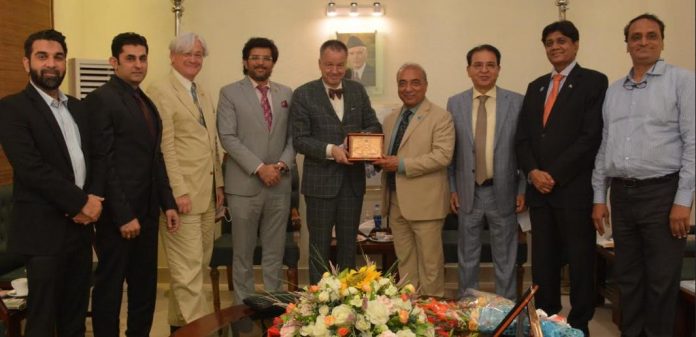
KARACHI, MAR 20 (DNA) – Ambassador of Germany Bernhard Stephan Schlagheck has assured to share information about the potential sectors and opportunities available in Pakistan amongst those German companies who might be interested in investing in this market that would improve relations between the business communities of the two countries.

The assurance was given by the envoy at a meeting during his visit to the Karachi Chamber of Commerce & Industry (KCCI) which was also attended by Consul General of Germany Holger Ziegeler, Vice Chairman BMG Anjum Nisar, President KCCI Shariq Vohra, Senior Vice President Saqib Goodluck, Vice President Shamsul Islam Khan, Chairman of Diplomatic Missions & Embassies Liaison Subcommittee Junaid Mundia and KCCI Managing Committee Members attended the meeting.

German Ambassador said, “We will certainly assist the business communities of the two countries looking forward to improving relations with each other and this is why I am here to seek your advice and recommendation on what we can do to promote trade and investment.”

Vice Chairman BMG Anjum Nisar said, “Germany is one of the few countries with whom Pakistan enjoys surplus trade which means we are exporting more to Germany and importing less.” He stressed that German business community must look into the possibility of either investing or undertaking joint ventures in many sectors of the economy, particularly the alternate energy, solar & wind energy or any other sector where quantum leap change could be witnessed and they can also collaborate in manufacturing various goods with proper branding as substitute for imports.

“It may appear unrealistic and look like a joke today to have US$10 billion trade with Germany but it was not impossible, keeping in view the massive trade potential”, he added while referring to Germany’s mammoth exports of US$1500 billion, of which goods worth a meager amount of US$1.17 billion was being exported to Pakistan.

President KCCI Shariq Vohra, in his remarks, appreciated German Ambassador for his keen interest to develop trade and investment ties between the two friendly countries but it was a bit unfortunate that not much investment was coming in from Germany.  “We need to discuss our relationship in a new dimension with a particular focus on exploring trade and investment opportunities in CPEC. However, it has been observed that businessmen and investors from European countries were not taking much interest in CPEC which requires attention”, he added.

He said that Pakistan has great potential for enhancing trade and investment with Germany in numerous sectors of the economy hence, German business community must look into the possibility of entering into this potential market with a sizeable population exceeding 225 million. “We can assist Germany by facilitating joint ventures in construction sector, infrastructure development, power generation and transmission, public transport and many other sectors”, he opined, adding that KCCI and German Consulate will have to make collective efforts for improving the existing bilateral relations so that the two countries could benefit.=DNA

==============

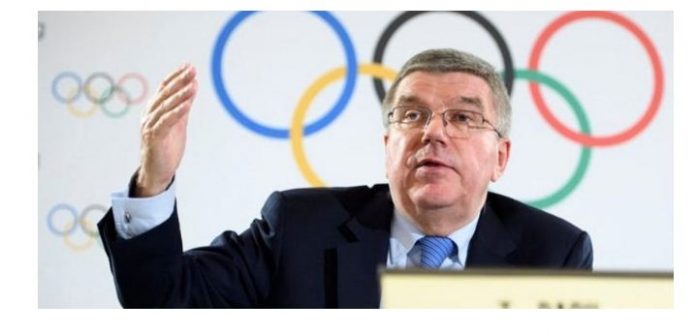
Tokyo Olympics to be played without overseas spectators

TOKYO, MAR 20 – Organizers of the Tokyo Olympics and Paralympics said on Saturday that the world’s biggest games would be held without overseas spectators, given the ongoing COVID-19 pandemic.

“We have to take decisions which may need sacrifice from everybody and we have to ask for understanding,” said Thomas Bach, International Olympic Committee (IOC) chief.

The decision was taken in a virtual meeting today, Kyodo News reported.

Raging COVID-19 delayed Tokyo Olympics 2020 until summer this year.

At a virtual meeting on Saturday, heads of five organizing bodies, including IOC, International Paralympic Committee, met Saturday to decide not to allow spectators to come into Japan for the games.

Bach added the organizers’ top priority is to “ensure the safety of all participants of the games and people in Japan.”

The pandemic has hit major events worldwide as respective governments tightened borders to stem the infection’s spread, which has affected over 122 million people, including over 2.7 million deaths since first reported in December 2019.

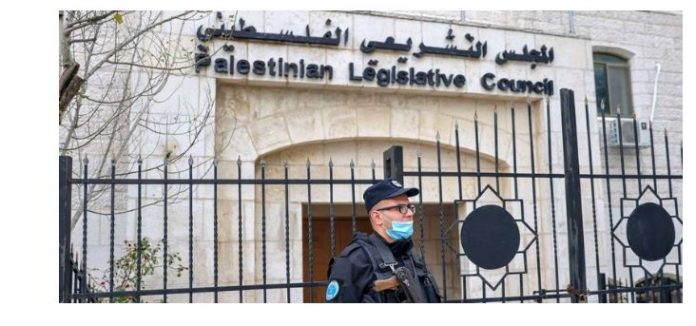
Palestine opens registration for legislative polls

RAMALLAH, MAR 20 – Palestinian authorities on Saturday opened registration for the legislative elections, scheduled for May 22.

In a statement, the Palestinian Central Elections Commission said registration will continue until March 31.

According to sources with the election commission, two electoral lists have so far applied to run in the polls, but without giving any further details.

In January, Palestinian President Mahmoud Abbas issued a decree to hold legislative elections on May 22, presidential polls on July 31 and the National Council elections on August 31. The National Council is the legislative body of the umbrella Palestine Liberation Organization (PLO).

The last legislative elections, in which Palestinian group Hamas won a majority, were held in 2006, while the last presidential polls were held in 2005.

On Wednesday, Palestinian factions concluded two days of talks in the Egyptian capital, Cairo, to discuss preparations for the vote.

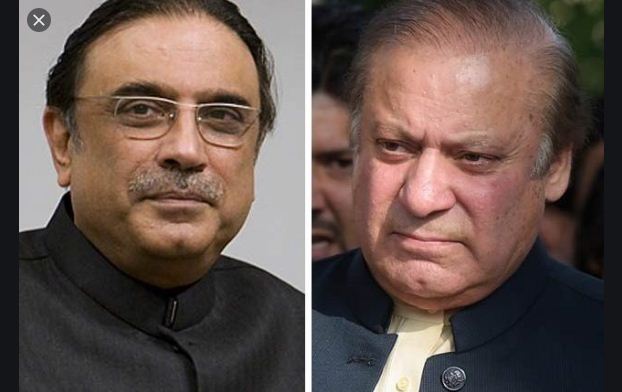
NAWAZ SHARIF REFUSES TO ANSWER ASIF ZARDARI’S CALL: SOURCES

LAHORE, Mar 20 (DNA): Former Prime Minister Nawaz Sharif refused to
answer Asif Ali Zardari’s call after a heated meeting of Pakistan
Democratic Movement (PMD), claimed sources privy to the development.

Former president Asif Ali Zardari made a telephone call to Pakistan
Muslim League-Nawaz supremo, Nawaz Sharif after the PDM meeting to
discuss the future strategy, but he reportedly refused to answer the
call despite being at home.

The former finance minister Ishaq Dar attended the call and told the PPP
co-chairman that Nawaz Sharif is angry and he is not willing to talk to
you.

During the telephonic contact Asif Ali Zardari raised reservations over
the nomination of Azam Nazeer Tarar as Opposition Leader in Senate as he
was the lawyer of the alleged killers of Benazir Bhutto, sources
familiar to the development said.

The PPP stalwart disconnected the telephone line after the aggressive
talk by Ishaq Dar. PPP Chairman Bilawal Bhutto Zardari also listened to
all the conversation on the speaker.

It is being reported that former Prime Minister Shahid Khaqan Abbasi and
Pervez Rasheed have been tasked to restore contacts with the Pakistan
People’s Party and convince them for the resignations from the
assemblies.

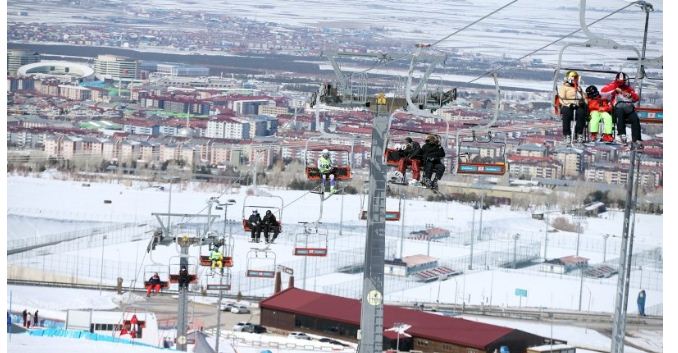
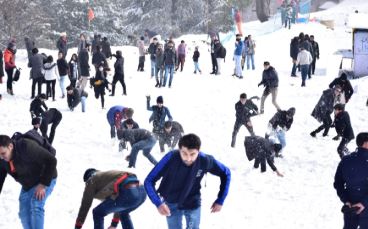
WINTER SEASON GOES ON IN TURKEY’S PALANDÖKEN SKI CENTER

The ski season in Palandöken, one of Turkey’s favorite winter wonderlands in the eastern province of Erzurum, has been extended with snowfall continuing in the spring.

New reservations made by the winter sports lovers to the ski resort for alpine skiing and snowboarding on Mount Palandöken have excited tourism professionals.

With an artificial snowmaking system, Palandöken kicked off the winter season in December and continues hosting tourists.

The winter wonderland hosts thousands of local and foreign tourists every year.

The resort offers a safe vacation to ski lovers amid the coronavirus pandemic with natural beauties and kilometers of ski tracks.

Despite the spring season, the snow quality did not deteriorate even in March, while the snow thickness reached about 1 meter (39.3 inches) with the recent snowfall.

COLONIZING MINDS: AN IN DEPTH ANALYSIS

Syed Nasir Hassan

The indigenous manufacturing was abandoned, and Indians were coerced to buy the British products which were produced using the Indian raw material. Extra duties were imposed in order to clamp the indigenous products.

The premise of Britain’s rule was never the so-called white man’s burden to civilize but in fact the absolute subjugation and exploitation of Indian sub-continent and its people. After incapacitating much of the Indian continent with its resources, British Government decided to roll back its imperialism

Modern inception of world has now established new but blurred battle grounds. What once was overt is now done in an oblivious manner. Previously empires used to shape world dynamics at the expense of the colonies. Throughout the imperial raj, the political corporation had drowned Indian continent into depths of debt by exploiting its resources for the empire’s own benefit and got the thrust it needed. It has been noted by Shashi Tharoor that by the time East India Company (EIC) anchored on the shores of India, India made up 27% of the world GDP and by the time it left, India stood at merely 4%. The indigenous manufacturing was abandoned, and Indians were coerced to buy the British products which were produced using the Indian raw material. Extra duties were imposed in order to clamp the indigenous products. The premise of Britain’s rule was never the so-called white man’s burden to civilize but in fact the absolute subjugation and exploitation of Indian sub-continent and its people. After incapacitating much of the Indian continent with its resources, British Government decided to roll back its imperialism.

Today it’s been more than seven decades since we got rid of the British rule, yet it seems that after plundering Indian sub-continent with material resources decades ago, it is now up to ransacking intellectual capital. Western powers seem to have adopted a subtle way of legitimizing their colonial and cotemporary supremacy by employing the soft power. What seems to appear as a part of public diplomacy, has in fact deep rooted impacts. Most of the western powers, including the Great Britain have been offering scholarships to students from the under-developed and developing countries as a part of public diplomacy. However, most of the time it seems that it is done in order to suffice the foreign policy objectives through non-traditional and sneaky means. Majority portion of the scholarships are offered to those countries which were once ruled by the British or Britain has encountered them in political manner.

Although, the scholarships are mostly offered/granted to underdeveloped countries but once scholarships students are enrolled new form of orientalism comes into play where an occident instructs an orient to do the same task. The students are conditioned to see their home country in a rather negative way. Rarely any non-resident scholar would research upon European affairs and mostly their work is revolves around the praise of westerners or criticism towards their home country.

What is achieved by doing so and what it reflects? It reflects the sheer sense of degraded socio-political environment narrated by indigenous people of a country which is then exaggerated by the western discourse. By using the same strategy, a passive message is being delivered throughout the globe that western civilization still dominates and it rightfully ruled in colonial times; professing the idea of white man’s burden. This cultivation of narrative is being done under the veil of public diplomacy aimed at harnessing non-resident ambassadors of western dominance. By employing informal means, imperial powers particularly Britain is on retribution of freedom of former colonies and dominions.

As we are living in first empire free millennium, it is hard for imperial powers to digest the change and let go of the leverage it used to have over foreign territories for centuries. That is why west continuously ploy to shape modern times as per their desires. In order to cast imperial shadows to the present day world, discourse needs to be steered in a manner which should advocate the western high social and political standards.  Another aspect to this type of diplomacy is to shape national identities through experience and creating plethora of discourses. The free thinking has now been molded into staged thinking and for that diaspora of former colonies need to sing the symphony of the former masters. The great “willingness” to share knowledge can be judged by the fact who these former imperial powers are welcoming to people from former dominions but have a very high cost of education for their own people.

In such an environment, where education programs are seems to be used to promote foreign objectives, developing world needs to widen the thinking space and own the indigenous work and discourse by native scholars rather deeming pride in foreign funded studies.

Syed Nasir Hassan is Research Fellow at Islamabad Institute of Conflict Resolution (IICR). He is doing MPhil (Defence and Strategic Studies), at Quaid-i-Azam University, Islamabad.

Stay Connected

64FansLike
60FollowersFollow

Latest Reviews

Exchange Rates

USD - United States Dollar
EUR
1.17
GBP
1.35
AUD
0.67
CAD
0.73