Home Blog Page 2874

FPCCI for accelerating agri growth through focus on per acre yield enhancement

KARACHI, MAR 13 – The Federation of Pakistan Chambers of Commerce and Industry (FPCCI) has asked the government to take measures to bring down the cost of agriculture production, prioritizing agri sector in its economic planning to ensure food security through enhanced per acre yield.

Due to lower produce of three major crops the import of wheat has jumped to $909 million, sugar $126 million and cotton $913 million during Jul-Feb 2021. The cumulative import bill of the three agriculture products in the eight months touched to the figure of almost $2 billion, lifting the ever-increasing trade deficit further, amidst alarming decline in cotton production by 34%, observed Mian Anjum Nisar.

FPCCI’s ruling party chairman said that lack of investment agriculture research, poor governance, bad planning and climate change have already resulted in shortage of wheat, sugar and cotton. As a result, the import bill of cotton has increased substantially owing to record low production.

According to the figures, till Feb 2021 cotton arrivals in Punjab are recorded at 3.5 million, while Sindh generated just 2.1 million which is 1.5 million bales less in Punjab and 38.52 percent less in Sindh respectively as compared to the last year’s production.

The country was producing 26.7 million tons of wheat on 9.2 million hectors few years back. Both yield and area of production declined to 24 million tons and area of production was reduced to 8.8 million hectors. Similarly, area of cotton production shrank to 2.5 million hectors. Cotton yield is 618 kilogram per hector while India is producing 29.4 million cotton bales. China is producing 27.5 million bales with 1,748 kg per hector yield, USA 19.5 million bales with 924 kg per hector, Brazil 12 million bales with 1,686 kg per hector. In the same way, sugarcane production was recorded at 75.5 million tons on 1.2 million hectors. Its production and area of cultivation was down to 66.8 million tons.

Mian Anjum Nisar said that country’s population has reached 222.1 million with growth rate of 1.9 and further expansion is expected in near future despite 11.5 percent increase in cultivated land along with 187 percent increase in production of wheat, 171 percent in cotton production and 162 percent increase in sugarcane production during the last 45 years.

In these circumstances, he suggested the government to reduce cost of production through direct support to farmers in purchase of machinery, fertilisers, pesticides and other inputs, while infrastructure should also be developed to ensure farm-to-market access. The government should formulate sustainable agriculture policy to ensure food security in the country, he added.

He said that due to the alarming decline in the cotton production seven million bales of worth $4 billion will be imported. There is a pressure on the economy. He also said that cotton production is lowest in 30 years. “The government should take practical steps for increasing the production of cotton in the country. It looked that government is not serious in increasing the production of the country.” After the 18th amendment agriculture is a provincial subject but unfortunately it looked that both the provincial governments of Sindh and Punjab are not serious in increasing the production as they had not taken any positive steps in this regard so far, he added.

Pakistan’s food security is dependent on production of essential crops that are providing basic food and input for industrial production, Anjum Nisar added. However, the performance of agriculture sector presently does not guarantee self-sufficiency.

FPCCI’s ruling group chief said that negligence of agriculture could lead the country towards severe food security while shortage of essential food items would increase inflation. “Seed is the basic input for agriculture sector and has an imperative role in enhancing agriculture productivity. The world has now focused on the use of certified seed for enhancing agriculture productivity owing to its better profitability coupled with the application of internationally acceptable quality parameters,” he pointed out.

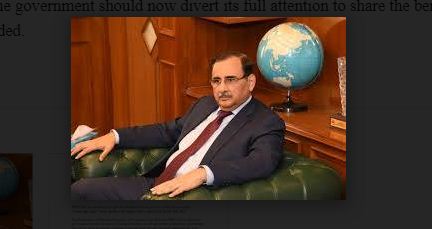
He said that technology and farm mechanization can accelerate the growth of agriculture sector. Since all the economic indicators are moving in positive direction the government should now divert its full attention to share the benefits of this positive movement in economic spheres with the public, he added.
3-days food, music festival started at convention centre, Islamabad

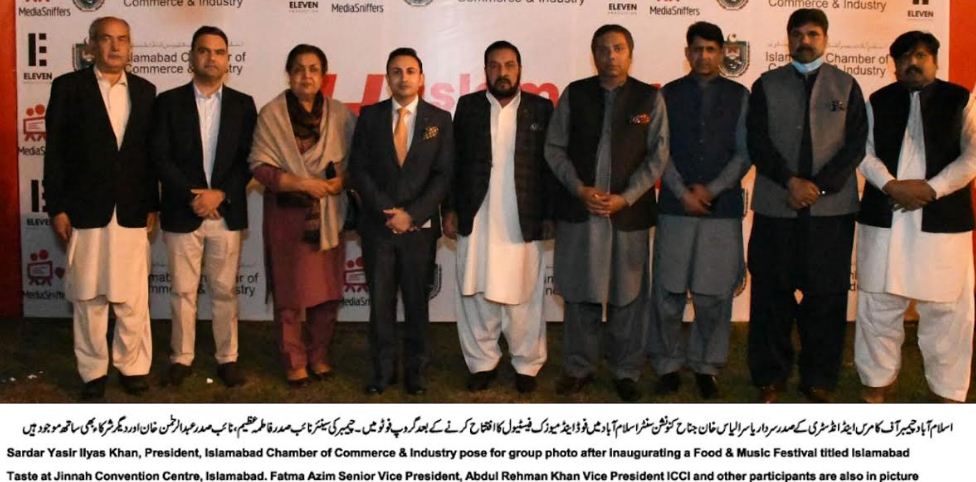
ISLAMABAD, MAR 13 (DNA) – The Islamabad Chamber of Commerce & Industry (ICCI) in collaboration with the Media Sniffers International (Pvt.) Ltd., and Eleven Production has organized a three days food and music festival titled “Islamabad Taste” at Jinnah Convention Centre, Islamabad. The festival was formally inaugurated by Sardar Yasir Ilyas Khan, President ICCI and the event has been organized by following SOPs for coronavirus.

In this signature food & music festival, 60 plus food stalls have been set up to provide different varieties of food tastes to the visitors. Various government officials and other dignitaries would visit the festival while celebrities and singers including Abrar Ul Haq, Bilal Saeed, Mustafa Zahid & Amanat Ali etc. would show musical performance in the event. Sufi night Saien Zahoor, Tahseen Sakeena & Ghulam Abbas will also be performing in the event.

Speaking at the occasion, Sardar Yasir Ilyas Khan, President, Islamabad Chamber of Commerce & Industry said that the festivals were an important source of generating business and economic activities and providing a festive environment to the visitors. He said that the whole nation had to pass through a difficult time due to Covid-19 pandemic restrictions and this festival was organized to boost economic activity besides providing a platform to the people to come out of a tense environment and enjoy some happy moments at the festival.

DNA 13-1

Sardar Yasir Ilyas Khan said that Pakistan has great potential to promote tourism and such events would contribute positively towards boosting multi-dimensional tourism, promoting soft image of Pakistan besides community building and socializing as people from all walks of life would visit the event.

ICCI President said that Covid-19 cases were again on the rise due to which the organizers have taken all precautionary measures for the health safety of visitors. However, he said that with the improvement in the coronavirus situation, ICCI would organize more events in the federal capital to generate business and economic activities so that businesses could recover some losses which they have suffered due to lockdowns and restrictions triggered by Covid-19 pandemic.

He thanked the Media Sniffers International (Pvt.) Ltd and Eleven Production for collaborating with ICCI to organize this important event and hoped that they would also organize such events in cooperation with ICCI in future as well.=DNA

==================

“Today’s warfare successful accomplishment depends on effective vision”: Air chief

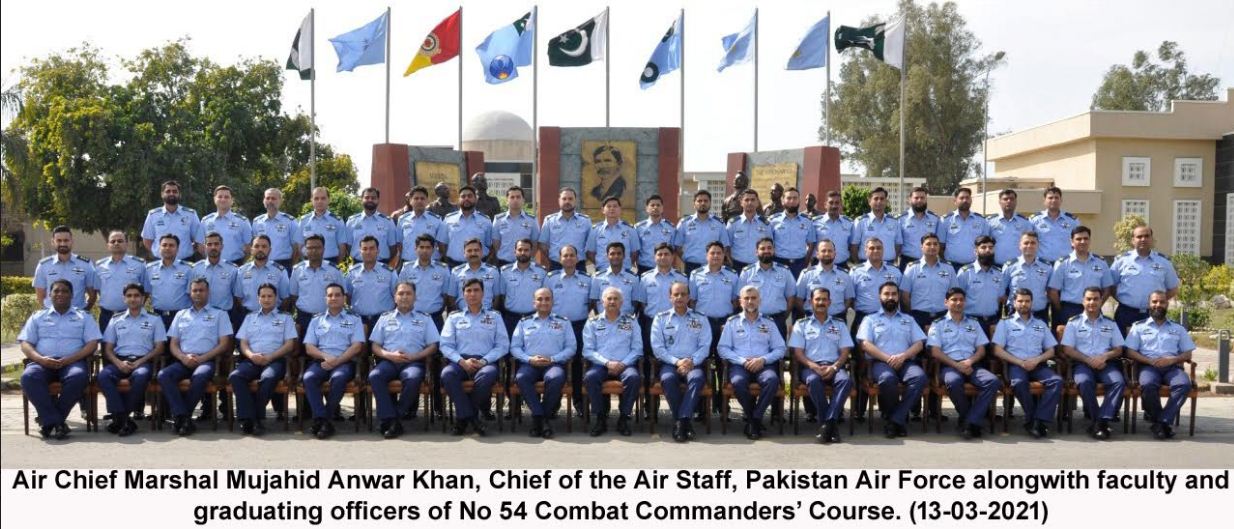
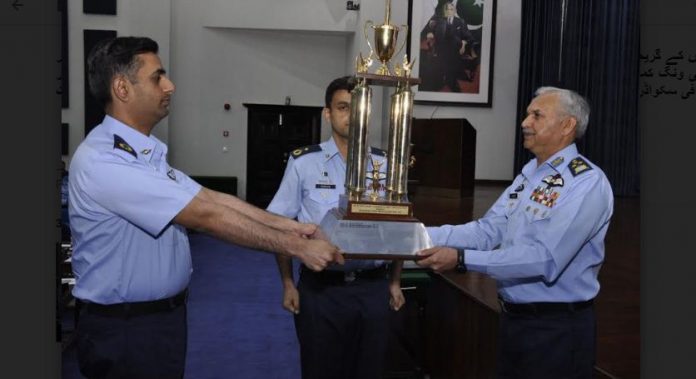
ISLAMABAD, MAR 13 (DNA) – “Today’s warfare successful accomplishment depends on effective vision and fusion”, said the Air Chief while addressing the graduation ceremony of No 54 Combat Commanders’ Course held at Airpower Centre of Excellence (ACE), today. Air Chief Marshal Mujahid Anwar Khan, Chief of the Air Staff, Pakistan Air Force was the Chief Guest on the occasion.

Speaking at the occasion, the Air Chief said, “The lessons of Operation Swift Retort are a manifestation of our operational training in realistic scenarios.

DNA 13-4

You have to be cognizant and be aware of our adversaries, what they are inducting.” He further expressed his satisfaction that ACE in general and Combat Commanders’ School in particular are taking strides in this very direction to train future combat leadership.

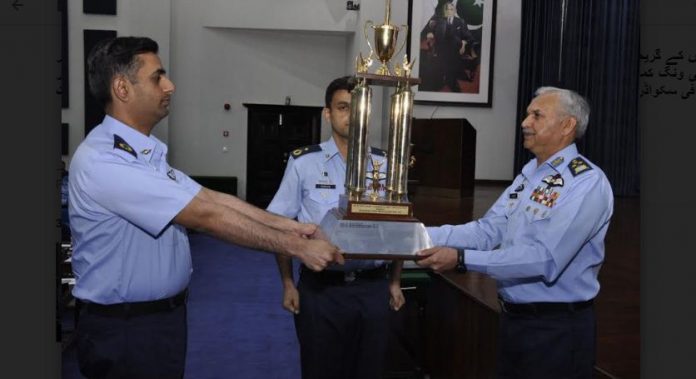
The Air Chief also awarded certificates and trophies to the graduating officers who underwent a strenuous and professionally demanding course. The Chief of the Air Staff Trophy for overall best performance amongst combat pilots was awarded to Wing Commander Waheed Zafar, while Air Officer Commanding Air Defence Trophy for overall best performance amongst combat controllers was awarded to Squadron Leader Ali Ahmed. The ceremony was attended by Principal Staff Officers and field commanders of Pakistan Air Force.=DNA

===============

Sanjrani wins; courtesy PDM and allies!!

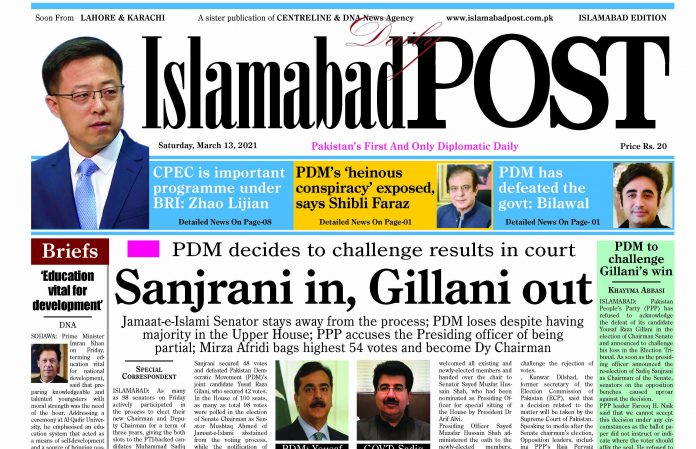
Miracles once again ruled supreme in the Chairman Senate elections on March 12, 2021 where govt-backed candidate and sitting Chairman Sadiq Sanjrani managed to regain the title despite the fact that they did not have the majority in the Uppar House.

The govt and its allies possessed 47 seats while the PDM tally was counted at 51 in the House of 98. Ishaq Dar of PML N is out of the country and Jamaat-e- Islami senator chose to stay away from the process. Sanjrani got 48 votes, one extra vote and PDM candidate Syed Yousaf Raza Gillani got 42. Seven votes were rejected while one candidate polled his or her vote for both the candidates simultaneously thus that vote was also rejected. For the post of Deputy Chairman Senate Mirza Afridi got 54 votes while Ghafoor Haideri of PDM got 44 out of the total 98 votes cast. Afridi who belongs to FATA, miraculously got seven extra votes.

The seven rejected votes issue became serious when the PPP leaders questioned the Presiding officer’s ruling who had outright rejected the votes. Farooq Naik had a valid point that it was not written anywhere in instructions that if a Senator affixed a stamp on the name of the candidate instead of the box in front of the name, the vote shall be rejected. Legal experts too share Naik’s opinion and think it does not matter when a stamp is affixed on the name of in the box in front of the name. This matter therefore for sure will go to the Supreme Court. But all said and done, the fact of the matter is that Sadiq Sanjrani has won and regained the Senate chairman slot.

The question that is still unanswered is that the Senators put stamp on wrong place deliberately or by mistake? In both cases one thing is certain that the govt camp remained steadfast and loyal but in PDM ranks some fatal fissures were observed. Even before the Chairman election it was quite evident that Sadiq Sanjrani shall succeed and Yousaf Raza Gillani despite a clear majority shall not be able to make it. The reasons are quite obvious. Yousaf Raza Gillnai was convicted by the Supreme Court of Pakistan and thus removed from the post of Prime Minister of Pakistan. The Chairman Senate post ranks number three in the top hierarchy after the President and the Prime Minister. When the President is out of the country or unable to perform functions as President then the Chairman Senate becomes the acting President. And by virtue of that the supreme commander of the armed forces of Pakistan as well. A convicted person sitting at the highest office thus did not make any sense, from the point of view of powers that be. Secondly the government ministers had made it clear well before the election that they will adopt each and every method to get their candidate elected as the chairman. And they did it.

March 12 will go down in the political and parliamentary history of Pakistan as a doomed day. Another day that has not earned any repute for the politicians for whatever happened in the Senate these Senators and politicians are responsible for that no matter whosoever coerced them to do so or they did it on their own. The entire drill has badly shaken the political process. If things have come to such a pass, the political parties are to blame for this. They are not ready to see one another’s faces. For personal gains, they would go to any extent. Thus, they provide the spoilers with ample opportunities of exploiting their differences.

The govt and its supporters wanted to get a clear majority in the Senate in order to have smooth legislation however the results show govt has not been able to achieve that goal despite that fact that PTI has emerged as the largest party in the Senate with 26 seats. The anti-govt parties would continue to maintain a majority in the Senate. So basically it will be a hotchpotch situation in the Upper House, which means no serious legislation shall take place.

PTI’s predicament is unique. Despite having a greater number of Senators, neither the Chairman Senate nor the Deputy belongs to PTI. This is yet another interesting and intriguing aspect of our politics. But that is how politics works here. The Senate results ostensibly may instill a new vigor into the PDM movement against the sitting government. Nevertheless, it is now not clear whether this movement would actually pose any threat to the ruling clique because winds are still blowing in favour of PTI and its allies.

‘Great joke with democracy’: Opposition vows to challenge Senate chairman election result

ISLAMABAD, MAR 12 – Members of the opposition on Friday blasted the result of the Senate chairman election which saw the ruling PTI-backed Sadiq Sanjrani defeat PPP’s Yousuf Raza Gilani — the Pakistan Democratic Movement’s joint candidate — and vowed to challenge the result in the courts.

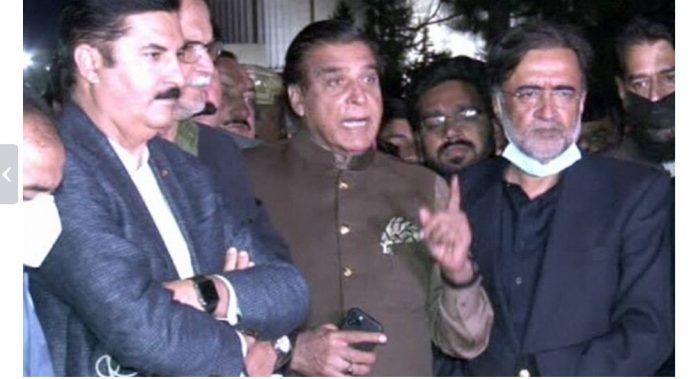
PPP leaders Raja Pervez Ashraf and Qamar Zaman Kaira along with senior PML-N leader Ahsan Iqbal addressed a press conference in Islamabad as they criticised the Senate chairman election during which seven votes cast in favour of Gilani were rejected.

Ashraf alleged that the “unconstitutional and unlawful” manner in which Gilani’s majority was defeated and the decision was given against him was “worthy of condemnation”. He alleged that those who had talked about the “sanctity and importance” of the vote had instead planted cameras to affect the polling process — a reference to the “spy cameras” allegedly found near the polling booth in the Senate earlier in the day.

“I think that when we go to the courts and they analyse the ballot papers […] Yousuf Raza Gilani will be successful,” he added.

Iqbal, meanwhile, also said the opposition would take the matter to the courts “and we expect from the court that it will correct this attack on the Consitution, the law and the vote”.

Both leaders sharply criticised the process through which Gilani’s seven votes were rejected and Ashraf claimed that the PDM had actually won, while the “government candidate has badly failed”. He questioned why Sanjrani had occupied the seat despite being in the minority.

“I understand that if he was a politician, a giver of democracy to the country and a lover of democracy then he would’ve himself rejected that I don’t have more votes [and] I don’t have the majority so I am not qualified to be sitting on this chair,” he said.

He added that the use of such tactics by the government was a sign that “its days are numbered”. “A great joke has been had with democracy. We and the PDM reject this election,” said Ashraf.

Iqbal said the seven rejected votes stood valid according to a decision of the Supreme Court (SC) he quoted.

“The question of the validity or otherwise of the ballot papers can only be determined by ascertaining the intention of the voters and in that respect, the manner of affixing the stamp is material.

“If the mark or stamp is affixed upon the name of the candidate instead of their symbol, there cannot be any hesitation to maintain that the voter had in fact shown his consent to cast vote in [the candidate’s] favour.”

He maintained that other decisions of the SC also held that the intent of the voter needed to be considered, saying there were “dozens of decisions of the SC, the high court and ECP (Election Commission of Pakistan) that [such a] vote is valid”.

“It is as clear as the rising of the sun that this rigging was done by forcefully invalidating seven votes to turn the defeat of the government into victory,” the PML-N leader alleged.

“PDM candidate Yousuf Raza Gilani won with 49 votes and government candidate Sadiq Sanjrani lost with 48 votes but the victory of the losing candidate was declared by forcibly rejecting seven votes of Yousuf Raza Gilani.”

PPP leader and Sindh Education Minister Saeed Ghani, meanwhile, citing a banner stating the instructions for casting vote in the Senate hall, said that according to it the stamp was to be placed inside the box containing the favoured candidate’s name.

He also claimed that the senate secretary had told him and PPP leaders Farooq Naek and Sherry Rehman “that the name can also be stamped”.

‘Political burial’

The ranks of the government, meanwhile, were abuzz with celebration in the wake of Sanjrani’s victory.

Speaking to media just after Sanjrani was declared the winner, Minister for Information Shibli Faraz said his victory showed that the time had come for the PDM’s “political burial”.

“I want to congratulate the people of Pakistan because the dark forces have been defeated,” he said.

Senator Faisal Javed added that not only the people of Pakistan, but “their own people rejected them”. He said Sanjran’s win was a win for all of Balochistan.

China approves plan to veto Hong Kong election candidates

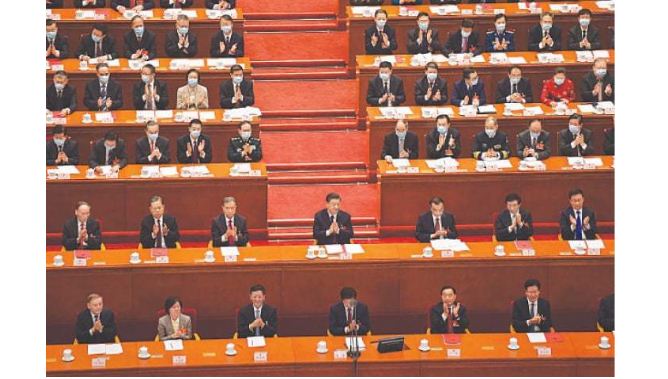
BEIJING: China’s parliament voted Thursday for sweeping changes to Hong Kong’s electoral system, including powers to veto candidates, as Beijing moves to ensure that only “patriots” run the city following huge pro-democracy rallies.

Beijing has acted decisively to dismantle Hong Kong’s limited democratic pillars after massive and sometimes violent protests coursed through the financial hub in 2019.

At last year’s meeting of the National People’s Congress, the Communist Party leadership imposed a national security law on Hong Kong that has since been weaponised against the democracy movement.

Dozens of campaigners have been prosecuted or jailed, smothering protests in a city which had enjoyed greater political freedoms than the authoritarian mainland under the “one country, two systems” arrangement established when Britain handed the territory back to China in 1997.

On Thursday, only one member of the 2,896-strong National People’s Congress abstained in the vote, which critics say will hammer another nail in the coffin of Hong Kong’s democracy movement.

The decision aims to place responsibility for running the city in the hands of “patriots governing Hong Kong”, Chinese Premier Li Keqiang told reporters after the vote.

Senior Chinese officials have made clear that loyalty to the Communist Party will be key to deciding if a Hong Konger is a “patriot”.

Loyalists in

Chinese state media on Thursday sketched out some of the key provisions of the law, which will still need to be written and then promulgated under the country’s opaque political system.

Hong Kong’s influential Election Committee, which selects the city’s leader and is already stacked with Beijing loyalists, will be expanded to 1,500 representatives, up from 1,200.

A separate committee will also be set up to vet the political views of candidates while the number of seats in the LegCo — Hong Kong’s legislature — will rise from 70 to 90.

Currently, only 35 seats in the chamber are directly elected and it is not yet clear what the future proportion will be.

But analysts said the initial details showed that China plans to reduce the influence of directly elected officials in both the LegCo and the committee that chooses the chief executive.

“It’s a fail-safe formula to ensure only people deemed patriots will be on those two important bodies,” Willy Lam, professor at the Chinese University of Hong Kong’s Centre for China Studies, told AFP.

“From Beijing’s point of view, members of the pro-democracy coalition are not considered to be patriotic.” Victoria Tin-bor Hui, Associate Professor of Political Science at the University of Notre Dame, took a similar view, telling AFP: “The new electoral arrangements will make sure that there is no chance for any pro-democracy figure to run in elections and get elected at all.” UK Foreign Secretary Dominic Raab said the plan would “hollow out the space for democratic debate in Hong Kong, contrary to the promises made by China”.

“This can only further undermine confidence and trust in China living up to its international responsibilities.”

Turkey, Russia, Qatar push for political resolution in Syria

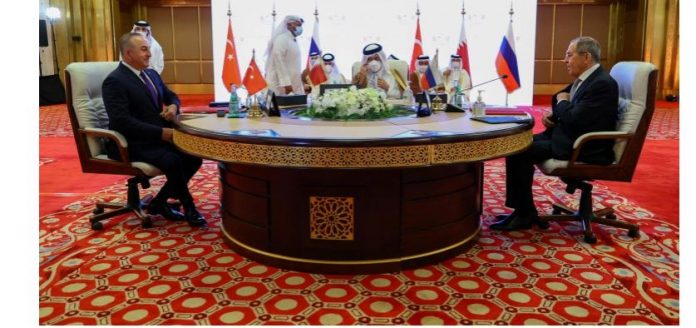
Turkey, Russia and Qatar are making a joint attempt to promote a political solution to Syria’s 10-year conflict, Turkish Foreign Minister Mevlut Cavusoglu said.

“Today we launched a new trilateral consultation process,” Cavusoglu said on Thursday after talks in Doha with Russian and Qatari foreign ministers. “Our goal is to discuss how we can contribute to efforts towards a lasting political solution in Syria.”

All three ministers emphasised in their meeting that the only solution to the conflict, in which hundreds of thousands of people have been killed and millions displaced, was not a military solution, but a political settlement in line with United Nations resolutions, he said.

In a joint statement after the talks, the ministers also reaffirmed their commitment to “preserving the sovereignty, independence, unity and territorial integrity” of Syria.

Turkey and Qatar have backed fighters who sought to topple Syrian President Bashar al-Assad, while Moscow provided military support which helped al-Assad seize back most of the country.

Russia’s Foreign Minister Sergey Lavrov said the three countries were not seeking to replace efforts which Turkey, Russia and Iran had jointly been making since 2017 to reduce fighting in Syria and discuss a political solution.

“I can only welcome Qatar’s desire to make its contribution to creating the conditions for overcoming the current tragic situation in Syria,” he said.

Syrian suffering

Qatari Foreign Minister Sheikh Mohammed bin Abdulrahman Al Thani said the ministers had also discussed mechanisms for delivering humanitarian aid across the whole of Syria, adding “there is a crucial need to lessen the suffering of the Syrians”.

He said the reasons for Syria’s suspension from the Arab League in 2011 remain, while Cavusoglu said recent international engagement with al-Assad’s government hindered efforts for a political solution by giving it more legitimacy.

In their nine-point joint statement, the ministers urged UN agencies and the World Health Organization to prioritise COVID-19 vaccinations inside Syria and to “enhance” efforts for delivering humanitarian aid.

Cavusoglu said Turkey would host the next round of the talks.

Australian HC, Army chief discuss matters of mutual interest

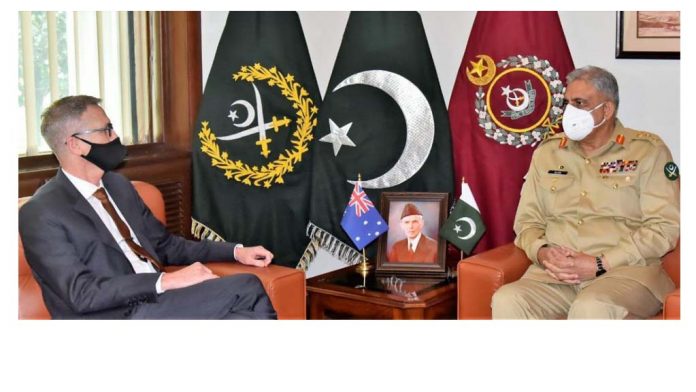
RAWALPINDI, MAR 12 (DNA) – Geoffrey Shaw, Australian High Commissioner to Pakistan called on General Qamar Javed Bajwa, Chief of Army Staff (COAS) at GHQ.

During the meeting matters of mutual interest, overall regional situation including Afghan Peace Process and bilateral cooperation in various fields were discussed.

COAS said that Pakistan values its strong diplomatic, economic and defence relations with Australia. Both reiterated the desire to further enhance bilateral cooperation including efforts for peace and security in the region.

Australian High Commissioner appreciated Pakistan’s positive role for regional peace & stability.=DNA

============

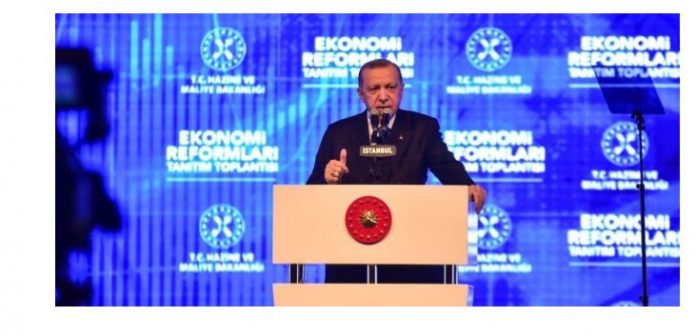
Erdoğan unveils Turkey’s economic reform plan

ANKARA, MAR 12 – Turkish President Recep Tayyip Erdoğan on Friday unveiled a long-promised economic reform package that he hopes will boost the confidence of skittish foreign investors and temper inflation while boosting trade.

It included tax breaks for small business owners and a pledge to improve efficiency that could help export-driven growth.

“The package aims to grow the Turkish economy on the basis of investment, production, jobs, and exports,” President Recep Tayyip Erdoğan told the Economic Reforms Introductory Meeting at the Halic Congress Center in Istanbul.

Turkey will raise its potential growth through boosting production efficiency thanks to this reform package, Erdoğan noted.

“We aim for a domestic and national economy which break export records with fewer imported input and more value-added production,” the president said.

He identified the fight against persistent inflation as “one of the main objectives” with the goal of quickly “bringing it down to single digits“.

Turkey weathered the 2009 global economic crisis and post-2013 crises in both politics and the economy to keep its 2023 targets within reach, Erdoğan stressed.

“We will achieve our goals by working day and night to make Turkey one of the world’s top 10 economies,” he said.

Saying that macroeconomic and structural policies form the backbone of Turkey’s new economic reforms, Erdoğan said Turkey is focusing on public finance, inflation, the financial sector, current account deficit, and employment as part of macroeconomic stability.

Encouraging investments, easing domestic trade, competition policies, market surveillance and control are in the reform package as part of structural policies, he noted.

STRONGER PUBLIC FINANCE

Turkey’s first target is setting stronger public finance structure to guard against risks, with fiscal discipline the top priority, the president underlined.

The share of foreign exchange in the country’s total debt stock will be cut to reduce its sensitivity to external shocks, Erdoğan said.

He highlighted that savings in public administration will be expanded such as limiting vehicle rentals and hospitality costs, adding:

“In addition to the central government, we aim to create a thrifty perspective in local administrations as well.”

Noting that the government knows of the difficulties small business owners have been struggling with during the pandemic, Erdoğan said the reform package also includes a tax exemption for low-income tradesmen.

“We will be exempting approximately 850,000 tradespeople who are subject to small business taxation rules, such as hairdressers, plumbers, haberdasheries, carpenters, lathe makers, tea shop operators, tailors, and repairmen, from income tax, and we will remove their tax filing obligations,” he said.

EASING TAXES, PUBLIC-PRIVATE PARTNERSHIPS

A digital tax office will be established which will operate 24 hours a day, seven days a week to enable the public to carry out their transactions in the digital environment without personally visiting a tax office.

“We have also included the tax problems faced by international investors within the reforms,” he noted, adding that the country is revising double taxation avoidance agreements to prevent possible problems that may arise.

As the country has praised public-private partnership projects, exemplified by city hospitals, Erdoğan said a public-private sectors cooperation law will be enacted.

“This will enable us to ensure that investors deal with a single law, to strengthen the legal infrastructure of projects, to introduce priorities among sectors and projects, and to make processes more foreseeable,” he said.

Stressing that one of the priority agenda items will be the fight against inflation, Erdoğan said Turkey aims to bring inflation down to single digits.

An early warning system will be established that will ensure the flow of data in order for the Food Committee to form policy recommendations and ensure that the market operates effectively.

In order to increase foreseeability in agricultural production and prevent price fluctuations, contractual agricultural mechanisms are being developed, he stressed.

Turkey is preparing uniform legislation that will accelerate the development of the participation financing sector, he said, adding: “A Central Advisory Board for the sector will be set up while the participation financing sector will be gathered under a single roof.”

A participation financing arbitration mechanism at international standards will be established, he underlined.

Stay Connected

64FansLike
60FollowersFollow

Latest Reviews

Exchange Rates

USD - United States Dollar
EUR
1.14
GBP
1.34
AUD
0.69
CAD
0.70