Home Blog Page 2951

Indus Motor renews pledge to educate country’s less privileged children

DNA

KARACHI – Indus Motor Company (IMC) has signed a MoU with The Citizens Foundation (TCF), renewing its pledge, for the 13th running year, to provide quality education from grass root level to the country’s less privileged children.

This collaboration will entail managing the Company’s flagship Toyota Goth Education Program (T-GEP) through TCF schools as well as TCF campuses built and supported by IMC in multiple cities.

The T-GEP was initiated in 2008 under IMC’s Neighbouring Community Uplift Program for out-of-school children living in ‘goths’ (villages) neighbouring IMC, providing full financial support for elementary and secondary school education. There are currently over 250 students enrolled under the program. In addition to this, around 1,100 students are currently studying at three IMC built and supported, TCF campuses located at Karachi, Hyderabad and Muzzafargarh.

Speaking on the collaboration, CEO Indus Motor Company, Ali Asghar Jamali observed, “Pakistan has the world’s second-highest number of out-of-school children aged between 5-16 years. IMC is committed to play its role in making a difference by supporting to educate the less privileged children of our country. Our continued collaboration with The Citizens Foundation in furthering this cause is a testament to that promise.”

He further added, ‘Every child has a right to education and girls have the same right to education as boys. I am proud to say that 48 percent of total students enrolled with T-GEP and at the three schools, are girls. Clearly, there is a shift in parents being more receptive today to educating their daughters which is very encouraging. Educating girls saves lives and builds stronger families, communities and economies.”

IMC as a signatory to the UNs Sustainable Development Goals, supports SDG 4 – Quality Education, which focuses on inclusive and equitable quality education and promotes lifelong opportunities for all. –

Indonesia likely to get millions of COVID-19 doses

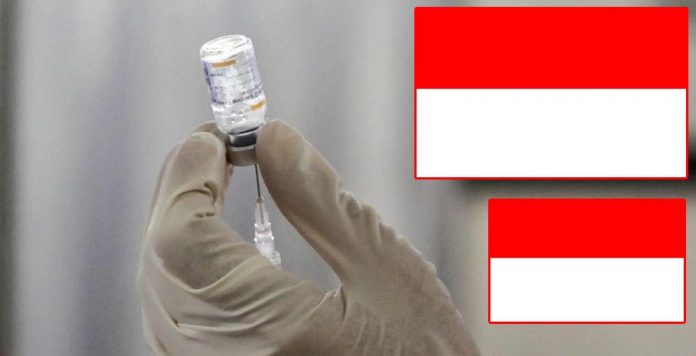
JAKARTA, FEB 1 – The Indonesian government is likely to receive tens of millions of doses of COVID-19 vaccine from AstraZeneca through the COVAX facility, co-led by the Coalition for Epidemic Preparedness Innovations (CEPI), the World Health Organization and the vaccine alliance, Gavi.

This scheme allows participating countries to get vaccines up to 20% of their total population once they are available, said the Health Ministry in Jakarta on Monday.

Siti Nadia Tarmizi, the ministry’s spokesperson for vaccination, said in a statement that based on the latest letter from Gavi, there are indications of an allocation between 13.7 million and 23.1 million doses of vaccine to the country.

Tarmizi said the allocation will be sent in two batches, 25-35% in the first quarter and 65-75% in the second quarter of this year.

“The distribution will be carried out after the AstraZeneca vaccine receives an emergency use listing from WHO,” she said, adding that it is also awaiting validation by the Independent Allocation of Vaccines Task Force and availability of supplies from manufacturers.

Tarmizi said the vaccine developed by the UK-based company and researchers at Oxford University will also need emergency use authorization from the Indonesian Food and Drug Administration prior to its use.

“The AstraZeneca vaccine is one of the vaccines that can be used for people aged 60 and above which have the highest fatality rate,” she said.

The country aimed to vaccinate 181.5 million people to achieve herd immunity.

It has secured 663 million doses of vaccine from Chinese firm Sinovac, Oxford-AstraZeneca, and American Novavax, and is also working on a deal for the Pfizer-BioNTech jab.

Indonesia, which has recorded over 1 million coronavirus cases and nearly 30,000 fatalities to date, started the vaccine rollout on Jan. 13, with the president as the first recipient.

Employees; backbone of the legislative body: says NA Speaker

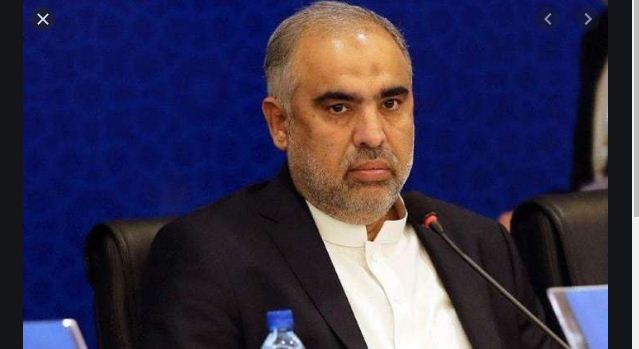
ISLAMABAD, FEB 1 (DNA) – Speaker National Assembly Asad Qaiser has said that the Employees of the National Assembly Secretariat irrespective of grades are backbone of the legislative body who have served this House with dedication.

He said that career progression and incentivizing of employees was imperative to enhance their productivity.  He expressed these views while chairing the ceremony of distributing orders of promotion and up-gradation of the Employees of National Assembly Secretariat in the Parliament House today.

Speaker Asad Qaiser said that after assuming office of the Speaker, he noticed that the officers/officials of the National Assembly were stuck in the same grade for fifteen years or more. He said that most of the cadres had no promotional incentive or career growth opportunities, thus the situation warranted immediate formulation of service structure, service rules and career growth plan.

He remarked that after the implementation new service rules through Directive No.5 on November 2019, 304 employees were promoted or granted time scale promotions in first phase. He mentioned that out of this loop majority employees were Naib Qasids, Staff Car drivers and other ancillary staff of the House. He further said that total of 187 employees have been elevated to the next grade out of which 111 were non-gazzetted staff.

The Speaker advised the employees to follow rules and serve with dedication to improve the efficiency and to achieve the organizational goals. He also mentioned that following merit would eliminate the culture of nepotism and recommendation culture.

The Senior Officers and Officials of the National Assembly employees expressed their gratitude to the Speaker’s policy of merit based promotion. They said that the promotion carried out in tenure of Speaker Asad Qaiser is unprecedented.

They also said that the merit based policy of promotion and up-gradation would be beneficial to their career growth. They pledged to serve this House with dedication, honesty and keeping in view the best interest of the House.

The Ceremony was attended by Secretary National Assembly Tahir Hussain, Advisor to Speaker on Legislative and Constitutional Affairs Latif Yousafzai, Additional Secretary (Admin) Chaudhry Mubarak Ali, Secretary to Speaker Shehryar Khan and other senior officers of the Secretariat.=DNA

===========

US Republicans invited to White House for relief bill

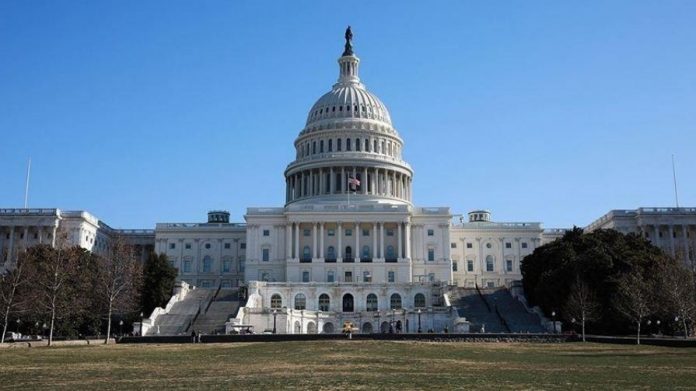
ANKARA, FEB 1 – US President Joe Biden has invited a group of Republican senators to discuss his $1.9 trillion relief plan, the White House said in a statement on Sunday.

The president received a letter from 10 GOP senators who asked to meet with him in the White House to discuss their ideas about the actions needed to address the pandemic-led economic crisis.

“We recognize your calls for unity and want to work in good faith with your Administration to meet the health, economic, and societal challenges of the COVID crisis,” Republicans, led by Senator Susan Collins from Maine, wrote in their letter.

The White House said in the statement “The American Rescue Plan – including $1400 relief checks, a substantial investment in fighting COVID and reopening schools, aid to small businesses and hurting families, and funds to keep first responders on the job (and more) – is badly needed.”

Republican Senator Bill Cassidy from Louisiana, however, told Fox News on Sunday that the GOP’s relief bill proposal would total $600 billion and include direct payments of $1,000 instead.

The much-awaited relief bill failed to pass the Congress before the 2020 US presidential election on Nov. 3, while more than 10 million Americans and thousands of small businesses await some sort of stimulus.

The US Congress on Dec. 22 approved a $900 billion package, which only offers some temporary relief and does not include funding for state and local governments.

CDA conducts mega operation against encroachments in sector I-15/4

ISLAMABAD, FEB 1 (DNA) – The administration of Capital Development Authority (CDA) conducted a mega operation against encroachments in sector I-15/4 and retrieved 350 kanal government’s land here on Monday. CDA got the occupation of said sector after 16 years. Those who interfered in the operation of CDA were arrested from the spot.

According to detail, anti-encroachment operation under the current administration of CDA is underway. In this regard, the enforcement department of CDA conducted a mega operation in the sub sector of I-15 on Monday. 350 kanal land was retrieved during the operation.

Land mafia had occupied the said land for years. They had constructed house, boundary wall, shades for animals, and other buildings on the said land. Deputy Director Department of Enforcement, Assistant Directors and other staff took part in the operation.

Prior to this, the authority also conducted an operation in Bari Imam area where a home, boundary wall, and 3 kitchens were demolished. Similarly the authority also demolished an under construction home, 11 rooms, and 2 homes in Panjgraan.=DNA

=============

‘Turkey cannot be ignored in Karabakh’

MOSCOW, FEB 1 – Russia cannot ignore Turkey’s position on the Nagorno-Karabakh conflict, Deputy Chairman of the Russian Security Council and former Prime Minister Dmitry Medvedev said on Monday.

Speaking in an interview with the Russian media about Turkey’s role in the Karabakh issue, Medvedev stressed close Turkish-Azerbaijani relations and the significance of the Russia-Turkey partnership.

He also called the Russian-Turkish cooperation in Nagorno-Karabakh “a stabilizing factor”.

“Turkey is our neighbor and a very important partner. And a very close country for Azerbaijan. This factor cannot be ignored. We have a productive dialogue with them — the president of our country constantly communicates with President [of Turkey Recep Tayyip] Erdogan on this topic.

“We must take into account the realities that exist in our region. And the reality is that today this issue needs to be discussed with our partners from Turkey,” he said.

Medvedev reaffirmed Russia’s commitment to a diplomatic solution to the Karabakh conflict, but said the issue of Karabakh’s territorial status should better be postponed to a future period, because it can provoke new escalation.

What happened in Karabakh?

Relations between the former Soviet republics had been tense since 1991, when the Armenian military occupied Nagorno-Karabakh, internationally recognized as an Azerbaijani territory, and seven adjacent regions.

When new clashes erupted on Sept. 27, 2020, the Armenian army launched attacks on civilians and Azerbaijani forces and even violated humanitarian cease-fire agreements.

During the six-week-long conflict, Azerbaijan liberated several cities and nearly 300 settlements and villages, while at least 2,802 of its soldiers were martyred. There are differing claims about the number of casualties on the Armenian side, which, sources and officials say, could be up to 5,000.

The two countries signed a Russian-brokered agreement on Nov. 10, 2020, to end the fighting and work towards a comprehensive resolution.

A joint Turkish-Russian center became operational on Saturday to monitor the truce, with 60 Russian and 60 Turkish troops on duty.

On Jan. 11, the leaders of Russia, Azerbaijan, and Armenia signed a pact to develop economic ties and infrastructure to benefit the entire region. It included the establishment of a trilateral working group on Karabakh.

The cease-fire is seen as a victory for Azerbaijan and a defeat for Armenia, whose armed forces have withdrawn in line with the agreement.

Violations, however, have been reported in the past few weeks, with some Armenian soldiers said to have been hiding in the mountainous enclave.

COAS, ISI chief meet PM Imran Khan

ISLAMABAD, FEB 1 (DNA) – Chief of Army Staff General Qamar Javed Bajwa called on Prime Minister Imran Khan in Islamabad.

Director General ISI Lt. Gen. Faiz Hamid was also present during the meeting.

Matters pertaining to internal and external security were discussed during the meeting.=DNA

=============

First COVID-19 vaccine tranche arrived from China

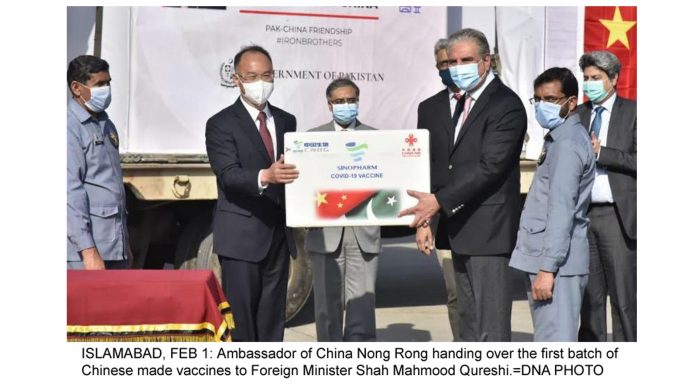
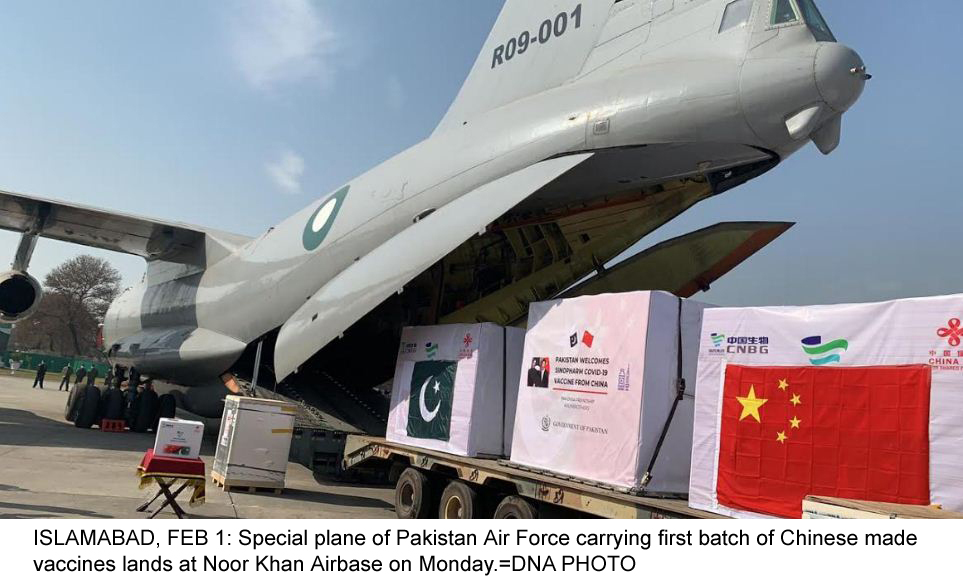
ISLAMABAD, FEB 1 (DNA): First Covid-19 tranche of the Sinopharm vaccine arrived here on Monday by Pakistan Air Force (PAF) special plane.

According to China Economic Net (CEN), Foreign Minister shah Mehmood Qureshi received the free of cost 500,000 doses of Covid-19 vaccine at the Noor Khan Airbase.

The Chinese ambassador to Pakistan Nong Rong, Special Assistant to Prime minister on health  Dr.Faisal Sultan were present on the occasion.

Addressing the ceremony Nong Rong announced that Pakistan is the first country in the world to receive the Chinese government donated vaccine.

“It is not only the vaccine to the people needed in Pakistan but more importantly a new manifestation to our iron brotherhood.

President Xi Jinping has repeatedly said that the Chinese COVID-19 vaccines once developed and put into use will be global public goods.”

He said “China has honored its commitment keeping the huge global need for vaccine in mind, China has lived to its best to offer assistance and support.

ISLAMABAD, FEB 1: Special plane of Pakistan Air Force carrying first batch of Chinese made vaccines lands at Noor Khan Airbase on Monday.=DNA PHOTO

Pakistan as our closest friend, is the priority of our cooperation. He appreciated the Pakistan government for its facilitation and cooperation in the approval of the emergency use authorization for Sinopharm’s vaccine and the phase III trial with the Casino company of China.

“We expect more cooperation to follow and more people can benefit from it, China is ready to contribute to Pakistan’s pandemic prevention drive, economic recovery and social development.

We are committed to the building of China- Pakistan community of shared future”, he added.

Talking to China Economic Net’s special correspondent the Chinese ambassador assured that the Sinopharm vaccine has proven effective and safe. Its license is issued not only to China and Pakistan but also to many other countries.

Foreign minister Shah Mehmood Qureshi in his speech on the occasion thanked the Chinese government on behalf of Prime Minister Imran Khan for the help and support they provided in the time of need and proved their distinct support and friendship with Pakistan.

He said “the plan is to first of all inoculate the frontline health care workers, they should be protected and then later to move to the rest of the sections of the society.

We will assess in the month of February, we will be requiring around 1.1 millions of more doses and we will be in touch with the Chinese government to send the next installment soon”.

It is to be noted that the first batch arrived in Pakistan is a “grant assistance” for which the country would not have to pay anything. This is a hand of goodwill and friendship that China has extended towards Pakistan.

According to the NCOC, all necessary measures have been put in place for vaccine storage at Islamabad and move of vaccine to various federating units particularly to Sindh and Baluchistan through air.

The NCOC has already released details of Pakistan’s vaccination plan for Covid-19.

Vaccine nerve center has been established at NCOC with provincial and district level vaccine administration/coordination centers/Adult Vaccination Centers.

The plan aims to vaccinate people under an integrated digital system following the best international practices, according to the NCOC. “Human involvement is limited to ensure transparency,” it added.

Pakistan has so far approved two vaccines for emergency use, the other being the Oxford-AstraZeneca jab.=DNA

====================

Central Europe as a community of shared aspirations

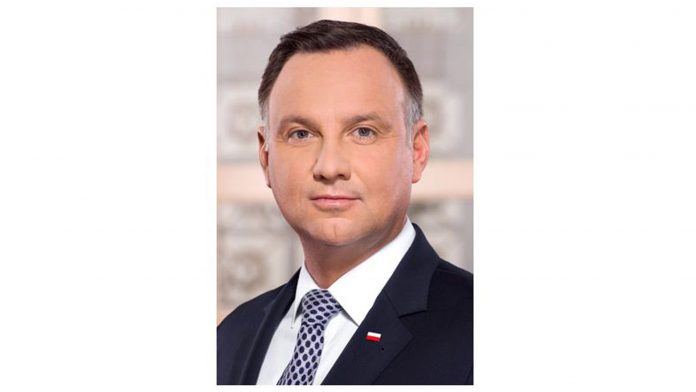
Andrzej Duda

A new decade of the 20th century has just opened. A decade of uncertainty brought forth by the global pandemic and its consequences, but also a decade of hope. A decade of opportunities for the civilization’s and economy’s recovery, a chance to create a world that is better, more just, more green, and one that respects the principles of sustained development. As we look towards the future, we are looking for areas which will be the centers of dynamic and positive changes. I am certain that Central Europe will be one of them on the European and global scale.

Central Europe or Central and Eastern Europe (the terms are used interchangeably) is a significant regional entity, a community of shared fate in terms of geography, politics, and economy as well as in terms of ideas and cultures. As for a location on a map, it is perceived as an area between the Baltic, Adriatic, and the Black seas or (even though it is oversimplification) between Germany and Russia. But above all, we constitute a circle of common memory. We have had our share of similar historical experiences, in the dramatic 20th century in particular. We have suffered from two totalitarianisms, the brown and red ones, that suppressed and oppressed us. But we also have great, glorious experiences from centuries ago. The 15th-17th centuries, the era called “the Europe of the Jagiellonian dynasty” to be later named the Polish-Lithuanian Commonwealth, saw a flourishing of a voluntary political union in a substantial part of the territory, a precursor to the European Union of today, which was a friendly home to many cultures and faiths and which respected the rule of law, parliamentarianism, and democracy. We are carrying lessons from those experiences – both good and bad – into the future as a universal warning as well as inspiration to work towards a common good, the prosperity of the region and all the integrated Europe.

A description of Central Europe in terms of values is important as well. Being part of Western civilization for more than a thousand years, we share its ideological foundations. Milan Kundera suggestively named Central Europe “a kidnapped West,” that is the part of Western civilization that found itself against its will under the Soviet domination – imperial, authoritarian, and unable to manage rationally. It must be emphasized, though, that our commitment to values that have built the European culture is not without reflection. We know perhaps better than others the high price one must pay for defending them. We are aware that one must cultivate and reconcile freedom and responsibility, rights and duties, individualism and solidarity, the attitude of criticism, innovation, and modernization with one that cherishes heritage and traditions that describe our identity.

On the threshold of the historic breakthrough of 1989, Timothy Garton Ash wrote that the concept of Central Europe has roused the Western world from thinking in Cold War terms, has challenged the common notions and priorities but also had something new to offer in return. This opinion seems to be valid today as well when the participation of Central European countries in the EU and NATO is a crucial and solidified part of the European and Atlantic order, and as our region with its solid economic growth has made a significant civilization leap. Also today, the concept of Central Europe contains dynamism and positive content. If I were to concisely present the modern face of Central Europe, including Poland as the biggest country in the region, I would say as follows: it is the community of shared success and the community of shared aspirations at the same time.

Central Europe constitutes a perfect example of how powerful and creative power freedom is. Freedom and its siblings – economic freedom, entrepreneurship, self-government, open up the space for fulfillment of bold ambitions and aspirations. Development accompanies the progress of freedom. The three decades that have passed since the fall of communism, the regional breakthrough initiated by the Polish “Solidarity” movement, are the story of the great economic success, of a social and civilization advancement that hardly ever happened over such a short time in the world history. Poland and the whole of Central Europe are a fascinating testimony to opportunities that come with freedom.

We can also serve as an inspiring example of how cooperation, joint initiatives and undertakings bring positive results. It was thanks to them that Central Europe ceased to be, as it was in adverse times, a peripheral area between the West and East, between imperial powers, and instead became a structure connected by multiple ties, one that is aware of its interests and has an influence on the course of European affairs. The emancipation of Central and Eastern Europe was a success, we are the crucial part of political and civilization processes.

Let me draw your attention to three important planes of Central European cooperation, which are not only of regional significance but are also crucial in the EU, Atlantic, and even global dimension. The first of them is the VisegradGroup, an entity of the longest existence which gathers Poland, the Czech Republic, Slovakia, and Hungary. Initiated in 1991 as a platform for political dialogue and coordination of efforts to gain membership in NATO and the EU, the Visegrad Group has also proven useful once it has achieved these strategic goals. Today it is one of the most important agents in activating regional cooperation in Central Europe and seeking understanding on European affairs.

The second of the planes is the Bucharest Nine, a structure that groups countries of NATO’s eastern flank: Poland, Romania, Lithuania, Latvia, Estonia, Hungary, Slovakia, Czech Republic, and Bulgaria. It was established in 2015 in Bucharest, where we signed a joint statement which said the Bucharest Nine countries join efforts to secure, where it is necessary, a “robust, credible and sustainable Allied military presence” in the region. To a large degree, the B9 is a response to Russia’s aggressive policy, to the violations of borders and territorial integrity of the neighboring Ukraine, which threaten a regional and Atlantic security. We are not going to watch it idly.

The third plane of cooperation is the Three Seas Initiative, which was initiated by the President of Croatia Kolinda Grabar-Kitarović and myself in 2015. The group comprises countries located between the Baltic, Adriatic, and Black seas: Austria, Croatia, Czech Republic, Estonia, Lithuania, Latvia, Poland, Romania, Slovakia, Slovenia, and Hungary. The goal is to make joint investments in infrastructure, transport, energy, and new technologies that will boost the development in our countries and contribute to the cohesion of the European Union. When we look at the map of economic connections within the EU, we will see a significant advantage of the horizontal flows along the West-East axis over vertical flows along the North-South axis. This includes the flows of people, goods, services, and capital, but also infrastructure networks: expressways, railroads, hubs, pipelines, power and IT lines. The Three Seas Initiative, a project aimed at boosting the structural transformation of this part of Europe, is to fill in the missing elements of the “scaffold” which will help strengthen the integration of our region and the entire EU as well. The fact that aside from the capital from within the EU, also investors from the United States, China, and other parts of the world are involved in the Three Seas Initiative ensures a sound diversification of benefits and mutual interdependence.

This is the picture of today and the vision of the future of Central Europe as the community of shared activities, success, and ambitious aspirations. We have traveled a long and successful road – from being a region almost non-existent in the minds of the main actors on the world stage for a long time (“in Poland, that is to say Nowhere,” as Alfred Jarry wrote in late 19th century) – to becoming a region which is one of the most dynamically developing parts of the globe and aspires to being listed in the category of centers of civilization. Central Europe – doesn’t the name say it all? Feel invited to take part in this fascinating adventure.

The writer is the President of the Republic of Poland.Text is published simultaneously in the Polish monthly magazine „Wszystko Co Najważniejsze” in partnership with the Warsaw Stock Exchange.


U.S. cattle shipments bolster productivity of Pakistan’s dairy sector

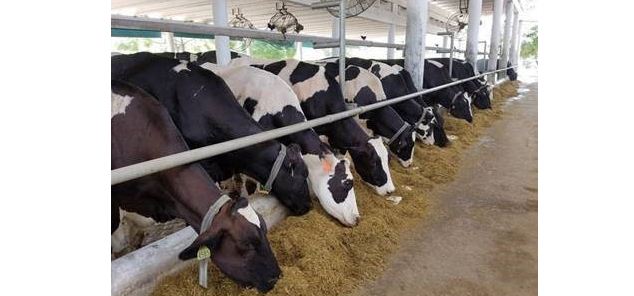
ISLAMABAD, FEB 1 (DNA) – A shipment of 2,078 U.S. cattle arrived at the port of Karachi on January 27, 2021.  As a result of the strong partnership between the U.S. Department of Agriculture and the Pakistan dairy sector, cattle shipments from the United States continue to supply Pakistan with high-quality bovine stock for its dairy and beef herds.

Roughly 95 percent of the cattle in this year’s first shipment are U.S. Holstein dairy cattle, which, thanks to U.S. livestock genetics, produce milk yields that are substantially higher than Holsteins imported from other countries.

The remaining animals are Jersey dairy cattle, noted for their high milk fat content, and Braham beef cattle, noted for their high-quality beef.  All breeds have the genetic potential to adapt to Pakistan’s climate.  At least two more shipments of U.S. cattle are expected to arrive before the end of March 2021, when the cattle shipping season closes.

Pakistan’s demand for milk is increasing, and the introduction of U.S. dairy cows is helping Pakistan reduce the gap between milk demand and supply, thereby contributing significantly to ensuring sustainable food security in the country.

Agriculture is Pakistan’s second-largest economic sector, accounting for nearly 20 percent of GDP in fiscal year 2019-2020.  It remains by far the largest employer, accounting for nearly 40 percent of Pakistan’s labor force.  For the nearly 63 percent of the Pakistani population living in rural areas, agriculture is a vital part of their daily life.  The U.S. government partners with Pakistani scientists and farmers to improve agricultural productivity.  The U.S. government has also supported the development of a model dairy farm at the University of Veterinary and Animal Sciences, Pattoki Campus, near Lahore, and to familiarize the Pakistani dairy sector about the unique characteristics of the U.S. cattle breeds that have been imported into Pakistan.=DNA

=======================

Stay Connected

64FansLike
60FollowersFollow

Latest Reviews

Exchange Rates

USD - United States Dollar
EUR
1.17
GBP
1.35
AUD
0.72
CAD
0.73