Home Blog Page 155

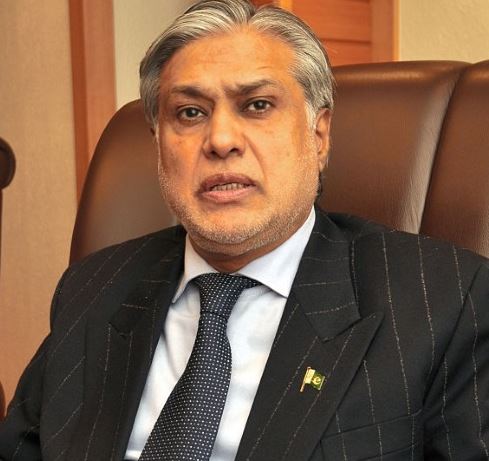
Ishaq Dar warns India: Water block means act of war

Deputy PM Dar Meets Norwegian Deputy FM Kravik

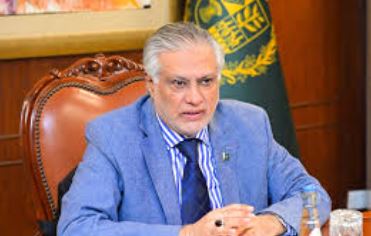
ISLAMABAD, May 5 /DNA/ – Deputy Prime Minister and Foreign Minister Senator Mohammad Ishaq Dar today warned that any future aggression against Pakistan would be met with the nation’s “full might, resolve, and determination,” as he addressed the diplomatic corps on the first anniversary of Marka-e-Haq (The Battle for Truth).

Hosted at the Ministry of Foreign Affairs, the address commemorated Pakistan’s military response to what Dar termed “unprovoked Indian aggression” on the night of May 6/7, 2025. He hailed Operation Bunyan-ul-Marsoos as a historic testament to the professionalism of the armed forces and a unified national message to thwart any threat to the country’s peace and prosperity.

The Foreign Minister detailed the events leading to the 2025 conflict, asserting that India reacted to the Pahalgam incident (April 22, 2025) with a “knee-jerk response” and belligerence, targeting civilian areas despite offers for an independent investigation. He confirmed that under the leadership of then-General Asim Munir (now Field Marshal and Chief of Defence Forces), and Air Chief Marshal Zaheer Ahmad Babar Sidhu, Pakistan’s military downed several Indian fighter jets and neutralized military targets—a “resounding success” that stands as a matter of record. He also commended the role of former President Trump in brokering the subsequent ceasefire.

In a stark escalation of rhetoric, Senator Dar reiterated the National Security Committee’s declaration that any Indian attempt to stop or divert Pakistan’s water flows under the Indus Waters Treaty (IWT)—which India has held in abeyance—would be considered “an Act of War.” He highlighted recent “unusual and unexplained” fluctuations in the Chenab and Jhelum rivers in April, December, and as recently as May 2-3, 2026, calling for full transparency and adherence to treaty obligations.

Shifting to regional diplomacy, the Foreign Minister revealed Pakistan’s pivotal role as a mediator in the ongoing Gulf crisis. He disclosed that Islamabad successfully facilitated direct talks between the US and Iran in Islamabad after a 47-year hiatus—a 21-hour marathon session on April 10-11, 2026. While those talks have advanced, Dar noted that parties returned to capitals for consultations, with Pakistan continuing to push for a truce. He noted he has received over 120 calls from global counterparts since February 28 regarding the crisis.

Reaffirming Pakistan’s stance, Dar stated that the unresolved Jammu and Kashmir dispute remains a threat to South Asian peace, calling for renewed UN-backed efforts. He highlighted Pakistan’s July 2025 UN Security Council presidency (leading to Resolution 2788) and announced upcoming leadership roles: the ECO chairmanship (2026-27) and the Shanghai Cooperation Organisation (SCO) summit in 2027.

Concluding, the Deputy PM emphasized that peace cannot be achieved through coercion or “block politics,” but only through dialogue, mutual respect, and international law. “Millions cannot live under the perpetual fear of war,” he said. “Now it is for our neighbour to make the choice.”

Despite Iran’s attacks on UAE, war has not resumed, US Gen. Dan Caine says

Despite Iran's attacks on UAE, war has not resumed, US Gen. Dan Caine says

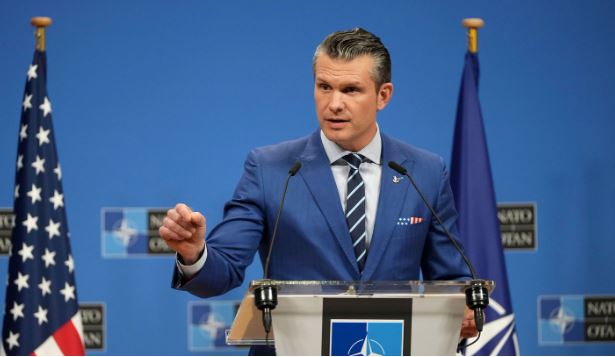
US Secretary of Defense Pete Hegseth added that the US established a “red, white, and blue dome” over the Strait of Hormuz as a “gift from the US to the world.”

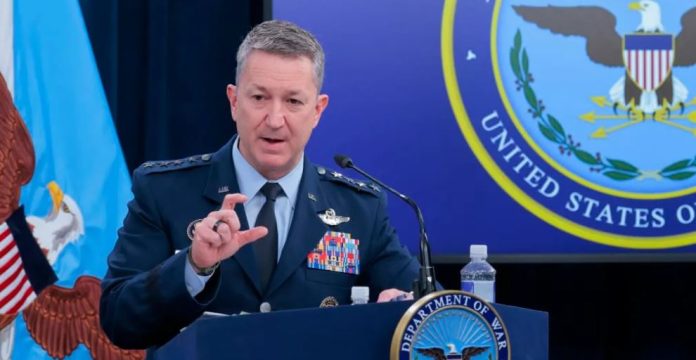
WASHINGTON, MAY 5: United States Chairman of the Joint Chiefs of Staff, Gen. Dan Caine, said in a Tuesday press conference at the Pentagon that Iran’s recent attacks would not restart the war, saying the attacks remain “below the threshold of restarting major combat operations at this point.”

Caine added that US operations remain at “low-level kinetics at this time.”

US Secretary of Defense Pete Hegseth also spoke, saying that the US established a “red, white, and blue dome” over the Strait of Hormuz as a “gift from the US to the world.”

US forces are “providing 24/7 overwatch for peaceful commercial vessels, except Iran’s,” said Hegseth.

Hegseth noted that six ships had tried to break the US blockade since the start of Operation Project Freedom on Monday, all of which were “turned around.”


The statement contrasted with statements by the US military on Monday, which said it destroyed six Iranian vessels.

Hegseth added that Operation Project Freedom is a temporary operation separate from both Economic Fury and Epic Fury.

Hegseth: Project Freedom ‘temporary in duration’
“Project Freedom is defensive in nature, focused in scope and temporary in duration, with one mission, protecting innocent commercial shipping from Iranian aggression,” said Hegseth. “American forces won’t need to enter Iranian waters or airspace. It’s not necessary. We’re not looking for a fight.”

Hegseth emphasized that Iran has been “harassing ships” in the Hormuz “for too long.”

“America is using its strength to lift up others,” Hegseth continued. “Iran is trying to subjugate others.”

Hegseth further said that Iran does not control the Strait of Hormuz and that “hundreds of ships are lining up” to pass through the waterway.

Reiterating that the mission is “temporary,” Hegseth demanded that the world “step up,” adding that “the world needs this waterway a lot more than we do.”

“At an appropriate place and time, we will hand responsibility back to you,” he said.

On Monday, US President Donald Trump urged South Korea to join the American effort in the Hormuz after a Korean cargo ship came under fire by Iranian forces.

Pakistan Navy rescues Indian, Indonesian crew stranded at sea

Pakistan Navy rescues Indian, Indonesian crew stranded at sea

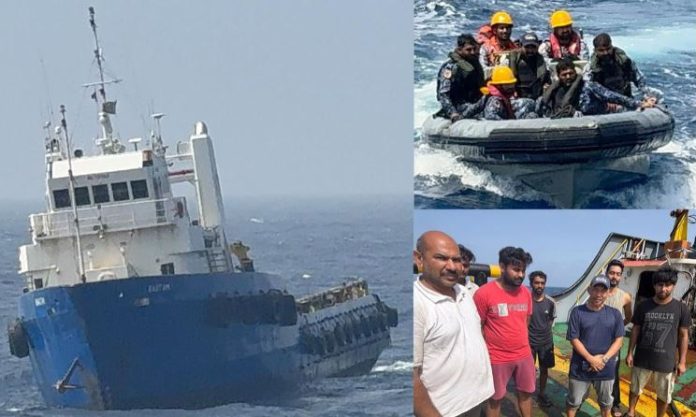
RAWALPINDI, MAY 5 /DNA/ – Pakistan Navy, demonstrating vigilance and commitment to international maritime obligations, promptly responded to a distress call from the offshore vessel MV GAUTAM in the Arabian Sea. The vessel carrying seven crew members, six Indian and one Indonesian, suffered a critical technical failure while en route from Oman to India, leaving it stranded at sea.

Upon receiving the alert from Maritime Rescue Coordination Centre (MRCC) Mumbai, Pakistan Navy initiated a swift response and deployed PMSA Ship KASHMIR. The ship provided food, medical aid, and technical assistance to help restore essential systems and ensure crew safety.

This operation underscores Pakistan Navy’s commitment to maritime safety and humanitarian responsibilities, irrespective of nationality, and highlights its readiness to respond to emergencies across regional waters.

From Stone Arrows to Bunyanun Marsoos

From Stone Arrows to Bunyanun Marsoos

by Muhammad Mohsin Iqbal

From the earliest dawn of human society, conflict has been an inescapable feature of collective life. Long before states, borders, or written laws, human groups clashed over territory, water, food, and survival. Even these primitive confrontations were not entirely spontaneous; they involved anticipation, planning, and strategy. Yet planning carried a fatal vulnerability. When intentions were revealed—through betrayal, careless speech, or interception—the advantage vanished. To overcome this, secrecy gradually became a cardinal principle of warfare, and plans began to be concealed under symbols, signals, and later, carefully chosen names. Thus emerged the earliest roots of what would much later be known as military code names.

Archaeological evidence confirms that organized violence predates civilization itself. The prehistoric cemetery at Jebel Sahaba along the Nile, dating back nearly fourteen thousand years, stands as the oldest known testimony to sustained warfare. The skeletons of men, women, and children bear stone arrowheads embedded in bone, some wounds healed, others fatal, indicating not a single massacre but repeated raids over time. Environmental stress and dwindling resources appear to have driven these conflicts, demonstrating that even nomadic hunter-gatherers could engage in prolonged, organized violence when survival was threatened. Similar traces of early warfare appear at sites such as Nataruk in Kenya and in rock art from Mesolithic Europe and Australia, reinforcing the conclusion that war is not merely a by-product of settled life, but a recurring human response to scarcity and fear.

With the advent of writing, warfare entered history in a new and more structured form. In ancient Mesopotamia, early Sumerian records describe conflicts between city-states and neighbouring regions such as Elam. The war between Lagash and Umma around 2450 BC, immortalized on the Stele of the Vultures, reveals organized infantry formations, command hierarchies, territorial conquest, and psychological warfare. Violence was no longer episodic; it became an instrument of state policy. A further leap occurred with Egypt’s account of the Battle of Megiddo in 1457 BC, the first conflict described in tactical detail, complete with routes of advance, weaponry, casualty figures, and siege operations. War had become systematic, documented, and consciously commemorated.

As warfare expanded in scale and complexity, the need for secrecy intensified. While ancient armies often named campaigns after places or rulers, the systematic use of operational code names emerged in the early twentieth century, driven by the dangers of intercepted communications. During the First World War, German offensives such as Operation Michael and Georgette used neutral names to conceal intent and sequence large-scale attacks. The Second World War elevated this practice into a sophisticated art. Operations such as Overlord, Barbarossa, Torch, Husky, and Bodyguard demonstrate how code names served not only secrecy but also deception, deliberately misleading adversaries about timing, location, and objectives. Names were chosen precisely because they revealed nothing, or occasionally because they suggested something false.

In the post-war and Cold War eras, code names became increasingly standardized, aided by formal naming systems to avoid duplication and confusion. At the same time, especially in the United States, names began to serve broader political and psychological purposes. Operations such as Just Cause, Desert Storm, Enduring Freedom, and Iraqi Freedom illustrate how code names evolved into instruments of morale-building and public persuasion. Warfare was now fought simultaneously on the battlefield and in the realm of narrative, where language shaped legitimacy, consent, and historical memory.

Pakistan’s military experience since independence reflects this global evolution in condensed form. Born in conflict in 1947, the country’s early operations were shaped by conventional warfare against India, particularly over Kashmir. Operation Gulmarg, followed by Gibraltar and Grand Slam in 1965, reflected an era of traditional military planning and territorial ambition. The tragedy of 1971, marked by Operation Searchlight, profoundly altered Pakistan’s strategic outlook. Thereafter, military involvement increasingly shifted toward internal stability, political intervention, and urban security, as seen in Operation Fair Play and later security operations in Karachi.

The post-9/11 era marked another decisive transformation. Pakistan found itself confronting asymmetric warfare, militancy, and terrorism across its western regions. Operations such as Al-Mizan, Rah-e-Rast, Rah-e-Nijat, Zarb-e-Azb, and Radd-ul-Fasad signified a doctrinal shift from conventional battles to intelligence-led, population-centric counter-insurgency. These operations carried names rich in symbolic meaning, invoking righteousness, deliverance, and reform, reflecting an effort to align military action with moral purpose and national resolve.

Closely aligned in spirit and purpose, Operation Markah-e-Haq further reinforces this trajectory. The very phrase, meaning “the battle for truth,” reflects not merely a tactical undertaking but a moral assertion. It underscores the continuing evolution of Pakistan’s security doctrine, wherein military operations are framed not only as responses to threats but as commitments to justice, stability, and national integrity.

Within this continuum, Operation Bunyanun Marsoos represents a mature expression of Pakistan’s contemporary security doctrine. Derived from a Quranic phrase meaning “a solid, unbreakable wall,” the name itself conveys unity, discipline, and collective strength. The operation embodied an integrated approach, emphasizing coordination among the armed forces, intelligence agencies, and civilian institutions. It signified a move beyond fragmented responses toward sustained, intelligence-based action against evolving threats. In choosing such a name, Pakistan demonstrated how modern military nomenclature blends operational security with cultural resonance, morale, and strategic messaging.

Across history, from prehistoric raids over dwindling resources to modern campaigns framed by carefully chosen names, warfare has continually adapted to human circumstances. Code names, once simple shields against espionage, have become multifaceted instruments—protecting secrets, enabling deception, coordinating vast forces, and shaping public understanding. Pakistan’s experience, spanning conventional wars, internal conflicts, and counter-terrorism campaigns, mirrors this broader human story.

Ultimately, while weapons, technologies, and terminologies change, the underlying impulses of war remain constant. Fear, ambition, insecurity, and power continue to drive conflict, while secrecy remains its trusted companion. Code names, whether carved into ancient stone, whispered over wartime radios, or announced in modern briefings, are more than labels. They are linguistic fortifications, concealing intent, unifying action, and shaping how wars are justified, remembered, and judged long after the echoes of battle have faded.

Outgoing Polish envoy praises Pakistan’s Middle East mediation role

Outgoing Polish envoy praises Pakistan’s Middle East mediation role

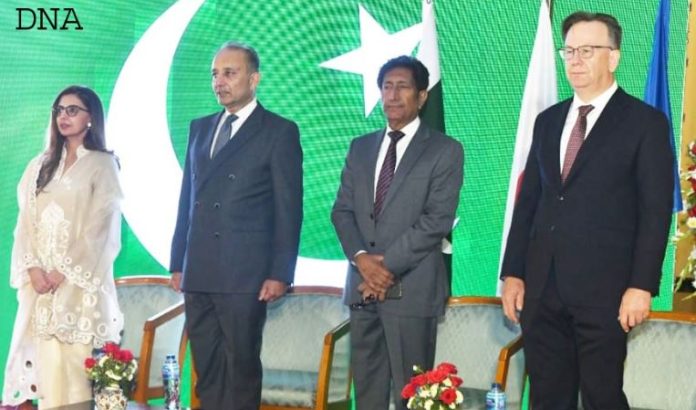
ISLAMABAD, MAY 5 /DNA/ – In a poignant and personal address on the occasion of Polish National Day, the outgoing Ambassador of Poland, Maciej Pisarski reflected on an eventful four-and-a-half-year diplomatic tenure in Pakistan, highlighting deepening bilateral relations, mediation efforts in the Middle East, and a shared commitment to international law.

Speaking at a ceremony commemorating the Third May Constitution of 1791, the Ambassador—who noted this would likely be his last formal address in the role—struck a tone of gratitude and reflection, steering away from a traditional farewell speech to offer a “personal and retrospective” account of his family’s journey in Pakistan.

The Ambassador painted a sobering picture of a “rapidly changing international environment,” marked by turmoil and human suffering. He recalled the embassy’s regular commemorations of the Russian invasion of Ukraine, the humanitarian catastrophe in Gaza, and the victims of terrorism in Pakistan.

“We have kept reminding ourselves that human suffering, especially of the civilian population, in one place should not, could not, make us numb to the sufferings of others,” he stated, adding that “there cannot be peace without justice; without self-determination and freedom to choose one’s future in a sovereign homeland.”

A notable highlight of the speech was the Ambassador’s praise for Pakistan’s recent role as a mediator in Middle Eastern conflicts. He referred to “The Islamabad Process,” stating that Pakistan has “stepped in as a mediator, working with the concerned parties to find a solution to the conflict through diplomacy and dialog,” and confirmed that the process “has already contributed to the de-escalation.”

Despite global instability, the Ambassador declared that Poland-Pakistan relations have “reached a higher level,” culminating in the successful October 2025 visit of Poland’s Deputy Prime Minister and Foreign Minister, Radosław Sikorski, to Islamabad. High-level talks with Pakistani leadership, including President Asif Zardari and Prime Minister Shehbaz Sharif, have opened “a new chapter” in cooperation, focused on upholding the UN Charter and international law.

Economic ties are also strengthening. Bilateral trade has exceeded 1.3billionUSD,describedbytheenvoyasagenuineGSPplusmiracleintheworking.Hehighlightedasignificant1.3billionUSD,describedbytheenvoyasagenuineGSPplusmiracleintheworking.”Hehighlightedasignificant500 million investment by Poland’s Orlen Group (PGNiG) in gas exploration projects in Sindh, which has brought indigenous gas to Pakistani consumers along with advanced technology and vocational training.

On a personal note, the Ambassador said the “lasting legacy” of his tenure would be the people-to-people connections fostered by the embassy. He cited educational projects in Islamabad and Chapursan Valley, vocational training for underprivileged children, and collaboration with women activists in Hunza to advance empowerment and safe spaces.

He also paid tribute to Pakistan’s high-altitude climbing community, noting Poland’s historic legacy—highlighting Wanda Rutkiewicz, the first woman to scale K2 in 1986.

The Ambassador extended deep thanks to his wife for her support, calling their Pakistani journey “amazing,” and praised the embassy team—without whom, he said, “the ambassador would be just a lone white sail, lost in a vast ocean.”

Concluding with a heartfelt “Hamari Pakistani Dostou – Bohot Shukria” (Thank you, our Pakistani friends), he declared: “Pak-Poland Dosti Zindabad” (Long live Pakistan-Poland friendship). He then invited guests to enjoy pierogis, a Polish specialty, as dinner was served.

Ceasefire with Iran is not over, Pentagon’s Hegseth says

Ceasefire with Iran is not over, Pentagon’s Hegseth says

WASHINGTON, MAY 5: US Defense Secretary Pete Hegseth said on Tuesday that the ceasefire with Iran was not over, even as the US and Iran exchanged fire in the Gulf as they wrestled for control of the Strait of Hormuz.

Hegseth said the US had successfully secured a path through the critical waterway and that hundreds of commercial ships were lining up to pass through, as Washington seeks to break a chokehold Iran has asserted on the Strait of Hormuz since the conflict began on February 28.

“We know the Iranians are embarrassed by this fact. They said they control the strait. They do not,” Hegseth told a Pentagon news conference.

The US military says it sank six Iranian small boats and intercepted Iranian cruise missiles and drones, after President Donald Trump sent the navy to escort stranded tankers through the Strait of Hormuz in a day-old campaign he called “Project Freedom.”

Several merchant ships in the Gulf reported explosions or fires on Monday, the first day of the operation.

General Dan Caine, the chairman of the Joint Chiefs of Staff, said Iran attacked Oman once on Monday and waged three attacks on the United Arab Emirates, before adding that, at least so far, “today is quieter.”

Caine said that since the ceasefire was announced on April 7, Iran had fired at commercial vessels nine times and seized two container ships. Iran has attacked US forces more than 10 times, he added.

However, the attacks fell “below the threshold of restarting major combat operations at this point,” Caine told reporters.

Asked whether the ceasefire with Iran still held, Hegseth said: “No, the ceasefire is not over.”

“We said we would defend and defend aggressively, and we absolutely have. Iran knows that, and ultimately, the president can make a decision whether anything were to escalate into a violation of a ceasefire,” he said.

Blockade

The operation is Trump’s latest effort to force an end to the disruption of international energy supplies caused by Iran’s blockade of the strait, which carried a fifth of global oil and liquefied natural gas before the war.

The US Navy is also enforcing a maritime blockade of Iran, which prevents ships from going to Iran or departing Iranian territory.

The two military operations seek to pressure Iran to strike a deal to end the conflict on Trump’s terms. But Iran has countered that there is no military solution to the crisis, and it has threatened to fight for as long as necessary.

The US military said on Monday two US merchant ships made it through the strait, with the support of Navy guided-missile destroyers.

Iran denied any crossings had taken place, though shipping company Maersk said the Alliance Fairfax, a US-flagged ship, exited the Gulf under US military escort on Monday.

Caine estimated 22,500 mariners embarked on more than 1,550 commercial vessels were stuck in the Gulf, unable to transit.

“CENTCOM, along with partner nations, is in active communication with hundreds of ships, shipping companies and insurers,” Hegseth said, referring to the US military’s Central Command, which leads operations in the Middle East.

“All of these ships from all around the world want to get out of the Iranian trap that they have been stuck inside.”

Raja Bazaar uplift work reviewed, early completion directed

Raja Bazaar uplift work reviewed, early completion directed

RAWALPINDI, May 5: Deputy Commissioner Rawalpindi Dr Hassan Waqar Cheema on Tuesday visited Raja Bazaar to review ongoing beautification and rehabilitation work along with Tahira Aurangzeb, MNA.

The officials reviewed measures related to cleanliness, beautification, removal of encroachments, infrastructure improvement and provision of civic facilities in the area.

The deputy commissioner directed the officers concerned to complete the projects within the stipulated time-frame and ensure quality of work without compromise.

Speaking on the occasion, Tahira Aurangzeb said the rehabilitation of Raja Bazaar was vital for improving the city’s outlook and boosting commercial activities, urging all departments to work in coordination for early completion.

The deputy commissioner said the district administration was utilizing all available resources for city improvement and provision of better facilities to citizens, adding that rehabilitation of key trade centres remained among the government’s priorities. Additional Deputy Commissioner (HQ) Abdul Rehman Khan also accompanied them during the visit.

DPM express satisfaction over sugar production, terms it adequate to meet domestic demand

DPM express satisfaction over sugar production, terms it adequate to meet domestic demand

ISLAMABAD, May 5: Deputy Prime Minister/Foreign Minister (DPM/FM ), Senator Mohammad Ishaq Dar on Tuesday expressed satisfaction that sugar production this season has been encouraging, noting that this would ensure adequate supply in the market to meet domestic demand while helping maintain price stability.

The deputy prime minister chaired a high-level meeting to review sugar production at the conclusion of the current crushing season, a DPM’s Office news release said.

The meeting was attended by Minister for National Food Security Rana Tanveer Hussain, Minister for Climate Change Musadik Malik, SAPM Tariq Bajwa, along with Secretaries of Industries, Commerce, and National Food Security, as well as other senior officials from relevant departments.

COAS chairs 275th Corps Commanders’ Conference at GHQ

COAS chairs 275th Corps Commanders’ Conference at GHQ

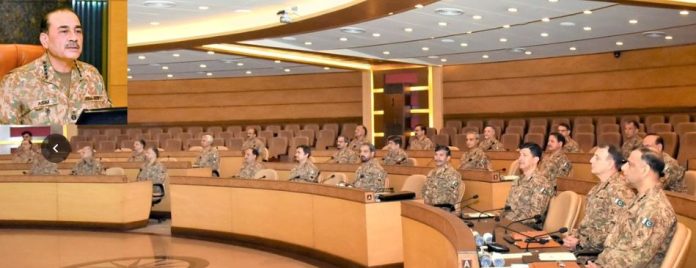
RAWALPINDI, MAY 5: /DNA/ – Field Marshal Syed Asim Munir, NI (M), HJ, COAS & CDF, presided over the 275th Corps Commanders’ Conference (CCC) at General Headquarters (GHQ), Rawalpindi.

The Forum paid rich tribute to the Shuhada of the Armed Forces, Law Enforcement Agencies, and innocent civilians who laid down their lives in defence of the motherland. Paying profound tribute to their unmatched sacrifices, the Forum reaffirmed that the enduring legacy of the martyrs continues to serve as the bedrock of Pakistan’s national security, unity, and resilience.

The COAS & CDF expressed satisfaction over the high standards of operational preparedness, professionalism, and combat readiness of the Pakistan Armed Forces. He commended commanders and formations for their unwavering commitment, vigilance, and success in ongoing intelligence-based counter-terrorism operations across the country.

The Forum undertook a comprehensive review of the prevailing internal and external security environment. The Forum resolved to maintain current operational tempo to decisively dismantle terrorist networks, disrupt their support infrastructure, and deny them any operational space within Pakistan.

The Forum acknowledged continued degradation of terrorists and their support infrastructure through operation Ghazb lil Haq. It noted that the irrational and perverted policy of Afghan Taliban regime to provide safe havens to Khawarij and other terrorist organisations, with total disregard to interests of Afghan people, is increasingly backfiring and stands fully exposed. It noted recent pattern of ongoing propaganda campaign by Taliban regime to falsely portray Pakistan as targeting civilians inside Afghanistan, terming such misleading narratives as part of a coordinated disinformation strategy by the regime to distract attention from their internal failures and play victim card. The Forum categorically rejected these frivolous allegations and reaffirmed that Pakistan’s defensive actions remain focused, precise, and directed solely against infiltrators, terrorist hideouts and support infrastructures.

Deliberating on the broader regional security environment, the Forum noted that emerging geopolitical developments carry significant implications for regional stability. While underscoring the importance of restraint and avoidance of escalation, the Forum acknowledged Pakistan’s continued responsible role in advocating stability and supporting efforts aimed at preventing further deterioration of the situation. It reiterated that peace and stability in the region are intrinsically linked to collective restraint, responsibility and respect for sovereignty.

The Forum congratulated the Nation and Armed Forces on the first anniversary of Marka-e-Haq, recognizing it as a defining moment reflecting national unity, collective resolve, and an unyielding commitment to safeguard Pakistan’s sovereignty at all costs. The Forum underscored that the national commemoration of Marka-e-Haq serves as a clear message to Indian hubristic political mindset that the Pakistani nation stands united, resilient, and fully prepared. It signifies the unshakeable harmony between the People, Government and Armed Forces of Pakistan, which stands together as “Bunnianum Marsoos” against all internal and external challenges.

The Forum strongly condemned ongoing atrocities, extrajudicial killings, and demographic changes in IIOJK, reaffirming Pakistan’s unwavering diplomatic, political, and moral support for the just struggle of the Kashmiri people.

In his concluding remarks, the COAS & CDF directed commanders to maintain the highest levels of vigilance, operational readiness, and adaptability in the face of evolving threats. He emphasized the need for continued focus on professional excellence, integrated response mechanisms, and proactive measures to counter both conventional and non-conventional challenges.

Climate Champions Take the Lead: PRCS Ignites Green Action for a Sustainable Tomorrow

Climate Champions Take the Lead: PRCS Ignites Green Action for a Sustainable Tomorrow

ISLAMABAD, MAY 5 /DNA/ – The Pakistan Red Crescent Society (PRCS), through its Climate Change Department, organized a vibrant “Climate Champion” event on Tuesday aimed at promoting environmental awareness and encouraging practical action against climate change. The event brought together students and youth in a series of engaging and creative activities designed to inspire a climate-friendly culture.

The event was attended by Chairperson PRCS Mrs. Farzhana Naek, Secretary General PRCS Mr. Muhammad Abaidullah Khan, along with heads of delegations and representatives from Movement partners including IFRC, ICRC, Turkish Red Crescent (Kizilay), Norwegian Red Cross, and German Red Cross. A large number of PRCS staff, volunteers, and students from the twin cities also participated, reflecting a strong collective commitment towards environmental responsibility.

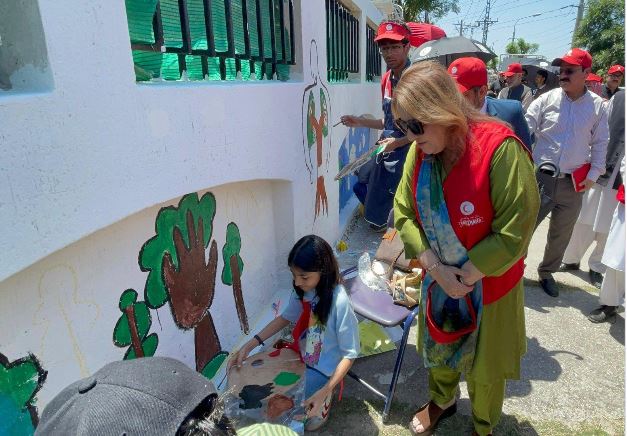
Students showcased powerful messages on climate change through art and painting on PRCS’s outer walls, visually highlighting environmental challenges and the urgent need to reduce carbon emissions. Awareness sessions focused on minimizing plastic use, while an interactive theatre performance presented simple yet impactful actions for environmental protection in an engaging manner.

A key highlight of the event was the establishment of a unique “Green Market,” where participants exchanged recyclable waste for green coins, promoting reuse, recycling, and reduction in an innovative and practical way. The initiative was widely appreciated for encouraging responsible consumption and environmental stewardship.

The event also featured a cycling activity and a symbolic walk to emphasize the importance of eco-friendly practices and sustainable living. Organized as part of the Red Cross and Red Crescent Week, the event reinforced the principles of Reduce, Reuse, and Recycle, while engaging a large number of participants.

Addressing the participants, Chairperson Mrs. Farzhana Naek underscored the collective responsibility to tackle climate change. She emphasized that reducing carbon emissions and eliminating plastic use are critical steps toward safeguarding the environment. She also appreciated the continued support of the German Red Cross in helping PRCS mitigate the sufferings of vulnerable communities and in strengthening its Climate Change Program. She reaffirmed PRCS’s commitment to promoting environmental awareness and fostering a culture of sustainability across communities.

The ceremony concluded with a tree plantation drive at the PRCS lawn, where fruit-bearing and shade trees were planted, symbolizing a shared commitment to a greener and healthier future.

Stay Connected

64FansLike
60FollowersFollow

Latest Reviews

Exchange Rates

USD - United States Dollar
EUR
1.14
GBP
1.34
AUD
0.70
CAD
0.71