Home Blog Page 847

Unregulated licensing of weapons draws CJP Isa’s ire

Unregulated licensing of weapons draws CJP Isa's ire

DNA

ISLAMABAD, JAN 17: “No one goes around carrying Kalashnikovs in big cars with tinted glasses anywhere around the world,” he says, CJP Isa inquires about issuance of licenses for prohibited weapons, SC issues notices interior secretary, home secretaries, others.

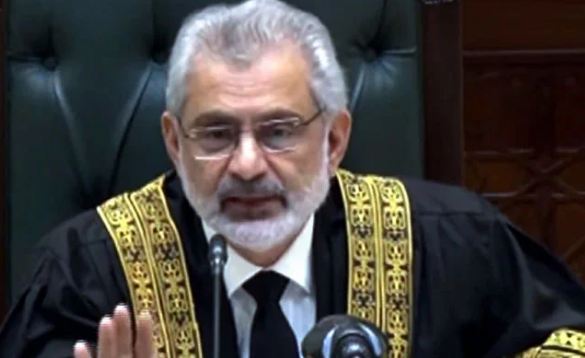
ISLAMABAD: Chief Justice Qazi Faez Isa Wednesday was angered over the unregulated licensing of weapons in Pakistan, questioning the interior ministry, home departments and law enforcers regarding ease in availability of weapons as well as the acquisition of their licenses.

The chief justice remarked that weapons and drugs have destroyed the nation, insisting that there is a need to eliminate Kalashnikov culture from Pakistan.

“Drugs and Kalashnikovs have destroyed Pakistan. No one goes around carrying Kalashnikovs in big cars with tinted glasses anywhere around the world,” the country’s top judge remarked.

CJP Isa said he has also been offered to acquire a Kalashnikov license.

The chief justice’s remarks came while hearing the bail plea of a petitioner accused of theft. The petitioner, Kashif, has been booked on charges of theft after a citizen’s home was robbed with their weapons also stolen in the robbery.

“How many licenses of prohibited weapons were issued across the country?” the chief justice asked, seeking details from concerned authorities.

The Supreme Court also issued notices to the interior secretary and provincial home secretaries, inspector generals, attorney general for Pakistan and provincial advocate generals. It has also directed sending a copy of the order.

CJP Isa lamented that the police did not demand a license from the person whose weapon was stolen. “The owner himself is confessing that two Kalashnikovs, a pistol and other valuables were stolen.”

He then asked the petitioner where he got the Kalashnikov from.

The chief justice hinted towards action against the IG since he was giving away licenses without any verification.

“We will write to the interior secretary to return all Kalashnikovs and their licenses,” he remarked.

CJP Isa insisted that guards stand outside homes in Islamabad carrying Kalashnikovs and people are seen standing with Kalashnikovs in schools and markets, while the police don’t dare question people with tinted glasses on their vehicles carrying Kalashnikovs.

“If you are afraid, stay at home. They come out to intimidate people and show their influence,” he added.

The chief justice questioned how one knows whether a person with a Kalashnikov is a terrorist or someone else.


Pakistan severs its relations with Iran

Pakistan sever is

relations with Iran

Recalls ambassador from Tehran, asks Iranian ambassador to Pakistan who is currently in Iran not to return

Statement by the Spokesperson on Last Night’s Violation of Pakistan’s Sovereignty by Iran

“Last night’s unprovoked and blatant breach of Pakistan’s sovereignty by Iran is a violation of international law and the purposes and principles of the Charter of the United Nations.

This illegal act is completely unacceptable and has no justification whatsoever. Pakistan reserves the right to respond to this illegal act. The responsibility for the consequences will lie squarely with Iran.

We have conveyed this message to the Iranian Government. We have also informed them that Pakistan has decided to recall its ambassador from Iran and that the Iranian Ambassador to Pakistan who is currently visiting Iran may not return for the time being. We have also decided to suspend all high level visits which were ongoing or were planned between Pakistan and Iran in coming days.”

Meanwhile, various political parties have condemned the Iranian act. PML N President Mian Shehbaz Sharif, the PTI and others have strongly condemned the Iranian attack inside the Pakistani territory. In his statement the former Prime Minister Mian Shehbaz Sharif said that Iran violated Pakistani air space by launching attack, which is against international norms.

Pakistan Tehreek-e-Insaf (PTI) Spokesperson has strongly condemned Iran’s unprovoked violation of Pakistan’s airspace, saying that this irresponsible and reprehensible act would sabotage the possibilities of much-needed unity among the Muslim Ummah in this hour of need.

PTI Spokesperson expressed his heartfelt condolences with the victims’ families and said that Iran attempted to ruin the prospects of an inevitable harmony and unity among the ummah with unprovoked violation of Pakistan’s sovereignty.

He sought an immediate explanation from the unconstitutional, illegal, unrepresentative and unelected government for its complete failure to safeguard the integrity, security and defense of Pakistan.

PTI Spokesperson further pointed out that after India and Afghanistan, the serious deterioration of relations with Iran is very concerning and worrisome which speaks volumes about our failed foreign and defense policies.

Caretaker Balochistan Information Minister Jan Achakzai Wednesday said the violation of Pakistani sovereignty by Tehran “damages relations” between Iran and Pakistan.

“The enemy forces are trying to intervene externally in Pakistan, especially in Balochistan. The enemies will never succeed in their plans,” the minister said.

The minister’s comments came during a presser in Quetta where he spoke in the wake of a drone and missile attack by Iran on ‘militant bases’ near its shared border with Pakistan late on Tuesday. The attack, however, resulted in the death of two innocent children and injured three girls. 

Islamabad, on the other hand, has strongly denounced the strike, terming it “unprovoked and “completely unacceptable”, warning Iran of serious consequences after Tehran violated its airspace.

High hopes for Japan’s ‘Moon Sniper’ mission

                Tokyo, dna :Japan’s “Moon Sniper” spacecraft will attempt a historic touchdown on the lunar surface this weekend using pinpoint technology the country hopes will lead to success where many have failed.

                  With its Smart Lander for Investigating Moon (SLIM) mission, Japan wants to become the fifth nation to pull off a fiendishly tricky soft landing on the rocky surface.

                  Only the United States, the Soviet Union, China and India have accomplished the feat, and Japan’s lander — equipped with a rolling robot developed by a major toy company — is designed to do so with unprecedented precision.

                  The descent of the lightweight SLIM craft, nicknamed the “Moon Sniper” by space agency JAXA, is scheduled to start at midnight Japan time on Saturday (1500 GMT Friday).

                  If all goes to plan, the touchdown will be around 20 minutes later.

                  The craft is targeting an area within 100 metres (330 feet) of a spot on the lunar surface — far less than the usual landing zone of several kilometres.

                  Success would reverse Japan’s fortunes in space after two failed lunar missions and recent rocket failures, including explosions after take-off.

                  It would also echo the triumph of India’s low-cost space programme in August, when the country became the first to land an uncrewed craft near the Moon’s largely unexplored south pole.

                  SLIM is expected to land on a crater where the Moon’s mantle — the deep inner layer beneath its crust — is believed to be accessible at the surface.

                  “The rocks exposed here are crucial in the search for the origins of the Moon and the Earth,” Tomokatsu Morota, an associate professor at the University of Tokyo specialising in lunar and planetary exploration, told AFP.

                  JAXA has already made a pinpoint landing on an asteroid, but the challenge is greater on the Moon, where gravity is stronger.

                  With just one shot at landing, the pressure is on — and the craft’s precision is vital in the attempt to “land on an area surrounded by rocks”, which it will examine with a camera, Morota said.

                  – Race to the Moon –

                  With its “sniper” technology, Japan hopes to “showcase its presence” in space and provide pivotal information on the Moon’s history, according to Morota.

                  The mission also has ambitions to shed light on the mystery of water resources that will be key to building bases on the Moon one day.

                  The lunar surface is desert-like, but at the poles, where the terrain is rugged and sunlight is scarce, there are areas where water could exist.

                  “The possibility of lunar commercialisation depends on whether there is water at the poles,” Morota said.

                  SLIM’s rolling probe, slightly bigger than a tennis ball, can change its shape to move on the Moon’s surface and was jointly developed by JAXA and Japanese toy giant Takara Tomy.

                  Adding to the playful mood, JAXA has released an online video game called “SLIM: The pinpoint moon landing game”.

                  More than 50 years after the first human Moon landing, countries and private companies are racing to make the trip anew.

                  But crash-landings, communication failures and other technical problems are rife.

                  This month, a private US lunar lander had to turn back after leaking fuel, while NASA postponed plans for crewed lunar missions under its Artemis programme.

                  Russia, China and other countries from South Korea to the United Arab Emirates are also trying their luck.

                  Previous Japanese lunar missions have failed twice — one public and one private.

                  In 2022, the country unsuccessfully sent a lunar probe named Omotenashi as part of America’s Artemis 1 mission.

                  In April, Japanese startup ispace tried in vain to become the first private company to land on the Moon, losing communication with its craft after what it described as a “hard landing”.

Pakistan agrees with Riyadh, Doha to go for international arbitration on investmen

ISLAMABAD: Pakistan agreed to allow the Kingdom of Saudi Arabia and Qatar to approach the Permanent Court of Arbitration (PCA) or International Centre for Settlement of Investment Disputes (ICSID) if any issue they face in the multibillion-dollar investments they plan to make in projects,.

The two sides are holding talks on the exact valuation of the Reko-Diq project and Manara Minerals is finalising the term sheet and valuation.

The Manara Minerals Investment Company is a new venture between the Saudi Arabian Mining Company (Ma’aden) and the Public Investment Fund (PIF) that will invest in mining assets globally for Riyadh and support the development of resilient global supply chains. While on Pakistan’s side, the Reko Diq Mining Company (RMDC) has been tasked to hire levies and payment mechanisms defined for Balochistan.

“Pakistan has negotiated to include a graduated approach for settlement of investment disputes between the state and investors. Through this arrangement, there will be a mandatory period of eight months to get the dispute resolved at the domestic forums,” sources told the publication.

An official said that in the case of non-resolution of disputes, it was agreed that recourse could be made to the PCA or ICSID as international forums of arbitration.

The investment chapter can be annexed with a Free Trade Agreement (FTA) to be signed with GCC (Gulf Cooperation Council) countries, including the process of investor and state dispute settlement through the ICSID as agreed with Saudi Arabia and Qatar, which was also shared with the GCC Secretariat.

GCC has told Islamabad that the legally cleansed draft will be shared with Pakistan in due course. 

In this regard, the Pakistani envoy has been tasked to follow up with the GCC Secretariat and give an update before the next Special Investment Facilitation Council (SIFC) meeting.

However, on the Aramco Refinery Project, it has been decided to follow up on the project to materialise it.

SIFC greenlights Nidra

In another major development, the SIFC has given approval in principle for the establishment of the National Industrial Development & Regulatory Authority (Nidra). 

The modalities of the authority will be finalised after consultations are held with the provinces.

The Board of Investment (BOI) has been tasked to launch the process of legislation for the proposed model under Article 147 in consultation with the provincial governments and stakeholders, including formulation of a framework for the unification of all existing economic and industrial zones by March 2024.

Till the legislation is passed, the proposed model will be worked on in consultations with the provincial governments.

Children’s Lives Lost: Pakistan Demands Accountability for Iranian Airspace Violation

Pakistan

Bilateral Trust at Stake: Pakistan Reacts to Unacceptable Sovereignty Breach

ISLAMABAD, JAN 17 /DNA/ – Pakistan strongly condemned the unprovoked violation of its airspace by Iran which resulted in death of two innocent children while injuring three girls. This violation of Pakistan’s sovereignty is completely unacceptable and can have serious consequences.

It is even more concerning that this illegal act has taken place despite the existence of several channels of communication between Pakistan and Iran. Pakistan’s strong protest has already been lodged with the concerned senior official in the Iranian Ministry of Foreign Affairs in Tehran. Additionally, the Iranian Charge d’affaires has been called to the Ministry of Foreign Affairs to convey our strongest condemnation of this blatant violation of Pakistan’s sovereignty and that the responsibility for the consequences will lie squarely with Iran.

Pakistan has always said terrorism is a common threat to all countries in the region that requires coordinated action. Such unilateral acts are not in conformity with good neighbourly relations and can seriously undermine bilateral trust and confidence.

AUKUS Challenges to China’s Dominance

AUKUS

Dr. Muhammad AkramZaheer

The AUKUS partnership is a special alliance involving the United States, the United Kingdom, and Australia. It is a significant collaboration that could have a big impact on the world in 2024. These three countries have a history of fighting together in various wars, and AUKUS can be seen as a continuation of their close relationship.Think of AUKUS as a “child” of the Five Eyes, which is a group formed after World War II for intelligence-sharing. The Five Eyes includes the U.S., the U.K., Australia, Canada, and New Zealand, and it is still active today. AUKUS shares similarities with what Winston Churchill had in mind when he wrote about the English-speaking nations in “A History of the English-Speaking Peoples.”The Five Eyes was built on the idea that its members could trust each other with their secrets. This trust is based not only on their shared strategic interests as maritime powers but also on cultural, political, and commercial similarities. Even though the Five Eyes is mainly a military alliance, its members together contribute to almost 30 percent of the world’s gross domestic product.AUKUS is a group formed to help Australia get nuclear-powered submarines. But it’s not just about submarines; it’s also about sharing intelligence, improving military capabilities, tightening security, and creating new weapons together. The main goal is to stop China’s navy from taking control of the Pacific.Although the focus is on the Pacific, AUKUS is also thinking about the Atlantic. Even though there’s no immediate threat there, they believe the sea could become a big concern in the future. All the AUKUS members are islands, including the United States, which needs to protect the seas around it. The U.K. is the example for AUKUS, but the U.S. has become the most important country in the world and needs to support its allies. While alliances can have tensions, AUKUS expects to become stronger in 2024, with New Zealand likely joining and Canada thinking about it. This is important globally because, besides being a military alliance, AUKUS has a strong economic influence, especially against China. It reflects the natural outcome of global culture and national interests. As China’s economy faces challenges, AUKUS will play a more significant role, incorporating all aspects of power, not just military, on a global scale. The focus in the coming year will be on aligning and using this power with New Zealand and Canada joining.

The geopolitical implications of AUKUS extend beyond the immediate military focus, encompassing economic, technological and diplomatic dimensions. The alliance highlights the interconnectedness of security and economic interests, as well as the role of advanced technologies in shaping the geopolitical landscape. The collaboration on nuclear-powered submarines not only underscores the strategic importance of the Indo-Pacific but also signifies a shared commitment among AUKUS members to maintain a rules-based international order. However, the alliance’s exclusion of other key regional players, such as France, has led to questions about its inclusivity and the potential for further fragmentation in international relations.AUKUS has triggered a reassessment of alliances and partnerships in the Indo-Pacific, with countries weighing the benefits and risks of aligning themselves with either the alliance or China. The diplomatic fallout from the abrupt cancellation of Australia’s submarine deal with France, which preceded the announcement of AUKUS, has strained relations between Western and European nations. The move has highlighted the complex interplay of interests and the challenges of balancing regional security concerns with global diplomatic relationships.

One of the central challenges for AUKUS is navigating the delicate balance between containing China’s assertiveness and avoiding a full-scale confrontation. The alliance’s leaders have emphasized that AUKUS is not aimed at containing or isolating China, but rather at ensuring a free and open Indo-Pacific. However, perceptions matter in geopolitics and the onus is on the member countries to demonstrate the alliance’s constructive intentions and commitment to regional stability. The delicate dance between competition and cooperation will require nuanced diplomatic efforts to prevent further escalation and foster a conducive environment for dialogue.The technological dimension of AUKUS introduces a new frontier in the global competition for strategic dominance. The collaboration on nuclear-powered submarines represents a leap forward in military capabilities and underscores the critical role of cutting-edge technologies in modern warfare. The alliance seeks to harness the scientific and technological prowess of its member countries to maintain a military edge in the Indo-Pacific. This has sparked concerns in China which perceives AUKUS as a challenge to its technological ambitions and a potential disruption to its efforts to become a global leader in areas such as artificial intelligence, quantum computing and advanced manufacturing.

As the AUKUS alliance progresses, its impact on the regional balance of power will become more evident. The geopolitical chessboard in the Indo-Pacific is intricate, with multiple actors vying for influence and navigating a complex web of alliances and rivalries. AUKUS, by design or consequence, has injected a new level of uncertainty into this dynamic. The challenge for policymakers in the region is to calibrate their responses, ensuring that the pursuit of security does not come at the cost of exacerbating tensions or triggering a destabilizing arms race.The economic implications of AUKUS also merit attention, as they intertwine with broader trade and investment dynamics in the Indo-Pacific. The alliance’s emphasis on advanced technologies and defense capabilities raises questions about the potential impact on economic cooperation and competition. China has positioned itself as a key player in the region’s economic development through initiatives such as the Belt and Road Initiative (BRI). AUKUS, with its focus on security and military capabilities, may influence the economic calculus of countries in the region, leading them to reassess their economic partnerships and alignments.Furthermore, AUKUS has sparked discussions about the future of multilateralism and the efficacy of regional security architectures. The alliance’s formation, outside the traditional frameworks of organizations like the United Nations or regional groupings, raises questions about the evolving nature of global governance. Some argue that AUKUS represents a pragmatic response to the limitations of existing institutions in addressing contemporary security challenges.

The emergence of the AUKUS alliance presents a multifaceted challenge to China’s dominance in the Indo-Pacific. The alliance’s focus on advanced military technologies, strategic partnerships, and the recalibration of regional dynamics underscores the complexity of contemporary geopolitics. As AUKUS moves from announcement to implementation, its impact on regional stability, economic dynamics and global governance will become increasingly apparent. The challenge for the international community lies in managing these complexities, fostering open dialogue and pursuing a balance between competition and cooperation to ensure a peaceful and prosperous Indo-Pacific.

Pakistan beat China  by 2-0 in 2nd match 

Pakistan Men’s Hockey Team endured a significant comeback victory against China by 2-0, after losing against their inaugural match of the Paris Olympics Qualifiers against Great Britain, succumbing to a resounding 6-1 defeat in Muscat, Oman.

Neither team scored any goal in the first three quarters of the match, but the Pakistani team strengthened its position in the match by scoring one goal in the third quarter. Pakistan team maintained their position in the last quarter of the game by scoring one more goal and won the match.

After winning this match, Pakistan team has moved to the third position in their group with 3 points while Great Britain is on the first position in Group A.

Election Fever in Shaheed Benazirabad: Aseefa Bhutto gears up for the polls

Election Fever in Shaheed Benazirabad: Aseefa Bhutto gears up for the polls

Aseefa Bhutto Zardari Energizes Election Campaign in Nawabshah

SHAHEED BENAZIRABAD: Bibi Aseefa Bhutto Zardari attended a corner meeting regarding the election campaign at Taj Colony in Nawabshah. She was accompanied by former Provincial Minister for Health and Population Welfare and PPP candidate for PS-36, Dr. Azra Fazal Pechuho. Nawabshah is the home constituency of President Asif Ali Zardari, who is contesting from here for the National Assembly seat, NA-207.

In a tweet regarding the corner meeting, Bibi Aseefa Bhutto Zardari said: “The enthusiasm of the people has made it clear that on February 8, only the arrow will be stamped.”

Ambassador Yerzhan Kistafin and Minister Jamal Shah forge cultural bonds between nations

Kazakhstan

DNA

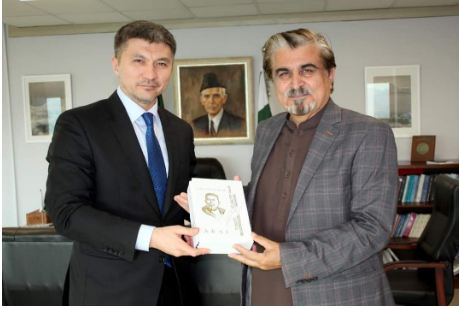
ISLAMABAD, Jan 16: Ambassador of Kazakhstan to Pakistan Yerzhan Kistafin had a meeting with Pakistan’s Federal Minister of National Heritage and Culture, Jamal Shah.

In the context of the tasks set by the President of Kazakhstan to develop “… constructive and good neighborly relations with the countries of South Asia,” the Ambassador emphasized the importance of fostering cultural collaboration particularly with Pakistan.

Ambassador Y.Kistafin also commended the recent success of the 12th Kazakh-Pakistani Intergovernmental Commission meeting on December 20-21, 2023, and congratulated Minister Shah on the signed Memorandum of Understanding in the cultural domain.

Minister Jamal Shah expressed a keen interest in fortifying cultural ties between Kazakhstan and Pakistan, spanning institutions like museums, libraries, theatres, and the film industry. During the negotiations, both sides agreed to jointly organize various events throughout the year.

Minister Shah invited Kazakh cultural figures and artists to participate in Pakistan’s cultural festivals in 2024.

Ambassador Y.Kistafin presented Minister Jamal Shah with poetry of Abai translated into Punjabi, Balochi, Sindi, and Pashto language. Additionally, he gifted the first Kazakh-English-Urdu phrasebook, underscoring plans for further cooperation in this linguistic domain. National Heritage and Culture Division, Pakistan.

Early detection can control ‘diabetic disease’

Early detection can control 'diabetic disease'

ISLAMABAD, JAN 16 (DNA) — Health expert Tuesday stressed public awareness for early detection and for adopting a healthy lifestyle to control Diabetic

as reduced physical inactivity, sitting jobs, poor sleep patterns and unhealthy food habits are mostly responsible for the increasing prevalence of disease among youngsters.

Talking to media channel, Diabetologist & specialist family physician Dr. Shehzad Tahir said that diabetes can be eliminated by simple lifestyle modifications, adding that early screening is very important in stopping the disease from progressing and with early detection we can easily beat diabetes.

He further said extreme temperatures can hurt both your body’s capacity to make and use insulin. As the temperature decreases, many diabetics’ blood sugar levels increase. Every diabetic patient requires a little bit of extra care and attention when the seasons change, he suggested.

“When the winter season arrives, people tend to skip their regular physical routines, such as yoga, exercise, and morning and evening walks, which correspond to increased blood sugar levels,” expert added. He further stressed that by adhering to standard care for high sugar levels, cholesterol and blood pressure, many complications could be reduced or completely avoided.

Replying a query, he described that improper diet, obesity, and poor lifestyle are the main causes of this disease, apart from this, if a person in the family is suffering from diabetes, such a person has a strong chance of suffering from other diseases.

He also said there was an urgent need to spread more awareness among healthcare professionals as well as common people so that diabetic foot ulcers and other complications of diabetes could be prevented in Pakistan. — DNA

Stay Connected

64FansLike
60FollowersFollow

Latest Reviews

Exchange Rates

USD - United States Dollar
EUR
1.17
GBP
1.35
AUD
0.67
CAD
0.72