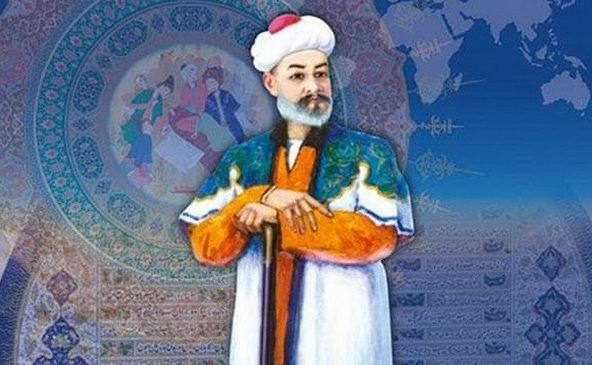
“…(Alisher’s) titles were written like this: “The guide, the highest point of honor and respect, the head of religion and statesmen, the strength of the leaders of the country and nation, the initiator of good deeds, the developer of charity institutions, the pillar of the kingdom, the ruler of kings Amir Alisher, the leader, the hope and trust of the sultan’s state, the sultan’s close friend, the law of truth and religion.”
From the work “Ravzat us-safo” by Khondamir
This year, on February 9, the 583rd anniversary of the birth of the great poet and thinker Alisher Navoi is widely celebrated. All the cultural and educational activities related to this blessed day will logically complement each other and will be of great importance in raising the spirituality of our country.
A new work on the life and work of Navoi
Alisher Navoi as an enlightened person was mentioned in historical sources both during his lifetime and in later periods, and was widely described and described in poetic works. For more than five centuries, many books have been written about the life path and creative activity of His Holiness Navoi.
The ideas of humanity and tolerance, goodness and justice are embodied in the life philosophy embedded in the core of Hazrat Navoi’s works. Our contemporaries, who are building a new Uzbekistan and rebuilding the foundation of the Third Renaissance, should have such good qualities. Why, the call of the President of Uzbekistan that “Spirituality should be ahead of other areas, become a new force, a new movement” requires exactly that.
Only in the 20th century, such outstanding scientists and writers as Izzat Sultan, Vahid Zohidov, Oybek, Aziz Qayumov, Hamid Sulaymanov, Natan Mallaev, Suyima G’anieva published their scientific, historical, literary and artistic works dedicated to various aspects of Alisher Navoi’s work. At the beginning of the new century – in New Uzbekistan, the consistent research of Navoi scientists and writers is rising to higher levels.
Rector of Tashkent State University of Uzbek Language and Literature named after Alisher Navoi, Academician Shuhrat Sirojiddinov is a dedicated researcher and one of the leading authors of this field. We share this opinion with the scientist’s book “Amir Alisher” published in 2023. The book “Life and activity” clearly confirms this.
In what respects does the new book differ from other works? As noted in the summary (resume) on the first page of this publication, the main distinguishing features are:
firstly, the first manuscript sources related to Alisher Navoi’s life and work were revised;
secondly, the degree of differentiation of information from early sources in the period before the 20th century was determined;
thirdly, some unknown aspects of the life of the great poet and statesman are clarified;
fourthly, by presenting a number of new information, it was possible to fully imagine the details of His Holiness Navoi’s life.
In this sense, the new book is a synthesis of the long-term research of the well-known naveistologist. This work is, so to speak, a weighty summary of in-depth scientific and creative research processes on a specific topic.
Alisher Navoi as a great figure of the Second Eastern Renaissance
In this book, as the author himself admits, “the biography of Alisher Navoi based on the information given in the oldest, first sources” is covered. This is very important from a scientific-historical point of view.
Because today’s reality related to New Uzbekistan puts on the agenda to promote Alisher Navoi’s great contribution to the development of our nation and world culture and science. In this case, it is necessary to study Navoi’s biobibliography in full and to create a true biography, to research the creativity and spiritual heritage of the nation with a deep understanding of its essence, and to use it consistently and efficiently.
Such new practical steps are necessary first of all for the rise of our spirituality and the restoration of our old history. At the same time, such a modern approach is to study the rich scientific-literary heritage of Alisher Navoi and dozens of other scholars, poets and thinkers who brought the culture of the peoples of the East closer with their life and work, by translating, publishing and popularizing the unique books and manuscripts left by them into different languages of the world. supporting related initiatives is extremely important in realizing the goals of making this universal material and spiritual heritage serve to strengthen the friendship of peoples.
Therefore, His Highness Navoi, the great Uzbek poet and thinker, famous state and public figure, patron of education and science, spirituality and culture, our native language and literature, is among the bright figures who had a strong and effective influence on the formation of the spiritual world of our people. Alisher Navoi occupies a special place in the history of world civilization as a major representative of the Second Eastern Renaissance.
The literary heritage of our great ancestor is huge and colorful, his poetic works alone contain more than 100 thousand lines. In the words of Academician Sh.Sirojiddinov, “It is no exaggeration to say that such a poet is few in world literature.”
The researches of our grandfather Navoi not only as a poet, but also as a literary critic were very important, and his effective work in this direction was of great importance in the development of Turkish and Persian literature. In the words of the author of the book we are interpreting, “He organized the aruz system in the work “Mezon ul-Avzan”, but he paid special attention to restoring the genres of Eastern poetry, such as problems and odes, which were almost forgotten by the 15th century.”
Another important aspect is that the sultan himself created great conditions and facilities for the development of the literary environment of Herat led by Navoi. In this way, the name of Alisher Navoi became famous as the patron of the virtues of the seven climates and artists.
Many tazkiranavis, historians, poets, scientists have testified about Navoi’s benevolent virtues in their works. The proof of this can be found in the works of our great ancestor’s contemporaries, even in various hymns written in honor of Navoi by many calligraphers and scribes.
Alisher Navoi is the founder of Turkish literary language
The President of Uzbekistan has been paying attention to solving a number of urgent issues in the field of spirituality and enlightenment based on the tasks that today’s complex and dangerous life puts before us. One of these priority tasks is to actually strengthen the status of the Uzbek language as a state language.
At the extended meeting of the Republican Council of Spirituality and Enlightenment held on December 22, 2023 under the chairmanship of President Shavkat Mirziyoyev, special attention was paid to the issue of increasing the effectiveness of teaching the Uzbek language. It was noted that the teachers of the subject “Uzbek language and literature” who have a national certificate will be paid a 50 percent bonus starting from the new academic year.
The head of our state also noted that measures will be taken to encourage our compatriots who have received education in other languages to learn the state language. It was noted that the hours of teaching the state language in schools specializing in other languages will be increased, and an international science Olympiad on the Uzbek language will be organized.
In this sense, “Amir Alisher. It is worth noting that the book “Life and activity” presents interesting information about the fact that Alisher Navoi is the founder of the Turkish literary language. On the one hand, this shows how relevant this work is, and on the other hand, the scientific information related to the formation and development of our native language, especially the complex and extremely important efforts to bring it to the status of a state language in distant history, will serve to fundamentally increase the knowledge of our contemporaries, especially our youth. .
For example, when thinking about Alisher Navoi’s struggle to raise the status of the Turkish language, it is appropriate to first of all dwell on the work “Muhokamat ul-lughatayn”. After all, in the form of this work, its author showed himself as a great linguist who showed the rich possibilities of our language and proved that it is a beautiful and powerful language in no way inferior to Arabic and Persian languages.
As noted by Academician Sh.Sirojiddinov, during Navoi’s lifetime, Persian was considered the language of poetry, Arabic was considered a scientific language, and Turkish was regarded as the language of the common people. This, of course, is the result of problems related to the many thousand years of experience of statehood and the rich spiritual and literary heritage, glorious history and humanitarian values of the Turkic peoples, which were destroyed by the Mongol invasion, and the fact that it was difficult to restore the fascinating language.
Therefore, as the author of the book points out, “Even in Temur’s palace, the work of bringing the Turkish language to the level of the state language has not been completed. In such a situation, Alisher Navoi set himself the goal of restoring the status of the Turkish-Uzbek language.
In this sense, today, in the development of modern technologies for learning the Uzbek language abroad and in our country, it is extremely helpful that the love for the mother tongue, the feeling of honoring it, realizing its incomparable wealth and greatness entered our thoughts and hearts first of all with the works of Navoi. Already, our great ancestor achieved his noble goal of restoring the status of the Uzbek language – he made the whole country yakkalam, i.e. monolingual.
As recognized in the famous ode “Uzbekistan” by our beloved poet Abdulla Oripov: “The place where Temur’s blade did not touch Alisher took it with a pen”.
Thus, in the words of the President of the Nation, “The great poet, in his poetic and prose works, showed high universal ideas, the incomparable vocabulary and limitless possibilities of expression of our mother tongue with all its charm and grace, and won a worthy and solid place in the hearts of millions of readers on earth.”
Studying Navoi’s heritage:
unexplored or controversial topics interpretation
In the years of independence, narratology also made remarkable progress. A number of researches were created on topics forbidden during the Mustabid regime, including the Qur’anic foundations of the work of the great poet, and Sufi worldview.
At the same time, one cannot turn a blind eye to the fact that there are still some problems that have not yet been thoroughly examined, certain topics that are fragile and “delicate”. Academician Sh.Sirojiddinov deeply analyzed some of these topics from a scientific and historical point of view.
The author of the book took into account that in the course of this complex research, the honor and love, value and value, reputation and attention of our grandfather Navoi would not be harmed. At the same time, we believe that it is noteworthy that any controversial issues are covered on the basis of various primary sources, in which the principles of historical truth and scientific objectivity are consistently observed.
It should also be said that in the previously published researches of the Navoi scholar, in particular, in the work entitled “Alisher Navoi: comparative-typological, textological analysis of sources” published in 2011, the original state of the information known to Navoi studies was studied. It is worth noting that by conducting a comparative typological-textological analysis of these data, the degree of difference of the data from the sources created in the period before the 20th century was determined.
For example, academician Sh.Sirojiddinov, during a detailed study of historical sources, comes to the conclusion that Abu Sa’id Bek, the grandfather of His Holiness Navoi, was a very close person to Husayn Boygaro in the Timurid period. In this place, “We even assume that Abu Sa’id Boykara may have been a close friend of Mirza, and in this sense Boykara was with him wherever he lived,” writes the author of the book.
On this basis, the navoi scholar comes to such a conclusion, which is unexpected, but has a certain historical and scientific-theoretical basis. That is, Mir Alisher, one of the four sons of Amir Temur – Husein Boygaro, who was severely punished for his rebellion during the reign of Shahrukh Mirza and was accused of poverty, deeply realized that it was impossible to justify in historical works and at the same time be proud of his grandfather, who was his close comrade.
As Academician Sh.Sirojiddinov rightly assessed, our grandfather Navoi was a supporter of not overshadowing the history of the Timurids. Therefore, it is logical that it is written in the book: “The reason why Mir Alisher does not mention the names of the Boykara family and his ancestors can be explained by this.”
Another confusing topic that has been unclear in Navoi studies: Was Alisher Navoi exiled to Samarkand? Our attention was drawn to the fact that in the book, by studying a number of sources related to the issues surrounding this question and analyzing them on a new basis, they tried to put forward the most appropriate answer.
In particular, based on the words of V. Bartold Babur, he approved the idea that Alisher Navoi was exiled to Samarkand by Abu Sa’id. Although Mir Alisher himself said that he went to study, he denied this evidence with the comment that “They did not go from Herat to Samarkand to study at that time.” As a result, most Navoi scholars relied on V. Bartold’s argument that “Navoi’s departure from Herat to Samarkand should be considered as an exile” and went on to develop it.
On the other hand, E. Bertels in his monograph “Navoiy” considered Navoi’s visit to Samarkand as an exile. He explained his conclusion with the opinion that “at that time, Samrqand was not a center of science”.
Academician Sh.Sirojiddinov, while critically analyzing various approaches in this regard, first of all, it is significant that he drew attention to the misinterpretation of Babur’s opinion. In particular, Zahiriddin Muhammad Babur actually asked, “Why did Abu Sa’id exile Nawai to Samarkand?” not that, but “I don’t know, for what sin was he expelled from Herat?” the scientist said.
In the book, the Uzbek scientist’s assessment of the same issue is also presented. That is, as Academician Sh.Sirojiddinov noted, “As Navoi himself admitted, “helplessness, disaster, fate and sadness” caused him to leave Herat, but it happened for reasons known only to him. Navoi was a poet who was not involved in politics during the time of Abu Sa’id Mirza.
In addition, it is openly recognized that there are different views in Navoi studies about the reasons for sending Alisher Navoi as governor to Astrobod. Because it is not a secret to anyone that our modern Neviology views the sending of our great ancestor to Astrobod as an exile.
The author of the book put forward ideas as close to the truth as possible to this problem. In particular, based on the conclusions of a number of Navoi scholars like A. Semyonov, he said that “Astrobad was the richest and most important province of Sultan Husayn, in which mainly princes or highly trusted people of the sultan were governors, and the appointment of Alisher as the governor of Astrobad was a “distant province” It cannot be understood as “honorary exile”, he believes.
Alisher Navoi is a fair statesman
Interest in the life and work of Alisher Navoi has not faded from his time to the present day, especially in recent years, it has been growing. Naturally, as socio-historical development progresses, human thinking shows different views on certain events.
If we assume that such views are born on the basis of ideological-aesthetic directions that appeared in each period, the activity of historical figures is the fruit of complex thinking of this ideological-artistic phenomenon. The second part of the new book “Amir Alisher and the palace” written by Academician Sh.Sirojiddinov is fully devoted to the details of the time of our grandfather Navoi’s 35 years in the service of the palace.
When talking about the history of the Timurid state, we proudly acknowledge that the name of Alisher Navoi is mentioned as a famous statesman. This recognition is fully confirmed by the description of Sultan Husayn Boykara ul Zat as “the pillar of the country, the support of the state”.
In this sense, in the opinion of the Uzbek scientist, the reasons why the name of Alisher Navoi will be engraved forever in history are due to the following three reasons:
the first basis is that he wrote works that show his unparalleled talent;
the second reason is that he was a famous statesman;
the third reason is that he has reached the level of the possessor of worthy behavior, which elevated him to the status of a great man.
In fact, Navoi always acted in accordance with Sharia laws and the Sunnah of our Prophet (pbuh) in the interests of the state and the people. In each case, he solved the problems of the oppressed from the point of view of justice.
Alisher Navoi Amiri Kabir – As the Prime Minister, he always combined the interests of the state and the people in the most important and sensitive parts of the state administration, such as the judiciary, internal affairs, tax system, foreign diplomatic relations, internal conflicts, border problems, public gatherings and events. protected. On the other hand, as the author of the book wrote, “Navoi’s qualities of tolerance, justice, wisdom, politicking and caring for the citizens helped the Sultan to manage the state fairly.”
It is very important that Academician Sh.Sirojiddinov put forward completely new, as the saying goes, “untouched” thoughts on these issues. He confidently stated, “The reason why our scientists deviated far from historical reality was that they relied on each other rather than expressing their opinions. Based on the ideology of the Soviet regime, the interpretations of the first Navoi scholars that Sultan “exiled him to get rid of his poisonous words” because Navoi was “a poet who was not afraid to tell the truth” are not true.
According to the work “Makorim ul-Akhlaq” (“Good manners”), Navoi had the right to appeal to the king up to nine times in order to defend his opinion on a decision or issue. However, as a contemporary Navoi scholar rightly noted, “As a subordinate of Alisher Navoi Sultan, he was never able to tell the truth clearly, but tried to explain it with mawridi.”
Academician Sh.Sirojiddinov rightly stated, “Two important sources written specifically about Alisher Navoi’s life and work have reached us. This is a collection of memories written by Ghiyaziddin Khondamir and Zayniddin Vasifi.”
In particular, Khondamir was able to fully reflect the spiritual image of Navoi in his work “Makorim ul-akhlaq”. When talking about the admirable qualities of Alisher Navoi, the famous historian described Amir Alisher as “a person whom God looked upon from childhood”, and on another page he paid special attention to showing the character of Navoi, which proves the truth of the same opinion.
At the same time, the well-known Navoi scholar was able to find the fault of the author of the work “Makorim ul-Akhlaq”. The fact is that “the author had the opportunity to provide accurate information, firstly, in many cases, he did not mention the dates of the events, and secondly, he did not reveal Navoi’s life in chronological order”, writes academician Sh.Sirojiddinov.
From this point of view, the scientist’s “Amir Alisher. In the book “Life and Activities” it is commendable that Amir Nizamiddin Alisher’s personality and activities as a statesman are covered based on a clear chronology.
This book is a continuation of the author’s monograph “Alisher Navoi: comparative-typological, textological analysis of sources” published in 2011. Because in the new work dedicated to His Holiness Navoi, the rare historical works and information from tazkiras, which were not analyzed in the previous book, are thoroughly analyzed and deserve attention and recognition.
Akmal Saidov,
academician, doctor of legal sciences,
Member of the Union of Writers of Uzbekistan