Home Blog Page 750

PTI seeks thorough probe into Bahawalnagar condemnable incident to identify culprits

PTI

DNA

ISLAMABAD: Pakistan Tehreek-e-Insaf (PTI) demanded a transparent and comprehensive enquiry into the unfortunate bloody clash between two institutions at Bahawalnagar forthwith to identify the culprits instead of providing cover to the perpetrators of this reprehensible incident with its report to be made public without editing.

PTI Spokesperson, in a strongly-worded reaction to the condemnable and brazen Bahawalnagar incident, said that the tragic incident clearly reflected a malady penetrated deep into societal fabric that was gravely impacting the functioning of the state.

He said that deprived of the constitution and rule of law, the state was rapidly sinking into widespread anarchy.

“Polarisation of the society among the ‘protected’ and ‘targeted’ factions, with patronage lavished upon the former, has driven a poisonous wedge with ominous consequences,” he added.

PTI Spokesperson lamented that the Bahawalnagar incident was the worst manifestation of the prevailing established lawlessness in the country and the deep-rooted acrimony and bitterness between the government and state ranks.

He noted that during the last 2 years, lawlessness and anarchy had been ruled the roost, as the constitution and law were buried at the state level and a certain group enjoyed a status above the law.

PTI Spokesperson pointed out that all the components and institutions of the state were facing the hooliganism, which had been fashioned to oust PTI from politics.

“We, at PTI, have been the victim of the worst state oppression and are fully aware of the effect it causes and pain it leaves behind. The process of healing the nation must commence in earnest with equal and equitable provision of justice to all being its first step,” he added.

He lamented that the self-centered touts sitting as heads of government departments and institutions were destroying the reputation, legal and constitutional role as well as utility of the institutions for their vested interests.

PTI Spokesperson said that earlier, six respected judges of Islamabad High Court openly mentioned the disease and challenge currently facing the entire system in their startling letter.

“Accentuation of this sinister malady will leave the state dangling in bits and pieces and those who expect to benefit from this divide may end up as the worst affected. Most importantly, it is the state that will be shorn of its legitimacy and rationale for survival” PTI spokesperson maintained.

He made it clear that the country could not make an inch of progress without establishing role of law and true justice system in the country.

PTI Spokesman asserted that time was ripe to make law supreme and all decisions be made on merit instead of further dividing the state into the ruler and those who were ruled or a class of subjected to law and above the law.

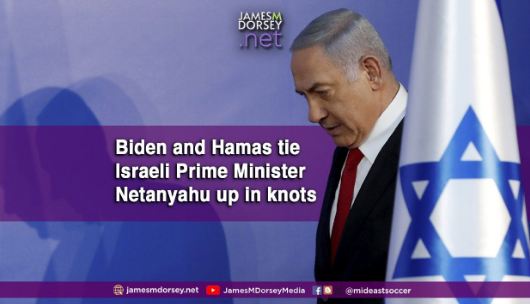
Biden and Hamas tie Israeli Prime Minister Netanyahu up in knots

Biden and Hamas tie Israeli Prime Minister Netanyahu up in knots

JAMES M. DORSEY

Israeli Prime Minister Binyamin Netanyahu is tying himself up in knots as he grudgingly, and only to a limited degree, bows to US President Joe Biden’s demands.

In doing so, Mr. Netanyahu is puncturing Swiss-cheese size holes into Israel’s Gaza narrative, making it easier for Mr. Biden to take him publicly to task.

Mr. Biden has demanded that Israel allow the unfettered flow of desperately needed humanitarian aid into Gaza, an immediate ceasefire linked to an exchange of Hamas-held hostages for Palestinians incarcerated in Israel, and the dropping of Israeli plans for a ground offensive in the southern Gazan city of Rafah, home to more than a million Palestinians displaced by the six-month-long war.

Israel allows aid trucks to enter Gaza. Credit: AP
In recent days, Mr. Netanyahu has granted entry into Gaza to more than 1,200 aid trucks, significantly reduced Israel’s on-the-ground military presence in the Strip, and raised to 150,000 the number of displaced Palestinians that would be allowed to return without Israeli security checks to their often destroyed homes in the north of the territory.

In addition, Mr. Netanyahu has played games with Rafah by claiming that he has set an undisclosed date for a ground offensive, even though Israeli officials are still discussing his plans with their US counterparts, and his defence minister, Yoav Gallant, insists that there is no date for the operation.

Even so, Mr. Gallant said the withdrawal of Israeli forces was to prepare for an offensive in Rafah. Israel asserts that Hamas’ remaining four armed brigades are in Rafah. It also suspects that Hamas’ top leadership, including Yahya Sinwar, Israel’s most wanted man, is hiding in tunnels under Rafah, shielded by many of the Hamas-held hostages still alive.

The contradictions in Israeli statements on Rafah reflect the knots tying up Mr. Netanyahu and the holes punctured by Israel in the prime minister and the government’s narrative.

Displaced Palestinian children at a refugee camp in Rafah. Credit: Saleh Salem/Reuters
By asserting that he set a date, Mr. Netanyahu hopes to pacify his ultra-nationalist coalition partners who threaten to topple the government if the prime minister fails to launch an offensive.

At the same time, Mr. Netanyahu is attempting to engineer a situation in which he can blame Mr. Biden if he decides not to commence ground operations in Gaza and/or for Israel’s overall failure to achieve its war objectives, including the destruction of Hamas and ensuring that the Strip no longer will be a launching pad for Palestinian resistance.

Many suspect Mr. Netanyahu of wanting to continue the war to extend his fragile political life. He is likely betting that his far-right partners may not make good on their threat, given opinion polls that suggest a new election would not return them or the prime minister to office.

The far-right may not be the only threat to the longevity of Mr. Netanyahu’s government.

Depending on how Mr. Biden and Hamas play their cards in ceasefire and prisoner exchange negotiations, Mr. Netanyahu could see a split in his war cabinet from which the far-right is excluded.

A tough-talking politician and retired general, Mr. Gallant suggested that Israel could be flexible in the negotiations.

“We have the absolute commitment to bringing our hostages home, and the operational circumstances created by the IDF’s constant pressure on Hamas and our position of power achieved in battle allow us flexibility, freedom of movement, and the ability to make difficult decisions,” Mr. Gallant said, referring to the Israel Defense Forces by their acronym.

“There will be difficult decisions, and we are prepared to pay a price to release the hostages,” Mr. Gallant added.

Israeli officials said neither Mr. Netanyahu nor Mr. Gallant had advance knowledge of this week’s killing of three sons and four grandchildren of Ismail Haniyeh, the head of Hamas’ political bureau and a ceasefire negotiator.

CIA Director Bill Burns (left) meets Egyptian President Abdel Fattah al-Sisi on 7 April 2024 during Gaza ceasefire talks. Credit: The Arab Republic of Egypt Presidency
The attack came as Mr. Biden called on Hamas to accept a ceasefire proposal put forward by CIA Director Bill Burns. Hamas says it is studying the proposal even though Israel’s response fails to address its demands.

Essentially, Mr. Burns’ proposal is a revival of a suggestion first crafted in January by US and Egyptian intelligence chiefs and Qatar’s Prime Minister in consultation with the head of Israel’s Mossad foreign intelligence service. The proposal called for a three-stage 90-day ceasefire, a phased prisoner exchange, and permanent ceasefire talks in the second stage.

The Burns proposal envisions the exchange of 40 Hamas-held civilian captives abducted during its October 7 attack on Israel for 900 Palestinians in Israeli prison. Hamas has committed itself to the release of the initial batch but has left open whether the 40 would include bodies of captives killed in the fighting.

The Hamas position has raised doubts whether the group still holds 40 live civilians. Many of the estimated 130 Hamas captives are Israeli military personnel who Hamas says it will only free as part of a permanent ceasefire deal. Of the 130, at least 40 have died in captivity.

Hamas abducted 250 people in October, more than 100 of which were swapped in November for 240 Palestinians incarcerated in Israel.

Under the new US proposal, Hamas would have to compromise on the number and identity of the prisoners they want released, while Israel would have to make concessions on the return of displaced Palestinian civilians to northern Gaza.

The CIA director’s proposal goes some way to meet Hamas’ demands for a permanent ceasefire, a complete Israeli troop withdrawal, the unfettered flow of aid into Gaza, and the return of displaced Palestinians to their homes in the north.

Mr. Netanyahu and Israel’s problem is that appearing to comply with Mr. Biden’s demands, including facilitating a ceasefire agreement, is self-incriminating.

A renewed prisoner exchange amounts to an admission that six months of military action has failed to free the hostages and, in effect, hands Hamas a victory.

For Mr. Netanyahu, that is a double-edged sword. While a prisoner exchange would take some of the stings out of growing domestic public demands that he prioritise the release of hostages, it would likely encourage mass demonstrations demanding the prime minister’s resignation.

Displaced Palestinians wait for food at Al-Shaboura camp, in Rafah. Credit: World Health Organisation
Moreover, the entry into Gaza this week of more than 1,200 aid trucks in three days is evidence that Israeli restrictions constitute the main obstacle and cause of the humanitarian food and medical crisis rather than international organisations’ lack of capacity, a breakdown of law and order in Gaza, or allegations that Hamas hijacks aid convoys, even if all of that plays a role.

Moreover, while Israel’s failed attempt to incite a popular revolt against Hamas by depriving Gazans of the basics of life is the main reason for the crisis threatening the lives of innocent Palestinians, it is not the only culprit.

Hamas, like Israel and the West Bank-based Palestine Authority (PA), Hamas’ archrival, sees aid distribution as a battleground that will shape the contours of the post-war administration of the Strip.

Palestine Red Crescent Society distributes aid central Gaza. Credit: Palestine Red Crescent Society.
While humanitarian organisations will not surrender control of distribution, Hamas believes it should play a role in securing the movement of aid trucks in Gaza and maintaining a semblance of law and order.

Hamas believes Israel is attempting to circumvent the group by approaching Gazan clan leaders and businessmen who have no ties to the Islamists as well as, albeit reluctantly, senior Palestine Authority intelligence officials to assist in securing and distributing aid.

Recently, Hamas detained six Authority representatives, two of whom were reportedly killed when Hamas fighters opened fire.

The officials were escorting aid convoys organised by the Authority in cooperation with the Egyptian Red Cresent that Hamas sought to prevent from traveling in the Strip. Hamas charged the officials were undercover security operatives seeking to sow chaos and division in Gaza.

“Two interesting conclusions emerge from this affair: Hamas will use all means available to thwart alternatives to its civil control of the Strip, and the Palestinian Authority is trying to stir the pot behind the scenes, even at the cost of Hamas harming the (Authority’s) own people,” said Israeli journalist Amos Harel.

Gaza devastation. Credit: AP
Mr. Netanyahu and Israel are also tying themselves up in knots when one compares the wanton death and destruction in Gaza that Israel claims was unavoidable in its effort to take out Hamas with the precision of targetted Israeli strikes against Iranian and Palestinian officials in residential neighborhoods in Lebanon and Syria.

Praising “the remarkable precision of Israeli attacks on Iranians and (Lebanese) Hezbollah operatives in Syria.” Middle East scholar Andrew J. Tabler calculated that Israel launched 50 air strikes on targets in Syria in the last six months, killing 50 Iranian Revolutionary Guards, Hezbollah, and Hamas operatives, and 75 Syrians.

It is unclear how many innocent civilians were among the Syrian casualties, but even if all were civilians, that would be a kill ratio of 1.5 Syrians for every operative targeted by Israel.

Israel attacks Iranian consulate in Damascus. Credit: AP/ Omar Sanadiki
Earlier this month, Israel launched a precise strike against a building in Damascus’ upscale Mezzeh neighbourhood, believed to house the Iranian consulate. The strike killed seven Iranian Revolutionary Guards and Palestinian Islamic Jihad operatives, including Brigadier General Mohammad Reza Zahedi and another senior Iranian commander.

The New York Times suggested that the operatives were part of a network smuggling arms into the West Bank. Shin Bet, Israel’s domestic intelligence service, said days before the attack that it had discovered an arms cache smuggled into the West Bank.

An Israeli drone strike the Beirut suburb of Dahiyeh kills Hamas official Saleh al-Arouri. Credit: Mohamed Azakir/Reuters
Israel was equally precise in its killing in January in a residential Beirut neighborhood of senior Hamas official Saleh al-Arouri. All seven people killed by a drone targeting their third-floor office in what appeared to be a four-story building were Hamas operatives.

In Gaza, assuming that 13,000 Palestinian fighters, the number of fighters Israel says it has killed, are included in the Gaza health ministry death count of more than 33,000, the kill ratio would be 1.5 too.

However, the casualty ratio is far higher if one takes into account the more than 70,000 wounded and maimed Palestinians, which, according to Israel’s estimate, would include less than 17,000 fighters based on its estimate that Hamas had 30,000 fighters under arms at the outset of the Gaza war.

Those casualty figures are stark even if one allows for urban fighting and the added complication of Hamas’ underground tunnel system.

The contrast has much to do with geopolitical and military restraints Israel accepts in Beirut and Damascus in terms of ensuring that conflicts do not spin out of control and an Israeli military culture in which the number of people killed in Gaza becomes a goal in and of itself rather than a last resort in the conquest of territory or self-defence.

“The rules that I know are that if one of your enemies has his hands up, you don’t shoot at him, only in a life-threatening situation. So, our interest was all along the fighting in Gaza…that if terrorists surrender, we shot them?… When we talk about ‘eliminating’ and ‘killing,’ those are the people of Messianic Judaism and the Jewish superiority; they want a territory clean of Arabs,” said former defense minister and chief of staff Moshe Ya’alon, a leader of the protests demanding Mr. Netanyahu’s resignation.

Dr. James M. Dorsey is an Adjunct Senior Fellow at Nanyang Technological University’s S. Rajaratnam School of International Studies, and the author of the syndicated column and podcast, The Turbulent World with James M. Dorsey.


US’s China Containment Policy: Marshal plan reimposed…

Qamar Bashir

By: Qamar Bashir

While it comes to China US rivalry, two opposite themes emerge. China says that this world is big enough for all of us to share its bounties and immense resources without undercutting each other. While the US leadership says that it may be true, the US will determine the rules of sharing, distribution and use of world resources, and anyone found deviating from this path will be punished. Resultantly, the US and its junior partner Europe and countries of Asia Pacific and Indo Pacific regions are following multifaceted policies to push back China.

At the forefront of these policies is the de-risking strategy aimed at reducing excessive reliance on China, particularly in supply chains and markets. This involves diversifying supply chains by sourcing from multiple countries, localizing or reshoring manufacturing operations to reduce dependency on Chinese factories, developing alternative markets, investing in technology and innovation to reduce reliance on Chinese technology, and fostering collaboration and partnerships with other countries or industry players.

On the military front, the US is bullying its partners and allies in the Asia Pacific and Indo pacific region to push back against Beijing by forging bilateral and multilateral initiatives and partnerships reflecting the United States’ efforts to address challenges posed by China’s assertiveness as part of US policy to encircle China in the Asia Pacific region and beyond as an overarching China containment policy.

In addition to the existing groups like QUAD and AUSKUS, USA has developed a new alliance with Japan and the Philippines in an attempt to isolate China from its immediate neighbors. The trilateral summit being held in Washington in the second week of April, 2024 has announced joint maritime patrols with the Philippines in the South China Sea, where sovereignty is disputed, and to restructure the US military command in Japan — the biggest upgrade to defense cooperation since the 1960s — to make them more responsive against threats from China.

Quadrilateral Security Dialogue(QUAD) which assumed belligerent posture against China in 2016 was formed by the US with Japan, Australia and India focused on maritime security, infrastructure development, supply chain resilience and to share concerns over China’s increasing assertiveness and influence in the Indo-Pacific region driven by the need to counterbalance China’s rise.

Formed in 2021, AUKUS is the second most important alliance of the US with Australia and the United Kingdom aimed to deepen trilateral cooperation on defense and security, with a focus on enhancing Australia’s maritime capabilities, including acquiring nuclear-powered submarines. Currently AUKUS is being expanded by offering membership to Japan. Geopolitically, AUKUS signifies a strategic move to counterbalance China’s influence in the face of evolving security challenges in the region. This forum aimed at empowering Australia to manufacture nuclear submarines which will be deployed in the strait that separates China and Taiwan specifically aimed to deter any Chinese move against Taiwan.

The next important alliance is “Five Eyes’ ‘ which boasts the membership of the United States, Canada, United Kingdom, Australia, New Zealand aimed at intelligence-sharing and cooperation on border security issues, including countering cyber threats and foreign interference. In October last year the Five Eyes countries’ intelligence chiefs came together to accuse China of intellectual property theft and using artificial intelligence for hacking and spying against the nations.

In addition, the US has forged many bilateral alliances which include U.S.-Japan. Under this alliance, the US is planning to help Japan create a new Japanese Self Defense Forces (SDF) by March 2025, overseeing all of the country’s military operations. The US will match Japan’s upgrade with an upgrade of US operational command” to lay the groundwork for a future unified Japanese-US command mainly to push back China.

Like Japan, the U.S has also forged Strategic Partnership with India aimed to deepen defense and security cooperation, promote economic ties, and address regional and global challenges, including those related to China.

During her visit to China (4-8 April, 2024) , the U.S. The Treasury Secretary made some interesting demands. Instead of improving US industrial efficiency and productivity, She asked China to slow down its industrial growth to match the sluggish growth of USA industries. Interestingly, her demands of ensuring balanced economic growth did not make any economic or financial sense. The balance of growth according to the US meant a reduction in production capacity for electric vehicles (EVs), lithium batteries, solar panels and other clean energy technology that threaten competing firms in the U.S. and other countries, and stop flooding US markets with exports that make it difficult for American and other firms to compete.

She also warned China to stop providing military aid or civilian technology which can have dual purposes. The threats hurled by Yellen were in line with President Biden’s earlier warnings to China to stop providing help in rebuilding Russia’s military industry and Blinken’s belligerent posture when he warned in Europe last week that China was providing aid to Russia on a “worrying scale,” including products such as rocket propellant.

Recently, the US started using credit rating agencies such as Fitch and Moody’s to discredit China’s credit ratings to negative citing risks to public finances. The ratings based upon self-serving data were rebutted by China arguing that there was no change in financial and economic outlook of China compared to last year, therefore reducing credit ratings had no justification whatsoever.

This multifaceted encircling of China is meant to suffocate China militarily by building aggressive alliances in Asia Pacific and Indo Pacific region, using existing agreements to empower US to intervene against military threats especially in South China Sea, Strait of Taiwan, Asia Pacific and Indo pacific region. On foreign policy front, the USA wants to control China’s bilateral relations with other countries of the world, especially with those countries which do not enjoy friendly disposition with the USA. While on the economic front it wants to control China’s industrial strategy by forcing it to reduce the speed of industrial growth to match the sluggish US industrial production. On the financial front it is using sovereign credit rating agencies to discredit China’s Financial outlook.

These confrontations are akin to the Cold War era involving intense geopolitical competition between major powers for influence and dominance in strategic regions, and like the cold war era US is building and strengthening alliances and partnerships with like-minded countries to counterbalance the influence and actions of China.

But this time around, the US is not confronted with Ideological warfare, less territorial but more of industrial warfare, knowing very well that unlike the USSR, it’s fighting a war which it is losing very fast. Soon the US will realize the best option for the US in not to impose tariffs on Chinese products, but to improve the efficiency and productivity of its sluggish industrial sectors, otherwise, it will lose its innovative and creative edge on the world market paving the way for Chinese dominance in these fields which were earlier only US specific.

By: Qamar Bashir
Press Secretary to the President (Rtd)
Former Press Minister at Embassy of Pakistan to France
Former MD, SRBC

Experts laud China’s role in advancing Hybrid Rice cultivation in Pakistan

Experts laud China's role in advancing Hybrid Rice cultivation in Pakistan

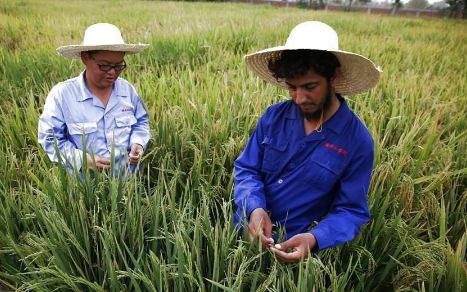
Islamabad, Apr 12 (DNA): Experts lauded China’s role in advancing Hybrid Rice cultivation in Pakistan, according to a report published by Gwadar Pro.

The Chairman of the Pakistan Hitech Hybrid Seed Association (PHHSA), Shahzad Ali Malik, in a press briefing, highlighted the pivotal role of Chinese expertise in revolutionizing Pakistan’s agriculture through hybrid seed technology.

This collaboration marks a significant stride towards self-sufficiency and the bolstering of Pakistan’s export potential in key crops including cotton, wheat, edible oils, and pulses.

Malik pointed out that the adoption of hybrid rice technology from China has already showcased remarkable yield improvements, setting a precedent for its application across other agricultural sectors.

The initiative aims at reducing Pakistan’s heavy reliance on imports by enhancing local production capabilities.

For cotton, a critical export commodity, hybrid technology promises higher yields and quality, positioning Pakistan to reduce imports and explore export opportunities.

Similarly, the introduction of hybrid wheat and oilseed varieties like soybean and sunflower is expected to boost productivity, quality, and domestic availability, potentially transforming Pakistan into a net exporter of these commodities.

Malik also touched upon the issue of pulse shortages, emphasizing that hybrid varieties could significantly enhance local production, thereby decreasing the need for imports and enabling Pakistan to meet its domestic demand more effectively.

This strategic move towards hybrid varieties, in collaboration with China, aims to ensure food security, achieve economic stability, and foster export growth, underlining the crucial role of advanced agricultural technologies in Pakistan’s development, he maintained.

President Zardari assures Iranian counterpart of boosting bilateral cooperation

President Zardari assures Iranian counterpart of boosting bilateral cooperation

ISLAMABAD: President Asif Ali Zardari spoke with his Iranian counterpart Seyyed Ebrahim Raisi and assured that Islamabad would continue to work with Tehran in all areas of mutual interest to further boost bilateral cooperation.

In a statement issued by the President’s House on Thursday, the two leaders held a telephonic conversation and exchanged greetings on the occasion of Eid-ul-Fitr.

The president also stressed on the need to enhance the exchange of information to overcome the security challenges being faced by the two countries.

“During the conversation, President Asif Ali Zardari offered his heartfelt condolences and sympathies with the Iranian leadership and the bereaved families who lost their dear ones in the Israeli attack on the Iranian embassy in Damascus,” said the statement. 

Recently, Israel attacked the Iranian embassy in the Syrian capital Damascus, killing 13 people. Those killed in the strike included a senior commander of Iran’s elite Quds Force and other military figures. 

The attack came amid Israel’s ongoing aggression in Gaza which has killed more than 34,000 people. 

President Zardari also expressed his concern over the humanitarian crisis and the genocide being committed by the Israeli forces, calling for an immediate ceasefire in Gaza.

“The president also wished the Iranian President and his family continued well-being, health and happiness,” said the statement, adding that he also extended an invitation to the Iranian president to visit Pakistan.

Eid Al-Fitr celebrated, Hundreds of Indonesian nationals gathered at the embassy’s compound

Eid Al-Fitr celebrated, Hundreds of Indonesian nationals gathered at the embassy's compound

Indonesian Embassy in Islamabad celebrates Eid Al Fitr, emphasizes unity and diversity

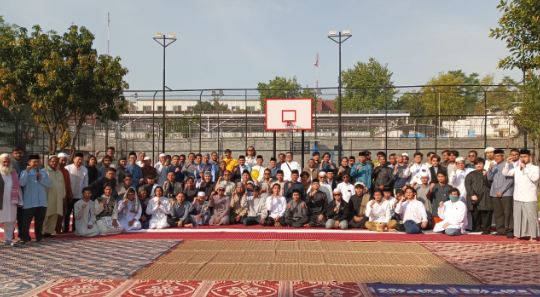
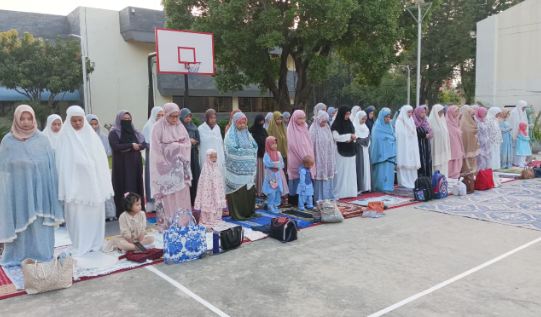
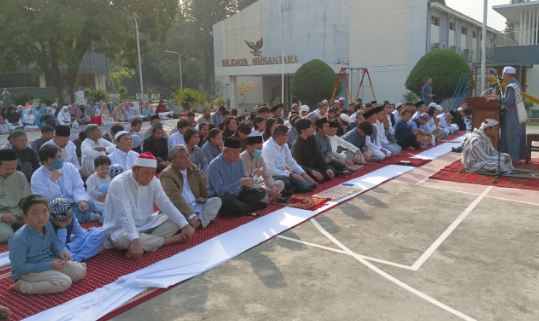
ISLAMABAD, APR 12 /DNA/ – Hundreds of Indonesian nationals attended the Eid Al-Fitr celebration at the Indonesian Embassy’s compound in the first day of Eid on 10 April.

The celebration was started by Eid prayer followed by Eid gathering which has been commonly known in Indonesia as “Halal Bihalal” as a term of forgiveness spirit during Eid. Takbir, tahlil, and tahmid continuously reverberated prior to the Eid prayer, while  Islamic nasheed was showcased during the gathering.

The Eid prayer was held on the open space of the Embassy amid moderate weather during Spring time. The congregation solemnly performed the Eid prayer led by Br. Muhsin Al Fatih Nasir as an Imam and continued to listen to Eid sermon addressed by Br. Farhan Aflah Abdillah as a Khatib. Both of them were students of Islamic Studies at the International Islamic University Islamabad (IIUI).

In his sermon, Khatib underlined the importance of Ramadhan spirits to be consistently kept in everyone’s heart and mind. “With such spirits, all Muslims are expected to be much better in their life, study, works, and caring to others,” he explained.

Comments and expectations came from the Indonesian community participated the event. “I come from Peshawar. I desperately miss Eid celebration along with the Indonesian community while enjoying the authentic Indonesian Eid food such as chicken opor, lontong (compressed rice cake.red), and rendang beef, ,” said Aditya, an Indonesian citizen who currently works in UNHCR Peshawar in a no-family assignment basis.

Not only from Peshawar, many Indonesians also came from other areas in Pakistan, such as Lahore, Gujrat, Faisalabad and Rawalpindi. “I arrived at the Embassy on 6 am. Departure time from Faisalabad was at midnight. I insisted to go early since I was worried of late,” said an Indonesian female who was familiarly called Nisa.

Indeed, the Indonesian Embassy’s compound has been a favorite venue for various Indonesian community gatherings within Ramadhan 1445 H. During Ramadhan this year, the Embassy hosted weekly iftar gathering for the Indonesian community and multiple community events. The Embassy always opens its compound for any Indonesian community events for free of charge. In Islamabad, the Indonesian community comes from representatives of Islamic organizations of Nahdlatul Ulama and Muhammadiyah, Indonesian student association, Indonesian madrassa association of Gontor, and many more.

In his Eid message, the Indonesian Embassy’s Charge d’Affaires Mr. Rahmat Hindiarta highlighted that the Indonesian community was a valuable asset of Indonesian public diplomacy in Pakistan. “All Indonesian people have to be proud of Pancasila (state five principles) as a reference for managing cultural and religious diversity in Indonesia. Therefore, you must be more confident in representing Indonesia as a democratic, moderate, and great nation to the world,” he concluded his remarks.

“Ramadan was Forgiving, but Eid May Not?”

Qamar Bashir

By: Qamar Bashir

Typically, Eid is anticipated to lower the political temperature, fostering exchanges of gifts, pleasantries, and visits among family, friends, and acquaintances. These interactions provide a valuable opportunity for frank discussions, idea exchanges, and strategic planning, often bringing even sworn enemies closer together. Within close family circles, Eid serves to bridge differences, reconcile belligerent parties, and resolve disputes.

For the country, the entire month of Ramadan presented a mix of positive developments and challenges. On the economic front, the IMF approved the final tranche of the Stand-By Agreement valued at $3.1 billion and has agreed in principle to release the remaining tranche of $1.1 billion. However, a significant challenge arose with the maturity of a $1 billion Eurobond, which coincides with the receipt of the IMF tranche. This will result in the Eurobond payment being offset against the IMF funds, leaving the country with a net balance of zero.

Despite this financial balancing act, there was positive news for the economy. The IMF’s approval of the Stand by Agreement (SBA) and its relatively favorable review of the economic outlook provided a much-needed boost to our stock exchange. This led to an unprecedented upward trend in Pakistan’s stock market history. However, this surge was not accompanied by substantial investment pledges, increased exports, or rising tax collections. Consequently, investors may anticipate significant market volatility and potential capital losses after Eid, as the market corrects itself.

The country remained without the Prime Minister and the largest and most important province of the country without its chief minister who spent the last days of Ramdan on the holy land enjoying the hospitality of the generous host and with VVIP protocol visiting the holy places, offering Umrah and special prayers for the prosperity, growth and safety and security of the monthland.

The Foreign Office ensured the issuance of a joint statement by Pakistan and Saudi Arabia to give this private visit an official outlook and justified the million of dollars spent on it. The highly anticipated meeting between the Prime Minister and Saudi Crown Prince Mohammad Bin Salman, predominantly a male gathering, was marked with the presence of Maryam Nawaz, the only lady in the meeting, who stood out—well-dressed, manicured, and elegant. Interestingly, the Prime Minister, typically expected to exude sobriety and seriousness, was seen cracking jokes and lightening the mood, rather than reflecting the gravity of the ongoing and unabated horrors and miseries inflicted upon Palestinians by Israeli horror throughout Ramadan.

Despite this, the joint statement brought a glimmer of hope, as discussions were held to materialize the initial wave of Saudi investment amounting to $5 billion, part of the larger commitment of $100 billion pledged by Saudi Arabia. This development provided a much-needed fodder for prime-time talk shows and instilled hope among the populace for better days ahead.

During the month of Ramadan, Israel intensified hostilities by relentlessly bombarding Gaza, resulting in a staggering death toll reported by Gaza’s Ministry of Health, with 34,000 casualties, predominantly children and women. Israel’s merciless actions included destroying three World Kitchen vehicles and killing seven volunteers, mostly foreigners, sparking global outrage that even prompted the United States to heed public opinion and urge Israel to halt its aggression, abandon plans for a ground attack on Rafah, and refrain from further violence.

Amidst this grim situation, there was a glimmer of hope on the Palestinian front as the USA, pressured by public opinion, refrained from vetoing a Security Council resolution passed on March 25, 2024. The resolution demanded an immediate ceasefire for Ramadan, the unconditional release of hostages, and urgent expansion of aid into Gaza by opening land, air, and sea routes to allow international aid agencies to deliver essential supplies like food, blankets, water, and medicines to save lives.

During Ramadan, Israel launched a belligerent attack on the Iranian Embassy in Syria, resulting in the deaths of seven high-ranking Iranian leaders and the complete destruction of the building. Iran responded with outrage, vowing to avenge the martyred leaders not only from Israel but also from the USA, which supports Israel. This prompted the US to elevate its alert status for assets in Asia and the Asia-Pacific region, issuing statements to clarify its non-involvement in the Israeli attack on the Iranian Embassy.

As Eid approaches or shortly thereafter, the world may witness proportional and lethal retaliatory strikes by Iran targeting Israeli interests, either directly within Israel or elsewhere, depending on Iran’s strategic objectives and willingness to escalate tensions in the volatile Middle East region. The situation remains highly charged and unpredictable, with potential ramifications that could escalate the conflict further.

During Ramadan, there was a significant development involving Donald Lu, who appeared before a subcommittee of the US Congress amid allegations that he had threatened Pakistan with dire consequences if Prime Minister Imran Khan was not removed from power through an upcoming vote of no confidence. Although Lu denied making such threats, his testimony indirectly acknowledged Pakistan’s controversial election history, where purportedly, PTI candidates who had initially won by outright majority based on Form 45 were later declared losers based on Form 47. Furthermore, Lu expressed full support from the US government toward the newly elected government of Shahbaz Sharif, implying that the government’s survival hinges on maintaining favorable relations with the establishment.

“PTI, seemingly hijacked by inexperienced but ambitious lawyers lacking political acumen, has torn the party apart. Their inept handling led to the loss of the party’s symbol, followed by its name and political capital and deprived the party from reserve seats for women and minorities. The infighting provided ample fodder for media throughout Ramadan, allowing other political parties to raise doubts about PTI’s future. The inexperienced leadership sent conflicting messages, with some aligning with the establishment while others adopted a belligerent posture. This division prompted Chairman Imran Khan to issue anti-establishment rhetoric late in Ramadan, setting the tone for the political climate post-Eid.”

The people of Pakistan, exhausted by relentless political slogans and grappling with hyperinflation, soaring utility and commodity prices, and exorbitant petroleum costs, are bracing for heightened agitational politics. With the exception of PPP and PML(N), all other parties are in aggressive mode. PTI has announced a series of public meetings and rallies, while Maulana Fazal Rehman, having lost much of his political capital post-election, did not find establishment support akin to that received by PPP and PML(N). Founder Chairman Imran Khan has sounded the war drums loudly and clearly.

As the country faces another round of electricity, gas, and petroleum price hikes amidst escalating political confrontation, the burden falls once again on the people, while the elites remain shielded from any repercussions. This situation threatens to deepen Pakistan’s economic and financial crisis, further harming its citizens.

By: Qamar Bashir

Press Secretary to the President (Rtd)

Former Press Minister at Embassy of Pakistan to France

Former MD, SRBC

Israel bombs Gaza during Eidul Fitr despite US rebuke

Israel bombs Gaza during Eidul Fitr despite US rebuke

GAZA, APR 10: Israel bombs Gaza during Eidul Fitr despite US rebuke. Biden labels Israel’s approach to the offensive a “mistake”.

Saudi King Salman urges end to Palestinian attacks in Eidul Fitr message

Saudi King Salman urges end to Palestinian attacks in Eidul Fitr message

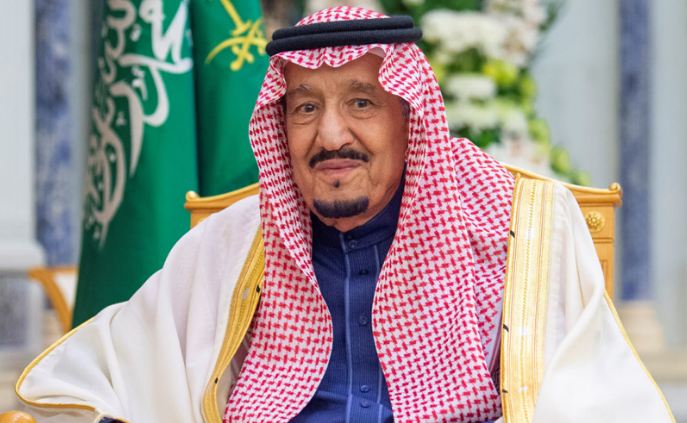
RIYADH, APR 10: In a heartfelt Eidul Fitr message, the Custodian of the Two Holy Mosques, King Salman bin Abdulaziz, extended warm congratulations to Saudi citizens, resident foreigners, and pilgrims.

According to the Saudi Press Agency (SPA), he emphasized the significance of stopping attacks on the Palestinian people, urging for prayers for their relief from suffering.

Minister of Information Salman Al-Dosari relayed King Salman’s Eidul Fitr speech. In his address, King Salman expressed gratitude to Allah for the completion of the blessed month of Ramadan, praying for acceptance of fasting and good deeds.

Acknowledging the importance of mutual respect, compassion, love, and tolerance, King Salman highlighted the opportunity provided by Eidul Fitr to celebrate the end of Ramadan. He thanked Allah for the chance to serve millions of pilgrims in the Haram and facilitate their comfort and rituals.

On this year’s Eidul Fitr, King Salman urged efforts to halt attacks on the Palestinian people, calling for prayers for an end to their suffering and the provision of relief corridors for them to live a peaceful life.

Concluding his address, King Salman prayed to Allah Almighty for the continued security and stability of the kingdom, invoking His grace and generosity.

Pakistan marks Eid ul Fitr with prayers for oppressed Gazans

Pakistan marks Eid ul Fitr with prayers for oppressed Gazans

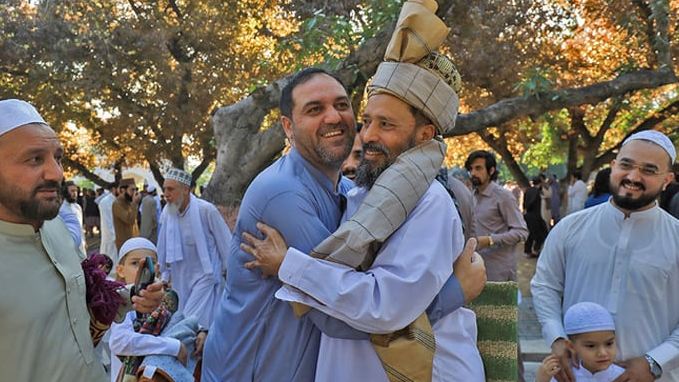
ISLAMABAD, APR 10: The Pakistani nation Wednesday marked Eid ul Fitr with prayers for brethren in Gaza, who have been facing death and destruction for the past six months at the hands of oppressive Israeli forces.

At least 33,360 Palestinians have been confirmed killed in six months of war, which began on October 7, Gaza’s health ministry said in its latest update, with thousands more dead feared unrecovered in the rubble.

Hamas is currently studying a ceasefire proposal put forth by Israel, but the group said it does not meet the demands of freedom fighters.

In their Eid messages, Pakistan’s top leadership expressed solidarity with the war-torn nation and impressed upon the international community to ensure immediate peace in Gaza and provision of assistance to the Palestinians.

The day kicked off with Eid prayers, which marked an end to the month-long holy month of Ramadan, during which Muslims fast from dawn till dusk. The three-day festival is observed to celebrate the completion of the fasting month by believers across the world.

In a bid to ensure that the religious festival witnesses no untoward situation, security has also been tightened across the country, with thousands of police personnel deployed.

‘Genocide’
President Asif Ali Zardari felicitated the Pakistani nation and the Muslim Ummah on the auspicious occasion and urged them to show compassion and generosity and share their happiness with the poor and needy.

In a statement, he said: “I pray to Allah Almighty to bring immense blessings, happiness, peace, and security to everyone on this blessed day.”

“After all the fasting, prayers, and charity in the sacred month of Ramadan, we should be thankful to Allah Almighty for bestowing all the blessings and happiness on us.”

“Eid ul Fitr is the day to share our happiness with others and show generosity to the deprived sections of society. On this auspicious day we should help the needy, poor, orphans, and destitute and share the happiness of Eid with them,” he continued.

The president said Eid sends Pakistanis the message that as a nation, they are determined to overcome challenges, extend a helping hand to the needy, and [be] ready to work for a bright and prosperous future for everybody.

“In our everyday lives we should make an effort to become a united and strong nation by showing brotherhood and tolerance and ensuring social and economic justice and mutual unity and solidarity,” he said,

Moving on, he added that on behalf of the Pakistan nation, “I want to give the message to the oppressed Muslims of Gaza and Palestine that the whole Pakistani nation express solidarity with you”.

“We impress upon the international community to ensure immediate peace in Gaza and provision of assistance to the Palestinians. The oppression, barbarity, and genocide by Israel is the gravest violation of human rights.”

The president stressed that on this occasion of happiness, the nation should also not forget the people of Indian Illegally Occupied Jammu and Kashmir.

He assured that the whole Pakistani nation stood with their Kashmiri brothers and sisters.

‘Compassion, generosity’
In his statement, Prime Minister Shehbaz extended his heartfelt greetings to the countrymen, noting that the day marked the end of Ramadan, a month of immense blessings, spiritual growth, forgiveness, patience, tolerance, and resilience.

“The underlying message of Eid is that of solidarity, compassion, generosity, and harmony, and inspires us to build a peaceful and prosperous society,” the prime minister, whose government faces an uphill task on the economic front, said.

He reminded people that while they enjoy the celebratory delight of this great occasion, they must not forget the least fortunate.

PM Shehbaz also asked the nation to remember those martyrs who have sacrificed their lives so that the masses live in peace and tranquility.

“We salute our gallant veterans who work tirelessly to protect our borders, maintain internal security and contribute to peacekeeping missions abroad. They deserve our utmost respect and recognition.”

He also urged Muslims around the world to remember their Palestinian and Kashmiri brothers and sisters who are facing the worst kind of atrocities of the occupation forces and they will be constrained to enjoy the joys of Eid.

“We all pray to Almighty Allah to ease their difficulties.”

“May the underlying meaning and significance of Islam spread among us all as a guide to the emancipation of humanity and may the world be filled with peace and harmony. Ameen!”

Remembering martyrs
Pakistan’s armed forces, alongside Chairman Joint Chiefs of Staff Committee General Sahir Shamshad Mirza and Service Chiefs, also extended their heartfelt wishes to all citizens, the Inter-Services Public Relations (ISPR) said in a statement.

“For a soldier, the true essence of Eid lies in the pride of serving on the frontlines, safeguarding our nation, away from loved ones and the festivities of Eid.

May the blessings of Allah shower upon our beloved homeland, ushering in peace and prosperity. Ameen.”

The ISPR said on this auspicious occasion, “let us reflect upon the unwavering courage of our national heroes, serving as a beacon of inspiration for both the Armed Forces of Pakistan and the entire nation”.

“We remain eternally grateful to these brave souls and their families for their sacrifices. Let us pay homage to the martyrs of Pakistan, who laid down their lives in defence of the motherland, ensuring its safety and sovereignty.”

Stay Connected

64FansLike
60FollowersFollow

Latest Reviews

Exchange Rates

USD - United States Dollar
EUR
1.16
GBP
1.34
AUD
0.67
CAD
0.72