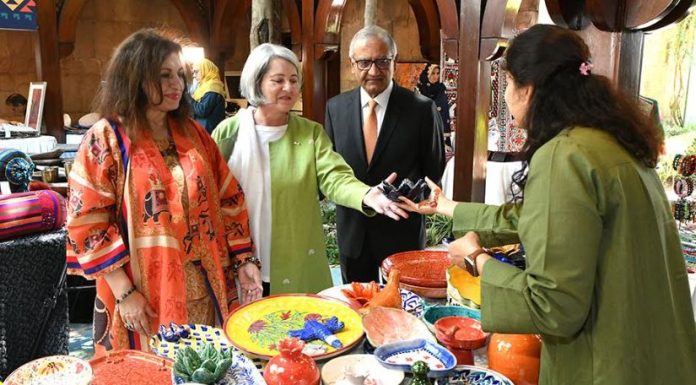
ISLAMABAD, AUG 22 (DNA) – Mayor Islamabad, Sheikh Ansar Aziz presided over a special meeting on the other day. The meeting reviewed the arrangements made by the Metropolitan Corporation (MCI) on the occasion of Muharram-ul-Haram.
According to details, the Mayor of Islamabad, Sheikh Ansar Aziz has decided to review the arrangements made by the corporation for the 9th and 10th Muharram processions.
The processions routes will be dotted with sabeel stalls, to provide water and milk to participants and general public. The mayor will personally oversee the arrangements made by the Metropolitan Corporation Islamabad (MCI) for Muharram.
The mayor will also visit Islamabad procession routes and central mourning procession. In this regard, the Mayor of Islamabad Sheikh Ansar Aziz has said that milk and water sabeels will be set up by the corporation on the routes of Muharram processions and around the central procession, which he will personally supervise.
The meeting was attended by Deputy Mayor; Syed Zeeshan Naqvi, Director General Water Management and Director Sanitation; Sardar Khan Zamri, Director Water Supply, Director City Sewerage, Director Emergency Disaster Management (E&DM) Iftikhar Haideri, Director Environment, Director Roads, Media Coordinator; Mohsin Sherazi, along with heads of other relevant departments. DNA
ISLAMABAD, AUG 22 (DNA) – Chinese Ambassador Yao Jing has reaffirmed commitment to add value to China-Pakistan Economic Corridor and bring dividends to the peoples of the two countries.
He was talking to China-Pakistan Economic Corridor (CPEC) Authority Chairman Lieutenant General (retd) Asim Saleem Bajwa during a visit to the CPEC Authority in Islamabad on Saturday.
In a tweet, the Chairman CPEC Authority said the Chinese Ambassador, on behalf of the Chinese government, paid gratitude to Pakistan government for an accelerated momentum and greater focus on CPEC.
The ambassador reaffirmed commitment to add value to CPEC and bring dividends to the people of two countries, Asim Saleem Bajwa added. = DNA
ISLAMABAD, AUG 22: DG Strategic Plans Division (SPD) Lt. Gen. Nadeem Zaki Manj called on Prime Minister Imran Khan at Islamabad. DG SPD briefed the Prime Minister regarding initiatives of Strategic Plans Division.
Prime Minister appreciated the role and contribution of SPD.
ISLAMABAD, AUG 22 (DNA) – The Chevening South Asia Journalism Fellowship (SAJP) application window is now open to receive applications for 2020/21 cohort.
The scheme is aimed at mid-career journalists from South Asian countries including Pakistan, Bangladesh, Pakistan, Sri Lanka, and the Maldives who have reached a position of influence and want to increase their knowledge, networks, and potential through tailored short courses, research, or professional placements at UK institutions.
The fully funded fellowship is a collaboration between the UK Foreign and Commonwealth Office and the University of Westminster. Individuals will undertake a bespoke eight-week fellowship titled ‘Good Governance in a Changing World: the Media, Politics, and Society’ hosted at the University of Westminster in London.
Applications are being accepted between 19 August and 19 October 2020. Interested journalists can find all information about eligibility, timelines, and the online application system on our website: www.chevening.org/apply or www.chevening.org/fellowship/sajp
The course includes lectures, visits, and discussions and interaction with key UK academics, media, and political figures in the field. Participants will also spend time meeting their peers in some of the UK’s top media organisations, as well as running a symposium on a topic of their choice in the final week.
Chevening Fellows are also invited to a programme of exclusive networking events and talks. On graduating, fellows join over 50,000 other Chevening Alumni who together form an influential and highly regarded global network.
Since 2012, 56 Pakistani journalists have participated in the programme. Every year, the British High Commission through a competitive recruitment process selects seven journalists from Pakistan to attend the course. In 2019/20 58% female journalists were chosen for the SAJP programme in Pakistan.
The South Asia Journalism fellowship programme will commence in March 2021 in the UK. DNA
BAKU, AUG 22 – Azerbaijan’s Human Rights Commissioner (Ombudsman) Sabina Aliyeva and representatives of the Pakistani embassy have discussed cooperation between ombudsman institutions of the two countries.
During the meeting held with Pakistan’s Chargé d’Affaires Navid Anjum and military attache Usman Aslami on August 20, the Ombudsman touched upon the cooperation between the ombudsman institutions of the two countries and noted that the Memorandum of Understanding signed between these institutions made a significant contribution to the effective protection of the rights and freedoms of citizens of both countries.
Aliyeva also expressed satisfaction with the deep historical roots of relations between the two brotherly countries, Azerbaijan and Pakistan, and the growing development of relations in economic, social, cultural and other fields. Emphasizing that Pakistan was one of the first countries to recognize the independence of our country, she noted that the two countries have always supported each other in the international arena.
Furthermore, it was noted that the Asian Association of Ombudsmen, of which the Azerbaijani Ombudsman is Vice President, makes an important contribution to the development of strong cooperation between ombudsman institutions in the Far East and Asia.
Touching upon the activities of the Association, the ombudsman stressed the special role of the Federal Ombudsman of Pakistan, which has headed the organization for many years, in the development of the organization.
In his turn, expressing gratitude to Aliyeva for the warm reception, Navid Anjum spoke about the importance of the peace-loving policy of the two countries. Thus, it was noted that it is important to always prioritize activities to ensure peace, tranquility and human rights.
Anjum also said that the Azerbaijani Ombudsman’s Office follows the multifaceted activities in the field of protection and promotion of human rights and freedoms in the country, and added that it is important to continue bilateral cooperation.
BERLIN, AUG 22 – The acutely ill Russian opposition leader Alexei Navalny has arrived in Germany from Siberia for treatment. He is in a coma after drinking what his supporters suspect was poisoned tea; they accuse the authorities of trying to conceal a crime.
Doctors treating him in Omsk had insisted on Friday that he was too ill to be moved.
But they later said his condition was stable enough for the flight. His wife Yulia is travelling with him.
On Saturday morning, Mr Navalny’s medical evacuation flight – paid for by the German NGO Cinema for Peace – landed at Tegel airport in Berlin. He is being treated at the Charité hospital in the German capital.
The founder of the Cinema for Peace Foundation, activist and filmmaker Jaka Bizilj, told that Mr Navalny’s condition had remained “stable” throughout the flight and after landing.
Medical staff treating Mr Navalny at the hospital in Omsk said before his flight that his life was not in immediate danger.
Mr Navalny’s spokeswoman, Kira Yarmysh, earlier tweeted: “Massive thanks to everyone for their support. The struggle for Alexei’s life and health is just beginning.”
Ms Yarmysh said it was a pity that doctors had taken so long to approve his flight as the plane and the right documents had been ready since Friday morning.
Mr Navalny fell ill during a flight from Tomsk to Moscow on Thursday, and his plane made an emergency landing in Omsk.
A photograph on social media appeared to show him drinking from a cup at a Tomsk airport cafe before the flight. His team suspects a poisonous substance was put in his tea.
Disturbing video appeared to show a stricken Mr Navalny howling in agony on the flight. Passenger Pavel Lebedev said he heard the activist “screaming in pain”.
What the doctors said on Friday
The head doctor at the hospital where Mr Navalny was being treated in Omsk, Alexander Murakhovsky, warned late on Friday that doctors did not recommend flying, “but his wife insists on her husband being transferred to a German clinic”.
“The patient’s condition is stable,” deputy chief doctor Anatoly Kalinichenko was quoted as saying by the Interfax news agency.
Mr Navalny is in a coma and is said to be in a stable condition.
“As we’re in possession of a request from relatives to permit him to be transported somewhere, we have now taken the decision that we do not object to his transfer to another in-patient facility,” Dr Kalinichenko said.
Doctors said earlier that no poison had been found in his body, suggesting his condition might be the result of a “metabolic disorder” caused by low blood sugar.
Health officials then indicated that traces of an industrial chemical had been found on his skin and hair. The local interior ministry told the Rapsi legal news agency that the chemical was usually included in polymers to improve their elasticity, but its concentration was impossible to establish.
The prominent critic of President Vladimir Putin has consistently exposed official corruption in Russia. He has served multiple jail terms.
What do Mr Navalny’s supporters say?
At a news conference in Berlin on Friday, Mr Navalny’s aide Leonid Volkov said at first doctors at the hospital had been helping to facilitate his transfer but abruptly stopped doing so.
“[It was] like something was switched off – like medicine mode off, cover-up operation mode on – and the doctors refused to co-operate any more, refused to give any information even to Alexei’s wife,” he said.
“The doctors who were helping to do the paperwork to make the transportation of Alexei to Charité possible started to say that he’s not any more transportable, he’s not any more stable, contradicting themselves.”
In 2018, the Cinema for Peace Foundation arranged for the treatment of Pyotr Verzilov – an activist with Russian protest group Pussy Riot – who had symptoms of poisoning.
Mr Verzilov’s ex-wife, activist Nadya Tolokonnikova, told BBC News that Mr Navalny’s condition resembles the “poisoning” of her ex-husband.
“What German doctors told me after not finding poison in my ex-husband’s blood is that the poison disappears in three days. So the Russian doctors only let him go when they were sure there was no traces of poison left,” she explained.
She also expressed surprise about what has happened to Mr Navalny: “I thought Alexei was so powerful as a political figure that Mr Putin would not interfere.”
Mr Navalny’s wife Yulia wrote to President Putin asking him to allow her husband to be moved. She feared the Russian authorities were stalling so that evidence of any chemical substance would be lost.
Mr Putin’s spokesman Dmitry Peskov said on Thursday that the Kremlin would help move Mr Navalny abroad if necessary and wished him a “speedy recovery”. On Friday he said it was purely a medical decision.
Foreign leaders including Germany’s Angela Merkel and France’s Emmanuel Macron have expressed concern for Mr Navalny. In the US, Democratic presidential candidate Joe Biden has described the incident as “unacceptable” and vowed that, if elected, he would “stand up to autocrats like Putin”.
Timeline: Navalny targeted
April 2017: He was taken to hospital after an antiseptic green dye was splashed on his face in Moscow. It was the second time he was targeted with zelyonka (“brilliant green” in English) that year. “It looks funny but it hurts like hell,” he tweeted following the attack.
July 2019: He was sentenced to 30 days in prison after calling for unauthorised protests. He fell ill in jail and doctors said he had suffered an acute allergic reaction, diagnosing him with “contact dermatitis”. His own doctor suggested he might have been exposed to “some toxic agent” and Mr Navalny said he thought he might have been poisoned.
December 2019: Russian security forces raided the offices of his Anti-Corruption Foundation, taking laptops and other equipment. CCTV footage showed officials using power tools to get through the door. Earlier that year, his organisation was declared a “foreign agent”.
ISLAMABAD , AUG 22 – The National Accountability Bureau filed a supplementary reference against former prime minister Shahid Khaqan Abbasi in the LNG terminal reference.
The reference, a copy of has accused the PML-N leader of money laundering. The reference has accused him of receiving Rs736 million (not including his salary) after the contract was awarded.
According to NAB, Abbasi transferred Rs560 million of the Rs736 million to his son Abdullah Khaqan’s account. The bureau claimed that Khaqan was not able to explain how or why the funds were transferred to him.
Abbasi, who served as the PM from August 1, 2017 to May 31, 2018, after the disqualification of Nawaz Sharif , has been accused of awarding the LNG Terminal-1 contract in a non-transparent way. His son, and former finance minister Miftah Ismail, are among others who have been named in the case.
From 2013 to 2017, unexplained deposits of Rs1.4 billion and Rs1.2 billion were made to Abbasi and his son’s bank accounts.
An accountability court in Karachi read out the charges against the PML-N leader. Abbasi has been accused of illegally appointing Sheikh Imranul Haq as the managing director of PSO and Yaqoob Sattar as the deputy managing director (finance) while he was serving as the minister of petroleum and natural resources from June 7, 2013 to July 28, 2017.
According to Haq’s LinkedIn page, he served on the post from 2015 to 2018. NAB has claimed that Haq received a salary of Rs4.95 million every month, while Sattar made Rs2.7 million per month. Their appointments caused a loss of Rs1.38 billion to the national exchequer.
NAB said that Haq had no experience in the field of oil marketing and was appointed on the basis of favouritism. The bureau claims that the appointment violated all the laws and rules set by the Supreme Court for managing directors and chief executive officers of public sector enterprises.
The PML-N leader, however, pleaded not guilty in the case.
PIA has reduced fares for domestic flights operating from Islamabad to Karachi and Lahore, and Lahore to Karachi. Abdullah Hafeez, the airline’s spokesperson, confirmed on Saturday that passengers heading from Karachi to Islamabad without baggage will be charged Rs7,860 one-way. But, they’ll have to pay Rs8,574 if they bring bags.
The airline schedules four flights to and from Islamabad and two to and from Lahore every day. The new fares have been applied with immediate effect.
The airline has been reducing fares for many domestic flights since the coronavirus pandemic hit Pakistan. The spokesperson had explained to SAMAA TV that the move is likely to encourage more people to travel.
In June, PIA was charging over Rs12,000 on all domestic flights, but the fares have gone down gradually.
ISLAMABAD, AUG 22 – The Pakistan Industrial & Traders Association Front has called for regionally competitive power and gas tariff for domestic as well as export sectors to capture the global market.
PIAF Chairman Mian Nauman Kabir, in a joint statement with senior vice chairman Nasir Hameed and vice chairman Javed Siddiqi, appreciated the commerce minister, who managed to get notified the special electricity and gas tariff for the export sector, demanding the same tariff should also be extended to the local industry, which cannot survive in present scenario.
He welcomed the country’s positive economic indicators, which have started showing recovery despite enormous challenges at external as well as internal fronts due to outbreak of coronavirus and subsequent lockdown,
During July 2020, Pakistan’s exports registered increase, whereas imports declined, which is very encouraging. Moreover, the renowned global institutions entities, monitoring the performance of different economic sectors across the world, have also started recognizing the growth of Pakistan economy through various reports.
Mian Nauman Kabir said that both International and domestic confidence was increasing. In addition, the Moody’s rating agency also provided stable rating for Pakistan economy and confirmed its B3 credit rating. It is fact that the COVID-19 outbreak and the subsequent lockdown drastically damaged the world economy and Pakistan was no exception which witnessed negative GDP growth. However, due to the better policies adopted by the government, including relief in energy tariff and markup rates the economic losses were mitigated to some extent, which now need to continue for further benefit.
PIAF senior vice chairman Nasir Hameed observed that country has not been able to achieve its full export potential and product diversification owing to limited access to raw-material and to this effect the application procedures for temporary import schemes should be simplified, so that exporters could be able to achieve price competitiveness and product diversification.
PIAF leadership expressed concern over excessively burdening the manufacturing sector that contributed around 22 percent to the economy, having a share of 72 percent in tax payments.
He added that promoting foreign direct investment, increasing the share of direct taxes and slashing the slab of indirect levies topped the proposals presented by the industry for the current year budget 2020-21.
He added that the PIAF has several time proposed a comprehensive action plan for the broadening of tax base and improving the tax-to-GDP ratio.
According to reports, the government took Rs730 billion worth of taxation measures in the budget, while the GDP growth was projected at 15 percent, requiring to help collect additional taxes of Rs575 billion.
PIAF vice chairman Javed Siddiqi said that industry was assured that sales tax refunds under the new system will be paid in 72 hours. However, the system has completely failed and billions of rupees of refunds are stuck in the system. He said that the ambitious target of $28 billion of exports of only one sector by 2025 cannot be achieved if the liquidity crisis of industry is not resolved, besides continuation of regionally competitive energy tariff for both domestic as well as exporting industries.
ISLAMABAD, AUG 22 – Foreign Minister Shah Mahmood Qureshi on Saturday said that Pakistan will continue to advance international efforts to protect individuals against xenophobia, intolerance, discrimination and violence based on religion or belief.
In a message on the International Day Commemorating the Victims of Acts of Violence Based on Religion or Belief, FM Qureshi said Pakistan has always been at the forefront of all international initiatives for promoting peace, tolerance, intercultural and inter-faith harmony.
“The present government has taken a number of steps domestically to promote freedom on the basis of religion or belief and protect minorities,” the foreign minister said.
In July, Pakistan told a UN panel that a deliberate campaign of hatred by the Indian government in the region was targeting adherents of a particular religious group that led to state-sponsored violence against them and stepped up attacks on their places of worship.
Speaking at the launch of a ‘Group of Friends of Victims of Acts of Violence based on Religion or Belief’, Pakistani representative Qasim Aziz said that hateful political rhetoric and incitement to violence in Pakistan’s neighbourhood was routinely used as a weapon against vulnerable minority groups, while also expressing grave concern over the alarming rise of Islamophobia worldwide.
Pakistan became the founding member of the new group formed in pursuance of last year’s General Assembly resolution that it jointly tabled with Poland, along with other cross-regional member states.
Under the terms of the resolution, August 22 was designated as International Day in support of the victims of violence based on their religion or belief.
In his comments, the Pakistani representative drew attention to the rising global Islamophobia that he stressed represented the contemporary manifestation of a similar kind of age-old hatred that spawned anti-semitism, racism, apartheid and many other forms of discrimination.
“Today, Islamophobia is slowly overtaking other forms of religious bigotry and violence,” Aziz told the group. “Indeed, it is becoming increasingly difficult to practice, look and live as a Muslim in many parts of the world,” he said, pointing out that the Christchurch, New Zealand, attack last year was a grim reminder of this fact.