Home Blog Page 2950

Islamabad people to be fined Rs20,000 for reusing plastic bags

ISLAMABAD – Using plastic bags in Islamabad can land you a fine of Rs5,000 from March onwards.  The Ministry of Climate Change had decided to take strict action on the use of plastic bags in the city.

People caught using plastic bags will be fined Rs5,000, while shopkeepers and manufacturers Rs10,000. A fine of Rs20,000 will be imposed on those who continue to reuse plastic bags. The bags will be seized too.

The ministry has started an awareness campaign about the usage of plastic bags.

Ajmal Baloch, the president of All Pakistan Anjuman Tajran, said that the problem is that Islamabad has banned plastic bags but Rawalpindi’s hasn’t. Sometimes plastic bags come to us from Rawalpindi

Plastic bags have been banned in the federal capital since August 14, 2019 as part of Prime Minister Imran Khan’s Clean Green Pakistan campaign. It is illegal to manufacture, sell and distribute plastic bags in the city.

Ordinary plastic doesn’t get degraded and stays for years and years, creating pollution and health hazards for living things.

============

Experts highlight Chinese role in regional connectivity

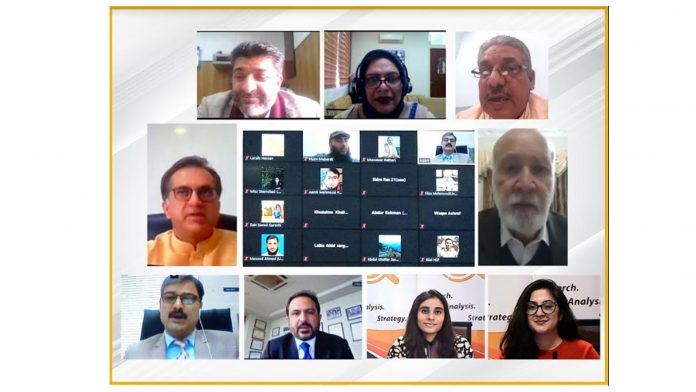
Center for Global & Strategic Studies (CGSS), Islamabad organized an Online Conference on, “Changing Dimensions of International & Regional Discourse, A Critical Analysis and Policy Options for Pakistan”

DNA

ISLAMABAD: Center for Global & Strategic Studies (CGSS), Islamabad organized an Online Conference on, “Changing Dimensions of International & Regional Discourse, A Critical Analysis and Policy Options for Pakistan”.

The conference commenced with the opening remarks ofMs. Palwasha Nawaz, Project Executive, Center for Global & Strategic Studies, Islamabad. She highlighted the importance of the conference and explained that it is of utmost importance tounderstand the transforming dynamics of international as a strategic discourse in the post-Covid-19 era. Moreover, she stated that the conference aims to analyze the policy perspectives of the incumbent US administration.

Mr. Muhammad Mudassir Tipu, Director General (China), Ministry of Foreign Affairs, Pakistan comprehensively discussed the role of China in addressing the key regional issues. He explained the role of China in regional connectivity. He highlighted that in a short period of six to seven years, we have completed excellent mega projects related to infrastructure, energy, agriculture, etc. Moreover, the second phase of CPEC will focus on agriculture, science, and technology, and socio-economic development, these are the projects that promise development in Pakistan.

He also stated that China’s financial and technological industry is enormous particularly when the global economy is in crisis due to COVID-19, which provides a lot of opportunitiesfor other states to collaborate.  He also explained that China has granted a lot of concessions through which Pakistan can export commodities to China. Moreover, he also highlighted the prospects of cooperation in the IT sector of both the states. He also suggested that over time, both nations should identify the sectors to enhance cooperation. He further highlighted the aspects of the development of the Gwadar port that has huge potential to connect many regions in the future.

Mr. Rahimullah Yousafzai, Senior Analyst & Journalist discussed the Afghan issue and the role of Pakistan. He also explained the regional policy framework vis-à-vis the current dynamics of the region. He highlighted the role of Pakistan in the Afghan peacemaking process and described the round of talks held between the US-Taliban and peace deal in detail. He also stated that both Taliban and Afghanistan were waiting for President Biden to decide the future policy discourse. The Taliban wanted the US to keep its promise of release of the Taliban prisoners. However, the release led to violence as they go back to their training camps. He also highlighted that the United States can ask for new deadlines but it is vital to ensure that the Taliban fulfilltheir commitment. He concluded that Pakistan is an important stakeholder in the Afghan peace process and the US also considers it as a core partner in negotiating with the Taliban. Mr. Rahimullah also said that the US can resolve its conflicts with Iran, hereby, it can play a significant role in the Afghan peace process.  Likewise, India can shed its traditional notion of reluctance and play a positive role in resolving Afghan Crises.

Prof. Dr. Shabir Ahmad Khan, Director of Area Study Centre, (Russia, China & Central Asia), University of Peshawar shared his thoughts on “Devising and implementing regional integration policies by Pakistan: Means and way forward”. He stated that China and Pakistan Economic Corridor (CPEC) is a game-changer, likewise, peace in Afghanistan will also prove to be a game-changer for Pakistan. He briefly explained the contours of CPEC and highlighted that this flagship project providesan opportunity for other regional states to integrate. He further stated that Pakistan is more inclined towards Central Asia for regional cooperation, as India’s reluctance provides a little opportunity for cooperation in South Asia. Moreover, Prof. Dr. Shabir stated that China is a friendly neighborand is assisting Pakistan to build a greater infrastructure. In this regard, regional countries should integrate to harness connectivity and regional collaborationvia CPEC projects.

Dr. Irum Khalid, Chairperson, Political Science Department, University of Punjab, Lahore briefly discussed the transforming US foreign policy approaches and analysis on Joe Biden’s Administration. She stated that Biden has made the targets clear in his first speech. He was more inclined towards revising the policies. In this regard, she also stated thatthere are certain constraints in new foreign policy options for the US regarding the regional political and economic discourse. The regional politics includes the Iran conflict, Yemen Crises, Middle East, Afghanistan, China, and South Asia. She concluded that in present times, the US cannot afford any other humanitarian crises. So, it should move slowly towards reconciling the damage. She also stated that the world is now more inclined towards a dialogue of civilization rather than theclash of civilizations.

Dr. Mussawar Hussain Bukhari, Chairman, Political Science Department, Islamia University of Bahawalpur (IUB) discussed the US foreign policy towards Asia, Objectives, and Implications. He described that mostly the policies of superpowers are based on three levels i.e., state, regional, and international. However, during the Trump regime, the policies were based on other three elements: military, economy,and soft image. He stated that the United States has lost its soft image at the international level in Trump’s tenure.He alsohighlighted the complexities of the region caused due to reluctant policies by India. Dr. Mussawar also explained briefly the important contoursof China’s connectivity through CPEC.Furthermore, he highlighted theregional policies and dynamics of Beijing and projectsof cooperation with other South Asian nations.

Dr. Adam Saud, Dean, Faculty of Humanities and Social Sciences, Bahria University, Islamabad explained the emerging realities in the international political system. The main focus was on the shift of foreign policies in recent times. He stated that soft power is the key to international stability. He briefly discussed the important transforming realities of today’s political system that have impacted the foreign policy and behavior of the countries. For example, digitalization, Artificial intelligence, fifth-generation warfare, ecological system, environment degradation, and Covid-19 pandemic.He concluded by suggesting that Pakistan should move prudently while keeping a view of its national interest. Moreover, he said that Pakistan should have good relations with other states as well to achieve stability in Afghanistan. He suggested that Pakistan has a key position in the region and international political system because of CPEC, which is a game-changer.

Mr. Jawad Majid, Director, Silk Bankdiscussed the role of socio-economic institutions and organizations for sustainable development in the post-Covid-19 era. He explained that in this crucial time of the pandemic, we have seen development and growth in different industries. This transformation also made the dynamics of the global environment shift. He explained that in the post-pandemic era, the economy of Pakistan has gradually improved specifically in the agriculture sector. Mr. Jawad also discussed that international organizations have assisted Pakistan in overcoming challenges caused due to COVID-19, he also highlighted the important role played by China. He also highlighted three dimensions that witnessed growth in an efficient manner including quality, positive economic construction in the women labor force, and improving the efficiency at the national level in the short and medium-term. He concluded that all institutions of Pakistan have played an efficient role in combating the pandemic. However, there should be more improvement in the policies to go along with the changing dynamics of regional and international affairs.

The conference was moderated by Ms. Laraib Fatima Hassan, Communication& Coordination Manager, Center for Global & Strategic Studies (CGSS), Islamabad, and was attended by 80 participants. It was also viewed live by 300 viewers on social media platforms.


Hasan stars as Pakistan complete series sweep over South Africa

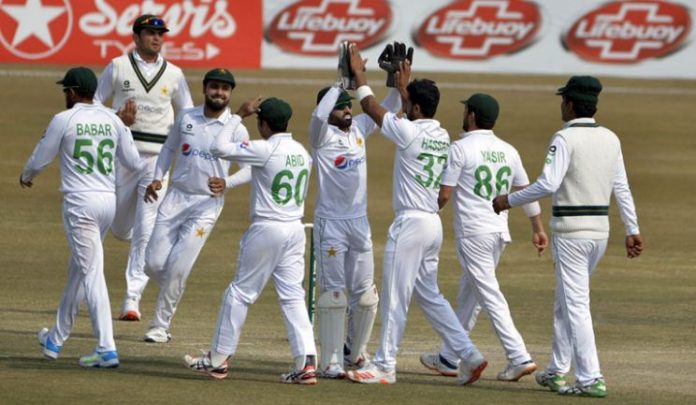
RAWALPINDI – Pakistan completed a historic series sweep over South Africa after winning the second Test in Rawalpindi on Monday. South Africa, chasing a target of 370 runs in the second innings, were dismissed for 274 thanks to a five-wicket haul by pacer Hasan Ali.

It is the pacer’s maiden 10-wicket haul in the longest format.

The side came out to bat at 219-3 with Aiden Markram and Temba Bavuma unbeaten at 100 and 44 respectively in the second session on day five.

However, captain Babar Azam’s decision to take the new ball worked wonders as Hasan bagged the wickets of Markram and captain Quinton de Kock on consecutive deliveries.

Temba Bavuma went on to score 61 before falling to Shaheen Shah Afridi.

Hasan took the wicket of George Linde (4) to complete his second five-wicket haul.

Keshav Maharaj and Kagiso Rabada were both dismissed by the left-armer without opening their accounts.

Yasir put the final nail in the coffin as Mulder was bowled for 20.

Lunch

South Africa’s opening batsman Aiden Markram scored a crucial century before the Proteas went for lunch at 219-3 on the fifth day of the second Test against Pakistan in Rawalpindi on Monday.

The side require another 151 runs to win in the remaining two sessions with seven wickets in hand.

Quinton de Kock’s side began the final day’s play on their overnight score of 127-1 with Markram and Rassie van der Dussen batting at 59 and 48 respectively.

Pacer Hasan Ali, who bagged a five-wicket haul in the first innings, provided the breakthrough with Dussen’s wicket. He then dismissed Faf du Plessis for five.

Rescue operation to locate Sadpara, two other climbers enters third day

SKARDU : The land and the air rescue operation of Pakistan Army helicopters to locate three climbers, including Pakistan’s Muhammad Ali Sadpara, who went missing while attempting to summit the world’s second-highest mountain K2 has entered the third day.

A land and air search was launched Sunday morning to locate Pakistan’s Muhammad Ali Sadpara and two foreign climbers, John Snorri from Iceland and JP Mohr from Chile went missing while attempting to summit the world’s second-highest mountain, K2.

Sadpara, John Snorri from Iceland and JP Mohr from Chile have not been contacted since the three began their push for the K2 summit from camp 3 at midnight between Thursday and Friday, according to their team.

Two army helicopters flew to their maximum limit of 7,800 metres for a second time and conducted aerial reconnaissance for an hour to locate the missing climbers.

Two teams took part in the search operation, including one aboard a Pakistan Army helicopter while the other scouring the K2 route the mountaineers had taken.

The son of Ali Sadpara, Sajid Sadpara has returned to the base camp after he was sent back from 8200 kilometers altitude owing to a malfunction in his oxygen regulator.

Earlier, it was reported that Prime Minister Imran Khan and Chief of Army Staff (COAS) Qamar Javed Bajwa are personally following developments regarding missing K2 mountaineers including Muhammad Ali Sadpara.

Don’t drag Army into politics : ISPR

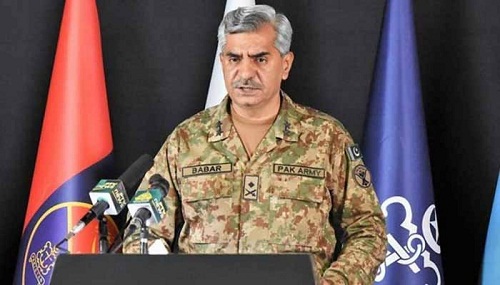
ISLAMABAD (DNA ) – Director General (DG) of Inter-Services Public Relation (ISPR) Major General Babar Iftikhar on Monday has clarified that Pakistan Army has nothing to do with politics.

While exclusively talking to Dunya News, the DG ISPR said that speculations regarding Pakistan Democratic Movement (PDM) are baseless. Those spreading such rumors should also provide proofs, he added.

Talking about the revelations made by EU DisinfoLab, Major General Babar Iftikhar said that Pakistan has always tried to expose nefarious plans of India.

Responding to a question, the DG ISPR said that Pakistani mountaineer Ali Sadpara is a national hero and asset. We pray for the safety of all the mountaineers who went missing during their K2 climb, he added.

Major General Babar Iftikhar went on to say that all the measures are being taken to find Ali Sadpara and his companions.

“Shock Wave 2” continues leading China box office

BEIJING, Feb. 8  : Crime thriller “Shock Wave 2” continued to lead daily box office chart on the Chinese mainland Sunday, grossing 9.89 million yuan (around 1.53 million U.S. dollars).

The film had generated close to 1.28 billion yuan in 46 days of screening, according to figures from the China Movie Data Information Network.

Coming in second was feature film “A Little Red Flower,” which raked in about 9.45 million yuan on Sunday.

It was followed by comedy film “Big Red Envelope” which earned about 8.55 million yuan on Sunday.

SC seeks timeframe for rebuilding Hindu shrine in Karak

ISLAMABAD : The Supreme Court (SC) has sought timeframe from the relevant authorities to rebuild Hindu shrine in Khyber Pakhtunkhwa’s Karak which was damaged in a tragic incident of vandalism on December 30 last year.

A three-member bench headed by Chief Justice of Pakistan (CJP) Justice Gulzar Ahmed heard the suo motu notice over the tragic incident of vandalism at the shrine of a Hindu saint in KP’s Karak district.A Member of the National Assembly (MNA) and Patron in Chief Pakistan Hindu Council, Ramesh Kumar told the court that the reconstruction work of Samadhi was not started so far.

During the hearing, the chief justice remarked that the compensation money was not received from the responsible persons in Karak incident. Justice Ijazul Ahsan remarked that the reconstruction work of the Hindu shrine should be started immediately.

KP’s Additional Attorney General (AAG) told the apex court that the provincial government allocated Rs34.8 million to rebuild the Samadhi. CJP remarked that 119 persons had been arrested over their involved in the Karak incident.

Justice Ahsan said that nobody would think about doing such a thing ever if compensation money is retrieved from the responsible persons.

CJP said that all properties of ETPB have been given on lease, whereas, some of the properties were permanently given on lease. AAG told the court that 14 properties of ETPB are currently occupied.

The chief justice maintained that ETPB properties could not be given to anyone. He questioned how ETPB would establish housing societies on its land. AAG said that geo-tagging of all properties is a positive aspect.

CJP Justice Gulzar Ahmed remarked that many multi-storey plazas had been demolished in Karachi over the directives of the Supreme Court (SC) which also include properties of ETPB.

The chairman of minorities’ commission Shoaib Suddle argued that ETPB does not cooperate with the one-member commission. To this, the chief justice remarked that ETPB chairman will be summoned here if it is a matter of non-cooperation.

Later, the top court summoned the chairman of Evacuee Trust Property Board (ETPB) in the next hearing besides seeking timeframe for rebuilding the Samadhi.

Dr Ramesh Kumar, told the court that Commissioner Multan was not taking responsibility of security of Multan temple. Dr Kumar said that the commissioner expressed security risks if the Holi festival is going to be organised there.

The apex court directed the Punjab government for making security arrangements for a temple ahead of Holi festival on March 28. Punjab’s chief secretary and inspector general (IG) have been asked to look after the matters related to the organisation of Holi festival.

The hearing was adjourned till February 15.

Suo motu notice over Karak incident

Earlier on December 31, Chief Justice of Pakistan (CJP) had taken notice of a tragic incident of vandalism at the shrine of a Hindu saint in Khyber Pakhtunkhwa’s (KP) Karak district.

Dr Ramesh Kumar, MNA and Patron in Chief Pakistan Hindu Council, had been called on the chief justice at the Supreme Court’s Karachi Registry and raised the issue of “desecration/burning of shrine of Hindu saint Shri Paramhans Ji Maharaj” by a mob in Karak on Wednesday, according to a statement issued by the SC.

CJP Ahmed had shown grave concern over the tragic incident and informed the member of Parliament that he has already taken cognizance of the matter and has fixed it before a bench for hearing on Jan 5 (Tuesday).

The country’s top adjudicator issued directions to the one-man commission on minorities rights, KPK chief secretary and IGP to visit the site of the shrine and submit a report on Monday.

According to reports, a mob had set the shrine of the Hindu saint on fire and demolished several of its parts in Teri area of Karak.

India’s Ishant Sharma bags 300th Test wicket

Chennai, India, Feb 8  : India fast bowler Ishant Sharma bagged his 300th Test wicket on day four of the opening match against England in Chennai on Monday.

Sharma trapped Dan Lawrence lbw for 18 — his third of the match — in his 98th Test for India.

The milestone reached during England’s second innings sees the 32-year-old enter India’s exclusive 300-wicket club, which includes pace greats Kapil Dev (434) and Zaheer Khan (311).

Spinner Anil Kumble remains India’s highest wicket-taker with 619 scalps before he retired in 2008.

Sharma, who made his Test debut against Bangladesh in Dhaka in 2007, has battled a series of injuries throughout a stop-start career.

He has taken 115 wickets in 80 one-day internationals.

India’s COVID-19 tally rises to 10,838,194, death toll over 155,000

NEW DELHI, Feb. 8  : India’s COVID-19 tally rose to 10,838,194 on Monday even as 11,831 new cases were registered during the past 24 hours, said the latest data from the federal health ministry.

According to the official data, the death toll mounted to 155,080 as 84 COVID-19 patients died since Sunday morning.

This was the third consecutive day when the death toll recorded in a single day was below 100.

There are still 148,609 active cases in the country, while 10,534,505 people have been discharged so far from hospitals after medical treatment.

January 16 was a crucial day in India’s fight against the pandemic as the nationwide vaccination drive was kicked off during the day. So far over 5.8 million people, mainly health workers, have been vaccinated across the country.

Meanwhile, the federal government has ramped up COVID-19 testing facilities across the country, even as nearly 202 million tests have been conducted so far.

As many as 201,900,614 tests were conducted till Sunday, out of which 532,236 tests were conducted on Sunday alone, said the latest data issued by the Indian Council of Medical Research (ICMR) on Monday.

The national capital Delhi, which has been one of the most COVID-19 affected places in the country, has been witnessing comparatively a lesser number of cases over past several months. As many as 119 new cases and two deaths were registered in the national capital through Sunday.

So far as many as 10,879 people have died in the national capital due to COVID-19, confirmed the Delhi’s health department.

Two types of vaccines are being administered to the people in India. While the “Covishield” vaccine, made by the Serum Institute of India, was supplied to all states, the “Covaxin” vaccine, made by the Bharat Biotech International Limited, was supplied to only 12 states.

ECP issues polling scheme for PS-88 Malir by-election

KARACHI : The Election Commission of Pakistan (ECP) has released a polling scheme for the by-election on Sindh Assembly’s vacant seat of PS-88 Malir.

The polling will be held on February 16.

As many as 108 polling stations have been set up for the by-poll in the constituency out of which 36 declared sensitive and 33 others were declared highly sensitive.
The District Returning Officer (DRO) has said that all arrangements are put in place for smooth and transparent polling.

The Sindh Assembly constituency fell vacant due to the death of Pakistan Peoples Party MPA and provincial minister Ghulam Murtaza Baloch due to the novel coronavirus infection in June last year.

Last month, Pakistan People’s Party (PPP) had secured a win in the PS-52 Umerkot by-polls.

As many as 12 candidates were participating in the contest, however, the real fight was between Pakistan Peoples Party’s Ameer Ali Shah and veteran politician and Grand Democratic Alliance (GDA) leader Arbab Ghulam Rahim.

Stay Connected

64FansLike
60FollowersFollow

Latest Reviews

Exchange Rates

USD - United States Dollar
EUR
1.14
GBP
1.33
AUD
0.69
CAD
0.70