Home Blog Page 2938

Asking Justice Isa to not hear cases on PM bad for ‘credibility’ of judiciary: Maryam

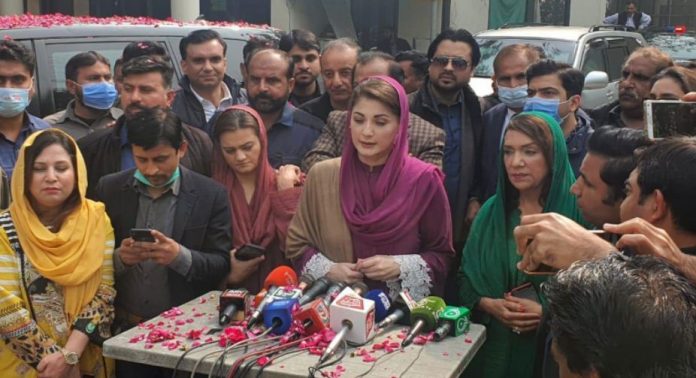
ISLAMABAD – PML-N Vice President Maryam Nawaz on Saturday said the written order by the chief justice of Pakistan in which he said Supreme Court Justice Qazi Faez Isa should not hear cases involving Prime Minister Imran Khan “is not good for the credibility and respect of the judiciary”.

“The whole system of justice and the respect of the judiciary is being risked to save an unqualified and incompetent person.”

Interacting with reporters before her departure from Jati Umra to Sialkot, where she will address a rally in Daska as part of the election campaign for NA-75, Maryam was asked about Thursday’s written order by the chief justice of Pakistan.

Responding to the question, Maryam said the development was completely different than the treatment meted out to her father, PML-N supremo Nawaz Sharif.

“People can see the faces, the decisions and the differences between the remarks,” she said.

“I understand that there have been historic attempts to break [the] PML-N […] the state and all institutions have been thrust against a party but […] the PML-N did not break apart,” Maryam said, adding that the reason behind this was the PML-N becoming an “ideological party”.

“Every coming day is proving that Mian [Nawaz Sharif] sahab‘s vision was right.”

Responding to another question, Maryam said Major General Babar Iftikhar, the director-general of Pakistan Army’s media wing, was “very respectable for me […] and he is a good man”. “However, when you say such things then they will become a subject of mockery among the nation.”

She was referring to his comments on Monday when he rubbished rumours that the armed forces and the opposition alliance, Pakistan Democratic Movement (PDM), were in contact through “backdoor channels” and said that the army should not be dragged into politics. “I would again request please don’t drag the institution into this dialogue,” he had said.

Maryam said a number of recent developments “were in front of the world [to see] so please speak that which the world will accept”. Otherwise, she said, it would not be good for his credibility and that of the institution he represents.

“The people will think you are lying […] it is better that you adopt silence and don’t talk on the issue but don’t give wrong statements.”

She also reiterated that both the PDM and the PML-N wanted electoral reforms and real democracy but any legislation on this front could not be be done with PM Imran at the helm.
Sustainable Development Goals – A way forward for Pakistan!

Muntaha Talat

Research Associate – IICR

Driving on the roads of Pakistan, you might have observed the spark in the eyes of a child selling flowers on the road to earn money, or a hungry boy picking up food from the leftovers, or a homeless family living on a footpath. This might have caught your attention forcing you to think about the striking difference that exists in the lifestyle of the people residing in this country and across the globe.

Although mankind has this instinct to strive and struggle throughout their life but the difference that divides the people between the rich and poor and the problems that accompany it are necessary to be dealt with on priority. Do you know that there are 689 million people, (9.2%) of the world population living under extreme poverty, with the situation worsened by the COVID-19 pandemic, and this brings forward the numerous challenges they have to face that most of us are unaware of.

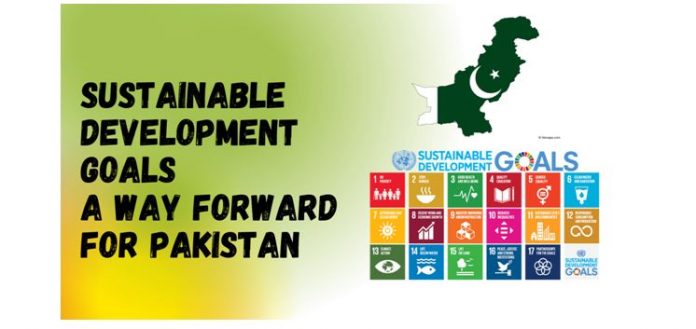
Sustainable Development Goals or the SDGs are a global effort to curb poverty, hunger, injustice, climate change, and other major challenges faced by the world. Adopted by all the member states of the United Nations in 2015, these 17 goals were a way forward for both the developed and developing countries. They aimed to opt for strategies that bring peace and prosperity in the world, along with the provision of better facilities to the people and to protect the environment.

This 2030 agenda for sustainable development opens the door for the countries to take steps towards a better future. It accounts for the integrated and interconnected efforts that unleash positive outcomes for all the aspects as a result of work done on any one aspect. Out of all the member states, Pakistan was the first country to make the SDGs as part of their national development agenda in February 2016. Is Pakistan on the right track or it has more to do is the point of concern here.

The global pledge for a better future in the form of SDGs is a ray of hope for many. However, the COVID-19 pandemic proved to be a major hurdle, as it affected millions of people, claimed 2.3 Million deaths, and pushed 20 million people back into poverty. With the lost income and inflation being the main reason for the increased ratio of people falling below the poverty line, Pakistan’s response in tackling the pandemic was considerably better. With effective strategies, the PTI government was somehow successful in containing the spread of pandemic and reducing its after-effects to a great extent.

Pakistan stood at 115 position out of 149 countries in 2016, while in 2019, it ranked 130th out of 167 countries. However, in 2020 its position slipped to 134 according to a sustainable development report. Pakistan was ranked lowest in South Asia, as Bangladesh and India took lead with 107th and 116th rank respectively. Currently, our SDGs score is 56.17/100 which is significantly low as compared to the other South Asian states. One of the prime reasons for this is the absence of a national assessment report for the year 2020, and the unavailability of the latest data that had to be collected through the surveys. Government officials say that the report is in draft form and data collection got delayed due to the pandemic.

Pakistan however showed a committed stance towards working on SDGs and formulated SDG units on federal and provincial levels. Moreover, a framework designed to achieve the desired goals was approved by the National Economic Council, which is chaired by the Prime Minister and is the country’s highest platform for approval of plans to implement policies. A number of policies have been planned and implemented since 2016 and most of the work has been done on SDG-4 (Quality Education), SDG – 8 (Decent work and economic growth), and SDG-16 (Peace, Justice and Strong Institutions). Apart from this under the current tenure of the PTI government, various projects including the Sehat Sahulat Program and The Lady Health Workers Program have proved to be a great initiative in the provision of better health facilities. Prime Minister Imran Khan had his focus on the environment and climate change as well and his initiative of the Billion Tree Tsunami Project received worldwide appreciation.

Despite all the challenges, Pakistan’s current leadership is showing commitment towards the achievement of SDGs. Steps taken for the betterment of citizens of Pakistan are going to yield magnificent results in the times coming up. With continued dedication towards the cause, it is hoped that in 2030, the terminal year of SDGs Pakistan will be celebrating prosperity and progress InshaAllah!

Power suspension schedule for 14th February-2021

DNA

ISLAMABAD, FEB 13 – According to Islamabad Electric Supply Company (IESCO)’s spokesman, System Maintenance is in process. Therefore the power supply of below-mentioned feeders/areas will be temporary suspended as per given schedule:-

On 14th February at 09:00 am to 02:00 pm, I-9/4, Noor Mohammad, Faizabad, Abu Bakar, Park View, Jail Park 1, Car Chowk, Mehboob Shaheed, Fuji Foundation, Morgah, Bolani, Military College, Puran, Duffer. G-11 Markaz, Kalingar Gadin, T&T, Pindi Point, Barian, Bilwara, Trit, Askari XI-, Misryal Road, Kamalabad, Nogzi, I-16/1, BB Shaheed, RIC, Chaklala, Jail Park-1, Model Town, Lalkurti, Chontra, Hyal, Sagri, Kahuta City-2, Basali, Mushtaq Hussain, Taxila, Brahma, Kohsar Valley, Paswal, Shakar Dara, Attock Cantt, Nard Topa, Vaisa, Mansar, Nika Kalan, Mathial, M. Shaheed, Khandha, Bolani, Kariala, Fatehpur, Khor, Puran, Boriyan, F-9 Chak Daulat, F-2 Chip Board, Industrial, F-10 Kala Base, M. Riaz Shaheed, Gadari, Bhagwal, Safdar Shaheed, Sanghui, Nathwala, Mumtaz Shaheed, Mankiala, Kantrila, Smoot, Bhone, Mangwal, Islamia Chowk Feeders, From 09:00 AM to 4:00 PM, G-10/2, G-10/1, G-9/4, G-9 Express, G-8 / 2, Mong City, Mongpatan Sher Khan, Mong Kanchan, Lehtar, Bilwara, Karoar-II Feeders, From 09:30 am to 12:30 pm Morgah, Zaraj Housing Society, Model Town, RCC Express, Sarwar Shaheed, AOWHS, Sawan, Bahria Town, Pepsi Cola, Fuji Foundation Hospital, Wilayat Complex, X-Lair Colony, Pindi Board, Dhok Awan, Feeders and surrounding areas will be remain without power. IESCO management apologizes to its esteemed customers for the power outage. If the work is completed ahead of time, the power supply can be restored even before the scheduled time.

Pro-women legislation needs implementation to ensure basic rights

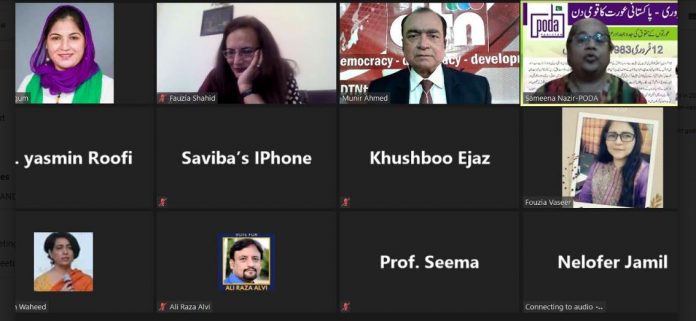
ISLAMABAD, FEB 13 (DNA) – The panel of experts speaking at a webinar said that Pakistani women’s struggle for equal rights has continued over the decades despite all odds and dictatorship. The democratic governments have done ample legislation but the implementation lacks that deprive women of their lawful rights.

Gender inequality underpins many problems which disproportionately affect women and girls, such as domestic and sexual violence, lower pay, lack of access to education, and inadequate healthcare.

The speakers said women suffer from pervasive gender-based violence, from domestic abuse, honour killings, and sexual violence to institutional discrimination. There is a widespread lack of consistent access to quality family planning services in Pakistan, resulting in one of the highest unmet needs in Asia. Still women are denied the right to vote, inheritance, choice of spouse and economic engagement.

The national webinar was organized by the Development Communications Network (Devcom-Pakistan) on Saturday. The guest speakers included senior journalist Fauzia Shahid, president PODA Sameena Nazir, Head of Women Development department of Islamic University Bahawalpur Dr Yasmin Roofi, Kinnaird College Lahore Professor Dr Kushboo Ejaz, Shad Development Foundation Executive Director Shad Begum from Khyber Pakhtunkhwa, National Press Club senior vice president Sadia Kamal, Dr. Nilofer Jamil from Quetta, Devcom-Pakistan Executive Director Munir Ahmed and senior journalists CR Shamsi, Anwar Iqbal (Washington) and Ali Raza Alvi.

Senior journalist Fauzi Shahid said February 12 is commemorated to remember the brave struggle of the women for their rights launched in 1983 when the dictatorial regime promulgated legislation contrary to the women’s democratic and lawful rights. Unfortunately the patriarchal thinking has continued over the years despite continuous struggle. Now women have found some space but the destination of equal rights is still far sighted.

PODA president Sameena Nazir said legislation is done but did not communicate to the bottom where it is to be implemented. There is no adequate mechanism to educate the implementing agencies about the enforcement of law. The rural areas and marginalized communities still suffer in the absence of implementation and sanitization of the agencies.

Devcom-Pakistan Executive Director Munir Ahmed said some of the problem faced by women in Pakistan are domestic violence, honour killing, rape and abduction, marital rape, forced marriages, and induced abortions. The Global Gender Gap Index report of 2020 ranked Pakistan 151 out of the total 153 countries. This is ironic that women rights are compromised despite assurance in the religion of Islam and the constitution of Pakistan.

Shad Begum said the social and political environment in Khyber Pakhtunkhwa is not conducive for women. It is very difficult to challenge the social taboos to raise the voice for women rights though we have ray of hope as the local women of the urban towns find their ways to the mainstream platforms. The majority still struggles for the basic human rights.

Dr. Yasmin Roof said what the women demand is not the western agenda but are the rights ensured in the religion and the constitutions. We need to restore the shrinking space for civil society voices. Males of the families need to encourage women to play their active role in the family and society.

Dr Khushboo Ejaz mentioned that Higher Education Commission has encouraged to establish anti-sexual harassment committees in the universities after having noticed the rising complaints of sexual harassment. We have legislation but needs to have implementation in letter and spirit.=DNA

===============================

Envoy terms Pakistan a viable option for German investors

ISLAMABAD, FEB 13 (DNA) – The investors of Germany were looking with interest at Pakistan, which was a viable option for them for JVs and investment. German company GIZ was working in Pakistan to promote technical training and skills development of its youth and Pakistani private sector should engage such trainees to improve its productivity.

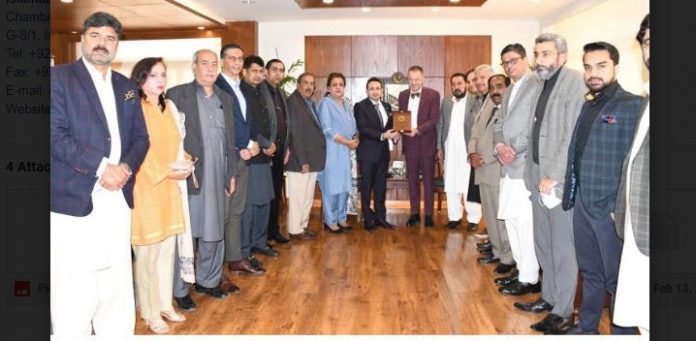
This was stated by H.E. Bernhard Stephan Schlagheck, Ambassador of Germany while interacting with the business community during his visit to Islamabad Chamber of Commerce & Industry (ICCI). Christian Böttcher, Economic Counsellor of German Embassy also accompanied him at the occasion.

Responding to a proposal for potential opportunities of JVs and investment for German investors in CPEC, the German Envoy said that investment by local investors in CPEC will give more confidence to foreign investors. He said that the economy of Pakistan was improving, however, Pakistan needed to focus on cohesive economic policies, improve tax regime to widen tax base and streamline lengthy litigation procedures to promote ease of doing business and attract more investment.

He said that SMEs were the backbone of German economy and there was a need to develop close cooperation between the SMEs of both countries to strengthen bilateral business relations. He highlighted water and waste management, healthcare, industry, agro manufacturing and food security as potential areas of cooperation between Germany and Pakistan. He assured that he was working in tandem with the Pakistan Ambassador in Germany to encourage more German investors towards Pakistan.

Speaking at the occasion, Sardar Yasir Ilyas Khan, President, Islamabad Chamber of Commerce & Industry said that Germany was an important trading partner of Pakistan with bilateral trade of over USD 3 billion, however, there was much more potential to increase trade volume given the size of both economies. He said that the automobile was a growing sector in Pakistan and German auto companies should transfer technology and set up manufacturing plants in Pakistan. Pakistan has abundant human talent with cheap labour cost, which provided great advantage to German investors to explore JVs and Investment in Pakistan.

He said that some German companies were already doing successful business in Pakistan and more should come to take advantage of growth opportunities in Pakistani market. He also briefed the Ambassador about the future plans of ICCI to organize various trade festivals & industrial exhibitions and said that German investors should explore them.

Fatma Azim Senior Vice President, Abdul Rehman Khan Vice President ICCI, Mian Shaukat Masud, Shakir, Javed Iqbal, Omais Khattack, Shaukat Hayat Khan, Aslam Khokhar, Shakeel Munir, Saeed Khan, Ch. Ashraf Farzand, Khalid Chaudhry, Nasira Ali and others also spoke at the occasion and offered useful proposals for further improving bilateral trade and economic relations between Pakistan and Germany.=DNA

=====================

Pakistan’s ambassador to Moldova presents letter of credence to Madam Maia Sandu

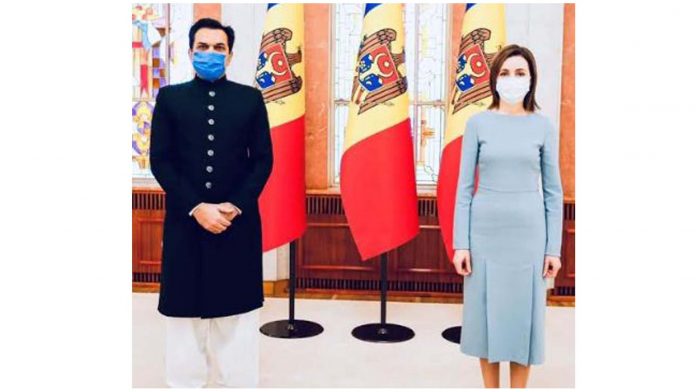
CHISINAU, FEB 13 (DNA) – The Ambassador of Pakistan to Romania Zafar Iqbal , who is also concurrently accredited Ambassador to Moldova, presented his Letter of Credence to the President of the Republic of Moldova, Madam Maia Sandu at a ceremony held at the Presidency in Chisinau.

During the discussion after the ceremony, President Maia Sandu underscored the importance that Moldova attached to its relationship with Pakistan. Dr. Zafar Iqbal, in turn, expressed that he would strive to strengthen bilateral ties and explore ways of furthering trade, investment and economic cooperation as well as people-to-people links between Pakistan and Moldova.

Diplomatic ties between Pakistan and Moldova were formally established soon after Moldova’s independence and since then both countries have enjoyed warm friendly relations.=DNA

=========

Pakistan eye series triumph as Proteas look to bounce back today

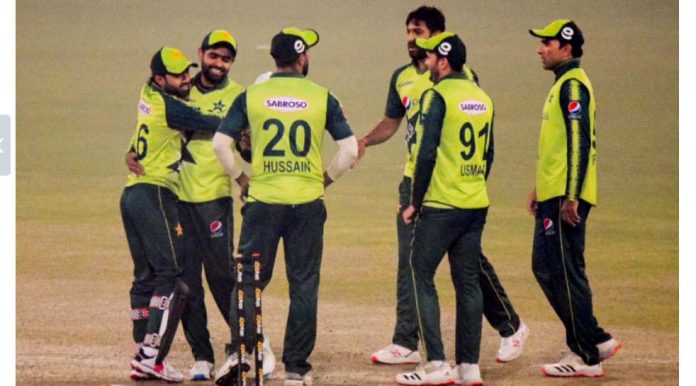
LAHORE, FEB 13: After recording a thrilling three-run victory against South Africa in the first Twenty20 International at the Gaddafi Stadium on Thursday, Pakistan seek to claim the series in the second game at the same venue on Saturday.

Though Pakistan were termed favourites to clinch the series opener under lights, a largely inexperienced but pumped up South African line-up fully stretched the hosts who in the end only managed to sneak home by three runs while defending a total of 169 as paceman Faheem Ashraf conceded 15 runs off a costly final over.

Batting display by all Pakistan players, except for gritty Mohammad Rizwan, remained below par in the first T20. Captain Babar Azam (0), Haider Ali (21), Hussain Talat (15), Khushdil Shah (12), Iftikhar Ahmed (4) and Faheem (4) all failed with the bat. And had Rizwan, who opened with Babar after Heinrich Klaasen opted to bowl first, not scored a gallant century (104 not out off 64 balls), the end result could have been opposite.

Though the home team’s spin duo of Usman Qadir (2-21 off four overs) and Mohammad Nawaz (0-21 off four overs) impressed on Thursday, all their pace bowlers were found wanting which almost cost them the match. Babar and company will need to look into this and make sure that fast bowlers make worthy contributions and support their spinners.

For South Africa, the situation does not seem encouraging as far as their batting is concerned. Apart from openers Janneman Malan (44) and Reeza Hendricks (54) who gave their team a brisk 53-run start inside the first six overs, all the other players including Klaasen fared poorly with the willow, particularly finding spin difficult to handle.

Klaasen’s approach of employing as many as seven bowlers also proved futile.

While the hosts are likely to retain the winning combination, South Africa may make a couple of changes to cover their bases for today’s game which is do-or-die for them.

Fog and dew factor has emerged during the last couple of days, posing a significant threat to completing the match. Heavy fog was witnessed during Thursday’s T20 and the situation was almost the same on Friday morning as well as evening.

However, encouraging is the fact that the met office has not forecast any rain till Sunday.

Teams (from):

PAKISTAN: Babar Azam (captain), Aamer Yamin, Amad Butt, Asif Ali, Danish Aziz, Faheem Ashraf, Haider Ali, Haris Rauf, Hussain Talat, Iftikhar Ahmed, Khushdil Shah, Mohammad Hasnain, Mohammad Nawaz, Mohammad Rizwan (wicket-keeper), Sarfaraz Ahmad (wicket-keeper), Shaheen Shah Afridi, Usman Qadir, Zafar Gohar, Zahid Mahmood

SOUTH AFRICA: Heinrich Klaasen (captain/wicket-keeper), Nandre Burger, Okuhle Cele, Junior Dala, Bjorn Fortuin, Reeza Hendricks, George Line, Janneman Malan, David Miller, Andile Phehlukwayo, Dwaine Pretorius, Ryan Rickelton (wicket-keeper), Tabraiz Shamsi, Lutho Sipamla, J.J. Smuts, Glenton Stuuman, Pite van Biljo (wicket-keeper)

Umpires: Shozab Raza and Asif Yaqoob (both Pakistan)

TV umpire: Ahsan Raza (Pakistan)

Match referee: Mohammad Javed Malik (Pakistan).

——————

The Last False Bet

Syed Nasir Hassan

In the year 2001, Washington closed in on Afghanistan with full zeal and ambitions of rooting out then menacing threat of terrorism. The US adventure in Afghanistan has been a series of high and lows, going through all kinds of phases. Upon dividing the US stay in Afghanistan, toppling the Taliban was aimed for during the first phase. For the second phase, a military defeat of Taliban on the hands of US Army and rebuilding of state institutions was targeted.

During the third phase, after a decade, in 2011, the population was to be protected from Taliban and withdrawal of US forces after transfer of power to Afghan Military and Police was planned. This approach however, failed. Finally, US withdrawal has been the talk of town since then, and till this date, after another decade, US forces have still their feet on Afghan soil.

Now, as the world has entered in 2021, after 20 years of wasting time, resources and energy in the form of Washington’s engagement in Afghanistan, the US decided to square up with the Taliban. The mighty Washington liberal in ideology but illiberal in conviction has now potentially accepted the role of Taliban which once it toppled. The same Taliban which, according to American statements, harbored Osama’s brainchild, and provoked a conflict that turned Afghanistan into ruins. With loss of more than 160,000 lives and flushing away nearly USD 141 billion of taxpayer’s money, Uncle Sam now appears ready for a deal. This diplomatic voyage from bullet to paper took almost 20 years because perhaps United States was unable to realize or learn from Africa the fact that irrespective to reconstruction and building infrastructure, sustenance and stability of a political structure is more important. The more there is political stability the more positive outcome of the reconstruction project would be.

In this regard, the linchpin of US’s foreign policy in Afghanistan under Donald Trump and his entourage would be the Afghan deal. Even before getting elected Trump was a consistent advocate of pulling out United States’ troops from Afghanistan. There has already been much debate about the content and terms and conditions of the whole agreement. Where is it now and how and who will ensure a smooth transition of the political and social system to a new channel? What will happen to the people tired of conflict?

Many specialists have recognized the flaws in the whole procedure as there are a variety of issues that are not being addressed specially in intra-afghan talks. The agreement clearly implicates that Oval Office under Trump was not prepared to deal with Afghanistan as a whole and wanted to pull out its forces from steeps of Afghanistan. Throughout the course of Trump’s policy towards Afghanistan it was shortsighted, focusing only on the withdrawal of troops and relegating to background the problem of the Afghan authorities’ unpreparedness for such a scenario. At the same time, we must not forget that in the event of a failure of the deal, which is now not in the best stage, Afghanistan could be engulfed in a new wave of violence.

At the same time, the American administration for some reason forgets about the many existing international formats for resolving the situation in Afghanistan. All countries of the Central Asian region are interested in resolving the Afghan crisis, which is the main obstacle to regional integration and the implementation of many planned transport and energy projects. At present, the intensification of the work in this direction within the UN, OSCE and the SCO-Afghanistan contact group is obvious. And the fact is that all countries bordering Afghanistan and suffering from the growth of drug trafficking, terrorism and cross-border crimes are in these organizations as permanent members or observers.

Similarly, it can be noted that Washington in the Past period only worsened relations with countries striving for peace and integration in Central Asia and having significant authority in the above-mentioned organizations. For example, instead of sitting down at the negotiating table, even in the difficult times of the pandemic COVID-19, sanctions pressure on Iran continued, a trade was unleashed with China and Russia.

The main issues remain the approaches of the newly elected US President to solving the problem of Afghanistan and his ability to establish an equal approach to a fruitful dialogue with members of the international community interested in a peaceful settlement. However, it is important to note that the stability on Afghanistan can be ensured only through negotiations and search for compromises, as well as by promoting the country’s economic development.

Syed Nasir Hassan is Research Fellow at Islamabad Institute of Conflict Resolution (IICR) and doing MPhil in DSS from Quaid-i-Azam University, Islamabad.

3 candidates to be chosen for Turkey’s space mission

ANKARA, FEB 12: As part of its efforts to put Turkish nationals in space by its centennial in 2023, Turkey is preparing to select three candidates, one of whom will don the astronaut suit.

Once recruited under Turkey’s National Space Program, all three candidates will undergo two years of rigorous training. Among them, the candidate assessed to be the “most successful” will make the upward journey.

The candidates will be selected based on their skills in conducting scientific studies and their physical abilities, though the list of specific criteria will yet be shaped by specialists in various fields including aeronautics, medicine and psychology, officials from the country’s Ministry of Industry and Technology told Anadolu Agency.

The timetable for the launch to the International Space Station will be determined under international cooperation programs. Once there, Turkey’s astronaut will conduct various scientific undertakings from biological experiments to space endurance tests for materials developed in Turkey, with the exact content to be determined by deliberations with universities and scientists.

Alongside expertise in science, technology, engineering and mathematics, national space agencies also often look for certain physical qualities in astronaut candidates, who can be chosen from among military ranks or civilians. Experience in aerospace can also be a reason for preference.

To take part in spaceflight and spacewalks, candidates must meet anthropometric requirements, which are tested through various trials. They also have to have perfect eyesight in both eyes at short and long distances, and not suffer from blood pressure conditions.

Those who conduct scientific studies in space must not consume alcohol or smoke, or have any illness or psychological condition. They must have normal joint and bone structure as well as the mental, personal and spiritual abilities to fulfill the space mission.

Stay Connected

64FansLike
60FollowersFollow

Latest Reviews

Exchange Rates

USD - United States Dollar
EUR
1.14
GBP
1.33
AUD
0.69
CAD
0.70