Home Blog Page 2493

MIAN ANJUM ASKS GOVT TO PUT BUSINESS AND TRADE ISSUES ON PRIORITY LIST

KARACHI /DNA/ – The Federation of Pakistan Chambers of Commerce and Industry’s Businessmen Panel Chairman Mian Anjum Nisar has warned of far higher trade deficit at the end of the current fiscal year 2021-22 than the targeted deficit of $28.4 billion fixed by the government, as trade figures are not as good as being shared by the authorities concerned.

Mian Anjum Nisar said the country’s July-Aug trade deficit has widened 120 percent to $7.5 billion after imports witnessed a new historic peak, with exports growth not matching the pace despite huge depreciation of local currency against the dollar. For the third straight month, exports have been dropping from their previous levels. Our export has long remained around $2 billion per month and the trend does not clearly change despite about 40 percent currency depreciation during the government’s tenure in the past three years. He said that rising imports would not only increase the external borrowing requirements but also dent the foreign exchange reserves, as the exports are not matching the pace of imports while the foreign remittances, which are important source of debt-free financing is expected to grow in single digit.

Mian Anjum Nisar said that previous current account surplus was emerged on the back of a sustained increase in remittances and a smaller trade deficit. To achieve consistency in that trend for a long period without compromising industrial growth the government will have to focus on increasing the exports further and put the business and trade issues on priority, otherwise, the economic problems and balance of payment could further disturb with the growing trade deficit.

The FPCCI former president said the government has already missed its annual export target, requiring at least 6 percent growth, he added. He said that the current export portfolio is marred by a lack of diversification, as few products are exported by some exporters to limited markets. So, a major enhancement in exports requires huge and wide structural reforms.

He, lamenting the gloomy picture of Pakistan’s position in the region with regard to its GDP growth, said that upward trend in remittances to Pakistan from overseas workers is a positive news for the country’s economy. He said that the oversees Pakistanis can invest in housing sector, agriculture, transportation and various other industries, which have huge potential. The government has badly failed to attract foreign investment because the persisting process of approval of projects discourages the investors, he added.

He said that the external trade projections figures have already become irrelevant within two months, showing weakening capacity of the central bank, Ministry of Planning & Development and the commerce ministry, which have been making annual plans, as imports during the Jul-Au period increased 73 percent to $12 while the two-month import bill was equal to 22 percent of the budgeted figures. He asked the economic managers to check the increase in the import of non-essential goods, as the government might face a challenge of an unmanageable current account deficit because of a projected record of $70 billion in imports this fiscal year. He pointed out that Pakistan exports have dropped from their previous levels, as the country’s exports in goods stood at $2.23 billion in August over a year ago, which were higher by 41 percent over the same month of the last year but these export receipts were the lowest in three months. The exports had peaked to $2.73 billion in June, then it dropped to $2.34 billion in July and finally further slipped to $2.32 billion in August.

While the imports last month hit a record high of $6.5 billion, which were higher by 95 percent, leading to widen yearly trade deficit to $4.2 billion in August.

He asked the bureaucracy to mould simple procedures by revisiting the existing processes so that the investors could be facilitated. He called for lowering of import duty on smuggling prone items, increasing the share of direct taxes in revenue and decreasing the slab of indirect taxes to achieve the key economic targets set for the year 2021-22.

He said that a quick turnaround can come from increasing competitiveness of the existing export base and demand-led production of agricultural products, especially high-value agriculture products. The long-term strategy needs structural reforms of the entire export sector, including high tech and innovative products, value-added exports commodities and market diversification towards unexplored markets.

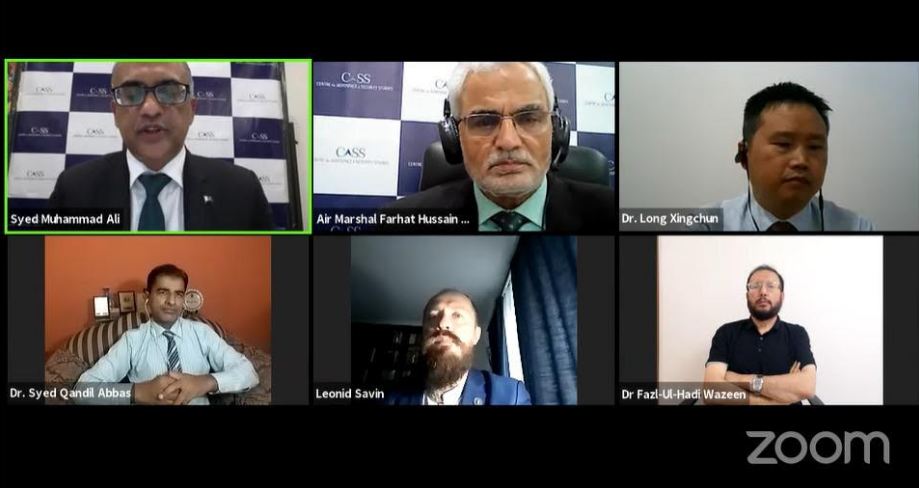
ABANDONING AFGHANISTAN WILL BE A MISTAKE: NSA MOEED YUSUF

ISLAMABAD, Sept 11 /DNA/ – Pakistan’s National Security Advisor Dr Moeed Yusuf has said that abandoning Afghanistan again by the international community will be a mistake. He was delivering the keynote address at an international webinar organized by the Centre for Aerospace & Security Studies (CASS), Islamabad on ‘Future of Afghanistan and Regional Stability: Challenges, Opportunities & Way Forward.’ 


Dr Moeed Yusuf said that the world needs to constructively engage Afghan Taliban in order to prevent governance collapse and avert another refugee crisis. He said Pakistan was coordinating with the world to have a stable and peaceful Afghanistan.Dr Yusuf said that after the Soviet-Afghan Mujahideen conflict in Afghanistan, the Western world committed catastrophic mistakes, including abandoning Afghanistan and sanctioning its “most allied of allies” and Pakistan was the only country which bore the brunt of abandonment of Afghanistan and the subsequent War on Terror. 
Dr Long Xingchun, President Chengdu Institute of World Affairs of China said that neighboring countries have to play the leading role in rebuilding Afghanistan and Pakistan is the most important country in this regard. He said that CPEC should be extended to Afghanistan and Gwadar port can play a big role in strengthening Afghan economy. 
Russian geopolitical expert Leonid Savin said that the recent take-over by Afghan Taliban has changed the regional political dynamics and this will have an impact on global politics. He said Russia can recognize the new government if China recognizes it first.
Professor Dr Fazl-Ul-Hadi Wazeen of Salam University, Kabul said that the international community should not corner Afghanistan and give the new government a chance to rule while Afghan Taliban must also keep their promises, adopt a reconciliatory approach and refrain from the use of force. 
Dr Syed Qandi Abbas of Quaid-e-Azam University said that both Pakistan and Iran expect an inclusive permanent Afghan government in future. He said that the current interim government is not inclusive which has included only three non-Pushtun individuals, out of a total of 34 and Iran expects a greater accommodation of non-Pushtun people if a civil war is to be avoided in future in Afghanistan.
Air Marshal Farhat Hussain Khan (Retd), Acting President of CASS and former Vice Chief of the Air Staff of PAF, in his concluding address urged the world to give peace a chance in Afghanistan and the region, after trying everything else in the past. He also stressed that the regional countries have a common interest in a peaceful and stable Afghanistan while regional connectivity projects such as CPEC could be the harbinger of economic well-being and prosperity for the whole region. 
The webinar was moderated by Syed Muhammad Ali, Director Nuclear & Strategic Affairs, Centre for Aerospace & Security Studies. He said that Afghanistan has remained a victim of conflicts and abandonment. Now the Afghan people deserve international help to rebuild a stable nation-state, in return for a security commitment by the new Afghan government that Afghanistan’s territory will not be used against any other country. 

MOROCCAN KING APPOINTS RNI’S AKHANNOUCH AS HEAD OF NEW GOVERNMENT

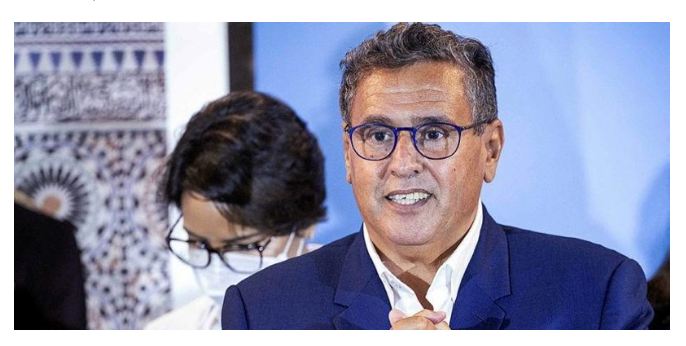
Morocco‘s King Mohammed VI on Friday appointed billionaire fuel tycoon Aziz Akhannouch as prime minister after his party came first in Wednesday’s parliamentary election.

Akhannouch, a former agriculture minister, is one of Morocco’s richest men with a fortune estimated at about $2 billion. He has led the liberal RNI party since 2016.

On Wednesday, RNI won 102 of the parliament’s 395 seats as the vote share of the PJD party that had been the biggest in the previous two elections collapsed.

Under reforms introduced in 2011, the king picks the prime minister from the largest party in parliament but retains veto power over cabinet members. In recent years he has taken back more powers within the palace walls, analysts say.

RNI is seen as close to the royal establishment and Akhannouch said in a speech after the election results were declared that he would “implement his majesty’s vision.”

Akhannouch, whose holding company operates in the fuel and gas distribution business, and was targeted by a consumer boycott campaign in 2018 over prices, has pushed RNI as a champion of social and economic reforms.

It must now build a governing coalition that can command a parliamentary majority of at least 198 seats.

The next-largest party after Wednesday’s vote was PAM, which is also a liberal and pro-establishment, with 86 seats.

The PJD, whose leader Saad Dine El Otmani had been prime minister since 2017, has complained of violations in the election including what it said was vote-buying by rivals.

However, after securing only 13 seats compared to 125 in 2016 it has said it will go into opposition and not seek to join the next governing coalition. Otmani and some other senior members have resigned from their party posts.

MOU SIGNED TO PROMOTE CHINA-PAK COOPERATION IN INTERNATIONAL ARBITRATION

BEIJING, Sept. 11 (DNA): Guangzhou Arbitration Commission (GZAC), China and Center for International Investment and Commercial Arbitration (CIICA) – Pakistan’s first international arbitration center – signed a memorandum of understanding (MoU), to deepen cooperation in international arbitration between both countries, according to China Economic Net.

GZAC stated that the signing of MoU symbolizes the joint construction of Belt and Road Initiative (BRI) by arbitration organizations of China and Pakistan. 

In the future, the two sides will further promote the “Four Sharing”, explore new paths for the development of online dispute settlement mechanisms, jointly cope with the increasing number of transnational disputes and offer international arbitration services in a better way.

Chen Simin, Director of GZAC, noted on the occasion that the cooperation reached between CIICA and GZAC in the “Four Sharing” will surely promote the cooperation between China and Pakistan in the field of arbitration legal services.

Rana Sajjad Ahmad, Founder & President of CIICA, pointed out that at present, the construction of CPEC is of great importance to Pakistan’s development, and there is an urgent need to improve the relevant legal dispute settlement mechanism.

“CIICA highly acknowledges the innovation and achievements in the construction of the online dispute settlement mechanism of GZAC,” he said, adding that CIICA is willing to collaborate with GZAC to promote the integration and interoperability of arbitration legal services between both countries.

Yang Yong, Director of China Council for the Promotion of International Trade, Guangzhou Committee, congratulates on the signing of the MoU and said it is hoped that through this cooperation, both sides can deepen mutual understanding and actively promote the development of bilateral trade and investment cooperation with international commercial arbitration.

With the deepening of trade and industrial cooperation between China and Pakistan, how to deal with the inevitable transnational commercial disputes has become a common concern of both sides. 

“Therefore, international arbitration is getting more and more important in promoting trade, investment, finance and infrastructure construction in CPEC,” remarked Ahmer Bilal Sufi, Former Federal Minister for Law and Parliamentary Affairs of Pakistan.

ICCI calls for urgent remedial measures to stabilize exchange rate

Islamabad /DNA/ – The Islamabad Chamber of Commerce & Industry (ICCI) has shown great concerns over the falling value of rupee against dollar as it would create multiple problems for business & economy and called upon the government to take urgent remedial measures for ending the volatility and bringing stability in the exchange rate.

Sardar Yasir Ilyas Khan, President, Islamabad Chamber of Commerce & Industry said that the value of Pakistani rupee has now tumbled to over Rs.168 against one dollar, which showed that our currency was losing its value at an alarming rate. It reflected a deteriorating market perception about the country’s capacity to finance its foreign debt obligations going forward. He said that the constant erosion in the value of rupee was severely disturbing all future plans of the business community as it needed a stable exchange rate for long-term business and investment planning.

He said that people were already facing great problems due to high inflation and falling value of rupee would bring a new wave of inflation in the country making life of common man more miserable. He said that Pakistan’s trade deficit has risen sharply in August driven by surging imports compared to exports as merchandise trade deficit has reportedly reached $4.05 billion in August against $1.740bn over the corresponding month of last year showing an increase of 133 percent. He stressed that the government should incentivise imports substitution to reduce dependence on imports that would arrest further devaluation of rupee and prevent the build-up of imported high inflation. He said that the traders were also reportedly booking dollars for future import payments at a higher premium or spread, which predicted further rupee depreciation. He said that in this scenario, the growth of the economy would remain uncertain amid fears of further deterioration in the fiscal and current account imbalances and it was high time that the government should take urgent remedial measures to curb the situation from getting worse.

Fatma Azim Senior Vice President and Abdul Rehman Khan Vice President ICCI said that some industries were importing around 70 percent of their raw material for manufacturing activities and decreasing value of rupee would further push up production cost making our exports more uncompetitive in the international market. They said that the government was charging high taxes on POL products and emphasized that it should make significant cuts in such taxes in these tough times to provide some relief to the inflation-hit people.  

E-Paper 11-09-2021

E-Paper 11-09-2021

PCB CAN MAKE CHANGES TO T20 WORLD CUP SQUAD UNDER SPECIAL CIRCUMSTANCES: CHIEF SELECTOR

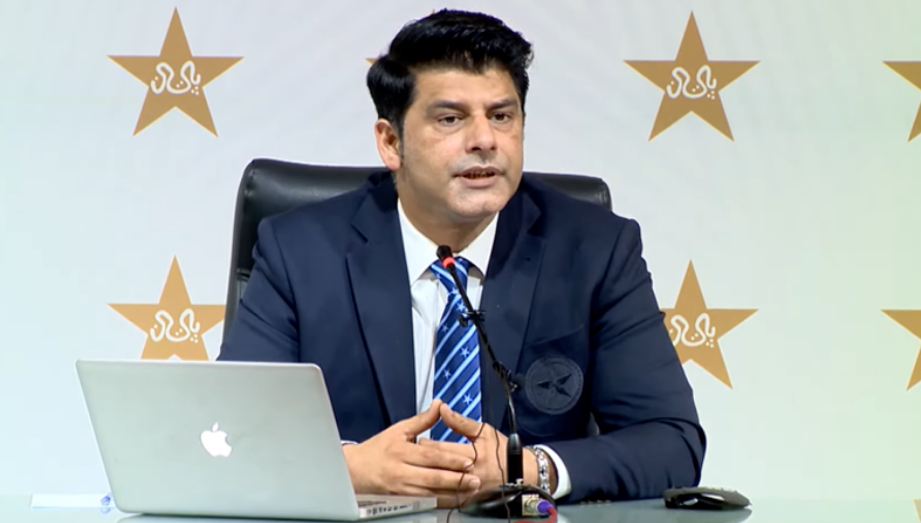
ISLAMABAD, SEPT 10: Pakistan Cricket Board (PCB) Chief Selector Mohammad Wasim on Friday said changes could be made to the squad announced for next month’s T20 World Cup under “special circumstances and in exceptional cases”.

he said that he “would not rule out changes” to the national team, which was announced earlier this week, as International Cricket Council (ICC) rules allowed changes to be made to the T20 World Cup squads till Oct 10.

“Of course, we did not announce the ICC World T20 Squad [just] to make changes later but under special circumstances [and in] exceptional cases, we can make changes in the announced squad,” he added.

Wasim admitted there were problems with the middle-order batsmen in the national side and implied that the previous management, led by former coach Misbah-ul-Haq, was to blame.

“We have a solid opening stand in the form of Babar [Azam] and [Mohammad] Rizwan, we also have experienced Mohammad Hafeez in the batting order but there many factors behind why we included Asif Ali, Khushdil Shah and Azam Khan in the middle order,” he shared.

Elaborating, the chief selector said, “Most of the middle-order players did not perform as per expectations and were not able to cement their place. I also have my reservations about the way chances were given to a few players by the [previous] management.”

Wasim defended selecting Asif, Khushdil and Azam, saying he was “hopeful” they would all perform well in the T20 World Cup. “Asif Ali performed well as a power hitter in the PSL and Khushdil Shah showed improvement in the recent domestic season. Azam Khan also maintained a good strike rate in PSL.”

Azam was also a reserve wicketkeeper for the team, Wasim said, adding that the PCB believed that if needed, the player could perform well in the role.

When asked about former captain Sarfaraz Ahmed’s exclusion from the national squad, the chief selector hinted that there was no place for him in the immediate future.

“Sarfaraz was in the Pakistan squad for the last two years but after Rizwan’s emergence and especially after his world-class performances, Sarfaraz did not find a slot in the playing 11 and that’s why we decided to include Haris [Rauf] in the ODI Squad and Azam as 2nd wicketkeeper in the World Cup Squad.”

When the show’s host pointed out that Sarfaraz had been included in all three formats previously and was dropped right before the T20 World Cup, Wasim said it was because squads had to be limited amid the pandemic.

“Previously, we obviously had the luxury of extended squads in which we could keep two or three [extra] options. Sometimes, a squad of 20 [players] went, sometimes 27. But you cannot go above 15 in the ICC event. So, in the 15-member squad, you have to select the best and fit options,” he added.

JOINT ACTION COMMITTEE EXPRESSES FULL SUPPORT FOR PFUJ’S DEMONSTRATION ON SEPT 13

KARACHI, SEPT 10 (DNA) – A meeting of the Joint Action Committee of Media Organizations was held on September 10, 2021. All representative media organizations namely Pakistan Broadcasters Association (PBA), All Pakistan Newspapers Society (APNS), Council of Pakistan Newspaper Editors (CPNE), Pakistan Federal Union of Journalists (PFUJ), and the Association of Electronic Media Editors and News Directors (AEMEND) reiterated their stance of rejecting the proposed Pakistan Media Development Authority (PMDA) vehemently and termed the concept as unconstitutional and a move to muzzle the freedom of press and expression by imposing state control to regulate all media platforms under one central body.

The Joint Action Committee expressed full support for the PFUJ’s demonstration on September 13 in front of the Parliament House against the establishment of the proposed Pakistan Media Development Authority. The statement further said, in addition to all media representative organizations, the Bar Associations, political parties, Human Rights organizations, and other civil society organizations will also participate in the sit-in.

All media associations in Joint Action Committee reiterated their commitment to thwart the government’s efforts to legislate for the establishment of the proposed Media Development Authority.

JAPAN ENVOY LAUDS PM KHAN FOR ADOPTING ‘MIYAWAKI METHOD’

ISLAMABAD, SEP 10 (DNA) – Japanese Ambassador to Pakistan Matsuda Kuninori on Friday appreciated Prime Minister Imran Khan for his initiative of adopting the “Miyawaki Method” for tree plantation campaigns in Pakistan.

Expressing his gratitude to PM for condolences over the passing away of Dr Miyawaki Akira, Ambassador said, “I hope that by tree planting activities, with the cherished memory of the late Professor Miyawaki, trees and forests throughout Pakistan will grow strongly, as Pakistan will do certainly”, said a press release issued here.

Prof Dr Miyawaki Akira, a Japanese botanist and expert in plant ecology passed away at the age of 93 in July this year. In Pakistan, he was known for “Miyawaki method,” tree planting approach actively promoted at the initiative of Prime Minister Imran Khan, said a press release issued by Embassy of Japan.

Under this approach, dozens of species that suit the environment are planted in the same area, close to each other, which ensures their growth in a competitive environment, allowing the trees to grow faster compared to normal plantation.

On the sad demise of Dr Miyawaki, PM Khan conveyed his sincerest condolences, which has been shared with Yokohama National University, where Dr Miyawaki worked as Professor Emeritus.

In response, UMEHARA Izuru, President of Yokohama National University, has conveyed his appreciations to PM Khan upon receiving his condolence message. = DNA

=======================

E-COMMERCE PROVIDES OPPORTUNITIES TO SMES TO BOOST EXPORTS

ISLAMABAD, SEPT 10 (DNA) – The internet has most critical role to play in emerging business environment and has already been able to contribute more than 15% of global GDP. Likewise, digital economy and e-commerce are great opportunity for SMEs, which are back bone of Pakistan’s economy as there are more than 3.2 million SMEs, accounting for nearly 90% of all enterprises in the country. 

This was the crux of discussion by trade experts during the webinar ‘Ecommerce and SMEs Preparedness’ organized by Sustainable Development Policy Institute (SDPI), in collaboration with International Trade Center Geneva (ITC) and Ministry of Commerce, here on Friday.   

The trade experts also highlighted that SMEs in Pakistan employ about 70% of the national labor force whereas exports by Pakistani SMEs account for 25% of total exports of the country. The true potential of SMEs can be leveraged if they become technology and internet enabled and thus, having the right eco-system and policy environment to trade internationally through ecommerce.

National Project Coordinator of ITC, Dr Tauqir Shah, while giving the overview of the Revenue Mobilisation, Investment and Trade Programme (ReMIT), which has been taken in partnership with ministry of commerce, said that ITC will strive to   enable small and medium enterprises (SMEs) in Pakistan to effectively engage in international markets.

He added that ITC is the only development agency that is fully dedicated to supporting the internationalization of small and medium-sized enterprises (SMEs). ITC enables SMEs in developing and transition economies to become more competitive and connect to international markets for trade and investment, thus raising incomes and creating job opportunities, especially for women, young people, and economically left behind communities.

Ms Aisha Humera Moriani, Senior Joint Secretary E-Commerce, Ministry of Commerce (MoC, informed the participants that the National Ecommerce policy is setting the direction for development of ecommerce, and it highlights SMEs as a key pillar. She added further that the freelancers are adding on to the ecosystem by creating huge remittances by contributing to the economic cycle of the country. She said that role of MoC is to ensure that public authorities and private sector can function and work hand in hand. 

While highlighting the regulatory challenges Director General, Competition Commission of Pakistan, Mr Ahmad Qadir, explained that the key stakeholders are e-commerce enterprises, financial institutions, revenue authorities, regulatory bodies and most importantly the consumers. He said that the consumer protection guidelines should be adhered to in line with the e-commerce policy framework.

Dr Vaqar Ahmed, Joint Executive Director, SDPI, earlier asserted that there are three most crucial areas for promotion of e-commerce including enabling infrastructure for online businesses in second-tier cities and rural areas; reducing fragmentation in tax regime faced by these businesses; and responding to customer feedback and experience in a more responsive manner.

Asfandyar Farrukh, Member National E-Commerce Council, Mr. Sheharyar Tahir, Head, External Affairs, SMEDA, Dr. Ghulam Samad, Senior Research Officer, CAREC Institute, also shared their insights and experience on participation of SMEs in global trade through e-commerce. They were of the view that fundamental issue is the financing faced by SMEs in reference to e-commerce policy.

The experts highlighted that the cross-border e-commerce provides a unique opportunity for small and medium-sized enterprises (SMEs) in countries and regions that may traditionally have found it difficult to reach regional and international markets and connect with potential buyers beyond their borders. SMEs development is directly linked with the development of cross border ecommerce.

Stay Connected

64FansLike
60FollowersFollow

Latest Reviews

Exchange Rates

USD - United States Dollar
EUR
1.16
GBP
1.35
AUD
0.71
CAD
0.71