Home Blog Page 1557

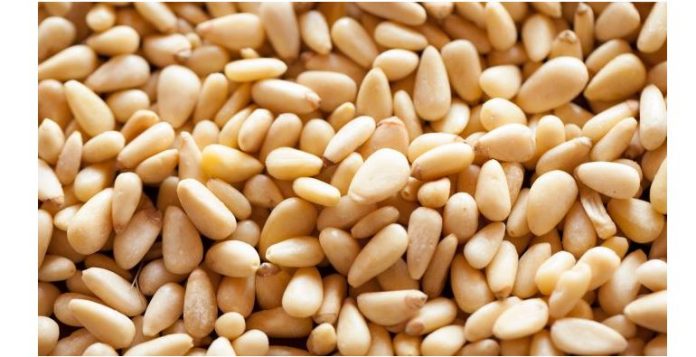
Pakistani pine nuts exports to China $41.48 mln in first seven months

BEIJING, Aug. 24 (DNA): Pakistani Pine nuts exports to China in the first seven months of this year crossed $41.48 million, Gwadar Pro reported on Wednesday quoting official data of China’s General Administration of Customs.

The data showed that during January-July of 2022, China imported 3,770.76 tons of pine nuts from Pakistan worth $41.48 million while in the same period, China imported 11,513.7 tons of pine nuts around the world valuing about $88.020 million. 
Overall, China has imported $88.020 million of pine nuts and out of that 47.12% is from Pakistan.

Yar Muhammad Niazi, Chief Executive of Hangzhou Aiza Food, and Shaoxing Aiza Trading told Gwadar Pro that the export of Pakistani pine nuts to China enjoys zero tariffs and Pakistani pine nuts are classified as high-end snacks in the Chinese market.

“The overall price of Pakistani pine nuts in the Chinese market is on the rise. This year’s season will start in late September and our target is to export 1,500 tons to China. China is a big market and we need to do B2B cooperation to capture a larger part of this market,” Niazi said.

He added that for the last two year the price remained low, valuing ¥130-140 per KG, while this year’s price is expected to go a little higher. 
They are now working on the value addition of this product and launching a new brand. Pakistani and Chinese governments should support Pakistani enterprises to participate in the exhibitions here to increase Pakistan’s exports to China, he added.  
Qadir Baloch comes from Balochistan, Pakistan. He and his family have been associated with the pine nuts business for the last fifty five years. He told Gwadar Pro that they export pine nuts to the USA, China, Europe, and some Arab countries.

“Our business has been badly affected by the travel and trade restrictions imposed globally due to the COVID-19 pandemic; secondly, a fire engulfed thousands of pine nut trees in Sherani, Balochistan last May, which caused us a very huge loss,” he mentioned.

Baloch further said that the fire has destroyed hundreds of trees located on Koh-e-Sulamain, a mountain range that connects three Pakistani provinces – Balochistan, Khyber Pakhtunkhwa, and Punjab – but still, they are trying to manage the situation and increase their exports to friendly countries, especially China.

“I would like to use this platform to thank Iran and China for helping Pakistan take immediate measures to control the fire that had put the lives of wildlife at risk in Balochistan,” Qadir stated.

He said that in the last few years China has become the main destination for Pakistani pine nuts and that is why local exporters are happy that they can earn a good profit from the neighboring market.

“China is one of the biggest buyers of pine nuts from Pakistan and even during the epidemic the Chinese government played a very vital role in having flexible policies in trade with Pakistan and that’s the reason why so far we have been successful to export pine nuts to China in huge quantity,” he added.

Data also showed that China imported 6,954.64 tons of pine nuts worth $39.19 million from Russia, 568.1 tons worth $4.32 million from Kazakhstan and 220.18 tons of pine nuts valuing $3.01 from Afghanistan in the first seven months of this year.
Wheat imports via Gwadar on the cards

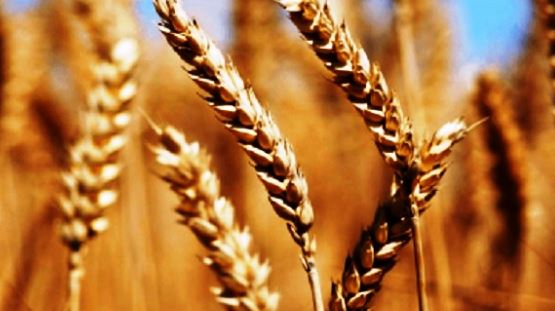
ISLAMABAD, Aug. 24 (DNA):  In a major development, wheat imports via Gwadar are being planned in collaboration with Gwadar Port Authority and National Food Security Division, promising to usher in a new era of business, commerce and trade vibrancy at Gwadar port.
Salient headway came up in an important meeting between Gwadar Port Authority (GPA) Chairman Naseer Khan Kashani and National Food Security Division Secretary Zafar Hasan, as per the Gwadar Pro’s reported on Wednesday.
GPA Chairman Naseer Khan Kashani dubbed the readiness to import wheat using Gwadar port a new milestone, saying wheat imports will spur up trade activities in Gwadar. 

“It will also boost employability when bustling activity get underway, skilled, semi-skilled and unskilled man force will be required to handle the entire scale of work.”

In order to materialize the wheat import seeking input of stakeholders, GPA Chairman Naseer Khan Kashani has also decided to hold a consultative meeting with local investors and Gwadar Chamber of Commerce and Industry soon.
On the occasion, National Food Security Division Secretary Zafar Hasan said “we are giving a serious thought to import bigger part of our wheat quota using useful channel of Gwadar port the first time.” 

He said that more thought-provoking meetings are planned to be held seeking numerous insights into the merits of wheat import via Gwadar. He hoped that National Food Security will gear up to make things happen at the earliest.

China, Pak jointly train talents for CPEC agricultural cooperation

BEIJING, Aug 24 (DNA): China and Pakistan had geard up for agricultural cooperation under the China-Pakistan Economic Corridor (CPEC),  according to a report published by China Economic Net (CEN)on Wednesday.
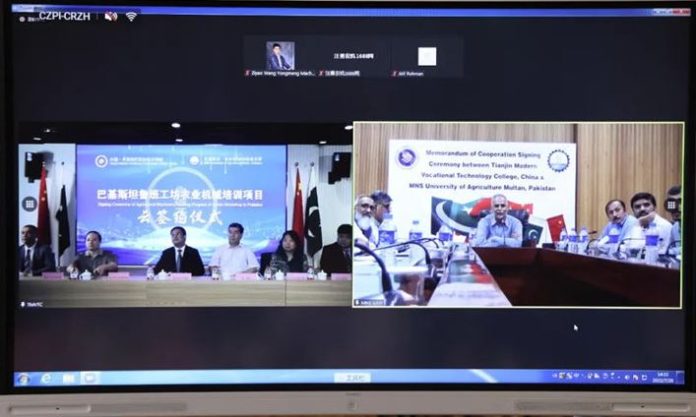
To train talents for China-Pak agricultural cooperation, Tianjin Modern Vocational Technology College (TMVTC), China and MNS-University of Agriculture, Multan (MNSUAM), Pakistan signed online an agreement for an agricultural machinery training program of Luban Workshop in Pakistan on July 28, 2022.
The two institutions will jointly promote the sci-tech exchanges and cooperation on agricultural machinery, germplasm resources and agricultural environment. They also aim to deepen the two nations’ vocational education cooperation and make contributions to Pakistan’s modernization of agricultural machinery.
At the ceremony, Kang Ning, President of TMVTC expressed that the Luban Workshop program is going to launch one or two kinds of vocational training on the whole process mechanization operation of crops for young Pakistanis based on the nation’s agricultural automation development demand.
The vocational training of China’s Luban Workshop has enabled more and more young Pakistanis to participate in the process of globalization, said Afifa Shajia Awais, Education Attaché of the Embassy of Pakistan in China, at the World Vocational and Technical Education and Development Conference held in August 2022 in Tianjin China.
According to Kang, TMVTC has been engaged in the operation of Luban Workshop program in Pakistan since it was launched in July 2018. TMVTC has completed totally 3,200 teaching hours in Lahore Punjab so far. About 95 young Pakistanis have finished training on electric automatization and mechatronics. The program has been incorporated into G3 vocational training system in Punjab, Pakistan.
Pakistan needs millions of skilled people to industrialize itself, according to Afifa Shajia Awais.
The Luban Workshop is a Chinese vocational workshop program training talent overseas, a win-win model for international vocational education cooperation. The program is named after Lu Ban, an ancient Chinese woodcraft master.

Cordial Ties with Multiple Global Players Imperative to Meet Growing Energy Needs

Islamabad: /DNA/ – The ongoing global transformation marked by growing US-China rivalry, increasing US-India strategic relations, Russia-Ukraine conflict, and climate change posed serious challenges to Pakistan’s foreign policy, said Ambassador Nadeem Riyaz, President IRS. He was addressing a seminar organized by the Department of Strategic Studies at Quaid-i-Azam University Islamabad.

He added that Pakistan should consider realignments vis-à-vis global environment. Besides the global environment, regional environment was also imperative. He asserted that we could not change our neighbors so it was vital to coexist with them. Pakistan needed to manage its relations with India, alongside dealing with Afghanistan, and the difficult relations with Iran, he said. He stressed the need for Pakistan to keep its ties unaffected with China, especially considering the fact that had taken a rather low-profile in recent past.  

He also highlighted that foreign policy was an extension of domestic policy so current political instability was posing a challenge to our foreign policy. Among other challenges, negative perceptions about Pakistan had always been a serious challenge. He further discussed that the strategic importance of Pakistan came at cost of various obstacles and that the most notable among Pakistan’s involvement in bloc politics.

While concluding the session, Ambassador Riyaz proposed solutions to the current trials that the country had been going through. He suggested that Pakistan must balance its ties with US and China while navigating Sino-US rivalry. Additionally, managing relations with India was also imperative as it bore the potential of initiating intra-regional trade. Moreover, Pakistan needed to effectively deal with Afghanistan while simultaneously maintaining balanced relations with Iran and KSA. He added that cordial relations with the entire international community were integral in present times, especially considering the current energy needs of Pakistan which required inevitable reliance on multiple global players.

Brutality Can’t Prosper

Dr. Abdus Sattar Abbasi

Despite huge military might, exceptional industrial potential and deep global penetration Israel failed to provide happy and peaceful life to Israelis. The eventual purpose of the progress and the development is to provide prosperous lifestyle to the nation but Israel remained terribly unsuccessful to realise this dream of millions of Jews because of fundamental flaw in the national approach which rests on oppression, occupation and brutalities against unarmed Palestinians.In spite of exceptional economic growth, erecting separation wall regardless of international condemnation and significant military capabilities Israeli citizens are subject to continuous threat of war and conflict.

There is no comparison of fighting capabilities of Israeli defence forces and Palestinians. According to the Global Fire Power (GFP) website, “For 2022, Israel is ranked 18 of 142 out of the countries considered for the annual GFP review while Pakistan is ranked among top ten. Israel holds a Power Index (PwrIndx) score of 0.2621 (a score of 0.0000 is considered ‘perfect’).

The finalized Global Firepower ranking utilizes over 50 individual factors to determine a given nation’s Power Index score with categories ranging from military might and financials to logistical capability and geography. The smaller ‘PwrIndx’ value the more powerful a nation’s theoretical fighting capability is by conventional means as nuclear capability is not taken into account.” How can anybody justify attacks of such a strong military on unarmed and civilian population of Palestine? A country with more than 40 thousand dollars GDP per capita being 31st biggest economy of the world with around 9 million of population can extend every peace and comfort to the citizens but Israel rendered nothing but incessant state of fear and unrest to its people.

Since we started learning about global dynamics we are witnessing brutalities of Israel onvulnerable Palestinians.After recent attacks of Israel on Gaza it was heart-breaking listening to a mother when she found her son has been martyred. Addressing a gathering while controlling her sorrow and grief she told age fellow of her son that my son has been shot but you all are like my son. My son followed the path of the prophets. He left for the beloved Creator. My son is the son of Palestine he is precious than my soul, I gave him to the Last Messenger, I gave him to Masjid Al-Aqsa, I gave him to the Creator, the One, the Eternal, the Satisfier of needs.  

Israel does this as a policy, according to Yuval Abraham, “The majority of Israelis believe that hundreds of children or families killed in Gaza during Israel’s military operations are killed unintentionally unlike the terrorist organizations. The former soldiers testified that they were told by their superiors that there is a certain number of ‘non-combatants’ — meaning families and children — that the army is allowed to kill during operational activities. The control of the borders, and the dependence of the strip’s residents on Israel, provides Israel with superior intelligence. They have no way to get out of there. Israel controls all their crossings — that gives Israel a lot of power. If Gaza is connected to the West Bank, you lose some of that power. Today we control everything that goes in and out, whether physically, electronically, or in terms of people. This allows for more modes of action: for example, people in Gaza beg to be able to travel in order to study abroad or visit relatives outside the strip. There is no such thing as privacy in Gaza. You know everything about the person. What they like, what they have photographed [on their phone], and whether they have a lover. Everything is completely exposed. You can collect information about anyone you want. And you know that these people wouldn’t want you to know these things.”

Last year’s report by the Amnesty International speaks volumes about brutalities of Israel. Report states, “During the armed conflict in May 2021, Israel committed apparent war crimes and possible crimes against humanity in the Gaza Strip. According to the OHCHR and the WHO, 242 Palestinians were killed, including 63 children, and some 9,000 were injured. More than 74,000 Palestinians were displaced. The housing needs of 4,000 families, including 7,000 children, whose homes were damaged or destroyed, had not been met by December. On the 10thMay, Israel bombed the seawater desalination plant in north Gaza, cutting water supplies to more than 250,000 people.”

In a latest report in February this year the agency states, “Israeli authorities must be held accountable for committing the crime of apartheid against Palestinians. Israel enforces a system of oppression and domination against the Palestinian people wherever it has control over their rights. Massive seizures of Palestinian land and property, unlawful killings, forcible transfer, drastic movement restrictions are all components of a system which amounts to apartheid under international law. This system is maintained by violations which Amnesty International found to constitute apartheid as a crime against humanity, as defined in the Rome Statute and Apartheid Convention. Amnesty International is calling on the International Criminal Court (ICC) to consider the crime of apartheid in its current investigation in the Occupied Palestinian Territories (OPT) and calls on all states to exercise universal jurisdiction to bring perpetrators of apartheid crimes to justice.”

International community should remember that liberation from such atrocities and brutalities is the natural outcome. According to Geraldine L. Palmer and her colleagues, “At a collective or community level, liberation is only possible when the group is able to gain power and control over the systems, and institutions that surround their lives. Liberation is a social act, a process of becoming free from ideologies that limit our freedom and the institutions or structures that constrain people’s collective determination. Liberation must be understood as having a critical consciousness of the circumstances and conditions of oppression that challenge and limit opportunities for freedom. Liberation is the dismantling of oppression and power, and striving to recognize the humanity and dignity of all people.”

Israel should also learn from 20 years of NATO allied forces in Afghanistan which resulted in a cost around two and a half trillion dollars with eventual withdrawal without any significant achievement except increasing burden to their budgets. We all should respect and support the desire and struggle of Palestinians for liberation from never-ending brutalities of Israel because as Martin Luther King said, “The silence of good people is more dangerous than the brutality of the bad people”.

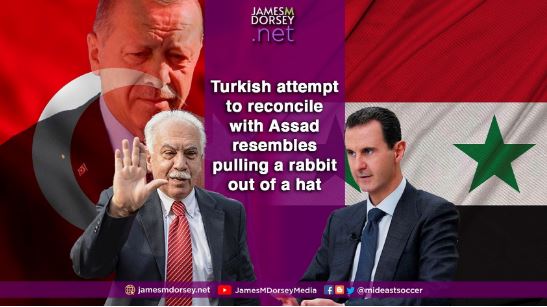
Turkish attempt to reconcile with Assad resembles pulling a rabbit out of a hat

At first glance, there is little that Turkish President Recep Tayyip Erdogan, an Islamist and nationalist, has in common with Dogu Perincek, a maverick socialist, Eurasianist, and militant secularist and Kemalist.

Yet it is Mr. Perincek, a man with a world of contacts in Russia, China, Iran, and Syria whose conspiratorial worldview identifies the United States as the core of all evil, that Mr. Erdogan at times turns to help resolve delicate geopolitical issues.

Seven years ago, Mr. Perincek mediated a reconciliation between Russia and Turkey after relations soured following the Turkish air force’s downing of a Russian fighter.

Now, Mr. Perincek is headed for Damascus to engineer a Russian-backed rapprochement with Syrian President Bashar al-Assad, whose overthrow Mr. Erdogan had encouraged for the past 11 years ever since the eruption of mass Arab Spring-era anti-government demonstrations that morphed into a bloody civil war.

Chances are that Mr. Perincek’s effort will be more successful than when he last tried in 2016 to patch up differences between Mr. Erdogan and Mr. Al-Assad but ultimately stumbled over the Turkish leader’s refusal to drop his insistence that the Syrian president must go.

Mr. Erdogan has suggested as much in recent days, insisting that Turkey needed to maintain a dialogue with the government of Mr. Al-Assad.

“We don’t have such an issue whether to defeat Assad or not… You have to accept that you cannot cut the political dialogue and diplomacy between the states. There should always be such dialogues,” Mr. Erdogan said.

He went on to say that “we do not eye Syrian territory… The integrity of their territory is important to us. The regime must be aware of this.”

Mr. Erdogan’s willingness to bury the war hatchet follows his failure to garner Russian and Iranian acquiescence in a renewed Turkish military operation in northern Syria. The operation was intended to ensure that US-backed Syrian Kurds, whom Turkey views as terrorists, do not create a self-ruling Kurdish region on Turkey’s border like the Kurdish autonomous region in northern Iraq.

Turkey hoped the operation would allow it to create a 30-kilometre buffer zone controlled by its forces and its Syrian proxies on the Syrian side of the two countries’ border.

Russia and Iran’s refusal to back the scheme, which would have undermined the authority of their ally, Mr. Al-Assad, has forced Turkey to limit its operation to shelling Kurdish and Syrian military positions.

The United States’ seeming unwillingness to offer the Kurds anything more than verbal support, and only that sparsely, has driven the Kurds closer to Damascus and, by extension, Russia and Iran as Syria quietly expands its military presence in the region. The US has long relied on the Kurds to counter the Islamic State in northern Syria.

The rejiggering of relationships and alliances in Syria is occurring on both the diplomatic and military battlefield.

The Turkish attacks and responses by the Syrian Democratic Forces (SDF) with the Kurdish People’s Protection Units (YPG) at its core appear to be as much a military as a political drawing of battlelines in anticipation of changing Turkish and Kurdish relations with the Al-Assad government.

By targeting Syrian military forces, Turkey is signalling that it will not stand idly by if Syria supports the Kurds or provides them cover, while unprecedented Kurdish targeting of Turkish forces suggests that the Kurds have adopted new rules of engagement. Turkey is further messaging that it retains the right to target Kurdish forces at will, much like it does in northern Iraq.

Both Mr. Erdogan and the Kurds are placing risky bets.

The Kurds hope against all odds that Mr. Al-Assad will repay the favour of allowing the president to advance his goal of gaining control of parts of Syria held by rebel forces and forcing a withdrawal of US forces from the area by granting the Kurds a measure of autonomy.

With elections in Turkey looming in the next year, Mr. Erdogan hopes that Mr. Al-Assad will help him cater to nationalist anti-Kurdish and anti-migrant sentiment by taking control of Kurdish areas.

Turkey wants to start repatriating some of the four million predominantly Syrian refugees it hosts. In early August, Turkey’s interior ministry announced that it had completed the construction of more than 60,000 homes for returning refugees to northeastern Syria.

Concern about a potential deal with Mr. Al-Assad and a call by Turkish Foreign Minister Mevlut Cavusloglu for reconciliation between opposition groups and Damascus sparked anti-Turkish protests in Turkish-controlled areas of northern Syria as well as rebel-held Idlib.

Turkey also expects Mr. Al-Assad, who is keen to regain not only territorial control but also maintain centralized power, to ultimately crack down on armed Kurdish groups and efforts to sustain autonomously governed Kurdish areas.

As a result, Mr. Perincek, alongside Turkish-Syrian intelligence contacts, has his work cut out for him. The gap between Turkish and Syrian aspirations is wide.

Mr. Al-Assad wants a complete withdrawal of Turkish forces and the return of Syrian control of Kurdish and rebel-held areas. He is unlikely willing or able to provide the kind of security guarantees that Turkey would demand.

Both the Kurds and Mr. Erdogan are caught in Catch-22s of their own that does not bode well for either.

The Kurds may be left with no options if a Turkish-Syrian rapprochement succeeds or face a Turkish onslaught if it fails.

Similarly, reconciliation on terms acceptable to Mr. Erdogan may amount to pulling a rabbit out of a hat.

Whether he agrees with Mr. Al-Assad or violence in northern Syria escalates, Mr. Erdogan risks sparking a new wave of refugees making its way to Turkey at a time that he can economically and politically least afford it.

In the words of analyst Kamal Alam, Mr. Erdogan’s problem is that the Turkish president “is running out of time before the next election to solve the Gordian knot that is Syria. For his part, Assad can wait this out – because after Turkey once again fails to bomb its way out of the northeastern problem, Erdogan will need Assad far more than the reverse.”

Dr. James M. Dorsey is an award-winning journalist and scholar, an Adjunct Senior Fellow at Nanyang Technological University’s S. Rajaratnam School of International Studies, and the author of the syndicated column and blog, The Turbulent World of Middle East Soccer.

15 more dengue cases reported in RWP

RAWALPINDI, Aug 23: As many as 15 more dengue cases were reported in Rawalpindi during the last 24 hours, raising the tally of confirmed cases to 194.

District Coordinator Epidemics Prevention and Control (DCEPC), Dr Sajjad Mehmood Tuesday said that, among the new cases, seven patients had arrived from Dhama Syeda and four from Chak Jalaldin in the Potohar town area while two cases were reported each from Kahutta and Islamabad.

During the last 24 hours, he added, around 128 dengue fever suspects were

brought to the city’s hospitals, out of which 15 tested positive, 22 probable and four non-dengue.

He added that six dengue patients with positive symptoms were admitted to the Holy Family Hospital and five to the Benazir Bhutto Hospital.

Dr Sajjad said that the district administration had sealed 351 premises, registered 897 FIRs, issued challans to 1,155, notices to 5,376, and a fine of Rs 3,133,500

was imposed on violations of SOPs in various areas of the district from January 1, 2022.

He added that prevailing weather was suitable for breeding dengue larvae and asked the concerned to remove stagnant water in outdoor and household settings to stop mosquitoes from breeding after rain and submerged water.

Furthermore, the health official urged the residents to keep their water tanks clean and not to leave any place wet with stagnant water as water accumulation was a leading cause of mosquito-borne diseases, including dengue fever.

Defining moment: Imran Khan invites youth to join ‘Imran Tigers’ 

DNA

Urges youth to convey his message of true independence door to door

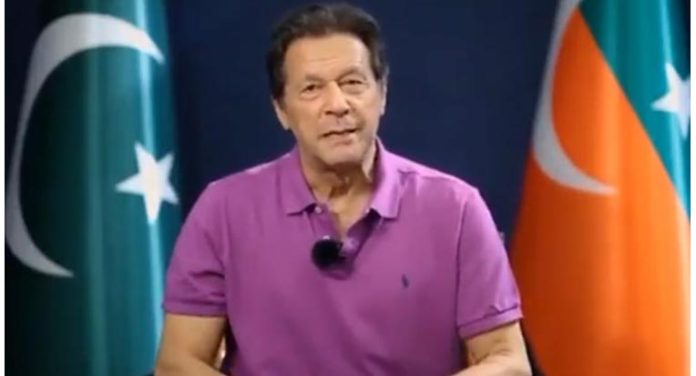
ISLAMABAD: As the journey of true freedom has now entered into a decisive phase, Pakistan Tehreek-e-Insaf (PTI) Chairman Imran Khan invited the youth to join the “Imran Tigers” in order to convey his message of really freedom door to door.

“Imran Tigers” will be the passionate youth of my country who will take my message to every nook and corner of the country,” Chairman PTI added.

Imran Khan further elaborated that his message was the message of true freedom and how they can become an independent and self-respecting nation, as there was a system of ignorance and injustice.

However, PTI Chairman stated that for this, he needed his youth to convey the message of true freedom everywhere.

Explaining the process of joining “Imran Tigers”, he said that just send ‘Yes’ on WhatsApp number 0300-1119444 and become a part of “Imran Tiger” immediately.

He further stated that after writing ‘Yes’, a website name would appear in the message and register in it.

Imran Khan urged that he wanted all the youth should fully participate fully in it because this would be the first step towards real independence.

“There is a system of injustice and ignorance in the country, as if a poor person steals something, he goes to jail, if a rich person commits robbery, he gets NRO,” Imran Khan added.

He said: “Iqbal’s Shaheen is the one who breaks chains and flies.” However, he said that unfortunately, we have not been able to become an independent nation hitherto.

He expressed the optimism that the journey of true freedom has now entered into a decisive phase to get the true freedom. 

Imran Khan went on to say that he also needed dedicated and ideological youth to be present at polling station to stop rigging on election day, as the mafia won the elections through polls rigging.

However, he hoped that God willing, they would rid the country of the mafia despite rigging.

Australia returns stolen Gandharan sculpture to Pakistan

DNA

CANBERRA, AUG 23: Today, in a momentous ceremony at the High Commission for Pakistan, Canberra, a Gandharan Head of Bodhisattva, dating back to the 3rd Century, was handed over to Pakistan by the National Gallery of Australia.

This magnificent historical work of art was illegally acquired and taken out of Pakistan by an international crime syndicate led by discredited Indian art collector Subhash Chandra Kapoor, who is currently facing criminal charges in New York and New Delhi for involvement in illicit art trade.

Mr. Kapoor sold the Gandharan Head of Bodhisattva to the National Gallery of Australia in 2006. However, the Gallery deaccessioned it after finding its uncertain legal and ethical status and association with Art of the Past under its ongoing Provenance Research Project. Consequently, the National Gallery of Australia in close coordination with the High Commission for Pakistan decided to return this historical work of art to the land and the people it belonged to.

The High Commission for Pakistan, Canberra has been working closely with all the concerned Departments in Australia for the identification and return of any historical works of art believed to have been illegally taken out of Pakistan.

Speaking on the occasion, High Commissioner Zahid Hafeez Chaudhri described the handing over ceremony as a landmark event as it underscored the importance of legal and ethical aspects of the historical work of art. He added that it was a practical manifestation of cooperation between countries and institutions in this important area. It also highlighted the need to further strengthen international legal and ethical framework and cooperation against trade in stolen, illegally excavated, illegally exported, or unethically acquired historical work of art.

The High Commissioner emphasized that criminal charges against Subash Chandra Kapoor must be used to expose and prosecute international crime syndicates dealing in historical works of art.

The High Commissioner particularly acknowledged the Provenance Research Project of the National Gallery of Australia and thanked its entire team for making the return of the historical work of art to Pakistan possible.

The High Commissioner also highlighted the rich civilizational heritage of Pakistan which is millennia old. He invited the guests to visit and explore Pakistan to experience its diverse culture, rich heritage, beautiful landscape, wonderful cuisine, and the hospitality of Pakistani people.

The ceremony was attended by senior Australian officials, Buddhist monks, members of the diplomatic corps, academicians, and the media.

Haleem’s arrest, crackdown on opposition condemnable: Imran Khan

DNA

Imran Ismail briefs Chairman PTI on Sindh political situation, flood devastation  

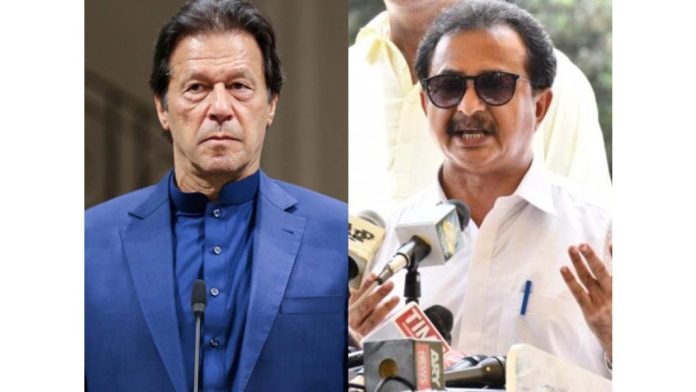
ISLAMABAD: Pakistan Tehreek-e-Insaf (PTI) Chairman Imran Khan strongly condemned the arrest of Leader of the Opposition in the Sindh Assembly Haleem Adil Sheikh and the ongoing worst crackdown against the opposition in the province.Talking to former Sindh Governor and Pakistan Imran Ismail and newly elected Member of National Assembly from NA-245 Mahmood Moulvi, who met him here on Tuesday, PTI Chairman congratulated Mahmood on his historic success in the by-poll.On the occasion, Imran Khan also felicitated Imran Ismail and PT Karachi organization for the successful election campaign to trounce the joint candidate of the government allied parties in NA-245.During the meeting, they discussed the political situation of the country and especially the devastation caused by the flood and the relief activities in Sindh.Imran Ismail briefed Chairman PTI on the ill-treatment meted to Haleem Adil Sheikh and on the ongoing worst crackdown and retaliatory activities against the opposition in the province.In the meeting, the chairman was also informed about the Pakistan People’s Party’s (PPP) efforts to escape from the forthcoming local body elections in Sindh.

Stay Connected

64FansLike
60FollowersFollow

Latest Reviews

Exchange Rates

USD - United States Dollar
EUR
1.18
GBP
1.35
AUD
0.67
CAD
0.73