Home Blog Page 1092

Walk for Change: Serena Hotels and ConnectHear Launch Joint Initiative on Int’l Day of Persons with Disabilities

DNA

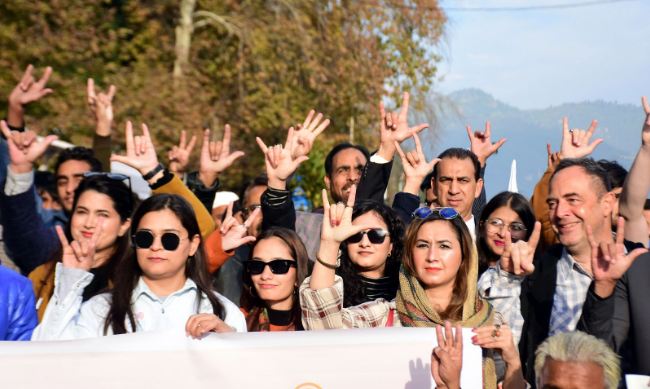
ISLAMABAD, DEC 3 – Serena Hotels, in a heartfelt partnership with ConnectHear under the Public Diplomacy initiative, has organized a walk of awareness on the International Day of Persons with Disabilities which started off at MOFA and culminated at Serena Business Complex in Islamabad.

This day is a global celebration of the rights and achievements of people with disabilities. The United Nations in 1992, officially declared a day dedicated to persons with disabilities, emphasizing the theme of “Full Participation and Equality” within society and developmental contexts. It highlights the crucial need for the inclusive involvement of individuals with disabilities across all facets of society and development, emphasizing the essential role this plays in creating a more equitable and compassionate world.

The event was attended by a significant number of participants including students, distinguished dignitaries, representatives from the corporate sector and media professionals and the effort to promote awareness through diverse activities was positively embraced by all the attendees.

Azeema Dhanjee, the co- founder of ConnectHear in her speech said, “our mission is to give the Deaf individuals of Pakistan the tools they need to make communication accessible to them, allowing them to be truly independent”. She also highlighted that Islamabad Serena Hotel has become the pioneer in the industry by implementing a sign language interpretation service to make their hotel accessible. She expressed gratitude towards Serena Hotels for both organizing the accessibility walk in Islamabad and for demonstrating a sincere commitment to this initiative.

 Serena Hotels has consistently endeavoured to play its role in raising awareness through various initiatives under the umbrella of Public Diplomacy and take pride in providing platform and in collaborating with organizations such as ConnectHear, who are dedicated to tirelessly ensuring people’s right to access essential services. Together, we strive to make a meaningful impact and contribute to positive change.

Israel strikes Gaza as pressure mounts to protect civilians

Israel strikes Gaza as pressure mounts to protect civilians

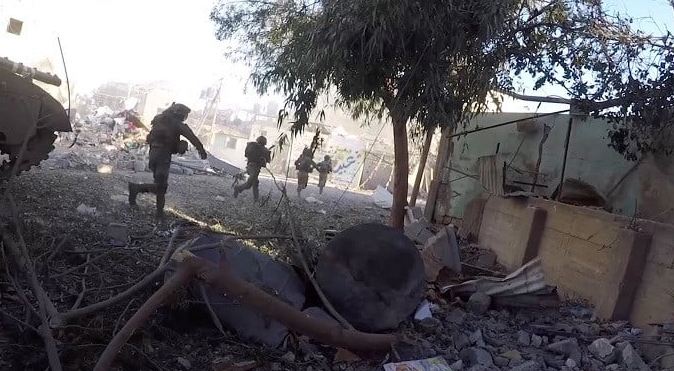
GAZA: Israel carried out deadly bombardments in Gaza on Sunday as international calls mounted for greater protection of civilians and the renewal of an expired truce with Palestinian resistance group Hamas.

The Israeli army said it had conducted more than 400 strikes in Gaza since a ceasefire collapsed on Friday, with the Palestinian government saying at least 240 people had been killed.

Hamas and Palestinian group Islamic Jihad announced “rocket barrages” against multiple Israeli cities and towns including Tel Aviv, and Israel said that two of its soldiers had died in combat, the first since the end of the truce.

At least seven people were killed in an Israeli bombing early Sunday near Gaza’s southern border with Egypt, the government said.

Israeli strikes also hit the Nuseirat refugee camp in central Gaza late Saturday, killing at least 13 people, according to the official Palestinian news agency Wafa.

US Vice President Kamala Harris on Saturday sharply rebuked the rising civilian toll in Israel’s eight-week war. “Too many innocent Palestinians have been killed,” she told reporters at UN climate talks in Dubai.

“Frankly, the scale of civilian suffering and the images and videos coming from Gaza are devastating.”

An estimated 1.7 million people in Gaza — more than two-thirds of the population — have been displaced by war, according to the United Nations.

“I cannot find words strong enough to express our concern over what we’re witnessing,” the head of the World Health Organization, Tedros Adhanom Ghebreyesus, said on Sunday on X, formerly Twitter.

Fadel Naim, chief doctor at the Al-Ahli Arab hospital in Gaza City, said his morgue had received 30 bodies on Saturday, including seven children.

“The planes bombed our houses: three bombs, three houses destroyed,” Nemr al-Bel, 43, told AFP, adding he had counted 10 dead in his family and “13 more still under the rubble”.

Gazans are short of food, water and other essentials, and many homes have been destroyed. UN agencies have declared a humanitarian catastrophe, although some aid trucks did arrive Saturday.

The Palestine Red Crescent Society said Israel had told NGOs not to bring aid convoys across the Rafah border crossing from Egypt after the truce expired.

But the charity said on Saturday its Egyptian colleagues had managed to send over a number of trucks.

Hamas fighters broke through Gaza’s militarised border into Israel on October 7. Israel vowed to eliminate Hamas in response and unleashed a brutal air and ground campaign that has killed more than 15,000 people, mostly civilians, the Palestinian authorities who run Gaza say.

A week-long truce, brokered with the help of Qatar and backed by Egypt and the United States, led to the release of 80 Israeli hostages in exchange for 240 Palestinian prisoners.

But that truce collapsed with both sides blaming each other for violating its conditions.

Israel claimed that Hamas had tried to fire a rocket before the ceasefire ended, and that it had failed to produce a list of further hostages for release.

Israeli negotiators left Doha on Saturday after reaching a dead end in talks aimed at securing a fresh pause in hostilities.
The Israeli army said 137 captives were still being held in Gaza.

Israel’s Defence Minister Yoav Gallant told reporters on Saturday that fresh military action was needed to “create the conditions that push (Hamas) to pay a heavy price, and that is in the release of hostages”.

Israeli captives released from Gaza spoke publicly on Saturday for the first time, urging their government to secure the release of the remaining captives.

“The moral obligation of this government is to bring them home immediately, without hesitation,” said Yocheved Lifschitz, 85, who was released by Hamas in October, before the truce deal.

French President Emmanuel Macron appealed for “stepped-up efforts to reach a lasting ceasefire” to free all captives, allow in more aid and to assure Israel of its security.

He took issue with Israel’s stated war aims, warning that if the “total destruction of Hamas” in Gaza was the goal, “the war will last 10 years”.

But Israeli Prime Minister Benjamin Netanyahu said the war would continue “until we achieve all its aims” including eliminating the resistance movement.

“Our soldiers prepared during the days of truce for total victory against Hamas,” he said in Tel Aviv on Saturday, at his first press conference since fighting resumed.

“There is no way to win except by continuing the ground campaign,” Netanyahu told reporters, underscoring that this would be done while “observing international law”.

Israel’s air, naval and ground forces have attacked more than 400 targets in Gaza since the ceasefire ended, the army said on Saturday.

The figure is roughly in line with the daily average number of strikes prior to the pause, according to military figures released previously.

Warplanes hit “more than 50 targets in an extensive attack in the Khan Yunis area” of southern Gaza, according to the Israeli military.

Separately, members of an Israeli armoured brigade “eliminated terrorist squads and directed fire against terrorist targets in the north of the Gaza Strip”, the military claimed.

In the occupied West Bank, the Israeli army said troops shot dead a Palestinian at a checkpoint near the city of Nablus after he “drew a knife and started to advance towards them.”

Syria said Israel carried out air strikes near Damascus on Saturday.

Iran’s Revolutionary Guard accused Israel of killing two of its members in Syria who it said had been on an “advisory mission”.

Punjab CM pledges upgradation of institutions, renames disabled persons as “Enabled”

Punjab CM pledges upgradation of institutions

LAHORE, Dec 2 /DNA/ – Chief Minister Punjab Mohsin Naqvi attended a ceremony being held in connection with the International Day of Enabled Persons at a local hotel today. CM formally inaugurated the web portal “Enabled” by the Social Welfare Department.

CM Mohsin Naqvi expressed his affection with the enabled children. CM called the female child on the stage who sent messages on the whatsapp to participate in the ceremony and expressed affection with the female child. The enabled female child gave an invitation card to CM Mohsin Naqvi to visit the institution. CM after accepting the invitation said that he would definitely visit the institution. Mohsin Naqvi apprised that this female child invited him by sending a message on the mobile by saying that he has to definitely participate in the ceremony.

After seeing the message, I decided to attend the ceremony after cancelling all my engagements. It is matter of great pride for me to participate in the ceremony of enabled children and it is my duty as well. CM went to an enabled child for doing painting during the ceremony, witnessed painting of the child, commended him and gave him gift also. CM Mohsin Naqvi while addressing the ceremony said that the word “enabled” will be used for the disabled persons in future.

Prompt measures will be undertaken in this regard and no one should call these children disabled but the word “enabled” will be used. A summary should be formulated to use the word “enabled persons” at the official level in this regard. Mohsin Naqvi while announcing to upgrade all the institutions of enabled children directed the Social Welfare Department to chalk out an upgradation plan of institutions in coming seven days and submit it in the Chief Secretary office. We will provide whatsoever resources are required and will get the centres of enabled children upgraded. Mohsin Naqvi revealed that in the past, the budget of special education institutions was allocated to the School Education Department, on account of which the budget used to be allocated with delay for the education, brought up of the children and studying in these institutions.

We have directly transferred the budget to the Special Education Department. Skilled and technical courses will be arranged for the enabled children of more than 18 years in TEVTA so that they can start their business after learning a skill. Chief Secretary has done a great work for the Autistic children. We are establishing state-of-the-art centre for the enabled children by retrieving a land from the land grabbers in Township.

Provincial Minister SHC&ME Dr. Javed Akram and DG Social Welfare also addressed the ceremony. Chief Secretary Zahid Akhtar Zaman, Secretary Social Welfare, Secretary Information, DG Social Welfare, prominent motivational Speaker Qasim Ali Shah and a large number of enabled children participated in the ceremony.     

Italian embassy hosts grand fashion show

Italian

Ambassador of Italy Andreas Ferrarese says trade volume between Italy and Pakistan has improved significantly

Ansar M Bhatti/DNA

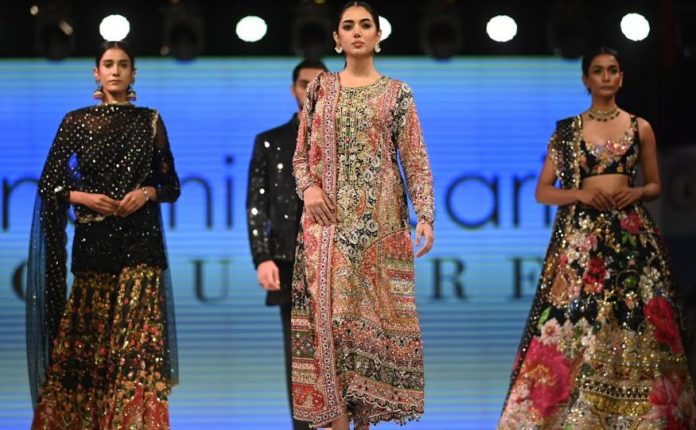
ISLAMABAD: The Italian embassy in Islamabad recently organized a grand Fashion Show within the premises of its under-construction new embassy. This event was notable not only for its celebration of fashion but also for the unique setting of being hosted at a location still undergoing construction.

The new embassy is expected to be completed in April 2024, showcasing a modern and elegant facility that will serve as Italy’s diplomatic hub in Pakistan. However, the current Ambassador of Italy Andreas Ferrarese  announced during the event that he would not be present for the formal inauguration of the new embassy. His departure from Pakistan is scheduled for January 15, 2024.

The decision to hold a Fashion Show at an embassy construction site could be seen as a creative and unconventional choice, blending the worlds of diplomacy and fashion. Such events often serve as cultural exchanges, promoting cross-cultural understanding and collaboration between nations. It’s possible that the embassy aimed to create a memorable and distinctive experience for attendees, highlighting the fusion of Italian style and Pakistani hospitality.

The event drew an impressive crowd, with seemingly the entire city of Islamabad converging on the venue to partake in the spectacle of exquisite dresses meticulously crafted by renowned Pakistani designers.

The ambassador said that the trade volume between Italy and Pakistan has touched two billion euros mark first time in the history of bilateral relations and hoped this figure shall further be improved in the days to come.

 There is a significant Pakistani community residing in Italy, estimated to be around 200,000 individuals. This emphasizes the community’s active participation in contributing to the development of Italy. This involvement implies that members of the Pakistani community are engaged in various aspects of Italian society, such as the workforce, economy, and potentially other spheres like culture and education.

Australia announce 14-man squad for first Test against Pakistan

Australia announce 14-man squad for first Test against Pakistan

Australia on Sunday announced the 14-man squad for the first Test match of the three-match home series against Pakistan which will be led by World Cup 2023 winning skipper Pat Cummins. 

The first match of the series will take place on December 14 to 18 at the Perth Stadium. 

Australian opener David Warner, who said that he would bring down a curtain on his 12-year career in the longest format, is included in the squad for the first Test alongside Usman Khawaja.

Other players included in the team are Scott Boland, Alex Carey, Cameron Greene, Josh Hazlewood, Travis Head, Marnus Labuschagne, Nathan Lyon and Mitchell Marsh.

Lance Morris, Steve Smith and Mitchell Starc were also included in the 14-member squad for the first Test. 

Australian chief selector George Bailey said there were still opportunities for others to play themselves into contention for the Tests against Pakistan in Melbourne and Sydney, as well as the two-match series against West Indies that follows.

“We look forward to seeing the continued strong performances from players who have been performing domestically, many of whom will get a tremendous opportunity in the Prime Minister’s XI fixture against Pakistan later this week,” he said in a statement.

Pakistan, who have not won a match in Australia in nearly three decades,  are currently preparing for the series. 

Australia squad: David Warner, Usman Khawaja, Marnus Labuschagne, Steve Smith, Travis Head, Mitchell Marsh, Alex Carey, Pat Cummins (captain), Mitchell Starc, Nathan Lyon, Josh Hazlewood, Scott Boland, Cameron Green, Lance Morris

Pakistan squad: Shan Masood (captain), Aamir Jamal, Abdullah Shafique, Abrar Ahmed, Babar Azam, Faheem Ashraf, Hasan Ali, Imam-ul-Haq, Khurram Shahzad, Mir Hamza, Mohammad Rizwan (wk), Mohammad Wasim Jnr, Noman Ali, Saim Ayub, Salman Ali Agha, Sarfaraz Ahmed (wk), Saud Shakeel and Shaheen Shah Afridi

Australia tour schedule:

Four-day match: PM’s XI vs Pakistan – December 6-9: Manuka Oval, Canberra

1st Test – Australia vs Pakistan – December 14-18: Perth Stadium

2nd Test – Australia vs Pakistan – December 26-30: Melbourne Cricket Ground (MCG)

3rd Test – Australia vs Pakistan – January 3-7: Sydney Cricket Ground (SCG)

Chinese Foreign Policy towards India and Pakistan

Chinese Foreign Policy towards India and Pakistan

Dr. Muhammad AkramZaheer

Since the late 20th century, China has shifted her policy from isolation and separation from the international community and now is on the way to becoming the major economic power of the world. The Chinese leadership has formulated more attractive, pragmatic and flexible policies for global affairs and issues. With economic growth, China is widening and deepening its quest for energy resources and expanding its investment, market and political influence.  It is also projecting her soft power vigorously and peacefully by promoting culture, sports, education, tourism and other exchanges. The Chinese believe in the emergence of a peaceful great power as once. Professor of international relations Yan Xuetong said, China is the second most powerful state in the world.

A rapid change in the domestic situations of countries and in the international system has been followed by the change of their, perceptions, priorities, foreign policies and interests. That’s why the modern dynamics of foreign policies are extending their activities into many spheres of the international system to increase influence. The quest for the achievement of national interests allows countries to continue work effectively on their potential, inherent to make useful policy. In the past, Chinese diplomacy was often employed to pursue goals of unbalanced interests.  Now the world has dramatically changed since after the Cold war and China is in the position to play a constructive role in the international system. China was allied to the USSR and viewed the USA as its principal enemy during the 1950s. On the other hand, Washington sought an anti-communist alliance with Pakistan as well as close relations with India. After the 1965 Indo-Pak war, US and Indian relations became weaker due to Washington’s limited sale of weapons to India. In1970s. India moved closer to the USSR while China grew closer to Islamabad because India’s of complicated strategic position. Then China inclined towards the USA in quest of its export market and as a counterbalance to the USSR.

After the USSR’s collapse, a peaceful environment favored China and a shift came in her policy towards south Asia. Now, Beijing was seeking political and economic bilateral ties with the regional countries, particularly positive developments in the process of Sino-India rapprochement. This shift did not favor Pakistan and posed negative consequences on the traditional Pak-China relationship. The impact of the foreign policy shift gave this impression during the Pak-India crisis over Kashmir in 1989-90 when Beijing did not support a resolution on Kashmir in the United Nations. It remained neutral and calm, emphasizing on both parties to solve the issue by dialogue. Contrarily, the Cold-war Chinese policy towards Pakistan was supportive against India. During the 1990s, China has been advising both Pakistan and India to solve their problems through dialogue.  In 1996, President Jiang Zemin visited Pakistan and in his speech to the Senate, he urged Pakistan to develop cooperative relations with India and put thorny issues aside. Pakistan should make trade and economic relations to lessen the hostility. During the Kargil crisis China-India rapprochement had entered the mature phase. This time again, China adopted a neutral policy and emphasized holding talks and solving the issue through negotiations. Pakistan was seeking active support on the issues of Kashmir and Kargil, but the Chinese position was unchanged. During the visit of the Pakistani Foreign Minister to China in1999, Chinese Foreign Minister Tang  Jiaxuan said the international community has great concerns about the South Asian situation and Pakistan should remain cool and exercise self-control. It was a warning to Pakistan that China would not support it militarily, and Pakistan should get out from Kargil and settle the crisis by dialogue.

After the cold war, India abandoned the Soviet model and looked for economic reforms. Therefore, India remained no longer allied so closely to Moscow and became less of a danger to China. Now the need of Islamabad for Beijing was narrowed to counterbalance Delhi and Moscow, but was concerned at the Delhi-Washington closeness. China wants to prevent India joining the USA to counter her and the USA looks to India to counterbalance China. This situation is very difficult for China to sustain and maintain the balance and demonstrate her ability in the region of nuclear powers.The incident of 9/11 brought regional and international developments and new adjustments in foreign policy for China. This led to a diplomatic standoff between Pakistan and India. Almost for a year, the military forces of both sides stood eyeball to eyeball. The terrorist attack on Indian Parliament and the Srinagar incident inflamed insecurity and instability in the region. Beijing has concerns about Pak-India tension and it played a proactive role at the diplomatic level to diffuse tension. China also activated SCO and other forums to dissipate tension between Islamabad and New Delhi. Soon after 9/11, the USA declared a global war against terrorism and China was discomforted and had many internal and external concerns. It warned the USA that counter-terrorism should not be used to practise hegemony. Although the war was against the Taliban regime in Afghanistan, China also managed the worsened situation of her troubled province of Xinjiang, and was unsettled by the presence of US forces near her border. China believed that Washington would create instability in the region and might have new political designs. The region, particularly Central Asia, was more attractive to China due to its energy resources and Washington’s political and military involvement in the region worried China.

Washington was increasing pressure on Islamabad to get Pakistani support for the war on terror in Afghanistan after 9/11. On the other hand, China had concerns of the expanding Delhi-Washington strategic cooperation. India and the USA were considering China as a common rival of both and were thinking to limit the rise of China. Washington made efforts to diffuse the crisis between Pakistan and India by a balancing posture during this period. China also maintained a balanced position towards Pakistan and India post 9/11. Another worry for China was the Indian move towards Japan and Vietnam, with whom Chinese relations remained tense. The past cooperation in political, economics, security and diplomatic issues and bilateral ties produced Chinese $62 billion investment in Pakistan through CPEC. China has provided support to Pakistan in the UNSC regularly. China has assisted Pakistan to improve security and defence capability by the joint venture of the JF-17 Thunder in 2003. The deteriorating relationship of Islamabad and Washington provide China motivation and impetus to improve relations. On the other hand, China and India are two natural strategic rivals with large populations in the region. A sense of competition between the two is very high. China has engaged Nepal, Bhutan, Bangladesh, and Maldives, which was considered in the area of Indian influence. China tried to build a road in Bhutan in the Doklam area, which is a source of tension for India. It seemed that China was occupying the strategic territory, which was very necessary for Indian security. In addition, India thinks that Pakistan is serving Chinese interests by forcing her to fight wars, reducing the Indian ability to counter the Chinese rise.

However, the leadership of both China and India has recognized the need of peace and cooperation to ease the tension. They met in the Wuhan summit in April 2018 and agreed to expand economic relations. China seems a major beneficiary of China-India economic relations. The importance of this partnership may not be worsening China-Pakistan relations. The example of the China and Pakistan cooperation is seen when Beijing put its weight behind Islamabad and forced a discussion in the UNSC on India’s latest reconfiguration of Kashmir. As its economic power grows, China has its own paradigm of development and new ways of interaction with regional and global powers on a win-win basis. Being the neighbour of China, Pakistan has the privilege to achieve investment and trade. The frequent exchange visits by the leadership of both have reinforced mutual trust and cooperation. On the other hand, China and India have agreed to expand their cooperation on multiple levels to ensure peace on their borders. However, India and Pakistan are challenging each other on the issue of Kashmir and both the countries had fought four wars in the past. On the issue of Kashmir, Chinese policy will have significant implications for the China-India-Pakistan relationship and will test China’s foreign policy towards Pakistan and India.

World Bank Vice President visits Tarbela 5th Extension, Dasu Hydropower Project

Dasu Hydropower Project

SAID ALAM KHAN

PESHAWAR: The World Bank Vice President Martin Raiser along with a 4-member delegation, visited Tarbela 5th Extension and Dasu Hydropower Project.  Chairman WAPDA Eng Lt Gen Sajjad Ghani (Retd) and World Bank Executive Director Syed Tauqir Hussain Shah also accompanied him. World Bank is providing financial support for construction of these projects.

In the first leg, the World Bank Vice President visited Tarbela 5th Extension Hydropower Project, being constructed on Tunnel No. 5 of Tarbela Dam. He witnessed construction activities on main components. The project management apprised him about progress on the power house, tail race culvert, canal and switch yard. Tarbela 5th Extension has an installed power generation capacity of 1530 MW. On its completion, power generation capacity at Tarbela Dam will increase from 4888 MW to 6418 MW. Tarbela 5th Extension Project will start electricity generation in 2025.

Later, the World Bank Vice President also visited 1410 MW-Tarbela 4th Extension Hydel Power Station, completed in 2018 with financial assistance of the World Bank. He was informed during the visit that Tarbela 4th Extension, since its completion, has provided 22.56 billion units to the National Grid.

In the second leg, the World Bank Vice President flew to under-construction Dasu Hydropower Project at River Indus upstream of Dasu town in Khyber Pakhtunkhwa. He visited the power house, transformers cavern and the project colony to review construction activities. Dasu project team, in a briefing, informed him about progress on main works of the project. It was briefed that the river diversion system has been functioning satisfactorily since its completion early this year. Flushing tunnel is also complete, while excavation of right bank bypass  tunnel has recently been completed. Excavation of right and left abutment of the main dam, intake, power house, tailrace tunnel, surge chamber and transformers cavern is in progress. The 4320 MW-Dasu Hydropower Project will be completed in two stages. At present, WAPDA is constructing Stage-I, with installed generation capacity of 2160 MW and annual energy generation of 12 billion units. Stage-I of the Project is likely to be commissioned in 2026. 

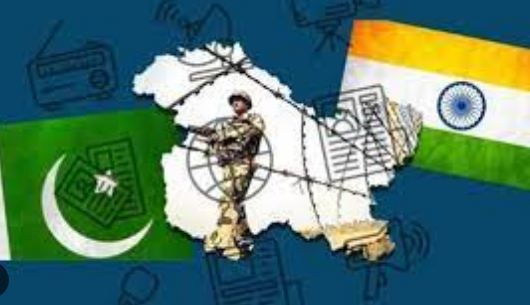
Anaylysis of Indian Kashmir Policy-Implications and Way Forward for Pakistan

Anaylysis of Indian Kashmir Policy-Implications and Way Forward for Pakistan

ISLAMABAD, Dec 02 (DNA): Special Assistant to the Prime Minister on
Human Rights and Women Empowerment, Mushaal Hussein Mullick called upon
the world powers and UN bodies to wake up of their sweet slumber to
circumvent the Indian initiative of implementing the Gaza model in
Indian Illegally Occupied Jammu and Kashmir (IIOJK).

Addressing a focused talk on “Anaylysis of Indian Kashmir
Policy-Implications and Way Forward for Pakistan” organized by Natoinal
Institute of Maritime Affairs (NIMA) as a Guest of Honor, Mushaal stated
that the fascist Indian government turned the scenic valley into a world
largest tortured cell and garrison city especially after revocation of
article 370 and 35-A of constitution on August 5, 2019.

Admiral (Retd) Muhammad Zakaullah NI(M) attended the focused talk as
Chief Guest. Other Participants included Ms. Sabien Hussein Mullick
(Focal Person to SAPM), Dr. Adam Saud (Dean H&SS BU), Mr. Syed Muhammad
Ali (Security Analyst), and Amb (Retd) Nadeem Riyaz (President IRS).

Mushaal Mullick noted that the brutal occupation forces unleashed a wave
of terrorism and barbarity to stifle the just dissenting voices in the
occupied valley, adding that supremacist Indian government fundamentally
altered the geopolitical and social fabric of the region, which remained
one of the most enduring and complex disputes in South Asia, causing a
constant threat for regional stability and international peace.

Mushaal feared that the Indian brutal forces were replicating the
Israeli model of genocide and ethnic cleansing to turn the Muslim
majority region into minority.

The SAPM on Human Rights and Women Empowerment highlighted that the
Narendra Modi-led fascist regime unleashed a reign of terror in the
IIOJK, as top Kashmir leadership including her husband Yasin Malik were
put in unlawful detentions in false, fabricated and politically
motivated cases.

Moreover, she said that the Indian troops were given license to kill and
torture Kashmir people with impunity, adding that women rape was used as
a weapon of war in the occupied valley to deter the freedom fighters in
order to defuse the just struggle.

Mushaal urged that the world powers, international community and UN
bodies should take prompt notice of world worst human rights abuses in
IIOJK and take practical measures to resolve the decades-old dispute as
per the aspirations of Kashmiri people and the UN agreed formula.

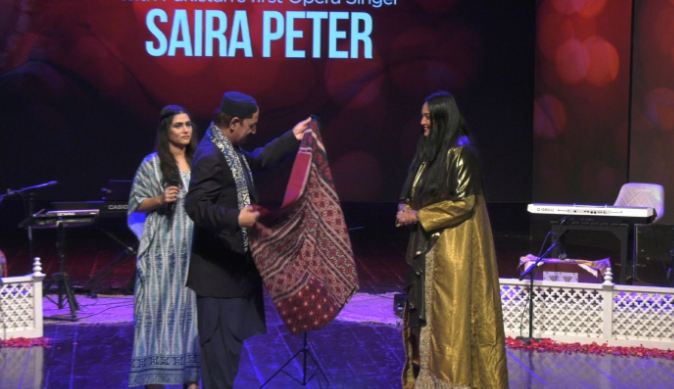
Saira Peter mesmerises the audience with her magical voice at PNCA

PNCA

ISLAMABAD, Dec 2: Saira Peter, a British-Pakistani soprano recognised as the Pakistan’s first Sufi Opera singer mesmerised the audience with her magical voice at musical evening in Pakistan National Council of the Arts.

Federal Minister for National Heritage and Culture Jamal Shah was the chief guest on the occassion.Prominent government officials, Diplomats and large number of people were also attended the event.In his opening remarks, Director General PNCA Muhammad Ayuob Jamali welcomed the guests at PNCA Auditorium.On the occasion, Federal Minister for National Heritage and Culture Jamal Shah appreciated the performance of Saira Peter and said that the people here love music.He termed Saira Peter as highly accomplished singer.

Saira Peter and her husband a music director Stephen Smith started the performance with classical opera receiving high applause from the audience. From there, Saira went on to perform Sufi Kalam.

Saira Peter has also the distinction to be the world’s first Sufi opera singer.

Saira Peter has received an overwhelming response to his live performance in jam packed PNCA Auditorium.Saira presented opera and classical songs, Urdu, Pashtu, ‘thumri’, ‘ghazals’, film, Sindhi, Balochi and Punjabi songs.

She also sang a special Arabic song during her performance.

Saira Peter and her enthusiastic audience shared lively interaction throughout the concert.She conveyed her love for the music of her homeland and thanked PNCA for showing so much honour.

Passionate about bringing together people of all backgrounds, Saira Peter identified music as a historical means of promoting a positive message.Simultaneously in the midst of studying Western Classical voice, she envisioned using her music to take Sufi peace poetry to the world stage.

She is currently working with a team of British artists to develop the world’s first full-scale “Sufi Opera”, a musical stage drama based on the story of Umar Marvi, one of Latif’s “seven heroines” of Sindh.

Saira Peter has also pioneered a fusion style of the qawwali genre in which she incorporates both Western operatic and South Asian classical styles of singing.

PM encourages gates foundation to strengthen stem education, disaster management in Pakistan

PM encourages gates foundation to strengthen stem education, disaster management in Pakistan

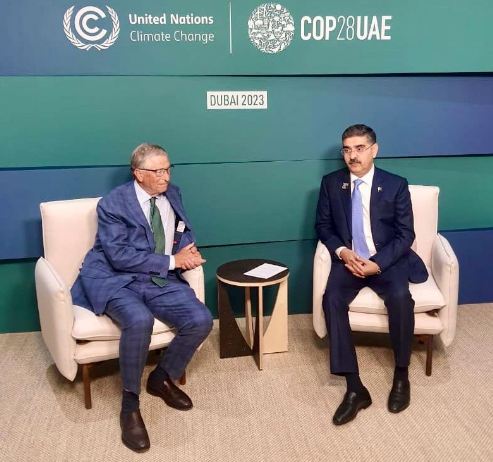
Dubai: Caretaker Prime Minister Anwaar-ul-Haq Kakar met Mr. Bill Gates, co-Chair, Bill & Melinda Gates Foundation (BMGF), on the sidelines of COP-28 in Dubai earlier today.

Prime Minister Kakar and Mr Gates discussed progress in Pakistan’s polio eradication efforts. The Prime Minister apprised Mr. Gates of the ongoing polio vaccination drive in Pakistan and said that Pakistan would spare no effort to eliminate poliovirus. The Prime Minister underlined the Government’s full commitment to maximizing outreach of vaccines to children all across Pakistan.

The Prime Minister and Mr. Gates also discussed cooperation extended by BMGF to Pakistan in financial inclusion, poverty alleviation and malnutrition. While lauding the support received from the Gates Foundation, the Prime Minister further encouraged the BMGF to work with Pakistan to enhance national capacities in STEM education, strengthen early warning and emergency operations for disaster management as well as to digitalize agricultural value chains.

Stay Connected

64FansLike
60FollowersFollow

Latest Reviews

Exchange Rates

USD - United States Dollar
EUR
1.17
GBP
1.35
AUD
0.72
CAD
0.73