Sadaf Noreen Awan
The Clash of Ages: Ancient Heritage vs. Modern Arrogance
When viewed through the lens of history, Iran stands as the custodian of an ancient and magnificent civilization with roots stretching back thousands of years. From the administrative genius of the Achaemenids to the poetic depths of the Safavids, the Iranian nation is defined by its history, knowledge, humility, and civilizational dignity. In stark contrast, the United States of America is a discovery of a mere few hundred years a nation built on expansionism that lacks the deep, spiritual anchors of an ancient society.
In the current geopolitical context, Iran’s struggle is not merely over a piece of land or a nuclear program; it is a battle for the survival of the Islamic identity, for the oppressed people of Gaza, for the dignity of the entire Muslim Ummah, and for the sanctity of the Masjid al-Aqsa. This was truly a conflict between the “Soldiers of Rahmān (the Merciful)” and the “Agents of Satan.” On one side stood those who place their absolute trust in the Divine, and on the other were the arrogant powers intoxicated by material strength, sophisticated weaponry, and a desire to trample upon human rights. Iran has proven to the world that when knowledge and humility are fortified by unwavering faith, they can force the world’s greatest material powers to bite the dust.
The Barbarism of the Oppressor and the Legacy of Minab
The beginning of this war was marked by a savagery that made the very soul of humanity tremble, echoing the darkest chapters of history. The Zionist aggressors and their American patrons targeted innocent children and defenceless civilians with unmatched brutality, reminiscent of the historical tragedies where the innocent were forced into ultimate sacrifices. We remember the 170 schoolgirls of Minab, whose legacy of choosing a dignified death over the dishonour of foreign capture remains a testament to the Iranian spirit. Today, the bombs falling on hospitals, schools, and refugee camps are, in reality, a bloody ritual, a gift offered to the modern altars of “Baal” by the “Sons of Satan,” Benjamin Netanyahu and Donald Trump.
They believed that by spilling the blood of infants, they could dampen the spirits of the resistance and break the will of a nation. However, their cold-blooded logic failed to account for a people who breathe the air of Karbala. They forgot that this is a nation following in the footsteps of Ali Asghar (as), where even the youngest is a soldier of truth. While the martyrdom of these innocents failed to stir the rusted conscience of the Western world, it provoked a wrath from the heavens, paving the way for the enemy’s ultimate strategic destruction.
The Miracle of Martyrdom and the Unity of a Nation
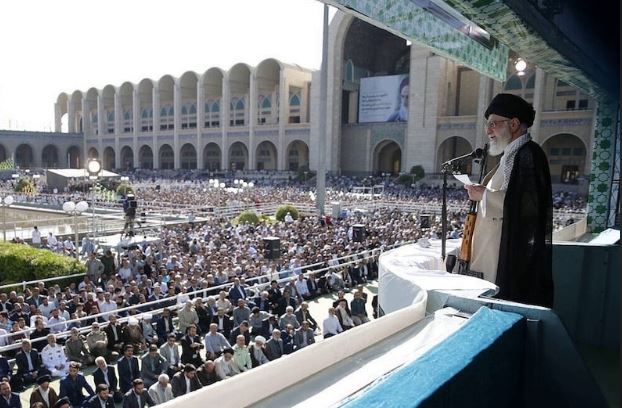
The enemy made a fatal strategic error by martyring the Leader. Their intelligence hubs predicted that a “regime change” would follow naturally, that the Iranian nation would crumble into chaos without its central pillar. Instead, the blood of the Martyr-Leader Syed Ali Khamanei acted as a catalyst for an unprecedented national awakening. Millions poured into the streets, not just in mourning, but in a display of fierce resolve that signalled the absolute end of foreign interference.
The martyrdom itself was shrouded in divine signs. In the ruins of the room where a massive concrete block had fallen, the body of the Rahbar (Leader) was found appearing as if he were sleeping in total tranquillity. That heavy stone did not crush him, it became a pillow of peace. This was a physical manifestation of his pure life and the acceptance of his sacrifice by the Creator, Allah the Almighty. It brought to mind the miracle years prior, when Allah saved him from a bomb hidden in a tape recorder. He was preserved then for a grand purpose, and he was taken now in a prestigious manner that ignited the hearts of an entire generation. A new, young leadership has emerged from this fire, carrying the same spirit of defiance, ensuring that the ambitions of the West remain buried under the rubble of their failed policies.
The Shattering of the Superpower Myth
At the completion of the 40th day of this war, the United States and Israel faced a crushing defeat that defied all their technological and military projections. Their elite think tanks, trillion-dollar research hubs, and high-tech idols were shattered before the “power of faith” (Emaan) and the ironclad nationalism of the Iranian people. The goals of the invaders were left unfulfilled, they failed to secure Iran’s uranium, they failed to achieve regime change, and they failed to break the will of the people.
Instead, Iran displayed a courage that shocked the world’s military establishment. The so-called “Iron Dome,” once marketed as an invincible shield, was proven to be little more than a toy against the precision of Iranian resistance. The counter-attacks shook the Zionist entity to its core. The world witnessed the reality that America is no longer the “superpower” it claimed to be, the air has been let out of its balloon, and its credibility has vanished. The United States was exposed as a treacherous actor, launching cowardly strikes even while negotiations were purportedly underway. This breach of trust has broken the world’s confidence in American diplomacy forever.
The Fall of Proxy Credibility and the Gulf Crisis
This war has also acted as a mirror for the Gulf states and Saudi Arabia. For decades, they relied on American protection, spending trillions of dollars and providing airbases to the U.S. military. Yet, when the moment of truth arrived, Iran’s strikes proved that the American military is a paper tiger, incapable of protecting its own assets, let alone its allies. Dubai and Abu Dhabi, once marketed as the safest hubs in the world, began to empty as international billionaires realized that the American security umbrella was full of holes. The Gulf states realized that their investment in American friendship brought them nothing but humiliation and financial ruin. Here, the Hadith of the Holy Prophet (pbuh) resonates with profound clarity, Do not provide your homes to your enemies to kill fellow Muslims. Now, a tide of public opinion has turned. From Qatar to the streets of Amman, a campaign is rising to free the land from American bases.
Control of the Strait: The Jugular Vein of the West
By asserting total control over the Strait of Hormuz, Iran placed its hand on the jugular vein of the global economy. Iran sent a clear message, Do not take us for granted like Venezuela. While Donald Trump issued daily threats via social media like a “teenage bully,” claiming he would force the Strait open, Iran maintained a dignified, calm replies.
As the crisis peaked, Pakistan stepped in, played a pivotal role in high-key diplomacy. Following consultations in Islamabad with leaders from Turkey, Egypt, and Saudi Arabia, a unified front began to emerge. Under this pressure and facing the reality of an empty American treasury and a defeated military, Trump was forced to consider Iran’s 10-point agenda. On the 40th day, Iran celebrated its victory, a victory reminiscent of the day Ali ibn Abi Talib (as) conquered the fort of Khayber.
The Political Death of the Aggressors
Today, it is a manifest reality that this is a magnificent victory for Iran. The myth of American global hegemony has been buried. The fact that the U.S. is now begging for the opening of the Strait of Hormuz is a testament to the shift in the global balance of power. Trump and Netanyahu have failed in every target they set before the war.
In America, Trump faced the wrath of 8 million of his own citizens on the streets, protesting against a war they knew was fought for his own personal face-saving. His attempt to hide his involvement in the “Epstein Files” through a foreign distraction failed miserably. He has not only lost the war abroad but has faced political death at home. The American earner is left with nothing but humiliation and a crippled economy. Meanwhile, the world now recognizes Netanyahu as the “cancer of humanity.”
A Moral Victory: Civilization vs. Chaos
In a desperate attempt to break the spirit of the nation, the American military targeted the very foundation of Iran’s future its intellectual and technological heart. They launched a cowardly attack on the Sharif University of Technology (the MIT of Iran), wishing to destroy the education, technology, and innovation of a rising power. Their missiles destroyed vital bridges, schools, and hospitals, and in their blind rage, they killed 2,300 people, the vast majority of whom were innocent civilians.
This display of raw, unguided violence was intended to spread terror, but it only highlighted the moral bankruptcy of the invaders. In stark contrast, Iran demonstrated the character of a true Islamic civilization; despite having the capability, Iran did not target civilians. Iran directed its strength against military installations, proving that it fights with a code of honor. This distinction has earned Iran a profound moral victory on the world stage. It showed that while the U.S. seeks to destroy education and infrastructure, Iran seeks to protect humanity.
Conclusion: The Diplomacy of Peace and the Triumph of Reason
Ultimately, this conflict has reaffirmed a fundamental truth often forgotten by the architects of war, even the most intense battles must eventually find their resolution at the negotiation table. As a nation built on the foundations of Islamic principles, Pakistan stepped forward to fulfil its sacred duty as a peacemaker, prioritizing the preservation of human life over the fires of destruction. By hosting these pivotal talks in Islamabad, Pakistan emerged as the diplomatic bridge between worlds, proving that the spirit of Islam always favours the path of peace and reconciliation.
Iran enters these negotiations not out of weakness, but from a position of unprecedented strength and moral high ground. It sits at the table with the quiet confidence of a nation that has already won the war on the battlefield and earned a civilizational victory in the hearts of the global populace. Donald Trump’s ambition was to erase the Iranian civilization from the map of history, yet his arrogance was met with an unbreakable wall of resilience. This dialogue in Islamabad is not just a diplomatic meeting; it is a formal recognition that the Iranian civilization which Trump sought to end has not only survived but has emerged as the defining architect of a new, multipolar world order. The victory belongs to those who stood firm, proving that while empires may rise and fall on the strength of their weapons, civilizations endure through the power of their convictions.
Reflecting on this invincible dignity, the great Persian poet Ferdowsi writes in the Shahnameh:
«ایران تنها نام یک سرزمین نیست، بلکه یک باور و وقار است که حفاظت از آن وظیفه هر نسل است.»
(Iran is not just the name of a land; it is a belief and a dignity that every generation is duty-bound to protect.)