Home Blog Page 704

Uzbekistan, China lead UN resolution for global dialogue and solidarity

Uzbekistan

The resolution decides to declare June 10 as the International Day of Dialogue among Civilizations

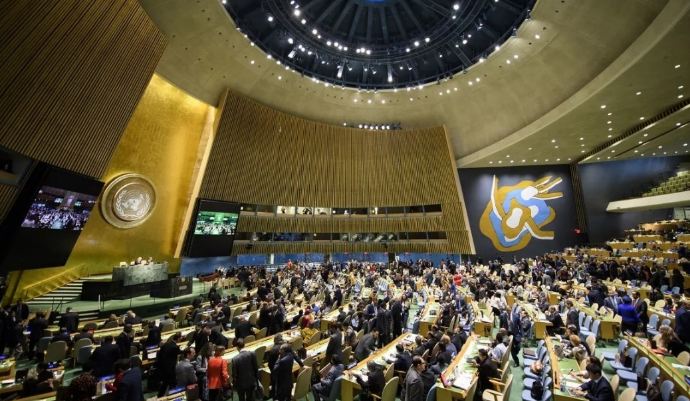
On June 7, the UN General Assembly unanimously approved a resolution entitled “International Day of Dialogue Among Civilizations” drafted by Uzbekistan and China.

The resolution was co-sponsored by more than 80 member countries, including all countries of Central Asia, Armenia, Azerbaijan, Belarus, Bahrain, Hungary, Egypt, Indonesia, Iran, Qatar, Kuwait, Saudi Arabia, Malaysia, the UAE, Pakistan, Russia and Türkiye.

The document conceptually reflects the visions of the Leadership of Uzbekistan, underscored at the 78th session of the UN General Assembly (2023) and the Samarkand SCO Summit (2022) on the need to promote the spirit of solidarity in the name of common security and prosperity, the desire for constructive cooperation, as well as mobilizing the efforts of international communities to achieve peace and sustainable prosperity.

The document positively notes the contribution made by all cultures and civilizations to the enrichment of humanity, recognizing the importance of religious and cultural diversity in the world. Tolerance, respect, dialogue and cooperation between different cultures and civilizations are encouraged.

The resolution decides to declare June 10 as the International Day of Dialogue among Civilizations in order to raise awareness of the value of the diversity of civilizations and promote dialogue, mutual respect and global solidarity.

It is worth recalling that on June 4, the UN General Assembly unanimously adopted a resolution initiated by Uzbekistan on the readiness of the countries of Central Asia to act as a united front and cooperate to effectively resolve and eliminate drug-related problems

On June 7, based on the results of a secret ballot, Uzbekistan received 185 votes from UN member states and, for the first time in its history, was elected to the UN Economic and Social Council (ECOSOC) for the specified term.

British HC calls on Chairman Senate Syed Yousaf Raza Gilani at Parliament House

British HC calls on Chairman Senate Syed Yousaf Raza Gilani at Parliament House

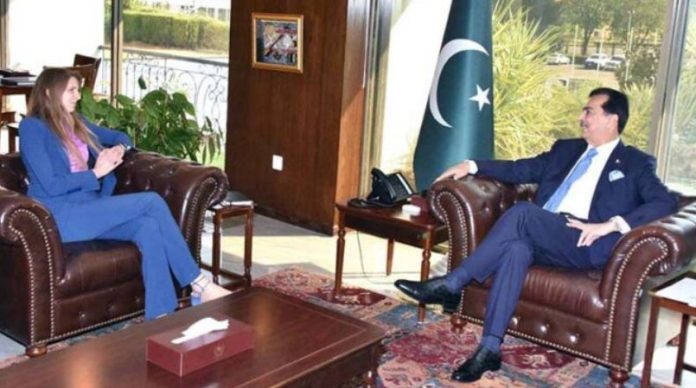
ISLAMABAD, JUN 12 /DNA/ – British High Commissioner Jane Marriott called on Chairman Senate Syed Yousaf Raza Gilani today at Parliament House. The discussions covered wide range of issues of mutual interest, including bilateral relations, trade, investment, and parliamentary cooperation.

The British High Commissioner congratulated Syed Yousaf Raza Gilani on his election as Chairman Senate and extended her best wishes for his tenure.

The Chairman Senate, welcoming the British High Commissioner, emphasized the longstanding cordial relations between Pakistan and England. He further expressed gratitude for Britain’s support during challenging times and its various welfare initiatives. Chairman Senate highlighted the importance of increasing partnership in the fields of health, education, and technology.

Highlighting the significance of parliamentary cooperation, the Chairman Senate observed that collaboration at international fora like IPU and CPA reflects that both countries attach high importance to their mutual relations.

The Chairman Senate emphasized the significance of people to people contacts and called for augmenting ties in educational and cultural exchanges. He also underscored the need for enhanced exchanges at parliamentary level.

The British High Commissioner acknowledged the significant role of the Pakistani diaspora in England in cementing relations between the two countries.

Syed Yousaf Raza Gilani extended his good wishes to the High Commissioner and expressed admiration for her appreciation of Pakistan’s hospitality and socio-cultural diversity.

T20 World Cup: Pakistan keep Super 8 hopes alive with win over Canada

T20 World Cup: Pakistan keep Super 8 hopes alive with win over Canada

New York, JUN 11: Pakistan defeated Canada by seven wickets in their third match of the T20 World Cup 2024 at the Nassau County International Cricket Stadium in New York on Monday.

After registering back-to-back losses against the United States (USA) and India in their first two matches of T20 World Cup, Pakistan made a comeback against Canada and managed to record a one-sided win.

Chasing the 107-run target, Pakistan had a tough start as they failed to score a boundary in the first four overs. Saim Ayub soon departed for the pavilion after scoring just six runs, leaving the Green Shirts 20-1 in 4.2 overs.

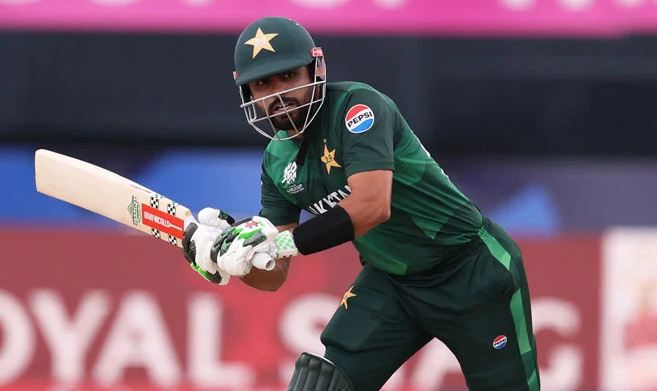
However, Pakistan continued to play with caution as Babar Azam and Mohammad Rizwan formed a 63-run partnership.

Azam lost his wicket for 33 runs but Rizwan (53 off 53) remained on the pitch and took Pakistan over the line by chasing the target in 17.3 overs.

Earlier in the first innings, the day belonged to Pakistan bowlers as the Canadian batters had no answers to their attack. Mohammad Amir, Shaheen Afridi, Naseem Shah and Haris Rauf all did their part with the ball as the Green Shirts managed to restrict Canada to 106-7 in New York.

Amir struck the first blow to Canada by removing their opener Navneet Dhaliwal in the third over by ripping the stumps with an inswinger. Shaheen continued what Amir started and took his first wicket of the day in the sixth over.

Pakistani bowlers continued their attack and kept on sending Canadian batters back to the pavilion but they struggled against Aaron Johnson, who played a valiant knock and scored 52 runs on 44 balls with the help of eight boundaries.

During the innings, Haris Rauf became just the second bowler after Shadab Khan to take 100 wickets in the shorter format for Pakistan.

Amir and Rauf bagged two wickets each while Naseem and Shaheen managed to take one each.

Playing XIs

Pakistan: 1 Mohammad Rizwan (wk), 2 Saim Ayub, 3 Babar Azam (capt), 4 Fakhar Zaman, 5 Usman Khan, 6 Shadab Khan, 7 Imad Wasim, 8 Shaheen Shah Afridi, 9 Naseem Shah, 10 Haris Rauf, 11 Mohammad Amir

Canada: 1 Aaron Johnson, 2 Navneet Dhaliwal, 3 Pargat Singh, 4 Nicholas Kirton, 5 Shreyas Movva (wk), 6 Ravinderpal Singh, 7 Dilon Heyliger, 8 Saad Bin Zafar (capt), 9 Kaleem Sana, 10 Junaid Siddiqui, 11 Jeremy Gordon

Afghanistan Demands Non-Interference From Other Nations: Nadim in Russia

Afghanistan Demands Non-Interference From Other Nations: Nadim in Russia

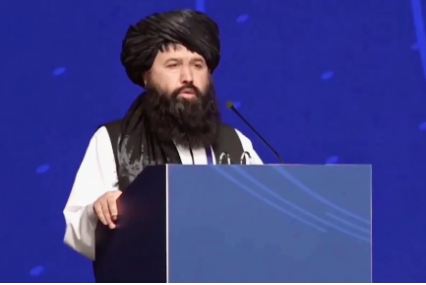
KABUL, JUN 11: Nada Mohammad Nadim, Acting Minister of Higher Education, criticized foreign interference in Afghanistan’s affairs during the Second International Forum of Education Ministers in Kazan, Russia, stating that the Islamic Emirate does not interfere in the internal affairs of other countries and expects the same from them.

The acting Minister of Higher Education also assured the conference of the Islamic Emirate’s efforts in combating terrorist groups.

“The Islamic Emirate has never interfered in anyone’s internal affairs and expects the same from others. We fight against all malicious activities,” he added.

Meanwhile, Habibullah Agha, acting Minister of Education, urged the international community to assist Afghanistan in the field of education during the conference.

Mansoor Ahmad Hamza, the spokesperson for the Ministry of Education, told TOLOnews that the acting minister shared the achievements and current challenges in the education sector with other education ministers.

“He shared the statistics of schools, teachers, and students with the participants and requested the international community to assist Afghanistan in building schools, printing books, and several other areas,” Mansoor Ahmad Hamza said.

Some university professors said the participation of the acting Ministers of Education and Higher Education in international conferences are crucial for gaining successful experiences and they emphasized the need for standardizing education and higher education in the country.

Zakiullah Mohammadi, a university lecturer, told TOLOnews: “They should strive to acquire and implement effective strategies from this visit to solve the current problems we are facing.”

The acting ministers of Education and Higher Education traveled to Kazan, Russia, two days ago to attend the Second International Forum of Education Ministers and are expected to meet with education ministers from other countries on the sidelines of the conference.

PAK vs CAN: Pakistan get 107-run target to win crucial T20 World Cup clash

PAK vs CAN: Babar Azam opts to bowl first against Canada in T20 World Cup match

New York, JUN 11: Pakistan won the toss and opted to bowl first in their third match of the T20 World Cup 2024 against Canada which is being played at the Nassau County International Cricket Stadium in New York on Tuesday.

Pakistan made one change in their playing XI from the last match against India as Saim Ayub has been included in place of Iftikhar Ahmed.

Playing XIs

Pakistan: 1 Mohammad Rizwan (wk), 2 Saim Ayub, 3 Babar Azam (capt), 4 Fakhar Zaman, 5 Usman Khan, 6 Shadab Khan, 7 Imad Wasim, 8 Shaheen Shah Afridi, 9 Naseem Shah, 10 Haris Rauf, 11 Mohammad Amir

Canada: 1 Aaron Johnson, 2 Navneet Dhaliwal, 3 Pargat Singh, 4 Nicholas Kirton, 5 Shreyas Movva (wk), 6 Ravinderpal Singh, 7 Dilon Heyliger, 8 Saad Bin Zafar (capt), 9 Kaleem Sana, 10 Junaid Siddiqui, 11 Jeremy Gordon

Pakistan are surely hitting rock bottom as they suffered defeats in the first two matches of the World Cup against the United States (USA) and India in Dallas and New York respectively and their chances of making way to the Super 8 of the tournament are now lingering on other results of the Group A games.

A win against Pakistan today would make things easier for Canada as they would have four points with just one more match to go. Their chances of qualifying for the T20 World Cup playoffs would still be alive.

However, if Pakistan lose, their campaign will be over as they will be officially eliminated with three successive losses.

Pitch Condition:

The pitches in New York have been supportive of bowlers as not even for once, a team managed to score 150 at the venue as the highest being posted by any team is 137. With no prediction of rain or clouds covering the sky, the pitch will continue to assist the bowlers.

Day of Russia celebrated

Day of Russia celebrated

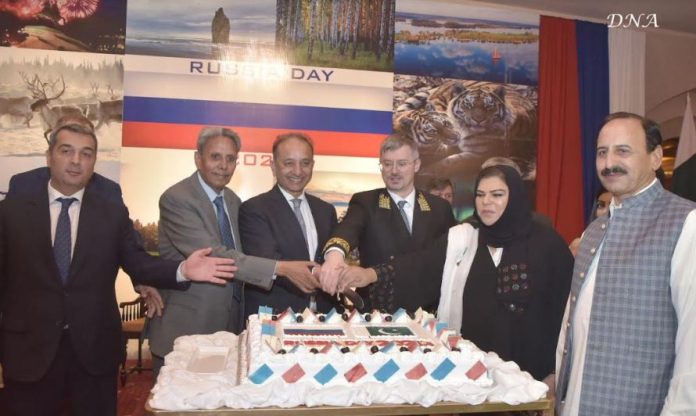
ISLAMABAD, JUN 11 /DNA/ – Federal Minister for Petroleum Mussadaq Malik, Ambassador of the Russian Federation Albert Khorev, Ambassador of Azerbaijan Khazar Farhadov and others cutting cake to celebrate the Day of Russia. DNA

Tribute paid to APS Peshawar terrorist attack martyrs in Ankara

Tribute paid to APS Peshawar terrorist attack martyrs in Ankara

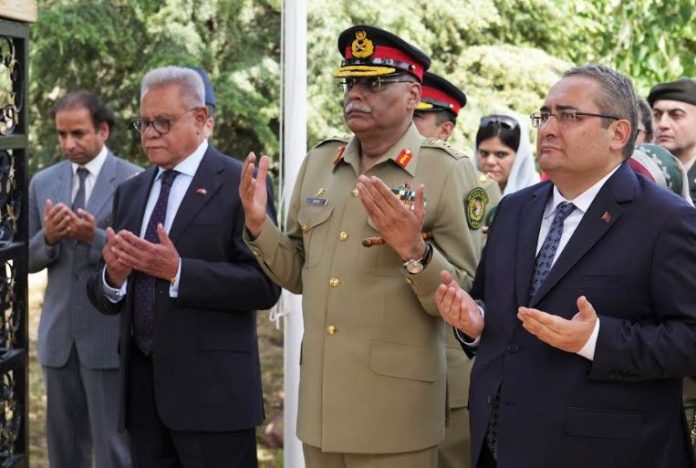
ANKARA, JUN 11 /DNA/ – Chairman Joint Chiefs of Staff Committee General Sahir Shamshad Mirza, NI (M) and Ambassador Dr. Yousaf Junaid accompanied by Keçiören Municipality Mayor Mesut Ozarslan visited APS Martyrs Memorial in Ankara to pay homage to the school children and staff martyred in the brutal terrorist attack on Army Public School (APS) Peshawar in 2014.

While expressing heartfelt gratitude to Turkish brethren for solidarity and keeping the memory of precious lives lost to terrorism alive, Ambassador Junaid stated that Pakistan suffered the worst atrocity by the brazen and violent terrorist attack on APS Peshawar. He noted, since that day our resolve to fight terrorism has grown stronger and our armed forces have conducted successful operations against terrorism.

Referring to the situation in Illegally Indian Occupied Jammu and Kashmir (IIOJK), ambassador stated   that definition of terrorism is incomplete without taking into account the ongoing atrocities in IIOJK. He thanked the leadership and people of Turkiye for their principled stance on Kashmir and support for the inalienable right of the self-determination of the Kashmiri people.

Reaffirming strong solidarity of Turkiye with Pakistan, Mayor Keçiören, Mesut Ozarslan condemned the terrorist attack and said nothing can justify such a brutal and inhuman act. He stated that the people of Turkiye would continue to stand by their Pakistani brothers in all aspects of life particularly in fight against terrorism.

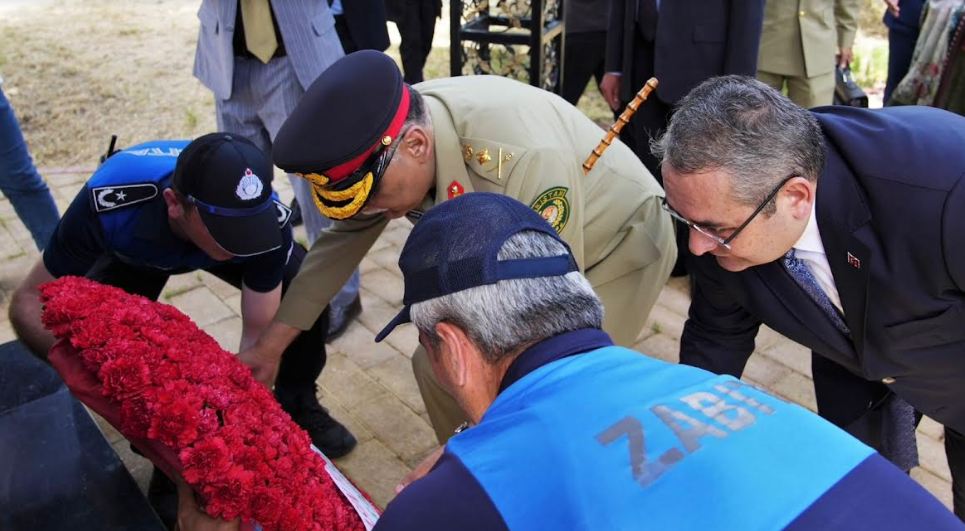
Later, Chairman Joint Chiefs of Staff Committee (CJCSC) General Sahir Shamshad Mirza along with Ambassador Junaid, Mayor Kecioren Mesut Ozarslan and other dignitaries laid wreath at the memorial of the APS martyrs.

CJCSC General Sahir Shamshad Mirza, is visiting Turkiye at the invitation of the Chief of Turkish General Staff, General Metin Gurak.  During his visit, CJCSC was received by Turkish Minister of National Defence Yasar Guler and held meetings at General Staff Headquarters. In recognition of his outstanding services for promoting Pakistan Turkiye defence ties , CJCSC General Sahir Shamshad Mirza was conferred upon ‘ Legion of Merit’ at Turkish General Staff Headquarters in Ankara.

IV Samarkand Forum on Human Rights to Address Climate Change Impact

IV Samarkand Forum on Human Rights to Address Climate Change Impact

SAMARKAND, JUN 11 /DNA/ – This is the name of the next topic of the IV Samarkand Forum on Human Rights, a traditional international conference to be held in our country on June 13-14, 2024. It is planned to hold three plenary meetings offline and online within the framework of the forum.

The main goal of this year’s Samarkand forum is to discuss issues related to the impact of climate change on human rights on a broad scale and on the basis of information analysis. In addition to gaining the necessary knowledge in this field, the participants of the international conference will have the opportunity to exchange experience and get acquainted with the best practices within the international community.

The Forum will focus on developing concrete recommendations and solutions to mitigate the negative impacts of climate change on human rights. The discussion is expected to serve as a forum for experts from various fields to develop effective strategies and approaches that help to achieve the Sustainable Development Goals and protect the rights of all people in a changing climate.

National organizers of the forum are the National Human Rights Center of the Republic of Uzbekistan and the Ministry of Justice of the Republic of Uzbekistan, as well as the “Strategy of Development” center.

Our international partners are the United Nations team in Uzbekistan. Among our international partners, in particular, the Office of the Permanent Coordinator of the United Nations in Uzbekistan, the Regional Office of the Office of the High Commissioner for Human Rights for Central Asia, the Office of the United Nations Development Program in Uzbekistan, the Office of the Coordinator of Projects in Uzbekistan of the Organization for Security and Cooperation in Europe, as well as Friedrich Ebert and Konrad Adenauer funds have representative offices in our country.

200 experts are scheduled to participate in the forum. In particular, national and foreign experts, climate specialists, officials of state organizations dealing with climate change issues, civil society institutions, mass media, scientific research centers, companies, business circles and representatives of international organizations were invited.

SC orders closures of all eateries in national park

SC orders closures of all eateries in national park

The chief justice observed that there is no military-owned land; the land belongs to the government of Pakistan

DNA

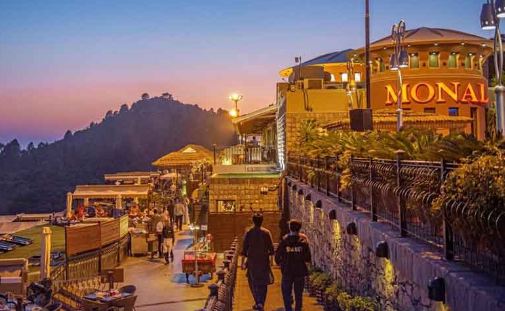
ISLAMABAD: The Supreme Court on Tuesday ordered the closure of all the eateries in the Margalla Hills National Park (MHPN) including Monal Restaurant in Islamabad.

The directives came in response to a March 11 court order in which it had sought the complete record of the land ownership of the restaurant. A three-member bench of the apex court, headed by Chief Justice Qazi Faez Isa, heard the petitions filed by Monal Restaurant, established in the Margalla Hills, as well as the Wildlife Department.

Earlier on March 8, the apex court ordered the de-sealing of the eatery after suspending the Islamabad High Court (IHC) verdict. The court had asked the Capital Development Authority (CDA) to furnish original records about the 8,600 acres of the MHPN land.

The additional attorney general had informed the court that the Military Estate Office claims the land as military-owned.However, the chief justice observed that there is no military-owned land; the land belongs to the government of Pakistan. He said that a simple question has been asked whether it is owned by the CDA or by someone else.

During the hearing, the top court summoned the CDA chairman on an immediate basis while rejecting the report submitted by the regulator.  CJP Isa said that the court had sought the details of Monal and other restaurants from the CDA.

At this, a CDA lawyer said that they have provided a report which contains all the details of all constructions in Margalla Hills National Park. The CJP said that a sports club, Pak-China Friendship Centre and Arts Council National Monument are also included in the CDA report.

“Is this the CDA’s honesty?” questioned the chief justice, asking whether the SC building also falls under the jurisdiction of the national park.

The lawyer said that he would have to look at the map to answer this question. “The world knows how many restaurants there are besides Monal except the CDA,” CJP Isa remarked, questioning whether the CDA’s office is also located in the national park.

He questioned how many times the Margalla Hills have caught fire, to this, the CDA chairman said 21 times this season. The Supreme Court then also directed all other restaurants in the National Park including Monal to relocate within the three-month period.

In its remarks, the court said that its aim is to ensure the protection of the National Park. It added that apart from National Park, the unnecessary notices issued to all other restaurants are terminated.

The court said that it is only focusing on the National Park. “All the leases granted to restaurants located in National Park are declared null and void,” said the court.

An Analysis of Pakistan’s Economic Growth Trends

An Analysis of Pakistan’s Economic Growth Trends

By: Maryam Wakeel

At the time of independence, Pakistan’s economy was predominantly agrarian, contributing over 50% to the GDP, with minimal industrial presence. The lack of essential infrastructure further undermined Pakistan’s economic sovereignty. The government’s focus on industrial development led to the neglect of agriculture in the early years. This neglect is evident in the agricultural growth rate, which was half that of the population growth rate. Contributing factors to this slow growth included water shortages and the impacts of partition, such as the water dispute with India and fluctuating rainfall and floods in the 1950s. Between 1947 and 1952, Pakistan’s average GDP growth was 3%, but the outbreak of the Korean War in 1952 boosted demand for goods, increasing GDP growth to 9%. Despite a global recession following the Korean War, Pakistan’s economy remained resilient due to its position as the sole exporter of jute at the time. The sustained high growth rate in the industrial sector during this period was achieved through deliberate policies that encouraged private industry investment and attracted substantial foreign aid. Import substitution and excessive protectionism also played crucial roles in maintaining the high growth rate in this sector.

The second decade of Pakistan’s history was characterized by the dictatorial regime of Field Marshal Ayub Khan. The 1960s were marked by robust economic performance. The Second Five Year Plan (1960-1965) aimed for a GDP growth of 20% over five years, exceeding the modest target of 15% set in the First Five Year Plan. The Third Plan (1965-1970) was formulated with great optimism, setting an annual growth target of 6.5%. The early years of the decade saw substantial growth in large-scale manufacturing, with an average annual increase of 16.9% between 1960 and 1965. However, the GDP growth rate declined to 3.1% in the latter half of the 1960s due to the war with India, though it subsequently recovered to 9.8% by 1970.

Bhutto initiated several socialist economic reforms aimed at stimulating Pakistan’s economic growth. A key component of these reforms was the process of nationalization. Initially, the policy targeted large firms, and within two years, all private banks, small manufacturing units, and colleges were nationalized without compensation to their former owners. Although intended to uplift the poor, these reforms quickly proved counterproductive. The inefficiency and incompetence of the nationalized institutions in the subsequent years demonstrated that nationalization was not in the national interest. Bhutto introduced land reforms aimed at enhancing the social and economic status of rural populations, over 80% of whom were directly involved in agriculture. Bhutto also announced a Labor Policy in February 1972, designed to elevate labor dignity, establish mechanisms for striking, promote labor-employer adjudication in labor courts, and extend material benefits to workers. This policy provided some relief through increased wages and welfare measures, including minimum wage hikes, injury compensation, old age benefits, and free education and medical facilities.

During Zia-ul-Haq’s regime, the economic growth rate averaged 6.6% annually. There was a significant increase in remittances, although this did not translate into a higher rate of savings and investments. Agricultural growth, while improved compared to previous years, remained relatively low. The manufacturing sector, however, experienced substantial growth, averaging 9% per year. This growth was driven by extensive public sector investments initiated during Bhutto’s era, the introduction of a flexible exchange rate policy, increased export rebates, and assurances against future nationalization. Special industrial zones were established to attract private investment, and regular currency adjustments positively impacted trade.

Despite these advancements, the national debt burden increased significantly, with interest payments rising from 1.9% of GDP in 1976 to 4.9% in 1987, primarily due to high-cost domestic borrowing. As part of his Islamization policy, Zia introduced an Islamic economic system, which included the establishment of the zakat institution and interest-free banking. However, these reforms did not yield significant economic benefits. The absence of an integrated economic and political framework has increasingly exposed Pakistan to the influence of international actors. Repeated agreements with international monetary institutions have plunged Pakistan into significant debt, compromising its economic sovereignty. Successive governments have depended heavily on borrowing from domestic and international sources, often neglecting the long-term economic consequences.

Analysts are divided on Musharraf’s tenure; some praise his liberal policies, while others criticize their short-sightedness. During Musharraf’s rule, the economy experienced robust growth, with an average GDP growth rate of 5.3%. His liberal economic policies attracted substantial foreign direct investment (FDI), restoring investor confidence and spurring growth across various sectors. However, his import-led growth strategy created an economic bubble. The surge in imports, particularly in the telecommunications and automotive sectors, strained the supply side of the economy. This issue was exacerbated by inadequate electricity supply, leading to an energy crisis that persists today. The resultant inflation eroded economic gains and reduced purchasing power, eventually bursting the economic bubble and causing significant economic decline.

Under the PPP government, Pakistan faced severe economic challenges necessitating difficult decisions at both the micro and macro levels. These decisions, including a macroeconomic stabilization program developed in consultation with the IMF, led to notable achievements. Inflation was halved by 2009, the fiscal deficit was reduced to 4.3% of GDP, the current account balance improved to 5.3% of GDP, and foreign exchange reserves surpassed $13 billion. These improvements were largely due to cuts in oil subsidies and development spending. The sudden drop in GDP growth exacerbated the situation, and the low tax-to-GDP ratio posed a significant threat to future growth. Rising public debt further strained revenue as interest payments increased. A temporary tax policy introduced through a Presidential ordinance aimed to generate additional revenue of Rs. 53 billion by the end of the 2010-11 fiscal years. Measures included the withdrawal of sales tax exemptions on agricultural inputs, an increase in special excise duty rates on non-essential items, and significant growth in direct and indirect tax collections. Throughout this period, the agriculture sector’s share of GDP fluctuated, while national savings and public investment as a percentage of GDP showed mixed trends. In fiscal year 2010-11, national savings were 13.2%, dropping to 10.7% the following year. Public investment increased slightly from 2.9% of GDP to 3.0% in 2011-12.

As of 2024, the country grapples with significant economic hurdles, including high inflation, a burgeoning debt crisis and political instability that impacts investor confidence. The agricultural sector remains a cornerstone, contributing substantially to GDP and employment, yet it faces productivity issues due to outdated practices and climate change effects. The industrial sector, particularly textiles, continues to be vital for exports, though it is hampered by energy shortages and infrastructural deficiencies. On a positive note, Pakistan’s burgeoning IT sector shows promise, driven by a young, tech-savvy population and increasing digital connectivity. Remittances from the Pakistani diaspora also play a crucial role in bolstering the economy. Despite these challenges, strategic reforms, improved governance, and international partnerships hold the potential to steer Pakistan towards a more stable and prosperous economic future. Pakistan’s contemporary economy is marked by a mix of significant challenges and emerging opportunities. Addressing structural issues, improving governance, and leveraging its strategic location and youthful population can pave the way for sustainable economic growth. Continued focus on reforms, technological integration and infrastructure development are essential for Pakistan to unlock its full economic potential.

At the end I thank to Dr. Muhammad Akram Zaheer who dedicates his time to guide students, driven by a genuine passion for enhancing their writing skills and helping them complete assignments. His expertise is particularly prominent in ideology and Constitution of Pakistan where he enlightens students about the captivating history of Pakistan. Dr. Zaheer truly embodies the essence of an inspiring educator and leaving an indelible mark on all his students.

Maryam Wakeel

Student BS Media Communication Studies

University of Okara

[email protected]

Stay Connected

64FansLike
60FollowersFollow

Latest Reviews

Exchange Rates

USD - United States Dollar
EUR
1.17
GBP
1.35
AUD
0.67
CAD
0.72