Home Blog Page 598

Two Conflicts, One Agenda: Joint Aggression on Muslim Sovereignty

Two Conflicts, One Agenda: Joint Aggression on Muslim Sovereignty

by Muhammad Mohsin Iqbal

The world revolves around power, conspiracies and vested interests. In view of these phenomena, the months of May and June 2025 have become etched in contemporary geopolitical memory for two seemingly separate yet strikingly parallel conflicts—one between Pakistan and India, the other between Israel and Iran. Though separated by thousands of miles, both episodes displayed a common methodology, a mirrored hostility, and an undeniable alliance behind the scenes. These were not coincidental skirmishes but coordinated acts of aggression targeting two Muslim nations. In both theatres, a joint strategic framework between Israel and India was unmistakably visible—an axis of power that seeks regional domination through calculated provocation.

On the morning of May 7, 2025, Pakistan was compelled to respond militarily to an Indian violation of its airspace and sovereignty. According to credible military reports, Indian drones attempted deep aerial reconnaissance over Azad Jammu and Kashmir as well as Pakistan under the guise of a “counter-terrorist maneuver. In retaliation, Pakistan scrambled these drones, successfully repelling the intrusion and conducting limited precision strikes on Indian military outposts along the Line of Control.

However, what set this episode apart was the chilling discovery that the drones were not of Indian origin. Defense analysts and electronic forensics teams traced the downed drones back to Israeli manufacturer Elbit Systems, confirming the presence of Hermes 900 and Harop drones—advanced combat UAVs previously used in Gaza and Lebanon. These drones had been remotely piloted not from Israeli territory, but from a command center near Jaisalmer, Rajasthan. Israeli defense technicians stationed on Indian soil, under a bilateral defense cooperation protocol signed in 2023, were operating these machines. This was no longer a matter of speculation; this was direct collaboration.

More disturbingly, diplomatic cables leaked through anonymous intelligence channels revealed that between May 1 and May 7, Prime Minister Benjamin Netanyahu and Prime Minister Narendra Modi were in communication at least four times. According to one cable sourced from a European intelligence agency, Netanyahu promised “tactical intelligence, technological support, and political cover in international forums” to India during its brief campaign. The entire exercise, it appears, was designed not only to provoke Pakistan but to assess its rapid response capabilities in the event of a larger future conflict.

This hidden agenda was later confirmed in an interview given by Prime Minister Netanyahu on June 10, only three days before the Israeli strike on Iran. Speaking to “The Jerusalem Chronicle”, Netanyahu openly referred to both Pakistan and Iran as “radical Islamic states possessing or nearing nuclear capabilities,” claiming that “the global community must remain vigilant against these ideological regimes with atomic teeth.” He further declared, “While we are focused on Iran’s ambitions, we cannot ignore Pakistan’s strategic position and military potential—especially when aligned ideologically with Tehran.” These remarks, though framed in the language of preemptive security, revealed a deep-seated bias and a justification for regional aggression under the veil of self-preservation. Netanyahu’s comments clearly exposed a strategic doctrine that does not differentiate between real threats and perceived ones if they arise from the Muslim world.

Interestingly, in the days preceding the May 7 escalation, the U.S. Vice President publicly stated that “the United States has no role to play in the Pakistan-India tension.” However, as the situation escalated and global markets wavered, the U.S. President intervened diplomatically, pressuring both sides into a ceasefire brokered through backchannel communication and high-level mediators. This inconsistency in U.S. posture—first denying involvement, then stepping in to halt conflict—reveals the West’s careful calibration of when and where to engage, driven not by moral clarity but by geopolitical calculus.

Given Iran’s remarkable resilience and military effectiveness during the June 13 Israeli assault—where Tehran’s air defenses neutralized nearly half of Israel’s advanced missile barrage—speculation is now rife that the U.S. President may once again be compelled to intervene diplomatically. Washington’s concern, analysts argue, is no longer only about regional escalation but about Iran’s demonstrated capability to withstand and respond to high-tech aggression. The world is watching, and once more, the United States may be forced to abandon passive neutrality in favor of pressured diplomacy.

Barely a month after the South Asian crisis, a new chapter of confrontation unfolded in the Middle East. On June 13, 2025, Israel launched a comprehensive military assault on Iran, striking key facilities in Isfahan, Bushehr, and Khorramabad. Over 36 missiles, including the long-range Jericho III and precision-guided Delilah cruise missiles, were deployed, alongside stealth drones from the Israeli Air Force. Among the primary targets were Iran’s nuclear fuel enrichment facilities, the Imam Ali military base, and communication hubs suspected of housing IRGC cyber units.

Once again, the hand of coordination with India was evident. Just hours before the attack, Netanyahu and Modi exchanged another round of communication, confirmed by international media monitoring encrypted traffic between Tel Aviv and New Delhi. Furthermore, the cyberattack that coincided with the missile strike disrupted over 40 percent of Iran’s air traffic control systems and disabled portions of the country’s oil export communication infrastructure. Cybersecurity firms in Tehran traced the malware to a software package originally developed by Tata Advanced Systems in partnership with Israel Aerospace Industries. The code, a hybrid of previously used Stuxnet and Flame variants, was engineered to target SCADA systems—further proof of Indo-Israeli cooperation in hybrid warfare.

Iran, like Pakistan, stood its ground. The Bavar-373 and Khordad-15 missile defense systems intercepted 19 of the incoming missiles mid-flight. In response, Iran launched a limited counterstrike, targeting Israeli intelligence positions in the occupied Golan Heights using Fateh-110 missiles. The swift defense and proportional retaliation reaffirmed Iran’s preparedness and capability to confront high-tech aggression. Supreme Leader Ayatollah Ali Khamenei, in a rare address to the nation, denounced the “Zionist-Hindu nexus,” calling for greater Muslim solidarity in the face of systematic regional destabilization.

The common thread in both conflicts is stark; Israel and India operating in tandem, combining military, technological, and cyber capabilities to challenge regional Muslim powers. For both, Iran and Pakistan represent ideological, strategic, and geopolitical resistance. While Israel seeks to eliminate Iran as a regional competitor and suppress any challenge to its nuclear monopoly, India eyes Pakistan as an obstacle to its ambitions of unchallenged hegemony in South Asia.

The broader concern, however, lies in the deafening silence of the global community. The United Nations failed to call any emergency session. Western media outlets framed the Pakistan-India conflict as a “border escalation” and the Israel-Iran exchange as a “preventive strike” against alleged Iranian provocation. Not a single resolution of condemnation was issued. This selective morality exposes the hollow core of so-called international justice—a system that blinks at violations when they target Muslim nations.

In the face of such complex aggression, the way forward for Pakistan and Iran is not merely reactive but strategic. Military intelligence sharing, coordinated cyber defenses, joint military exercises, and diplomatic synchronization must become the foundation of a deeper alliance. History shows that isolated states fall, but aligned states endure. Both nations must realize that their survival and dignity are now intertwined not only in faith and culture, but in fate.

The wars of May and June 2025 will be remembered not only for the might of drones and missiles but for the clarity they provided about the shape of the future. The age of hybrid warfare is upon us, where bullets and bytes go hand in hand. Yet even in this age, there remains a timeless truth: the soul of a nation, when united, cannot be conquered. Iran and Pakistan did not merely survive these attacks—they emerged strengthened, their peoples resolute, their enemies warned. Ultimately, tyranny may march with steel, but history always walks with justice. And justice, though delayed, never dies.


Iran, Israel continue to exchange strikes as world leaders push for de-escalation

Iran, Israel continue to exchange strikes as world leaders push for de-escalation

TEHRAN, JUN 16: Iran, Israel continue to exchange strikes as world leaders push for de-escalation. Iran’s intelligence chief Mohammad Kazemi killed in Israeli attacks, confirms Tehran’s semi-official news agency

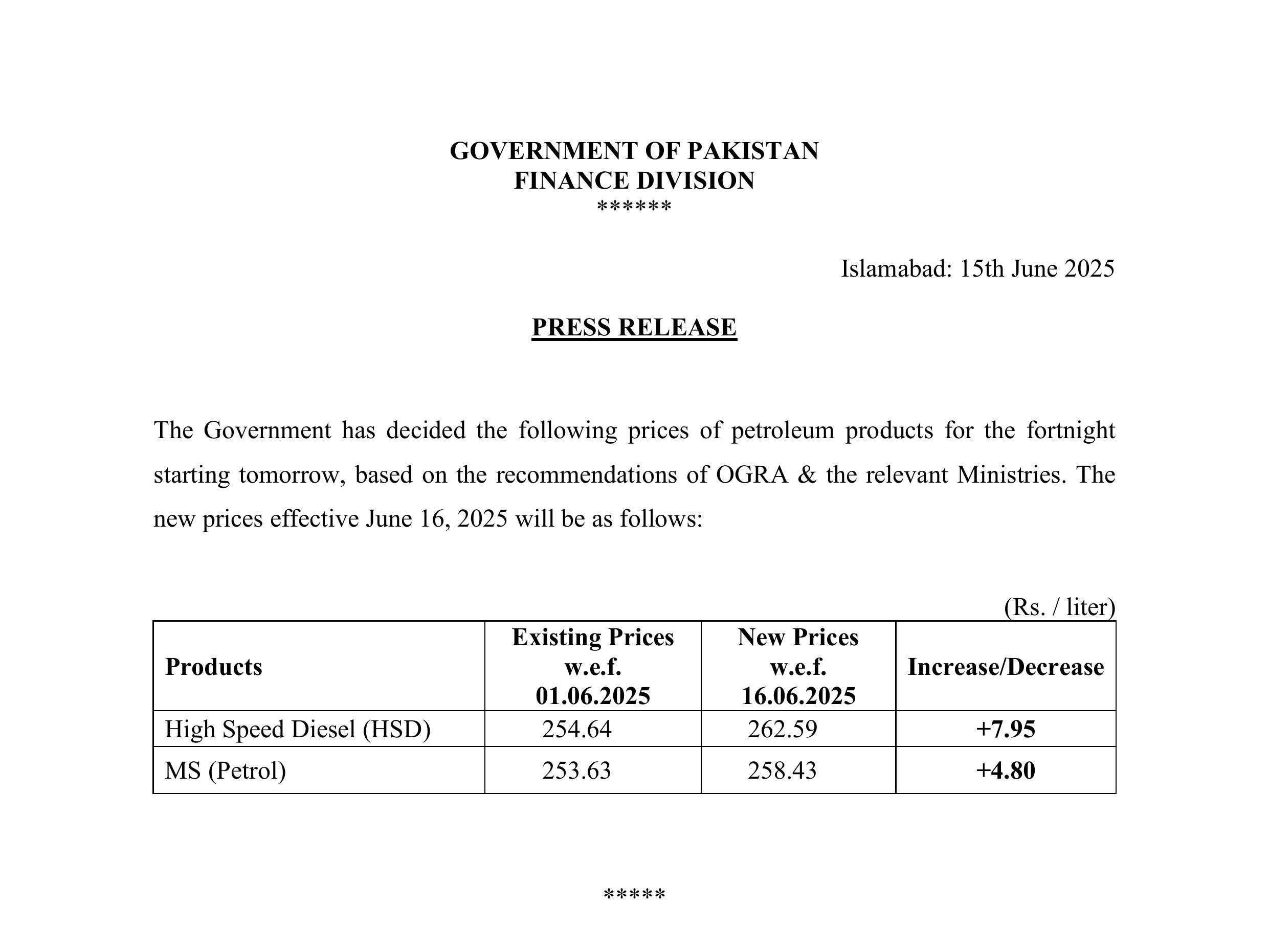
Govt increases petrol price by Rs4.8 per litre for next fortnight

Govt increases petrol price by Rs4.8 per litre for next fortnight

ISLAMABAD, JUN 16: The federal government on Sunday announced an increase in the petrol price by Rs4.80 per litre for the next 15 days, raising it to Rs262.59 from Rs254.64 per litre.

In a notification, the Finance Division said that the new petrol price will take effect from June 16.

The rate for high-speed diesel was also increased by Rs7.95 per litre, raising it to Rs258.43 from Rs253.63 per litre.

— Reporter
— Reporter

In the previous fortnight, the federal government had raised the petrol price by Re1 amid largely stable global oil markets.

Petrol is primarily used in private transportation, small vehicles, rickshaws, and two-wheelers. Rising fuel prices significantly affect the budgets of middle- and lower-middle-class households, who mainly rely on petrol for commuting.

In contrast, a substantial portion of the transport sector depends on high-speed diesel. Its price is considered inflationary, as it is extensively used in heavy goods transport vehicles, trucks, buses, trains, and agricultural machinery such as tractors, tube wells, and threshers. The increased cost of high-speed diesel directly contributes to the rising prices of vegetables and other essential food items.

The Last Stand: Iran Humiliates Israel and Revives the Dignity of the Ummah

Qamar Bashir


By Qamar Bashir

In a shocking revelation that sent ripples across global diplomatic circles, U.S. President Donald Trump recently vetoed a covert Israeli proposal to assassinate Iran’s Supreme Leader Ayatollah Ali Khamenei. The plan, reportedly hatched by Israeli intelligence and pushed forward by Prime Minister Netanyahu, was seen by many as a desperate move to provoke a full-scale regional war under the pretext of nuclear containment—a narrative Israel has been nurturing for over thirty years. Iran, notably, does not possess nuclear weapons, a fact verified time and again by international watchdogs.

Israel’s obsession with Iran has little to do with nuclear fears and more to do with Tehran’s refusal to bow to Israeli supremacy. Since its inception, Israel has either dismantled or neutralized regimes that dared challenge its military and political dominance. Iran remains the last ideological adversary. Netanyahu’s dream of bringing down the Iranian regime was merely an extension of this hegemonic vision. The “nuclear threat” was a convenient excuse—much like the WMD hoax used to obliterate Iraq.

As a Muslim bearing the wounds of a broken Ummah, one cannot help but feel a deep, bitter sense of despair, humiliation, and abandonment. Wherever Muslims have been oppressed—be it Kashmir, Burma, Bosnia, Palestine, or Sub-Saharan Africa—they have been silenced, murdered, and exiled with brutal impunity. And tragically, no Muslim nation has risen to their aid—not militarily, not diplomatically, and not morally.

Kashmir remains under siege by India’s military. The region is a shadow of its former self, where people are deprived of political rights, economic liberty, and even the basic right to movement or speech. India has converted it into a prison, and the world, especially the Muslim world, has turned a blind eye.

The same holds true for the Rohingya Muslims in Burma, driven from their homes, raped, and murdered in droves. Stateless and impoverished, they continue to suffer in camps. In Bosnia, the genocide carried out by Serbians left millions of Muslims dead or displaced. Gaza has become a permanent warzone where generations have grown up knowing only fear, hunger, and death. The death toll in Gaza alone has surpassed 75,000 civilians, yet the Muslim world’s silence is deafening.

Meanwhile, Israel flourishes with impunity. Encircled by silent Arab nations rich in oil and influence, it bombs Gaza, Syria, and Lebanon without pause or consequence. The October 7 attack by Hamas, widely condemned, was immediately used as a moral blank check by Israel to raze entire neighborhoods, hospitals, schools, and refugee camps. Its justification? That Hamas hides among civilians. But no civilized legal or moral system would condone the mass killing of civilians as retribution.

Israel brands itself as the “most moral army in the world,” a claim that collapses under the weight of its actions. When it bombed civilian targets in Gaza, it declared them legitimate; now, when Iranian missiles strike military targets in Israel, it cries foul. The hypocrisy is stunning.

But for the first time, that myth of Israeli invincibility has been shattered. Despite being crippled by over three decades of Western sanctions, Iran mustered the will, technological capability, and national unity to retaliate forcefully. Its missiles evaded Israel’s prized defense systems—Iron Dome, David’s Sling, and Patriot batteries—hitting strategic sites and exposing the hollowness of Israeli arrogance. Iran’s defiance was not just military; it was moral and symbolic.

What startled observers was the response—or lack thereof—from the international community. When Israel called for help, no nation rushed to its side. Even President Trump held back, declaring that America would not intervene unless U.S. interests were directly threatened. This marks a tectonic shift in America’s blind allegiance to Israel.

And now, Trump’s strategy is becoming clear.

In hindsight, Trump’s game was brilliantly Machiavellian. First, he encouraged both Israel and Iran to pursue nuclear negotiations. When Israel sabotaged that process with its reckless airstrikes, Trump remained publicly aloof. He let Israel bear the brunt of Iranian retaliation while quietly calculating the diplomatic fallout. Israel, intoxicated by power and assured of international backing, assumed Iran would not respond. But it did—and with deadly precision.

The result? Israel is isolated. Its defense narrative is crumbling. Its allies are retreating. And now, with its arrogance bruised and its invincibility myth destroyed, Israel is finally talking about returning to negotiations. Trump is again hinting that a diplomatic resolution is not only possible but likely. And this time, it might work.

Why? Because Iran never left the negotiation table. It was Israel that walked away and triggered the escalation. Iran, despite the provocations, held its ground diplomatically while defending itself militarily. Now, with leverage restored and deterrence firmly established, Iran is negotiating from a position of strength. This shift could offer the most fertile ground for a lasting resolution in years.

However, settling the issue won’t be easy. The U.S. and Israel’s demands extend far beyond nuclear non-proliferation. They want Iran to cut ties with Hezbollah, the Houthis, the Syrian regime, and most importantly, Hamas. These demands are aimed at dismantling Iran’s ideological and strategic support for resistance groups that defend oppressed Muslim populations. But Iran is the only Muslim country that refuses to yield. It supports the oppressed not just rhetorically, but financially, diplomatically, and militarily.

This is Iran’s real “crime” in the eyes of the West—not its nuclear ambitions, but its unwavering support for Palestine and other subjugated Muslim communities. That is the red line for Israel and the U.S., and it is why they have waged an endless campaign to contain or destroy Iran.

Iran’s resilience should now serve as a beacon for the Muslim world. For decades, Muslims have watched their brethren suffer while their governments remained spineless. Iran, despite its economic isolation, stood firm. It not only survived but demonstrated that it could hurt those who believed themselves untouchable.

What terrifies Israel now is not Iran’s missiles—it is Iran’s example. If one sanctioned, isolated, Muslim-majority country can rise and challenge the status quo, what happens if others follow? What if other Muslim nations find the courage to defy oppression and injustice with action rather than silence?

This fear is precisely why Israel is ramping up its propaganda campaign, trying to portray Iran as the global threat. But the narrative is failing. Even former allies are growing wary of Israel’s endless wars. The old equation—Israel attacks, the world supports—no longer holds.

Let this moment be remembered not just as a military confrontation, but as a moral awakening. Iran has reminded the world that the oppressed are not voiceless. That dignity, when paired with courage, can upend even the strongest empires. The centers of power are shifting—China is rising, Europe is reasserting its independence, Russia remains potent, and now, Iran has emerged as a formidable power of resistance.

Let this also be a lesson to Muslims everywhere: silence is complicity. Action is the only antidote to oppression. The world may not hand over justice—but it respects those who demand it. And for once, a nation did. Iran did.

By Qamar Bashir

Press Secretary to the President (Rtd)

Former Press Minister at the Embassy of Pakistan to France

Former MD, SRBC

Macomb, Michigan, USA

AUKUS under Review

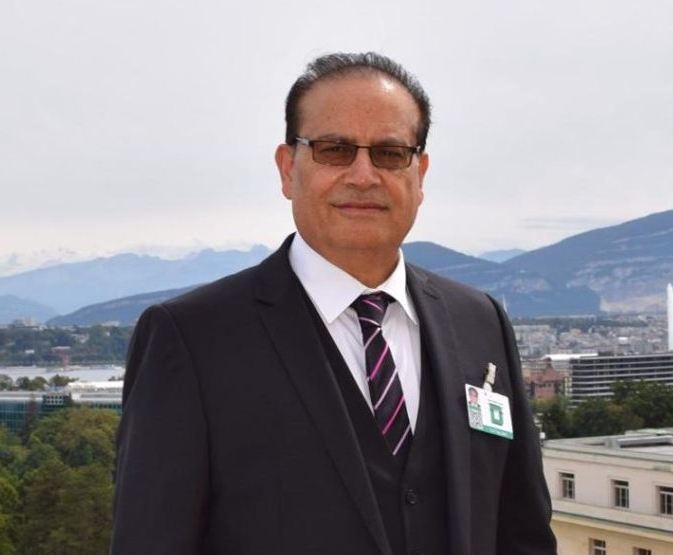
Dr. Muhammad Akram Zaheer

Dr. Muhammad Akram Zaheer

University of Okara

AUKUS, a landmark security agreement valued at approximately £176 billion (US$239 billion; A$368 billion), entails the transfer of nuclear-powered submarine capabilities to Australia a significant development given that, aside from the United Kingdom, no other nation has previously been granted access to the United States’ nuclear propulsion technology. The arrangement is widely interpreted as a strategic countermeasure to the growing assertiveness of the People’s Republic of China in the Indo-Pacific region. Initially, the United States is expected to provide Australia with three second-hand Virginia-class submarines, with an option for two additional vessels, followed by the collaborative design and construction of a new class of nuclear-powered submarines incorporating technologies from all three-partner nations.

Despite the far-reaching implications of this agreement, the current U.S. administration has signaled its intent to re-evaluate the pact, in terms of both its strategic utility and the degree to which it adheres to American defense priorities. According to a senior U.S. defense official, the review is being conducted to ensure that “this initiative of the previous administration is aligned with the President’s America First agenda,” emphasizing operational readiness, the optimization of military resources, and equitable contributions from allies. This review is being spearheaded by Elbridge Colby, a prominent defense strategist who has previously expressed skepticism regarding the advisability of transferring such advanced capabilities to allies at a time when U.S. military assets are already under considerable strain.

The review emerges amidst growing pressure from the U.S. for its allies to increase their defense expenditures. The Biden administration has urged partner nations to allocate no less than 3% of their gross domestic product (GDP) to defense. While the United Kingdom has committed to reaching 2.5% of GDP by 2028 and aims to hit 3% in the subsequent parliamentary term, Australia’s defense budgetary commitments remain below Washington’s expectations. Despite Canberra’s assurances of increased spending, it has yet to pledge alignment with the 3.5% target advocated by U.S. defense officials.

Australian Defense Minister Richard Marles has sought to downplay concerns arising from the review, expressing confidence that the agreement will proceed as planned. In remarks to local media, Marles reaffirmed the strategic necessity of a long-range submarine capability for Australia, particularly given the country’s geographic positioning within the Indo-Pacific theater. He emphasized the importance of adhering to the existing blueprint, noting the political and strategic complexities that emerged following the cancellation of a prior submarine agreement with France in favor of AUKUS.

From the Australian perspective, the acquisition of nuclear-powered submarines represents a transformative enhancement of its military capabilities. These platforms will allow the Australian Defense Force to project power over significantly greater distances and durations than is currently possible with its diesel-powered fleet. Furthermore, the pact enhances Australia’s capacity for strategic deterrence and grants access to elite defense technologies components often described in U.S. defense circles as the “crown jewels” of national security assets.

The review also draws attention to broader strategic concerns, particularly regarding the alignment of operational doctrines among the trilateral partners. Dr. Jennifer Kavanagh, a defense analyst at the American think tank Defense Priorities, has highlighted two core issues underpinning the U.S. reassessment: first, the existing constraints on America’s own submarine production capabilities, and second, the uncertainty surrounding how Australia would deploy these assets in the event of a regional conflict, notably one involving Taiwan. As such, the review may consider revising the partnership’s focus from direct submarine transfers toward broader technological cooperation in long-range strike capabilities.

Both Australia and the United Kingdom have characterized the review as a routine and expected development under a new U.S. administration. Official statements from both governments have emphasized continuity and mutual commitment to the strategic partnership. A UK defense spokesperson reaffirmed that AUKUS constitutes one of the most strategically consequential partnerships in recent decades, underscoring its significance for maintaining peace and stability in both the Indo-Pacific and Euro-Atlantic regions.

Notably, any substantive shift in the AUKUS framework such as a delay or diminution in the transfer of nuclear propulsion technology would have considerable geopolitical ramifications. A U.S. withdrawal or significant recalibration of the agreement would likely be met with approbation from Beijing, which has consistently condemned AUKUS as a destabilizing force and a potential catalyst for a regional arms race. For China, the pact symbolizes the consolidation of a military bloc aimed explicitly at containing its rise.

From a broader geopolitical perspective, the review could lead to sustained or enhanced cooperation and help reinforce deeper technological and strategic collaboration among the countries. Conversely, any retreat from the pact could undermine perceptions of U.S. reliability among its allies and embolden adversarial actors in an increasingly contested Indo-Pacific security environment.

Pakistan, Malaysia Play Thrilling 3-3 Draw in FIH Nations Hockey Cup

Pakistan, Malaysia Play Thrilling 3-3 Draw in FIH Nations Hockey Cup

DNA

KUALA LUMPUR: In a high-octane clash at the FIH Nations Hockey Cup on Sunday, Pakistan and Malaysia played out a thrilling 3-3 draw. The match showcased moments of brilliance from both sides, with Pakistan dominating the early phases before Malaysia staged a strong comeback in the final quarter.

Pakistan took a solid lead in the first three quarters, with quick passing and aggressive attacks keeping Malaysia on the back foot. The Green Shirts led 3-1 heading into the final stretch, with goals from Arshad Liaqat, Rana Waheed, and Sufyan Khan.

However, the momentum shifted dramatically in the fourth quarter. Malaysia launched a fierce counteroffensive, capitalizing on defensive lapses by Pakistan. Two late goals stunned the Pakistani side, exposing weaknesses in the defense and goalkeeping. Pakistan’s goalkeeper came under criticism for conceding two soft goals that allowed Malaysia to level the score.

Despite the draw, Pakistan showed flashes of promise and attacking flair. The team must now regroup quickly as they prepare to face Japan on Monday at 3:00 PM local time. A win against Japan is crucial if Pakistan hopes to advance in the tournament and keep their title hopes alive.

‘Baseless propaganda’: Pakistan denies supplying ballistic missiles to Iran

'Baseless propaganda': Pakistan denies supplying ballistic missiles to Iran

ISLAMABAD, JUN 15: Security sources have strongly rejected reports claiming Pakistan provided non-nuclear ballistic missiles to Iran, terming them baseless, frivolous, and part of a propaganda campaign led by Indian media and its affiliated foreign outlets.

The development came after a statement started circulating on social media regarding Pakistan’s involvement in the Israel-Iran standoff, which was shared with images of the Iranian and Pakistani flags.

Diplomatic sources termed the statement ‘fake’ and said it falsely attributed a claim to Pakistan about delivering a “nuclear response” against Israel in support of Iran.

They also clarified that the assertion regarding Pakistan’s military joining the war alongside Iran was entirely baseless.

Israel and Iran launched fresh attacks on each other overnight into Sunday, as the US president said the conflict could be easily ended while warning Tehran not to strike any US targets.

Israeli rescue teams combed through the rubble of residential buildings destroyed in strikes, using flashlights and sniffer dogs to look for survivors after at least seven people were killed, including children, authorities said.

Tehran has called off nuclear talks that Washington had said were the only way to halt Israel’s bombing, while Prime Minister Benjamin Netanyahu said the attacks by Israel so far were nothing compared with what Iran would see in the coming days.

According to the Iranian media, the death toll from Israeli attacks on Friday and Saturday was at least 128, including women and children, reporting hundreds more wounded.

At least “128 people were martyred in these military attacks, and around 900 injured individuals were admitted to” hospitals, said Etemad daily, citing the health ministry.

The report said the deaths include at least “40 women”, adding that the “number of martyred children is significant”.

‘Baseless propaganda’: Pakistan denies supplying ballistic missiles to Iran

'Baseless propaganda': Pakistan denies supplying ballistic missiles to Iran

ISLAMABAD, JUN 15: Security sources have strongly rejected reports claiming Pakistan provided non-nuclear ballistic missiles to Iran, terming them baseless, frivolous, and part of a propaganda campaign led by Indian media and its affiliated foreign outlets.

Water Crisis? CDA’s New ‘Liquid Gold’ plan revealed

Water Crisis? CDA’s New ‘Liquid Gold’ plan revealed

Water saves life which is a great blessing from Allah Almighty (SWT). Every individual to play its due role in saving water as every drop of water counts. Muhammad Ali Randhawa

ISLAMABAD, JUN 15 /DNA/ – Chairman, CDA Chief Comkisdioner Islsmabad and DG Civil Defence Muhammad Ali Randhawa, presided over a meeting. The meeting was attended by CDA Board Members, along with other relevant senior officers of CDA.

During the meeting, Chairman CDA, Muhasmmad Ali Randhawa said that Water is a great blessing from Allah Almighty, and it is the responsibility of every individual to play its due role in saving water as saving water saves life and every drop of water counts. The CDA is fully committed to addressing the water-related challenges faced by the citizens of Islamabad on a priority basis. We are making our best efforts to ensure uninterrupted access to clean and safe water to all the citizens of Islamabad.

Chairman CDA highlighted the establishment of the Islamabad Water Agency, which is now being made fully equipped with the necessary resources, including water experts, modern equipments, and trained manpower. He said that the Islamabad Water is a testament to our vision for sustainable water in future. We are strengthening its administrative and governance structure to ensure its effectiveness in addressing the water needs of the residents of the Federal Capital Islamabad.

Chairman CDA urged CDA, MCI and ICT and all other segments of the society to play its due role in conserving water, waste of water by repairing leaks, using water-efficient appliances, and adopting mindful water consumption habits, thus we all can collectively make a significant difference and impact in this regard. Secondly, through effective awareness campaigns about the importance of water and its usage among students of colleges and universities as well as teachers and other segments of society, we may be able to ensure the sustainable management of our water resources as per our needs.

It was briefed that CDA is actively exploring new avenues to meet the future water demands of Islamabad. During the meeting, various proposals were discussed, including alternative water supply sources and the modernization of the water distribution network.
In line with its long-term strategy, the CDA is also engaging with local and international donors and development partners to secure funding for viable water supply projects. It was briefed that CDA is working on various feasibility studies and consulting with stakeholders to ensure the successful implementation of these projects.

Chairman CDA affirmed that his goal is to provide safe and clean water to every citizen of Islamabad, today and in the future. He said that water plays an important role in our lives and the urgent need is to protect this vital resource. The CDA calls upon all stakeholders, including citizens, to join hands in safeguarding water resources for future generations.

Chairman CDA concluded the meeting with the message that individuals as well as collective efforts of all stakeholders could make a difference in achieving our targets in persevering water in order to address our future needs of water including ensuring safe drinking to its citizens, cultivation of agriculture lands as well as utilization of water for other needs. Let us work together to ensure that everyone has access to safe and clean water.

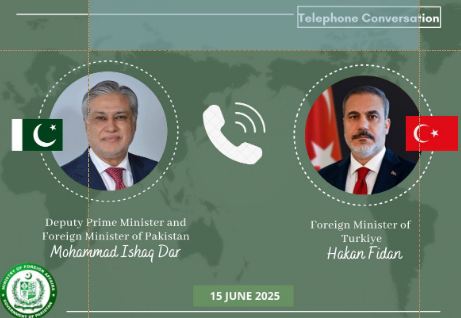
Dar, Turkish FM discuss rising tensions over Israel-Iran conflict

Dar, Turkish FM discuss rising tensions over Israel-Iran conflict

ISLAMABAD, JUN 15 /DNA/ – Deputy Prime Minister/Foreign Minister, Senator Mohammad Ishaq Dar @MIshaqDar50, today received a telephone call from the Foreign Minister of Türkiye, Hakan Fidan @HakanFidan.

The two leaders expressed deep concern and anguish over the deteriorating regional situation due to Israel’s unjustified attacks on Iran.

The DPM/FM also confirmed his participation in the forthcoming meeting of OIC Council of Foreign Ministers (CFM), and at the Islamic Cooperation Youth Forum’s (ICYF) ceremony to honour President Recep Tayyip Erdoğan, both scheduled to be held next week in Istanbul.

Stay Connected

64FansLike
60FollowersFollow

Latest Reviews

Exchange Rates

USD - United States Dollar
EUR
1.17
GBP
1.35
AUD
0.72
CAD
0.73