Home Blog Page 574

RCCI, PESSI agree on worker welfare awareness campaigns

RCCI

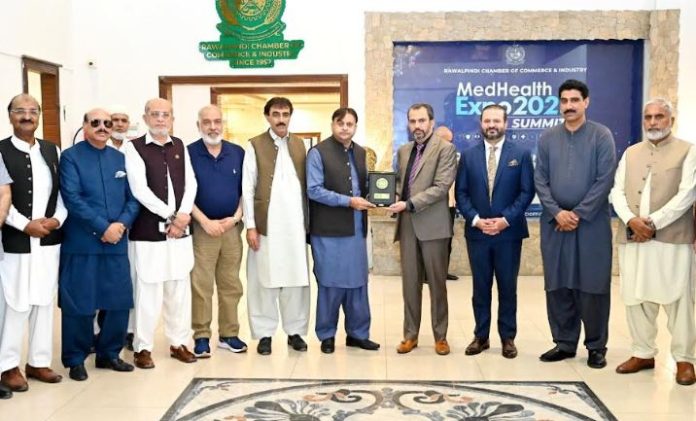
RAWALPINDI, JUL 14 /DNA/ – Director of the Punjab Employees Social Security Institution (PESSI), Mr. Malik Farrukh Mumtaz, paid an official visit to the Rawalpindi Chamber of Commerce and Industry (RCCI). He was accompanied by Deputy Director Mr. Munir Malik and Inspector Mr. Naeem Azizi.

During the visit, Director Malik Farrukh Mumtaz shared that significant amendments have been made to the laws governing the collection of the Workers’ Welfare Fund (WWF) and the Workers’ Participation Fund (WPPF). As per the new regulations, the complete authority for collection of these funds has been transferred to PESSI. Consequently, all contributions and related payments will now be made directly to PESSI.

He welcomed the Chamber’s proposals regarding awareness sessions, registration processes, and contribution mechanisms, emphasizing the importance of stakeholder engagement.

Acting President of RCCI, Mr. Khalid Farooq Qazi, welcomed the delegation and proposed measures to further strengthen the collaboration between the two institutions. He offered the Chamber’s platform for organizing awareness sessions focused on registration and available facilities.

Mr. Qazi also appreciated the valuable services provided by the Social Security Institution for the welfare of workers, including pensions, disability allowances, medical treatment at social security hospitals, death grants, and other social protection benefits.

The session was attended by Vice President Mr. Fahad Barlas, former President Mr. Jalil Malik, executive committee members, and representatives from various business sectors.=DNA

Pakistan youth must upskill for automation-driven future: ICCI

ISLAMABAD, JUL 14 /DNA/ – President Islamabad Chamber of Commerce and Industry (ICCI), Nasir Mansoor Qureshi, has emphasized that in an era where automation is transforming industries at an unprecedented pace, it is crucial for the country’s youth to equip themselves with future-facing skills to not just survive, but thrive in the evolving economic landscape.

He made these remarks while addressing a group of young entrepreneurs who visited the Chamber House on Monday. On this occasion, ICCI Senior Vice President Abdul Rehman Siddiqui and Vice President Nasir Mehmood Chaudhry were also present.

Highlighting the immense potential of Pakistan’s youth, the ICCI President stressed the urgent need for skill-based training to help the younger generation view rapid technological changes as opportunities rather than threats. “The future belongs to those who can adapt, innovate and lead in a tech-driven world,” he said.

Nasir Mansoor Qureshi urged academic institutions to revamp their teaching methodologies by integrating problem-based learning, real-world case studies, and simulations that foster forward-thinking, creativity, and confidence among students.

He further encouraged young people to become tech-agile and open to emerging career paths such as digital entrepreneurship, remote freelancing, and content creation—viable alternatives to conventional employment.

Reaffirming the Chamber’s commitment to this cause, Qureshi said, “ICCI is dedicated to bridging the gap between academia and industry through strategic collaborations to prepare our youth for the challenges and opportunities of the future.”=DNA

FAO, Japan aid flood-hit farmers in Pakistan

flood-hit farmers

ISLAMABAD, JUL 14 /DNA/ – The Food and Agriculture Organization of the United Nations (FAO) has concluded a critical emergency project that provided support to flood-affected farming and herding communities in Pakistan’s Balochistan and Sindh provinces, made possible through generous funding from the Government of Japan.

The FAO-led intervention, backed by a contribution of USD 6.48 million, focused on restoring food production, improving household nutrition, and building longer-term resilience in areas devastated by the unprecedented 2022 floods. Over 74,000 households—equivalent to more than 520,000 people—benefited from the initiative, which combined agricultural support with livestock protection and targeted assistance for female-headed families.

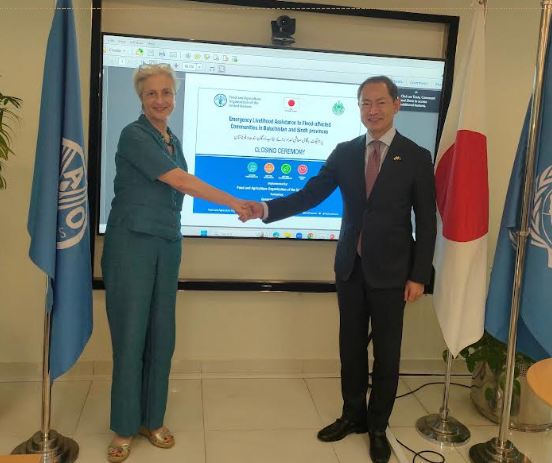
A project completion event was held at FAO premises in Islamabad on July 14to highlight the key results and express appreciation for Japan’s contribution. The event brought together Ambassador of Japan to Pakistan, H.E.Mr. Akamatsu Shuichi, FAO Representative in Pakistan, Florence Rolle, and senior representatives from national and provincial partners.

“The Government of Japan has always prioritized human security in its development cooperation,” said Ambassador Akamatsu, adding, “This project reflects our commitment to helping the people of Pakistan recover from the devastating floods and rebuild their lives through practical and sustainable agricultural support.”

FAO’s response involved the distribution of seeds, fertilizers, and training to help families restart food production. Over 14,000 households received inputs for vegetable and field crop cultivation, while 1,500 hectares of agricultural land were rehabilitated. As a result, farming families were able to grow a wide range of crops, including wheat, rice, maize, okra, brinjal, and tomatoes—improving food availability and income opportunities.

Support to livestock-owning families included the distribution of animal feed, mineral blocks, poultry, and small ruminants, along with the construction of animal shelters and a mass vaccination campaign that reached more than 629,000 animals, benefiting 35,000 households. Special focus was given to female-headed households, who received livestock and poultry packages along with training in animal care and poultry production to help diversify and stabilize their incomes.

“This project made a real difference in the lives of rural communities that lost nearly everything to the floods,” said Florence Rolle, FAO Representative in Pakistan. “With Japan’s timely support, families not only regained their ability to produce food but also strengthened their resilience against future shocks.”

Implemented in close coordination with the Ministry of National Food Security and Research, disaster management authorities, and non-governmental partners, the project also helped enhance local knowledge of climate-smart practices, food security planning, and livestock management—laying the foundation for more resilient rural systems in the future.

The uncertain future of TAPI

TAPI

The Turkmenistan-Afghanistan-Pakistan-India (TAPI) gas pipeline project, once hailed as a game-changer for regional energy cooperation, remains stuck in limbo. Originally slated for completion by 2022, the project has faced repeated delays, primarily due to geopolitical tensions, security concerns in Afghanistan, and disagreements over India’s participation. While Turkmenistan insists on keeping India in the deal, Pakistan has grown increasingly reluctant to allow its regional rival to benefit from the pipeline. With the TAPI dream fading, another regional connectivity project—the Pakistan-Uzbekistan rail link via Afghanistan—appears to be making progress, raising questions about whether TAPI will ever materialize.

The TAPI pipeline, designed to transport 33 billion cubic meters of natural gas annually from Turkmenistan’s Galkynysh field to energy-starved South Asia, was envisioned as a win-win for all stakeholders. However, the project has been plagued by multiple roadblocks:

Pakistan has long been skeptical of allowing India to become a key beneficiary of the pipeline, given the tense bilateral relations. While Turkmenistan and Afghanistan see India’s participation as crucial for the project’s financial viability, Pakistan fears energy dependence on a hostile neighbor. Recent statements from Pakistani officials suggest a growing push to exclude India, which could derail the entire initiative.

Even if political differences were resolved, the Taliban-controlled Afghanistan remains a major security risk. The previous Afghan government had pledged to protect the pipeline, but the current regime’s ability to ensure safe transit is uncertain. Instability in the region makes financing and construction a risky proposition.

The estimated cost of TAPI exceeds $10 billion, and securing investment has been difficult due to the project’s geopolitical risks. International investors remain hesitant, and without strong commitments from all parties, the pipeline may never break ground.

While TAPI flounders, another regional connectivity project—the Trans-Afghan Railway connecting Pakistan, Afghanistan, and Uzbekistan—is gaining traction. This rail link, expected to be operational much sooner than TAPI, promises to enhance trade and transit between Central and South Asia. Unlike TAPI, this project does not involve India, making it more politically palatable for Pakistan. The railway could serve as a model for regional cooperation without the complications of Indo-Pak rivalry.

Turkmenistan, desperate to monetize its vast gas reserves, is unlikely to abandon India—a massive energy market—without a fight. However, if Pakistan remains adamant about excluding New Delhi, the project may need a drastic redesign. One possibility is scaling down TAPI to a Turkmenistan-Afghanistan-Pakistan (TAP) pipeline, supplying gas only to Pakistan and Afghanistan. Yet, this would require alternative financing and buyers, as the original feasibility depended on India’s demand.

The TAPI pipeline, once a symbol of regional cooperation, now appears increasingly unviable due to geopolitical rifts and security challenges. While Turkmenistan clings to the hope of keeping India on board, Pakistan’s reluctance and Afghanistan’s instability cast a long shadow over the project’s future. Meanwhile, the progress on the Pakistan-Uzbekistan rail link demonstrates that regional connectivity is still possible—just not in the form originally envisioned.

Unless all stakeholders make urgent compromises, TAPI may join the long list of ambitious but failed energy projects in South Asia. The window for saving it is closing fast, and if no breakthrough occurs soon, the dream of a trans-regional gas pipeline may finally be laid to rest.

Time for a new Islamic bloc

Time for a new Islamic bloc

The ongoing humanitarian catastrophe in Gaza has exposed the shocking impotence of the Organisation of Islamic Cooperation (OIC) and the Arab League. Despite countless emergency meetings, strongly worded statements, and hollow declarations, these organizations have failed to take any meaningful action to stop the bloodshed or hold the aggressors accountable. Their inaction raises serious questions about their relevance and effectiveness in the Muslim world.

The OIC and the Arab League have become mere platforms for rhetoric, issuing condemnations that lead to no concrete steps. While innocent Palestinians continue to suffer under relentless violence, these organizations remain paralyzed by internal divisions and the influence of a few powerful members who prioritize their political and economic interests over Islamic solidarity. The recent emergency summits on Gaza have produced nothing but photo-ops and empty promises, proving once again that these bodies are incapable of delivering real solutions.

The OIC, which claims to represent 57 Muslim-majority nations, has been effectively hijacked by a handful of countries that dictate its agenda. Instead of being a unified voice for the Muslim Ummah, it has become a tool for geopolitical maneuvering. Similarly, the Arab League remains divided, with some member states normalizing relations with Israel while Palestinians endure occupation and bombardment. This hypocrisy undermines the credibility of these organizations and leaves the Muslim world without genuine leadership.

Given the failure of the OIC and the Arab League, it is time for a new coalition of Muslim nations that can act decisively on critical issues like Palestine. Countries like Pakistan, Turkey, Indonesia, Malaysia, and Azerbaijan – which have consistently shown moral clarity on Gaza – should lead this bloc. Unlike the OIC, this alliance must be free from the dominance of a few powerful states and should prioritize justice, humanitarian intervention, and practical steps over mere statements.

This new bloc could start with a core group and later expand to include other nations willing to take a principled stand. The OIC and Arab League have proven to be ineffective institutions, held hostage by political compromises and external influences. The Muslim world cannot afford to wait for their empty gestures anymore.

A new alliance, led by nations with the courage to act, must emerge to fill this leadership vacuum. If the existing bodies cannot fulfill their duty, then history will remember them as failed institutions, and the responsibility will shift to those willing to take real action for justice and liberation.

BLA and Mukti Bahini: Two Names, One Agenda

BLA and Mukti Bahini: Two Names, One Agenda

by Muhammad Mohsin Iqbal

Although I was born four years after the Indo-Pak war of 1965, the stories I read and heard throughout my childhood spoke of a resolute Pakistan defeating India from all sides. That warwas fought with valor and strategic brilliance. However, the battlefield was only the beginning. India, bruised yet unbroken, resorted to covert tactics after its defeat. It turned to a more insidious form of warfare—a proxy war that would, within a few years, dissociatethe eastern wing of Pakistan apart and result in the creation of Bangladesh. History teaches us not to trust the intentions of an adversary whose very identity thrives on enmity.

After almost six decades, Pakistan once again found itself facing the same nefarious design, this time, on May 7, 2025, India committed aggression against Pakistan in the name of Operation Sindoorwhich forced India to hoist the white flag with the determined spirit of Operation Bunyan al-Marsus. This time too, defeated India cunningly continued the proxy war through stealth. The methods have not changed. Only the region. Where Bengali nationalism was once incited and armed, now Baloch nationalism is also being exploited with the same cunning. The agents are different in name but the same in function. The strategy of insurgency is familiar; fomenting ethnic division, creating distrust against the federation, and facilitating insurgency under the guise of independence.

This is no mere speculation. The statistics speak for themselves. According to the latest biannual data issued by the Home Department of Balochistan, terrorism has surged alarmingly. In just the first six months of this year, a staggering 501 terrorism-related incidents occurred across the province. These attacks resulted in the loss of 257 lives, including 133 security personnel, and left 492 injured—among them 238 security officials. Notably, the number of terrorist attacks rose by 45%, while the targeted killings of non-local settlers doubled, increasing by 100%.

In 14 separate attacks on settler individuals, 52 people were killed and 11 wounded solely because of their ethnicity or perceived affiliation. A total of 81 bombings, hand grenade assaults, IEDs, landmine explosions, and rocket attacks claimed 26 lives and injured 112 more. There were also 39 attacks directly targeting ordinary citizens, killing 11 and wounding 29. In one of the most horrifying incidents, two separate attacks on trains during this period resulted in the deaths of 29 innocent passengers. Even humanitarian efforts were not spared—a polio worker was killed in a targeted attack. Moreover, nine assaults on mobile phone towers injured two and aimed to disrupt basic communication infrastructure.

These are not random acts of violence—they are the hallmarks of an orchestrated insurgency aimed at destabilizing Pakistan internally. The Mukti Bahini, the so-called “Liberation Army” of East Pakistan, was not merely a local movement of discontent. It was a well-orchestrated and externally funded insurgency. Trained and armed under India’s Operation Jackpot, the Mukti Bahini specialized in guerrilla tactics—ambushes, sabotage, and coastal raids—that left the Pakistani military overstretched and disoriented. The role of India’s Research and Analysis Wing (RAW) and Directorate of Naval Intelligence was no secret. Nor was the involvement of Israel, which clandestinely supplied arms in return for diplomatic favours. It was, in essence, an international campaign to dismember Pakistan. The political fuel came from the Awami League, whose leadership—particularly Sheikh Mujibur Rahman—had long been agitating for autonomy and, eventually, secession. Following Mujib’s arrest in 1971, his loyalists formed a sub-faction, the Mujib Bahini, which played an even more direct role in the insurgency.

In a startling moment of candour during his 2015 visit to Bangladesh, Indian Prime Minister Narendra Modi admitted India’s decisive role in the events of 1971. His words—“We fought together, we sacrificed together, and we won together”—laid bare a historical truth that had long been whispered but seldom acknowledged so openly. That confession did not just echo through South Asia; it exposed a doctrine of interventionism that continues to haunt the region today.

The parallels between the Mukti Bahini and the Baloch Liberation Army (BLA) are too striking to ignore. The BLA, formed officially in the early 2000s but inspired by older Baloch separatist movements, mimics the same strategy of asymmetric warfare. The targets have changed—now it is Chinese nationals, infrastructure projects under the China-Pakistan Economic Corridor (CPEC), and Punjabi settlers—but the goal remains consistent; to fragment Pakistan by fomenting ethnic hatred and sabotaging national integration. Their ideology cloaks itself in Baloch nationalism and secularism, yet it reeks of ethnic cleansing and calculated terrorism.

Pakistan has consistently charged and presented evidence of RAW supporting the BLA, drawing parallels with RAW’s involvement with the Mukti Bahini decades ago. The 2016 arrest of Kulbhushan Jadhav, an Indian naval officer, in Balochistan added weight to these claims. His confession outlined how Indian intelligence financed and supported Baloch militants to destabilize the region. Reports have also surfaced about BLA operatives receiving medical treatment and logistical aid in India. Just as East Pakistan’s insurgents were provided with training camps and safe havens in the past, today’s separatists are reportedly granted covert sanctuaries.

What is most alarming is the violence against civilians. In the name of liberation, the BLA has repeatedly targeted non-Baloch communities, particularly Punjabis. Innocent laborers, engineers, and traders have been massacred for the sole reason of their ethnicity—an act that betrays the very idea of political resistance and exposes the ethnic hatred that lies at the core of the movement. CPEC, a project vital to Pakistan’s economic future, has become a battleground not just for geopolitical rivalries but for domestic terror, with Chinese workers being abducted and killed as a message to both Islamabad and Beijing.

It is easy to lay the blame solely on external actors, and while that blame is largely justified, we must also examine our own role in allowing such fissures to grow. Some state functionaries, through neglect or incompetence, may have allowed space for such insurgent sentiments to fester. Yet the ultimate cost has always been borne by Pakistan itself. It is our soil that bleeds, our citizens who suffer, and our unity that is threatened.

In both 1971 and today, the enemy did not attack from across the border—it first entered the minds and hearts of our own people. This makes the challenge all the more profound. Pakistan cannot afford to ignore these warning signs, nor can it continue to treat them as isolated incidents. The battle is not merely for land; it is for the soul of the nation.

Let history not repeat itself through our own silence or inaction. Let us remain vigilant, united, and wise to the lessons of our past. For if the price of liberty is eternal vigilance, then the cost of forgetfulness is national disintegration.

Iran says ‘no specific date’ for US nuclear talks

Iran says 'no specific date' for US nuclear talks

TEHRAN, JUL 14 (AFP/APP):Iran said Monday it had “no specific date” for a meeting with the United States on Tehran’s nuclear programme, following a war with Israel that had derailed negotiations.

                  “For now, no specific date, time or location has been determined regarding this matter,” said foreign ministry spokesman Esmaeil Baqaei of plans for a meeting between Iran’s top diplomat Abbas Araghchi and US envoy Steve Witkoff.

                  Araghchi and Witkoff met starting in April, without concluding a deal after five rounds of talks that were the highest-level contact between their two countries since Washington in 2018 abandoned a landmark nuclear agreement.

                  The Omani-mediated negotiations were halted as Israel launched surprise strikes on Iran’s nuclear facilities on June 13, starting a 12-day war which the United States later joined.

                  “We have been serious in diplomacy and the negotiation process, we entered with good faith, but as everyone witnessed, before the sixth round the Zionist regime, in coordination with the United States, committed military aggression against Iran”, said Baqaei.

                  Israel and Western nations accuse Iran of pursuing nuclear weapons, a charge Tehran has consistently denied.

                  While it is the only non-nuclear power to enrich uranium to 60-percent purity, close to the level needed for a warhead, the UN’s atomic energy watchdog has said it had no indication that Iran was working to weaponise its stockpiles.

                  Israel’s offensive last month, which it said was aimed at thwarting a nuclear threat from the Islamic republic, killed nuclear scientists and top-ranking military officers as well as hitting military, nuclear and other sites and residential areas.

                  The United States launched its own set of strikes against Iran’s nuclear programme on June 22, hitting the uranium enrichment facility at Fordo, in Qom province south of Tehran, as well as nuclear sites in Isfahan and Natanz.

                  The extent of the damage from the strikes remains unknown, and Baqaei said it was “still under investigation”.

                  Iran responded with missile and drone attacks on Israel, and attacked a US base in Qatar in retaliation for Washington’s strikes.

                  – Sanctions –

                  Baqaei said on Monday that Iran remains in contact with Britain, France, and Germany, the three European parties to the 2015 nuclear deal that the United States later withdrew from.

                  The Europeans have threatened to trigger the “snapback” mechanism under the 2015 agreement, which allows the reimposition of UN sanctions in the event of non-compliance.

                  Baqaei said Tehran was “in continuous contact with these three countries” but added that he “cannot provide an exact date” for the next meeting with them.

                  There was “no legal, moral or political basis” for reimposing sanctions, according to Baqaei, as Iran was still committed to the 2015 agreement.

                  The ministry spokesman added that such a move would be met with an “appropriate and proportionate” response, following Iranian threats to quit the nuclear non-proliferation treaty.

                  After the United States pulled out of the nuclear accord during Donald Trump’s first term as president, Iran began rolling back its commitments to the agreement that restricts its atomic activities in return for sanctions relief.

                  “The Islamic Republic of Iran still considers itself a member of the JCPOA,” Baqaei said of the 2015 deal.

Zorhan Mamdani: The Painful Path to the New York Mayoralty

Qamar Bashir

 By Qamar Bashir

Zorhan Mamdani, the first South Asian, first Muslim, and first immigrant in serious contention for the mayorship of New York City, is no ordinary candidate. At just 38 years of age, with a radiant forehead, a disarming smile, and eyes that sparkle with conviction, he has become a symbol of possibility in a system long rigged against outsiders. Yet from the moment he clinched victory in the Democratic primary—stunning the political elite—his journey has been met with a resistance unparalleled in the annals of modern American municipal politics.

Born in Kampala, Uganda, and raised in the U.S. from the age of seven, Mamdani personifies a generation molded by the American dream yet scarred by systemic exclusion. His ascent through the ranks of local politics was not accidental—it was forged in the fire of grassroots mobilization, tireless door-knocking, and fearless messaging grounded in the everyday struggles of working-class New Yorkers. He achieved the unthinkable when he defeated former Governor Andrew Cuomo in the Democratic primary—a titan of influence, wealth, and elite connections with roots that run all the way to Washington.

That upset victory sent shockwaves through both political parties. The Democratic establishment, accustomed to anointing successors, scrambled to contain the insurgency. The GOP, meanwhile, saw in Mamdani not merely a political opponent, but a threat to the status quo they’ve long defended. From the very next day, the attacks began—not measured critiques, but demonizations. President Donald Trump, in a now-viral clip alongside Israeli Prime Minister Benjamin Netanyahu, dismissed Mamdani as a “lunatic communist.” Netanyahu, with a chuckle, added, “He’s mayor now?” The smirk wasn’t just dismissive—it was chilling. The machinery of institutional power had been activated.

The backlash intensified rapidly. Jewish advocacy groups labeled him an anti-Semite for his pro-Palestinian stance and previous associations with slogans like “globalize the Intifada,” despite his repeated clarifications that his critiques were of government policies, not religious communities. Right-wing media and conservative evangelicals branded him a “radical Islamic sympathizer.” Threats escalated, targeting his safety, his citizenship, and his family. What began as political opposition devolved into personal vilification, an orchestrated campaign to break his spirit and discredit his legitimacy.

In one televised appearance, Mamdani struggled to hold back tears while reading aloud hateful messages sent to his loved ones. These weren’t ordinary criticisms; they were dehumanizing attacks meant to remind him that, in the eyes of the power elite, his existence in public life was conditional, his dreams illegitimate. The vitriol implied a brutal truth—that a South Asian, Muslim immigrant may sweep floors or drive a cab in New York, but aspiring to lead it is a step too far.

As the general election looms, the obstacles grow more daunting. His opponents are flush with millions in campaign cash, much of it from shadowy donors. Spoiler candidates have emerged overnight, designed to divide progressive votes. The city’s convoluted electoral procedures create fertile ground for legal contestation, recounts, and administrative sabotage. There is even the looming threat of federal scrutiny—an extreme, but not unimaginable, tactic in today’s charged political climate.

But through all this, Mamdani’s base is only growing stronger. He has galvanized a diverse coalition: working mothers in the Bronx, Bangladeshi storeowners in Queens, idealistic youth in Brooklyn, and Harlem’s reform elders. They see in him more than a candidate—they see a champion for those long ignored, a voice that echoes their frustrations, and a leader who walks beside them, not above them.

However, with this support comes danger—the danger of being baited into battles not his to fight. Much of the controversy surrounding Mamdani’s campaign has nothing to do with garbage collection, housing shortages, transit reform, or public safety—the issues that matter to New Yorkers. Instead, his critics have shifted focus to foreign policy questions irrelevant to the mayoral office: Will he visit Israel first? Does he support the Palestinian Intifada? Would he arrest Netanyahu or Modi if they visit the city? These are traps—not debates. They are lures designed to shift the narrative from potholes and public housing to geopolitics and ideological warfare, where Mamdani can be painted as divisive and dangerous.

This is where discipline is required. Mamdani must rise above these distractions and resist the temptation to respond to every provocation. His focus must remain on New York—the city’s crumbling infrastructure, unaffordable rents, stagnant wages, and racial disparities in policing and healthcare. His promise lies not in foreign affairs, but in fixing failing subways, reducing gun violence, expanding after-school programs, and restoring dignity to the underserved. The best rebuttal to hate is competence. And the best response to slander is service.

Still, even if he wins in November, the road ahead remains treacherous. Victory will be followed by a confirmation process with the city’s Election Commission and a transition period where outgoing officials—some openly hostile—may seek to delay or undermine his authority. His formal assumption of office in January 2026 is not guaranteed until every bureaucratic hurdle is cleared. The system, with all its invisible levers, may yet try to disqualify him—not through ballots, but through bureaucracy.

This battle is no longer just about a mayor’s office. It’s about whether America truly believes in what it professes: liberty and justice for all. When an American citizen—who pays taxes, pledges allegiance, and serves his community—is treated as a suspect rather than a statesman, the nation must pause. When his ambition is questioned not on merit but on ethnicity, the illusion of inclusion stands exposed.

Yet there is hope. At the street level, the cynicism of institutions meets the decency of people. Millions of New Yorkers see Mamdani not as a foreigner, but as one of their own—raised on city streets, shaped by its rhythms, and determined to heal its wounds. His campaign is not merely a political movement; it is a referendum on whether democracy still functions when tested.

If Zorhan Mamdani wins, it will be more than personal triumph. It will affirm that this nation can still defy its darker instincts. That a campaign built on subway fares, small donations, and sheer willpower can beat back dynasties, donors, and demagogues. But if he is denied his victory through media manipulation, electoral trickery, or manufactured scandal, it will be a stark indictment of the American promise—a sign that we have failed to rise above the narrowness of race, religion, and riches.

Let sanity prevail. Let New York be guided not by fear, but by fairness. Let this beautiful country—with all its promise and all its pain—choose a path of justice, inclusion, and integrity. Because the world is watching. And Zorhan Mamdani’s march may well be America’s last great test.

By Qamar Bashir

 Press Secretary to the President (Rtd)

 Former Press Minister, Embassy of Pakistan to France

 Former MD, SRBC | Macomb, Michigan, USA

Pakistan-China ties: rebuilding trust

Supreme Court verdict on reserved seats: ‘a death knell for democracy’


Opinion

Ansar Mahmood Bhatti

The China-Pakistan Economic Corridor (CPEC), once hailed as a game-changing strategic partnership between Pakistan and China, today stands at a crossroads. Once the cornerstone of regional connectivity, economic rejuvenation, and strategic collaboration, CPEC has suffered a series of unfortunate disruptions in recent years. These setbacks, many stemming from political decisions during the PTI government under Prime Minister Imran Khan, have left numerous projects suspended and cast an unfortunate shadow of suspicion over one of the most promising bilateral ventures in South Asia.

As of now, several critical infrastructure and energy projects under the CPEC framework remain incomplete or have slowed to a crawl. Pakistan cannot afford to let CPEC — the symbol of Pakistan-China friendship — become a casualty of mistrust, mismanagement, or political point-scoring. It is imperative for the current government to take bold yet pragmatic steps to restore the confidence of our Chinese partners, revive the stalled projects, and reaffirm our commitment to a friendship that has stood the test of time.

It is true that the PTI government had legitimate concerns regarding transparency and accountability in some of the early CPEC agreements. Ordering a comprehensive audit of all CPEC projects was presented as a move in the national interest, aimed at unearthing alleged corruption, ensuring fiscal responsibility, and safeguarding Pakistan’s sovereign economic interests. There were indeed reports and indicators suggesting financial irregularities, mismanagement, and favoritism in contract awarding processes. In that context, calls for greater scrutiny were not entirely misplaced.

However, what the PTI government underestimated — or failed to manage diplomatically — was the sensitivity of the matter for the Chinese side. The abruptness of the audit announcement, without proper prior consultation or confidence-building, led to a freeze in progress. The Chinese perceived the move not just as a bureaucratic exercise, but as a lack of trust in their intent and commitment. It disturbed the mutual respect that had characterized Pakistan-China relations for decades.

To make matters worse, the political noise surrounding the allegations amplified the damage. The very narrative that CPEC was a hotbed of corruption spread across media channels and political platforms, creating an environment of suspicion and skepticism. Today, even the most well-intentioned project under the CPEC umbrella is viewed with a cautious, often mistrustful eye. This shift in public perception must be reversed — and urgently.

Let us not forget that CPEC is not merely a portfolio of roads, energy plants, and special economic zones. It represents the deep strategic convergence between China and Pakistan. For China, it provides a crucial land-based route to the Arabian Sea through Gwadar, helping it diversify its trade routes and reduce dependency on the Strait of Malacca. For Pakistan, it offers critical investment, infrastructure development, energy security, and job creation — all vital for a struggling economy.

In times of war and peace, China has proven to be a friend of Pakistan. Be it diplomatic support at global forums, generous COVID-19 vaccine assistance, or unequivocal support during periods of heightened tensions with India, China has stood by Pakistan. The spirit of “iron brotherhood” is not a mere slogan — it is a lived reality. It is only appropriate that we now reciprocate with equal sensitivity and understanding, especially when it comes to preserving the long-term vision behind CPEC.

While the damage from the PTI era cannot be undone entirely, it can certainly be managed with renewed political will and diplomacy. The current government must take the lead in engaging with the Chinese authorities to sort out the outstanding issues. Wherever irregularities were found, transparency should be restored through quiet diplomacy and corrective mechanisms — not through public scapegoating or political grandstanding.

At the same time, Pakistan must ensure that new and ongoing CPEC projects are governed by improved transparency and accountability standards. This will not only reassure the Chinese investors but also regain public confidence in Pakistan. Institutions like the CPEC Authority need to be empowered, depoliticized, and staffed with capable professionals who understand both the Chinese perspective and Pakistan’s development needs. China, too, must adapt to evolving ground realities in Pakistan.

One of the persistent criticisms of Chinese involvement in Pakistan is the narrowness of their outreach. Chinese companies and institutions tend to work with the same group of local contractors, consultants, and intermediaries they partnered with during the initial phase of CPEC. While this may offer comfort and continuity, it risks alienating emerging players, particularly in an ever-evolving political and media landscape.

It is also a concern that Chinese representatives avoid mainstream media or civil society engagement, possibly fearing that these forums may not echo their narrative. But this approach is counterproductive. Open engagement, rather than selective interaction, is the key to soft power. Chinese diplomats and companies must become more accessible — not just to government functionaries and handpicked stakeholders — but to business chambers, media professionals, academia, and the general public.

China must realize that public perception matters. People need to see and hear from those who are working on the ground. Not only will this help dispel myths and counter anti-CPEC propaganda, but it will also forge deeper and more diverse friendships across Pakistani society. China has always been seen as a reliable friend by the people of Pakistan; it must now invest in engaging with them more proactively.

The fear that mainstream media will not “toe the line” is based on a misunderstanding. Responsible journalism is not about blind allegiance, but about honest storytelling. By sharing accurate information, granting access to project sites, and offering regular briefings, the Chinese stakeholders can help the media report facts — which in turn, will strengthen CPEC’s credibility.

It is time for the Chinese mission in Pakistan and their business partners to consider a communications overhaul. Employing trained public relations professionals, expanding media outreach, and holding periodic briefings with journalists and civil society will only work in their favor.

The path forward lies not in reliving the mistakes of the past, but in paving the way for a new chapter of collaboration. Pakistan must reassure China that it remains fully committed to the original vision of CPEC. This includes addressing legacy issues in a mature manner, re-prioritizing stalled projects, and ensuring the security of Chinese nationals working in Pakistan.

China, in return, must recognize that Pakistan’s democratic and economic landscape has evolved. Partnering with a broader set of stakeholders, listening to local voices, and working through institutional channels rather than closed-door arrangements will make CPEC more resilient and widely accepted.

Above all, the trust that was momentarily shaken must be rebuilt — not just between two governments, but between two peoples.

CPEC is too important to be derailed by suspicion or shortsightedness. It is a symbol of a time-tested friendship, a blueprint for shared prosperity, and a foundation for regional peace. Both Pakistan and China must rise above the noise of past controversies and recommit themselves to the ideals that inspired CPEC in the first place.

Kazakh train service to Tashkent, Samarkand, Bukhara

Kazakh

ASTANA, JUL 14 (DNA): East Kazakhstan governor Nurymbet Saktaganov met with Uzbekistan’s Ambassador to Kazakhstan Bakhtiyor Ibragimov, Kazinform News Agency cites the governor’s press service.

The talks focused on the prospects for further cooperation between East Kazakhstan and Uzbekistan, particularly in the agro-industrial complex and tourism.

As stated there, this year Ust Kamenogorsk will resume train service to Tashkent, Samarkand and Bukhara. To note, direct flights were launched from Ust Kamenogorsk to Uzbekistan.

The sides debated opportunities for delivering nuclear fuel for the future NPP in Uzbekistan and exchanging practices in industrial waste treatment and burial.

The governor said development of joint projects will elevate cooperation between East Kazakhstan and Uzbekistan to a new, strategically important level. As reported earlier, Uzbekistan and Kazakhstan strengthen cooperation in geology.

Stay Connected

64FansLike
60FollowersFollow

Latest Reviews

Exchange Rates

USD - United States Dollar
EUR
1.17
GBP
1.35
AUD
0.72
CAD
0.73