Home Blog Page 562

Uzbek Envoy presents credentials to Sri Lankan Chief of Protocol

Uzbek Envoy presents credentials to Sri Lankan Chief of Protocol

DNA

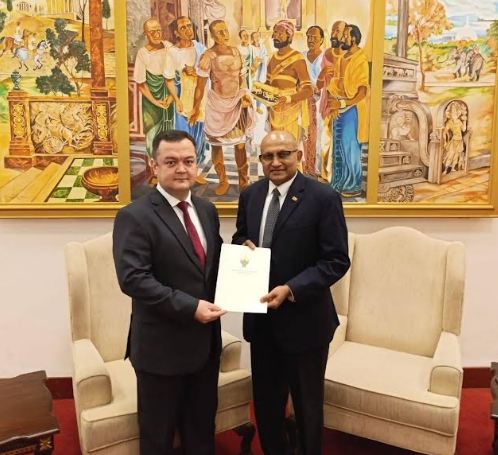
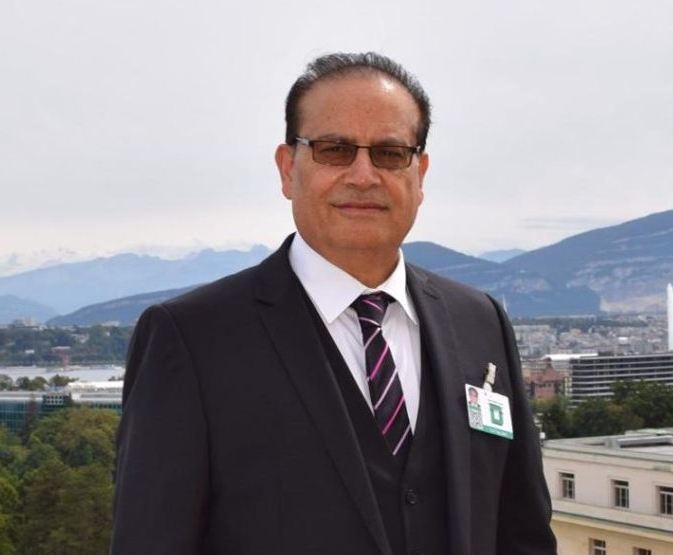
COLOMBO, JUL 23: In a moment of diplomatic significance, Ambassador Alisher Tukhtaev, the Ambassador of the Republic of Uzbekistan to Pakistan and now concurrently accredited to Sri Lanka, formally presented his Letter of Credence to Mr. Rohan Ambagolla, Chief of State Protocol of Sri Lanka.

Held in the capital city of Colombo, the ceremony symbolized a historic turning point in bilateral relations between the two nations. Ambassador Tukhtaev, who will reside in Islamabad, was warmly received by Mr. Ambagolla, who extended his deep appreciation to the President of Uzbekistan, Shavkat Mirziyoyev, for the landmark decision to establish a permanent diplomatic mission in Colombo.

During their meeting, Mr. Ambagolla termed the establishment of the Uzbek mission in Sri Lanka as a “powerful political signal” and the dawn of a qualitatively new chapter in Sri Lanka-Uzbekistan relations. He praised President Mirziyoyev’s bold reform agenda, highlighting Uzbekistan’s consistent GDP growth, ambitious infrastructure modernization, improved investment environment, and the overall enhancement in living standards.

“Uzbekistan today stands as one of the most dynamically advancing countries in the region, demonstrating clear commitment to modernization and openness,” said Mr. Ambagolla.

In the spirit of deepening economic and developmental cooperation, Ambassador Tukhtaev presented a comprehensive proposal aimed at infusing practical content into the growing bilateral ties. Key initiatives proposed included:

·         Establishing an Uzbekistan Trade House in Colombo to facilitate bilateral commerce.

·         Initiating targeted exports of Uzbek goods such as dried fruits, flour, cotton yarn, and construction materials.

·         Launching direct negotiations with major Sri Lankan retail networks to explore market entry opportunities.

·         Developing integrated logistics channels to re-export Sri Lankan tea and spices to Central Asia and the CIS region via Uzbekistan.

·         Offering educational and IT-based platforms to benefit Sri Lankan youth, farmers, and technical professionals, with a focus on virtual learning.

Sri Lankan officials expressed full support for these initiatives, underscoring their readiness to engage in this expanded format of cooperation. They welcomed Uzbekistan’s strategic outlook on enhancing regional connectivity, ensuring food security, and fostering sustainable trade and logistics partnerships, particularly with Global South economies.

Both sides recognized the deep cultural and historical connections between their nations, each rooted in ancient civilizations, and expressed optimism about a shared future of mutual prosperity and development.

Dar reiterates Pakistan’s principled stand on Palestinian issue

Dar reiterates Pakistan’s principled stand on Palestinian issue

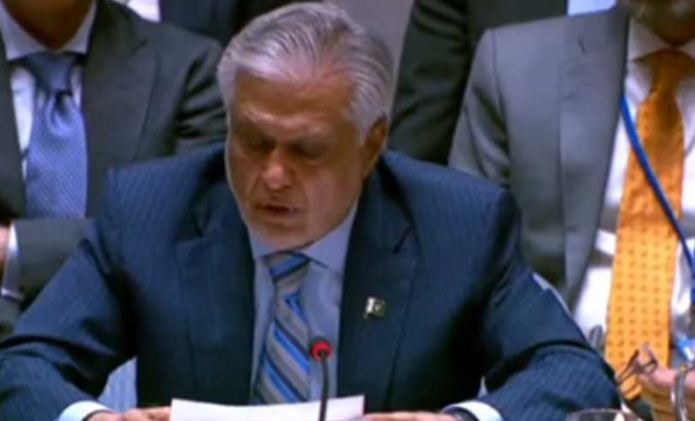
ISLAMABAD, JUL 23: Deputy Prime Minister Ishaq Dar reaffirmed on Wednesday Pakistan’s principled position on the Palestinian issue during the United Nations Security Council’s open debate on the Middle East.

Speaking at the session chaired by Pakistan, Dar said that Gaza had become a site of widespread suffering, with hunger and devastation affecting civilian populations. He called for the urgent and uninterrupted provision of humanitarian assistance to those affected.

He emphasised the country’s unwavering solidarity with the Palestinian people and condemned the ongoing humanitarian crisis in Gaza.

Dar reiterated Pakistan’s longstanding support for a two-state solution, grounded in political negotiations, as essential for lasting peace in the region.

He urged the Security Council to fulfil its responsibilities and take meaningful action to advance peace efforts.

Dar also expressed Pakistan’s support for stability and a lasting peace in Syria. Additionally, he voiced concern over the recent Israeli attack on Iran, calling for restraint and adherence to international law.

Also Read: Ishaq Dar, Marco Rubio to hold first high-level talks on July 25

Earlier, it was reported that Deputy Prime Minister and Foreign Minister Ishaq Dar is scheduled to meet US Secretary of State Marco Rubio on July 25 in Washington in what will be the first high-level engagement between the two since Rubio assumed office.

The meeting, confirmed by US State Department spokesperson Tammy Bruce, will see senior officials from both sides in attendance.

“Preparations for the meeting are complete, and I will be present alongside top leaders from both delegations,” Bruce said during a press briefing.

Dar is currently on an official visit to the United States and is expected to travel to Washington after concluding engagements in New York, which include meetings with the Pakistani diaspora and leading US think tanks, as well as interviews with international media.

India to resume issuing tourist visas to Chinese citizens

India to resume issuing tourist visas to Chinese citizens

Tourist visas for Indian nationals remained restricted until March this year

New Delhi, JUL 23: India will resume issuing tourist visas to Chinese citizens from July 24 this year, its embassy in China announced on Wednesday, marking the first time in five years that both countries are working to repair their rocky relationship.

Tensions between the two countries escalated following a 2020 military clash along their disputed Himalayan border. In response, India imposed restrictions on Chinese investments, banned hundreds of popular Chinese apps and cut passenger routes.

China suspended visas to Indian citizens and other foreigners around the same time due to the COVID-19 pandemic, but lifted those restrictions in 2022, when it resumed issuing visas for students and business travellers.

Tourist visas for Indian nationals remained restricted until March this year, when both countries agreed to resume direct air service.

Relations have gradually improved, with several high-level meetings taking place last year, including talks between Chinese President Xi Jinping and Indian Prime Minister Narendra Modi in Russia in October.

China’s Foreign Ministry spokesperson Guo Jiakun said on Wednesday that Beijing had noted the positive move.

“China is ready to maintain communication and consultation with India and constantly improve the level of personal exchanges between the two countries,” he said.

India and China share a 3,800-kilometre (2,400-mile) border that has been disputed since the 1950s. The two countries fought a brief but brutal border war in 1962, and negotiations to settle the dispute have made slow progress.

In July, India’s foreign minister told his Chinese counterpart that both countries must resolve border friction, pull back troops and avoid “restrictive trade measures” to normalise their relationship.

IIUI, Jordan aim for stronger university partnerships

IIUI, Jordan aim for stronger university partnerships

ISLAMABAD, JUL 23 (DNA): Dr. Maen Khreasat, Ambassador of the Hashemite Kingdom of Jordan to Pakistan, here on Wednesday visited the new campus of the International Islamic University, Islamabad (IIUI), where he discussed the areas of bilateral educational cooperation in high-level meetings.

During his visit, Ambassador Khreasat met separately with IIUI’s Rector, Prof. Dr. Mukhtar Ahmed and President, Prof. Dr. Ahmed Saad Alahmed. The discussions during the  meetings focused on enhancing mutual cooperation between IIUI and Jordanian universities, with emphasis on technical assistance-based scholarships, academic exchange, and the possibility of jointly organized international conferences, said a press release.

Welcoming the ambassador in his office, Rector Dr. Mukhtar Ahmed appreciated the ambassador’s proposals, terming “education diplomacy” a key tool for promoting global peace, harmony, and development. He assured full support to strengthen academic ties between Pakistan and Jordan.

In a separate meeting, President IIUI Prof. Dr. Ahmed Saad Alahmed shared the university’s vision, academic profile, and strategic goals. He expressed IIUI’s commitment to expanding international educational linkages, particularly with institutions in the Muslim world.

Ambassador Khreasat acknowledged IIUI’s contributions to Muslim societies through education and termed the visit a step toward a “win-win situation” for both sides. He also emphasized the importance of cultural exchange and said he foresaw an increase in the number of Jordanian students at IIUI in the future.

Nuclear Security in the Middle East: The Role of Saudi Arabia as a Rising Stakeholder

Nuclear Security in the Middle East: The Role of Saudi Arabia as a Rising Stakeholder

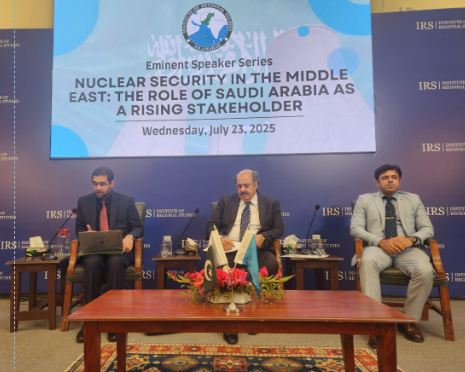
ISLAMABAD, JUL 23 /DNA/ – The Institute of Regional Studies (IRS) hosted an insightful talk on “Nuclear Security in the Middle East: The Role of Saudi Arabia as a Rising Stakeholder”, focusing on the country’s evolving nuclear trajectory amidst the complexities of a volatile regional landscape.

Dr. Rizwan Naseer, Senior Research Fellow at the Institute of Regional Studies, delivered the opening remarks, emphasizing the critical importance of nuclear politics for scholars in the field of strategic studies. He highlighted the growing relevance of nuclear governance regimes such as the Non-Proliferation Treaty (NPT) in light of increasing proliferation challenges and international pressure on nuclear-capable states.

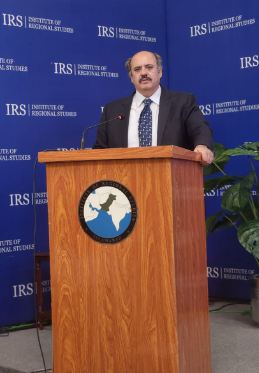
The principal talk was delivered by Dr. Zafar Nawaz Jaspal, Dean and Meritorious Professor at the School of Politics and International Relations, Quaid-i-Azam University. Dr. Jaspal discussed both the opportunities and challenges associated with nuclear energy for Saudi Arabia, noting its evolving nature, particularly in response to ongoing conflicts in the Middle East including the resurgence of inter-state warfare after nearly three decades.

Dr. Jaspal identified four primary drivers behind Saudi Arabia’s nuclear policy. “One of the drivers of Saudi Arabia’s nuclear policy is the strategic competition with Iran, followed by Iran’s ability to remain within the NPT and pursue its nuclear potential. The third driver is the transformation in international politics, followed by the sustainability and durability of nuclear energy.”

Addressing concerns surrounding nuclear energy, Dr. Jaspal contended that much of the alarm is rooted in the nuclear energy’s capacity to reshape the nature of warfare. He argued that while all forms of energy carry risks, the consequences of nuclear accidents are statistically less severe than those associated with coal mining, a point often highlighted by nuclear energy proponents. Dr. Jaspal highlighted the internal and external challenges faced by Saudi Arabia including internal terrorism, radical extremism, threat from the Houthis and Iran’s ‘Axis of Resistance’. He asserted that under Article III & IV of the NPT, Saudi Arabia holds the right to acquire nuclear technology for peaceful purposes. He further noted that civilian enrichment facilities carry the potential to be repurposed for the production of nuclear weapons material.

The seminar concluded with an engaging Q&A session. Dr. Jaspal underscored the reality that technology knows no borders and nuclear technology is no longer novel, making it attainable for any state. He further noted that Saudi Arabia’s potential acquisition of nuclear weapons could heighten the regional security dilemma, particularly given Israel’s opposition to such a development. Towards the end, he stressed that any decision made by Saudi Arabia in this regard will have significant implications for regional stability.

Will the U.S. Follow the Soviet Union’s Collapse?

Qamar Bashir

By Qamar Bashir

The warning comes not from an enemy, but from within the ranks of intellectual scrutiny. Peace Studies researcher Jan Oberg has sounded the alarm that the United States is dangerously close to walking the same doomed path as the Soviet Union. His theory is not based on ideological rhetoric but on a structural analysis of declining empires—those that prioritized militarism over diplomacy, war over peace, and brute force over political legitimacy. According to Oberg, and substantiated by today’s geopolitical developments, the United States is eroding its foundational strength by investing in weapons while its economy weakens, its diplomacy falters, and its international credibility dwindles. His chilling comparison to the Soviet collapse, which came after overextension in an unwinnable arms race, holds a mirror to current American foreign policy—and the reflection is deeply troubling.

A powerful nation is not defined by its military might alone. Oberg argues that a truly enduring power must have equilibrium—military capability, yes, but equally robust economic resilience, diplomatic dexterity, adherence to international law, and a moral compass that commands global respect. America’s current trajectory betrays this balance. It has increasingly become a nation that exports weapons instead of solutions, one that supplies bombs instead of brokering peace. In doing so, it is forfeiting not just friends but also its own values. While other economies—China, India, Brazil—grow rapidly, building infrastructure, trading in goods, and cultivating partnerships, the U.S. has become synonymous with conflict zones.

Nowhere is this truer than in Ukraine. Had the U.S. and NATO been willing to acknowledge Russia’s core concern—its opposition to Ukraine joining NATO—this war may have been averted altogether. But instead of diplomacy, Washington chose to flood Ukraine with arms, sending billions in military aid, even as the nation’s own cities crumble under the weight of failing infrastructure and economic stress. By turning Ukraine into a geopolitical battleground against Russia, the U.S. prolonged a war rather than seeking its resolution. It invested in firepower, not peace talks.

Then there is the U.S. alliance with Israel, which, more than any other, has morally bankrupted America’s standing in the world. For decades, Israel has carried out operations in Gaza, Lebanon, and Syria, and now first the Biden and now Trump administration have stood complicit in enabling Israel’s bombardment of Gaza—an act many are calling ethnic cleansing. A nation that once claimed to champion democracy and human rights now vetoes UN resolutions aimed at feeding starving children. Stories abound of Gazan citizens collapsing from hunger at aid distribution points, mothers whose skeletal forms mirror images from the worst genocides in history, and children dying before they can reach food lines. The world watches in horror. And at the center of this horror, the United States is no longer seen as a neutral power, but as an accomplice to mass suffering.

It is not only distant nations that recoil from American policy. Even its closest allies, like Canada, are increasingly disillusioned. Long considered America’s trusted neighbor and friend, Canada is now resisting U.S. economic pressure, building its own resilience to unjust restrictions and defining its foreign policy apart from Washington’s dictates. Likewise, Europe, once united under the NATO umbrella, is slowly seeking independence from American dominance, investing in its own defense frameworks and strategic autonomy.

More alarming still is America’s behavior toward Iran. The recent bombing of Iran’s nuclear facilities—conducted without credible proof, international backing, or even meaningful justification—has shaken global confidence in the U.S. respect for sovereignty and due process. Iran, which has never been proven to develop nuclear weapons and which operates under the fatwa of its Supreme Leader forbidding such development, became a target not of deterrence, but of sheer political arrogance. Bomb first, ask later. This behavior no longer inspires awe; it invites isolation.

True strength, Oberg contends, does not lie in flexing military muscles. It lies in diplomacy that solves conflicts, not escalates them. It lies in upholding human dignity, protecting freedom of speech, and respecting sovereignty. It lies in providing infrastructure, education, healthcare, and technological innovation—not merely funding the next generation of fighter jets. And America is increasingly failing to meet those criteria.

The economic dimension of this decline is undeniable. The United States has lost a significant part of its economic sovereignty, now burdened with record debt, trade imbalances, and an eroding manufacturing base. Instead of investing in domestic welfare, it chooses to finance wars abroad. While its people struggle with rising inflation, healthcare crises, and decaying infrastructure, Washington prioritizes regime changes, proxy wars, and military aid to allies that violate international norms. The result is clear: America’s legitimacy is in free fall.

In contrast, China offers a different model of global power. It has not bombed a country in living memory. It has not participated in regime change operations. Its power grows not through war, but through trade, investment, and connectivity. The Belt and Road Initiative is a prime example—building railways, ports, and power plants from Asia to Africa without firing a single missile. China does not send tanks; it sends fiber-optic cables. It does not fund insurgencies; it builds high-speed rail. That is not to say China is perfect—but it has learned the art of gaining influence without generating destruction.

It is this contrast that should alarm American policymakers. If the U.S. continues to reject the values it once championed—rule of law, human rights, diplomacy—it will lose more than allies. It will lose the very moral compass that once made it a beacon of freedom. Even the Freedom of Press Index and Human Rights Index now show America sliding backward. A country that once condemned censorship now suppresses dissent. A nation that once prized civil liberties now spies on its citizens and arrests journalists. And all this while claiming to export democracy.

The lesson, as Jan Oberg suggests, is clear. Military power must be retained—but as a deterrent, not a default. It must protect the homeland, not destroy foreign ones. And it must be balanced with economic strength, political wisdom, moral authority, and diplomatic sophistication. No country has the right to decide another’s destiny. The notion that America must bring “freedom” through war is a relic of failed imperial thinking. Iraq, Libya, Afghanistan, Vietnam, Palestine—each a graveyard of American hubris.

To reverse course is still possible. The West is not without hope. Democratic societies can learn from their mistakes. They have the tools to self-correct—debate, dissent, elections, and institutions. But that self-correction requires courage: the courage to admit that wars are not solutions, that diplomacy is not weakness, and that power, unmoored from ethics, is merely force.

The 21st century demands a new model of strength. Not one built on coercion, but on cooperation. Not one built on regime change, but on mutual respect. The future will belong not to those who dominate with drones, but to those who uplift with ideas, dignity, and infrastructure. If the U.S. wants to lead this future, it must rediscover its soul before it loses its seat at the global table—forever.

By Qamar Bashir

Press Secretary to the President (Rtd)

Former Press Minister, Embassy of Pakistan to France

Former MD, SRBC | Macomb, Michigan, USA

‘Terrorist attack’ injures 6 FC personnel in KP’s Bannu: police

‘Terrorist attack’ injures 6 FC personnel in KP’s Bannu: police

BANNU, JUL 23: Six Frontier Constabulary (FC) personnel were injured in a “terrorist attack” at a checkpoint in Khyber Pakhtunkhwa’s Bannu district on Wednesday, a police spokesperson said.

Bannu Police spokesperson Aamir Khan told Dawn.com: “Terrorists attacked a Frontier Constabulary checkpoint situated in the border area of Takhti Khel Wazir in Bannu.

“As a result of the attack, six personnel of the FC were injured, but the immediate response of the constabulary forced the terrorists to flee.”

Over a week ago, President Asif Ali Zardari promulgated an ordinance empowering the federal government to transform the FC, a border security force, into the Federal Constabulary.

Aamir added that the injured constables have been taken to the Combined Military Hospital in Bannu for treatment.

“Police teams have been sent to the area and have begun a search operation to track down the terrorists,” he said.

Pakistan has witnessed a surge in terrorist attacks, especially in KP and Balochistan, predominantly targeting the police, law enforcement agencies’ personnel, and security forces.

Attacks increased after the proscribed Tehreek-i-Taliban Pakistan (TTP) broke a ceasefire agreement with the government in 2022.

Over the past few months, multiple areas of KP — including Bannu, Peshawar, Karak, Lakki Marwat and Bajaur — have seen a series of attacks, particularly targeting police personnel in Bannu this month.

A day ago, a police official identified as Constable Hayatullah was martyred when terrorists attacked him in the district while he was returning home from duty.

On July 21, over a dozen terrorists attacked a police station in the Bakkakhel town of Bannu. However, the cops responded effectively and thwarted their nefarious plan to take over the building. The police also thwarted a sabotage bid by defusing explosives in the Ghoriwala town of Bannu. An official said the explosives were seized during an intelligence-based operation in the area.

On July 19, two police officials, including an officer, were injured when terrorists carried out a quadcopter attack on Bannu’s Miryan police station.

PSB meeting approves reforms for sports federations’ accountability

PSB meeting approves reforms for sports federations' accountability

ISLAMABAD, JUL 23 /DNA/ – The 34th meeting of the Pakistan Sports Board (PSB) was held under the chairmanship of Prime Minister’s Adviser on Inter-Provincial Coordination (IPC), Rana Sanaullah Khan. The session brought together top officials, including IPC Secretary Mohyuddin Wani, Director General PSB Mohammad Yasir Pirzada, and Major General Irfan Arshad.

Notable members such as Dr. Mukhtar Ahmed (Chairman HEC), Zargham Ishaq Khan, Aisam-ul-Haq, and Andaleeb Sandhu participated in the meeting. Two new members – Major General Irfan Arshad and Andaleeb Sandhu – were formally welcomed by the board.

Rana Sanaullah emphasized the board’s responsibility in supporting smart and efficient sports federations and promoting new talent in the country. He also assured full support from the Ministry and PSB to all federations.

Key Highlights of the PSB Meeting:

  • Hockey Federation Funding Concerns:
    The board expressed disappointment over the federation’s lack of transparency and accountability.
  • FIH Pro League Participation:
    PSB to write an official letter outlining the objectives and benefits of participating in the international hockey league.
  • Mountaineering as a Sport:
    A sub-committee was established to consider the formal inclusion of mountaineering.
  • Federation Registrations:
    • Registration of Chak Ball, Paragliding & Hand Gliding, and Canoeing Federations canceled due to missing documentation.
    • Conditional registration granted to Basketball, Archery, and Long Range Shooting Federations based on SECP incorporation.
    • Archery Federation must get its election results verified by PSB.
  • Futsal Oversight:
    Football Federation will now oversee Futsal due to their close relation.
  • Blind Sports Federation:
    The case has been sent to the Panel of Adjudicators for resolution.
  • New Sports Funding Regulations Approved
    • Age limit of 70 years set for federation officials.
    • Presidents of federations will be invited to PSB board meetings.
    • Establishment of Contributory Pension Fund approved to reduce financial burden.
    • Full implementation of federal pension policies instructed.
  • Junior Teams Age Fraud Policy:
    PSB praised the DG’s initiative to formulate policies to prevent age fraud in junior sports teams.

This comprehensive meeting of the Pakistan Sports Board is expected to bring reforms and accountability to the country’s sports structure and federations.

Ishaq Dar, Marco Rubio to hold first high-level talks on July 25

Ishaq Dar

ISLAMABAD, JUL 23: Deputy Prime Minister and Foreign Minister Ishaq Dar is scheduled to meet US Secretary of State Marco Rubio on July 25 in Washington in what will be the first high-level engagement between the two since Rubio assumed office.

The meeting, confirmed by US State Department spokesperson Tammy Bruce, will see senior officials from both sides in attendance.

“Preparations for the meeting are complete, and I will be present alongside top leaders from both delegations,” Bruce said during a press briefing.

Dar is currently on an official visit to the United States and is expected to travel to Washington after concluding engagements in New York, which include meetings with the Pakistani diaspora and leading US think tanks, as well as interviews with international media.

While the official agenda has not been publicly disclosed, diplomatic sources suggest that regional security, including the Kashmir dispute, India-Pakistan border tensions, and the suspension of the Indus Waters Treaty by New Delhi, are expected to feature prominently in the discussions.

RELATED: Trump restates five jets were downed in India-Pakistan air clash

The visit comes in the backdrop of heightened tensions in South Asia following a deadly attack in April in Indian Illegally Occupied Jammu and Kashmir’s Pahalgam that left 26 men dead.

India blamed Pakistan for the incident, an allegation Islamabad strongly denied, calling instead for an independent investigation.

Subsequently, on May 7, Indian jets bombed multiple sites inside Pakistan, triggering a sharp military exchange between the two nuclear-armed neighbours involving fighter jets, drones, missiles, and artillery. The escalation led to dozens of casualties on both sides before a ceasefire was reached.

According to officials familiar with the matter, Dar is expected to convey Pakistan’s appreciation to US President Donald Trump for what Islamabad views as his “constructive role” in de-escalating the recent military confrontation between Pakistan and India.

Last month, Pakistan formally recommended President Trump for the Nobel Peace Prize, with a letter signed by Dar himself and sent to the Nobel Committee in Oslo.

President Trump had earlier described the Kashmir dispute as a “long-standing, unresolved issue” and offered to mediate between the two countries—a proposal welcomed by Pakistan but firmly rejected by India.

Gen Mirza meets Turkish, Azeri defence chiefs at Istanbul Expo

Gen Mirza

RAWALPINDI, JUL 23 /DNA/ – General Sahir Shamshad Mirza, NI (M), Chairman Joint Chiefs of Staff Committee (CJCSC), attended the 17th International Defence Industry Fair (IDEF-2025) at Istanbul, Turkiye, a globally renowned event that highlights cutting-edge innovations and advancements in the defence sector.

On the sidelines, CJCSC held separate meetings with General (Retd) Yasar Guler, Minister of National Defence of Turkiye, Colonel General Hasanov Zakir Asgar Oglu, Minister of Defence of Azerbaijan, Mr Gurbanov Agil Salim Oglu, Deputy Minister of Defence Azerbaijan and General Metin Gurak, Chief of Turkish General Staff.

Discussions were held on variety of issues of bilateral military cooperation with emphasis on importance of expanding cooperation in the fields of defence and security. The dignitaries reaffirmed their shared commitment to deepening strategic partnerships and enhancing defence corporation in line with dictates of future geo-strategic environment and technological advancements.

The dignitaries praised the professionalism, operational excellence, and sacrifices of the Pakistan Armed Forces in the fight against terrorism, recognizing their significant contributions to regional and global peace and stability.

Stay Connected

64FansLike
60FollowersFollow

Latest Reviews

Exchange Rates

USD - United States Dollar
EUR
1.17
GBP
1.35
AUD
0.72
CAD
0.73