Home Blog Page 543

President Zardari Vows to Work for Welfare and Protection of Minorities’ Rights

President Zardari Vows to Work for Welfare and Protection of Minorities’ Rights

ISLAMABAD, AUG 11 /DNA/ – President Asif Ali Zardari has said that Pakistan’s minority communities are an essential and respected part of society, and that their rights, freedoms, and safety are fully protected under the Constitution of Pakistan. He praised their valuable contributions to the country’s strength and progress, noting their important role in national development. He made it clear that the State stands determined against all forms of discrimination, extremism, and violence, adding that such acts have no place in society and will not be allowed to threaten national unity and integrity.

The President said the State has taken practical measures to promote inclusion and ensure equal opportunities for all. These include separate seats for non-Muslims in the Parliament and Provincial Assemblies, a 5% quota in federal and provincial government jobs, and scholarships for minority students from the primary level to higher and professional education.

Speaking on the occasion of National Minorities Day at Aiwan-e-Sadr, the heads of various minority communities thanked President Asif Ali Zardari for his historic decision in 2009, during his first tenure as President of Pakistan, to declare 11th August as National Minorities Day, to be observed each year. They acknowledged this initiative as a milestone in recognising their contributions and upholding their rights.

He further assured the minority communities that their worship places, if presently under illegal occupation, would be retrieved without delay. He said he would ask the government to take steps to ensure such places are immediately restored to their rightful custodians.

He noted that the National Policy for Interfaith Harmony has been designed to promote religious tolerance, strengthen social integration, and unite all religious communities as part of a cohesive national fabric.

The President said that our religion, Islam, upholds peace, justice, and human dignity — principles reflected in the Charter of Madina, which granted equal rights to all communities, including non-Muslims. He added that Quaid-e-Azam Muhammad Ali Jinnah envisioned a Pakistan where every citizen, regardless of religion, would enjoy equal rights — a vision that continues to guide state policies.

Marking the significance of the day, President Zardari called for a collective resolve to build an inclusive and stronger Pakistan where every citizen enjoys equality, mutual respect, and legal protection, and is empowered to contribute meaningfully to the nation’s shared destiny.

Pakistan, Azerbaijan vow closer coordination ahead of UN, OIC meetings

Pakistan, Azerbaijan vow closer coordination ahead of UN, OIC meetings

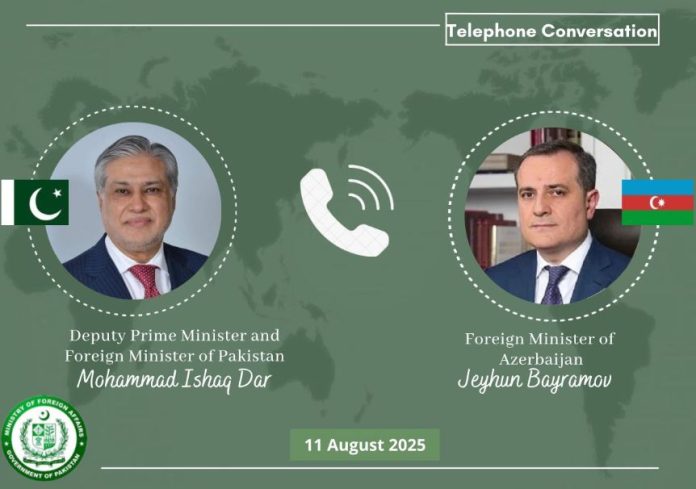
ISLAMABAD, AUG 11 /DNA/ – Deputy Prime Minister/Foreign Minister, Senator Mohammad Ishaq Dar @MIshaqDar50 today spoke with Foreign Minister of Azerbaijan, Jeyhun Bayramov @Bayramov_Jeyhun.

The two leaders discussed cooperation in trade & investment. Expressing satisfaction over collaboration in multilateral fora, they agreed to maintain close coordination for forthcoming UN and OIC engagements, as well as consultations on SCO related issues.

Petroleum product prices likely to further drop from August 16

Petroleum product prices likely to further drop from August 16

ISLAMABAD: In a sigh of relief for the inflation-hit masses, petroleum product prices in Pakistan are expected to see another reduction from August 16, following a fall in global crude oil prices over the past 11 days, Geo News reported on Monday.

According to market data, US crude oil prices have dropped by $5.71 per barrel, from $69.26 to $63.48. Similarly, Brent crude has fallen by $5.72 per barrel, from $71.70 to $65.98. The government will make changes to domestic petroleum prices on August 16.

In the previous fortnightly review, the federal government had slashed petrol price by Rs7.54 for the next fortnight to Rs264.61 per litre, while diesel’s price was increased by Rs1.48 to Rs285.83 per litre.

Separately, during the National Assembly’s Question Hour, Minister of State for Petroleum Ali Pervez Malik said that on April 16 this year, the petroleum levy was increased by Rs8 on petrol and Rs7 on diesel. However, at that time, prices for consumers were not raised.

The minister informed the lower house of parliament that Rs34.87 billion was collected through the petroleum levy until 30 June, and an estimated Rs1.485 trillion will be collected in the fiscal year 2025–26.

PM Shehbaz greets President Aliyev on historic Armenia peace deal

PM Shehbaz greets President Aliyev on historic Armenia peace deal

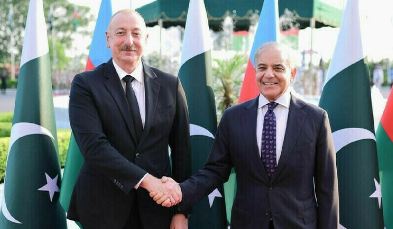
ISLAMABAD, AUG 11 /DNA/ – Prime Minister Muhammad Shehbaz Sharif received a telephone call from H.E. Mr. Ilham Aliyev, President of the Republic of Azerbaijan this evening. The Prime Minister offered his warm felicitations to President Aliyev and the people of Azerbaijan on the historic peace agreement that was recently concluded between Azerbaijan and Armenia.

During their warm and cordial telephone conversation, the Prime Minister lauded the visionary role of President Ilham Aliyev in bringing the three decades-old conflict between Azerbaijan and Armenia to a peaceful and mutually beneficial end especially as it would usher in a new era of prosperity for the Caucuses. The Prime Minister particularly appreciated the role played by U.S. President Donald Trump in facilitating this historic deal that would now bring peace and prosperity to the region. The Prime Minister also mentioned the positive role of the President Trump in ending the recent Indo-Pak war and appreciated Preident Trump as peace maker across the globe.

President Aliyev expressed deep appreciation for Pakistan’s longstanding and consistent support to Azerbaijan on the Karabakh issue. The Prime Minister responded that it has always been a matter of duty for the people of Pakistan to extend their support to their Azerbaijani brothers and sisters on this core issue and it was heartening to note that, under President Aliyev’s bold leadership and statesmanship, peace had finally been established in this region. While thanking the Prime Minister, President Aliyev said that peaceful development in the region would create new opportunities for enhanced connectivity between Pakistan and Central Asia. 

The two leaders also expressed their satisfaction on the positive trajectory of their bilateral cooperation. While recalling their recent interactions in Lachin and Khankendi, the Prime Minister reiterated his invitation to President Aliyev to undertake an official visit to Pakistan soon. Both leaders are also expected to meet in Tianjin on the margins of the upcoming SCO Summit.

Pakistan strongly condemns recent airstrike by Israeli occupying forces in Gaza

Pakistan strongly condemns recent airstrike by Israeli occupying forces in Gaza

ISLAMABAD, AUG 11 /DNA/ – The Government of Pakistan strongly condemns the recent airstrike by Israeli occupying forces in Gaza, which tragically resulted in the loss of numerous civilian lives.

Pakistan extends its deepest condolences to the families of the victims and reaffirms its unwavering solidarity with the Palestinian people during this period of profound suffering.

This egregious attack constitutes yet another serious violation of international humanitarian and human rights law, underscoring the scale and severity of the crimes perpetrated by the occupying power.

The Government of Pakistan calls upon the international community to take immediate and decisive action to end Israeli impunity, ensure the protection of civilians, and hold Israel accountable for its actions.

Pakistan reiterates its longstanding support for the Palestinian cause and advocates for a just, sustainable, and peaceful resolution,in line with the relevant UN Security Council resolutions that uphold the rights and dignity of the Palestinian people. This includes the establishment of an independent, sovereign, viable, and contiguous Palestinian State, based on the pre-June 1967 borders, with Al-Quds Al-Sharif as its capital.

ICCI praises DRAP’s move towards international quality standards

ICCI praises DRAP’s move towards international quality standards

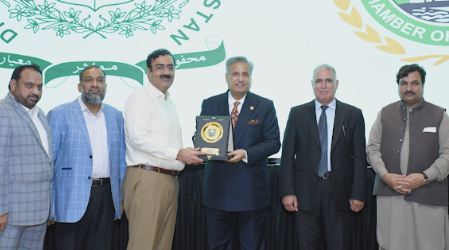
ISLAMABAD, AUG 11 /DNA/ – President Islamabad Chamber of Commerce and Industry (ICCI) Nasir Mansoor Qureshi, has lauded the Drug Regulatory Authority of Pakistan (DRAP) for organizing a Training Session on Implementing Quality Management System (ISO 9001:2015) in collaboration with TUV Austria Bureau of Inspection and Certification at ICCI auditorium. The event drew wide participation from DRAP, PS&DC ICT regulators and DC TMD, NIH.

He commended the initiative as a significant step towards institutional excellence and global alignment, noting that DRAP’s adoption of internationally recognized quality standards would enhance regulatory efficiency and bolster public trust. “ISO 9001:2015 is more than just a certification; it is a holistic approach to quality that nurtures continuous improvement, customer focus, and process efficiency,” he said. He added that the framework would promote transparency, accountability, and consistency in regulatory decisions, thereby ensuring safe and effective medical products for the public.

Highlighting the economic impact, the ICCI President stressed that a credible regulatory environment is vital for attracting local and foreign investment, particularly in healthcare and pharmaceuticals. He pointed out that robust quality systems reduce compliance burdens and foster a more business-friendly, globally competitive environment. Qureshi reaffirmed ICCI’s support for institutional capacity building and public-private collaboration, congratulating DRAP for setting a benchmark for other public sector bodies.

In his closing remarks, DRAP CEO Dr. Obaidullah underscored the Authority’s dedication to institutional reform and regulatory excellence. He said the adoption of ISO 9001:2015 would streamline operations, enhance transparency, and align DRAP’s oversight with international benchmarks. Appreciating the engagement of experts and staff, he reiterated DRAP’s commitment to continuous capacity building and stakeholder confidence.

The sessions also featured addresses by Muhammad Adnan Azam, and Umar Habib. The event concluded with an interactive Q&A session, certificate distribution, and a group photograph.

Director Licensing DRAP Dr. Noor Muhammad, ICCI Senior Vice President Abdul Rehman Siddiqui, Vice President Nasir Mehmood Chaudhry, Executive Members Zulqurnain Abbasi, Imran Minhas and ICCI member Shah Faisal also attended the event.

PNCA announces winners of youth art competition

PNCA announces winners of youth art competition

Saifullah Ansar

ISLAMABAD, AUG 11 /DNA/ – The PNCA is proud to announced the winners of the National Youth Art Competition 2025 organised by its Visual Arts Division (VAD). This annual event celebrates the creativity and talent of young Pakistani artists, providing them with a national platform to showcase their skills and compete with their peers.

The exhibition was inaugurated by renowned calligrapher Lt. Gen. (R) Humayun Bangash, who also presented awards to the winners. He was joined by former Ambassador to Japan, Mr. Farukh Amil, and Director General PNCA M. Ayoub Jamali.

General Bangash, a celebrated figure in the field of calligraphy, has made significant contributions to Pakistan’s cultural heritage.

This National Youth Art Competition and Exhibition was announced in July 2025 under the themes

 “Bunyanum Marsoos” and “Marka-i-Haq” received an overwhelming response from young artists. Nationwide, more than 300 submissions were received, each reflecting deep patriotism love for the country and heartfelt tributes to the brave soldiers safeguarding Pakistan’s borders.

Top Prize Winners received cash prizes, including First Prize (Rs. 40,000): Ms. Arina Khan,  second prize (Rs. 30,000): Ms. Amna Wajahat, third prize (Rs. 20,000) Syeda Wajeeha Fatima. The Honourable Mentions (Rs. 5000) included participants, Ms. Saleha Naseem, Ms. Urooj Saleem, Ms. Noor Ul Fajar, Ms. Mishal Mahsud, Ms. Abeeha Humayun, M. Hassan Ali and Ms. Amna Bibi.

All participating artists were awarded certificates in recognition of their creativity and dedication.

In line with this years Pakistan 78th Independence Day celebrations the art competition and exhibition carried the banner of “Marka-i-Haq” (Battle of Truth) symbolising Pakistan’s resilience, progress and national pride.The initiative served as a heartfelt tribute to the courage sacrifice and patriotism of the Pakistan Armed Forces, who continue to protect the nation against external threats.

Artworks of senior artists Ms. Nusrat Ji, Ms. Farrah Mahmood and Calligraphies of Humayun Bangash were also included in the exhibition.

Director General of the Pakistan National Council of Arts, M. Ayoub Jamali said that it is very pleasing to see the youth participating in this exhibition and competition, and we hope for the same efforts and participation in the future as well.

Speaking at the ceremony, Honourable Chief Guest  Lt. Gen. (R) Humayun Bangash said:

Today, I have witnessed not just art but the voice of a proud and determined generation. These young artists have shown through colours and strokes what words often can not express their unwavering love for Pakistan and deep respect for the armed forces who guard our freedom. The creativity, discipline, and passion displayed here today assure me that the future of our cultural heritage is in safe and capable hands. I congratulate PNCA for providing such a meaningful platform and commending every participant for their inspiring work.

The exhibition will continue till 22nd August 2025. Saturday galleries are closed.=DNA

Qureshi acquitted; other PTI leaders get heavy sentences

Qureshi acquitted; other PTI leaders get heavy sentences

Staff Report /DNA

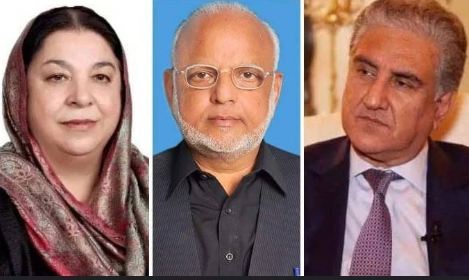
LAHORE: In a major development in the ongoing legal proceedings against Pakistan Tehreek-e-Insaf (PTI) leaders, the court on Monday acquitted former foreign minister Shah Mahmood Qureshi in 2 cases related to the May 9 incidents. However, other prominent PTI figures were not as fortunate. Former Punjab minister Mahmood-ur-Rashid and former federal minister Sarfraz Cheema were each handed 10-year prison sentences, while PTI leaders Alia Hamza and Sanam Javed were sentenced to 5 years each.

The verdict has sparked a new wave of political debate across the country, with many questioning the apparent disparity in judicial outcomes for different leaders linked to the same series of events. The acquittal of Qureshi, a senior PTI figure and two-time foreign minister, has given rise to speculation that a “deal” may have been reached with the establishment — a claim widely discussed in political circles though officially unacknowledged. Observers note that Qureshi has been acquitted in multiple cases in recent months, fuelling predictions that he may soon be allowed to walk free entirely.

Meanwhile, the harsh punishments for those perceived as “non-compromising” leaders have amplified concerns over selective justice. Both Mahmood-ur-Rashid and Sarfraz Cheema have been vocal in their criticism of the government and have refused to distance themselves from PTI’s core political narrative. Likewise, Alia Hamza and Sanam Javed have been known for their staunch party loyalty and outspoken stance against what they term as “political victimisation.”

This pattern has led to growing unease among political commentators, civil society, and even members of rival parties. They warn that eliminating political opponents through legal manoeuvres sets a dangerous precedent. In Pakistan’s turbulent political history, leaders from various parties have faced sudden disqualifications, arrests, or convictions, only for such measures to be reversed years later when political winds change.

Earlier this year, several PTI leaders were handed down sentences in different cases, followed by their disqualification from legislative assemblies. Critics argue that this approach undermines the democratic process by reducing political competition and depriving voters of their chosen representatives. The current developments, they say, only reinforce the perception that Pakistan’s political arena remains heavily influenced by extra-parliamentary forces.

Analysts caution that today’s political victimisation against PTI could tomorrow be directed at another party. Pakistan’s political landscape is replete with examples of shifting alliances and changing fortunes. Those in power today may face similar treatment if the precedent of removing rivals through controversial legal processes continues.

The issue, many agree, goes beyond PTI itself. It touches the very foundation of democratic governance, where differences should be settled in the political domain, not in courtrooms tilted by political influence. The selective application of justice not only damages the credibility of institutions but also erodes public trust in the fairness of the system.

As the political and legal battles continue, one thing remains clear: the path Pakistan chooses now in dealing with its political rivals will have lasting consequences for the country’s democratic health and stability.

Italian Crew Stopped Saudi Ship Carrying Arms to Israel

Qamar Bashir

By Qamar Bashir

It was the kind of news I wanted desperately to dismiss as a fabrication — a malicious AI-generated smear designed to inflame anger against a Muslim nation. The claim seemed too outrageous to be true: an Italian dockworkers’ union had stopped a Saudi-owned ship carrying weapons to Israel, even as Gaza’s people were being starved, bombed, and hunted like wild animals by one of the most advanced militaries on Earth. As a trained analyst, my first instinct was to reject it outright. Surely, I thought, no Muslim country — least of all the custodian of the Two Holy Mosques — would supply arms to those slaughtering Palestinians, many of them children.

But deeper investigation left no room for doubt. On August 7, 2025, at the Port of Genoa, a Saudi-flagged vessel — the Bahri Yanbu — was stopped by some 40 dockworkers after they discovered its cargo: weapons, ammunition, explosives, armored vehicles, and at least one Italian-made Oto Melara naval cannon. According to port sources and union officials, the shipment was bound for Israel, even as it intensified its siege of Gaza.

This was no minor cargo ship. The Bahri Yanbu is owned by Bahri, the Saudi state shipping company, with a long record of transporting military cargo globally. The ship had sailed from Baltimore, USA, and was scheduled to collect more military equipment before heading toward Israel. The dockworkers — organized under the Unione Sindacale di Base (USB) and the Collettivo Autonomo Lavoratori Portuali (CALP) — refused to touch the cargo, declaring, “We do not work for war.” Their action was grounded in both Italian law (Law 185/90 prohibits arms exports to conflict zones) and in moral conviction.

In response, the Genoa port authority pledged to create a “permanent observatory on arms trafficking,” with formal discussions scheduled for September. This was not the first confrontation: in 2019, dockworkers in Genoa blocked the same Bahri Yanbu from loading arms bound for the war in Yemen. History, it seems, was repeating itself — only this time, the weapons were meant for Israel’s campaign in Gaza.

That the workers who took this stand were not Muslim but overwhelmingly Christian deepens the sting. For the love of humanity, they risked livelihoods, defied a powerful foreign state, and upheld the principle that complicity in war crimes is itself a crime. They acted while too many Muslim governments stood paralyzed, issuing hollow statements that echo like empty promises across a devastated Gaza.

The humiliation is bitter. This is the same Saudi Arabia that Donald Trump visited twice — once during his first term in 2017 and again in his second term — extracting trillions of dollars in investments, arms purchases, and trade deals for the United States. It is the same kingdom that spares no expense in projecting an image of power, prosperity, and religious leadership before the Muslim world. Yet, when the moment came to stand unequivocally with the Palestinians — not in words, but in decisive action — it was dockworkers in Italy who bore the moral burden.

This is not a new shame. In 1990, during another Middle Eastern crisis, reports emerged of Muslim-owned vessels transferring arms later used against other Muslims. The bitter lesson then, as now, was that political expediency, alliances with Western powers, and economic self-interest can override the Qur’anic injunction that Muslims are one body: “If one part suffers, the whole body feels the pain.”

Islamic history offers many examples of rulers who came to the aid of the oppressed without hesitation, regardless of religion. The standard was never sect or ethnicity, but justice. If a Christian community under Muslim protection was attacked, Muslim armies would defend them. Yet today, Gaza’s children — many too young to comprehend the politics dictating their fates — are being buried under rubble, not by weapons smuggled by criminal gangs, but by munitions carried aboard a vessel owned by the Muslim world’s wealthiest state.

Meanwhile, ordinary Americans are showing unexpected moral clarity. Across social media, independent outlets, and even segments of mainstream media, Israel’s siege is being condemned as genocide and ethnic cleansing. Prime Minister Netanyahu is increasingly depicted as a butcher and war criminal. The anger is fueled by the understanding that silence is complicity — an understanding apparently clearer to Christian dockworkers in Genoa than to many leaders in the Muslim world.

Saudi Arabia now faces a stark choice — one that will define its reputation and its claim to lead the Muslim ummah. If the government authorized this shipment, it must answer to the Muslim world. If it claims the transfer was conducted by a private contractor, then that party must be punished so severely that no one dares to repeat the offense. This is not mere public relations; it is about moral survival.

It is also a wake-up call for all Muslim nations. The defense of Palestinians cannot be left solely to Iran, which, despite crippling sanctions and isolation, has resisted U.S. and Israeli pressure and materially supported Palestinian armed resistance. The Qur’an and the Prophet’s example leave no room for inaction when oppression is visible. Even if every worldly power aligns against them, Muslims are commanded to stand for justice.

The events in Genoa strip away all excuses. They show that moral courage is not bound by religion, nationality, or language — it is a choice made regardless of personal or political cost. The dockworkers did not calculate their odds before boarding that ship; they saw a line that could not be crossed and refused to cross it.

Muslim leaders must now ask themselves a painful question: will history remember them as the custodians of holy places who stood idle while Gaza’s people starved and bled, or will they seize this moment to move beyond hollow declarations and take tangible action? The answer will not be written in speeches, but in whether arms shipments like those aboard the Bahri Yanbu are ever allowed to leave port again.

If they act, they may yet restore the unity, dignity, and purpose the ummah once embodied. If they fail, history’s judgment will be harsh — and it will not be written by allies in Washington, London, or Tel Aviv, but by the very people whose cries they ignored. In that record, the names of the Genoa dockworkers will stand as men and women of conscience, while those who turned away will find their titles and riches no shield from infamy.

The moral of this moment is unavoidable: justice does not wait for convenience, and righteousness does not bow to fear. If Christian dockworkers in Italy can risk everything to stop a Muslim nation’s complicity in genocide, then Muslim leaders have no excuse left. Either they act now for Palestine, or they forfeit forever the moral authority to speak in its name.

By Qamar Bashir

Press Secretary to the President (Rtd)

Former Press Minister, Embassy of Pakistan to France

Former MD, SRBC | Macomb, Michigan, USA

Ukraine’s Gamble on Belarus

Ukraine’s Gamble on Belarus

Dr. Muhammad Akram Zaheer

The seismic shifts in Ukraine following the Euromaidan Revolution and the 2014 election of a pro-Western government fundamentally altered the nation’s geopolitical trajectory. Declaring European Union and NATO integration as its paramount objectives, Ukraine decisively pivoted away from Russia. This dramatic reorientation logically suggested an inevitable cooling in relations with Belarus, a state traditionally aligned with Moscow and under the enduring authoritarian rule of Alexander Lukashenko. Yet, contrary to expectations, Ukraine embarked on a policy of sustained, even strategic, engagement with Minsk. This approach, predicated on a critical misreading of Belarusian sovereignty, ultimately proved a costly failure, culminating in Belarus’s complicity in the 2022 invasion.

Prior to 2014, under President Viktor Yanukovych, Ukrainian-Belarusian relations existed within a framework of gradual convergence with Russia. Despite nominal pro-European rhetoric, Yanukovych’s policies fostered deeper ties with both Moscow and Minsk, making strong bilateral cooperation appear a natural extension of Kyiv’s overall orientation. The Euromaidan upheaval shattered this dynamic. Ukraine’s new leadership unequivocally rejected Russia’s sphere of influence, embracing Western structures instead. This created a profound divergence: Ukraine sought security and integration with the West, while Belarus remained entrenched within Russian-led frameworks like the Commonwealth of Independent States (CIS), the Eurasian Economic Union (EAEU), the Collective Security Treaty Organization (CSTO), and the deeply integrating Union State.

Despite this starkly diverging path, Ukraine’s post-Maidan leadership made a conscious choice not to isolate Lukashenko. Instead, they elevated Minsk to a central role in regional diplomacy, most notably as the venue for the Minsk Agreements aimed at resolving the Russian-Ukrainian conflict in Donbas. This decision served multiple purposes for Kyiv. Firstly, Minsk was perceived as a neutral location acceptable to all parties involved, including Russia and the OSCE. Secondly, and more strategically, Ukraine sought to leverage this engagement to pull Lukashenko away from Moscow’s orbit. By offering Belarus a platform for international relevance and fostering bilateral economic ties, Kyiv hoped to cultivate a degree of Belarusian independence beneficial to Ukraine.

This engagement yielded immediate, albeit superficial, benefits for Lukashenko. Hosting high-stakes negotiations provided a veneer of international legitimacy and became a crucial tool in his efforts to emerge from the isolation imposed by the West due to his regime’s human rights record. Improved dialogue with Kyiv facilitated tentative outreach to the EU and even the US. For Ukraine, the logic was multi-layered. Beyond the practicalities of a negotiation venue, Kyiv aimed to bind Belarus economically, creating mutual dependencies that would deter Minsk from hostile actions. Preserving existing economic benefits – trade, transit, joint ventures – was a significant motivator. This explains Kyiv’s notable reluctance, even after the brutal crackdown on Belarusian protesters in 2020, to fully align with Western sectoral sanctions against Belarus, seeking to insulate bilateral economic cooperation from broader geopolitical condemnation.

However, this strategy rested on a fundamental and ultimately catastrophic miscalculation: the overestimation of Alexander Lukashenko’s genuine independence from Russia. Ukrainian policy treated Lukashenko as a pragmatic, albeit authoritarian, leader capable of balancing between Moscow and the West to preserve his own power and Belarusian sovereignty. This perception was dangerously divorced from reality. By 2014, and indeed much earlier, Belarus was already deeply enmeshed within Russia’s political, economic, and military structures. Membership in the CIS, EAEU, CSTO, and the Union State represented not just formal alliances, but profound integration. Belarus’s economy was critically dependent on Russian energy subsidies and market access. Its military doctrine and capabilities were inextricably linked to Russia’s, with deep interoperability.

The events of 2020 laid bare the true nature of Lukashenko’s dependency. The Kremlin’s overt political backing and alleged involvement of Russian security “consultants” in suppressing protests demonstrated unequivocally that Lukashenko’s political survival hinged on Vladimir Putin’s support, not on maintaining distance from Moscow. His regime was a client state, its stability purchased with loyalty to the Kremlin. Despite this stark revelation, Ukraine persisted with its engagement strategy, albeit in a diminished form, clinging to the hope of economic leverage and the Minsk negotiation format.

The brutal culmination of this failed policy arrived on February 24, 2022. Belarus, far from acting as a neutral buffer or a state restrained by economic ties to Ukraine, actively facilitated the Russian invasion. Its territory served as a crucial launchpad for Russian troops and missiles attacking Kyiv and northern Ukraine, transforming Belarus from a problematic partner into a direct co-aggressor. This act irrevocably shattered any illusions about Minsk’s capacity or willingness to pursue an independent course contrary to Moscow’s dictates. The war laid bare the utter ineffectiveness of eight years of Ukrainian policy towards Lukashenko.

The core systemic error was evident from the outset: Ukraine fundamentally misjudged the nature of the Belarusian state. It treated Belarus as a genuinely sovereign actor capable of strategic neutrality, rather than recognizing it as a de facto Russian vassal, deeply integrated and subordinate within Moscow’s imperial project. Given the ongoing Russian aggression in Crimea and Donbas since 2014, Ukraine should have adopted a far more cautious and realistic approach. The minimal prudent stance would have been to treat Belarus unequivocally as an ally of the aggressor state, adjusting all political and economic relations accordingly, minimizing dependencies, and anticipating potential threats from Belarusian territory. Instead, the pursuit of a “Minsk mirage” the belief that engagement could foster Belarusian neutrality blinded Kyiv to the hard reality of Belarus’s subordination to Russia, leading to a profound strategic failure with devastating consequences. The war has now forced a complete reassessment, with Ukraine recognizing Belarus not as a neutral neighbor, but as occupied territory instrumentalized by the Kremlin. The lessons of this miscalculation resonate far beyond their bilateral relationship, underscoring the peril of underestimating the depth of authoritarian dependencies within Russia’s sphere.

Stay Connected

64FansLike
60FollowersFollow

Latest Reviews

Exchange Rates

USD - United States Dollar
EUR
1.17
GBP
1.35
AUD
0.72
CAD
0.73