Home Blog Page 387

APJCCI delegation meets Azerbaijani Ambassador

APJCCI delegation meets Azerbaijani Ambassador

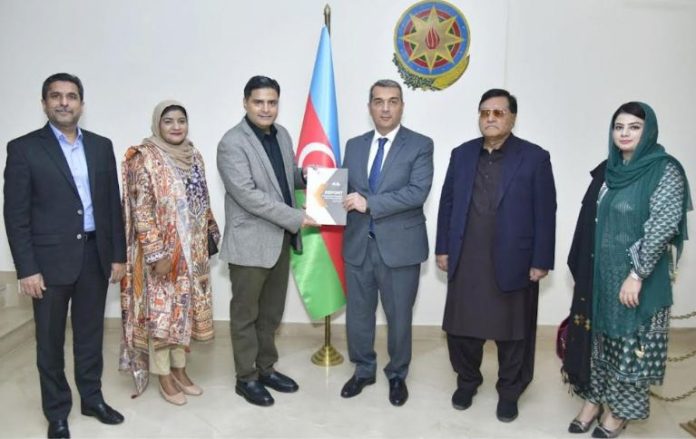
ISLAMABAD, NOV 14 /DNA/ – Ambassador of the Republic of Azerbaijan to Pakistan, H.E. Khazar Farhadov, has said that trade and business relations between Pakistan and Azerbaijan will continue to grow stronger with time, and that the Azerbaijan Pakistan Joint Chamber of Commerce & Industry (APJCCI) can play a vital role in this regard.

He expressed these views during a meeting with a high-level APJCCI delegation led by Chairman Mr. Zafar Bakhtawari at the Azerbaijani Embassy.During the meeting, detailed discussions were held on the ongoing efforts and new initiatives aimed at strengthening economic, trade, and investment cooperation between the two brotherly nations.

Ambassador Farhadov shared that during Prime Minister Shahbaz Sharif’s recent visit to Baku, the Prime Minister acknowledged and appreciated APJCCI’s efforts in promoting bilateral trade.

 Mr. Zafar Bakhtawari  praised Ambassador Farhadov for his exceptional contributions toward enhancing bilateral ties and said that, owing to his outstanding services, he deserves nomination for Pakistan’s highest civil award.APJCCI Patron-in-Chief Mr. Ahsan Zafar Bakhtawari presented the report of the Chamber’s recent delegation visit to Baku, held in September.

 He said the delegation’s meetings with government institutions, business organizations, and private companies proved highly productive, opening new avenues of cooperation. He also announced the launch of APJCCI’s official website  . Mr. Ahsan Zafar Bakhtawari further informed that APJCCI, in collaboration with the Islamabad Women Chamber of Commerce & Industry (IWCCI), will organize the 7th Islamabad Expo 2025 on December 6–7 at the Pak-China Friendship Centre, Islamabad, and extended an invitation to the Ambassador to attend as Chief Guest. He added that around ten Azerbaijani companies are expected to participate in this mega event.

He also announced that APJCCI plans to hold the Azerbaijan–Pakistan Business Forum next year , Former IWCCI President Ms. Naima Ansari also invited the Ambassador to attend the Expo as Chief Guest, a request he graciously accepted.

Pakistan will not hold talks with any terrorist group: FO

Pakistan will not hold talks with any terrorist group: FO

Saifullah Ansar

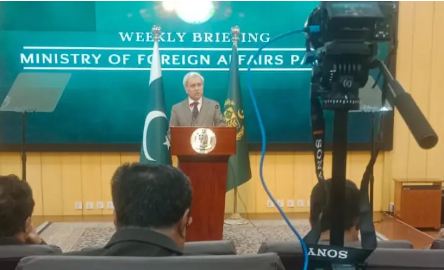
ISLAMABAD: Foreign Office (FO) Spokesperson Tahir Hussain Andrabi asserted on Friday that Pakistan had never eschewed dialogue with any government in Kabul but would not hold talks with any terrorist groups.

“Pakistan has never eschewed dialogue with any government in Kabul. However, Pakistan will not hold dialogue with any terrorist groups, be it Tehreek-i-Taliban Pakistan (TTP) or Balochistan Liberation Army (BLA),” he said while addressing his weekly press briefing.

“The third round of talks with the Afghan Taliban regime concluded on November 7 in Istanbul,” he said, expressing appreciation for the “sincere efforts” of mediating countries Qatar and Turkiye.

“Since the Taliban regime came to power in Afghanistan, there has been a sharp surge in terrorist attacks emanating from Afghan soil on Pakistan. Throughout these years, Pakistan — despite suffering military and civilian casualties — exercised maximum restraint and did not escalate,” he said.

He added that Pakistan’s expectation was that with the passage of time, the Taliban regime would be able to control these attacks and take concrete actions against the banned TTP.

He said that during this time, Pakistan also tried to positively engage with the Afghan Taliban regime, offering bilateral trade assistance and humanitarian assistance.

“However, despite all these positive gestures by Pakistan, the response from the Taliban regimes has only been hollow promises and inaction,” he regretted.

He said that TTP and the BLA were declared enemies of Pakistan.

“Anyone harbouring, abetting or financing them is not considered a friend and a well-wisher of Pakistan and its people,” he said.

“Pakistan is determined to take every possible action to safeguard its security and the security of its people. We regret that the Taliban regime is constantly trying to misrepresent the issue of terrorists hiding in Afghanistan as a humanitarian issue.

“Taliban regime is also trying to portray TTP and BLA as refugees in Afghanistan. This is not a humanitarian or a refugee crisis but a ploy to frame terrorists as refugees,” he said.

“Pakistan is ready to receive any Pakistani living in Afghanistan … provided they are handed over at the border crossing … and not hurled across the border fully equipped with sophisticated weapons and equipment,” he said.

The FO spokesperson also stated that there were some elements in the Afghan Taliban that did not want confrontation with Pakistan but there was a “strong lobby” with monetary support from foreign actors that had been tasked to “stoke tension”.

“These elements have been engaged in abuses and outrageous allegations against Pakistan, and in doing so, they are fast eroding whatever good-will they had,” he said.

Democracy in Pakistan

Democracy in Pakistan

JALAL-UD-DIN

Democracy is the system of governance in which most of the power lies in the hands of the people. It allows citizens to elect their leaders. Democracy is based on the principles such as free and fair election, the rule of law, protection of fundamental rights etc. The ancient Athens firstly adopted the democratic system which they called as direct democracy in 5th century.

Pakistan was established in 1947 on democratic ideals, despite this Pakistan had a complex and turbulent relationship with democracy. The country has faced many political problems, military take over and weak institution but still, the journey towards a stable democratic system is still continue.Pakistan emerged as an independent state in 1947 in the world map. The founder of Pakistan Quaid-e-Azam envisioned a democratic and inclusive society. He also believed in constitutionalism, civil liberties, and the rule of law. However, despite that, Pakistan has struggled to maintain a stable and mature democratic system.

Pakistan had not any proper constitution to run the whole country, so the 1935 Act is used as a constitution after few amendments in it. Later, in 1956, the first Pakistan’s constitution is formed in the era of Governor-General Iskander Mirza and it was adopted as first constitution. It was a very short interval of time that democracy is being stabilized but after the two years of stabilizing period of democracy, the martial law was imposed by Ayub Khan in 1958. It was the first time that martial was imposed in Pakistan. By the perspective of historians, they said that the reason behind the imposition of martial law is the leadership vacuum and political instability in Pakistan.

Ayesha Jalal is a very famous historian because of her two famous books “The Struggle for Pakistan” and “The Sole Spokesman.” In her research, she emphasized that democracy in Pakistan is fragile but resilient. The main cause of democratic instability in Pakistan is due to the alternate switching of political parties and multiple imposition of martial law by the military coup. The other minor causes of democratic instability are the weaker civilian institutions. It means that political parties often lack internal democracy and vision which makes the country democratically unstable. Even also the judiciary and media manipulate the people. In addition, the lack of political awareness among the different parties’ leaders and members causes the instability in democracy of Pakistan.

By the perspective of different historians like Ayesha Jalal, Stephen Cohen, Iftikhar Malik, etc., they said that the real evolving time of democracy is after the general election of 1988 because after the general election the military coup hand over the authorities to civilian government. In that time, Benazir Bhutto became the first female prime minister of Pakistan, but in this way a very suspicious question revolve in our mind that if democracy is completely restored then why Pakistan’s democracy system is not stable?The answer of this question according to the mentioned historian is that the military did not hand over all the authorities to the civilian government. They involved in foreign policies, in elections,media etc.

Democracy in Pakistan is fragile but not completely failed. Our country learn from their history that how we improve our democracy system. It has survived numerous challenges and continues to evolve. However, to flourish the democracy, we must work collectively by all the stakeholders including politicians, intelligentsia, civil society, and the public. We know that only a strong and functional democracy can ensure justice, equality, stability, and development for Pakistan in the years to come.

Pakistan Zindaba!

JALAL-UD-DIN

Student of Language and cultural studies at University of Baltistan

Korea launches global youth ‘Vibe with us’ challenge

Korea launches global youth 'Vibe with us' challenge

ISLAMABAD, NOV 14 /DNA/ – The Ministry of Foreign Affairs of the Republic of Korea has launched a global public diplomacy initiative titled the “Vibe with us” Relay Challenge, aimed at fostering empathy, hope, and cross-cultural understanding among youth worldwide including in Pakistan.

The initiative seeks to highlight the challenges confronting today’s younger generation, such as economic inequality, shrinking opportunities, generational divides, loneliness, and social isolation. Through the campaign, the Korean government hopes to encourage young people across borders to share messages of solidarity, comfort, and inspiration.

The “Vibe with us” Relay Challenge invites participants to create short Instagram Reels using a special template that incorporates a K-hand sign. Each participant is encouraged to express their own “My K,” representing an aspect of K-culture—whether music, film, food, language, or personal inspiration—that has offered them comfort or motivation.

In Pakistan, the campaign has gained remarkable momentum due to the promotional efforts of popular content creators. Majid Mushtaq, a well-known Pakistani YouTuber and alumnus of the Global Korea Scholarship (GKS) program, and Leneha Junsu, a K-Influencer associated with Korea’s Ministry of Culture, Sports and Tourism, have produced engaging videos encouraging Pakistani audiences to join the challenge. Their content has resonated widely, inspiring many K-culture enthusiasts across the country to participate.

The Embassy of the Republic of Korea in Pakistan has also played an active role in promoting the initiative. Alongside supporting the relay challenge, the Embassy organized a KOREAZ promotional event during its public diplomacy programs, including the K-Wave Festa hosted in October at Serena Hotel, Islamabad. These efforts aim to deepen awareness of Korea’s culture, policies, and global engagement through platforms such as @mofa_koreaz on Instagram and the KOREAZ YouTube channel.

In a statement, the Embassy reaffirmed its commitment to expanding cultural exchange between Korea and Pakistan, noting, “We plan to continue strengthening mutual understanding and cultural ties through a variety of public diplomacy initiatives.” The Embassy also encouraged the public to follow its official Instagram account @koreanembassy_pakistan, along with @mofa_koreaz and the KOREAZ YouTube channel, for updates on future events and activities.

Pakistan win toss, opt to bowl first in second Sri Lanka ODI

Pakistan win toss, opt to bowl first in second Sri Lanka ODI

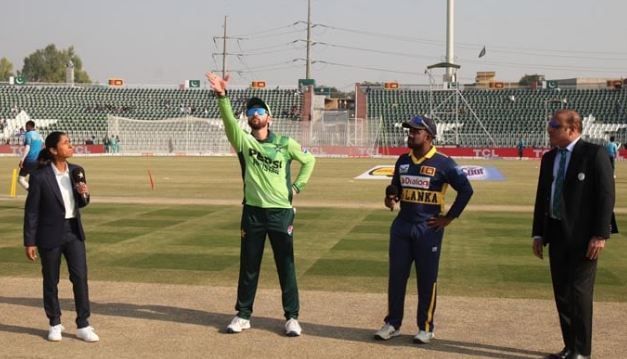
ISLAMABAD, NOV 14: Pakistan won the toss and elected to bowl first in the second one-day international against Sri Lanka at the Rawalpindi Cricket Stadium on Friday.

Pakistan’s ODI captain, Shaheen Afridi, has been ruled out of the second ODI after falling ill with the flu.

“Shaheen is unwell, and Faheem also misses out. Abrar Ahmed and Wasim Jr come in,” stand-in skipper Salman Ali Agha said at the toss.

Originally slated for Thursday, today’s and the last match were rescheduled after Sri Lanka Cricket (SLC) confirmed continuation of the ongoing tour after fears arose following Tuesday’s suicide bombing in Islamabad, which martyred 12 people and wounded 36 outside a court in the federal capital.

The last match will now be played at the same venue on November 16.

Playing XIs
Pakistan: Fakhar Zaman, Saim Ayub, Babar Azam, Mohammad Rizwan (wk), Salman Agha (c), Hussain Talat, Mohammad Nawaz, Mohammad Wasim Jr, Haris Rauf, Naseem Shah, and Abrar Ahmed.

Sri Lanka: Pathum Nissanka, Kamil Mishara, Kusal Mendis (wk), Sadeera Samarawickrama, Charith Asalanka (c), Janith Liyanage, Kamindu Mendis, Wanindu Hasaranga, Dushmantha Chameera, Pramod Madushan, and Asitha Fernando.

UK, Pakistan strengthen ties at royal event

UK and Pakistan strengthen ties at royal event

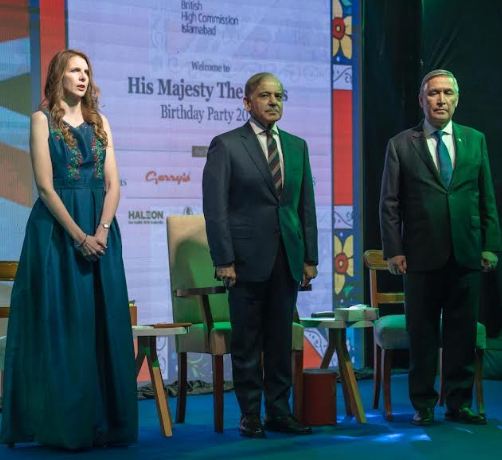
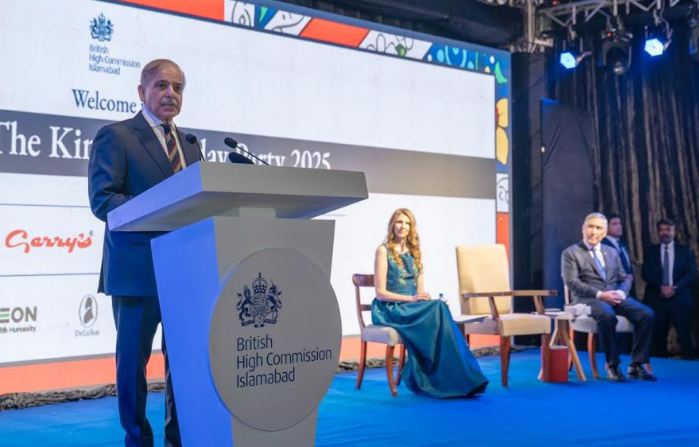
ISLAMABAD, NOV 14 /DNA/ – Prime Minister Shehbaz Sharif joined British High Commissioner, Jane Marriott CMG OBE, to welcome guests to celebrate His Majesty King Charles III’s 77th birthday in Islamabad.

The celebration followed an important year for the UK-Pakistan relationship. It saw connectivity between the two countries improve with the lifting of the air safety ban on Pakistani airlines, leading to PIA’s first flight to Manchester in 5 years. This year also saw the UK introduce eVisas for students and workers, making travel easier and strengthening ties.

2025 also saw bilateral trade reach £5.5 billion, crossing the £5 billion mark for the first time. The UK continued its support for Pakistan’s flood recovery efforts, while the launch of the UK–Pakistan Trade Dialogue opened new opportunities in services and innovation.

British High Commissioner to Pakistan, Jane Marriott CMG OBE, said:

“Just as Pakistan is made up of rich and diverse cultures, the UK has incredible diversity through its four nations. And all four of our nations- England, Scotland, Northern Ireland and Wales- have a vital part to play in our partnership with Pakistan.”

The event celebrated the cultural ties between the UK and Pakistan, with guests arriving to music of Bagpipers from the Pakistani Military. There was a special performance from Maria Unera who played a medley of classic British hits from across the four nations.

Trump’s Empty Seat at COP30 Signals a Global Turning Point

Qamar Bashir

By Qamar Bashir

The absence of President Donald Trump from the COP30 Climate Summit, held from November 6–17, 2025 in Belém, Brazil, was more than a diplomatic misstep; it was a disgraceful abandonment of global responsibility. This was openly acknowledged by Democratic leaders in Washington, who described the empty American chair as “a historic humiliation for the United States.” At a press conference held on the same day the summit opened, leaders lamented that America had “vacated its seat at the head table,” leaving the world’s most important climate forum without the presence of the leader of the world’s largest historical emitter. Trump’s decision to abstain, and to send only a symbolic understaffed delegation, reflected not merely neglect but a deeper, dangerous rejection of science, consensus, and global leadership.

This matters even more because the 2025 COP30 summit is one of the most consequential climate gatherings since the Paris Agreement, attended by a constellation of world leaders who are shaping humanity’s environmental future. The summit was inaugurated by Brazil’s President Luiz Inácio Lula da Silva, joined by UN Secretary-General António Guterres, Chinese President Xi Jinping, French President Emmanuel Macron, German Chancellor Olaf Scholz, UK Prime Minister Keir Starmer, Canadian Prime Minister Justin Trudeau, European Commission President Ursula von der Leyen, and leaders of almost every major African, Asian, and Latin American nation. Their presence underscored the urgency of the moment. The only notable absentee was Donald Trump.

Trump’s worldview on climate change remains skewed, unscientific, and rooted in denial. He has repeatedly dismissed climate science as “nonsense,” called global warming a “hoax,” and ridiculed decades of research produced by NASA, NOAA, the IPCC, and America’s own Department of Defense. His administration has reversed environmental regulations faster than any in modern history, rolling back more than 125 climate and pollution safeguards, reopening federal lands for oil and gas drilling, dismantling the Clean Power Plan, slashing environmental budgets, and restricting renewable energy incentives. The result is a United States stepping backward while the rest of the world steps forward.

His absence is especially alarming because the climate crisis is intensifying far faster than predictions. The world is now 1.3°C warmer than pre-industrial levels. Sea levels are rising at 4.5 millimeters per year, twice the pace of the 1990s. Extreme weather killed more than 60,000 people in 2024, with devastating storms, heatwaves, wildfires, and catastrophic floods striking every continent. Cities like Miami, New Orleans, Jakarta, and Lagos face annual flooding. Air pollution kills 7 million people annually, according to WHO. And the ozone layer, though recovering, is still vulnerable due to rising emissions of unregulated industrial chemicals.

Yet Trump chose to skip COP30 at the very moment when world leaders were committing unprecedented political and financial capital to reverse global warming. Nearly 190 countries reaffirmed climate change as “an existential threat to humanity,” agreeing to accelerate decarbonization, build climate-resilient infrastructure, and expand climate financing. China, which Trump falsely accuses of “polluting the world,” arrived with the strongest national plan: expanding renewable capacity to 5,000 gigawatts by 2030, investing $900 billion in green technologies, and pledging a national carbon peak before 2030 and neutrality by 2060. Ironically, the very nation he blames is now leading the world.

Europe also demonstrated unprecedented unity. The European Union declared climate change “the defining security challenge of the 21st century” and reaffirmed its €1 trillion Green Deal roadmap. Germany committed to shutting all remaining coal plants by 2030. France announced a massive nuclear and solar expansion. The UK pledged rapid EV adoption, banning new combustion engines by 2032. Canada committed billions to green hydrogen and Arctic protection. The contrast is stark: the world sees climate change as a war for human survival; the United States, under Trump, is withdrawing from the battlefield.

America’s withdrawal is part of a broader trend: the retreat of U.S. leadership across global institutions. The same pattern has occurred at the WHO, UNESCO, UNHRC, and WTO, where American influence has diminished due to policies seen as negative, confrontational, or aligned with narrow private interests instead of global well-being. Washington is increasingly outvoted, sidelined, or isolated—not because America lacks power, but because it has chosen to apply that power in ways that contradict scientific consensus and international expectations.

Trump continues to push policies that drag America further backward. He reopened federal financing for coal plants, issued more than 2,500 new oil and gas permits, expanded offshore drilling, and encouraged combustion-engine production while discouraging electric vehicles. He weakened fuel-efficiency standards, cut EV tax credits, and raised tariffs on imported electric cars. While China will sell over 11 million EVs in 2025, the United States faces stagnation due to inconsistent policy.

Meanwhile, renewable energy has become the cheapest electricity source in history: solar costs have fallen 89% in a decade, and wind by 70%. The world now installs 400 gigawatts of solar power annually, more than all U.S. coal capacity combined. Within a decade, fossil fuels will be economically obsolete. If America delays any longer, it will re-enter the clean energy race as a beginner—untrained, unprepared, and uncompetitive.

Inside the United States, powerful voices are rising in protest. Scientists, environmental organizations, governors, mayors, universities, and corporate leaders have condemned the administration’s retreat. California, New York, Michigan, Illinois, and more than 200 American cities reaffirmed their commitment to the Paris Agreement. At COP30, multiple senators openly declared that Trump’s absence “damages U.S. credibility and weakens national security.” Photos of the empty U.S. seat in the main plenary hall went viral worldwide, symbolizing a superpower turning its back on humanity.

America once led the world in environmental policy. It shaped the Paris Agreement, built climate finance structures, and pushed global emissions reduction. That legacy is being dismantled. Trump’s policies not only endanger the U.S. but threaten global stability. A superpower that once led from the front is now missing at the moment of greatest need.

The United States must rethink its direction before it is too late. It must return to clean energy innovation, rebuild institutional capacity, train its workforce for the green economy, and reclaim its leadership at COP and across all UN bodies. Leadership lost today will not be easily regained. The world is moving forward at high speed, and America cannot afford to be left behind again.

By Qamar Bashir

Press Secretary to the President (Rtd)

Former Press Minister, Embassy of Pakistan to France

Former Press Attaché to Malaysia

Former MD, SRBC | Macomb, Michigan, USA

27th Amendment Triggers Legal Storm in the Country

By Ansar Mahmood Bhatti

ISLAMABAD: The country’s legal and political landscape has been thrown into fresh turmoil following the passage of the 27th Constitutional Amendment  a move the government hails as a milestone in judicial reform, but which critics see as a grave threat to judicial independence and the supremacy of the Constitution.

Adding to the unfolding judicial drama, Chief Justice Yahya Afridi is set to host a farewell reception in honour of Justice Aminuddin Khan, who will retire from the Supreme Court on November 30. However, Justice Aminuddin’s departure from the apex court will not mark the end of his judicial career. The government has appointed him as the first Chief Justice of the Federal Constitutional Court, a newly created body under the 27th Amendment — a position that effectively extends his judicial tenure by another three years.

While the creation of the Federal Constitutional Court is being celebrated by the government as part of its “judicial modernization” initiative, the move has sparked intense debate within the legal fraternity. Many view it as an attempt to curb the powers of the Supreme Court and to bring the judiciary under tighter executive control.

The sense of unease has been compounded by the resignations of Justice Mansoor Ali Shah and Justice Athar Minallah, both of whom have chosen to step down rather than, in their words, “become part of a crippled and managed judiciary.” Their decision has sent shockwaves through judicial and political circles alike, reinforcing fears that Pakistan’s judiciary is being systematically undermined.

The 27th Amendment, passed amid heated debate and protests in Parliament, has already ignited one of the most divisive legal controversies in recent years. While government spokesmen have called it a step toward efficiency and transparency in the justice system, opposition parties and constitutional experts argue that several provisions are not only unconstitutional but also un-Islamic.

Among the most contentious clauses is the grant of lifetime immunity to the President, the Field Marshal, and the Service Chiefs, a move that many legal experts describe as a direct violation of the principle of equality before law — a central tenet of both Islamic jurisprudence and Pakistan’s constitutional framework.

“No law can override the injunctions of Islam as enshrined in the Constitution,” remarked a senior constitutional lawyer. “Granting lifetime immunity to any office-holder is against both the Constitution and the teachings of Islam. It’s an affront to the rule of law.”

Analysts say the immunity clause was inserted as a political compromise, reportedly to secure the support of President Asif Ali Zardari and other key stakeholders for the amendment’s passage.

The legal community expects that the controversial clauses of the 27th Amendment will soon be challenged in the superior courts, setting the stage for yet another constitutional showdown. Some even predict that the Federal Constitutional Court itself may end up adjudicating challenges to the very law that created it — a scenario that would test the limits of judicial ethics and constitutional logic.

Beyond the political implications, the creation of a parallel judicial structure has triggered serious concerns about the fragmentation of judicial authority. Under the amendment, the Federal Constitutional Court will handle all constitutional disputes — a mandate that overlaps significantly with the traditional jurisdiction of the Supreme Court. This overlap, lawyers warn, could create confusion, weaken the authority of the apex court, and deepen divisions within the judiciary.

“Parallel systems rarely work,” commented a senior advocate of the Supreme Court. “Instead of reforming the judiciary, the 27th Amendment risks politicizing it further. Once politics seeps into judicial appointments, impartial justice becomes impossible.”

Inside judicial circles, quiet conversations are reportedly taking place about the next phase of leadership transitions. Justice Aminuddin Khan’s elevation to head the new constitutional court is expected to trigger reshuffling at the top of Pakistan’s judicial hierarchy, possibly influencing future appointments and the balance of power within the judiciary.

For now, the nation’s attention remains focused on how these unprecedented developments unfold. Will the newly created Federal Constitutional Court enhance judicial efficiency and constitutional clarity, as claimed by the government? Or will it deepen divisions and compromise the independence of the judiciary, as critics fear?

One thing is clear: the 27th Amendment has opened a new and uncertain chapter in Pakistan’s constitutional history. Its defenders view it as a necessary evolution of the legal system; its opponents, as a dangerous political maneuver to control the courts.

As the country braces for what many predict will be a prolonged legal battle, the fate of the amendment — and indeed the future of judicial independence in Pakistan — now rests with the very institution it seeks to redefine: the judiciary itself.

Justice Aminuddin to head the FCC

President Zardari approves Justice Khan’s appointment as first chief justice of FCC

DNA

ISLAMABAD: President Asif Ali Zardari has approved the appointment of Justice Aminuddin Khan as the first Chief Justice of the newly established Federal Constitutional Court.

Chief Justice Yahya Afridi is set to host a farewell reception in honour of Justice Aminuddin Khan, who will retire from the Supreme Court on November 30. However, Justice Aminuddin’s departure from the apex court will not mark the end of his judicial career after this appointment.

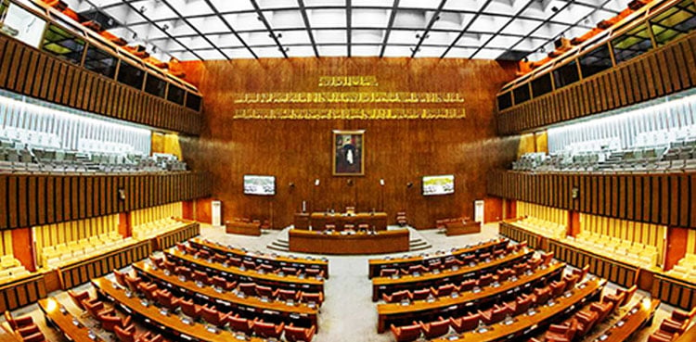
Senate green-lights 27th Amendment Bill again with changes approved by NA

PTI, JUI-F defectors vote in favour of revised amendments despite opposition’s objection amid noisy protest

Saifullah Ansar

ISLAMABAD: The Senate on Thursday approved the 27th Constitutional Amendment Bill, following changes approved by the National Assembly day earlier, amid noisy protest by the opposition.

Federal Minister for Law Azam Nazeer Tarar presented the constitutional amendment bill again today, with the tweaks to the draft earlier approved by the upper house. The amendment bill received the 64 votes (two-thirds majority in the 96-member House) in favour and four against.

As the session kicked off with Senate Chairman Yousuf Raza Gilani presiding, Pakistan Tehreek-e-Insaf (PTI) Senator Ali Zafar maintained that his party and JUI-F defectors are disqualified under Article 63-A of the Constitution as they, in the previous session claimed on the floor of the house that they had resigned.

“If they have indeed resigned and the article applies, I request that the votes of these two members not be counted [during the re-voting]. Otherwise, we will challenge the entire process,” he added.

Meanwhile, Jamiat Ulema-e-Islam-Fazl’s (JUI-F) Senator Kamran Murtaza said that if someone votes against party lines and a resignation is sought from him under Article 63-A, then those who wish to vote against the party should follow proper procedures.

Tarar, however, disagreed, saying that the objection of PTI and JUI-F that a member is automatically disqualified under Article 63-A for voting against party lines is incorrect. He explained that the party head can submit a reference to the presiding officer or speaker under the Constitution. “We shouldn’t twist the Constitution for political point scoring,” he added.

He further explained the process, saying that the presiding officer has two days to examine a written reference submitted by the party head and forward it to the Election Commission. The party head must also conduct a hearing with the defector for voting against party directives, as sometimes instructions are not properly communicated. The matter is then sent to the Election Commission, where a formal hearing is conducted. The member concerned can appeal a deseating decision in the Supreme Court.

“Until the process is formally completed in black and white, the member remains in office,” Tarar added. He also noted that a senator who resigns must submit it in writing to the Senate chairman and satisfy him. The Senate chairman clarified that he has not yet received any resignation.

A day earlier, the National Assembly passed the amendment bill that seeks to change the judicial structure and military command, with 234 votes in favour and four against amid opposition’s walkout. It included eight amendments — not part of the Senate-approved previous version — aimed at clarifying the chief justice’s position.

The amended bill fine-tunes the structure of the newly established Federal Constitutional Court (FCC), clarifies the titles and ranking of the country’s top judges, and drops several clauses from the Senate-approved draft that had sought to alter oath-related provisions for various constitutional offices.

Stay Connected

64FansLike
60FollowersFollow

Latest Reviews

Exchange Rates

USD - United States Dollar
EUR
1.14
GBP
1.34
AUD
0.69
CAD
0.71