Home Blog Page 328

Punjab govt discontinuation of health card; Azma denies

Punjab Government’s discontinuation of health card

According to Khawja Salman Rafiq, the Punjab govt has decided to discontinue health card in the government hospitals of Punjab. While the Punjab Information Minister Azma Bukhari said that no such decision has been made. In any case, the Punjab government’s decision to abolish the Sehat Sahulat (Health Card) Program would be nothing short of a betrayal of the poor and vulnerable. This program, launched by the previous PTI government, was a lifeline for millions of underprivileged families, providing them with free healthcare coverage of up to Rs. 1 million per family per year. However, since the current Punjab government took over, the program has been systematically weakened—first by reducing the coverage amount from Rs. 1 million to Rs. 700,000, then to Rs. 400,000, and now, shockingly, by scrapping it altogether.

This move will leave thousands of patients, especially those suffering from cancer, heart disease, kidney failure, and other critical illnesses, in utter despair. Many were in the middle of their treatments, relying on the health card to cover their medical expenses, only to be abruptly informed that the service has been discontinued. Reports indicate that on June 30, numerous patients who were due for surgeries or chemotherapy in government hospitals received phone calls telling them that the health card was no longer valid. They were given a cruel choice: either arrange the money themselves or wait indefinitely—an impossible demand for those already struggling to make ends meet.

The Punjab government, led by Chief Minister Maryam Nawaz Sharif, claims to stand with the poor, yet this decision exposes a stark disconnect between rhetoric and reality. The Sehat Sahulat Program was one of the most successful social welfare initiatives in Pakistan’s history, benefiting over 10 million families in Punjab alone. It ensured that even the poorest could access quality healthcare without falling into crippling debt. By dismantling it, the government has effectively denied healthcare to the most vulnerable segments of society.

Patients battling life-threatening diseases cannot afford delays or financial barriers. Many will be forced to abandon treatment, leading to preventable deaths.

If the Punjab government truly cares about the poor, it should strengthen, not destroy, a program that directly aids them.

Economic Burden on Families – Without the health card, families will be pushed into poverty due to catastrophic medical expenses. This abrupt withdrawal would erode public confidence in government health initiatives.

The Punjab government must urgently reverse this decision, if any, and restore the Sehat Sahulat Program in its original form. If there are concerns about misuse or financial constraints, reforms can be introduced—but scrapping the program altogether is unjustifiable and inhumane.

Healthcare is a basic human right, not a privilege for the rich. The government must prioritize saving lives over political point-scoring and reinstate this vital program without delay. The middle class of Punjab deserves better—they deserve a government that protects, not abandons, them in their time of need. The time to act is now—before more lives are lost.

Punjab govt decision to discontinue health card slammed

Punjab govt decision to discontinue health card slammed

LAHORE, JUN 30 /DNA/ – The Punjab government’s recent decision to discontinue the Punjab Health Card scheme has sparked widespread criticism, with opposition parties and citizens condemning the move as “anti-people.” The initiative, which provided free healthcare services to millions, was hailed as a lifeline for the middle and lower-income groups, enabling them to access quality medical treatment without financial burden.

Critics argue that scrapping the program will deprive thousands of families of essential healthcare services, forcing them to bear expensive medical costs. Many beneficiaries have expressed anger, stating that the health card was a crucial support system during medical emergencies.

Opposition leaders have slammed the government, accusing it of neglecting public welfare. “This decision reflects the administration’s insensitivity towards the poor and middle class,” said a prominent opposition member.

Public demand for the scheme’s revival is growing, with affected citizens urging the government to reconsider. “The health card was a blessing for families like ours. Its discontinuation is a huge setback,” said a Lahore resident.

AUKUS under Review

AUKUS under Review

Dr. Muhammad Akram Zaheer

University of Okara

AUKUS, a landmark security agreement valued at approximately £176 billion (US$239 billion; A$368 billion), entails the transfer of nuclear-powered submarine capabilities to Australia a significant development given that, aside from the United Kingdom, no other nation has previously been granted access to the United States’ nuclear propulsion technology. The arrangement is widely interpreted as a strategic countermeasure to the growing assertiveness of the People’s Republic of China in the Indo-Pacific region. Initially, the United States is expected to provide Australia with three second-hand Virginia-class submarines, with an option for two additional vessels, followed by the collaborative design and construction of a new class of nuclear-powered submarines incorporating technologies from all three-partner nations.

Despite the far-reaching implications of this agreement, the current U.S. administration has signaled its intent to re-evaluate the pact, in terms of both its strategic utility and the degree to which it adheres to American defense priorities. According to a senior U.S. defense official, the review is being conducted to ensure that “this initiative of the previous administration is aligned with the President’s America First agenda,” emphasizing operational readiness, the optimization of military resources, and equitable contributions from allies. This review is being spearheaded by Elbridge Colby, a prominent defense strategist who has previously expressed skepticism regarding the advisability of transferring such advanced capabilities to allies at a time when U.S. military assets are already under considerable strain.

The review emerges amidst growing pressure from the U.S. for its allies to increase their defense expenditures. The Biden administration has urged partner nations to allocate no less than 3% of their gross domestic product (GDP) to defense. While the United Kingdom has committed to reaching 2.5% of GDP by 2028 and aims to hit 3% in the subsequent parliamentary term, Australia’s defense budgetary commitments remain below Washington’s expectations. Despite Canberra’s assurances of increased spending, it has yet to pledge alignment with the 3.5% target advocated by U.S. defense officials.

Australian Defense Minister Richard Marles has sought to downplay concerns arising from the review, expressing confidence that the agreement will proceed as planned. In remarks to local media, Marles reaffirmed the strategic necessity of a long-range submarine capability for Australia, particularly given the country’s geographic positioning within the Indo-Pacific theater. He emphasized the importance of adhering to the existing blueprint, noting the political and strategic complexities that emerged following the cancellation of a prior submarine agreement with France in favor of AUKUS.

From the Australian perspective, the acquisition of nuclear-powered submarines represents a transformative enhancement of its military capabilities. These platforms will allow the Australian Defense Force to project power over significantly greater distances and durations than is currently possible with its diesel-powered fleet. Furthermore, the pact enhances Australia’s capacity for strategic deterrence and grants access to elite defense technologies components often described in U.S. defense circles as the “crown jewels” of national security assets.

The review also draws attention to broader strategic concerns, particularly regarding the alignment of operational doctrines among the trilateral partners. Dr. Jennifer Kavanagh, a defense analyst at the American think tank Defense Priorities, has highlighted two core issues underpinning the U.S. reassessment: first, the existing constraints on America’s own submarine production capabilities, and second, the uncertainty surrounding how Australia would deploy these assets in the event of a regional conflict, notably one involving Taiwan. As such, the review may consider revising the partnership’s focus from direct submarine transfers toward broader technological cooperation in long-range strike capabilities.

Both Australia and the United Kingdom have characterized the review as a routine and expected development under a new U.S. administration. Official statements from both governments have emphasized continuity and mutual commitment to the strategic partnership. A UK defense spokesperson reaffirmed that AUKUS constitutes one of the most strategically consequential partnerships in recent decades, underscoring its significance for maintaining peace and stability in both the Indo-Pacific and Euro-Atlantic regions.

Notably, any substantive shift in the AUKUS framework such as a delay or diminution in the transfer of nuclear propulsion technology would have considerable geopolitical ramifications. A U.S. withdrawal or significant recalibration of the agreement would likely be met with approbation from Beijing, which has consistently condemned AUKUS as a destabilizing force and a potential catalyst for a regional arms race. For China, the pact symbolizes the consolidation of a military bloc aimed explicitly at containing its rise.

From a broader geopolitical perspective, the review could lead to sustained or enhanced cooperation and help reinforce deeper technological and strategic collaboration among the countries. Conversely, any retreat from the pact could undermine perceptions of U.S. reliability among its allies and embolden adversarial actors in an increasingly contested Indo-Pacific security environment.

Iran appreciates Pakistan’s unwavering support amid conflict

Iran appreciates Pakistan’s unwavering support amid conflict
ISLAMABAD, JUN 27: Speaker National Assembly Sardar Ayaz Sadiq receiving Ambassador of Iran, Reza Amiri-Moghadam at Parliament House.=DNA

ISLAMABAD, Jun 30 (DNA): Ambassador of Iran to Pakistan, Dr. Raza Amiri Moghaddam, on Monday commended Pakistan’s proactive and unwavering support for Iran during the recent escalation in the region.

Speaking to a private news channel, the envoy said Pakistan played the most prominent role among all the brotherly nations, and the Iranian people deeply respect and value this support.

He said, “Pakistan’s government, people, and media stood firmly with us. Pakistan extended full support at international forums including the UN Security Council and IAEA Board of Governors. The Ministry of Foreign Affairs and Ministry of Defence of Pakistan offered complete cooperation.”

In contrast, India offered no support to Iran during the conflict, the ambassador said, suggesting that India remains under U.S. influence and maintains close ties with Israel.

Dr. Amiri appreciated the Organization of Islamic Cooperation (OIC) for its stronger-than-usual condemnation of the Israeli attacks, acknowledging improved performance compared to past.

He also praised the roles of the Arab League and the Gulf Cooperation Council (GCC), stating that “they all supported us.”

He clarified that Iran’s response was defensive, as the aggression originated from Israel.

The war started because of their provocations. Any future ceasefire depends on their actions. The losses they suffered may deter them from reigniting conflict soon, but if they feel they can win, they will not hesitate to start war again.”

Highlighting global diplomatic relations, the ambassador thanked China and Russia for backing Iran at the UN, alongside Pakistan, Algeria, and Türkiye.

He emphasized the need for the Muslim world to unite, resist Western pressure, and take concrete steps for oppressed Muslims, especially in Gaza and Palestine.

“We ignore mere claims of victory,” he concluded. “What matters is how the people and the world perceive it. Both the U.S. President and Israeli Prime Minister have openly stated they want to overthrow Iran’s government. This was a war of imposed aggression, not one we initiated.”

Pakistani Students Earn Global Acclaim at 2025 APAC Solution Challenge

Pakistani Students Earn Global Acclaim at 2025 APAC Solution Challenge

MANILA, JUN 30 /DNA/ – The Embassy of Pakistan in Manila is proud to announce that a student team from Pakistan have achieved prestigious honors at the 2025 Asia-Pacific (APAC) Solution Challenge—a premier global tech competition supported by Google and the Asian Development Bank (ADB).

Out of more than 750 teams representing 12 countries across the Asia-Pacific region, Team GeoGemma from the Institute of Space Technology (IST), Islamabad, was awarded the Best AI Use Award. The competition’s Top 10 finalists included teams from South Korea, Japan, Singapore, the Philippines, and Indonesia.

GeoGemma’s groundbreaking solution leverages satellite imagery and artificial intelligence through the Gemini API to deliver early warning alerts and risk assessments for disaster-prone areas. Their system holds life-saving potential by using geospatial technology. The team—comprised of Ahmed Iqbal, Hanzila Bin Younas, Khalil Ur Rehman, and Abdullah Asif—was commended for its innovative use of geospatial technology in disaster preparedness.

Team i+1 from NUCES FAST also made Pakistan proud by securing a spot among the Top 10 finalists. Their AI-powered document classifier, also developed with Gemini tools, aims to make complex texts more accessible for neurodivergent individuals, promoting inclusivity and access to knowledge.

In celebration of their achievements, Pakistan’s Ambassador to the Philippines, Dr. Asima Rabbani, hosted both teams at her official residence. Congratulating them on their success, she remarked, “You represent the bright future of Pakistan. Your innovation, determination, and global recognition are a source of pride for the entire nation.” She also commended the role of academic mentors, institutions, and competition organizers, emphasizing that such accomplishments signal Pakistan’s growing potential in the global AI and innovation ecosystem.

“These victories serve as powerful inspiration for aspiring technologists across Pakistan,” she added. “They also demonstrate how Pakistani youth are contributing solutions to some of the world’s most pressing challenges, including disaster preparedness and accessibility.”

WB appoints new Country Director for Pakistan

Pakistan

ISLAMABAD, Jun 30 (APP):The World Bank (WB) has appointed Ms. Bolormaa Amgaabazar the new World Bank Country Director for Pakistan effective from July 1.
According to WB press release Ms Amgaabazar is succeeding Najy Benhassine in this role.
“I am delighted to be appointed the World Bank’s new Country Director for Pakistan,” said Ms. Amgaabazar.

“The World Bank and Pakistan have a long-standing partnership that has benefited millions of people over generations. I look forward to deepening our engagement with the federal and provincial governments, local institutions, civil society, the private sector, development partners, and other stakeholders.”
Ms. Amgaabazar, a Mongolian national, has over two decades of international development experience.

She joined the World Bank in 2004 and has worked in the East Asia and Pacific, Africa, and Eastern Europe and Central Asia regions.

She has also held managerial responsibilities in the Bank’s country offices in Kyrgyz Republic and, most recently, in Indonesia and Timor-Leste. Prior to joining the Bank, Ms Amgaabazar worked in international development in Mongolia, Indonesia and Timor-Leste.
“We will continue to support Pakistan to address some of its most acute development challenges including child stunting, learning poverty, its exceptional exposure to the impacts of climate change, and the sustainability of its energy sector,” added Ms. Amgaabazar.

Trump’s “Big, Beautiful Bill”: A Legislative Breakdown

Qamar Bashir

By Qamar Bashir

It is one of the greatest ironies of the American political system that the President of the United States wields near-unchecked power on the international stage—able to bomb foreign nations, greenlight wars, broker ceasefires, and tip the global balance of power without even consulting Congress. Yet, when it comes to domestic policymaking—specifically, delivering on economic promises like tax reform or welfare restructuring—the same president often appears as powerless as a ceremonial figurehead.

President Donald J. Trump now faces this paradox head-on as his much-hyped “Big Beautiful Bill” stalls in the U.S. Senate. This sprawling legislative package—central to his campaign and populist economic vision—was supposed to be signed into law on July 4, 2025. But despite controlling the White House and a slim Senate majority, Trump faces intense resistance not from Democrats alone, but from inside his own party.

The bill, estimated at nearly $4 trillion, was introduced as a sweeping effort to reduce taxes, boost consumer income, strengthen border security, and overhaul federal entitlement spending. It includes generous income tax exemptions for military, veterans, police, and firefighters, as well as deductions on tips ($25,000) and overtime pay ($12,500) through 2028, part of Trump’s promise to “put more money in the hands of working Americans.”

But where would this money come from? Trump’s answer: tariffs. By taxing foreign imports, the bill aims to fund domestic tax cuts and infrastructure investments. In theory, it’s a bold nationalist formula: tax the world, enrich America. But critics—many of them conservative—say this strategy is deeply flawed.

One of the most vocal critics is Elon Musk, once Trump’s trusted ally and now his most formidable tech-world adversary. In a firestorm of posts on X, Musk slammed the bill as “insane,” “destructive,” and “political suicide,” arguing that it favors outdated industries at the cost of clean energy and future innovation. “It puts America in the fast lane to debt slavery,” Musk warned, pointing to projections that the bill will inflate the national deficit by $2.8 trillion by 2034, according to the nonpartisan Congressional Budget Office.

Musk’s criticism cuts deep because it reflects growing unease within Trump’s own base. A recent NBC News poll shows that 40% of Republican voters now view reducing the national debt as their top priority, while a majority believe existing spending on programs like Medicaid must be preserved. These concerns have led GOP Senators like Rand Paul, Thom Tillis, Lisa Murkowski, and Susan Collins to express opposition to various provisions of the bill—ranging from Medicaid cuts and the debt ceiling hike to restrictions on Planned Parenthood funding.

And therein lies Trump’s domestic dilemma: while the international stage presents him as a unilateral powerhouse—stopping wars in Pakistan and India, halting Iranian retaliation after the bombing of the Fordow nuclear facility, or reshaping global alliances—he finds himself cornered and constrained in the democratic trenches of Capitol Hill.

Even elements of Trump’s own “America First” coalition are rebelling. Farmers and agribusinesses recently forced the administration to roll back immigration-related work restrictions on undocumented workers in agriculture. Without these migrants, they warned, the entire U.S. food supply chain would collapse, bringing economic shockwaves across rural America and driving food prices through the roof. This public pressure forced Trump to carve out exceptions—a rare reversal that underscores how little space even the President has when facing economic realities and political mobilization.

Simultaneously, America’s political diversity is rising in ways Trump did not anticipate. The election of Zohran Mamdani—a young, South Asian, progressive voice—as Mayor of New York City marks a cultural and political counterpoint to Trumpism. A vocal critic of Israeli aggression in Gaza and a staunch advocate for Palestinian rights, Mamdani represents a rising class of elected officials who openly oppose Trump’s policies—from tax cuts for the rich to full-throated support for Netanyahu’s war machine.

Trump labeled Mamdani a “communist lunatic,” but the new mayor’s confident, smiling response reflected something deeper: a generational shift that even presidential authority cannot reverse. Mamdani has pledged to arrest Netanyahu if he ever visits New York—citing the International Criminal Court’s genocide charges—and has blasted Modi’s Gujarat massacre record. These bold declarations indicate just how much the grassroots of American politics is diverging from the executive narrative.

Back in Washington, Trump’s bill faces another challenge: the gutting of essential safety nets. Proposed Medicaid cuts, totaling hundreds of billions, would strike at the very heart of American welfare—affecting the elderly, disabled, veterans, and low-income families. The Senate Parliamentarian has already ruled against parts of the bill that tried to remove funding for gender-affirming care and limit coverage for undocumented immigrants. But the damage to public perception has been done.

And what about Social Security? While Trump promised to make its payouts tax-free, the bill also tightens eligibility and introduces new scrutiny provisions, leaving many fearing future erosion of benefits. This comes at a time when 67 million Americans—across class, race, and party lines—depend on Social Security as their financial lifeline.

Ironically, Trump’s economic record gives him some legitimacy. Inflation, which soared to nearly 8% under President Biden, has now stabilized at 2.4%–2.6% under Trump’s second term. That’s no small feat. However, if the price for that stabilization is a massive increase in the deficit, reduced healthcare access, and shrinking consumer protections, the political costs could outweigh the economic gains.

This complex reality is what Trump now faces: he campaigned on a promise to “raise incomes, cut taxes, and build America.” But the mechanisms to fulfill that promise—tariffs, spending cuts, and partisan loyalty—are faltering. He is now encountering what every president eventually faces: domestic politics is far messier than foreign policy.

The President may yet pull off a miracle and get the bill passed—perhaps with revisions, compromises, or brute-force pressure. But the real question is: what kind of America will emerge from this legislative gamble? One that is economically revitalized? Or one that is politically fractured, strategically weakened, and fiscally unbalanced?

Only time—and the Senate—will tell.

By Qamar Bashir
 Press Secretary to the President (Rtd)
 Former Press Minister, Embassy of Pakistan to France
 Former MD, SRBC | Macomb, Michigan, USA

Ogra notifies 50% increase in fixed gas charges for domestic consumers

Ogra

Fixed charges for protected category increased from Rs400 to Rs600

DNA

ISLAMABAD: The Oil and Gas Regulatory Authority (Ogra) on Sunday announced revised gas prices for the fiscal year 2025-26, notifying a 50% increase in fixed gas charges for domestic consumers, effective from July 1.

“The federal government, in response to Ogra’s determinations of SNGPL [Sui Northern Gas Pipelines Limited] and SSGCL [Sui Southern Gas Company Limited] of estimated revenue requirement for FY 2025-26, has advised revised category-wise natural gas sales effective July 01, 2025,” stated a notification issued by Ogra..

According to the notification, the federal government increased the fixed charges for protected category from Rs400 to Rs600, while those in the non-protected category will now pay Rs1,500, up from Rs1,000.

For non-protected consumers whose gas consumption exceeds 1.5 cubic hectometres (hm³), fixed charges have been raised from Rs2,000 to Rs3,000, it stated.

Despite the hike in fixed charges, the actual gas tariffs remain unchanged, the notification clarified. The sale prices for both protected and non-protected domestic consumers, as well as for tandoors, commercial units, CNG stations, and ice factories, will remain the same.

However, the gas sale prices for general industries, power stations and independent power producers have risen.

The development came two days after the Economic Coordination Committee (ECC) of the Cabinet approved a revised natural gas pricing structure for the fiscal year 2025–26, allowing a hike in prices for bulk consumers.

Under the Oil and Gas Regulatory Authority (Ogra) Ordinance, the federal government is required to notify revised consumer gas prices within 40 days of determination to ensure cost recovery and regulatory compliance.

The move also aligns with structural benchmarks agreed with the International Monetary Fund (IMF), including rationalisation of captive power tariffs and a shift from cross-subsidies to direct, targeted support for low-income consumers.

The ECC decided to maintain gas prices for household consumers, with only fixed charges re-adjusted in the domestic sector to recover asset costs.

China ‘rolls over’ $3.4bn of commercial loans to Pakistan

China

Foreign loans, particularly from China, vital for stabilising Pakistan’s depleted foreign exchange reserves

DNA

BEIJING: China has rolled over $3.4 billion in loans to Pakistan, which together with other recent commercial and multilateral lending will boost Pakistan’s foreign exchange reserves to $14 billion, a finance ministry source said on Sunday.

Beijing rolled over $2.1 billion, which has been in Pakistan’s central bank’s reserves for the last three years, and refinanced another $1.3 billion commercial loan, which Islamabad had paid back two months ago, the source said.

Another $1 billion from Middle Eastern commercial banks and $500 million from multilateral financing have also been received, he said.

“This brings our reserves in line with the IMF target,” he said.

The loans, especially the Chinese ones, are critical to shoring up Pakistan’s low foreign reserves, which the IMF required to be over $14 billion at the end of the current fiscal year on June 30.

Pakistani authorities say that the country’s economy has stabilised through ongoing reforms under a $7 billion IMF bailout.

Two fugitives wanted by Pakistan nabbed in Spain on Interpol’s red notice: ministry

Two fugitives wanted by Pakistan nabbed in Spain on Interpol's red notice: ministry

MADRID, JUN 29: Spanish authorities have arrested two fugitives wanted by Pakistan in cases related to terrorism, murder, and abduction for ransom following the issuance of Interpol’s red notice, interior ministry said on Sunday.

The proclaimed offenders will be handed over to Pakistan after formal formalities, the ministry’s spokesperson said, adding that one of the accused, Nawazish Ali Hunjra, was wanted in 23 cases of terrorism, murder, abduction for ransom, and others.

Furthermore, the second fugitive arrested in Spain was Haroon Iqbal. Iqbal was also wanted by Pakistani authorities in several cases, the statement added.

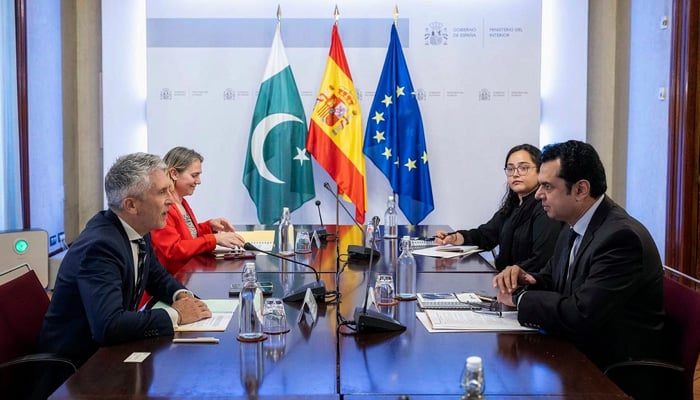
This development came after Minister of State for Interior Talal Chaudhry’s recent visit to Spain where he met his counterpart, Fernando Grande-Marlaska.

Minister of State for Interior Talal Chaudhry (right) holding a meeting with Spanish counterpart Fernando Grande-Marlaska. — PTV News/File

During the visit, Chaudhry sought action on the red notices issued against dozens of suspects.

Speaking on the development, Minister Talal Chaudhry thanked the Spanish government and Interior Minister Marlaska for their prompt action and cooperation.

He expressed confidence that this success marks the beginning of a broader crackdown on fugitives who flee Pakistan to avoid legal consequences.

“This is a major step forward in our commitment to justice. I am grateful to the Spanish authorities for understanding the gravity of the situation and taking swift action. We hope to see the remaining fugitives arrested and extradited soon,” said Chaudhry in a statement.

Legal proceedings are now underway to facilitate the extradition of the arrested individuals to Pakistan, where they will face trial under the country’s anti-terrorism and criminal laws.

Pakistan has long been seeking the arrest and extradition of 38 fugitives from Spain, most of whom are wanted in serious criminal and terrorism-related cases.

These individuals had managed to evade justice for years, exploiting legal loopholes and a lack of coordination between international enforcement agencies.

The development is being hailed as a milestone in international law enforcement cooperation, and a sign that Pakistan is intensifying efforts to bring back criminals who have found refuge abroad.


— With additional input from APP

Stay Connected

64FansLike
60FollowersFollow

Latest Reviews

Exchange Rates

USD - United States Dollar
EUR
1.16
GBP
1.34
AUD
0.67
CAD
0.72