Home Blog Page 3202

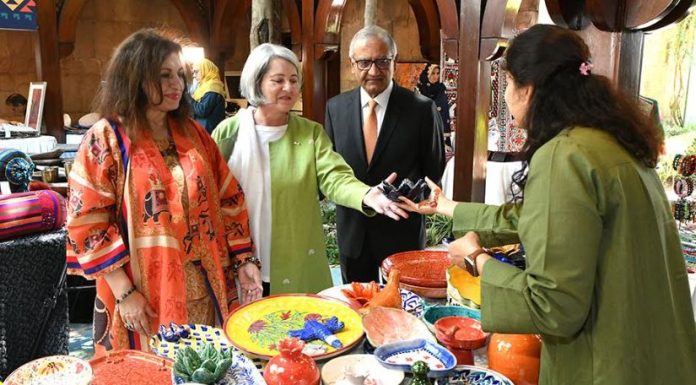
Kazakh Ambassador visits COMSTECH office

DNA

ISLAMABAD, SEPT 16 – Ambassador of the Republic of Kazakhstan to the Islamic Republic of Pakistan, Mr. Akan Rakhmetullin visited Islamabad-based Secretariat of the Organization of Islamic Cooperation Standing Committee on Scientific & Technological Cooperation (COMSTECH ) and held the talks with its Coordinator General, Prof. Mr. Iqbal Choudhary, on matters, related to ongoing cooperation between Kazakhstan and COMSTECH, as well as to specific projects, which aim to extend it. DNA

=========

PIA incurs Rs280mn loss after suspension of EU flights

ISLAMABAD : The Pakistan International Airlines (PIA) incurred a loss of Rs280 million after suspension of its flight operation to and from the European Union (EU) states, Aviation Minister Ghulam Sarwar informed the National Assembly on Wednesday.

In a written reply, he said the national flag carrier’s receipts from its flight operation in the EU bloc fell to Rs1.41 billion from Rs1.69 billion in July-August 2020.

However, the minister said the airline raked in a sum of Rs520 million from its Pakistan-UK flights during this period. He said it hired the services of Malta company for flights between the two countries besides operating four roundtrip charter flights during coronavirus lockdowns.

The PIA raked in Rs5.81 billion revenue as against expenditure to the tune of Rs5.31 billion, he added.

Sarwar said the Pakistan International Airlines also resumed flights to Canada, UAE, Oman, Qatar, Malaysia, Afghanistan, and Saudi Arabia.

In July, the European Union Air Safety Agency (EASA) had suspended the authorisation for the PIA to operate in the bloc for six months. “EASA has temporarily suspended PIA’s authorisation to operate to the EU member states for a period of 6 months effective July 1, 2020, with the right to appeal against this decision,” a Pakistan International Airlines statement had said.

Japan’s Yoshihide Suga formally voted in as PM

TOKYO : Japan’s Yoshihide Suga was voted prime minister by parliament’s lower house on Wednesday, becoming the country’s first new leader in nearly eight years, as he readied a “continuity cabinet” expected to keep about half of predecessor Shinzo Abe’s lineup.

Suga, 71, Abe’s longtime right-hand man, has pledged to pursue many of Abe’s programmes, including his signature “Abenomics” economic strategy, and to forge ahead with structural reforms, including deregulation and streamlining bureaucracy.

Abe, Japan’s longest-serving premier, resigned because of ill health after nearly eight years in office. Suga served under him in the pivotal post of chief cabinet secretary.Suga won 314 votes out of 462 cast by parliament’s lower house members. The chamber takes precedence in electing a premier over the upper house, which was also expected to pick Suga because of a ruling bloc majority.

Suga, who won a ruling Liberal Democratic Party (LDP) leadership race by a landslide on Monday, faces a plethora of challenges, including tackling COVID-19 while reviving a battered economy and dealing with a rapidly aging society.

With little direct diplomatic experience, Suga must also cope with an intensifying U.S.-China confrontation, build ties with the winner of the Nov. 3 U.S. presidential election and try to keep Japan’s own relations with Beijing on track.

Domestic media said that roughly half of the new cabinet would be people from the Abe cabinet. There will be only two women and the average age, including Suga, is 60.

Among those expected to retain their jobs are key players such as Finance Minister Taro Aso and Foreign Minister Toshimitsu Motegi, along with Olympics Minister Seiko Hashimoto and Environment Minister Shinjiro Koizumi, the youngest at 39.

“It’s a ‘Continuity with a capital C’ cabinet,” said Jesper Koll, senior adviser to asset manager WisdomTree Investments.

Abe’s younger brother, Nobuo Kishi, is likely to be tapped for the defence portfolio, while outgoing Defence Minister Taro Kono will take charge of administrative reform, a post he has held before.

Yasutoshi Nishimura, Abe’s point man on COVID-19 response, will remain economy minister, while Trade and Industry Minister Hiroshi Kajiyama, the son of a politician to whom Suga looked up as his mentor, will also retain his post, media reported.

Shehbaz says Nawaz Sharif’s return not possible without treatment

LAHORE : Pakistan Muslim League-Nawaz (PML-N) President Shehbaz Sharif said on Wednesday that it was not possible for his brother and former prime minister Nawaz Sharif to return to the country without getting treatment.

The PML-N president’s statement comes a day after the Islamabad High Court (IHC) issued non-bailable arrest warrants for Nawaz Sharif during a hearing over the former prime minister’s petition requesting exemption from court appearance.

In a brief ruling, IHC’s Justice Mohsin Akhtar Kayani remarked that the PML-N supremo neither underwent a surgery despite citing it as a reason behind obtaining bail to travel to the United Kingdom nor was he admitted to a hospital.

“Our bail order has expired, which has its own effects,” the judge said during a hearing at the IHC over a petition to cancel Nawaz’s bail in the Avenfield properties reference.

The non-bailable arrest warrants were issued in order to ensure the PML-N leader’s appearance at an upcoming hearing on September 22.

“Returning without treatment is a serious threat to Nawaz Sharif’s life and the right to life is most important and cannot be ignored,” said the opposition leader in the National Assembly in a statement issued from Lahore.

Shehbaz said that the problem was not of the return of the former prime minister but was his health. He added that the ruling Pakistan Tehreek-e-Insaf (PTI) had claimed that Kulsoom Nawaz, wife of the PML-N supremo, was not ill but she passed away asking if it was possible to repair the damage done by the allegation.

The former chief minister reminded that the doctors have said that travelling for Nawaz Sharif in the current situation can be “life-threatening”. He added that the government had also “admitted” that the PML-N supremo’s treatment could not be done in Pakistan.

“Government had sent him to London on the recommendation of government and non-government doctors but his treatment was delayed due to coronavirus,” said Shehbaz in the statement.

‘Jos Buttler came to me with some queries’ Younis shares

Karachi : Younis Khan, who served Pakistan as batting coach on the recently concluded England tour, shared moments he spent with English wicket-keeper Jos Buttler.

Speaking to a local news channel, Khan revealed that Buttler came to him to conduct a 15 minutes session with him and his teammates. “‘Younis Bhai, I want to talk to you, and can you come with us and conduct 15 minutes session’?” Buttler asked Khan.

Khan said he replied: “Yeah, why not. Will do a session soon.”

Adding on, Khan said after winning the first Test and performing up to the mark, still Buttler came to him and ask for some of his time. “He once again came to me after they won the first Test and he performed really well. I looked at him and ask “What else do you want now after such an outstanding performance but he said ‘Younis Bhai I want to learn a few things from you related to sweep shot and technique’,” Khan shared.

It must be noted here that Buttler scored match-winning 75 runs against Pakistan in the first Test to push England to victory by three wickets. He along with Chris Woakes scored 139 runs together. The rest of the two Tests ended in a draw due to bad weather and Pakistan lost the Test series 1-0. The green shirts leveled T20I series 1-1.

Maryam challenges FBR notice for recovery of income support levy

LAHORE : PML-N Vice President Maryam Nawaz on Wednesday filed an appeal in the Lahore High Court (LHC) challenging a notice by the Inland Revenue department of the Federal Board of Revenue (FBR) for recovery of income support levy.

She through her counsel moved the appeal assailing an LHC single bench’s verdict regarding income support levy, citing the FBR and other relevant officials as respondents.

The appellant states that she has been served a notice by the FBR for recovery of Rs657,000 income support levy despite the fact that she had paid all taxes and requested the court to declare it illegal.

Last year in May, the LHC had disposed of a petition filed by the PML-N vice president against the Federal Board of Revenue’s (FBR) notice for recovery of income support levy. Justice Abid Aziz Sheikh directed her to file an appeal challenging a single bench’s verdict in this regard.

Maryam’s lawyer had contended before the court that the recovery of income support levy is a violation of the country’s Constitution as the Inland Revenue department lacked authority to impose and recover a tax in the name of social protection after the passage of the 18th Constitutional Amendment.

The counsel said his client had been asked to pay income support levy on her assets worth more than Rs317 million and demanded that the impugned notice be declared illegal and unlawful.

India facing defeat at international forums: FM Qureshi

ISLAMABAD : Foreign Minister (FM) Shah Mehmood Qureshi on Wednesday said that India is facing defeat at international forums due to its aggressive behaviour.

In his reax over Indian objection raised over a political map of Pakistan at the Shanghai Cooperation Organization (SCO), Shah Mehmood Qureshi said New Delhi’s objection was rejected at the SCO and added that even Russia as hosts of the summit did not second Indian objection.

Kashmir is a bilateral issue between Pakistan and India and such issues cannot be raised at the SCO, said the FM and added that such issues are raised at the sideline meetings.

Shah Mehmood Qureshi said that Indian occupied Kashmir is a disputed territory and United Nations resolutions are also there for its solution.
The FM further added that India is facing isolation due to its behaviour at the international forums. Commenting on fuming tensions with China by the BJP-led Indian government, he added that Beijing repeatedly urged for talks for the solution of the Ladakh issue, but India took aggressive position and faced defeat.

Special Assistant to Prime Minister (SAPM) on National Security Moeed Yusuf had said on Tuesday that Pakistan successfully defended its projection of the new political map in Shanghai Cooperation Organization (SCO) meeting while India’s Doval left the meeting disappointed as their objection was rejected.

A hybrid model of education

By Muhammad Omar Iftikhar

 The reopening of educational institutions across Sindh has been seen as an event that could have been postponed. The reopening could be delayed as the fear of Covid-19 spreading in its second phase seems to be inevitable. The virus was real and it affected people in Pakistan. While the scare of this virus is still here, children need to be protected. In this regard, children need to wear masks at all times when at school. However, children may get frustrated because the mask can cause some level of suffocation. Moreover, children from the primary classes may not keep the mask on their face for long. They are innocent beings and may take the mask off when talking to classmates or when playing. The objective of the educational institutes across Pakistan must follow the hybrid educational method. Under this system, the classes are held online and on campus. Where half or a predetermined strength of the class can stay at home and take classes online, the rest willing to come to campus can take physical classes. However, in this regard, the management and staff of educational institutes must be on the same page with the parents and their students. A hybrid method will facilitate the management and faculty members. Where the faculty will conduct classes from home, students will take such classes from the safety of their homes. However, the concerned authority can also permit colleges and universities to continue teaching from home. Students who need to perform practical can be asked to visit their campus at predetermined hours while following SOPs. The main objective is to keep the students safe. This can only happen when educational institutions are working on the same page. Online education was successful when the country was under lockdown. The same strategy can be continued until the fear of Covid-19 looms over us.

CPC: A Force behind China’s Power

By Syed Ali Nawaz Gilani

The Communist Party of China (CPC) which is under constant fire of western media and US President who have been mentioning it time and again, especially during the COVID 19 tenure.CPC is going to complete 100 years of its establishment in July 2021. Maintaining political grip since its inception almost ten decades ago, the CPC has witnessed country’s rapid economic growth and rise as a global power: facing challenges abroad and at home simultaneously, during the times of crises like economic inequality and the coronavirus pandemic.

The present escalating row between US & China over blame for the coronavirus pandemic is fast becoming a battle over the CPC’s legitimacy, raising the stakes in an already fraught relationship. In castigating China for its failure to contain the outbreak, senior US officials have gone out of their way to portray the crisis as a deadly illustration of the threat that Communist party rule poses the Chinese people – and the world beyond.This need to know about CPC and its functioning, role and strength.

President Xi Jinping, who is the supreme leader of the CPC has acquired power in 2012, has accrued more political power than any Chinese leader since Chairman Mao Zedong.Xi has amassed vast authority after being named party general secretary in 2012, effectively becoming leader for life. He took over as leader of the military to head party bodies that oversee economic reform and other important issues.It was a break with two previous generations of leadership, which were based on consensus among members of the ruling party’s inner circle of power, the Standing Committee.That has allowed Xi to push through ambitious plans, including the multi-billion-dollar Belt and Road Initiative, to expand trade by building ports, railways and other trade-related infrastructure across Asia, Africa and the Middle East.

Undoubtedly, inspired by the Russian Revolution, the CPC was founded in 1921 on the principles of Marxism-Leninism. Tensions between the Communist party and the nationalist Kuomintang, its primary rival, erupted into a civil war from which the Communists emerged victorious in 1949. Despite China’s market reforms in the late 1970s, the modern Chinese state remains a Leninist system, like those of Cuba, North Korea, and Laos.

Since 2012 President Xi Jinping came to power, he has consolidated his control over the infamously party, with many experts calling him the most influential Chinese leader since Mao Zedong. In 2017, the CPC reaffirmed President Xi Jinping’s dominance and elevated new officials to support him in setting the agenda for the one of the largest economies in the world.

The CPC relies on three pillars: control of personnel, propaganda, and the People’s Liberation Army. Around 70 percent of its nearly ninety million members are men; farmers, herdsmen, and fishermen make up roughly 30 percent of its membership.

The CPC convenes its National Party Congress (NPC) every five years to set major policies and choose the Central Committee, which comprises around 370 members and alternates including ministers, senior regulatory officials, provincial leaders, and military officers. The Central Committee acts as a sort of board of directors for the CPC, and its mandate is to select the Politburo, which has twenty-five members.

In turn, the Politburo elects through backroom negotiations the Politburo Standing Committee, which functions as the epicenter of the CPC’s power and leadership. The Standing Committee currently has seven members, but membership has ranged from five to nine people. Xi, who took over from Hu Jintao in 2012, sits atop the system as general secretary. He is also the president and head of the military, exerting enormous influence in setting government policy. The premier, Li Keqiang, heads the State Council, China’s equivalent of a cabinet.

As long as China’s power politics & its transition are concerned, the party leadership succession is decided through internal negotiations. These complex dynamics can be seen in Xi’s extensive anticorruption campaign. While corruption crackdowns are not uncommon following a transfer of power, the scope of Xi’s campaign has been unprecedented and with these initiatives President Xi Jinping is targeting some two million officials since late 2012. Experts argue that the antigraft movement, though extremely popular among Chinese people, may alienate some elites and paralyze governance at lower levels for fear of falling under the party corruption watchdog’s suspicions.

The 18th Party Congress in 2012 marked the peaceful transition of China’s leadership from Hu to Xi, then the 19th congress in 2017 solidified Xi’s ascent as a decisive leader. In the reform era that followed the death of Chairman Mao and his personality cult, Deng Xiaoping steered the party from strongman rule to consensus rule (or even collective leadership) among the elite and institutionalized the transfer of power from one leader to the next, with each president serving a maximum of two five-year terms. These principles had dictated leadership succession since the early 1980s.

In March 2018, the congress amended China’s constitution to roll back term limits for China’s president, paving the way for Xi to remain officially in power beyond 2022.

No doubt that CPC is in firm control of the People’s Republic of China and transformed China from less developed country to one of the most scientifically advanced country of the world. The CPC decision making is based on democratic Centralism and has not only succeeded in feeding more than one billion Chinese people but has considerably raised their living standard. We can rightly mention CPC as a force behind China’s Social, economic and political power. (Mr. Syed Ali Nawaz Gilani is Secretary-General Pakistan-China Friendship Association Khyber Chapter & President Radio China Listener’s Club his email syeed,[email protected])

Four more people die of coronavirus, 665 test positive

ISLAMABAD : The coronavirus claimed four more lives across the country during the last 24 hours, lifting the death toll from the highly contagious disease to 6,393.

According to the National Command and Operation Centre (NCOC), 665 more people tested positive for the infection during this period, bringing the number of confirmed cases in the country to 303,089.

As many as 290,760 Covid-19 patients have recuperated from the disease, pushing the number of active cases down to 5,936. 29,097 samples were tested during the previous 24 hours, out of which 539 turned out to be positive.

Thus far, more than 3 million tests have been conducted across the country.

India’s cases surpass five million mark

According to Reuters, India’s coronavirus cases surged past 5 million on Wednesday with a single-day jump of 90,123 infections in the last 24 hours, data from the federal health ministry showed.

India is only the second country in the world to cross the grim milestone of 5 million cumulative cases, after the United States. The death toll from COVID-19 is now at 82,066, the ministry said, with 1290 fatalities recorded in the last 24 hours.

Stay Connected

64FansLike
60FollowersFollow

Latest Reviews

Exchange Rates

USD - United States Dollar
EUR
1.17
GBP
1.36
AUD
0.72
CAD
0.74