Home Blog Page 3010

CPEC to boost Agriculture Sector in Pakistan: Chairman PARC

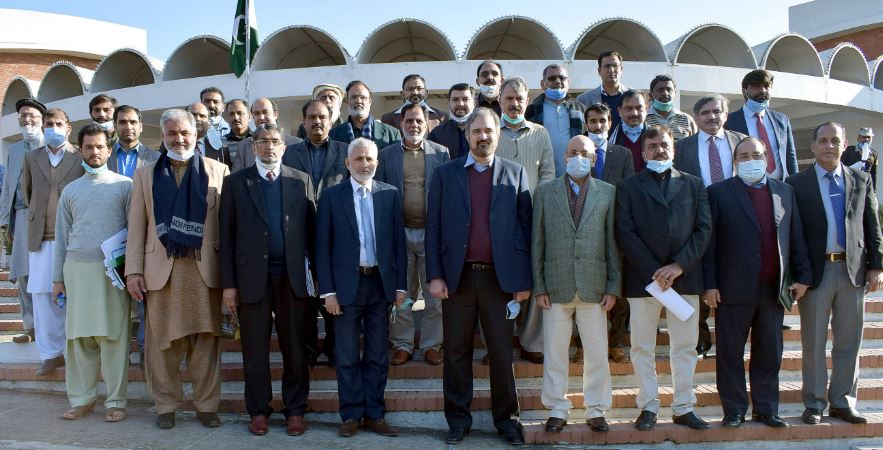
ISLAMABAD, JAN 6 (DNA) – Parliamentary Committee on CPEC headed by Sher Ali Arbab (MNA)/ Chairman Committee visited National Agricultural Research Centre (NARC) this Wednesday. Secretary MNFS&R, Mr. Ghufran Memon, Chairman PARC Dr. Azeem Khan alongwith DG NARC Engr. Shamimul Sibtain Shah welcomed the members of the Committee.

The purpose of this meeting was to make agriculture sector an important part of CPEC and find possible Pak-China agricultural cooperation and technical assistance through PARC interventions. PARC National Agriculture Research Centre is the largest research center of PARC. The delegacy was briefed about various agri. research & development activities carried out by the institutes working under NARC.

A display exhibition of PARC research products and technologies was also arranged for the said delegation. Chairman Committee on CPEC Mr. Sher Ali Arbab (MNA) chaired the meeting while Dr. Azeem Khan presented a comprehensive report about PARC and other projects related to agriculture sector.

000000

On the occasion, Dr. Azeem Khan identified the Joint Working Groups, agricultural commodities in different Agro-ecologies along CPEC routes and Modern Pakistan Cotton Farm Project by CMEC China. He further added solutions for cotton crises through improved agricultural technologies which is possible by the development of water saving cotton farms and expanding its planting area.

While sharing 10 years development targets under CPEC Chairman PARC told our aim is to change Pakistan from cotton import country to cotton export country and save foreign exchange of 1.5 billion USD. Besides renovation of existing orchards, introduction of new varieties, reduce post-harvest losses, improve value chain and development of rural industries are our major proposed interventions.

Mr. Sher Ali Arbab, Chairman, Parliamentary Committee on CPEC, after the briefing, emphasized that we must first address the existing agricultural infrastructure in Pakistan and its shortcomings so that in the light of modern agricultural knowledge and experience comprehensive and sustainable strategies can be formulated and solutions to the shortcomings in agriculture can be found on a modern scientific basis.=DNA

==================

Dr. Sania convenes maiden meeting of Ehsaas steering committee

DNA

ISLAMABAD, JAN 6 – A maiden meeting of the Ehsaas steering committee for Waseela-e-Taleem Digital, an education conditional cash transfer programme was convened under the chair of SAPM Dr. Sania Nishtar. The steering committee members were briefed on the massively reformed Waseela-e-Taleem Digital, that has massively been reformed and scaled up through end-to-end digitization, cost effective changes in institutional infrastructure, new stipend policy, and nationwide expansion across all districts. The Rs. 80 billion programme will bring 5 million deserving primary school children into its fold from across all 154 districts of Pakistan over a 4-year duration.

The steering committee reviewed the programme performance, discussed the way forward and explored options to enhance the outcomes of the programme capitalizing on conditionalities introduced in the programme. Terms of reference of the steering committee were also principally crystallized in consultation with committee members.

“The purpose of the deep-rooted digital reform in Waseela-e-Taleem under Ehsaas was to promote integrity, transparency, accountability and to improve targeting. And, the programme has been scaled up nationwide to address the problem of out of school children”, said SAPM Dr. Sania Nishtar. Adding further, she said, “As per Ehsaas payment policy, all payments are biometrically verified in real time; girls get Rs. 2000 and boys get Rs. 1500 per quarter, when 70% school attendance is ensured.”

The meeting brought together members of the steering committee from Ministry of Economic Affairs, Ministry of Education and Professional Training, Foreign Commonwealth and Development Office, the World Bank, Asian Development Bank and Education Departments from provinces including AJK and GB who were joined by Waseela-e-Taleem Digital operations team.

The committee richly lauded quantum changes in the Waseela-e-Taleem Digital programme specifically comprehensive and deep-rooted reforms that have been designed and deployed over the last year and a half under Ehsaas, a as a result of which far reaching results would be achieved in the outcomes of programme.

In her concluding remarks, SAPM Dr. Sania thanked the steering committee experts and members for their time and valuable inputs and reiterated that this steering committee forum will open doors to collaborate and bring rich expertise from provincial education departments, key stakeholders, and development partners.

During the course of the meeting, it was also discussed that Ehsaas plans to roll out nationwide drive for school enrolment soon in collaboration with provinces and key development stakeholders to enhance primary school enrolments and minimize dropouts. “The programme targeting will also be aligned in keeping with results of Ehsaas National Socio-economic Registry survey that is currently 61% complete in the field and is expected to be concluded before June 2021 nationwide”, stated SAPM Dr. Sania.

It was agreed that a sub-committee will be constituted with experts from the steering committee stakeholders and provinces for a deep dive into the deep-rooted reforms and integrations in the education conditional cash transfer programme. The steering committee will meet biannually to review the progress and strategic direction of programme.

Pakistan challenges Indian ‘hegemony’ in South Asia: Senator (R) Javed Jabbar

DNA

ISLAMABAD, JAN 6 – Former Senator Javed Jabbar has said that Pakistan is the only country in the South Asian region which challenges and deter the Indian hegemony.

He was speaking in a webinar organized by Muslim Youth University (MYU), International Relations department titled “Revitalization of Two Nation Theory from perspective of Indian illegally occupied Jammu and Kashmir.”

Jabbar said that many people believe that the two-nation theory ended with the creation of Bangladesh, something he could not agree with. Bangladeshis rejected the state of Pakistan, not the concept of a Muslim nation. They are still proud and committed Muslims, he said.

He further added that the Two-Nation theory becomes the two Nation three-state. We still have two nations in the subcontinent if religion is considered to be one of the criteria for defining a nation.

“Pakistan should aim to become the Israel of South Asia, in the best, not the worst sense,” the former senator said.

He said the Pakistani nation is ethnically diverse and that was its strength. History and civilization bound together with the people of Pakistan regardless of their caste, colour, ethnicity and religion.

Earlier, in his welcome remarks, vice-chancellor Muslim Youth University Dr Syed Tahir Hijazi welcomed the distinguished speaker, laying out the agenda for the discussion.

While presenting the Vote of thanks and concluding remarks Dr Muhammad Munir, Head of Department International Relations thanks the guest speaker for sharing their opinion.

It was attended by more than 100 participants from civil society, media professionals, academia, international organisations and students.

Reeling Indian Juggernaut in the Himalayas

Abdul Rashid Shakir

India’s hegemonic posture and expansionist designs in the South Asia can be well appreciated if we dissect its lethal miscalculations on economic and political fronts.

Economically, Indian authorities boasted of their upsurge in the emerging market countries, and their joining multi-trillion dollar economies club with $2.8 Trillion GDP and export revenue of around $324 Billion in 2019. Its impressive IT industry, with around $147 Billion exports, tempted it to aspire for a bigger-than-stature role in international power politics. But ostensibly, blindfolded by this illusion of self- aggrandizement, Indian policy makers ignored their dismal performance on major socio-economic indicators. Raging poverty, alarming law and order, miserable condition of human rights and minorities mock at Indian claims of economic turnaround. Seriously hit by COVID-19 pandemic in recent times, its progress on any of the 17 Sustainable Development Goals (SDGs) is not enviable. Moody’s recently published revised economic growth outlook for 2020 shows India growing at -8.9%. Its poor score of Gini Coefficient, a gauge of income distribution inequality among population, further augments this bleak picture of Indian social fabric.

Politically India takes credit in being world’s biggest democracy with a population of over 1.3 Billion. It is proud of inheriting British legacy of running democratic institutions. But unfortunately, it is oblivious of nurturing basic values needed for the democracy to flourish: higher literacy rate, economic self-sufficiency, and freedom of expression through independent media.

Ground realities in India paint a gloomy picture. Firstly, India dropped 10 point to 51st position in Economist Intelligent Unit’s 2019 Democracy Index that measures state of democracy worldwide in 165 independent states and two territories. They have cited erosion of civil liberties as the main cause of this sharp dip in democratic outlook of the country. Secondly, distribution of wealth in India is so skewed in favor of rich that Just 1% of its richest elite own 58.4%, and the richest 10% own 80.7% of country’s total wealth. Thirdly, poor quality teaching and learning practices, especially for the children of Schedules Castes, Schedules Tribes and religious minorities, coupled with a custom of early marriages result in

early children drop out from schools. Currently more than 6 million school-age kids are out of school in India. Fourthly, India’s place in Reporters without Borders’s Press Freedom Index has dropped from 136th in 2015 to 142nd in 2020 due to oppressive policies of the ruling BJP government, led by Prime Minister Namenda Modi.

These fundamental flaws in assessing their economic and political worth led Indians to other fatal misconceptions about their diplomatic, tactical, and strategic prowess.

Diplomatically, India being sweet heart of major world powers, behaves like a spoiled child at all international forums, be it United Nations (UN), International Atomic Energy Agency (IAEA), or Financial Action Task Force (FATF). But it failed to understand that world powers are ignoring its whimsical wish list because of its bigger market, in order to secure their economic interests.

Tactically, India tried to assume role of a policeman in South Asia, bullying all its neighbors to stamp its authority in the region. However, quite recently, Nepal’s stubborn stance on Kalapani, Lipu Lekh and Limpiyadhura areas, located at a strategic three-way junction between Nepal, India and China, is a humiliating blow to Indian hegemonic claims in the region.

Strategically, India is projected as a counter weight to China in the region. But historic thrashing of its so-called brave troops by their Chinese counterparts in a non-conventional clash with sticks and clubs in Galway Valley, Laddakh in June 2020 is an eye-opener, not only for Indian authorities but also for their international aides, especially in Quadrilateral Security Dialogue (QSD) or Quad: an informal strategic alliance of the United States, Japan, Australia and India to counter increasing Chinese military and economic power in the region.

In the back drop of more than six-months long standoff with Indian troops across the Line of Actual Control (LAC) in Ladakh, China has strategically cemented its position in the region. It is a massive defeat of India and its sponsors, rather launchers, to encircle China and gain a position of influence in the region. All Indian tactics, like putting a ban on around 150 Chinese Apps, to control China economically would prove counterproductive at the best.

Out of this deep sense of embarrassment, India is imploring China again and again to pull back its troops and maintain status quo in the area to give her an honorable exit from the crisis, but of no avail so far. Currently eighth round of border talks between the two countries has ended inconclusively.

Keeping the aforesaid in view, one can painlessly point at how sham and ill- founded sense of grandeur Indian civil and military establishments harbor. Pragmatism demands that better sense should prevail. India should come out of deep slumber to confront bitter realities plaguing its socio-economic order. It must put its own house in order before aspiring for a global role.

([email protected])

Energy sector experts highlight importance of facilitation for renewable energy initiatives

DNA

ISLAMABAD – It is high time for Pakistan to shift towards Green Energy. Therefore, government needs to come up with policies to facilitate stakeholders to explore more options for sustainable renewable energy.  The energy and environmental sectors experts said this while sharing their views with the participants at the inception meeting of the Network for Renewable Energy Research and Advocacy titled ‘Clean Energy Transition in Pakistan’, organized by the Sustainable Development Policy Institute (SDPI) here on Wednesday.

Managing Director Pakistan Power & Infrastructure Board, Mr Shah Jahan Mirza, while covering various aspects of the clean energy landscape in Pakistan, said that power and energy sectors in Pakistan are not in desirable shape for various factors. Our natural resources, especially gas is fast depleting and thus, we need to act now keeping the projection of our future needs of energy in view.

“The processes for private sector investment in Green Energy also need to be streamlined.” Mirza added while highlighting the role of private initiatives in the sector.

Mr Christoph Nedopil, Founding Director of Green Belt Road Initiative Center, was of view that it is high time for Pakistan to move to renewable energy. He said that policy should be evolved to facilitate green investment in the sector. While highlighting the possible role of China in Pakistan’s renewable energy sector, he said that secure investment would remain a key concern for the private sector initiatives.

Dr Hina Aslam, Research Fellow Energy, SDPI, earlier shared the findings of SDPI’s research report on the energy sector of Pakistan. She said that public and private investments, integrated water resource management, tapping renewable energy resources, gender-based equality and women empowerment related initiatives and environmental sustainability are some of the critical issues that have been covered in the report.

She added further that the report has also highlighted the importance of integrated energy plans, stakeholders’ stakeholders’ involvement, and renewable energy resources and thus, provided critical insight for policy initiatives.

Dr Fatima Khushnood, representing Engro Energy limited, highlighted the importance of the measures to ensure environmental sustainability. Explaining the role of private sector in energy resources development, she said that this role could be further strengthened through the right policy initiatives and facilitation.

Syeda Hadika Jamshaid from Ministry of Climate Change (MoCC) informed the participants that Pak-INDC (Pakistan’s Intended Nationally Determined Contribution), Pakistan is pursuing the goal of reducing carbon emissions and thus, renewable energy has important role to play to achieve this objective. Mr. Mushtaq Gaadi, noted academician and Dr Najeeb Ullah, from University of Peshawar, also shared their views on the topic and said that we need a paradigm shift to move to green energy and ensure environmental sustainablity.

Hafeez Shaikh chairs ECC meeting of Cabinet

DNA

ISLAMABAD – Federal Minister for Finance and Revenue, Dr. Abdul Hafeez Shaikh, chaired the meeting of the Economic Coordination Committee (ECC) of the Cabinet today.

Federal Minister for Interior Sheikh Rasheed Ahmed, Minister for Privatization Mohammad Mian Soomro, Minister for Planning, Development and Special Initiatives Asad Umar, Minister for Industries and Production Hammad Azhar, Adviser to the PM on Commerce Abdul Razak Dawood, SAPM on Revenue Dr. Waqar Masood, SAPM on Petroleum Nadeem Babar and Minister for National Food Security and Research Syed Fakhar Imam participated in the meeting. Governor State Bank of Pakistan Reza Baqir also participated through video link.

Ministry of Commerce presented a summary regarding removal of additional 2% customs duties on 152 tariff lines, mostly raw material, on horizontal basis under National Tariff Policy 2019-24. The ECC approved the summary with a direction that budget cycle must be observed while planning important incentives for businesses & industries for smooth planning and subsequent implementation during the financial year.

Ministry of Maritime Affairs tabled a summary for awarding contract regarding infrastructure facilities, sewerage system and water supply system in Gulshan-e-Benazir Township Scheme (GBTS) at Port Qasim Authority, Karachi. The ECC approved the projects in conformity with the PQA Act-1973, in principle, and directed Ministry of Maritime Affairs to settle the modalities for the award of contracts as per rules.

Ministry of National Food Security and Research presented a detailed summary regarding provision of additional quantities of wheat to KPK, AJ&K and Utility Stores Corporations (USC). The Additional Secretary, M/o NFS&R gave a detailed presentation regarding availability of wheat stocks across the country. The ECC approved additional wheat allocation of 200,000 MT for KPK 80,000 MT to AJ&K and 220,000 MT to USC from PASSCO as requested. ECC also approved the import of additional wheat to buffer up stocks till the arrival of fresh crop after seeking detailed input from all concerned.

The summaries related to the Textile and Apparel Policy (2020-25) and National Freight and Logistics Policy (NFLP) were deferred to next ECC for comprehensive consultation process with key stakeholders.

ECC approved the following Technical Supplementary Grants during the meeting:

a)                 Rs. 30 million for the Ministry of Defence for the purchase of spare parts for Helicopters for the government of Khyber Pakhtunkhwa (KPK).

b)                 Rs. 400.020 million for the Ministry of Law and Justice to establish additional courts in compliance with the orders of the Supreme Court.

c)                 Rs. 2.268 billion for the Higher Education Commission for completion of various Disbursement linked Indicators (DLIs) under the IDA credit facility.

Pakistan’s former ambassador accused of embezzling Rs19m in Bulgaria

ISLAMABAD, JAN 6 (DNA) – Pakistan’s accountability bureau has filed a corruption reference against a former ambassador for using embassy funds for personal expenses.

Babar Hashmi has been accused of working with former accountant Tufail Qazi and embezzling Rs19 million from 2016 to 2018. The government released the funds for its embassy in Sofia, Bulgaria.

NAB Rawalpindi conducted the inquiry on the request of the Ministry of Foreign Affairs.

The two men have been accused of embezzling $96,052 (Rs15 million) and 45,758 Bulgarian lev (Rs4 million) for paying bills of expensive hotels and “throwing parties”.

“The embezzlement continued for two years and surfaced when a new accountant took charge of the embassy,” the bureau said in the reference. “During the investigation, it was established that both men being official signatories withdrew funds from official accounts of the embassy maintained at Bulbank Sofia, Bulgaria and used them for personal benefit/gain.”

Hashmi and Qazi failed to submit a bank reconciliation statement to the chief accounts office of the foreign ministry, which is a violation of rules, the bureau said.

Qazi has been arrested in the case. The court will take up the case after the scrutiny by the Registrar’s Office.=DNA

=======================

PM Imran urges Hazaras to bury slain miners, promises to visit them ‘very soon’

ISLAMABAD – Prime Minister Imran Khan on Wednesday urged the protesting members of Balochistan’s Shia Hazara community to bury the bodies of the miners killed in a brutal attack in Mach, promising he would visit them “very soon”.

On Sunday, armed attackers slit the throats of 11 miners in a residential compound near a mine site in Balochistan’s Mach coalfield area, filming the entire incident and later posting it online. The gruesome attack was claimed by the militant Islamic State (IS) group.

Since then, thousands of Hazaras have staged a protest along with coffins containing the miners’ bodies in the western bypass area in Quetta, while members of their community have also held protests in Karachi.

The protesters have said they will not bury the miners’ bodies until Prime Minister Imran meets them and the killers are brought to justice, continuing their protest on Wednesday for a fourth straight day.

“I want to reassure the Hazara families who lost their loved ones in a brutal terrorist attack in Machh that I am cognisant of their suffering & their demands,” the premier said on Twitter, adding that the government was taking steps to prevent such attacks in the future and knew that “our neighbour is instigating this sectarian terrorism.”

“I share your pain and have come to you before also to stand with you in your time of suffering. I will come again very soon to offer prayers and condole with all the families personally,” he said while addressing the mourning Hazaras.

“I will never betray my people’s trust. Please bury your loved ones so their souls find peace.”

Hashtags criticising Prime Minister Imran for not visiting the protesters and stressing ‘Hazara Lives Matter’ have been the top trends on Twitter in Pakistan during the last three days.

Meanwhile, Balochistan Chief Minister Jam Kamal Khan Alyani also requested the protesters to “not link Prime Minister Imran’s visit with the burials” of the miners.

Addressing a press conference in Quetta along with Minister for Maritime Affairs Ali Zaidi and Adviser to the Prime Minister on Overseas Pakistanis Zulfiqar Bukhari and members of the Shia community, Alyani said that as Muslims, we “have our religious responsibilities [to bury the deceased]” and these should be fulfilled.

“I would request the community to not associate it with some official’s visit,” he added.

The minister and adviser arrived in the city late on Tuesday night.

Expressing grief over the incident, Alyani said that he was in the United Arab Emirates when he heard the news of the attack and he came back as soon he received negative results for his Covid-19 test. “I held a meeting with [officials from law enforcement agencies],” he said while talking about the steps his government has taken so far.

“Our coming here is witness to how serious we are taking this and owning this,” he said, adding that the Shia Hazara community members “are our brethren and we have no hesitation in talking to them”.

The chief minister said that conditions in the province had “improved considerably” since a decade ago and no such incident happened in 2020.

Alyani said his government did not look at people in terms of their ethnicity or religious affiliation. Mentioning how conditions had improved in the province over the last few years, he said he had also participated in several programmes in Quetta’s Hazara Town.

“But the enemies of Balochistan and Pakistan did not like this. The Balochistan government is a very big stakeholder and we are making efforts to take things forward so citizens and children of this city can progress.”

Referring to the 2019 blast in Quetta’s Hazarganji market that was also targeted at the Hazara community, he said back then too the authorities had gone to visit the affected community and talked to them and the problem was “solved”.

“We came here [today] to show solidarity with the whole community,” he emphasised. “We will also visit the relatives [of the slain miners]. Wherever they are, we will go visit them.”

Responding to a question about the protesters’ demand for a visit by the premier, he said that “the biggest responsibility” lay with the Balochistan government.

“[The prime minister] will definitely come, the president will come, ministers and parliamentarians will come. But even if the prime minister comes, we have to solve our problems ourselves.”

‘Foreign hand in attacks’

Ali Zaidi, who spoke after the chief minister, too appealed to the Shia Hazara community to bury the deceased miners.

“We talked to the PM and he will come [but] for God’s sake, the people who have been martyred should now be buried.

“Your demands are valid but please do not associate the burial with the PM’s visit,” he stressed.

He also urged people — irrespective of which party or religious sect they belonged — to “not play into foreign hands”.

“The external enemies of Pakistan commit such acts in Pakistan. What is saddening is that we find Mir Sadiqs and Mir Jafars from among us,” the minister said, adding that he could “present proof of foreign interference” in the country.

“[Indian spy] Kulbushan Jadhav was also arrested from Balochistan.

“[Before this,] the people of the army were killed and navy cadets too. This province is going in the right direction and these elements do not want that to happen,” he added.

Protests in Karachi

Separately, several roads were blocked in Karachi on Wednesday as protesters took to the streets, burning tyres and wood and disrupting traffic.

According to a police update, the protests, which were organised by the Majlis-i-Wahdat-i-Muslimeen (MWM), were happening at several places across the city, including Abbas Town, Abul Hasan Ispahani Road, Kamran Chowrangi at Gulistan-i-Jauhar, Power House Chowrangi in North Karachi, M. A. Jinnah Road, Sharea Faisal and Malir 15.

In another update, Karachi traffic police said the protests had spread to other areas of the city as well including Nipa Chowrangi.

A day earlier, members of the Hazara community staged sit-ins in various parts of the city including Abbas Town, Numaish, and outside the Karachi Press Club.

Over 200 men, women, and children from the Hazara community had gathered at the KPC, demanding that Prime Minister Imran Khan and Chief of Army Staff General Qamar Javed Bajwa ensure the safety of their community.

Malaysia records new daily high of 2,593 Covid-19 cases, 965 from Selangor

KUALA LUMPUR, Jan 6 — Malaysia reported a new record high of 2,593 Covid-19 cases today, with 965 detected in Selangor, Health director-general Tan Sri Dr Noor Hisham Abdullah said.

The latest daily addition is 68 cases more than the country’s previous record high of 2,525 cases, which was recorded on December 31 last year.

After Selangor, the states with the highest number of new cases were Johor and Sabah.

In a press conference this evening, Dr Noor Hisham said four more deaths were recorded while the total number of infections now stands at 125,438.

“There are 24,347 active cases with 141 patients being treated in intensive care and 67 requiring respiratory assistance,” he said.

Threats Posed by Islamophobia Need Collective Response of Muslim Leadership; Sanjrani

DNA

ISLAMABAD, JAN 6 –  Expressing his delight on the recent development with regard to resumption of diplomatic ties between Qatar, Saudi Arabia, Egypt, Bahrain and United Arab Emirates,  Chairman Senate of Pakistan Muhammad Sadiq Sanjrani termed it good omen for the whole Gulf region. 

He said that mutual differences between Qatar and KSA, Egypt, Bahrain and UAE have been resolved peacefully and normalization of diplomatic ties between these key players of the Gulf region would augur well for the socio-economic growth and prosperity of not only the Gulf region but whole Muslim Ummah.  Chairman Senate observed that mere misunderstandings and petty issues are creating hurdles in our way of unity and collectivism and these issues can be resolved peacefully through dialogue, negotiation, political and diplomatic parlays.  He said that our problems are common and we have to make collective efforts to search a solution for the problems.

Chairman Senate further remarked that conflicts, internal rifts, terrorism, poverty and other such common issues have plagued the development process of Muslim Ummah as one entity.  He also referred to the recent wave of Islamophobia posing new threat and challenges.  He said that these issues require a joint effort on the part of Muslim leadership.  Chairman Senate hoped that the normalization of ties between Qatar, KSA, Egypt, Bahrain and UAE would be marked as a new beginning.  He called upon all the parties to move forward and work together for development of region.  Chairman Senate also lauded the efforts of Saudi Arabia in the whole process.  He said that no country can live in isolation and leadership of the Muslim Ummah has to take cognizance of the situation and work together for a bright future of Ummah as a whole.  He said that the government, parliament and people of Pakistan appreciate these steps and we hope that the leadership of Gulf region would make efforts for resolving the Yemen crises to ensure lasting peace and prosperity.

Stay Connected

64FansLike
60FollowersFollow

Latest Reviews

Exchange Rates

USD - United States Dollar
EUR
1.17
GBP
1.35
AUD
0.72
CAD
0.73