Home Blog Page 2990

We will Run a full-fledged campaign against expensive counterfeit drugs: Hafiz Amjad

DNA

MUHAMMAD TAHIR

FAISALABAD, SEPT 26 – Hafiz Muhammad Amjad, president of Anjuman-e-Tajiran Aman Committee expressed deep concern over increase in price by the federal cabinet, said that instead of cracking down on companies selling expensive drugs the federal cabinet gave approval of 94% increase in prices of emergency life-saving drugs, The government has not thought about how the poor people will get treatment for their disease.

We demand the government to reduce the prices of medicines. Every year, billions of rupees are received from counterfeit drugs in Pakistan, but this criminality often results in the loss of thousands of human lives at the same time.. According to the WHO, global trade in counterfeit and sub – standard drugs is up to $ 200 billion worldwide.

Experts predict counterfeit drugs are the most profitable industry globally, making illicit and poor – quality copies of legal and popular products. However, at the international level, this greed for illicit gain often triggers the deaths of millions of civilians, and such deaths are more common in Pakistan. Govt. has to make sure that effective medicines are available in Pakistan. But there are still so many unfortunate deaths in Pakistan caused by illegal pharmacists and drug dealers who play with the lives of patients for excessive income.

This statistic is not in the tens or hundreds, but every year in the thousands. Many senior Pakistani drug enforcement officials still insist that the illicit drug industry is not widespread in Pakistan, murdering patients or there are any illegal factories. A few days earlier in Faisalabad, the Quality Control Board decided to send the cases of 10 medical stores engaged in the sale of sub-standard and counterfeit products to the drug courts.

On the drug control situation, Khawaja Razzaq Sikka, city president of Anjuman-e-Tajiran, said that the rise in drug prices is direct evidence of the government’s failure and that many poor people will die due to the inability to purchase expensive drugs from the market.

Due to a scarcity of labs, effective detection of counterfeit drugs is also unavailable. Many people who make such drugs are making millions with doctors. ۔ Doctors who do this or prescribe only medicines manufactured by a particular company for their patients receive valuable gifts or foreign trips. As far as the condition of drug control in Pakistan is concerned, it can be seen that many individuals, public and private institutions are fulfilling their duties and professional responsibilities, but Awa’s voice has deteriorated as a whole.

There are several counterfeit medications that prolong patients’ suffering and even cause their deaths. , Pharmacists, doctors, drug distributors, drug dealers and people in all walks of life, are involved in this illicit business. Counterfeit drugs also make them sicker rather than healthier. Patients may die instead of being healthy from the use of bogus drugs. Substandard drugs can be fatal to both mother and infant in gynecology alone. It is critical that the selling of illegal or non-standard medicines is strictly prosecuted so that this harmful activity can be eradicated.

Olympic organisers unveil scaled-back pandemic Games plan

TOKYO: Athlete welcome ceremonies will be scrapped and flashy spectacles axed at a scaled-back Tokyo 2020 Games, organisers said on Friday, but a senior Olympic official insisted the event “has to happen”.

Fewer free tickets and savings on banners, mascots and fireworks are among more than 50 cost-cutting measures agreed by organisers and Olympic officials, less than a year before the virus-postponed event begins.

Despite the complications and extra costs of the delay, and continued uncertainty about how the massive international event can be held safely, International Olympic Committee vice-president John Coates said cancellation was not an option.

“It would have been very easy for you to say ‘this isn’t possible’,” he said via videolink after a meeting of organisers and Olympic officials in Tokyo and elsewhere.

“But I think we all share the view that this has to be possible, this has to happen, because we cannot disregard a generation of Olympic athletes.”

Documents released by organisers painted a picture of a less-than-opulent event, with the size of behind-the-scenes delegations reduced by 10 to 15 per cent, and perks cut back.

The number of athletes will not be reduced, organisers pledged.

But officials, press and others involved with the Games will be given fewer complimentary tickets to the opening and closing ceremonies — with changes to the usually dazzling contents of the events themselves under review.

“What was initially proposed (for the ceremonies) has been drastically changing,” acknowledged Yoshiro Mori, president of the Tokyo organising committee.

“Maybe it will end up a bit more modest and simple, but I hope it will be something that gives joy,” he added.

The 2020 Games were postponed earlier this year as the deadly new coronavirus spread around the globe, and are now set to open on July 23, 2021.

The latest budget is for $12.6 billion — with costs set to balloon further as venues and transport must be re-booked, and staff retained for an extra year.

Other cost-cutting plans include giving athletes less time to train at venues, and consolidating security points, raising the possibility of longer queues for bag-checks.

Presentation ceremonies to introduce each sport should be produced in “bare-minimum quality and quantity”, the documents said.

And welcoming ceremonies held for Olympic and Paralympic teams will be scrapped altogether.

Coates described the plans as a blueprint for “a new Games, fit for a post-corona world” that could be used in future.

“We’re going to leave an important legacy which we’re calling the Tokyo Model,” he added.

There are signs that public enthusiasm in Japan is waning for the Olympics, however, after a recent poll found just one in four want them to go ahead next year, with most backing either another postponement or a cancellation.

Organisers and local officials are engaged in complex discussions about how to safely hold the Games if the pandemic is not under control.

Coates said measures including regular testing and mandatory vaccination — if a vaccine is available — were among the possibilities.

Kashmir will never be a part of India: Pakistan responds to Indian statement on PM’s UNGA speech

ISLAMABAD, SEPT 26 — in a strongly worded rebuke to the Indian response following Prime Minister Imran Khan’s speech at the United Nations General Assembly (UNGA) — categorically stated that Jammu and Kashmir never was and never will be a part of India, adding that New Delhi has no claim over the region other than that of a “military occupier”.

“In Jammu and Kashmir, India has no other claim than that of a military occupier. It is compelled to use naked force to impose its occupation on an unwilling and oppressed people. Ask the people of Jammu and Kashmir and they will tell you emphatically: Jammu and Kashmir is not a part of India. It never was and never will be,” said Zulqarnain Chheena, representing Pakistan at the forum.

Earlier on Saturday, India had responded to the prime minister’s UNGA address calling it “full of lies, misinformation and warmongering”, according to Hindustan Times. The Indian delegate had also walked out while the premier’s pre-recorded UNGA speech was aired.

In a rebuttal to the Indian statement, the Pakistan representative said that the Indian reply was “another shameful attempt to deflect attention away from the real issues”.

“India, however, will not be able to escape accountability for its crimes. In his statement, the prime minister shed a spotlight on Indian Prime Minister Narendra Modi’s India which is defined by its oppressive and brutal occupation of the land and resources of Jammu and Kashmir.

The Pakistani representative said that the state of Jammu and Kashmir was an internationally recognised disputed territory as decreed by the United Nations Security Council (UNSC).

“The final disposition of the state will be made in accordance with the will of the people expressed through democratic methods of a free and impartial plebiscite under the auspices of the UN.”

He said that the indigenous Kashmiri freedom struggle seeks to realise the implementation of the UNSC resolutions in exercise of their inalienable right to self-determination.

“The Kashmiris have a legitimate right to resist occupation by all means at their disposal. This just struggle cannot be denigrated or described as terrorism. It it the occupying state that is guilty of terrorism against the occupied people.

“Like all oppressors India continues to believe it can subdue the legitimate Kashmiri resistance through brute force. In its playbook, the alternative to suppression is even more suppression. But like all colonial oppressors of the past, India will fail in its strategy of occupation and oppression.

“Kashmir will be free one day. This is not only a lesson of history, it is also an imperative of justice,” he said.

Chheena added that the people of Pakistan, the Islamic world and all freedom-loving people stood with the valiant people of occupied Kashmir.

Oppression of minorities

The Pakistani representative also commented on the oppression of minorities, particularly Muslims, in India.

“The Nazis are often credited with perfecting the art of concocting lies and peddling false propaganda. But listening to the Indian representative, even the Nazis would acknowledge that the mantle has shifted to their BJP-RSS acolytes.

“The egregious human rights violations of the Kashmiri people, the deliberate promotion of the supremacist Hindutva ideology, the expansionist Indian designs against Pakistan and all other neighbours of India and the avowed aim of New Delhi to act as a regional bully: These are all objective realities, not partisan facts.

“As India’s dissent into a fascist state accelerates, the projections which PM Imran made last year of the imminent disaster being fueled by the BJP-RSS policies are now being confirmed by their brutal actions.”

Taking the example of the riots in Delhi’s Shaheen Bagh neighbourhood against the Indian government’s controversial citizenship law, Chheena said: “Hindu zealots perpetrated a well organised and orchestrated pogrom of Muslims in order to teach the traitors a lesson.

“Countless Muslims were killed, their homes burned, their properties looted, their places of worship desecrated, all with the connivance and complicity of the Indian state.

“The charred streets of Delhi not only expose the Hindutva ideology in all its intolerant glory, they also manifested the trusted method the Hindu extremists have resorted to — from Gujrat in 2002 to Delhi in 2020 — to address the Muslim menace,” he said.

“It is no secret that the architects of the Gujarat massacre were also the masterminds of the Delhi pogrom. Just like the victims of Gujarat, the victims of Delhi will no doubt search in vain for justice in this bastion of fascism.”

He stated that the perpetrators of these crimes will continue to enjoy impunity and will be encouraged to “spill more Muslim blood” to further consolidate the hold on power.

“It is a tragedy that state institutions in India have also become willing agents of this ominous Hindutva agenda,” Chheena said.

Indian state sponsored terrorism

The Pakistani representative also commented on Indian state sponsored terrorism, calling the country “the mothership of terrorism”.

“India has used terrorism against each of its neighbours, against its own people and against the innocent people of Indian occupied Jammu and Kashmir.

“India is actively involved in orchestrating, financing and providing logistical support to terrorist organisations to target Pakistan from across borders. It has hired organised criminal groups located across our western border to conduct terrorist attacks in Pakistan especially to disrupt the development of the western and southern regions.”

He added that Kulbhushan Jadhav, a former Indian Navy officer arrested in Pakistan on espionage charges, had confessed to organising and supporting these criminal groups to perpetrate terrorism in Pakistan.

“Pakistan and our entire region faces Hindutva terrorism as well. The BJP-RSS extremists continue to espouse the fiction a ‘Greater India’ which represents their desire for a unified subcontinent, dominated by the Hindu religion where minorities either convert to Hinduism or become second-class citizens.

“The Indian government is also responsible for the worst form of state terrorism against the oppressed people of illegally occupied Jammu and Kashmir. Over 100,000 Kashmiris have lost their lives under the brutal occupation spanning over seven decades. [But] not one Indian soldier has been punished for crimes against humanity and these atrocities.

“Despite India’s wishes the international community can clearly see through the Indian hoax of presenting itself as a victim of terrorism.

“We must confront and defeat terrorism in all its forms and manifestations. This goal can’t be accomplished without confronting the terrorism of hate and ambition which currently emanates from fascist ideologies […] in India.

“Instead of tilting at windmills, India would be better served to put its own house in order and to strive for regional peace based on equality and mutual respect, and a peaceful settlement of disputes,” the diplomat concluded.

FPCCI recommends more incentive to further spur remittances

DNA

KARACHI, SEPT 26  – Federation of Pakistan Chambers of Commerce and Industry President Mian Anjum Nisar has recommended more incentives for oversees Pakistanis to further escalate foreign remittances, besides enhancing investment in the country by Pakistani expatriates, as the inflow of foreign currencies by overseas Pakistanis has slowed down in Aug from the record high of previous two months though remaining strong at over $2 billion.

He said that if government assists overseas Pakistanis and provides them incentives, they can play a pivotal role in boosting Pakistan’s economy through their remittances and investments for the socio-economic prosperity.

“The FPCCI is happy that the Pakistan Remittances Initiative (PRI) has started giving results following the reopening of businesses in major countries of Europe, the US and the Middle East, leading to improvement in remittances’ inflow for the third consecutive month from June to Aug contrary to the anticipation of 12 percent drop in remittances to five Asian nations, including Pakistan, in the second half of 2020 by the top global credit rating agencies,” he observed.

Mian Anjum Nisar observed that the government’s present efforts are appreciable, announcing incentives for global and domestic banks and remittance-transferring firms to make the inflow of foreign currencies faster, cheaper and more convenient under the PRI. It is good step that the government has allowed overseas Pakistanis to open and maintain bank accounts in local and foreign currencies in Pakistan through mobile and internet banking under the new Digital Account initiative, which will definitely improve the inflow of workers’ remittances and foreign exchange reserves through the digital account, he added.

He said that foreign remittances flows are the only hope which can support the current account balance, as the GDP growth is expected to decelerate in FY21 amidst low volumes of foreign direct investment declining trend of exports which have dipped by almost 20 percent in August.

The FPCCI President warned that high workers’ remittances in June-Aug have been received on the back of temporary factors, including the impact of lockdown restrictions on transferring funds.

Remittances remained high, as overseas Pakistanis continued to send money through formal banking channels in absence of parallel illegal channels like Hundi and Hawala and temporary suspension of international flights amidst Covid-19.

He, lamenting the gloomy picture of Pakistan’s position in the region with regard to its GDP growth, said that upward trend in remittances to Pakistan from overseas workers is a positive news for the country’s economy, as the Overseas Pakistani workers sent $2.095 billion in remittances in August 2020, reporting 24 increase than August last year. For the first two months of this fiscal year, Pakistan’s remittances are up 31 percent over the same period of last year. Quoting the data, he said that inflows from Saudi Arabia increased by 18 percent to $593 million in August. Inflows surged by 51 percent to $202 million from the United States while they grew by 67 percent to $302 million from the UK.

He noted that structural reforms can revive Pakistan’s economic growth with major focus on incentives for oversees Pakistanis workers and industrialization.

He remarked that oversees Pakistanis can invest in housing sector, agriculture, transportation and various other industries, which have huge potential. The government has badly failed to attract foreign investment because the persisting process of approval of projects discourages the investors, he added.

He asked the bureaucracy to mould simple procedures by revisiting the existing processes so that the investors could be facilitated.

Mian Anjum Nisair called for continuation and consistency in long-term policies once it is announced, as changes and revisions hurt the industrialists’ plan of production and purchases and booking of orders which is made according to the policy announcement.

Mian Anjum Nisar observed that country has not been able to achieve its full export potential and product diversification owing to limited access to raw-material and to this effect the application procedures for temporary import schemes should be simplified, so that exporters could be able to achieve price competitiveness and product diversification.

He called for lowering of import duty on smuggling prone items, increasing the share of direct taxes in revenue and decreasing the slab of indirect taxes to achieve key economic targets set for the year 2020-21.

He said that both export as well as the local industries should be facilitated. He was of the view that rules, regulations and procedures for industrial sectors should be easy so that it could play its due role in economic stability of the country.

Pakistani students take online Chinese proficiency test

DNA

BEIJING, Sept. 26  – Sichuan Normal University (SICNU), China held the first online Hanyu Shuiping Kaoshi (HSK or Chinese Proficiency Test) amid the COVID-19 outbreak for international students to pursue their research dreams.

As per Liu Tianhao, a Pakistani student form SICNU, the Chinese Proficiency Test empowered him to explore China. “Mastering local languages will enrich your experience in foreign countries,” he told Gwadar Pro.

“Each language is beautiful with its history and content, so are Urdu and Chinese,” he added.

According to SICNU, while doing a good job in epidemic prevention and control, they spare no efforts in the normalization of HSK.

“We take HSK as an opportunity to vigorously develop international students’ education at all levels, so as to create a new landscape in international Chinese education,” said the source from SICNU.

The candidates of this online HSK are from Pakistan, Austria, Russia, South Korea, Laos, the United States, Japan, Singapore and some other countries, SICNU noted.

Most of the examinees are from colleges and universities in Sichuan, China; a small number of social examinees are from the Consulate General of Singapore in Chengdu, a well-known foreign enterprise, etc.

HSK, translated as the Chinese Proficiency Test used in China, is the standardized test of Standard Chinese (a type of Mandarin Chinese) language proficiency of China for non-native speakers such as foreign students and overseas Chinese.

The test is administered by Hanban, an agency of the Ministry of Education of the People’s Republic of China.

FATF urged to put India on grey list till the investigation of money laundering of 44 Indian Banks

DNA

ISLAMABAD, SEPT 26 – FPCCI’s Businessmen Panel on Saturday demanded that the Financial Action Task Force (FATF) must investigate the money laundering element from 44 Indian banks and put India on grey list till the conclusion.

As 1.53 billion dollars amount were transferred in over 3000 transactions.Secretary General (Federal) of the Businessmen Panel, Ch. Ahmad Jawad said India always made troubles for Pakistan with baseless propaganda, now it’s time for world community to take action on the account of these transactions which is great concern for us , might be this money used against Pakistan instability.

According the details, Data obtained by the International Consortium of Investigative Journalism (ICIJ) from suspicious activity reports (SAR) filed by American banks reveal that 44 Indian banks – public, private and foreign – were flagged for these transactions. These could relate to activities such as money laundering, terrorism and drugs.

Documents also show that Indian banks are listed in SAR related to over 2,000 transactions valued at over $1 billion between 2011 and 2017. These include several hundred transactions related to Indian entities and businessmen where the Indian shippers or recipients have addresses in foreign jurisdictions.He said FATF’s recommendations and rules should also be followed equally in India.

Far from it, an accountable, dynamic, transparent, and well-regulated financial architecture driven by the rule of law and financial professionalism.Jawad also said India has been continuously trying to destabilize Pakistan to divert attention from its own internal chaos. 

he said India is interfering in Balochistan province of Pakistan at the same time it is also adversely affecting peace efforts in Afghanistan.India always wants incidents of terrorism to divert world attention. He said it is India, which orchestrated the drama of Pulwama attack. He also urged the Pakistani importers  to make necessary scarification before placing orders to indian buyers.

Regarding PM speech at UNGA, he referred to the prime minister’s address as ‘strong’ and ‘hard-hitting’. From Kashmir to Palestine. From the economic woes arising from money laundered and stashed in developed states to the need for a global response to mitigate the economic issues arising from Covid-19 and climate change. DNA

===========

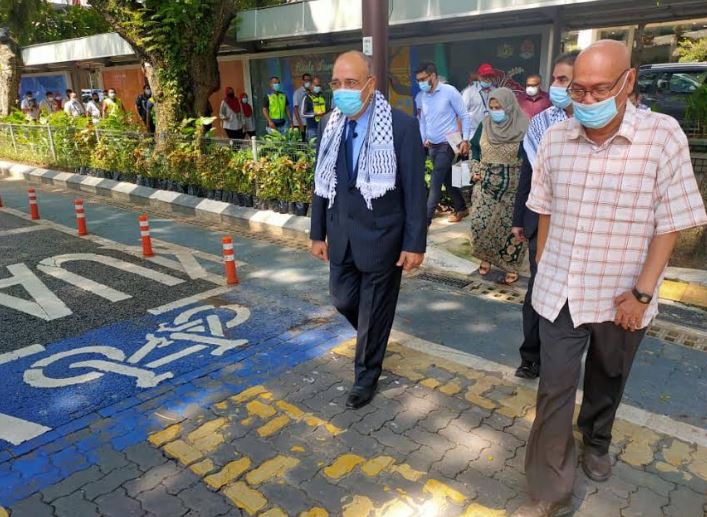
Street of Palestine “Jalan Palestine” inaugurated in Kuala Lumpur

KUALA LUMPUR, SEPT 26 (DNA) – The Mayor of Kuala Lumpur and Ambassador of the state of Palestine, Walid Abu Ali officially inaugurated the Street of Palestine “Jalan Palestine” in the heart of the city centre of Kuala Lumpur, on Saturday.

24

This initiative assures and extends the bilateral relations between the two brotherly nations and affirms on Malaysia and the Malaysian’s support to Palestine and its people. DNA

=========

Mahmoud Abbas thanks PM Khan for presenting legitimate demands of Palestine at UNGA

ISLAMABAD, SEPT 26 (DNA) President of Palestine, Mahmoud Abbas thanked to the Prime Minister of Pakistan Imran Khan for showing his support for establishment of an Independent State of Palestine at UNGA.

President of Palestine said All regards and respect to your Excellency for giving comprehensive, speech to the UN General Assembly session, where you truly presented the legitimate demands of Palestine and its people to the International World.

On behalf of the Government of Palestine and its people I heartily thank Your Excellency for your great stance towards establishment of an Independent State of Palestine with Jerusalem Al-Quds as its capital.

We Palestinians always receive great support from Government and people of Pakistan on all the forums of the World, we are proud of having such support for Palestine. DNA

==========

Statement of PM Imran Khan to 75th Session of the UN General Assembly

Mr. President,
Secretary General Guterres,
Excellencies,
Ladies and Gentlemen,

I am honoured to address the United Nations General Assembly once again. I congratulate His Excellency Mr. Volkan Bozkir on his election as the President of the seventy-fifth session of the General Assembly.

We also appreciate the skilful leadership of the outgoing President, His Excellency Tijani Muhammad-Bande, especially during the COVID-19 crisis.

We commend the leadership of the Secretary General in these extremely turbulent times.

Mr. President,

Since my government assumed office, our consistent effort has been to fundamentally transform Pakistan.

We envisage ‘Naya Pakistan’ to be modeled on the principles of the State of Madinah, established by our Holy Prophet Muhammad (P.B.U.H).

A just and humane society where all Government policies are directed at lifting our citizens out of poverty and creating a just and equitable dispensation.

To achieve this goal, we need to have peace and stability. Thus our foreign policy aims to have peace with our neighbours and settle disputes through dialogue.

Mr. President,

The 75th Anniversary of the United Nations is an extremely important milestone as this is the only body in the world that can help us achieve our goals of peace and stability in our neighbourhood. This is also a time for us to reflect whether as the United Nations we have been able to realize the promise we collectively made to our peoples.

Today, the foundations of the ‘world order’– non-use of or threat of unilateral force, self-determination of peoples, the sovereign equality and territorial integrity of States, non-interference in their internal affairs, international cooperation – all these ideals are being systematically eroded.

International agreements are being flouted and set aside.

Renewed great-power rivalries are leading to a new arms race.

Conflicts are proliferating and intensifying.

Military occupation and illegal annexations are suppressing the rights of human beings to self-determination.

According to respected Professor Noam Chomsky, mankind is at even a greater risk than it was before the 1st and 2nd World Wars in the last century, and this is because of the increased threat of nuclear war, Climate Change, and sadly the rise of authoritarian regimes. We must come together to prevent such a catastrophe.

We believe that the driving force in international relations must be cooperation, in accordance with the principles of international law, and not confrontation and force.

We all must emphatically reaffirm our support for multilateralism.

Mr. President,

The COVID-19 pandemic has illustrated the oneness of humanity. In our interconnected world, no one is safe unless everyone is safe.

Locking down to control the pandemic has triggered the worst recession since the Great Depression in the last Century. This has hit the poorest countries the hardest as well as the poor in all the countries.

In Pakistan, we realized very early on that if we imposed a strict lockdown, the type that several affluent countries had imposed, we would have more people dying of hunger than the virus.
Therefore, we adopted a policy of ‘smart lockdown.’ While concentrating on the virus hot-spots we opened up our agricultural sector immediately and then followed it up by the construction sector, which employed most of the people.

At the same time, and this is despite financial constraints, my government deployed an unprecedented 8 billion dollars for our health services; plus support the poorest and most vulnerable households with direct cash payments through Ehsaas programme; and then subsidies to the small businesses.

Even though our ‘smart lockdown’ was heavily criticized in the beginning, but thanks to Almighty Allah’s Grace, we have not only managed to control the virus, stabilize our economy, but most importantly, we have been able to protect the poorest segment of the society from the worst fall out of the lock down.

Today, Pakistan’s response is cited among the success stories in controlling and responding to the pandemic. However, we are still not out of the woods, like no country is out of the woods today.

Mr. President,

It was obvious from the outset that developing countries would need fiscal space to respond to, and recover from, the COVID crisis.

Debt relief is one of the best ways to create that fiscal space for developing countries. Therefore, in early April, I called for a “Global Initiative on Debt Relief”.

We appreciate the G-20’s official debt suspension initiative and the emergency and rapid financing offered by the IMF, World Bank, Asian Development Bank and UN Agencies.

This, however, is not going to be enough.

The IMF has estimated that developing countries will need over US$ 2.5 trillion to respond and recover from the crisis.

The official debt suspension will need to be extended and expanded. Additional debt relief measures will also be needed.

Development Banks should ensure adequate financial inflows.

Rich countries have generated over ten trillion dollars to finance their own response and recovery. They should support the creation of at least US$500 billion in new Special Drawing Rights for the developing world.

Mr. President,

In my address to the General Assembly last year, I had highlighted the tremendous damage that illicit financial flows from developing countries to rich countries and to offshore tax havens cause. This leads to the impoverishment of the developing nations. Money that could be used towards human development is siphoned off by corrupt elites. The loss of foreign exchange causes currency depreciation that in turn leads to inflation and poverty.

The quest for getting back these stolen resources is nearly impossible, given the cumbersome procedures. Moreover, the powerful money launderers have access to the best lawyers. And sadly, because they are the beneficiaries, there is a lack of political will in the rich countries to curb this criminal activity.

Mr. President,

If this phenomena is unaddressed, it will continue to accentuate the inequality between the rich and the poor nations, and eventually will spark off a far bigger global crisis than the present migration issue poses.

The rich states cannot hold forth on human rights and justice when they provide sanctuary to money launderers’ and their looted wealth.

There are robust anti-Money Laundering and anti-Terrorist Financing regimes. I call upon this Assembly to take the lead in efforts to build a global framework to stem the illicit financial flows and ensure speedy repatriation of stolen wealth.

It is important to realize that the aid that flows from rich countries to the developing world is miniscule compared to the massive out-flows by our corrupt elites.

Stay Connected

64FansLike
60FollowersFollow

Latest Reviews

Exchange Rates

USD - United States Dollar
EUR
1.17
GBP
1.35
AUD
0.67
CAD
0.73