Home Blog Page 2981

Pakistani students take online Chinese proficiency test

DNA

BEIJING, Sept. 26  – Sichuan Normal University (SICNU), China held the first online Hanyu Shuiping Kaoshi (HSK or Chinese Proficiency Test) amid the COVID-19 outbreak for international students to pursue their research dreams.

As per Liu Tianhao, a Pakistani student form SICNU, the Chinese Proficiency Test empowered him to explore China. “Mastering local languages will enrich your experience in foreign countries,” he told Gwadar Pro.

“Each language is beautiful with its history and content, so are Urdu and Chinese,” he added.

According to SICNU, while doing a good job in epidemic prevention and control, they spare no efforts in the normalization of HSK.

“We take HSK as an opportunity to vigorously develop international students’ education at all levels, so as to create a new landscape in international Chinese education,” said the source from SICNU.

The candidates of this online HSK are from Pakistan, Austria, Russia, South Korea, Laos, the United States, Japan, Singapore and some other countries, SICNU noted.

Most of the examinees are from colleges and universities in Sichuan, China; a small number of social examinees are from the Consulate General of Singapore in Chengdu, a well-known foreign enterprise, etc.

HSK, translated as the Chinese Proficiency Test used in China, is the standardized test of Standard Chinese (a type of Mandarin Chinese) language proficiency of China for non-native speakers such as foreign students and overseas Chinese.

The test is administered by Hanban, an agency of the Ministry of Education of the People’s Republic of China.

FATF urged to put India on grey list till the investigation of money laundering of 44 Indian Banks

DNA

ISLAMABAD, SEPT 26 – FPCCI’s Businessmen Panel on Saturday demanded that the Financial Action Task Force (FATF) must investigate the money laundering element from 44 Indian banks and put India on grey list till the conclusion.

As 1.53 billion dollars amount were transferred in over 3000 transactions.Secretary General (Federal) of the Businessmen Panel, Ch. Ahmad Jawad said India always made troubles for Pakistan with baseless propaganda, now it’s time for world community to take action on the account of these transactions which is great concern for us , might be this money used against Pakistan instability.

According the details, Data obtained by the International Consortium of Investigative Journalism (ICIJ) from suspicious activity reports (SAR) filed by American banks reveal that 44 Indian banks – public, private and foreign – were flagged for these transactions. These could relate to activities such as money laundering, terrorism and drugs.

Documents also show that Indian banks are listed in SAR related to over 2,000 transactions valued at over $1 billion between 2011 and 2017. These include several hundred transactions related to Indian entities and businessmen where the Indian shippers or recipients have addresses in foreign jurisdictions.He said FATF’s recommendations and rules should also be followed equally in India.

Far from it, an accountable, dynamic, transparent, and well-regulated financial architecture driven by the rule of law and financial professionalism.Jawad also said India has been continuously trying to destabilize Pakistan to divert attention from its own internal chaos. 

he said India is interfering in Balochistan province of Pakistan at the same time it is also adversely affecting peace efforts in Afghanistan.India always wants incidents of terrorism to divert world attention. He said it is India, which orchestrated the drama of Pulwama attack. He also urged the Pakistani importers  to make necessary scarification before placing orders to indian buyers.

Regarding PM speech at UNGA, he referred to the prime minister’s address as ‘strong’ and ‘hard-hitting’. From Kashmir to Palestine. From the economic woes arising from money laundered and stashed in developed states to the need for a global response to mitigate the economic issues arising from Covid-19 and climate change. DNA

===========

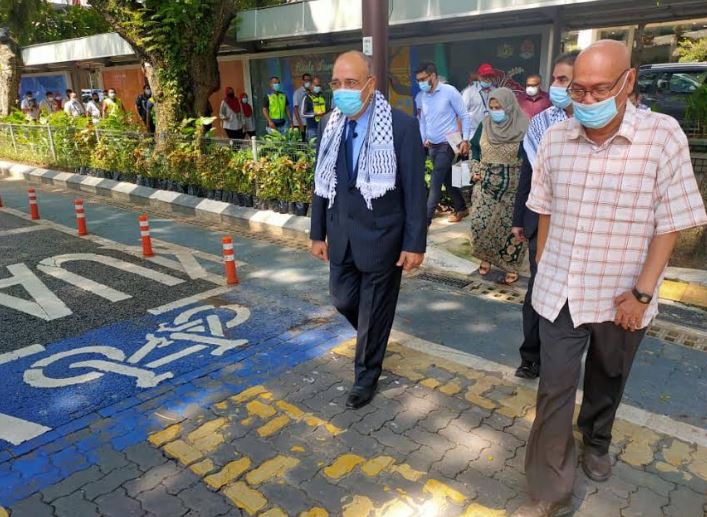
Street of Palestine “Jalan Palestine” inaugurated in Kuala Lumpur

KUALA LUMPUR, SEPT 26 (DNA) – The Mayor of Kuala Lumpur and Ambassador of the state of Palestine, Walid Abu Ali officially inaugurated the Street of Palestine “Jalan Palestine” in the heart of the city centre of Kuala Lumpur, on Saturday.

24

This initiative assures and extends the bilateral relations between the two brotherly nations and affirms on Malaysia and the Malaysian’s support to Palestine and its people. DNA

=========

Mahmoud Abbas thanks PM Khan for presenting legitimate demands of Palestine at UNGA

ISLAMABAD, SEPT 26 (DNA) President of Palestine, Mahmoud Abbas thanked to the Prime Minister of Pakistan Imran Khan for showing his support for establishment of an Independent State of Palestine at UNGA.

President of Palestine said All regards and respect to your Excellency for giving comprehensive, speech to the UN General Assembly session, where you truly presented the legitimate demands of Palestine and its people to the International World.

On behalf of the Government of Palestine and its people I heartily thank Your Excellency for your great stance towards establishment of an Independent State of Palestine with Jerusalem Al-Quds as its capital.

We Palestinians always receive great support from Government and people of Pakistan on all the forums of the World, we are proud of having such support for Palestine. DNA

==========

Statement of PM Imran Khan to 75th Session of the UN General Assembly

Mr. President,
Secretary General Guterres,
Excellencies,
Ladies and Gentlemen,

I am honoured to address the United Nations General Assembly once again. I congratulate His Excellency Mr. Volkan Bozkir on his election as the President of the seventy-fifth session of the General Assembly.

We also appreciate the skilful leadership of the outgoing President, His Excellency Tijani Muhammad-Bande, especially during the COVID-19 crisis.

We commend the leadership of the Secretary General in these extremely turbulent times.

Mr. President,

Since my government assumed office, our consistent effort has been to fundamentally transform Pakistan.

We envisage ‘Naya Pakistan’ to be modeled on the principles of the State of Madinah, established by our Holy Prophet Muhammad (P.B.U.H).

A just and humane society where all Government policies are directed at lifting our citizens out of poverty and creating a just and equitable dispensation.

To achieve this goal, we need to have peace and stability. Thus our foreign policy aims to have peace with our neighbours and settle disputes through dialogue.

Mr. President,

The 75th Anniversary of the United Nations is an extremely important milestone as this is the only body in the world that can help us achieve our goals of peace and stability in our neighbourhood. This is also a time for us to reflect whether as the United Nations we have been able to realize the promise we collectively made to our peoples.

Today, the foundations of the ‘world order’– non-use of or threat of unilateral force, self-determination of peoples, the sovereign equality and territorial integrity of States, non-interference in their internal affairs, international cooperation – all these ideals are being systematically eroded.

International agreements are being flouted and set aside.

Renewed great-power rivalries are leading to a new arms race.

Conflicts are proliferating and intensifying.

Military occupation and illegal annexations are suppressing the rights of human beings to self-determination.

According to respected Professor Noam Chomsky, mankind is at even a greater risk than it was before the 1st and 2nd World Wars in the last century, and this is because of the increased threat of nuclear war, Climate Change, and sadly the rise of authoritarian regimes. We must come together to prevent such a catastrophe.

We believe that the driving force in international relations must be cooperation, in accordance with the principles of international law, and not confrontation and force.

We all must emphatically reaffirm our support for multilateralism.

Mr. President,

The COVID-19 pandemic has illustrated the oneness of humanity. In our interconnected world, no one is safe unless everyone is safe.

Locking down to control the pandemic has triggered the worst recession since the Great Depression in the last Century. This has hit the poorest countries the hardest as well as the poor in all the countries.

In Pakistan, we realized very early on that if we imposed a strict lockdown, the type that several affluent countries had imposed, we would have more people dying of hunger than the virus.
Therefore, we adopted a policy of ‘smart lockdown.’ While concentrating on the virus hot-spots we opened up our agricultural sector immediately and then followed it up by the construction sector, which employed most of the people.

At the same time, and this is despite financial constraints, my government deployed an unprecedented 8 billion dollars for our health services; plus support the poorest and most vulnerable households with direct cash payments through Ehsaas programme; and then subsidies to the small businesses.

Even though our ‘smart lockdown’ was heavily criticized in the beginning, but thanks to Almighty Allah’s Grace, we have not only managed to control the virus, stabilize our economy, but most importantly, we have been able to protect the poorest segment of the society from the worst fall out of the lock down.

Today, Pakistan’s response is cited among the success stories in controlling and responding to the pandemic. However, we are still not out of the woods, like no country is out of the woods today.

Mr. President,

It was obvious from the outset that developing countries would need fiscal space to respond to, and recover from, the COVID crisis.

Debt relief is one of the best ways to create that fiscal space for developing countries. Therefore, in early April, I called for a “Global Initiative on Debt Relief”.

We appreciate the G-20’s official debt suspension initiative and the emergency and rapid financing offered by the IMF, World Bank, Asian Development Bank and UN Agencies.

This, however, is not going to be enough.

The IMF has estimated that developing countries will need over US$ 2.5 trillion to respond and recover from the crisis.

The official debt suspension will need to be extended and expanded. Additional debt relief measures will also be needed.

Development Banks should ensure adequate financial inflows.

Rich countries have generated over ten trillion dollars to finance their own response and recovery. They should support the creation of at least US$500 billion in new Special Drawing Rights for the developing world.

Mr. President,

In my address to the General Assembly last year, I had highlighted the tremendous damage that illicit financial flows from developing countries to rich countries and to offshore tax havens cause. This leads to the impoverishment of the developing nations. Money that could be used towards human development is siphoned off by corrupt elites. The loss of foreign exchange causes currency depreciation that in turn leads to inflation and poverty.

The quest for getting back these stolen resources is nearly impossible, given the cumbersome procedures. Moreover, the powerful money launderers have access to the best lawyers. And sadly, because they are the beneficiaries, there is a lack of political will in the rich countries to curb this criminal activity.

Mr. President,

If this phenomena is unaddressed, it will continue to accentuate the inequality between the rich and the poor nations, and eventually will spark off a far bigger global crisis than the present migration issue poses.

The rich states cannot hold forth on human rights and justice when they provide sanctuary to money launderers’ and their looted wealth.

There are robust anti-Money Laundering and anti-Terrorist Financing regimes. I call upon this Assembly to take the lead in efforts to build a global framework to stem the illicit financial flows and ensure speedy repatriation of stolen wealth.

It is important to realize that the aid that flows from rich countries to the developing world is miniscule compared to the massive out-flows by our corrupt elites.

British HC Christian Turner visits Peshawar museum

PESHAWAR, SEP 25 (DNA) – British High Commissioner to Pakistan, Christian Turner visited Peshawar museum to explore beautifully preserved cultural treasures in Peshawar.

Christian Turner shared his video message via his Twitter handle, starting with Pashtu. He said that the UK is helping the Khyber Pakhtunkhwa government in various sectors. He appreciated the efforts of the provincial government to ensure women education and making them independent.

Last week, the United Kingdom’s (UK) credit financing agency, UK Export Finance (UKEF) has increased its financing limit to three times for British businesses looking to export to and invest in Pakistan to £1.5 billion, said British High Commissioner to Pakistan Dr. Christian Turner.

The high commissioner had met with the Adviser to Prime Minister on Commerce and Investment Abdul Razak Dawood on Friday to discuss trade ties and business potential between the two countries. =DNA

==================

Canadian food market offers exciting opportunities for Pakistani exporters

DNA

OTTAWA, SEPT 25 – Pakistan’s food growers and exporters must adapt to use of modern technology and agricultural practices and spend more on research and development to turn out new food varieties and enhance production and quality to target developed and sophisticated markets like Canada.

This was the consensus among the participants of a webinar arranged by the Consulate General of Pakistan Toronto under the auspices of the High Commission for Pakistan, Ottawa. The webinar moderated by Mr. Azhar Husain, Trade and Investment Counsellor of Pakistan to Toronto, focused on the food sector exports to Canada with a focus on market potential, strategy, regulatory requirements and challenges in the Canadian food market.

The participants including some big names from the food suppliers in Pakistan as well as Pakistani importers based in Canadian market, agreed that Canada was an emerging market for the Pakistani food exporters who could increase their presence there through better quality, packaging and labelling as well as proper branding, marketing, and networking with local distribution networks and mainstream food market in Canada.

Pakistan’s annual exports to Canada currently stand at US $ 340 million while the food exports have reached US $ 12.5 million, the second largest segment after textile products finding way in the Canadian market. In view of the Pakistani food exports to Canada mostly concentrated in rice, fruits and vegetables, spices and confectionaries, the webinar panelists suggested product diversification and product differentiation to create more space for the Pakistani products, particularly value-added products such as rice glucose, rice protein, sprouted rice flour, stabilized rice bran and pre-cooked (retort packed) rice. They also urged better understanding of local environment, custom duties, distribution channels, regulatory environment and challenges in the Canadian market to gain access to mainstream Canadian food market.

Addressing the webinar, Mr. Shahjahan Malik, chairman of Rice Exporters Association of Pakistan (REAF), Waheed Ahmed, chairman of All Pakistan Fruit & Vegetable Exporters, Importers and Merchants Association (PFVA) as well as Shahbaz Sheikh, Mian Mohsin Aziz and Faizan Ghori representing the food sector in Pakistan called for greater investment in the research and development for production of newer and better varieties of foot products to enhance the food basket available for export.

They noted that the Pakistani basmati rice despite its being slightly more expensive than some of the “blend-and-mix” varieties exported by its competitors, had fared better in many markets, particularly in the Gulf and the EU, in recent years for its better variety, powerful aroma, rich taste and above all its being completely free of the pesticides residues. On the other hand, rice varieties from Pakistan’s main competitor had been banned by the EU due to tricyclazole or pesticides residues. We should capitalize on this situation and approach the food authorities in countries such as Canada, to present and market our rice as “Free from Pesticide Residues” to connect with conscious consumers.

The participants called for networking with the mainstream market in Canada rather than focusing entirely on the ethnic and Pakistani consumers in large Canadian cities. They also favoured the idea of joint ventures and even acquisitions of Canadian brands as a long-term strategy for staying strong and relevant in the Canadian market.

Giving the local perspective, Shahab Hassan and Akib Majeed, two leading Pakistani food importers based in Canada, called for better understanding of food regulations and proper labelling both in English and French of Pakistani food products to make them popular in Canada. They said price competitiveness was also a key factor in determining and enhancing the position and popularity of our food products in the Canadian market.

Addressing the seminar, Mr. Abdul Hameed, Consul General of Pakistan in Toronto, thanked the panellists for appraising the Pakistani community of the huge potential of food sectors exports in the Canadian market and discussing other vital issues related to food security and climate change. Going forward, he said the use of new technologies, modern agriculture, greater research and development, better seed development, innovation, branding and consistency in quality were essential for developing the food sector on modern lines in Pakistan. He called for better linkages between the academia and the industry to harmonise efforts in the research and development in the food and agriculture sector in Pakistan. He called on the Pakistani exporters to expand product base and venture in value-added products in close coordination with local importers and distributors.

Earlier, Mr. Shahbaz Malik, Deputy High Commissioner for Pakistan, Ottawa, lauded the Consulate General of Pakistan and the participants of the webinar for a fruitful discussion. He said the Consulate and the High Commission for Pakistan would continue providing similar platforms in coming days for close communication and coordination among Pakistani exporters and local importers and distributors to explore possible emerging sectors in the local food market.

Mushahid Hussain praises UN support for Kashmir cause

DNA

ISLAMABAD, SEPT 25 – The Chairman of the Senate Foreign Affairs Committee, Senator Mushahid Hussain has said that there are no political differences and divergences on Kashmir cause; the entire political spectrum shares the same line and passion to address this issue and ensure protection of fundamental rights of people of Indian Occupied Jammu and Kashmir he made these remarks during the Senate foreign Affairs Committee meeting held at the parliament House which was briefed by the Federal Minister for Human Rights, Dr. Shireen M Mazari and Mr. Omar Waraich, Head of Amnesty International for South Asia Senator Mushahid Hussain said that Pakistan has become the center point of strategic issues which is an important window of opportunity given the fact that our strategic move have compelled India to take defense position at various international fronts.

He acknowledged that support to the Kashmir cause by the United Nation Secretary General and United General Assembly President during their to visit to Pakistan and letter from 14 US Senators demanding sanctions on India are successful interventions steered by Pakistan.

Dr. Shireen M Mazari, briefed the Committee on Human Rights Diplomacy; Challenges and opportunities for Pakistan.  She highlighted that notion of diplomacy has been changed; war has been replaced by ‘hybrid warfare’. No State is sovereign per se as they have voluntarily chipped away their sovereignty by agreeing to international agreements to govern their interstate relations in a growing number of fields.

The Human Rights Diplomacy stresses the need to identify four main actors including States, Inter-Governmental Organizations (e.g. U.N., QAS, NATO, etc.) NGOs and   European Union (EU). Pakistan should utilize this evolving concept of Human Rights Diplomacy for highlighting the human rights violations in the Indian Occupied Jammu & Kashmir (IOJ&K); the interventions can include,- lobbying with the EU and its Member States for revocation of the India’s Generalized Scheme of Preferences (GSP)Standard Status, imposition of sanctions on India in line with EU’s Directorate General for External Policies’ guidelines, 2015. Pakistan has to move proactively on multiple international forums in a coordinated manner; advisory opinion of ICJ on the matter would be a viable way forward. Mr. Omar Warraich, Head of Amnesty International briefed the Committee on the role of Amnesty International in promoting Kashmir cause.

He informed that Amnesty international works in IOJ&K and in reviewing the human rights violations with grave concern. In this regard several reports have been issued highlighting the atrocities and human rights violations. Mr. Abdul Hameed Loan from All Parties Hurriyat Conference was also present in the briefing.

The Committee also examined the matter of amount contributed by Pakistan so far towards financing of South Asian University (SAU) established by SAARC countries, which was raised by  Senator Nuzhat Sadiq, life threats/ extortion demands received by Senator Hilal ur Rehman from banned TTM (Jamat ul Ahrar) operating from Afghanistan, issuance of Notice by FBR to the Ambassador of Palestine. With regard to the observance of quota in posting of non-career diplomats aborad, the Committee asked Senator Dr, Shahzad Waseem, Leader of the House to take up the matter with the Prime Minister to consider giving adequate representation to people from Balochistan in said postings especially in Europe.

The Committee also considered the Public Petition Mr. Abdullah regarding release of his mother from UAE jail. The Committee noted with satisfaction that Mrs. Gul Bahar Begum mother of Abdullah has already travelled to Pakistan on 24th February 2020, which has also been confirmed via telephone by his son. Public petition by Mr. Zubair Khan for transfer to prison in Pakistan from Chian on medical grounds, the Ministry informed that transfer of sentenced persons between Pakistan and China was signed in November, 2018. Currently ratification of the treaty is under process.

Once ratification is completed by both sides, the implementation of Treaty will start. Regarding Repatriation of Pakistani Juvenile prisoner namely Naseeb Ullah, a juvenile  from India, it was informed that Pakistan High Commission in New Delhi is vigorously pursuing the matter of his release at the earliest. The High Commission for Pakistan in New Delhi is making every effort for early release and repatriation of all Pakistani prisoners detained in Indian jails.

The meeting was attended by Senators Abdul Rehman Malik, Anwaar-ul-Haq Kakar, Atta Ur Rehman, Dr. Asif Kirmani, Dr. Shahzad Waseem, Muhammad Javed Abbasi, Nuzhat Sadiq, Seemee Ezdi, Sherry Rehman, Sitara Ayaz, Hilal ur Rehman, Dr. Shireen M Mazari, Minister for Human Rights, Omar Waraich, Head of Amnesty International for South Asia and senior officials from the Foreign Office.

UN picks Hadiqa Bahsir as 17 member in global cohort of young leaders

DNA

SWAT, SEPT 25 – Eighteen year old human rights activist Hadiqa Bahsir from Swat was selected as one of the 17 members in global cohort of young leaders on sustainable development goals by United Nations. The UN recognises 17 young changemakers, who are leading efforts to combat the world’s most pressing issues and whose leadership is catalyzing the achievement of the SDGs on a biennial basis.

These young leaders aging between 18 and 29 years old represent the diverse voices of young people from every region of the world and are collectively responsible for activating millions of young people in support of the SDGs.Hadiqa Bashir was born in 2002 in iftikhar’s home at saidu sharif swat, she was working on the issue to end child marriages concept in Pakistan since 2013.

”During my efforts I successfully abandoned 7 early marriages at different localities at Swat , she said. When I started work on the issue mostly people I met hasn’t proper awareness and had poverty issues which compels parents to sell their children or allow girl’s in minor age, she added.

Hadiqa said that at marghazar area of Swat she provided financial support to one a family who are going to arrange marriage of her child in early stage due to poverty, we formalise strategy that how can we assist the family financially to end this early marriage.

She further went on saying that at many areas of her home town where mostly women’s were facimg harassment issues in public streets due to lack of proper lighting arrangement after which she started efforts and ensures street lights in each and every streets.

Talking to this Correspondent bashir’s father’s Iftikhar Hussain said that we are very happy for her nomination, I will support my daughter at every stage and forum, she will be role model for other girls in the entire region. Answering to a questions Hussain told that my daughter is visionary and confident, the day is not far when she will emerged successful in her mission,he added.

Stay Connected

64FansLike
60FollowersFollow

Latest Reviews

Exchange Rates

USD - United States Dollar
EUR
1.17
GBP
1.34
AUD
0.67
CAD
0.73