Home Blog Page 2926

Algerian president dissolves lower house of parliament amid calls for protests

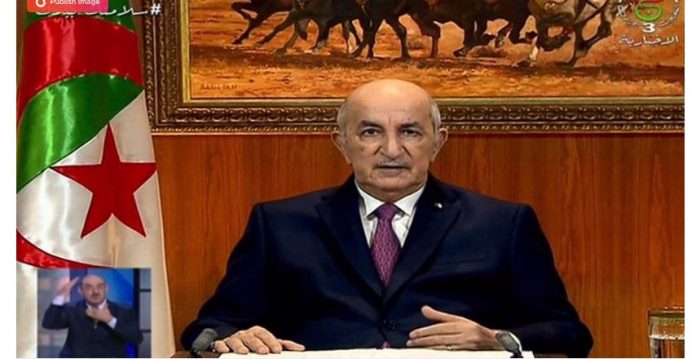
Algerian President Abdelmadjid Tebboune has dissolved the lower house of parliament and called for snap legislative elections as activists have launched a campaign to mobilize the street again against authorities.

“I decided to dissolve the assembly and call elections to build a new institution,” Tebboune said in a televised address to the nation, without giving a date for the vote.

The five-year lower house of parliament was formed after the May 2017 election which saw allies of deposed President Abdelaziz Bouteflika winning a clear majority.

Tebboune described the dissolution of the parliament as part of reforms after voters approved amendments to the constitution aimed at giving parliament more powers in November last year.

He also announced that a government reshuffle would take place “within 48 hours at most”, and ordered the release of about 60 detainees of the “Hirak” protest movement that ousted his predecessor, Bouteflika, in 2019.

The release of protesters, who have been in detention since the protests broke out on February 22, has been one of the major demands of the Hirak.

“We have vowed to meet all demands raised by the Hirak,” Tebboune said in the speech.

His speech comes amid calls on social media to stage street marches to mark the second anniversary of the demonstrations.

The Arab Weekly reported that opposition activists launched a large campaign on social media to turn the movement’s second anniversary into a launchpad for a new wave of anti-regime protests.

The new announcements are seen as an attempt to appease protesters.

Thousands of people staged a protest in the town of Kherrata, the cradle of the Hirak, on Tuesday to mark the second anniversary of the movement, defying coronavirus restrictions.

They chanted “President Tebboune is a forger brought in by the army” and “the generals in the trash.”

The protesters called for “a civilian, not military state,” “the release of detainees” and “the exit of the authorities and the generals,” bringing back memories of the political protests that swept Algeria between 2019 and 2020 before the government banned marches in March last year as part of measures to curb the spread of the coronavirus.

Tebboune, once a prime minister under Bouteflika, was elected in December 2019 amid protests demanding the removal of the whole ruling elite, with many people boycotting the vote as they saw it as unfair and not transparent.

Ambassador of Qatar lauds excellent performance of NAB

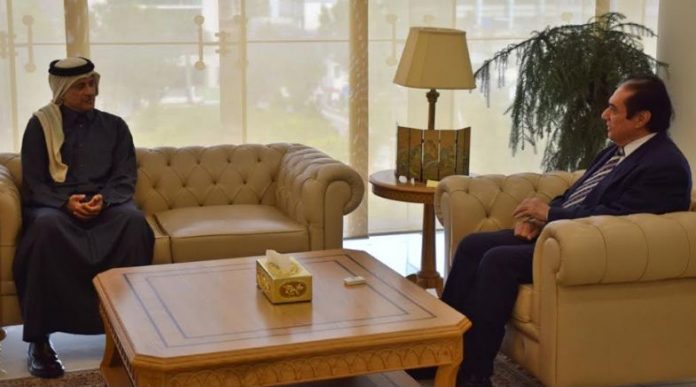
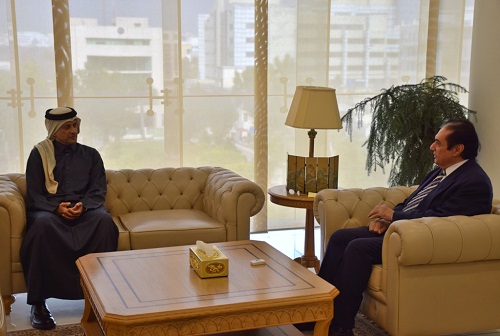
ISLAMABAD, FEB 19 (DNA) – Sheikh Saoud Abdulrahman Al-Thani, The Ambassador of the State of Qatar to the Islamic Republic Pakistan called on Justice (RETD) Javed Iqbal, Chairman National Accountability Bureau (NAB) at NAB Headquarters here today and discussed the possibility of execution of Memorandum of Understanding (MOU) between Qatar and Pakistan.

It was agreed that the draft Memorandum of Understanding (MOU) be made available to H.E. Sheikh Saoud Abdulrahman Al-Thani, The Ambassador of the State of Qatar to the Islamic Republic Pakistan through proper channel for necessary action.

It was also assured by H.E. Sheikh Saoud Abdulrahman Al-Thani, The Ambassador of the State of Qatar to the Islamic Republic Pakistan that every possible help will be rendered to Pakistan Anti Corruption Academy (PACA).

It was further assured that the facility of training of NAB Officers/Officials will be considered in the main institutions of Qatar i.e: Rule of Law and Anti Corruption Center, Qatar.

Mr. Justice Javed Iqbal, Chairman, National Accountability Bureau appreciated the efforts being made by H.E. Sheikh Saoud Abdulrahman Al-Thani, The Ambassador of the State of Qatar to the Islamic Republic Pakistan to make the ties more stronger between Qatar and Pakistan. Honorable Mr. Justice Javed Iqbal, Chairman, National Accountability Bureau Chairman NAB apprised H.E. Sheikh Saoud Abdulrahman Al-Thani, The Ambassador of the State of Qatar to the Islamic Republic Pakistan about NAB’s National Anti Corruption Strategy in order to eradicate corruption from Pakistan and remarkable efforts to nab the corrupt elements and to recover looted money and deposit it in national exchequer as per law.

NAB during the present management of NAB has recovered Rs. 487 billion from 2018 to 2020 which is a remarkable achievement as compared to other anti corruption organizations with an overall conviction ratio of 68.8 percent. NAB is the focal organization of Pakistan under United Nations Convention against Corruption (UNCAC) as Pakistan has ratified and is signatory of UNCAC.

NAB is the chairman of SAARC Anti Corruption Forum. This was the recognition of NAB’s excellent work as NAB is considered as a role model among SAARC countries.

NAB’s anti corruption efforts have been acknowledged by the World Economic Forum, Transparency International Pakistan, Global Peace Canada, Mishal Pakistan and PILDAT. As per Gillani and Gallup survey, 59 percent people have shown trust upon NAB which gives NAB encouragement.

H.E. Sheikh Saoud Abdulrahman Al-Thani, The Ambassador of the State of Qatar to the Islamic Republic Pakistan lauded NAB’s excellent performance under the dynamic leadership of Honorable Mr. Justice Javed Iqbal, Chairman National Accountability Bureau (NAB) in order to make Pakistan corruption free considering it as our national duty through concerted efforts to eradicate corruption from Pakistan.=DNA

====================

FO’s apathy towards vaccination of diplomats

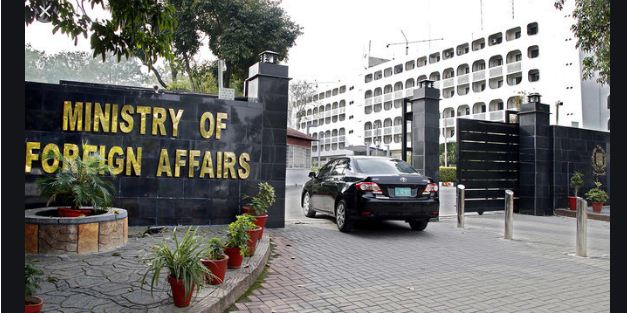
The Ministry of Foreign Affairs was supposed to communicate with the Diplomatic Corps and brief it about updates, if any, however Foreign Office’s silence has further added to the woes of the diplomatic corps

Ansar Mahmood Bhatti

ISLAMABAD: As COVID 19 pandemic continues to take a heavy toll on all and sundry, the diplomatic community especially is worried about its well-being. It is still not clear to the community as to when it will get vaccination.

The Ministry of Foreign Affairs was supposed to communicate with the Diplomatic Corps and brief it about updates, if any, however, Foreign Office’s silence has further added to the woes of the diplomatic corps.

Even on Thursday, the Foreign Office spokesperson Zahid Hafeez did not make any mention as to when the Ministry of Foreign Affairs shall update the missions about administration of vaccine.

A few weeks ago, when Foreign Minister Shah Mahmood Qureshi interacted with the ambassadors and high commissioners of various countries to brief them about the Kashmir issue, some ambassadors raised this issue with the Foreign Minister nevertheless Minister Qureshi, as reports suggest, did not pay any heed to the question.

A few foreign missions including the Embassy of United Arab Emirates have administered vaccination to their staff on their own. The UAE Embassy arranged vaccine doses through its own Ministry of Foreign Affairs.

Likewise, reports suggest Embassies of the United States of America and United Kingdom have also vaccinated their staff members, while a few other missions are in the process of getting vaccines through their own sources.

The lack of interest on the part of the Ministry of Foreign Affairs of Pakistan has literally left the diplomats in the lurch. In such a situation the Dean of the Diplomatic Corps should have taken the lead by raising the issue with the Ministry of Foreign Affairs but unfortunately the Dean of Diplomatic Corps is yet to act on this particular issue.

The primary responsibility nevertheless rests with the Pakistan government and Ministry of Foreign Affairs to address this issue as soon as possible because it involves the reputation and image of the country.

It may be mentioned here that Pakistani missions abroad have been facilitated by the respective governments in provision and administration of vaccines. Diplomats based in Pakistan expect similar arrangements here as well.

Visit of Ambassador Zamir Kabulov, Russian Presidential Envoy for Afghanistan

Islamabad,19 February 2021 : Russian Presidential Envoy for Afghanistan, Ambassador Zamir Kabulov, is visiting Islamabad for a one-day visit, today.

During the visit, Ambassador Kabulov will call on the Foreign Minister and meet with Special Representative for Afghanistan and other dignitaries for exchange of views on the latest developments in the Afghan peace process.

The visit of Ambassador Kabulov is part of Pakistan’s diplomatic outreach in support of the Afghan peace process. Besides the exchange of views on the Afghan peace process, the visit will contribute to further strengthening Pakistan-Russia bilateral cooperation.

Romanian celebrates Constantin Brancusi Day

On 19th February in Romania is celebrated ”Brancusi Day” as a national holiday in honor of Constantin Brancusi, one of the most influential sculptors of the 20th-century and a pioneer of modernism, called also ”the patriarch of modern sculpture”.

This year is celebrated 145 years since Constantin Brancusi was born in Hobita (Romania), on 19th February 1876. A passionate wood-carver, he produced numerous wood sculptures, often with a folk flavour, and he frequently carved prototypes for works later executed in other materials. He is best known for his abstract sculptures of ovoid heads and birds in flight.

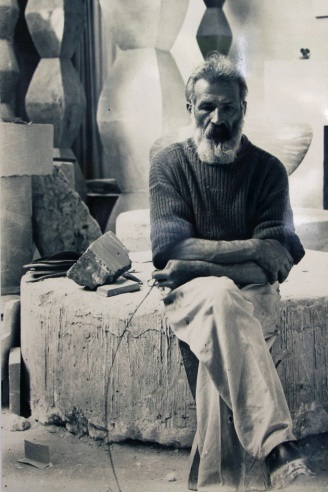
Constantin Brancusi in his studio

Formal studies took him toCraiova School of Arts and Crafts, where he pursued his love for woodworking, graduating with honors in 1898 and then to Bucharest School of Fine Arts, where he received academic training in sculpture. He worked hard, and quickly distinguished himself as talented. He continued his studies in Munich, and École des Beaux-Arts in Parisand was invited to enter the workshop of Auguste Rodin. Even though he admired the eminent Rodin he left the Rodin studio after only two months, saying, “Nothing can grow under big trees”. He continued

2

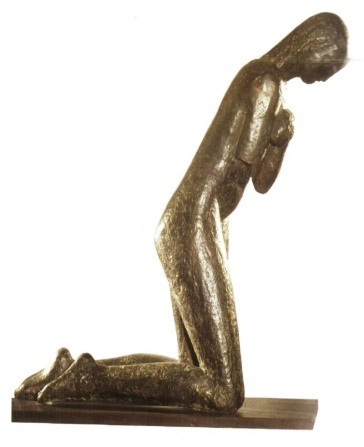
After leaving Rodin’s workshop, Brâncuși began developing the revolutionary style for which he is known. His first commissioned work, The Prayer, was part of a gravestone memorial.

It depicts a young woman crossing herself as she kneels, and marks the first step toward abstracted, non-literal representation, and shows his drive to depict “not the outer form but the idea, the essence of things.” He also began doing more carving, rather than the method popular with his contemporaries, that of modeling in clay or plaster which would be cast in metal, and by 1908 he worked almost exclusively by carving.

3

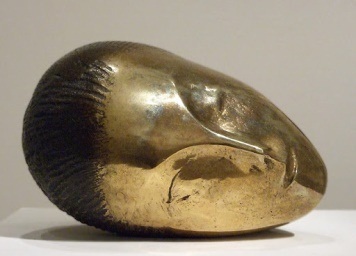
In the following few years he made many versions of Sleeping Muse  and The Kiss, further simplifying forms to geometrical and sparse objects.

His works became popular in France, Romania and the United States and in 1913 Brâncuși’s work was displayed at both the Salon des Indépendants and the first exhibition in the U.S. of modern art, the Armory Show.

One of his major groups of sculptures involved the Bird in Space — simple abstract shapes representing a bird in flight.

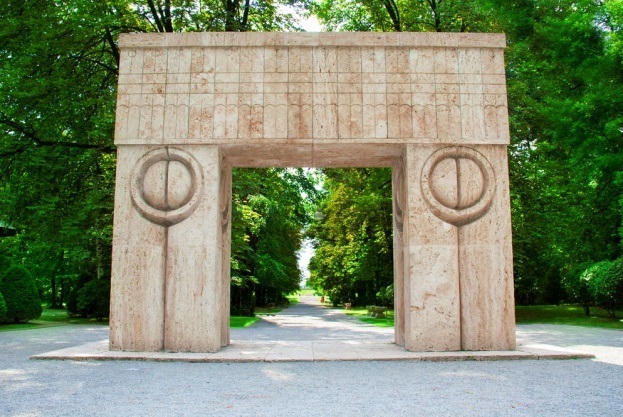
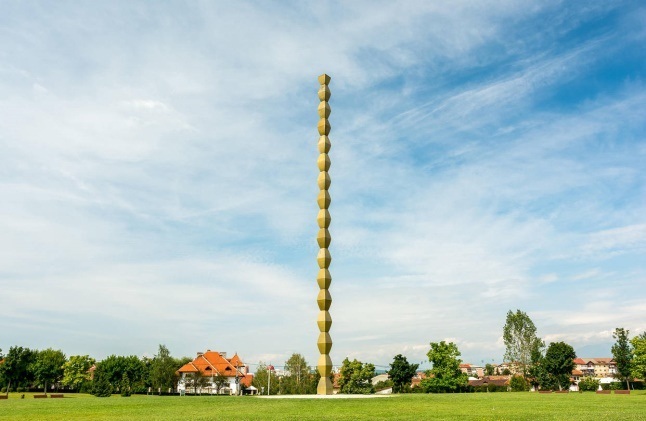
The works are based on his earlier Măiastra series.In Romanian folklore the Măiastra is a beautiful golden bird who foretells the future and cures the blind. In 1938, he finished the World War I monument in Târgu-Jiu (Romania) where he had spent much of his childhood. Table of SilenceThe Gate of the Kiss, and Endless Column commemorate the courage and sacrifice of Romanians who in 1916 defended Târgu Jiu from the forces of the Central Powers.

4

The Gate of The Kiss

5


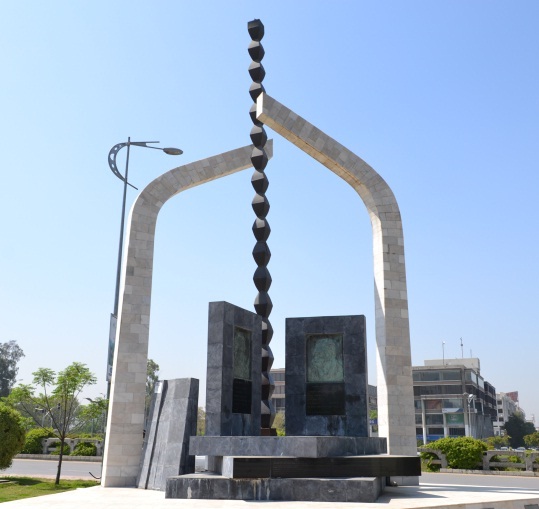
The Endless Column

Brâncuși spent most of his artist career in France and in 1952 he became a French citizen. He  died on March 16, 1957, aged 81. He was buried in the Cimetière du Montparnasse in Paris.

At his death Brâncuși left 1200 photographs and 215 sculptures. He bequeathed part of his collection to the French state on condition that his workshop be rebuilt as it was on the day he died. This reconstruction of his studio, adjacent to the Pompidou Centre, is open to the public nowadays.

Brâncuși was elected posthumously to the Romanian Academy in 1990.

Google commemorated his 135th birthday with a Doodle in 2011 consisting of seven of his works.

6

Brâncuși’s works are housed in the National Museum of Art of Romania (Bucharest), the Museum of Modern Art (New York) and other museums around the world. The Philadelphia Museum of Art holds the largest collection of Brâncuși sculptures in the United States.

A small copy of The Endless Column of Brancusi can be observed in the central part of Islamabad, to the Allama Iqbal – Mihai Eminescu Monument, a symbol of friendship between Romania and Pakistan.

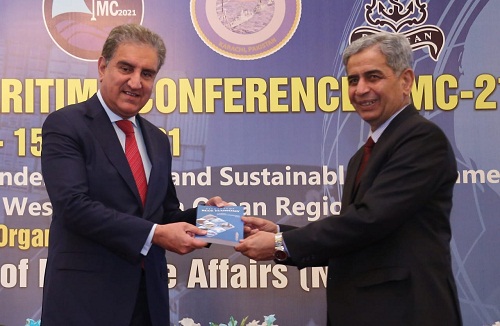
V/Admiral Iftikhar Ahmed Rao presenting his book to Pakistan’s Foreign Minister Makhdoom Shah Mehmood Qureshi

Karachi : V/Admiral Iftikhar Ahmed Rao presenting his book Elements of Blue Economy (recently published by IPS Press, the publishing arm of Institute of Policy Studies) to Pakistan’s Foreign Minister Makhdoom Shah Mehmood Qureshi and Chief of Naval Staff Admiral Muhammad Amjad Niazi in the concluding session of 9th International Maritime Conference held in Karachi from 13-15 February 2021 in the sidelines of Aman-2021 Naval Exercises participated by 45 navies from across the world.

Ambassador of Qatar called on Chairman NAB today on 19-2-21

????????????????????????????????????

Islamabad, Feb 19, 2021 : H.E. Sheikh Saoud Abdulrahman Al-Thani, The Ambassador of the State of Qatar to the Islamic Republic Pakistan called on Honorable Mr. Justice Javed Iqbal, Chairman National Accountability Bureau (NAB) at NAB Headquarters here today and discussed possibility of execution of Memorandum of Understanding (MOU) between Qatar and Pakistan. It was agreed that the draft Memorandum of Understanding (MOU) be made available to H.E. Sheikh Saoud Abdulrahman Al-Thani, The Ambassador of the State of Qatar to the Islamic Republic Pakistan through proper channel for necessary action. It was also assured by H.E. Sheikh Saoud Abdulrahman Al-Thani, The Ambassador of the State of Qatar to the Islamic Republic Pakistan that every possible help will be rendered to Pakistan Anti Corruption Academy (PACA). It was further assured that the facility of training of NAB Officers/Officials will be considered in the main institutions of Qatar i.e: Rule of Law and Anti Corruption Center, Qatar.

Honorable Mr. Justice Javed Iqbal, Chairman, National Accountability Bureau appreciated the efforts being made by H.E. Sheikh Saoud Abdulrahman Al-Thani, The Ambassador of the State of Qatar to the Islamic Republic Pakistan to make the ties more stronger between Qatar and Pakistan. Honorable Mr. Justice Javed Iqbal, Chairman, National Accountability Bureau Chairman NAB apprised H.E. Sheikh Saoud Abdulrahman Al-Thani, The Ambassador of the State of Qatar to the Islamic Republic Pakistan about NAB’s National Anti Corruption Strategy in order to eradicate corruption from Pakistan and remarkable efforts to nab the corrupt elements and to recover looted money and deposit it in national exchequer as per law. NAB during the present management of NAB has recovered Rs. 487 billion from 2018 to 2020 which is a remarkable achievement as compared to other anti corruption organizations with an overall conviction ratio of 68.8 percent. NAB is the focal organization of Pakistan under United Nations Convention against Corruption (UNCAC) as Pakistan has ratified and is signatory of UNCAC. NAB is the chairman of SAARC Anti Corruption Forum. This was the recognition of NAB’s excellent work as NAB is considered as a role model among SAARC countries. NAB’s anti corruption efforts have been acknowledged by the World Economic Forum, Transparency International Pakistan, Global Peace Canada, Mishal Pakistan and PILDAT. As per Gillani and Gallup survey, 59 percent people have shown trust upon NAB which gives NAB encouragement.

H.E. Sheikh Saoud Abdulrahman Al-Thani, The Ambassador of the State of Qatar to the Islamic Republic Pakistan lauded NAB’s excellent performance under the dynamic leadership of Honorable Mr. Justice Javed Iqbal, Chairman National Accountability Bureau (NAB) in order to make Pakistan corruption free considering it as our national duty through concerted efforts to eradicate corruption from Pakistan.

1,245 new cases, 40 Covid deaths reported in 24 hours

ISLAMABAD: Pakistan has recorded 40 more coronavirus-related deaths in past 24 hours, surging the overall death toll to 12,527.

According to the latest statistics of the National Command and Operation Centre (NCOC), the COVID-19 has claimed 40 more lives and 1,245 fresh infections were reported.The total count of active cases is 24,139.

In the past 24 hours, as many as 1,243 patients have recovered from the virus in a day and 1,626 patients are still in critical condition.

According to the National Command and Operation Centre (NCOC), with fresh inclusion of the infections in the country the national tally of cases now currently stands at 568,506.

A total of 34,754 tests were conducted across the country during this period. Overall 531,840 people have recovered from the deadly disease so far while 8,602,515 samples have been tested thus far.

Electoral legislation of Uzbekistan:

Effects of steadiness

Makhmud ISTAMOV

Exactly one year has passed since the Parliamentary and Local elections held in our country on the basis of the new legislation.

In a democratic state and society, it is paramount that the will of the people is respected above all else, without deviation.

Article 7 of the Constitution of the Republic of Uzbekistan stipulates that “the people are the sole source of state power” and Article 32 states that “Citizens of the Republic of Uzbekistan shall have the right to participate in the management of public and state affairs, both directly and through representatives”.

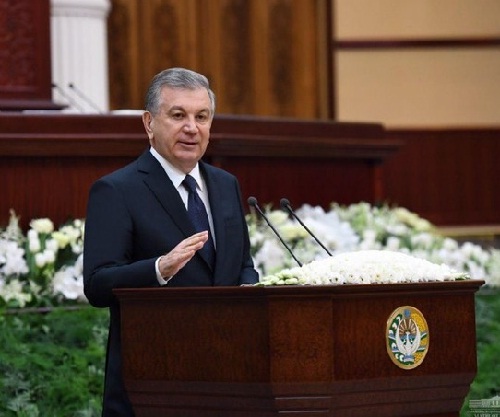
The President of the Republic of Uzbekistan.

These rights find their practical expression exactly in the elections. The dedication of a separate chapter in the Constitution to electoral issues has served as an important legal basis for the formation of the national electoral legislation of the country. At the same time, this constitutional provision is an important factor in the continuous improvement of electoral legislation in Uzbekistan.

From this point of view, if we focus on the changes that have taken place in the electoral legislation and practice in recent years, we can see a high degree of efficiency of the systematic reforms in the field of national elections. Over the past six years, Uzbekistan has held two parliamentary and two presidential elections.

The extensive practical and legal experience gained during these elections, as well as the recommendations made by both national and international observers, have played an important role in improving electoral legislation.

In 2014, amendments were introduced to Article 117 of the Constitution of the Republic of Uzbekistan, the Central Election Commission was granted constitutional status and guarantees of its formation and independent activity were established.

The independence of the CEC members is guaranteed by the fact that their term of office is not limited in time and they are elected by local representative bodies and parliament.

H.E. Mrs. Tanzila Narbaeva, the Chairperson of the Senate of the Oliy Majlis  (Parliament) of the Republic of Uzbekistan.

According to the Law of 2015 and presumption of innocence it was determined that polling stations should be set up in temporary detention places to ensure that persons under investigation and whose guilt is not established by legal order participate in the elections.

The number of signatures in support of presidential candidates has also been sharply reduced, based on international electoral standards. Specifically, the required number of signatures was reduced from five to one per cent of the total number of voters.

In 2019, on the initiative of President Shavkat Mirziyoyev, the adoption of a single and unified Election Code, which included five existing election laws and dozens of by-laws, created an important legal basis for raising the electoral practice to a high quality level.

The Parliament of the Republic of Uzbekistan.

The adoption of the Election Code allowed to systemize the norms of electoral legislation (codification), eliminate similar norms and unify this sphere of legislation.

The draft Code was subject to international legal examination by the Venice Commission and a conclusion was obtained. The Code has implemented a number of international election standards, as well as recommendations of the OSCE Office for Democratic Institutions and Human Rights (ODHIR). As a result, the Election Code has been enriched with a number of improvements.

These important changes include: allowing the participation in the elections of persons who have committed misdemeanors and crimes not constituting great social danger; abolishment of 15 reserved seats for Ecological Movement in the Legislative Chamber of the Oliy Majlis; participation in the observations of elections by the representatives of non-governmental non-profit organization – citizens’ self-government bodies; allowing voters to sign in support of one or more political parties or presidential candidates.

H.E. Mr.Nurdinjon Ismailov, the Speaker of the Legislative Chamber of the Oliy Majlis (Parliament) of the Republic of Uzbekistan.

Reforms in the electoral legislation and practice have been widely recognized not only by the participants of the electoral process, but also by the international community. This was also evident in the 2019 elections to the parliament and local Kengashes.

Specifically, the report of OSCE ODIHR’s full-fledged Election Observation Mission in connection with the 2019 parliamentary elections under the slogan “New Uzbekistan – New Elections” acknowledges a number of positive changes.

In particular, the Mission emphasizes in its report that “the elections took place under improved legislation and with greater tolerance of independent voices. There is more acceptance of free expression. The contesting parties presented their political platforms and the media hosted debates, many aired live. The Election Code incorporates several previous ODIHR recommendations and brings the legal framework closer in line with OSCE commitments and other international obligations and standards for democratic elections. The elections showed that the ongoing reforms need to continue”.

Undoubtedly, the updated electoral legislation of 2019, as well as the strengthening and widening environment of openness and transparency in our country, allowed the Central Election Commission to organize the parliamentary elections and raise it to a new, higher level.

H.E. Mr. Akmal Saidov, the First Deputy Speaker of the Legislative Chamber of the Oliy Majlis (Parliament) of the Republic of Uzbekistan

What are the systematic changes that are being steadily implemented?

The formation of a single electronic voter list to ensure the implementation of the principle of “one voter – one vote” has become a completely new practice in the national electoral system of Uzbekistan. The list includes information on more than the 20.5 million citizens of voting age and was used during the previous elections.

Political parties and candidates have been provided with more opportunities than ever before to hold pre-election meetings. The 26 TV debates they held were all broadcast live. All this contributed, for the first time in the history of modern Uzbekistan, to elections held in a true competitive environment.

The opportunity of all our compatriots living abroad to vote is another important change. At 55 polling stations established in 38 foreign countries, 112,411 citizens exercised their constitutional right to vote. In the previous elections, only registered citizens in the diplomatic missions of our country abroad could participate in the elections.

During the preparation for the elections, about 180,000 members of election commissions were trained in practical seminars.

One of the most important innovations in the national electoral system of Uzbekistan – for the first time in the history of our country persons who have committed misdemeanors and crimes not constituting a great social danger had the honor to vote. Thus 4,308 such individuals exercised their right to vote in the previous elections.

A mechanism for a rapid response to media, social networks and citizens reports of electoral violations has been created which also allowed appropriate legal action to be taken if necessary. Through this mechanism, the results of the elections of the local representative bodies in two constituencies were declared invalid and the process of repeat elections was used for the first time in the national electoral practice.

It should be noted that this is, first of all, a clear confirmation of changes in the socio-political environment of new Uzbekistan, the principles of democracy, openness and transparency are beginning to be implemented. The whole world is watching with interest as the reforms are being steadily implemented, which require great wisdom, patriotism, a huge devotion to national traditions and ideas of modern democracy and a strong political will.

The adoption and successful implementation of the Election Code was a major step towards further strengthening and improving our national electoral legislation, which was formed during the years of independence, and relied on our nearly thirty years of experience in conducting democratic elections.

For the first time, the Central Election Commission has developed analytical information on the parliamentary elections in 2019, which, along with the achievements in the organization of elections, reflected the shortcomings and problems, the measures to be taken.

Further improvement of our national electoral legislation, to bring it in line with universally recognized international standards is a continuous and ongoing process.

The recommendations of international organizations on the improvement of the electoral system will be taken into account and implemented in compliance with the ongoing structural reforms in our country, of course, based on the national traditions and unique cultural values of our people.

At the same time, the analysis of Uzbekistan’s scores in the World Democracy Index over the past six years in the “Electoral Process and Pluralism” category raises some concerns and we hope that our international partners will pay more attention to this issue.

For six years in a row from 2014 to 2019, the score of Uzbekistan was the same – 0.08 in the World Democracy Index “Electoral Process and Pluralism”. According to the criterion of “free and fair elections” of the Transformation Index, compiled by the Bertelsmann Foundation – 2.

However, we believe that the effective reforms implemented in the electoral system of Uzbekistan in 2019 alone will significantly improve these numbers. As noted, it would be considered fair if the next international rankings reflect the adoption of a single Election Code and the analytical reports of influential international organizations published in 2020.

Of course, the ultimate goal is not to improve the numbers in the rankings. The most important thing is to firmly establish democracy, which is steadily strengthening in new Uzbekistan, and to further improve the conditions that serve to expand the electoral rights of citizens.

On 5 February 2021 elected New Chairman of the Central Election Commission Zainiddin Nizamhodjaev

Makhmud ISTAMO is the Member, Central Election Commission of the Republic of Uzbekistan

Pakistan can prosper and progress by implementing faith unity and discipline

LAHORE Feb 18 (DNA) : President SAARC chamber of commerce and Industry and veteran trade leader Iftikhar Ali Malik on Thursday stressed the urgent need to implement the Quaid guiding motto of faith unity and discipline in true letter and spirit in every sphere of life that can make  Pakistan as one of the most powerful country in the comity of nation.

Addressing the 3-day concluding session of 13th national conference on “Nazria-I-Pakistan” held under aegis of Nazria Pakistan Trust,he said Quaid-e-Azam Muhammad Ali Jinnah, the founder of Pakistan gave  us three golden principles which he followed in his life  and got Pakistan. He said our success  will depend mainly on following Unity, Faith and Discipline. If we follow these principles in our individual, social and political life, we can make Pakistan very powerful. Unfortunately, we have not paid much attention to them.

Iftikhar Ali Malik said unity  gives a nation strength to face its enemies. Pakistan appeared on the map of the world on August 14, 1947 and this miracle was achieved through the unity of the Muslims. In Islam, all the Muslims are brethren to each other. He advised the people from all walks of life to be united in our work for the country.

He said Quaid-i-Azam united the Muslims of India into a disciplined organization and created unity among them.He said  no civilized society can exist and progress without discipline. In absence of discipline, our energies are scattered and we can make no progress he added.

Iftikhar Ali Malik said If we want to develop our country, we should be sure for what we are working. Nothing can be achieved without faith. Pakistan is the result of firm faith. Even now if we have faith in our religion, we can work wonders in a short time, to make Pakistan strong in all walks of life.

He said his illustrious father late Muhammad Shafi Malik Sitara-I-Imtiaz also  played role in creation of Pakistan and worked closely with the father of the nation. His father attended the most important historic  annual meeting of 27th all India Muslim League on March 23.1940 he concluded.

Stay Connected

64FansLike
60FollowersFollow

Latest Reviews

Exchange Rates

USD - United States Dollar
EUR
1.15
GBP
1.34
AUD
0.69
CAD
0.71