
Home Blog Page 2873

Balochistan Regulatory Reform Committee holds first meeting

DNA

QUETTA, NOV 24 – The first meeting of the Balochistan Regulatory Reform Committee (BRRC) was held today in Quetta. Formed with the support and technical assistance of the International Trade Centre (ITC) under the European Union funded Growth for Rural Advancement and Sustainable Progress (GRASP) project, the Planning and Development Department notified the constitution of Balochistan Regulatory Reform Committee (BRRC) on 8th September 2020.

Mr. Ghulam Farooq, Secretary Planning and Development Department, chaired the meeting attended by BRRC members, which included representatives from key provincial government departments, private sector organizations and academia. Secretary Livestock Mr. Tayyab Lahry expressed his interest in the project, and gave his valuable inputs on ways the committee could be mutually beneficial to the GRASP, government institutions, and SME’s in the province. Mr. Dawood Bazai, DG Small Industries, Mr. Imran, Additional Secretary Agriculture, representatives from Women Development Department, ITC GRASP staff and other key stakeholders from the agriculture and development sector also joined the event.

GRASP Deputy Coordinator Mr. Owais Khattak gave a detailed overview of the functions and purpose of BRRC. He explained that the objective of the BRRC is to advance policy dialogue among public sector, private sector and academia to take a holistic view of the regulatory environment and build consensus among the stakeholders for new laws and policies. Inter-Departmental coordination realized through BRRC will ensure that different laws and policies developed by different Departments of the government are mutually supportive.

Mr. Ghulam Farooq, Secretary Planning and Development Department while concluding the session acknowledged the efforts of all stakeholders and stated that establishment of this forum is a significant step for policy coherence. All key stakeholders are required to work in close liaison in regulatory reforms to address common challenges in the area of policy design and its implementation. A conducive regulatory regime and effective implementation of business-friendly policies are important prerequisites for the growth and sustainability of MSMEs and the competitiveness of the value chains, added Mr. Jahanzeb Khan, GRASP lead for Balochistan.

GRASP is a six-year project designed to reduce poverty in Pakistan by strengthening small-scale agribusinesses in Balochistan and Sindh, and is implemented with active participation from local partners. It will help small and medium-sized enterprises in horticulture and livestock become more competitive by making improvements at all levels of the value chain.
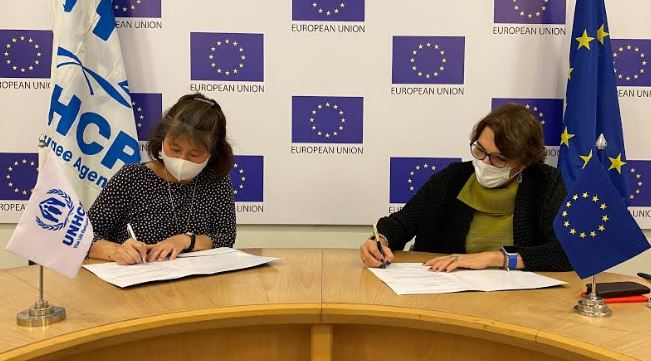

EU provides €10 million support for refugees and Pakistanis impacted by COVID-19

Assistance will help UNHCR mitigate short-term and medium-term impact of COVID-19 pandemic on refugees and Pakistani host communities

DNA

ISLAMABAD, NOV 24 – The European Union (EU) is providing €10 million to significantly boost UNHCR’s assistance for Afghan refugees and their host communities in Pakistan. The funding will focus on mitigating the short and medium-term impact of the COVID-19 pandemic.

With this funding, UNHCR will expand its health response as well as improve water, sanitation and hygiene (WASH) facilities in refugee and host communities. Another important component of the new project will be implementing activities that help protect and empower vulnerable Afghan refugees and host communities, including through livelihood opportunities.

The three-year project will be implemented across the country and is expected to benefit some 370,000 Afghan refugees and Pakistani host communities.

The Ambassador of the EU Delegation to Pakistan, H.E. Ms. Androulla Kaminara, and UNHCR’s Representative in Pakistan, Ms. Noriko Yoshida, signed the agreement at a ceremony on Monday.

DNA 24-5

The agreement coincides with the quadrennial Afghanistan Conference held in Geneva, which is intended to present an important opportunity for the Afghan Government and the international community to commit to common objectives for promoting sustainable development, prosperity and peace in Afghanistan.

At the signing ceremony, Ms. Kaminara said: “As the world faces a second surge of COVID-19, it is clearer than ever that we must assist the most vulnerable and the most in need. We are glad to partner with UNHCR in assisting the Afghan refugee community, which is generously hosted in Pakistan, as well as the Pakistani host communities.”

Placing the support for refugees in a larger political context, the Ambassador underlined: “The European Union has reaffirmed its strong support to an Afghan-led and Afghan-owned peace process which ultimately would ensure safety, fundamental rights and prosperity for all Afghans and allow refugees to return to their homeland in safety and dignity.”

The UNHCR Representative in Pakistan, Ms. Yoshida, welcomed the EU’s contribution and said such support amid the current COVID-19 pandemic demonstrates the EU’s commitment to “leaving no one behind”. “This support is truly significant. At a time when it is most urgently needed, the EU will help make a difference in the lives of so many refugees and Pakistani host communities impacted by the COVID-19 pandemic,” she said.

She said that UNHCR’s overall emergency response is in support of efforts by the Government of Pakistan to prevent and respond to the COVID-19 pandemic. She added that UNHCR has been advocating for the inclusion of refugees in the Government’s COVID-19 Prevention and Response Plan.

Since July 2018, the EU has contributed €37 million from its development budget and €10 million from its humanitarian resources to support Afghan refugees and their host communities, in particular through UNHCR’s regional programmes.

In May 2020, the EU announced a 150 million package to support Pakistan’s efforts in addressing the short-term and long-term public health and socio-economic effects of the COVID-19 pandemic, including this new funding of €10 million for UNHCR. This funding will be channelled towards three sectors: health, WASH and social protection.

In the health sector, it will boost health initiatives by helping to provide personal protective equipment, medical supplies and other relief items to health facilities in support of refugees and host communities. Community outreach on the prevention and response to COVID-19 will also be strengthened.

In the WASH sector, the EU’s contribution will help enable UNHCR to upgrade or construct facilities such as toilets, handwash basins and water pumps in schools, health centres and communal facilities in or close to refugee villages – benefitting both refugees and Pakistanis.

In terms of social protection, the assistance will contribute to UNHCR’s emergency cash programme for the most vulnerable registered Afghan refugees in Pakistan. The one-time cash assistance mitigates the impact of the COVID-19 pandemic by helping refugees meet their basic needs.

In addition, the project – covering a three-year period – aims to support the COVID-19 recovery through medium-term interventions, such as income-generating activities and technical and vocational skills training. This will ultimately help provide new skill sets to both refugees and their host communities.

ICCI calls for unbundling energy sector to promote competitive power market

DNA

ISLAMABAD – Sardar Yasir Ilyas Khan, President, Islamabad Chamber of Commerce & Industry (ICCI) said that Pakistan’s power sector was marred with multiple issues including high electricity prices for industrial, commercial and domestic consumers, rising circular debt, capacity payment issues, inefficient performance of GENCOs and DISCOS, high transmission and distribution losses and rising power theft losses, therefore, he urged that government should seriously consider to unbundle the power sector by encouraging private sector participation that would address all these issues and promote a competitive power market in the country. He said this while addressing a meeting of the ICCI Executive Body.

Sardar Yasir Ilyas Khan said the capacity payment obligation, which was Rs.488 billion in 2018 was projected to increase to over Rs.1.4 trillion by 2023 as system utilisation would stand at 55 per cent, compared to 84 percent in 2018. He said that these projections were not good for the economy as it would increase per unit cost of electricity and further enhance the cost of doing business in the country. He said that the circular debt has risen to Rs.2.15 trillion by 2020, which would create more problems for business and investment activities in the country. He said though the government has claimed that it has taken major initiatives for reducing the cost of power generation that would lead to Rs.300 billion impact over the next three years, however, he stressed that government should prefer unbundling the power sector vertically and horizontally and bring private sector players in the power sector through good incentives in order to promote a highly competitive power market.

ICCI President said that unbundling of banking and telecom sectors have brought phenomenal improvement in performance and service delivery of these sectors besides introducing competitive prices for the end consumers. He said that opening these sectors has also created plenty of new jobs apart from improving tax revenue for the government. However, keeping the generation and transmission of electricity in the public sector has not produced good results for the economy as it has made Pakistan’s energy cost as one of the highest in the region.

Sardar Yasir Ilyas Khan said that the standard package of reforms prescribed by the international donors for Pakistan also advocated for vertical and horizontal unbundling of power utilities, private sector participation and promoting competition in the power sector. He was of the view that opening the power sector for private sector would produce multiple benefits for the economy as it would reduce the fiscal burden of subsidies being given by the government to the power sector, bring operational efficiencies in the entities, improve financial sustainability and service delivery and reduce power tariffs for end consumers leading to low production cost and better growth of business and investment activities in the country.

Launching ceremony of book ‘Phool se Lipti Aag’ arranged by PUCAR

DNA

Rawalpindi, NOV 24 –  Punjab Council of the Arts in collaboration with  Halqa Ilam-o-Adab Pakistan arranged a launching ceremony of the book ‘Phool se Lipti Aag’ by Khalid Mehmood Malik. The ceremony was presided over by international fame poet and intellectual Iftikhar Arif while senior poet Naseem-e-Saher and Dr Farhat Abbas were chief guests while Dr Abid Sial was guest of honor of the ceremony.

The book was based on poetry collection of Khalid Mahmood. Chairman Halq Ilam-o-Adab Arif Farhad anchored the ceremony. Addressing at the occasion, Iftikhar Arif said that poetry was the name of sensitive feelings and the poetry of Khalid Mehmood was also in the phase of transition. He appreciated his work and ideas presented in poetry. Naseem-e-Saher and Dr Farhat Abbas said that poetry had its important place in literature.

Khalid Mehmood expressed many difficult things in the form of poems in a very beautiful way. A large number of people belonging to the literary circles were present at the event.

Coronavirus updates: Essential information for Pakistan

Known case updates as of 12:30pm, Tuesday, November 24, 2020
Pakistan: 379,883 (1,302 new)

Islamabad: 20,694
Sindh: 164,651
Punjab: 115,138
Khyber Pakhtunkhwa: 44,932
Balochistan: 16,846
Azad Jammu and Kashmir: 6,203
Gilgit-Baltistan: 4,558Tests done as of 12:30pm, Tuesday, November 24, 2020Total: 5,256,120
Over 24 hours: 39,165Positivity rate: 7.54Critical cases: 74

Deaths from the virus as of 12:30pm, Tuesday, November 24, 2020
So far, 7,744 people have died of the virus in Pakistan. (48 new)
Islamabad: 285
Punjab: 2,879
Sindh: 2,845
Khyber Pakhtunkhwa: 1,330
Balochistan: 163
Azad Jammu and Kashmir: 147
Gilgit-Baltistan: 95

In memoriam: Names of health workers who died fighting COVID-19

Recoveries as of 12:30pm, Tuesday, November 24, 2020
So far, 331,760 people have recovered from the virus in Pakistan.
Islamabad: 21,990
Sindh: 146,366
Punjab: 98,034
Khyber Pakhtunkhwa: 40,422
Balochistan: 16,061
Azad Jammu and Kashmir: 4,584
Gilgit-Baltistan: 4,303

Important SOPs

What are the symptoms of COVID-19?Cough (usually dry), fever, difficulty breathing, muscle aches and pains, tiredness, loss of taste and smell, chest pain

Which authorities should I contact?
Your government helplines

What will they do?
They will guide you about the next steps. You will be connected to a doctor who will take your medical and travel history. You will be told whether you need to be tested or not.
If you need to be tested health authorities will send an ambulance your way to take you to a hospital isolation ward. Your contacts will be traced and also tested.

What precautions should I take to protect myself from COVID-19?

  • Wear a face mask anywhere outside your house. This includes crowded indoor places as well.
  • Follow social distancing, keep a distance of at least one metre from other people
  • Avoid large public gatherings
  • Wash your hands frequently with soap and water for at least 20 seconds
  • Carry an alcohol-based hand sanitiser with you. The alcohol content should be 60% or higher.
  • Avoid touching your mouth, nose and eyes
  • Stay at home if you feel sick
  • Disinfect workplace and home surfaces, door knobs, counters
  • Cook food thoroughly

Where can I go to get tested?

Contact list to get tested for coronavirus in Pakistan

Punjab:
All Divisional Headquarters hospitals
Lahore: Mayo Hospital, Expo Centre, Pakistan Kidney and Liver Institute, Shaukat Khanum and Chughtai Lab
Sindh:
Karachi: AKUH Karachi, Dow OJHA, Indus Hospital, SIUT, Chughtai Lab, PNS Shifa, Essa Lab, Civil Hospital, Liaquat National, Ziauddin Hospital
Hyderabad: LUMHS Hospital
Khairpur: GIMS
Larkana: CMCH
Khyber Pakhtunkhwa:
Peshawar: Khyber Medical University, Hayatabad Medical Complex, RMI, NWGH, Anwar Lab
Swat: Saidu Group of Teaching Hospitals
Abbottabad: ATH
DI Khan: MMTH
Balochistan:
Quetta: Fatima Jinnah Hospital
Taftan: Mobile testing unit
Gilgit-Baltistan:
Skardu: CMCH
Gilgit: DHQ
Islamabad: PIMS, NIH
Azad Jammu and Kashmir:
Muzaffarabad: Abbas Institute of Medical Sciences

Isolation wards and centres in Pakistan (Updated May 9)

Sindh:
1. AKUH Karachi
2.JPMC, Karachi
3.Dow OJHA, Karachi
4.Civil Hospital, Karachi
5. Liaquat Uni Hospital, Hyderabad
6. PMCH Nawabshah
7. Civil Hospital Mirpurkhas
8. GMMMC Sukkur
9. CMCH Larkana
10. Expo Centre Karachi

Punjab:
1.Mayo Hospital Lahore
2. PKLI Centre Lahore
3. Expo Centre Field Hospital Lahore
4. Nishtar Hospital Multan
5. Allama Iqbal Memorial Hospital Sialkot
6. Allied Teaching Hospital, Faisalabad
7. Sheikh Zayed Hospital, Rahim Yar Khan

Khyber Pakhtunkhwa:
1. Khyber Medical University, Peshawar
2. Hayatabad Medical Complex, Peshawar
3. RMI, Peshawar
4. NWGH, Peshawar
5. Swat: Saidu Group of Teaching Hospitals
6. Abbottabad: ATH
7. DI Khan: MMTH

Balochistan:
1. Sheikh Zayed Hospital, Quetta
2. Prince Fahad/ DHQ Hospital, Dalbandin, Chaghi
3. Jam Mir Ghulam Qadir Hospital Hub Lasbela
4. DHQ Hospital, Uthal, Lasbela
5. DHQ Hospital Gwadar
6. Red Crecent Hospital, Gwadar
7. GDA Hospital, Gwadar
8. GDA Hospital, Gwadar
9. DHQ Teaching Hospital, Turbat

If you’re looking for places that can provide oxygen cylinders, oximeters and plasma, we’ve compiled a list of contacts here.

What treatment approaches has Pakistan used for COVID-19 so far?

Doctors in Pakistan are trying a number of different approaches including:
1. Chloroquine and hydroxychloroquine
2. Remdesivir
3. Steroids
4. Tocilizumab and Sarilumab
5. Convalescent plasma or immunoglobulins
6. Proning
7. Lopinavir/ritonavir
8. Radiology for diagnosis

Read about them here.

Pakistan’s COVID-19 timeline: Major stories from across the country

Twitter handles to follow:

1.Faisal Sultan, Special Assistant to the Prime Minister on Health: @fslsltn
2. National Institute of Health (NIH) Pakistan: @NIH_Pakistan
3. Ministry of National Health Services, Regulations and Coordination: @nhsrcofficial
4.Health and Population Welfare Department, Sindh: @SindhHealthDpt
5. Dr Azra Fazal Pechuho, Minister of Health & Population Welfare Sindh: @AzraPechuho
6. Senator Murtaza Wahab, Sindh Government Spokesperson: @murtazawahab1
7. Taimur Khan Jhagra KP Finance and Health Minister: @Jhagra
8. Health Department KP: @HealthKPGovt
9. Usman Buzdar Punjab Chief Minister: @UsmanAKBuzdar
10. Dr Yasmin Rashid Punjab Minister For Primary & Secondary Healthcare: @Dr_YasminRashid
11. Health Department Punjab: @HealthPunjabGov
12. Jam Kamal Khan Balochistan Chief Minister: @jam_kamal
13. Liaquat Shahwani Balochistan Government Spokesperson: @LiaquatShahwani
14. Health Department Balochistan: @HealthDeptBlo
15. World Health Organisation Country Office in Pakistan: @WHOPakistan
16. Medical Microbiology and Infectious Diseases Society of Pakistan MMIDSP: @mmidsp
17. Aga Khan University; @AKUGlobal
18. The Indus Hospital: @indus_hospital
19. Tedros Adhanom Ghebreyesus, Director-General of the World Health Organisation: @DrTedros
20. UNICEF Pakistan: @UNICEF_Pakistan

A Pakistani worker secures award of BRI’s video compilation

BEIJING Nov.24 (DNA): The video Story of a Pakistani construction worker who works under CPEC project won the hearts of audiences and secured awards at the 2nd Belt and Road (BRI) Short Video Competition, says a report published by Gwadar Pro.

Aside from presenting CPEC’s potential of sustainable development in the lives of individuals, the story also showcased Pakistani worker’s work ethic and dedication, which spoke loudly for the nations’ character.

The 2nd Belt and Road (BRI) Short Video competition, co-organized by China Public Diplomacy Association, News Center of the State-owned Assets Supervision and Administration Commission of the State Council (SASAC), and Global Times Online, was held in Wuhan, Central China.

The competition aimed to unfold touching stories of individuals from countries all along the Belt and Road, and to help to build a community with a shared future for mankind.

Under the theme of “Act in Solidarity”, 500 pieces of short videos, telling inspiring stories of Belt and Road builders and beneficiaries, poured in from more than 80 countries.

The video story of a Pakistani construction worker who works with China Gezhouba Group Corporation (CGGC) INTERNATIONAL LTD.at Dasu Dam, stood out and won the audiences heart.

CPEC changed my life’ through China Gezhouba Group Corporation (CGGC). He come from Kohistan district in Khyber Pakhtunkhwa Province, Pakistan and is now working at Dasu Dam, a large hydroelectric gravity dam, whose civil engineering were undertaken by CGGC.

“I used to be unemployed, and do not have stable income, as a result, my child was deprived of education.” Naseer stated in the video, “My life changed drastically since I was employed by CGGC.

This job enables me to provide education to my child, I have opened a small shop with my salary, and what’s more, I feel respected, not only by my Chinese colleagues but also by my family.”

Naseer’s diligence laid solid foundation for his success, a Chinese staff from Dasu dam told Gwadar Pro. “Like many of my Pakistani friends, Naseer is candid and extremely hardworking, he took control of his life and we are all glad that it paid off.”

At the Dasu dam, Pakistani and Chinese workers are bonding regardless of their nationalities. “Naseer and others would invite us to their house for dinner after work, we respect each other like brothers. CPEC has brought us together.” Lu Yong, a Chinese staff from Dasu Dam told reporter.

To date, various CPEC projects have provided 700,000 direct jobs to people across Pakistan, Naseer’s story is not just an exception.

Fakhar allowed to go home after testing negative in second COVID-19 test

Lahore : Left-handed opener Fakhar Zaman has been allowed to go home after testing negative in second COVID-19 test.

Sources further revealed that all of his test reports are cleared and the 30-year-old is now feeling better.

Note, Fakhar was ruled out of the New Zealand tour due to high fever which could lead to COVID-19 symptoms. The cricketer underwent two tests according to COVID protocols.

FO responds to media queries regarding reported briefing to a group of foreign envoys

DNA

ISLAMABAD – Pakistan Foreign Office has responded to media queries regarding the reported briefing to a group of foreign envoys at the Indian Ministry of External Affairs on the so-called attempted terrorist attack in Nagrota district in Indian Illegally occupied Jammu and Kashmir (IIOJK), the Spokesperson said:

Following presentation of the Dossier by Pakistan containing irrefutable evidence of India’s active planning, promoting, aiding, abetting, financing and execution of terrorist activities in Pakistan, the Indian Government has escalated its anti-Pakistan campaign, marked by false narratives, concocted evidence, and orchestration of false flag operations.

The purported briefing by the Indian Ministry of External Affairs is yet another attempt to mischievously implicate Pakistan in some alleged planned attack in IIOJK.

The completely baseless and unsubstantiated Indian allegations are nothing but a reflection of desperate efforts on India’s part to salvage its false terrorism narrative against Pakistan and to divert international attention from its state-terrorism in IIOJK and state-sponsorship of terrorism against Pakistan.

Pakistan has been consistently sensitizing the international community regarding the possibility of India undertaking a false flag operation with the intention to implicate Pakistan and jeopardizing regional peace and security. We forewarn the world community once again.

Pakistan will continue exposing India and not let the world community be misled by Indian propaganda. The world community, including the United Nations counter-terrorism mechanisms, must act on the Dossier presented by Pakistan with incontrovertible evidence of Indian state-sponsorship of terrorism.

SC admits Zardari’s plea for transfer of NAB cases to Karachi

ISLAMABAD : The Supreme Court on Tuesday admitted for hearing a plea of former president Asif Ali Zardari seeking transfer of corruption cases filed against him in Islamabad’s accountability courts to Karachi.

After an initial hearing in his chamber, Justice Umar Ata Bandial set aside the SC registrar office’s objections to the plea. The SC judge ordered that the case be fixed before a bench for hearing within two weeks.Zardari through his counsel Farooq H Naek challenged the registrar office’s objections. On November 3, he approached the SC, requesting the court to transfer the graft cases filed against him by the NAB from Islamabad’s courts to similar courts in Karachi where he lives.

He stated in his plea that he can’t appear in accountability courts in Islamabad due to his illness as he was suffering from various ailments and had been critically ill. He said the cases were being heard in Islamabad courts despite the fact that all the accused persons, witnesses and documents are from Karachi.

Zardari along with his sister Faryal Talpur is facing multiple corruption cases stemming from a mega-money laundering scam that came to light in 2018.

Pakistan condemns missile attack in Jedda

DNA

ISLAMABAD, NOV 24 – Pakistan strongly condemned the missile attack by Houthi militants at petroleum distribution terminal in Jeddah causing a fire in a fuel tank which was successfully extinguished without any causalities.

Pakistan calls for immediate cessation of such attacks that violate the territorial integrity and sovereignty of the brotherly Kingdom of Saudi Arabia, and threaten the lives of innocent civilians.

We reaffirm our full support and solidarity with the brotherly Kingdom of Saudi Arabia against any threats to its security and territorial integrity.

Stay Connected

64FansLike
60FollowersFollow

Latest Reviews

Exchange Rates

USD - United States Dollar
EUR
1.17
GBP
1.35
AUD
0.67
CAD
0.72




