Home Blog Page 2833

Dr Donald Farquhar Int’l Medical Director for MRCP arrives in Pakistan

DNA

ISLAMABAD, DEC 15 – After mutual collaboration, conferences and Memorandum Of Understanding between Surgeon General of Pakistan Army and Royal College of Physicians UK, Federation of Royal Colleges of Physicians UK five member team headed by Dr Donald Farquhar International Medical Director for MRCP visited Pakistan to conduct MRCP PACES clinical examination.

The MRCP PACES clinical examination was conducted at Pak Emirates Military Hospital Rawalpindi which is the first ever center established in Pakistan by Royal College of Physicians UK. This has been the 15 year journey to open a “MRCP PACES Center in Pakistan”.

From now on, MRCP PACES Clinical Examination (UK) will be held regularly at least twice a year in Pakistan.The panel of examination from UK, Dr Donald Farquhar, Prof Charles Twort, Dr Peter Newman, Dr Tanzeem Raza and Dr Roderick Harvery, were joined by team in Pakistan included Prof Aamir Ghafoor Khan Lead Examiner for MRCP in Pakistan, Prof Imran Fazal, Prof Khurshid Muhammad Uttra, Prof Wasim Alamgir, Prof Zafar Ali Qureshi, Prof Shazia Nisar, Prof Azmat Hayat, Dr Asim Yousaf, Dr Muhammad Salim, Dr Haroon Hafiz and Dr Mohsin Saif.

The exam lasted three days and 45 candidates were examined.Dr Donald Farquhar, Federation International Medical Director for Assessment shared, “MRCP exams are offered in 36 countries around the world at more than 100 locations and over 25,000 doctors take the exams each year. The advent of these high level medical exams in Pakistan will provide doctors with the opportunity to take this examination locally”.

Bulgaria needs an experienced envoy in Pakistan

Ambassador Roumen not only focused on diplomatic relations but he spent much of his time in building people to people contacts. Likewise, culture was yet another sphere where Ambassador Roumen did quite well

DNA

ISLAMABAD: Bulgarian embassy in Islamabad needs a professional diplomat as the post is still vacant ever since services of Ambassador Aleksandar Borisov Parashkevov were terminated on corruption charges.

Bulgaria and Pakistan have had excellent relations. Respective ambassadors and charge d affaires who were appointed in Pakistan to represent their country, had put in their best efforts to promote and strengthen bilateral relations.

In late 90s Mr. Angel served as Charge D Affaires. During his tenure relations between two countries touched new heights. He remained in Pakistan for quite some time and contributed greatly towards cementing of Pakistan-Bulgaria relations. Mr. Angel is now a senior officer in the Ministry of Foreign Affairs of Bulgaria.

Then came Mr. Roumen who joined the Embassy as Charge D Affaires and then was elevated to fully fledged ambassador. Mr. Roumen stayed in Pakistan for more than eight years. His was perhaps the best time when relations between Pakistan and Bulgaria witnessed new horizons.

Ambassador Roumen not only focused on diplomatic relations but he spent much of his time in building people to people contacts. Likewise, culture was yet another sphere where Ambassador Roumen did quite well.

Because of his benign nature and elegant personality he was able  to make good friends in Pakistan. It is because of his selfless services that he is still remembered in Pakistan.

Keeping in view proximity of relations between the two countries, Bulgaria needs in Pakistan a diplomat like Ambassador Roumen who not only understands this region very well but enjoys impeccable reputation among Pakistanis and government circles.

Respective diplomats have done a lot to build a strong relationship with Pakistan therefore their efforts should not go waste. It is possible only if Ambassador Roumen of a diplomat like him is appointed in Pakistan.

Pakistan eases visa facility for Chinese investors

DNA

ISLAMABAD, Dec. 15  – Pakistan has ordered to ease visa facility for Chinese investors to attract investment in the country, Gwadar Pro reported on Tuesday.

According to Interior Minister Sheikh Rashid Ahmed that directions in this regard had been issued.

“The directives have been issued to ease visa facility for the Chinese investors. This is aimed at attracting investment in the country,” Ahmed said.

The Interior Minister expressed the commitment to making efforts towards bringing improvement in law and order in the country to facilitate the investors.

Over the weekend, Faisalabad Industrial Estate Development and Management Company (FIEDMC) chairman Mian Kashif Ashfaq said more than 25 Chinese companies had signed accords to invest in Allama Iqbal Industrial City, Faisalabad alone.

Chairing a meeting, Mian Kashif said several Chinese and other foreign companies were in contact with the FIEDMC for investment in the city.

He said the Punjab provincial government had promised full cooperation to FIEDMC, which was playing due role in fulfilling the prime minister’s mission.

Separately, Federal Minister for Science and Technology Fawad Chaudhry said Pakistan had become an attractive market for the Chinese investors through China-Pakistan Economic Corridor (CPEC).

The minister said that CPEC projects had a great future and it would change the fate of the region along bringing economic prosperity. He said, “we welcome Chinese investors in Pakistan”.

The minister disclosed that his ministry has planned to uplift semi-conductor industry and bring value addition to Pakistan’s own products with the cooperation of Chinese friends.

The minister said Pakistan was also focusing on renewable energy which is the future for Pakistan’s power system.

He said in this regard, his ministry has approached the Chinese companies to shift their solar panel manufacturing units to Pakistan.

Pak Navy wants collaboration with local industry for indigenous production of its systems

DNA

ISLAMABAD, DEC 15 – A delegation of Pakistan Navy visited Islamabad Chamber of Commerce & Industry and held a meeting with Sardar Yasir Ilyas Khan President to discuss the collaboration with local industries for designing, development, construction, training and tests/trials of various equipment used/fitted on board.

Capt. Asif Maqsood Director Technical Development, Cdr. Tasneem Ahmad Director Indigenous Technical Development and Lt. Cdr Amir Bin Hamid Staff Officer Indigenous Technical Development were in the delegation.

Capt. Asif Maqsood said that Pakistan Navy was importing many parts and equipment to meet its needs of manufacturing frigates and other defence related systems.

However, he said that the Pakistan Navy wanted complete indigenous production of frigates and its other systems that would also be beneficial for the local industry. He said that the local firms with good capability and expertise in electrical and mechanical fields have the potential to collaborate with Pakistan Navy to meet its defence needs and achieve better growth. He said that some private firms were already doing good business with the Pakistan Navy and they wanted that more firms should come forward to play a role for further strengthening the defence systems of naval forces.

Addressing the delegation, Sardar Yasir Ilyas Khan, President, Islamabad Chamber of Commerce & Industry (ICCI) said that the private sector has great potential to enter into business partnership with defence sector and more collaboration was needed to harness its actual potential for strengthening the defence systems of the country. He said that public private partnership between local industry and Pakistan Navy would be mutually beneficial for both sides as it would promote the local industry and save a lot of precious forex reserves of the country. He said that a long term contract of defence sector with local industry for indigenous production would build the confidence of the private sector and it would invest more in its machinery and plants to improve manufacturing capability in order to produce world class defence equipment and products.

Sardar Yasir Ilyas Khan assured that ICCI would play a role as a bridge between Pakistan Navy and local industry for building long-term business relations between them that would ultimately benefit our economy. Both sides exchanged ideas on the potential areas of collaboration between Pakistan Navy and private sector and ICCI assured to identify the local industries that have the potential and capability to build sustainable relationships with PN for indigenous production of its required equipment and systems.

Federal cabinet likely to make petroleum commission’s report public

ISLAMABAD : Prime Minister Imran Khan will chair the session of the federal cabinet to discuss 14-point agenda today.

The federal government will deliberate upon publicising the investigation report of the petroleum commission. The agenda of the forthcoming cabinet meeting was extended by the inclusion of three more items.It is expected that the federal cabinet will give approval to make the probe report of the petroleum commission besides taking decisions for the initiation of strict actions against the responsible persons.

Moreover, Attorney General of Pakistan will brief the cabinet members over the legal matters. The appointment of new chairman of the National Disaster Management Authority (NDMA) was also included in the agenda.

Some ministers will participate in the meeting through video link due to coronavirus. The cabinet members will mull over the political, economic situation of the country besides reviewing the matters related to COVID-19 pandemic and security issues.

The deadline given by, Pakistan Democratic Movement (PDM), and the next phase of the anti-government movement announced by the opposition alliance will also be discussed.

A briefing will be held by finance ministry regarding the disbursement of funds and resources to the provinces. Another briefing will be organised pertaining the survey of Ehsaas Kifalat programme and Corona Relief Fund.

The other items of the agenda include a report on the use of Metropolitan Club’s building in F-9 Park; appointment of chief executive officer (CEO) of Ignite, a subordinate institution of the Ministry of Information Technology (IT); appointment of managing directors (MDs) of Sui Northern and Southern gas companies; appointment of CEOs of power supply companies; appointment of the members of the board of directors (BoD) of Public-Private Partnership Authority (PPPA) and re-structuring of the board of trustees of Employees’ Old-Age Benefits Institution (EOBI).

UK Queen recognises Pakistani charity founder with Commonwealth Points of Light award

ISLAMABAD, DEC 15 (DNA) – The British High Commissioner Dr Christian Turner presented the award to Hamza Farrukh today at a ceremony arranged by the British High Commission in Islamabad.

Her Majesty Queen Elizabeth II has recognised Hamza Farrukh, representing Pakistan, as the 129th Commonwealth Point of Light in honour of his exceptional voluntary service providing clean water to local communities in Pakistan.

Mr Farrukh runs a charitable project ‘Bondh-E-Shams’ (droplets of sunshine) which is serving over 45,000 people across 13 remote Pakistani villages.

Hamza began Bondh-E-Shams’ as a college project in March 2014, focusing on one particular Pakistani village. He was then awarded further funding to set up the charity, which has now provided over 10 million cups of water to people in remote communities in Pakistan through an environmentally friendly, solar-powered water extraction and filtration system.

Hamza Farrukh said: “At Bondh E Shams, we have promised to take on the global water crisis: lack of access to safe water in large swaths of developing nations is symptomatic of the numerous structural disadvantages faced by the global south. My team and I realise the responsibility we have towards the 1.2 billion people who go to bed thirsty each night, and are dedicated to this lifelong fight.”

The British High Commissioner, Dr Christian Turner, said: “I am delighted to present Hamza Farrukh with the Commonwealth Points of Light award for his exceptional voluntary service and ingenuity in helping to provide safe drinking water to tens of thousands of Pakistanis. Her Majesty The Queen has recognised Mr Hamza as Pakistan’s Point of Light for delivering a significant impact on the lives of others.”

Gwadar Int’l Terminals witness significant developments despite COVID-19

DNA

ISLAMABAD, Dec. 15 – Despite the ongoing Covid-19 and many othet challenges, the Gwadar International Terminals have made significant developments during 2020, says a report carried by Gwadar Pro on Tuesday.

The management of the terminals (GITL) proudly mentioned their remarkable achievements during this year. This includes; the first International transshipment of Bulk and containerized cargo, Afghan transit trade of containerized and Bulk cargo, LPG imports etc, said Chairman China Overseas Ports Holding Company Zhang Baozhong.

The GITL has worked together with Pakistan Customs (transit trade directorate), Customs bonded carriers’ association, Customs clearing agents and relevant security agencies to enable the port to excel and transform Gwadar into a preferred port of call to support the high trade volumes in the region said Capt Dai Xiaolong, CEO of GITL.

He further elaborated that Pakistan’s other ports are facing huge congestion due to high traffic of vessels carrying bulk cargoes, which result in delaying the operation and transportation of shipments; thus disturbing the entire supply chain mechanism.

The Port due to its unique geographical position makes it a fast-economical link between land-locked central Asian states and to the rest of the country.

GITL’s economic and efficient facilitates provides enormous opportunities to logistic companies, customs clearing agents and port related businesses.

In the wake of covid-19 port officials have been working closely with industry stakeholders and other Government agencies in taking all necessary precautionary measures to safe guard’s health and safety of personnel involve in port operations and to make sure our stakeholders businesses continue to run efficiently and smoothly.

Now Gwadar port is all set to become the hub of international transshipment which will help the country in earning much needed foreign exchange in near future which also is in line with the vision of Prime Minster of Pakistan to launch first-ever transshipment policy to promote regional economic integration.

The port is expected to add new cargo movements (import of more bulk commodities like coal, wheat, sugar & steal, import of LNG and transported through virtual pipeline, export of clinkers etc.) to increase its cargo handling capacity in millions of tons by 2025.

This will help in earning foreign exchange and will generate many local jobs through various business related activities and will also substantially earn a much needed foreign exchange which country direly need at present.

On 8th December 2020, DAP fertilizer imported from Australia arrived on bulk vessel Strategic Endeavour at Gwadar port to discharge 22,000 tons.

This represents culmination efforts of Ministry of Maritime Affairs, Ministry of Commerce, Gwadar Port Authority (GPA) and Pakistan Customs (in-particular) to continue Afghan Transit Trade in this very important port.

The transit goods for Afghanistan has been gradually normalized at time of world vide Covid-19 pandemic and supply chain challenges which have emerged out of it.

This was the highest discharge rate ever achieved for DAP fertilizers in just over 4 days. The vessel completed discharge of 22,000 tons and sailed from Gwadar port in minimal time due to immediate on-arrival berthing, zero waiting time at Anchorage and efficient handling facilities with highly capacitive terminal structure and logistic services.

This development also reflects the keen interest of our stakeholders to support economic development in Pakistan and in the region.

Japan grants USD 9.5 million to Pakistan for confronting COVID-19

DNA

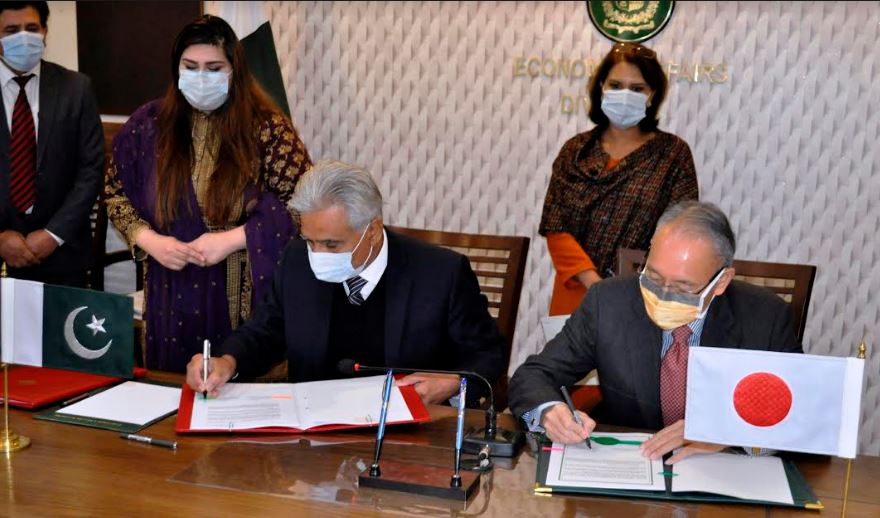
ISLAMABAD, DEC 15 – Government of Japan has extended a grant assistance of JPY 1 billion (approx. USD 9.5 million) to Pakistan for enhancing its capacity to confront COVID-19 and other infectious diseases. Notes to this effect were signed and exchanged between MATSUDA Kuninori, Ambassador of Japan to Pakistan and Mr. Noor Ahmad, Secretary of the Ministry of Economic Affairs, in Islamabad on December 15, 2020.

DNA 15-2

Equipment & machineries to be provided to medical institutions

In this program, more than 30 types of medical equipment including the Bedside X-ray Machine will be provided to medical institutions in Pakistan through the National Disaster Management Authority (NDMA). NDMA has taken effective measures against national-level disasters such as floods, earthquakes, COVID-19 and locust invasion since its establishment in 2007. The Embassy of Japan and NDMA have been working together since the beginning of COVID-19 outbreak in Pakistan with due consideration to the need of front-line medical institutions.

Japan’s firm commitment to control COVID-19 and prepare for the future

In the signing ceremony, Ambassador MATSUDA clearly stated, “Our assistance will not only improve the capacity of controlling COVID-19 but will prepare for the risk in the future. The Government of Japan has expressed its strong commitment to this assistance, recognizing the necessity to go hand in hand on a global scale to confront the unknown viruses such as COVID-19.”

Japan’s counter-COVID-19 support reaches USD 16.91 million

As for COVID-19, Japan delivered diagnostic kits in the beginning of February, three weeks before the first case was reported in Pakistan. Then, Japan provided a total of USD 7.41 million to Pakistan through international organizations. With this support to the NDMA, Japan’s support to Pakistan for controlling COVID19 will reach USD 16.91 million in total.

Genocide: a tale of Indian Muslims

Attiay Munawar

Indian Muslims have been victims of Hindu prejudice since the founding of Pakistan and now their genocide continues. International experts and genocide research organizations have also expressed concern over the genocide of 200 million Muslims under the patronage of the Indian government.

However, Human rights expert Tina Ramirez says persecution of Muslims is worsening their economic situation, with Indian Muslims suffering from constant fear and insecurity. The Indian state’s anti-Muslim sentiments and the worst treatment of Muslims have also been voiced by insiders, Leading Indian writer and political activist Arundhati Roy had also said in her interview that the situation in India is now heading towards genocide, because this has been the agenda of the government.There is a storm of hatred against Muslims in India. The massacre in Delhi was carried out because people were protesting against the anti-Muslim law on citizenship. Crimes against humanity continue unabated in India, the socio-economic life of the Muslims there has been ruined; the situation of the Indian Muslims is a tragedy which is very real, but not new.

It is clear that after independence, the Indian leadership, in order to win the trust of minorities, said in the interests of the moment that India would be a secular state in which people of all faiths would have equal rights, but minorities would always be oppressed by extremists. They faced oppression and discrimination and were forced to accept Hindu supremacy, just as the Muslims of Andalusia have been persecuted and forced to accept one of the three options, convert to Christianity, emigrate or prepare for massacre.Even in present-day India, minorities especially Muslims, are forced to live a life of deprivation- deprived of their rights.

RSS, the main party of Indian Prime Minister Modi, has been saying for years that India should be a Hindu state. The Modi government is pursuing the same old plan of integrating Dalits into Hinduism and making Muslims untouchables in their place, while Muslims have ruled India for a thousand years, but they never interfered in the religious affairs of Hindus, nor could have forcibly converted them to Muslims even if they wanted to, because the teachings of Islam are not like that. In contrast, the situation is different in India, a so-called secular country, where Muslims are being burned and exiled.

This situation has proved that India has always been a Hindu state and Iqbal’s bi-national ideology and Quaid-e-Azam- Muhammad Ali Jinnah’s creation of Pakistan was correct, but it is also a clear fact that the Muslims of India played an important role in the liberation of this country. The Muslims of the subcontinent had united under the leadership of Quaid-e-Azam and achieved an independent state through struggle.

The atrocities being perpetrated against Muslims and other minorities in other Indian states, including Kashmir, are not being hidden from the world. It is encouraging that voices are sometimes raised against it in a forum, but the consistency with which this work should be done is not visible. There has been a global outcry, but delays in action have boosted the morale of Indian extremists.But delays in action have boosted the morale of Indian extremists. Before minorities in India are treated like Rohingya Muslims, the international community will have to take steps to stop this tyranny. If this extremism is not stopped, it will manifest itself in other countries in the future as well. India calls itself the largest democracy in the world, but in practice it is the opposite. The genocide of Muslims in India are provoking Muslims all over the world. If Indian racist genocidal acts are not stopped immediately, the region could be plunged into a new armed conflict.

Twitter: @Attiya Munawer

Kazakhstan is on the way to big changes

Akan Rakhmetullin

On December 16, 2020 Kazakhstan is celebrating the 29th anniversary of its existence as a sovereign country. In historical terms this is, certainly, not a lot. But what should be well kept in mind, is that modern-day Kazakhstan and its people occupy a huge landmass, where Europe meets Asia and where ancestry of contemporary Kazakhs created and ran states, which had played their own distinguished role in Eurasian history. This is what we in Kazakhstan keep in mind. In doing so Kazakhstan massively marked this year the 750th anniversary of the mighty Golden Horde, whose founders set up the lineage of Kazakh khans. This is the reason why Kazakhstan is fully eligible to identify itself as one of the Golden Horde’s historical heir nations.

It causes no doubt that modern-day Kazakhstan, which is geographically located at the very heart of the world powers strategic interests, is simply destined to bridge Europe and Asia both politically and economically. This is what probably constitutes a fundamental mission of Kazakhstan, which it inherited from its predecessor states, and our country has been following for the last 29 years.

It is not enough to just comprehend the greatness of that mission. One must comply with it in every possible sense. For this reason, from the very onset of our independence in 1991 the First President of Kazakhstan and Leader of the Nation Nursultan Nazarbayev clearly articulated the country’s strong commitment. It is to build up an open, democratic and economically competitive society. That was the primary goal to achieve, what Kazakhstan’s multi-vector and peacemaking foreign policy was aimed at.

We are the world’s largest landlocked country, which makes us in turn to be keen in benefiting from it through extending the network of trade and transport routes in every possible way via Kazakhstan terrain with the aim of linking Europe and Asia, as did earlier the Great Silk Road.

After all, a primary time milestone for our country is 2050, which is expected to be the year of Kazakhstan’s joining the list of 30 most developed countries in the world. Kazakhstan has everything to meet this incredibly ambitious objective, and all we need to do is just to be sufficiently intelligent and careful in handling assets we have.

Kazakhstan is known today as the largest economy across Central Asia. This largely occurred due to our country’s possession of vast natural resources and skilled workforce. This, in turn, enables the government to develop vigorously the national economy’s diversification policy, leading the economy away from its any exorbitant dependence solely on raw materials export. Therefore, there are some initiatives that are taken for implementation to develop the economy in various areas, such as transport, pharmaceuticals, telecommunications, petrochemicals and the food industry.

Another unique feature of the Kazakh economy is its openness and attractiveness for investments, including ones from the outside. This is brightly demonstrated by the relative statistics. Within the period from 1991 up to 2020 Kazakhstan succeeded to attract into its domestic economy 330 billion US dollars as direct foreign investments. This amount of investments certainly indicates that foreign investors are willing to come to Kazakhstan because of its political stability, educated personnel and capability to provide access to large regional markets. For instance, Kazakhstan membership in the Eurasian Economic Union makes investors access the Russian market with more than 140 million consumers and the common market of the Union with more than 180 million consumers.

Apart from that, by opening reginal offices in Kazakhstan overseas companies get easier access to the markets of West China (300 million consumers) and those of the Caspian countries (150 million consumers). This sort of understanding encouraged some big international companies to open their regional headquarters in our country. A number of global technology leaders and international companies, such as General Electric, Toyota Motors, Chevron, Hyundai Motors, Sanofi, Linde, Metro Group, Peugeot and Sumimoto Metal Mining, currently operate in Kazakhstan.

It is worthwhile to note that private investors activity in Kazakhstan is also driven by the Kazakh government’s forceful policy, which is designed to decrease steadily the volume of the state involvement in the economy. For example, over the last three years about 500 Kazakhstani companies were put up for sale under the privatization program, while assets sold to investors accumulated about 500 million US dollars. Privatization of large state-owned enterprises will keep going until the state’s share in the Kazakh economy reaches 18%.

Furthermore, the government’s measures to stimulate the growth of small and medium-sized businesses suggest that their total share in Kazakhstan GDP will increase to 35% by the year 2025. This goal is also to be achieved through implementation of the national strategy for gender equality, published in 2017, aimed at increasing women’s share in small and medium-sized businesses.

All business activity stimulating measures to have been mentioned above are reflected and well credited in leading international rating studies. Thus, the World Bank’s “Doing business for 2020” report ranks Kazakhstan as the 25th in the world, what is three positions higher, compared to last year’s indicators.

The spread of COVID-19 throughout the globe had certainly a negative effect to the Kazakh economy’s growth rates. But even these sorts of unfavorable circumstances prove the degree of Kazakhstan economy’s openness to the outside world and its inevitable dependence upon ongoing trends in the global economy. Nevertheless, Kazakhstan’s GDP growth is expected to reach 2.8% in 2021 and 4.6% by 2025.

Upcoming parliamentary elections, scheduled to be held on January 10, 2021 should also contribute to further stabilization of the socio-political situation in Kazakhstan. It should be noted that the elections will be held after some norms were introduced into the legislation in the middle of the current year. These norms are to make the competition among political parties more intense and to confirm Kazakhstan’s commitment to develop truly democratic and responsible civil society.

There is no doubt that such massive economic and domestic political transformations cannot be drafted and implemented without favorable external conditions properly ensured. This is exactly the most fundamental task of Kazakhstan’s foreign policy, which has constantly been designed to develop a peaceful and constructive dialogue with all countries of the world.

It is well known that at the very beginning of the 1990-s our country, which then was little known in the world, renounced nuclear weapons it inherited from the USSR, and shortly before that renouncement closed the Semipalatinsk nuclear test site on its territory. Besides, Kazakhstan and other brotherly regional countries did their best to fix in legal terms the status of Central Asia as the nuclear-weapon-free zone.

Later on, of course, foreign policy of Kazakhstan got a massive credit from the international community. Over the years it became visible, when Kazakhstan was elected a chair country in some big international organizations, for instance, the Organization of Islamic Cooperation, as well as hosted global international events. Among the latter events the Summit of the Organization for Security and Co-operation in Europe (OSCE) and the First Organisation of Islamic Cooperation Summit on Science and Technology both held in Kazakhstan in 2010 and 2017 respectively, are to be particularly noted. Election of Kazakhstan as a non-permanent member of the United Nations Security Council for the years 2017-2018 was our foreign policy’s another great achievement, which significantly raised our understanding of what were the essence of global problems and their possible solutions.

Nowadays Kazakhstan is trying to apply this understanding upon the way it develops interstate relationship with all countries over the world, including, definitely, friendly Pakistan. With this in mind Kazakhstan greatly values a high- level political partnership between our countries, which was established from the very beginning of Kazakh-Pak relations.

The Independence Day is always a good opportunity for us to recall those countries, which were among the first to recognize Kazakhstan as a sovereign and independent state. One of them, as it is known, was Pakistan, which Kazakhstan legalized cooperation principles with in February of 1992 at the state visit of the President of H.E. Mr. Nursultan Nazarbayev to Islamabad. Since then relations between Kazakhstan and Pakistan have developed only in a friendly and constructive way. Today the main task for both sides is to make a bilateral interstate dialogue a systematic and tangible result-oriented one, both in bilateral and multilateral cooperation formats.

The 9th meeting of the Pakistan-Kazakhstan Joint Intergovernmental Commission on Trade, Economic, Scientific, Technical and Cultural cooperation, which was held in Islamabad in February 2020 appeared to be a major breakthrough in a domain of a bilateral relationship. The meeting outcomes set up some long-awaited new guidelines for development between Kazakhstan and Pakistan in the years to come. Another point with regards to that Intergovernmental Commission meeting was that it took place after a five-year break following the previous meeting and surely became for this reason a quite notable event within the chronology of official Kazakh-Pak contacts through the outgoing year of 2020.

Another big event for bilateral relations was the maiden round of political consultations to have been also held in Islamabad in February 2020 at the level Foreign Ministries.

I note with great sense of satisfaction that trade volume between our countries, which was steadily declining over the past few years, has visibly increased this year. According to the Kazakhstan’s Bureau of National Statistics, the trade volume amounted within January-October 2020 to almost 37 million US dollars, while it totalled just 27 million US dollars through the entire 2019. These indicators are very clear to show us that trade and economic cooperation between our countries definitely has a potential to be further enhanced and extended.

Besides trade and economic relationship, Kazakhstan is very interested in exploring Pakistan’s vast experience in carrying out peacekeeping missions under the UN mandate. Defence and Foreign ministries of both countries are already in touch with mutual intention to develop this UN peacekeeping domain of Kazakh-Pak relationship. My personal belief is that launching a bilateral cooperation on international peacekeeping track is likely to be the best demonstration of friendly cooperation existing between Kazakhstan and Pakistan.

In conclusion I would like to extend the hope that the forthcoming year 2021, or the year of the 30th anniversary of Kazakhstan’s Independence, will be even more prolific in terms of Kazakh-Pak contacts to get our bilateral relations stronger.

The writer is the Ambassador of Kazakhstan to Pakistan.

Stay Connected

64FansLike
60FollowersFollow

Latest Reviews

Exchange Rates

USD - United States Dollar
EUR
1.17
GBP
1.35
AUD
0.67
CAD
0.72