Home Blog Page 2699

APNS condemns incidence of manhandling of family at residence of Waqas Tariq

KARACHI, JUN 4 (DNA) – The All Pakistan Newspapers Society strongly condemns the incidence of dacoity and manhandling of family at the residence of Mr. Waqas Tariq Farooq, Chief Editor, Daily Jehan Numa, Lahore.

The APNS expresses its solidarity with Mr. Waqas Tariq Farooq and noted with concern that in a posh residential area, the unidentified dacoits escaped despite the presence of law and order forces.

The APNS has requested the Chief Minister, Home Minister of Punjab Government and the IG Police to take strong notice of the incidence and apprehend the culprits and bring them to book at the earliest.

STRATEGY FOR DENGUE PREVENTION DISCUSSED

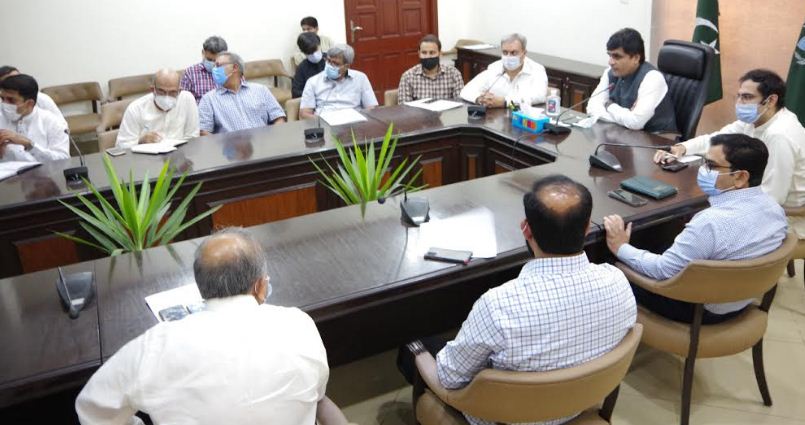
FAISALABAD, JUN 4 (DNA) – The meeting of District Emergency Response Committee for Anti Dengue was held at DC office which was presided by Deputy Commissioner Muhammad Ali.

CEO DHA Dr.Mushtaq Sipra, District Health Officer Dr.Bilal Ahmad, District Coordinator Epidemics Control Dr. Zulqarnain and other officers from different departments attended the meeting. Deputy Commissioner directed the departments to more gear up the surveillance against dengue  and collective efforts were required to stop the breeding of larvae in this regard.

He asked the ACs for holding Tehsil Emergency Response Committee meeting on regular basis and reviewed the performance of departments in connection with anti dengue. He said that the officers of concerned departments should be active in field to achieve the desire results of the anti dengue campaign because the moonson season is coming and eyes should be opened during the survillance. He asked for submitting departmental performance reports regarding surveillance and prevention activities daily.

He cleared that the carelessness  from duties should not be tolerated and stern action would be taken against the officials showing poor performance in this regard. Deputy Commissioner said that the strict monitoring of the anti dengue measures is being carried out by the District Administration to make the preventive and precautionary measures a success on durable basis.  

During the meeting District Coordinator for Epidemics control gave detailed briefing on indoor and out door surveillance and informed that action was also taken against shopkeepers for not maintaining cleanliness.

MCI asked to address sanitation and sewerage issues in markets

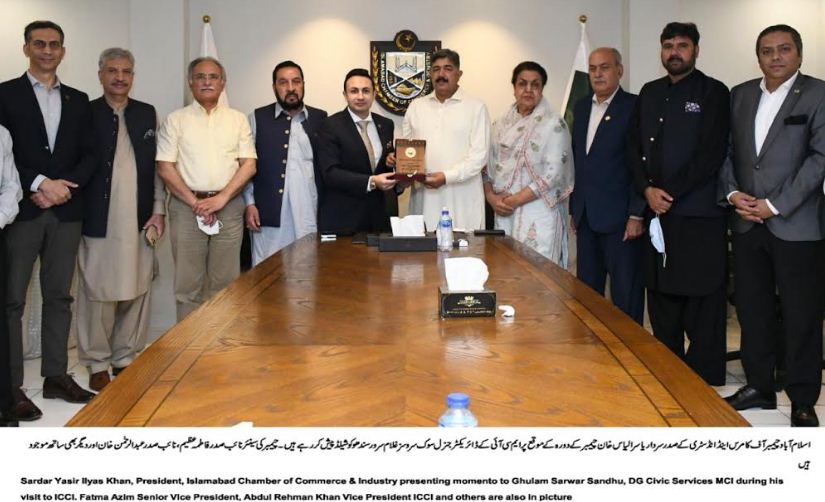
ISLAMABAD, JUN 4 (DNA) –  Sardar Yasir Ilyas Khan, President, Islamabad Chamber of Commerce & Industry said that the business community was facing problems due to old and dilapidated sewerage and water lines in markets and industrial areas and emphasized that MCI should address these issues on priority to facilitate the growth of trade and industrial activities.

He said this while exchanging views with Ghulam Sarwar Sandhu, Director General Civic Services, MCI during his visit to ICCI. Fatma Azim Senior Vice President, Abdul Rehman Khan Vice President ICCI, Muhammad Ejaz Abbasi, Khalid Chaudhry, Saeed Khan, Omais Khattak, Aslam Khokhar, Naveed Malik and others were present in the meeting.

Sardar Yasir Ilyas Khan said that Chairman CDA Amir Ali Ahmed in collaboration with ICCI has started development works in markets and industrial areas including carpeting of roads and restoration of streetlights and stressed that MCI should also work with ICCI to find out the key issues of business community and take measures to address them that would help in promoting business activities smoothly.

Fatma Azim Senior Vice President, Abdul Rehman Khan Vice President ICCI, Ejaz Abbasi former President ICCI and others also briefed Ghulam Sarwar Sandhu about the major issues of business community related to MCI and hoped that he would cooperate in resolving them.

Speaking at the occasion, Ghulam Sarwar Sandhu, Director General Civic Services MCI highlighted the key initiatives being taken by the MCI to improve the civic services in the city. He said that MCI was working to improve the sanitation system and replace old sewerage pipelines with new ones. He said that the contract sanitation system was being abolished in G-Sectors while renovation of Nullahs for smooth water drainage was in progress.

He said that new dustbins would be placed in the city and new garbage collection vehicles were being purchased to improve sanitation services. He assured that he would start visiting markets to resolve the key issues of traders.

It was agreed in the meeting that the President ICCI and MCI team would conduct joint visits of markets to know about the issues of the business community and take remedial measures to resolve them.=DNA

==============

US TROOPS’ EXIT FROM AFGHANISTAN

By Muhammad Omar Iftikhar

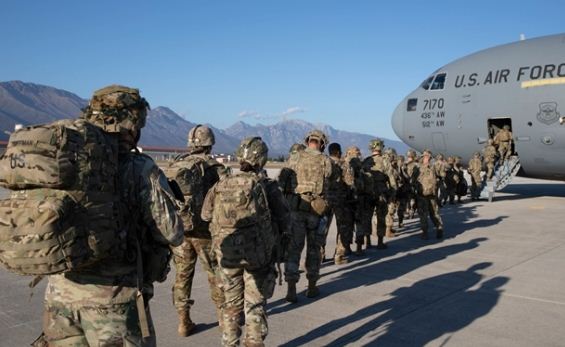
The US forces and UN troops will leave Afghanistan in 2021. The withdrawal process will continue until September. US President Joe Biden and his administration are looking forward to the US troops’ return from Afghanistan. It has been one of the most talked-about military engagements by the US in recent years.

Moreover, some opine that this was an “Unwinnable War” for the US. The mission in Afghanistan by the US troops and allies has been in process for two decades. However, recently Pakistan’s National Security Adviser Dr. Moeed Yusuf said that the sudden withdrawal of the United States from Afghanistan was not ideal, adding that any shifting of blame on Pakistan for “facesaving” would be unacceptable.

While speaking on a Pakistani TV show, Dr. Yusuf said, “[The] United States has assured us that Pakistan will not be made a scapegoat amidst the withdrawal [of US troops] from Afghanistan, but only time will tell whether [they stay true to their word] as history suggests otherwise.” He reiterated that although peace in Afghanistan must manifest, however, the rapid withdrawal of US troops from Afghanistan will not bode well for Pakistan. While talking about geopolitics and regional affairs, Dr. Yusuf said, “The approach is still regional. [Though], they [the US] have shifted focus from Af-Pak and are now obsessed with China, seeing India [as a country] that has a role to play [in this equation].”

Indeed, Afghanistan holds an important position when it comes to peace and stability in the South Asian region. The term, AfPak was coined by the US to show the significance Afghanistan and Pakistan hold in the region. Despite many efforts in the past, the US left a residual force in Afghanistan after each withdrawal. Now that the entire military is leaving Afghanistan, analysts fear that Afghanistan’s extremist elements may surface again to scuffle with the country’s security apparatus.

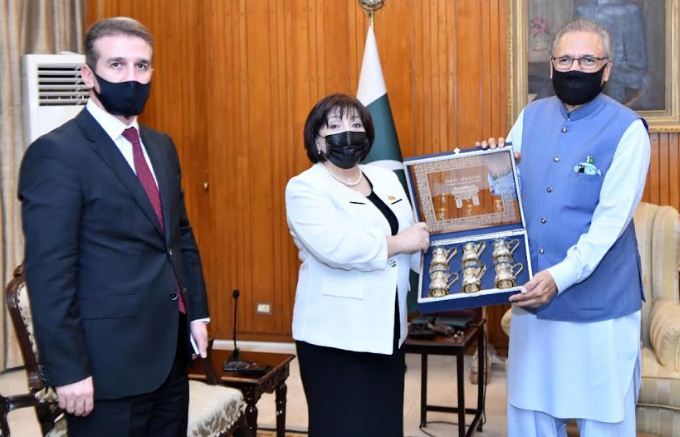
PAKISTAN KEEN TO DIVERSIFY TIES WITH AZERBAIJAN: ALVI

Prof. Sahiba Gafarova emphasized the need for increasing interactions between the two countries at economic, political, cultural and strategic levels

Asnar M Bhatti

ISLAMABAD: :President Dr Arif Alvi has said that Pakistan wants to further strengthen bilateral ties with Azerbaijan, particularly in the fields of trade, energy, defence, culture and tourism.

He said that Pakistan attached utmost significance to its ties with Azerbaijan as both countries had shared religion, values, culture, as well as commonalities of views on regional and international issues. He made these remarks while talking to the visiting Speaker of the Parliament of Azerbaijan, Prof. Sahiba Gafarova, who called on him, at Aiwan-e-Sadr,.

The President underscored the need for exchanging political, cultural, and economic delegations at high levels to further solidify bilateral cooperation. He congratulated the government and people of Azerbaijan on liberation of their territories from occupation of Armenia and signing of landmark peace agreement.

The President appreciated the steadfast support extended by Azerbaijan to the legitimate cause of Kashmiri people. He expressed the hope that her visit would further deepen bilateral relations. He asked the Speaker to communicate his good wishes to the people and government of Azerbaijan.

Prof. Sahiba Gafarova emphasized the need for increasing interactions between the two countries at economic, political, cultural and strategic levels. She also underlined the need for promoting cultural ties to build bridges between the people of the two brotherly countries. She conveyed that the people and political leaderships of Azerbaijan were highly grateful to Pakistan for supporting her country’sstance on Nagorno-Karabakh. She added that her country would continue to support Pakistan’s stance on Kashmir at all fora.

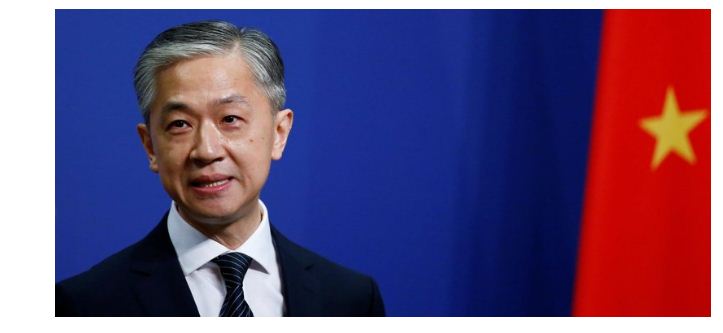
CHINA URGES U.S. TO WITHDRAW INVESTMENT BAN

BEIJING, JUN 4 – China said on Friday that it strongly condemned U.S. President Joe Biden‘s signing of an order to ban investment in dozens of Chinese defense and tech firms.

China urged the United States to respect market law and principle and withdraw the investment ban list, foreign ministry spokesman Wang Wenbin told a regular news briefing.

Biden signed an executive order on Thursday that bans U.S. entities from investing in dozens of Chinese companies with alleged ties to defense or surveillance technology sectors, a move his administration says expands the scope of a legally flawed Trump-era order.

SHIFTING BLAME ON PAKISTAN TO ‘SAVE FACE’ AMID US WITHDRAWAL FROM AFGHANISTAN UNACCEPTABLE: MOEED

ISLAMABAD – National Security Adviser Dr Moeed Yusuf said on Wednesday that the sudden withdrawal of the United States from Afghanistan was not ideal, adding that any shifting of blame on Pakistan for “facesaving” would be unacceptable.

Speaking on DawnNewsTV show ‘Live with Adil Shahzeb’, Yusuf said international media had been biased against Pakistan in the past and it was the same today.

“[The] United States has assured us that Pakistan will not be made a scapegoat amidst the withdrawal [of US troops] from Afghanistan, but only time will tell whether [they stay true to their word] as history suggests otherwise,” he remarked.

He added that it was “too early to predict whether they [the US] will stick to their words.” The adviser said Pakistan had always wanted peace in Afghanistan and the hasty withdrawal of US troops from the country was not a good idea.

Yusuf also stressed that Pakistan needed to maintain bilateral ties with the US, which continued to view Pakistan as a regional player, without compromising on national interests.

“The approach is still regional. [Though], they [the US] have shifted focus from Af-Pak and are now obsessed with China, seeing India [as a country] that has a role to play [in this equation],” said Yusuf.

In reply to a question about Pakistan allowing the US to continue to use its airbases, Yusuf denied such reports.

“It has been very clearly communicated to the Americans so it’s not debatable,” he said, adding that Prime Minister Imran Khan had been opposing the war in Afghanistan for the past 15 years, so allowing the US access to airbases after its withdrawal from Afghanistan was not on the table.

To another question, he stressed that “it’s important for all stakeholders in Afghanistan to sit together for a … political settlement.”

Yusuf also empahsised economic stability for Afghanistan, saying that the Afghan economy could not function without support from the outside.

“And for that, only Pakistan can give them the regional connectivity, and for investment from China [and the] US, Pakistan is the only linchpin. Afghans must understand this.”

The adviser reiterated that in the wake of the US withdrawal from Afghanistan, Pakistan wanted bilateral relationships with America, but with a focus on “not what the US can give us, but what we can take from the US”.

He added that Pakistan had made its priorities clear to the world in Geneva, where he met the US National Security Adviser Jake Sullivan last month.

He went on to say that Afghans should decide their own fate, adding that any terrorist activities in Afghanistan were not acceptable to Pakistan.

US pullout and security vaccuum

The US has announced troop withdrawal from Afghanistan by September 11. However, with the US troops pulling out from the war-torn country since May 1— a deadline set in the US-Taliban agreement signed last year— there have been reports of the withdrawal being completed by July 4, which is celebrated as the US Independence Day.

US President Joe Biden is determined to end what he called “the forever war”, announcing in April that the withdrawal of the remaining 2,500 American forces would be complete by the 20th anniversary of the September 11 attacks.

The prospect of an end to the US presence in Afghanistan after 20 years comes despite fighting raging across the countryside in the absence of a peace deal, giving rise to security concerns and fears that violence will increase and could also spill over to neighbouring states, including Pakistan.

In a statement issued on Tuesday, the Foreign Office had said Pakistan was worried about a security vacuum in Afghanistan after the US pullout as the already dim prospects of successful reconciliation between warring Afghan groups were growing dimmer with every passing day.

Although another round of intra-Afghan talks is scheduled to begin in the next couple of days, Pakistani officials don’t seem very hopeful about a breakthrough.

Foreign Minister Shah Mahmood Qureshi, while talking to Speaker of Afghanistan’s Wolesi Jirga Mir Rahman Rahmani on Tuesday, had urged the Afghan groups to “seize this historic opportunity and work out an inclusive, broad-based and comprehensive political settlement for durable peace and stability in Afghanistan and the region,” according to the statement.

The fears of a security vacuum have been growing because of the stalemate in the peace process.

The peace dialogue has made little progress since it started in September last year except for an understanding of the principles and procedures, which too was achieved after haggling for months over minor issues.

Several efforts were made by Pakistan and the international community to push all stakeholders to return to the negotiation table to settle the remaining outstanding issues for ending the conflict, but none of the efforts have succeeded so far.

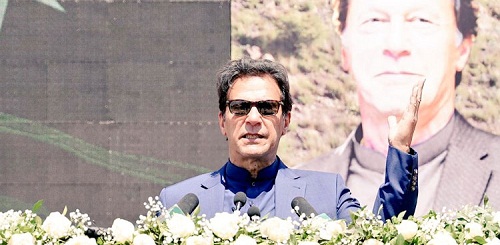
Mafias want to topple incumbent govt at any cost: PM Imran Khan

ISLAMABAD: Prime Minister Imran Khan on Friday said that mafias are trying to topple the democratic government at any cost after their irregularities have been exposed.

Addressing a ceremony to lay the foundation for the up-gradation of the Multan-Lodhran section of the N-5 motorway, the prime minister said that those who called themselves democratic are demanding the military to topple the government.

“These mafias are bent upon doing anything to safeguard their interests as billions of dollars stashed by them abroad through money looted in the country have been probed,” he said and added that rule of law changes the society and ensures that there are no sugar and land mafias.

He said that a change has been witnessed owing to their actions as now farmers are getting their due money from sugar mills and it has led to a record harvest of the sugarcane this year.

He challenged as to how a change could come immediately after resuming power and said that Muslims in the sub-continent struggled for years to achieve their target of a separate homeland in 1947.

“Change is not possible without a struggle,” the prime minister said adding that the opposition raised a hue and cry regarding a change a week after they took power.

“An impression was given as the new Pakistan will be build just after pushing a button,” Imran Khan said while terming the recent struggle against mafias as one of the biggest in the country after the struggle for independence in 1947.

The prime minister said that it was Almighty Allah who rescued them from the COVID situation after they took decisions to balance between the economy and the infection.

Sharing progress on CPEC, Imran Khan said they are entering the second phase of the multi-billion dollar project with China and the establishment of special economic zones will help them in lifting their exports.

The prime minister said that it was for the first time that the government is stressing the need of the IT sector and their exports in the sector have risen to Rs90 billion. “We are further constructing dams for clean energy,” the prime minister shared while stressing the need on saving the country from the effects of global warming.

He said that the establishment of national parks, plantation of 10 billion trees, and construction of dams are steps aimed at saving the next generations of the country. He further shed light on improving tourism in the country to gain fully from its potential and make it a source of increasing foreign reserves.

Imran Khan said that the vaccination will help them in improving tourism besides also safeguarding people from COVID-19.

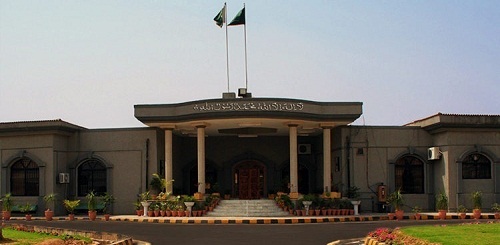
IHC seeks reply in ordinance allowing voting rights to overseas Pakistanis

ISLAMABAD : The Islamabad High Court (IHC) on Friday sought response from the federal government, Election Commission of Pakistan, and law ministry in a plea challenging the presidential ordinance that allows voting rights overseas Pakistanis and the use of electronic voting machines (EVMs).

Justice Amir Farooq of the IHC heard the petition of Pakistan Muslim League-Nawaz (PML-N) MNA Shahnawaz Ranjha against allowing voting rights to overseas Pakistanis and the use of EVMs through a presidential ordiannce.

The court decided to club all the petitions challenging the presidential ordinances and forwarded the request to the IHC Chief Justice Athar Minhallah to form a divisional bench.

The court has sought response from the federal government, the ECP and the law ministry, while the attorney general of Pakistan (AGP) has been directed to assist the court in the case.

Ranjha in his plea has pleaded with the court to declare the ordinance, allowing voting rights to overseas Pakistanis, null and void, stating that the government has become habitual of issuing presidential ordinances.

On May 8, President Dr Arif Alvi had promulgated the Election (second amendment) ordinance 2021, allowing voting rights to overseas Pakistanis.

According to the ordinance issued by the president, changes were made to section 94 (1) and section 103 of the Election Act 2017.

The amendments would help in ensuring that overseas Pakistanis vote during the next general election.

The federal cabinet on May 04 approved two ordinances regarding the use of electronic voting machines (EVMs) and voting rights for overseas Pakistanis.

Azerbaijan and Pakistan: new opportunities for great friends

Rusif Huseynov

DunyaSuleymanova

Since Azerbaijan became an independent state in 1991, it has had close relations with Pakistan. The latter was among the first three countries that immediately recognized Azerbaijan’s independence from the former Soviet Union. Both Azerbaijan and Pakistan are Muslim-majority countries that have supported each other throughout the last three decades on important political issues such as Kashmir and Karabakh. For instance, in April 1993, when the Armenian forces illegally occupied Azerbaijani province of Kalbajar, Pakistan co-sponsored the United Nations Security Council (UNSC) Resolution 822, which demanded the immediate cessation of the hostilities in Karabakh and the withdrawal of Armenian occupying forces from the afore-mentioned province.

Furthermore, Pakistan remains the only country that avoids recognition of Armenia due to the latter`s aggressive policy against Azerbaijan, and one of few countries to have officially recognized the scale of the horrendous Khojaly massacre carried out by Armenian gangs against Azerbaijani civilians in February 1992.

Such a fraternal and warm attitude by Pakistan has always sparked reciprocal rhetoric and action by Azerbaijan, which in turn has always supported Pakistan’s stance on the Jammu and Kashmir issue. Azerbaijan is also a member of the Jammu and Kashmir Contact Group and backs Pakistan in resolving its border disputes with India.

Azerbaijan`s capital in green

During the Second Karabakh war last autumn, Pakistan extended full and unconditional support, again, to Azerbaijan and welcomed the liberation of the territories formerly occupied by Armenia.

This attitude triggered an unprecedented Pakistanomania across Azerbaijan: throughout the 44-day war (27 September – 10 November), as well as in the immediate aftermath, Pakistani flags (along with Azerbaijani and Turkish flags) became something routine and usual for Azerbaijani towns, especially the capital city, Baku, where Parcham-e Sitarah o-Hilal was hung from balconies, and on façade of the buildings, painted on walls, and placed inside houses and offices. Numerous private vehicles were decorated with Pakistani national colors. One of the most creative displays of this obsession took place inside a supermarket, which hosted the Pakistani flag (again together with Azerbaijani and Turkish) made with fruits and vegetables. Both the Victory Day (10 November) and subsequent Victory Parade (10 December) had Pakistani flags as an integral element of celebrations.

Post-war relations

The post-war period did not shrink the political and military alliance; on the contrary, the sides are resolute to strengthen these relations. Several Pakistani officials visited Karabakh, where they would witness the scale of the Armenian-made destruction and call on the international community to help Azerbaijan rehabilitate the liberated areas.

Very recently, in early March 2021, Azerbaijan was attended by a high-level Pakistani delegation led by General Nadeem Raza, the Chairman Joint Chiefs of Staff Committee. In his meeting with Azerbaijani military officials, General Raza discussed the prospects for the development of cooperation between the two countries in the military, military-technical, military-educational, and other spheres, as well as joint military exercises.

In late March 2021, Azerbaijani Foreign Minister Ceyhun Bayramov met with his Pakistani counterpart Shah Mahmood Qureshi to discuss various opportunities for cooperation.

The Azerbaijan-Pakistan relations is also transforming into a more effective triangle with the involvement of Turkey: according to a tripartite declaration signed in January 2021, the three nations are to support each other in challenging issues, further develop the trilateral relations between these countries, since regional transportation and communication channels that provide more opportunities for cooperation have opened as a result of the liberation of Azerbaijani territories. Some experts even suggest this trio can partner in space-related activities.

Current economic relations

While Azerbaijan and Pakistan enjoy the highest level of political ties, the economic and trade relations leave much to be desired: in 2019, Pakistan’s exports to Azerbaijan amounted to some $25 million, while goods in the reverse direction slightly exceeded $1 million. The trade turnover was even lowered to $10 million in 2020, due to the pandemic.

Noticing the economic relations trail behind the political ties, the officials in both countries have been keen to improve this trend in the recent years. The 2015 business forum hosted in Baku was attended by presidents of both Azerbaijan and Pakistan, Ilham Aliyev and Mamnoon Hussain. Organized in 2019 by Azerbaijan`s Export and Investment Promotion Foundation (AZPROMO) and Pakistan`s Border Trade and Industry Chamber, a similar business forum attracted over 150 entrepreneurs operating in various sectors.

In 2017, Azerbaijan and Pakistan signed an agreement on cooperation in the energy sector, with two countries having set goals to buildlong-term energy ties. Azerbaijan`s oil giant SOCAR has been offering the supply of gasoline and LNG cargo to Pakistan LNG Ltd as well as Pakistan State Oil. At the end of 2020, Socar announced that it would help Pakistan to overcome natural gas crisis that could have happened in January 2021. Consequently, it offered bids at the level of 20.4832% of Brent for the time interval from January 29 to February 1, 2021.  According to information, SOCAR is soon going to operate fuel stations in Pakistan.

What can further be done?

The liberation of the occupied territories in Karabakh has not only changed the geopolitical picture in the Caucasus, but also is offering new economic opportunities and prospects. As the entire infrastructure of once prosperous cities and villages in Karabakh had been razed to the ground by the Armenian occupants in the past 25 years, the region`s revival will require a lot of resources and synergy in the forms multi-billion-dollar infrastructure projects. Since it would be too difficult for Azerbaijan to solely rebuild new settlements, Baku is considering proposals for outside investors as well. It should also be noted that the Azerbaijani side will offer preferential policies and concessions to those countries who had been supportive of Azerbaijan`s military efforts of liberating the formerly occupied lands. Pakistan is among these few nations, whose companies can and must partake in the Karabakh infrastructure projects, by enjoying the said preferential attitude. This invite was voiced at the highest level: in the 14th Summit of Economic Cooperation Organization (ECO), the President of Azerbaijan Ilham Aliyev once again thanked Pakistan for its active support throughout the conflict and invited the government of Pakistan, as well as private companies, businesses, investors to invest in the liberated territories of Azerbaijan.

According to the Azerbaijani government`s plan, smart towns and smart villages will be built in the newly liberated areas. This is one of the sectors in which Pakistan can be involved and be effective: Pakistan`s growing IT sector, which generates an annual revenue of between $3 and $4 billion, can put forth viable solutions to Azerbaijan`s smart settlement concepts.

Pakistani agricultural and pharmaceutical firms can not only discover a new market in Azerbaijan, but also use Azerbaijan as a springboard (through joint ventures or re-export) to access to a huge post-Soviet market.

In the post-pandemic period, when traveling mode will return to normalcy, mutual tourism should be encouraged. According to reports, the sides plan to launch Baku-Islamabad direct flight, which can boost not only people-to-people contacts and tourism, but also economic relations.

While Pakistan enjoys a highly positive image in Azerbaijan, this soft power should not be based solely on political and military relations. Pakistani industrial and agricultural companies, as well as cultural organizations should also assume more role within this framework. Why not introduce Lollywood products in Azerbaijan or organize fairs of Pakistan-made exotic fruits in Baku, for instance?

In other words, both societies have an ocean of opportunities to boost economic and cultural ties, which await to be properly exploited.

Rusif Huseynov is the Co-founder and Director of Topchubashov Center, a Baku-based think tank.  Dunya Suleymanova is a research intern at Topchubashov Center.

Stay Connected

64FansLike
60FollowersFollow

Latest Reviews

Exchange Rates

USD - United States Dollar
EUR
1.14
GBP
1.34
AUD
0.70
CAD
0.71