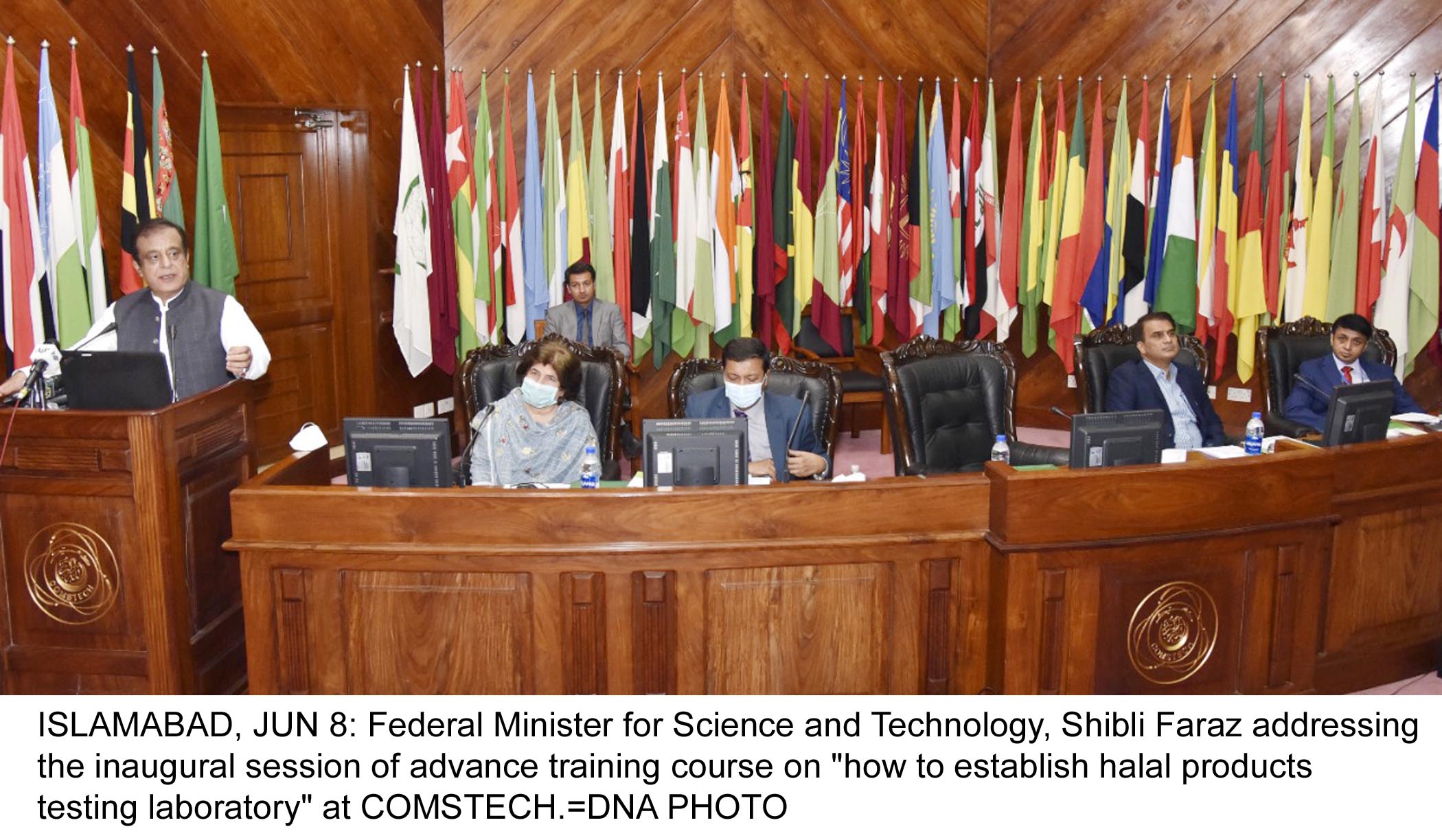
ISLAMABAD, JUN 8: Federal Minister for Science and Technology, Shibli Faraz addressing the inaugural session of advance training course on "how to establish halal products testing laboratory" at COMSTECH.=DNA PHOTO
ISLAMABAD, JUN 8 (DNA) – By our conviction, Islam is a way of life. Islam sets food standards for humanity. Corruption is not Halal, Halal means doing things in lawful manner, said Mr. Shibli Faraz, Minister for Science and Technology while addressing 3-day COMSTECH training course on “How to establish Halal testing laboratory”, here on Tuesday, at COMSTECH Auditorium.
He said rather focusing on going international, focus on ensuring healthy food quality. Labs should have capacity to determine Halal and Haram with the focus on complete food value chain. The Minister encouraged all Halal industry related institutions to develop mechanism for increasing capacities and advised that universities should be part of this as well.
Mr. Faraz highlighted the way forward for research by mentioning that there is a huge gap between research done in the past in Pakistan and its application. He emphasized that research should bring benefit to the people of Pakistan and the entire humanity. He said that research should yield to patent and then be commercialized.
Prof. Dr. Iqbal Choudhary, Coordinator General COMTECH said that Halal accreditation and certification is a niche in which we can achieve excellence. He said that Halal business is growing over 20% and there are no major Halal certification bodies in Muslim countries. Dr. Choudhary said that we at COMSTECH are focused on science based commercialization and developing capacity in OIC member states focusing on the application of science research output. He said that the theme of today’s event is relevant to industrial development of Pakistan and OIC.
Secretary General, The Standards and Metrology Institute for Islamic Countries (SMIIC), Turkey, Mr. İhsan ÖVÜT, said that we need to develop common standards with the commitment to practice them to compete internationally.
The inaugural session was addressed by Ms. Ismat Gul Khattak, Director General, Pakistan National Accreditation Council, Mr. Akhtar A. Bughio, Director General, Pakistan Halal Authority, and Prof. Dr. Syed Ghulam Musharraf, Professor, Dr. Panjwani Center for Molecular Medicine and Drug Research, ICCBS, Karachi.
The inaugural session was attended by 800 participants online and 80 people participated in-person. This 3-day event will end on Thursday, June 10.=DNA
Says cabinet approved Mubashar Hassan name for MD APP; Tariq Malik returns as NADRA chairman; slams opposition for negative politics
Ansar M Bhatti
ISLAMABAD: Minister for Information and Broadcasting Chaudhary Fawad Hussain has said the demonstration process of Electronic Voting Machine, under government’s electoral reforms agenda, will be completed within a week.
He was briefing media in Islamabad on Tuesday afternoon about decisions taken in the Federal Cabinet that met in the Federal Capital today with Prime Minister Imran Khan in the chair.
The Minister said initially we have ordered 500 EVMs for trials in the elections of Bar Councils and press clubs. He said all the 36 conditions of Election Commission of Pakistan have been fulfilled in initial trials of the EVMs. The EVMs are being manufactured by three companies.
Fawad Hussain said PML-N has filed a petition in the court to deprive the overseas Pakistanis of their right to vote while it is among our top priorities to give them basic right of voting as we consider them an integral part of the country. He said we are waiting for PPP’s response in this regard to finalise the legislative procedure.
The cabinet prayed for the martyrs of Ghotki train accident and victims of a Pakistan origin family in Canada. Chaudhary Fawad Hussain said the incident of Canada vindicates Prime Minister Imran Khan’s reservations regarding rising trends of Islamophobia in the West. Condemning the incident, the cabinet stressed on western countries to take immediate steps to root out the major cause of Islamophobia.
The Prime Minister has directed the Minister for Maritime Affairs Ali Haider Zaidi to finalise the reforms in transportation and logistics. The Law Minister Farogh Naseem briefed the cabinet about reforms in criminal law.
The cabinet was informed that around 17 million people are getting benefits of Ehsas program. The data of Ehsas program is being digitalized to make it more transparent.
The cabinet was briefed that Utility Stores Corporation is making sales of over 100 billion rupees and first time it has come out of loss.
The cabinet approved the Corona relief package for Tajikistan to help fight against the pandemic.
The cabinet also accorded the approval to record the National Anthem of Pakistan in modern vogue. The minister also slammed opposition for what he called its negative politics. He called upon them to join hands with the government in nation building.
To a question, Minister for information said we are ready to negotiate with opposition but there would be no compromise on bargaining with corrupt elements. Chaudhary Fawad Hussain said it is condemnable that PML-N does not want to give right of vote to the overseas Pakistanis.
The minister said Mubashir Hassan has been appointed as Managing Director of Associated Press of Pakistan. He told that Tariq Malik has has re-oppointed as Chairman NADRA.
ISLAMABAD, JUN 8 (DNA) – World Oceans Day is celebrated to focus the maintenance and development of the oceans and coastal areas. Oceans are very important for mankind as these are major source of sustenance of life on earth and act as lungs to our planet as they provide more than 50% of the oxygen produced on this planet.
They are also major absorbers of greenhouse gases and carbon dioxide. Oceans regulate our climate holding 97% of the water on earth, almost all rain that drops on land comes from the sea. The human activity on land is directly affecting the oceans and the life that flourishes within.
The theme selected for World Oceans Day-2021 by United Nations is, ‘The Ocean: Life and Livelihoods’. This offers an opportunity to explore the human life relationship with the oceans.
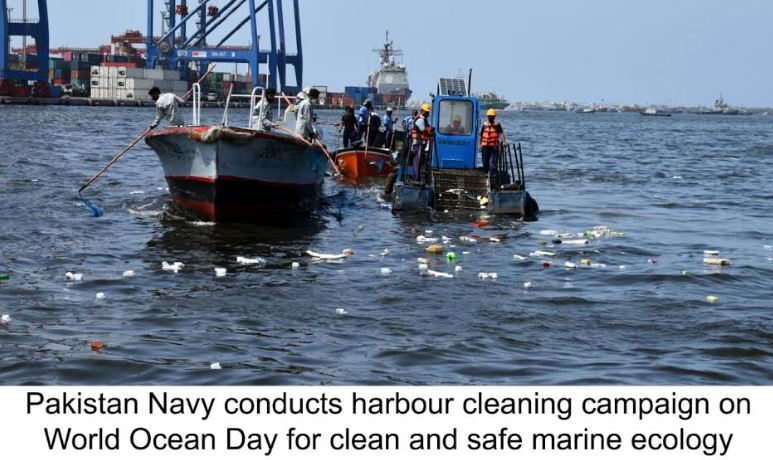
To commemorate significance of the World Oceans Day, Pakistan Navy is playing a lead role in promoting safe and sustainable use of ocean resources. Some of the major Pakistan Navy initiatives include; beach cleaning, construction of harbour debris collection barges, intensive Mangroves plantation, banning use of destructive fishing nets, tackling oil pollution at sea and coordination with industrial community to reduce waste dumping into the sea.
Amidst the ongoing crisis of Covid 19, activities involving Mass gatherings were not held this year. However, other activities related to creating awareness about importance of the oceans through effective use of media have been undertaken. In this regards National Institute of Maritime Affairs (NIMA) has also arranged a number of activities including seminar/ webinar and panel discussions focusing on ocean resources and Blue Economy.
Chief of the Naval Staff, Admiral Amjad Khan Niazi in his message of the day reaffirmed PN resolve and commitment to make every effort to protect, preserve and conserve the oceans for our future generations. He directed men under Command to continue practical and result oriented efforts in this direction.=DNA
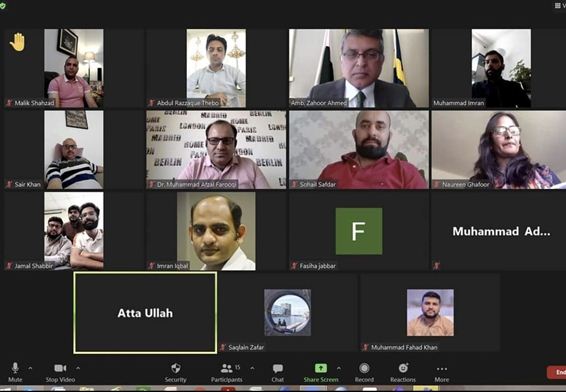
The Ambassador of Pakistan to Sweden and Finland, Dr. Zahoor Ahmed visited Hallunda Church in Stockholm and interacted with Pakistani and Christian community
DNA
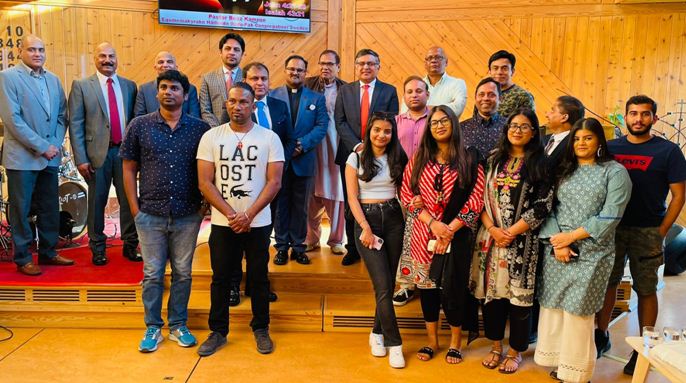
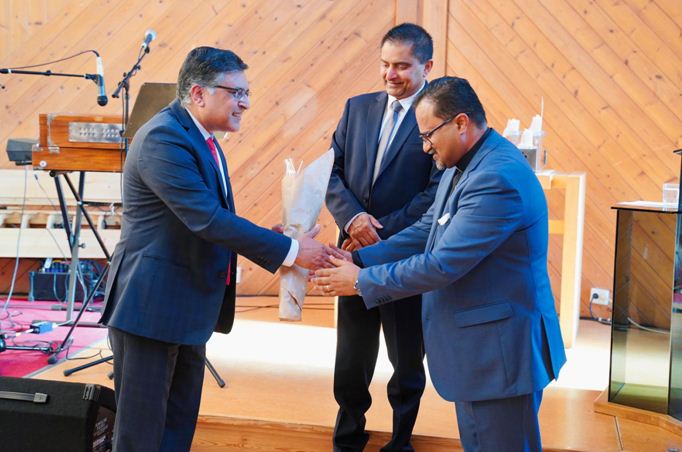
STOCKHOLM: The Ambassador of Pakistan to Sweden and Finland, Dr. Zahoor Ahmed visited Hallunda Church in Stockholm and interacted with the Pakistani Christian Community. The Ambassador was welcomed by Pastor Boaz Kamran and other congregation members.
Speaking on the occasion Ambassador Zahoor Ahmed said Pakistan values the contributions of its Christian population. The white portion of Pakistani flag represented all minorities including the Christian Community who were an asset to the country. He pointed out that Pakistani Christian community had always played an instrumental role in the development of the country particularly in fields of health and education. The institutions established by them have always been an example of excellence and distinction.
He highlighted that Pakistani community in Sweden was a bridge between their country of origin and Sweden and was portraying a soft and positive image of Pakistan.
Pakistan is a diverse country with believes in peace around the world and a dialogue between faiths and civilisations. He reiterated that the embassy would regularly maintain interactions with all segments of the community and work together for promoting relations between Pakistan and Sweden in all spheres.
He remarked that he earlier couldn’t physically meet the community members due to pandemic restrictions and was glad to attend the first congregation after the easing of restrictions.
In the end, prayers were said for peace and prosperity of Pakistan Sweden and entire world.
E-Kachehri For Facilitation Of Pakistani Community in Sweden and Finland
H.E. Zahoor Ahmad Ambassador of Pakistan in Stockholm held E-Kachehri today for Pakistani community in Sweden and Finland.
Ambassador Zahoor’, in his opening remarks, informed the participants that the Embassy held a webinar on Roshan Digital Account in coordination with State Bank of Pakistan, Meezan Bank and Pakistan Stock Exchange on 29 May 2021. He encouraged Pakistanis to benefit from the facility
Pakistani community shared their problems regarding consular matters like problems in filling online visa application, availability of credit card and Pakistan Origin Card which were addressed by Ambassador. He assured that he would continue his engagement with the community for addressing their issues and encouraged them to actively participate in E-Kachehri.
When we hear or watch news, there is a piece of our lives that feels disconnected and helpless. Maybe it is the harsh reality of human against human or the dog-eat-dog verity of the world leaders. Something that separates us from all this cruelty also tends to kill a part of our humanness.
But we seek ways to come back to our human existence and connect with the reality of this world till something starts to fill the void within. There is a sense of satisfaction and peace that happens when you can search for ways to be connected.
When you take that journey, there is no better place to realize the mutual connection with humanity than your history. Asyou walk through your emotions you can understand that this world has been evoking the vigor of the past. Our lives rest on a stagnant pool of ancient ways that tell us where we had come from and where we seem to be going. Human behavior through history has shown major tyrannous acts against the oppressed but it has also proved that humans can always find ways to stand against the tyrant as well.
Unfortunately, due to the fear of being shunned by the powerful authorities, most media influencers and networks do not take the risk of naming the oppressors and the tyrants, rather they use passive tones to address the crimes. Even if someone calls out these heinous crimes of massacre and apartheid, the bullies find ways to even them out by shifting the blame through anti-Semitic label. The atrocities committed by the colonial era and the shift of the blame is not for the East to bear. Just like slavery and racism were not generated by the East or the Muslim countries, similarly the Muslims cannot be blamed for the horrors of holocaust. In fact, history is a proof that Jews have been well tolerated during the Muslim rule, after centuries of institutionalized Western anti-Semitism. The Muslims do not carry the blame of historical cruelty and racist labels that the West tries to shift upon them from time to time.
Having an open discussion about the global affairs gives us the true sense of where we stand. As we start to learn about our history and become more open to discussing our present, we realize that our connection as humans is very powerful. We are not even aware of it though it is right there and has always been. These borders that have been defined for communities as countries exist because of years and years of struggle and sacrifice by our ancestors. People who have been working for generations have made it possible for our identities. You cannot be humbled by that kind of sacrifice nor be forged into living under a rule that bereaves you of that very identity.
Foreign Minister Shah Mahmood Qureshi’s recent appearance at an interview on CNN resulted in the sloppy rendition of his comments that invited anti-Semitic label. The main problem is that the conversation deviated from the real issue of discussing the Palestinian persecution to be scapegoated with Semitism card propelled with tired tropes. While the West must refrain from using such tiresome labels to lighten their own guilt of past mistakes, the Muslims need to understand their role in being more careful while addressing sensitive issues. The fault lies with both sides, when instead of calling out the tyrant, people are busy playing East vs West. Equating the standing of the whole religious community with the atrocities of the Israeli government merely destroys the reality of the Middle East conflict by shifting the tone to a Jews vs Muslims propaganda. Such off the cuff remarks by prominent world leaders provide the licence to countries like Israel to get away with their atrocious tyrannies. Whether it is the Muslims in Palestine, Kashmir, Myanmar or Burma, the solution to discussing their situation lies in acknowledging their identities not pitching one religious community against the other.People who struggle for their freedom in these countries are not only oppressed but have been ripped apart from their loved ones and made to live under a rule that they have no say in.
After living under coercion for so long people seek solutions and openness to their suffocating frustrations. Through media and social networks, we are also soaking in part of that suffocation and there is a sadness that comes along with it. At the same time there is a sense of pleasure as you realize the beauty of human survival, the richness of human hope and fruit of human endeavor through time. Learning about the truth and speaking it out loud is so empowering that you start to see a sense of purposefulness in life. It boosts the confidence of not only those who endure but also awakens the minds of silent observers. We seek knowledge about the past to move forward with better solutions with our words and thoughts.
When we decide to discuss with open minds and hearts, in that moment our memories, our beliefs and our purpose all come together to provide better solutions. Once there is no pointing of fingers or shifting of blames, then there is no doubt to the truth. We will soon be on our way to find better solutions with a focus on reality through our knowledge of history and our courage to stand up against the tyrant. Standing up against the cruel leaders is a clear way of showing how we are going to make it to a better future. When those in power open about an atrocity, they share the light of an idea with many who do not have the guts or the chance to speak up. An impossible change may happen, only because some brave leader had the power to address an issue openly.
(Wajeeha is author of “The Conscious Ego”, “The Beautiful Present”)
The advanced mechanism in international relations has been going through a profound transformation and evolutionary development. New regionalism or regionalization has emerged as a significant trend in international affairs. Now, countries have deepened cooperation among other states and region.
Along with the explicit benefits these processes bring, fundamental pillars of the new regionalism are institutions and organizations that provide integrated platforms. It builds qualitatively modern forms of interactions.The interdependence of markets exerts reciprocal influence on the dynamics of economic processes in various regions and strengthens trade relationships. In this aspect, the Association of Southeast Asian Nations (ASEAN) is aninclusive model for extensive collaboration.
It is a front runner and substantially increasesthe socio-economic development of Asia Pacific regional countries while enhancing multilateral cooperation. Apart from the regional economic, social and cultural development, ASEAN has an ambitious agenda to promote regional peace and stability by adhering to justice and the rule of law in the inter-state relationships. In its more than 40 years of history, ASEAN has steadily progressed in internal economic integration.
In 2003, the ASEAN leaders established an ASEAN integrated community comprising three pillars: security community, economic community, and socio-cultural community. In this aspect, it can be seen that the ASEAN countries are inclined towards resolving their internal disputes, combating Non-Traditional Security (NTS) threats vis-à-vis cooperation under the ASEAN framework, and contributing to the stability of the Asia Pacific region.Therefore, the paper explains the intra-ASEAN cooperative patterns and highlights the profound developments in recent times. The study also provides aprofound analysis of thesocio-economic and political structure of ASEAN.
The ASEAN Economic Community (AEC): A Robust Intra-StateFramework
ASEAN is amid three major pillars, i.e., political security community, economic community, and socio-cultural community. The ASEAN Economic Community(AEC)focusedon wider economic integration.In 2015, its establishment paved the way for implementing its blueprint in recent times.The primary AEC goals incorporatemultiple sectoral dimensions. There are various transformative mechanisms of ASEAN’s economic integration that are interconnected.AEC is an ‘’FTA-Plus’’ economic integration, and it targets the level of market integration, similar to those of the Economic Partnership Agreement. Thus, it is highly praised for its integration and steady development process. The broader vision of AEC2025 aims to participate in the global value chainand attract Foreign Direct Investment (FDI). Furthermore, it can be evaluated as a successful model of broader association among different countries.
ASEAN envisions AEC2025 as a great achievement towards hybrid alignment in the economic framework. Moreover, it has been perceived that itsenhanced collaboration withsectoral cooperation, resilient structure, and people-centered communityassociated with the global economy would result in a boon for all parties involved. It has five majortenants and multiple key features that are beingcomprehensively described in the table below:
Tenants
Features
A highlyprogressive and integrated economy
Goods & servicesConducive strategies for Foreign Direct Investment (FDI)Financial sustainabilityFacilitating workforce and business sectorEnhancing participation in global value chains
Enhanced cooperation-sectoral development
Academic cooperation&E-Commerce, Energy, Food, agriculture and forestryTourismHealthcareTransport
A competitive, transforming & dynamic structure of ASEAN
Digital economy Research and developmentScience & Technological advancement.Tariff’s feasibility Good governance, regulatory reformsResponsive regulations RegimesSustainable economic growthResolving trade-related Issues
A resilient, inclusive, people-oriented ASEAN
Facilitating the micro&medium enterprises (SMEs) EncouragingPublic-private partnershipsCombining allstakeholders to contribute to regional peace
Global ASEAN
Develop coherent and investment-friendlyincentives for maintaining external economic relation Playing constructive role at other international platforms Maintain economic alliance with non-FTA dialogue partners
The Intra-State ASEAN’s framework details mentioned abovereflect that these countriesare likely to gaineconomic benefit from FTA in future and further foster collaborative measures vis-à-vis reinvigorating financial stability, maintaining investment flows, technology transfer, reducing intra-regional transactions costs to doing business, and supporting policy reform. Moreover, it is also expected that the ASEAN’s new member states would also maximizelucrative outcomes from the socio-economic integration projects in the region and beyond. The broader regional arrangements will help ASEAN countries overcome the conflictby adhering toneeded reforms whileassisting in information sharing for conflict resolution and crisis management.
Flexible Paradigm of ASEAN and Regional Integration Theory
The origins of regional integration theory can be traced back to Viner’s study in 1950. His workformulated a structure for analyzing the effect of creating trade &customs union or regional/international organizations for regulating the governments. The pillars of the regional integration theory amid broader economic aspects. It seeks to explain the establishment of regional or international organizations. In this aspect, the theory also answers the major question ofhow regional organizations expand their targets, competencies, and members? and what impact they have on states and societies in their regions?ASEAN is a supranational body that has transnational corporations and interest groups encouraged by the integration process. Therefore, the ASEAN framework can be seen through the prism of the regional integration theory of international relations. The wider association enables a variety of ripple impactsand path-dependencies that takeconnectivity beyond the regional confines. ASEAN covers the establishment and progress of supranational policies. The member states promote beneficiaries of socio-economic progress. In this aspect, the wider integration has remained successful because of several reasons:
Robust interstate trade/commerce strategies
Durable liberalization policies while setting high goals
The significant role of the FDI companies
Promotion of trade with countries outside the ASEAN region
Efforts to curtail intra-regional disparities
Upgrading and developing the transportation infrastructure
Indonesia’s Substantial Role in Fostering Intra-ASEAN Socio-Economic Structure
Indonesia is the major economic power in the ASEAN region. Moreover, it has played a pivotal role as a mediator between other ASEAN-states in resolving their disputes. Within ASEAN, Indonesia enjoys aleading position. Pakistan has the status of Sectoral Dialogue Partner (SDP) in ASEAN. Indonesia has been helping Pakistan to attain the status of a full dialogue partner in the organization. The relationship between Indonesia and Pakistan has marked significant progress in recent times. The valuable asset of the relation is that the ASEAN countries are convinced of Pakistan’s sincere intentions to engage fruitfully with the region. In this aspect, ASEAN-Pakistan Joint Sectoral Committee works effectively to seek deeper association with the Asia Pacific and ASEAN countries. Presently, China’s engagement with ASEAN has increased manifold. Both are linked via multilateral frameworks, institutional involvements, constructive engagements, and aid programs. Moreover, the ASEAN countries are directly part of the Belt & Road Initiative (BRI) and Asia Pacific Economic Cooperation (APEC) projects. Therefore, the full inclusion of China as a member state in ASEAN would be beneficial for the region and all parties involved.
Khalid Taimur Akram is the Executive Director, Center for Global & Strategic Studies (CGSS), Islamabad
ISLAMABAD: Ambassador of Palestine Ahmed Rabei has expressed deep sense of sorrow and grief over the loss of lives in train accident. In a message addressed to the Prime Minister of Pakistan Imran Khan and Foreign Minister Shah Mahmood Qureshi, the ambassador said govt and people of Palestine were with Pakistan in this difficult time.
The text of the letter reads, “On behalf of the Government of Palestine, Palestinian people and on my personal behalf, I would like to convey my deepest condolences and sympathies for the people when at least 31 people were killed while more than 100 were injured on Monday after two passenger trains collided near Daharki, a city located in the Ghotki district of upper Sindh, it is indeed a great loss and we Palestinians are very much grieved over the loss of precious lives of our brothers and sisters, may Allah give the martyrs an eternal peace in Jannah, and bless the injured ones speedy recovery.
Our good wishes and prayers are with the bereaved families in this difficult time, and we would feel grateful to extend any possible assistance on our part, in whatever way possible, to be a part of the efforts for families affected by this accident.
I take this opportunity to renew again my heartfelt condolences to Your Excellency and your nation, May your nation has the fortitude to bear this irreparable loss”.
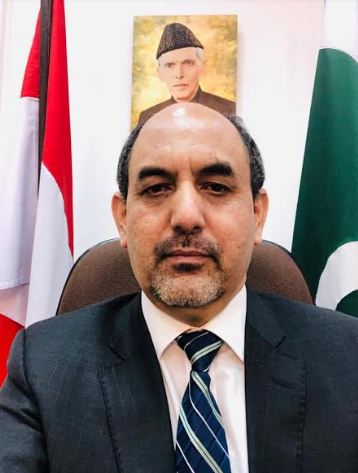
Ambassador Hassan proposed cooperation between NDMA of Pakistan and disaster management agencies of ASEAN through information sharing, early warning, surveillance, joint training, and common standards
DNA
JAKARTA: Speaking at the launching ceremony of the Association of East Asian Nations (ASEAN)’s Disaster Management and Emergency Work Program for the year 2021-25, Ambassador of Pakistan to ASEAN, pledged Pakistan’s full support to ASEAN’s disaster and risk management efforts.
The meeting was attended by the representatives of all ASEAN member states and its development partners. Pakistan is a Sectoral Dialogue Partner of ASEAN. In this capacity, Pakistan partners with ASEAN in many programmes of the Organization including those related to climate change and risk management. Pakistan’s Ambassador to ASEAN, based in Jakarta is also concurrent.
During his speech, Ambassador Muhammad Hassan stated that Pakistan would be happy to support the initiatives and the priority programmes, especially those related to disaster risk reduction and climate change adaption.
Pakistan believes that in any disaster, regional and international partnerships are important in building resilience amongst partner states and preparing communities to effectively respond to disasters through further stakeholder coordination.
The Ambassador further stated that climate change phenomena are amplifying the risk of extreme weather disasters. It also poses significant risks to vulnerable groups, especially the poor, in both rural and urban areas all over the world including Pakistan and ASEAN. Pakistan’s climate change concerns included unusual rain patterns especially during monsoons, the likely impact of receding Himalayan glaciers on the Indus River system, decreased capacity of water reservoirs, reduced hydropower during drought years, and extreme events including, floods and droughts. Government of Pakistan was looking at ways to urgently addressing it. One successful initiative taken by the government was restoration of ecosystem by planting Ten Billion Trees Tsunami, which has been acknowledged by UNEP.
Ambassador Hassan proposed cooperation between NDMA of Pakistan and disaster management agencies of ASEAN through information sharing, early warning, surveillance, joint training, and common standards and protocols required for regional cooperation. He said that NDMA had the mandate to manage complete spectrum of disasters by adopting a disaster risk reduction perspective in development planning at all levels, and through enhancing institutional capacities for disaster preparedness, response and recovery. The agency already had cooperation agreement with a number of partner organizations in friendly countries. It was also ready to share its experiences with ASEAN partners.
Azerbaijan naval chief briefed on Pakistan Navy’s roles & objectives and contributions toward peace and stability in the region
Staff Report
ISLAMABAD: Rear Admiral Subhan Bakirov, Commander Azerbaijan Naval Forces (ANF) called on Chief of the Naval Staff, Admiral Muhammad Amjad Khan Niazi at Naval Headquarters, Islamabad.
Upon arrival, Commander Azerbaijan Naval Forces was received by Chief of the Naval Staff. A smartly turned out contingent of Pakistan Navy presented Guard of Honour. Thereafter, the dignitary laid floral wreath at the Shuhada’s Monument and was introduced to the Principal Staff Officers at Naval Headquarters.
Later, Commander Azerbaijan Naval Forces called on Chief of the Naval Staff. During the meeting matters of mutual interest including bilateral collaboration and regional security were discussed. The visiting dignitary appreciated and acknowledged Pakistan Navy’s efforts and commitments in support of collaborative maritime security in the region.
Both the dignitaries agreed on further enhancing mutual interactions in diversified naval domains. A briefing was also given to the visiting dignitary on Pakistan Navy’s roles & objectives and contributions toward peace and stability in the region. The dignitary is also scheduled to visit Karachi and Lahore to have interaction with Field Commanders of Pakistan Navy and visit Pakistan Navy Training institutes.
It is expected that the visit of Commander Azerbaijan Naval Forces will further enhance bilateral collaboration between the two countries in general and navies in particular.=DNA
Karachi/Islamabad, 8 June 2021: Mapping and development of strategic human and natural resources in the maritime sector is the need of the hour to sow the seeds of blue economic revolution in Pakistan.
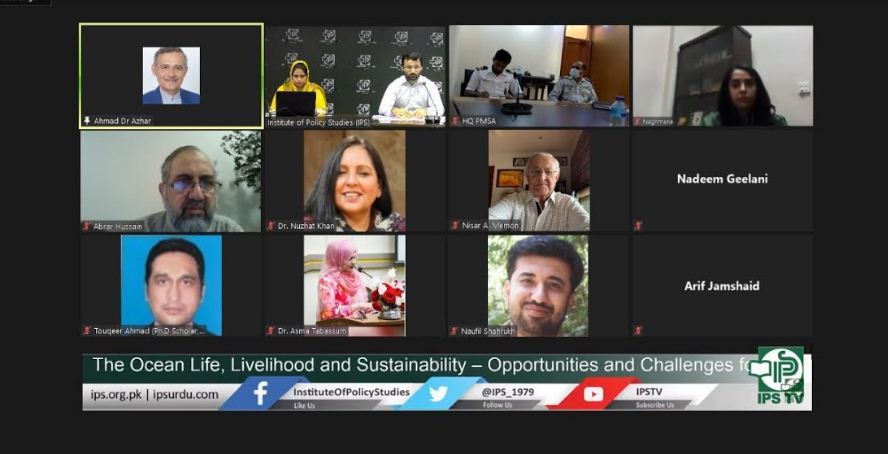
This was the crux of the views expressed by maritime policy experts and marine scientists at a webinar titled ‘The Ocean: Life, Livelihood and Sustainability – Opportunities and Challenges for Pakistan’, which was organized on the eve of World Oceans Day 2021 by Institute of Policy Studies (IPS) in collaboration with University of Karachi, National Institute of Maritime Affairs (NIMA), Pakistan Maritime Security Agency (PMSA), and Maritime Study Forum (MSF).https://googleads.g.doubleclick.net/pagead/ads?client=ca-pub-7078513716629609&output=html&h=280&adk=230062724&adf=2510378044&pi=t.aa~a.2356292401~i.10~rp.4&w=696&fwrn=4&fwrnh=100&lmt=1623147699&num_ads=1&rafmt=1&armr=3&sem=mc&pwprc=2527759049&psa=1&ad_type=text_image&format=696×280&url=https%3A%2F%2Fislamabadpost.com.pk%2Fexperts-stress-importance-of-ocean-health-at-ips-webinar-on-world-oceans-day%2F&flash=0&fwr=0&pra=3&rh=174&rw=696&rpe=1&resp_fmts=3&wgl=1&fa=27&adsid=ChAI8Kr8hQYQueHGxqj0_a0TEjkA9cGHIl8dDn2_7XI2QqK-5_H9QnLvKiVOvJug9RhMh2XmkWK3eNu40M6QaWyUx6JILN8dE_PUG9Y&uach=WyJXaW5kb3dzIiwiNi4xIiwieDg2IiwiIiwiOTEuMC40NDcyLjc3IixbXV0.&dt=1623147699211&bpp=4&bdt=7334&idt=-M&shv=r20210603&cbv=%2Fr20190131&ptt=9&saldr=aa&abxe=1&cookie=ID%3D2cab8dd1d7a97507-2251d758ada700c6%3AT%3D1619371132%3ART%3D1619371132%3AS%3DALNI_MbCWjL6fpbAI7C_Q4Gb9OcZB0P5kA&prev_fmts=0x0%2C1200x280&nras=3&correlator=6791700173158&frm=20&pv=1&ga_vid=400380057.1623147695&ga_sid=1623147695&ga_hid=2130674516&ga_fc=0&u_tz=300&u_his=4&u_java=0&u_h=768&u_w=1366&u_ah=728&u_aw=1366&u_cd=24&u_nplug=3&u_nmime=4&adx=141&ady=1609&biw=1349&bih=600&scr_x=0&scr_y=0&eid=42530672&oid=3&pvsid=1925115839950766&pem=180&eae=0&fc=1408&brdim=0%2C0%2C0%2C0%2C1366%2C0%2C1366%2C728%2C1366%2C600&vis=1&rsz=%7C%7Cs%7C&abl=NS&fu=128&bc=31&ifi=3&uci=a!3&btvi=1&fsb=1&xpc=eIwPTwKt5m&p=https%3A//islamabadpost.com.pk&dtd=111
The webinar was chaired by Ambassador (r) Syed Abrar Hussain, IPS’ vice chairman and addressed by Dr Azhar Ahmad, associate professor, Bahria University, Dr Nuzhat Khan, former director general, National Institute of Oceanography (NIO), Nisar A. Memon, technocrat and former chairman of the parliamentary committee on water resources, Dr Asma Tabassum, manager ORIC, Karachi University, Naghmana Zafar, senior research fellow, NIMA, Naufil Shahrukh, GM Operations, IPS and general secretary, Maritime Study Forum (MSF), while Commander Moeed, Lt Cdr Imran, and Lt Jameel represented the PMSA. The session was moderated by Hafiz Inamullah Khan, deputy manager outreach at IPS.
The discussants were of the view that developing aquaculture is critical for enhancing the livelihood means and skills of the fisherfolk coastal communities of Pakistan, which populate the 1001km long coastline of the country in large numbers. Research done in universities can help them in developing aquaculture in their coastal villages for algae, sea grasses, and several other valuable biological species having great economical, medicinal and environmental importance.
A lot of meaningful research focusing the marine resources of Pakistan has already been carried out in Karachi University, Bahria University and other universities and research institutions, however the government’s apathy and lack of interest in the industrial sector to invest in R&D and commercialize available academic research is a big hurdle that needs to be overcome, they deplored.https://googleads.g.doubleclick.net/pagead/ads?client=ca-pub-7078513716629609&output=html&h=280&adk=230062724&adf=1934099346&pi=t.aa~a.2356292401~i.16~rp.4&w=696&fwrn=4&fwrnh=100&lmt=1623147700&num_ads=1&rafmt=1&armr=3&sem=mc&pwprc=2527759049&psa=1&ad_type=text_image&format=696×280&url=https%3A%2F%2Fislamabadpost.com.pk%2Fexperts-stress-importance-of-ocean-health-at-ips-webinar-on-world-oceans-day%2F&flash=0&fwr=0&pra=3&rh=174&rw=696&rpe=1&resp_fmts=3&wgl=1&fa=27&adsid=ChAI8Kr8hQYQueHGxqj0_a0TEjkA9cGHIl8dDn2_7XI2QqK-5_H9QnLvKiVOvJug9RhMh2XmkWK3eNu40M6QaWyUx6JILN8dE_PUG9Y&uach=WyJXaW5kb3dzIiwiNi4xIiwieDg2IiwiIiwiOTEuMC40NDcyLjc3IixbXV0.&dt=1623147699146&bpp=3&bdt=7268&idt=3&shv=r20210603&cbv=%2Fr20190131&ptt=9&saldr=aa&abxe=1&cookie=ID%3D2cab8dd1d7a97507-2251d758ada700c6%3AT%3D1619371132%3ART%3D1619371132%3AS%3DALNI_MbCWjL6fpbAI7C_Q4Gb9OcZB0P5kA&prev_fmts=0x0%2C1200x280%2C696x280%2C324x250&nras=5&correlator=6791700173158&frm=20&pv=1&ga_vid=400380057.1623147695&ga_sid=1623147695&ga_hid=2130674516&ga_fc=0&u_tz=300&u_his=4&u_java=0&u_h=768&u_w=1366&u_ah=728&u_aw=1366&u_cd=24&u_nplug=3&u_nmime=4&adx=141&ady=2207&biw=1349&bih=600&scr_x=0&scr_y=0&eid=42530672&oid=3&pvsid=1925115839950766&pem=180&eae=0&fc=1408&brdim=0%2C0%2C0%2C0%2C1366%2C0%2C1366%2C728%2C1366%2C600&vis=1&rsz=%7C%7Cs%7C&abl=NS&fu=128&bc=31&ifi=4&uci=a!4&btvi=3&fsb=1&xpc=rqHDKDBAfQ&p=https%3A//islamabadpost.com.pk&dtd=987
Integrated coastal zone management and strict enforcement of national and international environmental laws to protect the sea and its resources was also emphasized by the speakers.
During the discussion in the webinar, it was highlighted that all over the world coastal communities are better off because the coastal areas are more developed. But in Pakistan, except for Karachi, the entire coast has remained neglected. Although CPEC has given a fillip to the maritime sector, more concerted efforts are required to impart modern training and necessary skills in all elements of blue economy.
The National Maritime Policy, promulgated in 2002, was revised in draft form almost a decade back but could not be finalized so far, which the discussants termed as apathy and nonchalance for maritime affairs on the part of the policymakers. Pakistan needs a comprehensive maritime policy which should be formulated by taking all the stakeholders on board, it was urged.
The speakers lauded the efforts of IPS to address sea blindness in Pakistan and help create a maritime research community engaging universities and think tanks across the country. To enhance awareness of the oceans and maritime sector, introduction of the subject in the educational curriculum at various levels was also advocated.
Commenting on the deteriorating ocean health, the discussants urged the PMSA to take the lead in enforcing environmental laws strictly by creating synergies among the environmental protection agencies of Sindh and Balochistan and the local governments of the coastal districts of both the provinces.