Home Blog Page 2212

Andrew Cuomo says he will resign as Governor

ALBANY, N.Y. — Gov. Andrew M. Cuomo of New York said on Tuesday he would resign from office, succumbing to a ballooning sexual harassment scandal that fueled an astonishing reversal of fortune for one of the nation’s best-known leaders.

Mr. Cuomo said his resignation would be effective in 14 days. Lt. Gov. Kathy Hochul, a Democrat, will be sworn in to replace him. She will become the first female governor of New York.

The governor framed his resignation as a necessary step given the firestorm of controversy surrounding his continued leadership, including an impeachment inquiry that he referred to as a “distraction” from pressing issues pressing the state as it recovers from the pandemic.

“Given the circumstances, the best way I can help now is if I step aside and let government get back to governing,” Mr. Cuomo said. “And therefore that’s what I’ll do.”

The announcement from Mr. Cuomo, a three-term Democrat, came one week after a report from the New York State attorney general concluded that the governor sexually harassed nearly a dozen women, including current and former government workers, by engaging in unwanted touching and making inappropriate comments.

The 165-page report also found that Mr. Cuomo and his aides unlawfully retaliated against at least one of the women for making her complaints public and fostered a toxic work environment.

The report put increased pressure on Mr. Cuomo to resign, leading to new calls to do so from President Biden, a longtime friend of the governor, and other Democratic leaders who had withheld judgment until the report’s findings were made public, and leaving Mr. Cuomo with few, if any, defenders.

The report’s fallout had left Mr. Cuomo increasingly isolated: His top aide, Melissa DeRosa, resigned after concluding the governor had no path to remain in office, according to a person familiar with her thinking.

In the end, Mr. Cuomo followed through on the advice his top advisers and onetime allies had been offering: leave office voluntarily.

Mr. Cuomo stepped down as he faced the specter of forced removal from office through impeachment and was poised to become only the second governor to be impeached in the state’s history.

Following the report’s release, the leaders of the State Assembly, which is controlled by Democrats, began moving to draft articles of impeachment and appeared to have enough support to impeach him.

Numerous steps taken for development of Balochistan: PM

LESBAILA: Prime Minister Imran Khan has said the government has taken numerous steps for the development of Balochistan as it is linked with the progress of Pakistan.

Inaugurating tree-plantation at sonmiani beach in Lesbaila this evening, he said around one trillion rupees have been allocated for the development of Balochistan, which is unprecedented in the history of Pakistan.

The Prime Minister said that the government is devising a plan to tap natural resources of the province that could be utilized for the prosperity of the local people. He regretted that the previous governments paid a deaf ear to the development of Balochistan. He said steps will be taken to promote tourism along the coastal line from Lesbaila to Gwadar. He urged the locals to overwhelmingly support government’s a forestation efforts and to protect the existing tree cover of the country so that adverse impacts of the climate change can be averted.

United States vows to isolate Taliban if they take power by force

WASHINGTON, AUG 10: A U.S. peace envoy brought a warning to the Taliban on Tuesday that any government that comes to power through force in Afghanistan won’t be recognized internationally after a series of cities fell to the insurgent group in stunningly quick succession.

Zalmay Khalilzad, the U.S. envoy, traveled to Doha, Qatar, where the Taliban maintain a political office, to tell the group that there was no point in pursuing victory on the battlefield because a military takeover of Kabul would guarantee they will be global pariahs. He and others hope to persuade Taliban leaders to return to peace talks with the Afghan government as American and NATO forces finish their pullout from the country.

The insurgents have captured five out of 34 provincial capitals in the country in less than a week. They are now battling the Western-backed government for control of several others, including Lashkar Gah in Helmand, and Kandahar and Farah in provinces of the same names.

After a 20-year Western military mission and billions of dollars spent training and shoring up Afghan forces, many are at odds to explain why the regular forces have collapsed, fleeing the battle sometimes by the hundreds. The fighting has fallen largely to small groups of elite forces and the Afghan air force.

The success of the Taliban blitz has added urgency to the need to restart the long-stalled talks that could end the fighting and move Afghanistan toward an inclusive interim administration.

The new pressure from Khalilzad follows condemnations from the international community and a similar warning from the United Nations that a Taliban government that takes power by force would not be recognized. The insurgents have so far refused to return to the negotiating table.

Khalilzad’s mission in Qatar is to “help formulate a joint international response to the rapidly deteriorating situation in Afghanistan,” according to the U.S. State Department.

He plans to “press the Taliban to stop their military offensive and to negotiate a political settlement, which is the only path to stability and development in Afghanistan,” the State Department said.

Meanwhile, the Taliban military chief released an audio message to his fighters on Tuesday, ordering them not to harm Afghan forces and government officials in territories they conquer. The recording was shared on Twitter by the Taliban spokesman in Doha, Mohammad Naim.

In the nearly five-minute audio, Mohammad Yaqoob, the son of late Taliban leader Mullah Mohammad Omar, also told the insurgents to stay out of abandoned homes of government and security officials who have fled, leave marketplaces open and protect places of business, including banks.

It was not immediately clear if Taliban fighters on the ground would heed Yaqoob’s instructions. There have been reports by civilians who have fled Taliban advances of heavy-handed treatment by the insurgents — schools being burned down and repressive restrictions on women.

There have also been reports of revenge killings in areas where the Taliban have gained control, and the insurgents have claimed responsibility for killing a comedian in southern Kandahar, assassinating the government’s media chief Kabul and a bombing that targeted acting Defense Minister Bismillah Khan Mohammadi, killing eight and wounding more. The minister was not harmed in the attack.

The intensifying war has also increased the number of civilian casualties.

The International Committee of the Red Cross said that its staff has treated more than 4,000 Afghans this month in their 15 facilities across the country, including in Helmand and Kandahar, where Afghan and U.S. airstrikes are trying to rein in the Taliban onslaught.

“We are seeing homes destroyed, medical staff and patients put at tremendous risk, and hospitals, electricity and water infrastructure damaged,” Eloi Fillion, ICRC’s head of delegation in Afghanistan, said in a statement.

“The use of explosive weaponry in cities is having an indiscriminate impact on the population,” Fillion added. “Many families have no option but to flee in search of a safer place. This must stop.”

The surge in Taliban attacks began in April, when the U.S. and NATO announced they would end their military presence and bring the last of their troops home. The final date of the withdrawal is Aug. 31, but the U.S. Central Command has said the pullout is already 95% complete.

On Monday, the U.S. emphasized that the Biden administration now sees the fight as one for Afghan political and military leaders to win or lose — and showed no sign of stepping up airstrikes despite the accelerating Taliban gains.

“When we look back, it’s going to come down to leadership and what leadership was demonstrated, or not” by Afghans, Pentagon spokesman John Kirby said at a Pentagon news conference. “It’s their country to defend now. It’s their struggle.”

Khalilzad, the architect of the peace deal the Trump administration brokered with the Taliban, was expected to hold talks with key regional players, as well as unspecified multilateral organizations to see how to restart talks and halt the Taliban onslaught.

The U.S. envoy will also likely seek a commitment from Afghanistan’s neighbors and the region not to recognize a Taliban government that comes to power by force. When the Taliban last ruled Afghanistan, three countries recognized their rule: Pakistan, Saudi Arabi and the United Arab Emirates.

Senior Afghan officials have also travelled to Doha, including Abdullah Abdullah, who heads the government’s reconciliation council. Pakistan’s national security adviser, Moeed Yusuf, on Monday called for “reinvigorated” efforts to get all sides in the conflict back to talks, describing a protracted war in Afghanistan as a “nightmare scenario” for Pakistan.

Yusuf, speaking to foreign journalists in Islamabad, refused to definitively say whether Pakistan, which holds considerable sway over the Taliban, would recognize a Taliban government installed by force, saying instead that Pakistan wants to see an “inclusive” government in Kabul.

INDIA WILL NOT DISCARD ILL-INTENTIONS AGAINST PAKISTAN EVEN IF WE DROP KASHMIR: AJK PRESIDENT

MUZAFFARABAD, AUG 10 /DNA/ – The President of Azad Jammu and Kashmir (AJK), Sardar Masood Khan has said that the history of the past 73 years bears testimony that even if we drop Kashmir, India will not discard its nefarious intentions against Pakistan. In a detailed article he wrote for a Pakistani news web portal and its print edition, he said that we have to squash the myth that Kashmir is responsible for the slow economic growth of Pakistan. The AJK President stated that Kashmir is not responsible for the decline in the economic growth of Pakistan. There are other factors that keep pushing down our macroeconomic indicators, such as hidden wealth, a subterranean economy that refuses to join the tax regime, chronic dependence on external debt, corruption, and rent-seeking, he argued. President Masood expressed his optimism that despite these barriers, Pakistan’s economy is poised to grow rapidly in the coming years. Kashmir is no drain on economic development. So this is a false argument if ever invoked. With or without Kashmir being a factor, we still need to allocate resources for the armed forces for our national security because we have long vulnerable borders on all sides that need to be defended 24/7. Dispelling the notion that if we drop Kashmir temporarily, India would open the door for economic development and wealth for us, President Masood said he doesn’t think so as the current and past literature dating back to the very inception of Pakistan substantiates that India wants to emasculate Pakistan and turn it into its economic satellite for raw materials, semi-finished goods, and a monopolist’s consumer market. “Kashmir or no Kashmir, India will not discard that agenda, and it will not matter whether the reins of government are with the proponents of Hindutva or a disingenuous brand of secularism”, he emphasized. He said that Pakistan’s economic opportunities lie in its north and northeast, Western Hemisphere, the south, southeast Asia, and Africa; not with the eastern neighbour though we share the same subcontinent and have multiple cultural, social, and historical linkages. The division with the eastern neighbor is strategic and civilizational. He went on to say that the fault line of Kashmir sits at the center of the existential divide that we live through. Maybe one day wisdom would prevail, and India’s people would be persuaded to give Kashmiris their right, and we would be able to create South Asia’s brave new world.

DECISION TO KEEP PAKISTAN ON RED LIST BASED ON ‘DATA AND SCIENCE’: UK

LONDON, AUG 10: The British High Commission in Pakistan on Monday said that the decision to keep the country on the red list, under the coronavirus travel restrictions, was based on data and science.

The British government placed Pakistan and India on the red list on April 2 and 19, respectively. However, in an updated list, the government announced that India, Bahrain, Qatar and the UAE would be moved to the amber list from August 8.

A day earlier it was reported that UK senior health official JO Churchill said that Pakistan was being retained on Britain’s “red list” due to the “worsening Covid-19 situation and low testing rates”.

The decision was met with backlash from the Pakistani public and politicians alike who termed it unjust. Human Rights Minister Shireen Mazari criticised the British government, calling the measure ‘ridiculous’.

“UK gov[ernmen]t, dominated by Indophiles and despite globally documented India’s continuing disastrous handling of Covid pandemic, moved India to Amber List but keeps Pak on Red [list]; then under pressure from Opp[osition] MPs gives feeble excuse Pak didn’t share data,” Minister Mazari said in a tweet.

She further stated that the British government had never asked for Pakistan’s Covid-19 data which was already publicly available as the National Command and Operation Center (NCOC) has a centralised database, which is updated daily and added that it was also being shared with the UK High Commission.

“Earlier UK govt had given another excuse – that more Pak passengers than Indians tested positive! Shifting goalposts!” the minister added.

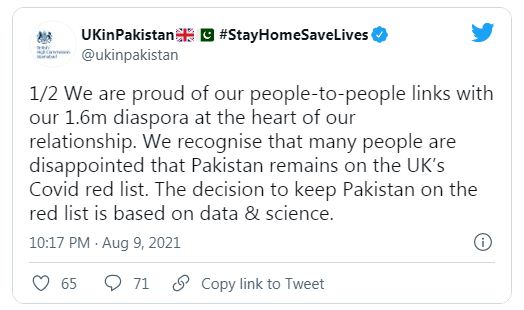
“We are proud of our people-to-people links with our 1.6m diaspora at the heart of our relationship. We recognise that many people are disappointed that Pakistan remains on the UK’s Covid red list,” the British High Commission in Pakistan wrote on its official Twitter handle late on Monday.

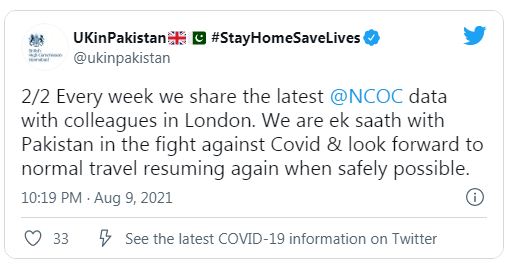
It said that the decision to keep Pakistan on the red list is based on data and science. “Every week we share the latest NCOC data with colleagues in London. We are ek saath (together) with Pakistan in the fight against Covid & look forward to normal travel resuming again when safely possible,” it wrote in another tweet.

In a letter dated August 6, Churchill while explaining the reason for keeping Pakistan on the red list of countries said the UK’s Joint Biosecurity Centre continues to assess risk based on factors including incidence, trends in deaths/hospitalisations, exported cases as well as testing and test positivity rates.

Her response comes after Pakistan including several members of the British House of Commons slammed the UK government for keeping Pakistan on its red list of countries at the latest coronavirus travel update while removing India from it.

“In Pakistan, the combination of a deteriorating epidemiological situation, combined with low testing rates and limited genomic surveillance, presents a high risk that an outbreak of a new variant, or existing VoC [variant of concern], will not be identified before it is imported to the UK,” she said in a letter.

The red list of the countries means only the UK nationals and those with residency rights will be allowed to travel to the country if they stayed in Pakistan in the 10 days before they arrive. The amber travel list means that returnees can quarantine at home, rather than in a hotel.

Britain’s MP Yasmin Qureshi had termed the move to keep Pakistan on the red list while downgrading India “a clear and blatant discrimination towards Pakistan”.

PAKISTAN REJECTS REPORT OF ‘CRACKING DOWN’ ON DISSIDENTS ABROAD

ISLAMABAD, AUG 10: Pakistan on Tuesday “categorically rejected” a foreign media report claiming the country was cracking down on dissidents abroad, with the Foreign Office terming such accusations baseless.

The FO, responding to the report published in The Guardian, said there was no question of any threat being made to any national of any state including Pakistan’s own nationals living anywhere on any pretext whatsoever.

The report had claimed that exiled Pakistanis who were critical of the military had been warned by UK authorities “that they will be targeted”.

“Pakistan, a strong UK ally — particularly on intelligence issues — might be prepared to target individuals on British soil,” the story alleged.

The Guardian report also featured a statement from Mark Lyall Grant, the former UK high commissioner to Pakistan, who said: “If there is illegal pressure, in particular on journalists in the UK, then I would expect the law enforcement agencies and the British government to take notice of that and to make an appropriate legal and/or diplomatic response.”

The report also noted that a man was charged in London last month with conspiring to murder political activist Ahmad Waqass Goraya in the Netherlands.

It also said political analyst had received an Osman warning from the Metropolitan Police — a warning named after a case from the late 90s. The warning was issued by British authorities who believe there is a death threat to the prospective victim.

Reacting to the claims carried in the report, the Foreign Office spokesperson, Zahid Hafeez Chaudhri said that the unsubstantiated allegations appeared to be part of the rather “blatant on-going misinformation campaign” against Pakistan to malign the country and its state institutions.

The spokesperson insisted that Pakistan is a parliamentary democracy with a “vibrant civil society, free media and independent judiciary”, which remains fully committed to promotion and protection of human rights for all its citizens without discrimination.

“Our strong commitment to the right to freedom of opinion and expression is demonstrated by presence of scores of vibrant media channels and newspapers in the country,” said the statement.

The Foreign Office rued that the provision of a platform for peddling of unsubstantiated and false narratives against Pakistan by any news outlet was “regrettable”.

NEW FACE FOR AGING CPEC CHALLENGES

Munir Ahmed

About a week back, the government appointed an energy specialist and former Chief Executive Officer (CEO) of the Hub Power Company Limited Khalid Mansoor as Special Assistant to the Prime Minister on CPEC Affairs. His appointment took place just a month after his resignation from the Hub Power Company soon after it was paid off around Rs 23 billion by the government. Khalid Mansoor, CEO of the first IPP in Pakistan under Power Policy 1995, had played a key role in striking a deal for the IPP with the government. Some careless rumours about the deal are in the air. Anyone cares?  

The CPEC Authority will go through a major overhauling after severe reservations from China, and slowed down the pace of progress. Next expected notification is expected soon announcing Khalid Mansoor’s appointment as chairman CPEC Authority with a mandate to make required changes in the structure and the relevant teams. Looking forward to good omen for CPEC  (China-Pakistan Economic Corridor), the backbone of the Belt and Road Initiative (BRI).

Many speculations are in the air about the “resignation” of former CPEC chairman retired Lt. General Asim Saleem Bajwa. Several believe that he was in the hot waters after a “scoop story” about his “family business” in the US amounting to billions. Both the government and the former chairman CPEC waited for the “right time” to part ways. Infact, Chinese companies were not happy about the “one window” oprrations that could not expedite the procedural formalities. The security measures taken by the government could not satisfy them too. The US ally mindset is yet not accepting the emerging reality in the region while the Dasu incident proved all the Chinese apprehensions.   

The big challenge to CPEC at the momement is deviating from the original plans in the name of “realignment”. The crap named “realignment” is politically motivated, and engineered by the vested interest of some high-powered individuals and influential institutions. Most of the insiders denote the resignation to the generally slow and sluggish performance of the CPEC projects that has caused severe reservations and inconvenience to the other party known for efficiency and time management. The undue political aspirations of the present government is another huge challenge. China has been putting up their reservations on the security of their engineers and workers for quite long besides worries on the crawling projects, and interferece by the irrelevant. 

From the Planning Commission of Pakistan to the CPEC Authority, only China’s woes were increased with added personal, political and institutional vested interest of the stakeholders of the CPEC projects. The Dasu incident peaked the anger that reflected in the China government statements. The cancellation of the scheduled Joint Coordination Committee (JCC) of both countries was a red alert too. Even the urgent Beijing visit by Foreign Minister Shah Mahmood Qureshi and ISI chief Lt. General Faiz Hameed could not serve the desired objective.

Apparently, it looks like changing the game of the ‘Game Changer’ for some personal and vested interests. It has been the top most agenda of all that have been in power. The tradition continues even in the present government despite they have been shouting loud all the slogans of transparency, merit and accountability. We all are behaving like fifth generation zombies. In the given circumstances, the point to ponder is if the CPEC would remain a ‘game change’ for Pakistan or it would largely be an embarrassment?

The CPEC Authority was suggested to get rid of bureaucratic hurdles and long delays for different departmental procedures and processes. ‘One Window’ for time efficient management of the CPEC projects was the only objective of the Authority. Was it achieved as claimed by the outgoing chairman? In his tweet, he said: “I bow my head before Allah Almighty for giving me an opportunity to raise & steer the important institution of CPEC Authority as one window for all CPEC projects, charting the future direction. Wouldn’t have been possible without full confidence & support of the PM and his government. The course is set for future progression of CPEC, this journey will go on. My best wishes to Khalid Mansoor sb, who is fully equipped to take it forward. CPEC is the life line for Pakistan, it will transform us into a progressive and fully developed country, InshaAllah.”

Federal Minister for Planning, Development and Special Initiatives Asad Umar has tweeted on the appointment of his former Engro Pakistan colleague:  “I welcome Khalid Mansoor to the team as SAPM for CPEC affairs. His vast corporate experience, with extensive work with Chinese companies and his direct involvement in leading some of the biggest CPEC projects makes him an ideal person to lead the next phase of CPEC.”

Khalid Mansoor brings with him over four decades of experience working with multiple organisations in energy, petrochemicals and fertilizers industries. He is expected to lead the second phase of CPEC, which will focus on industrial cooperation. His extensive experience of working with the Chinese companies and has a deep understanding of joint ventures, project development and execution with Chinese partners.

Mansoor is termed as a well-known business leader and has also served as President of Overseas Chamber of Commerce of Industry (OICCI). He holds a Degree in Chemical Engineering, and has over 32 years of experience and expertise in energy and petrochemical sectors in leading roles for mega projects development, execution, management and 0perations.

Being an optimist, I personally believe that the new leadership shall expedite the laid-out CPEC plans and dynamically work on the second phase that is industrialization and sustainable agriculture. The CPEC output and impact is still behind the curtains. Shall the people of Pakistan expect from the new leadership unveiling of them? The CPECA doors remain closed for unknown reasons. No discussion on the reservations of the local communities and stakeholders. Their reservations and conflicting situations remained unaddressed. The China government is frustrated with the “realignment” of the infrastructural projects and deepening personal and political vested interests in the CPEC projects. The Chinese companies have their own woes of playful processes and procedures, and long-pending payments. Many issues upfront for the new CPEC leadership.   

The writer is a freelance journalist and broadcaster, Director Devcom-Pakistan, an Islamabad-based policy advocacy and outreach think tank. He can be reached at [email protected] and tweets @EmmayeSyed

US, KHYBER PAKHTUNKHWA PARTNER TO PREVENT ILLEGAL CROP PRODUCTION

ISLAMABAD, Aug 10 — On August 9, the U.S. Embassy in Islamabad and the Khyber Pakhtunkhwa (KP) Planning and Development Department (P&D) celebrated the successful completion of a crop control and area development project worth $4.2 million that benefitted more than 4,500 families from the Bajaur, Khyber, and Mohmand districts.  At the same event, partners celebrated the launch of a new project worth $1.3 million that will benefit farming communities from the Torghar district.  Director of the U.S. Embassy’s International Narcotics and Law Enforcement (INL) team Mark Tervakoski and Director General of P&D Muhammad Bakhtiar Khan chaired the ceremony.  

With U.S. government funding, the KP government built 21 kilometers of roads, 31 irrigation channels, and 18 drinking water supply systems, and gave 350 farmers high value crop seeds and training to cultivate more than 1,733 acres of land with lucrative legal crops in lieu of illegal ones.  The new roads gave law enforcement access to the rural communities, and those communities gained access to markets to sell their legal crops, hospitals to care for their sick, and schools for their children.

P&D Director General Khan said, “The Government of Khyber Pakhtunkhwa highly values the long-term partnership with and commitment of INL towards eradicating illicit crops and providing alternate sources of livelihoods in the tribal districts of Khyber, Mohmand, and Bajaur.  The project successfully replaced poppy cultivation with more socially acceptable crops yielding greater income.  With INL’s assistance, the government of KP was able to construct roads to formerly inaccessible areas, develop water sources for drinking and irrigation, and train farmers to increase yields.”  He expressed appreciation for the collaboration with the United States to bring sustainable “change to the lives of the targeted communities.”

During the ceremony, INL Director Tervakoski recognized the long-standing and strong partnership between the U.S. and KP governments to curb illegal crop production in the province.  “This achievement illustrates the fruits of our labor.  The $4.2 million investment to offer lucrative legal alternatives to farmers vulnerable to illicit crop production will have a lasting impact in the Mohmand, Bajaur, and Khyber districts,” Tervakoski said.

For more than 30 years, the United States and Pakistan have worked together to reduce the supply of poppy and enhance alternative livelihood opportunities for the farmers of the KP province and its newly merged districts.  The U.S. Department of State’s Bureau of International Narcotics and Law Enforcement works in more than 90 countries to help combat crime and corruption, counter the narcotics trade, improve police institutions, and promote court systems that are fair and accountable.  To find out more about INL, visit: http://www.state.gov/j/inl

PAKISTAN IS INTERPRETATION OF DREAMS OF MUSLIMS OF THE SUBCONTINENT: WAJIA AKRAM

RAWALPINDI /DNA/ – Punjab Arts Council displayed a photo exhibition on Tehreek-e-Pakistan under the title ’Umeed Ka Safar. The special guest of the exhibition was Wajiha Akram, Member National Assembly and Parliamentary Secretary for Federal Education. The exhibition features photographs based on the struggle for Tehreek-e-Pakistan from 1857 to 1947. The arrival of refugees in Pakistan after independence in 1947 and the atrocities along the way are also on display. While addressing the ceremoney, Member National Assembly Wajiha Akram said that Pakistan is the interpretation of the dreams of the Muslims of the subcontinent. Looking at the photo exhibition, it is sad to see how many sacrifices and hardships Pakistan was built after. Quaid-e-Azam Muhammad Ali Jinnah made a dream come true  by working day and night. Our young generation is very hardworking and worthy. The young generation has to protect Pakistan on ideological basis, she added. Former Director Arts Council Naheed Manzoor said that freedom is the greatest blessing of the world. Today we are breathing in the open air because of our Quaid-e-Azam. The value of freedom should be asked of Kashmiris. At the end, Director Arts Council Waqar Ahmed thanked the special guest and participants. A large number of people from different walks of life participated in the exhibition. The photo exhibition will continue for a week.

Stay Connected

64FansLike
60FollowersFollow

Latest Reviews

Exchange Rates

USD - United States Dollar
EUR
1.17
GBP
1.34
AUD
0.67
CAD
0.73