Home Blog Page 2171

TALIBAN: THEN AND NOW (PART -2)

The Taliban have won the war, but can they lead the peace?

“Kabul has changed significantly during the last 20 years, not least because of the demographic explosion that has created a vibrant urban and educated middle class that has tasted the fruits of freedom, development and democracy”

Ishtiaq Ahmad

The New Face

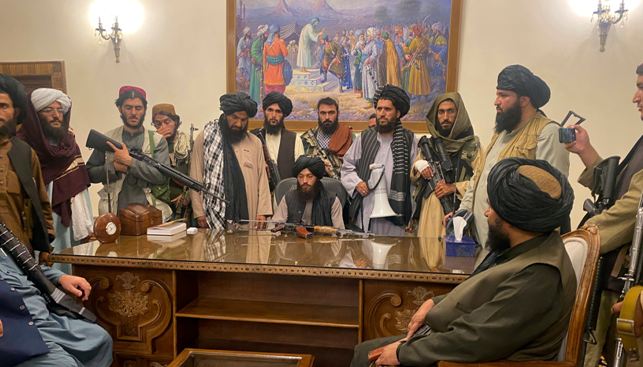
Meanwhile, the fate of the Afghans is once again in the hands of the Taliban. For the nations in the region and beyond, their return to power has also caused serious alarm. We are well aware of their conduct in power at home and in relations beyond the last time around. Can we expect the Taliban to act differently this time?

There are two opposite perspectives on the expected conduct of the Taliban once again in power, one motivated by political interests and another by humanitarian concerns. The first one is offered by some official circles and seconded by the so-called embedded journalists or scholars. It holds that the Taliban have learned their lessons from the long war and will not repeat the mistakes made during their previous stint in power.

The ‘change’ argument is grounded in the Taliban’s pronouncements from Kabul that they are not seeking to monopolise the government and are ready to share power with other Afghan parties and minority groups; that they have no objection to women at workplace or girls at schools as long as Islamic principles are being observed; and that they will not allow the use of Afghan soil by the Al-Qaeda or any other terrorist group for terrorist activities against neighbouring countries and the world.

However, the facts on the ground, as reported by the UN High Commissioner for Human Rights, the Human Rights Watch and major media outlets, confirm the veracity of the alternative perspective on the expected conduct of the Taliban while in government again. It is that the Taliban have already committed war crimes and ruled withfear in the areas under their occupation:executing captured soldiers, persecuting unarmed civilians, shutting down schools for girls, restricting women’s movementin public, levying heavy taxes, so on and so forth.

Kabul has changed significantly during the last 20 years, not least because of the demographic explosion that has created a vibrant urban and educated middle class that has tasted the fruits of freedom, development and democracy. Therefore, for now, the Taliban have been careful in not enforcing their strict Shariah edicts on the public at large. However, there have been isolated incidents of repression by Taliban gunmen. The private media, including major TV outlets, have chosen to adapt to the new normal under the Taliban through self-censorship. 

The Taliban havealso reportedly not kept their end of the bargain in the February 2020 agreement with America: that they will not allow the use of Afghan soil by Al Qaeda or any terrorist group or individual against the security of the United States and its allies.Since then, the UN Sanctions Monitoring Committee has twice reported to the Security Council about the Taliban’s persisting nexus with the Al Qaeda and its affiliate, the Al Qaeda in the Indian Subcontinent. 

As the recent bombing at the Kabul airport by Islamic State Khurasan Province (ISKP), which killed 13 US soldiers and several dozen Afghan civilians, suggests, the Taliban do have an ideological transnational Islamic rival to defeat in Afghanistan. No US solider had died in Afghanistan since the US-Taliban accord in February 2020. Hence, this was indeed a departing salvo to the US military in the last days of its evacuation from Kabul. It is also most likely that the US was able to kill twoISKP leaders, including the alleged planner and facilitator, with the help of intelligence provided by the Taliban. Hence, at least in the case of ISKP, we can expect the Taliban to cooperate with the outside world to eliminate this relic of the ISIS. 

Currently, the Taliban are in the process of forming a government, which they claim will be inclusive and based on power sharing. They have already stated clearly that the new political setup will not be democratic, as there will be no elections. It will be run by a leadership council, a jirga of sort, which the Taliban already have as a governing body of their movement.

In their agreement with the US, the Taliban had made no commitments on human rights, knowing very well the US was simply seeking face saving through this accord. Their pronouncements on preserving women rights or media freedom, though in accord with Shariah law and Afghan values, will be fully tested only once the government they lead comes into practice on the ground.

If my afore-cited recollection of the time spent with the Taliban leaders in their infancy, even if most of them are dead now, suggests anything, it is thatthe Taliban are Taliban, old or new doesn’t matter. How can Mullah Haibutullah Akhundzada, their current Emir-ul-Momineen, be better than earlier two Emirs? Ultimately, the Taliban remain a militant movement, rooted in religious bigotry, seeking to impose its brand of Islam on the Afghan people and desiring that the fellow Muslim nations shall replicate the same.

The legitimacy of the Afghan Taliban movement lies in its ideological purity, which the Taliban leaders will try to uphold at all cost. Otherwise, they will lose their key public support base. If left alone, the Taliban will do exactly what they did to the people before on the basis of religion, gender and ethnicity. If left unchecked, sooner or later, they will play host to Al Qaeda or other terrorist groups, once again jeopardising regional peace and international security. In any case, their wholesome victory in Afghanistan already seems to serve a glimmer of light for the world of extremism and political Islam.

The Current Challenge

Therefore, the current dilemma facing the outside world in dealing with the new rulers of Afghanistan is extremely acute. The key challenge will be to ensure that the Taliban strictly comply with their commitments on women and minority rights, freedom of speech and relations with the world. The Taliban-led regime will be in dire need of international financial support, which must also be made conditional on its internal conduct and external behavior.

The danger is that if the Taliban-led regime was ostracised by the outside world, it will most likely revert to the same puritanical venture as before, with deadly consequences for the Afghan people and the nations beyond. The US has frozen around $10 billion Afghan foreign exchange reserves, and it still has the final say in decision of the IMF, World Bank and other international financial and donor organizations.

Thus, the Taliban have inherited a country that is not to only difficult to government due to pent up expectations of the youthful urban population in urban spaces like Kabul, but is currently short of cash even to meet basic needs of the people. Thus, the fear is that, after having been defeated and humiliated in Afghanistan, the US may try take revenge against the Taliban by squeezing the economic capacity of Afghanistan, by denying what is its due. The question is, will the US allies in Europe again bandwagon with Washington to worsen the economic challenge for the Taliban-led government? All these countries must be aggrieved for also have been humiliated by band wagoning with the US in the 20-year fruitless war as members of NATO.

So, ultimately, the international engagement, especially of the countries in the region, with the Taliban-led Afghanistan remains the only viable option. China and Russia abstained in the UN Security Council, as it resolved on August 30 to hold the Taliban responsible if they dithered on their public commitment to respect human rights and allow the safe passage of the remaining foreigners and Afghans desiring to leave the country.

Now the mantle is on China, Russia and European powers to prevent the economic collapse of the post-American socio-political order in the war-ravaged nation. They must prevail in the UN-led global decision making to prevent the implosion of the Afghan state under the Taliban, which will surely taking us back to the 1990s and lead to the repeat of the deadly events that harmed the Afghans, the nations of the region and ultimately hit the symbolic pillars of US financial and military power: the destruction of World Trade Centre in New York and the damage to the Pentagon building in Washington, DC, on 9/11.

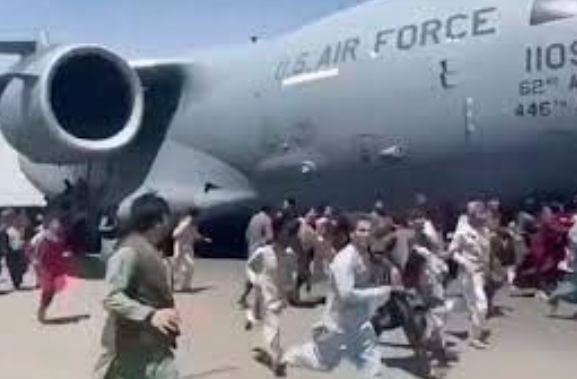
In the end, the 20-year war ended by damaging the leftover of  American credibility as a global power as well as its moral standing in the world, if we also add the images of the Afghans clinging desperately to the sides of the US military planes and meeting their unfortunate fate after falling from the sky; or if we take into account the appeals on social media being made by the Afghan enablers left behind by the US and British armies as they cut and ran from Kabul to complete the withdrawal a minute before midnight of August 30.

The departing forces of the US have also left an additional expression of their recklessness behind, as they destroyed not just the military and civilian planes at the Kabul airport but also smashed its control tower and everything else that is need to regulate the air traffic. Of course, the Qatri and Turkish engineers may overtime be able to operationalize the airport, but this sort of behaviour cannot be expected from a country that claims to champion democracy and human rights the world over.

The Future Ahead

We can only hope that the Biden administration will build upon its correct decision to take the US out of an unwinnable war, by prevailing upon the “special interests” inside the US – the war machinery built upon the deep nexus between the Pentagon and CIA, and the defence contractors, the so-called military-industrial complex – not to punish the government of Afghanistan led by the force that defeated the US war machinery and exposed the “Special interests” in the manner never seen in recent history.

Through the international financial institutions and human rights organisations, the outside world can keep a constant tab on the Taliban way of governance, tightening the screws each time Taliban leaders waver from meeting global expectations. This is the point that China, Russia, Afghanistan’s other regional neighbours and the European powers can make in the ensuing international debate on Afghanistan’s future so as to ensure a working relationship and a healthy engagement with the upcoming Taliban-led political order in Afghanistan.

It is also important to underline another point about the regionalization of post-America Afghanistan: The country lies at the confluence of Central,West and South Asia. International efforts for the economic integration of these adjoining regions in the past couple of decades has been hostage to persisting Afghan insecurity. Therefore, one way of taming the Taliban-led regime is to revive these efforts, especially the gas pipeline agreement between Turkmenistan, Afghanistan, Pakistan and India (TAPI), which has been pending implementation since 2010.

The TAPI project offers a win-win solution by seeking to link the energy-rich Central Asia with the energy-starved South Asia, with Afghanistan providing the most crucial corridor. Ultimately, such regional integration projects bind the participating nations in a chain of interlocking economic interests, thereby ensuring that their regimes stay focused on economic progress at home and strive for peace in the region. The Taliban-led Afghanistan should not be an exception.

The author can be reached at [email protected]Twitter: @ahmadishtiaq
PEARL-CONTINENTAL HOTEL TO OPEN BY THE STUNNING ATTABAD LAKE

ISLAMABAD, SEPT 3 /DNA/ – Complementing the natural beauty and dramatic splendour of Attabad Lake with a blend of premium hospitality, a new Pearl-Continental Hotel will open its doors to the scenic Hunza Valley soon.

Overlooking the turquoise-blue lake and surrounded by the majestic Karakoram Mountains, the five-star Pearl-Continental Hotel Attabad Lake will attract both travellers and adventure enthusiasts alike.

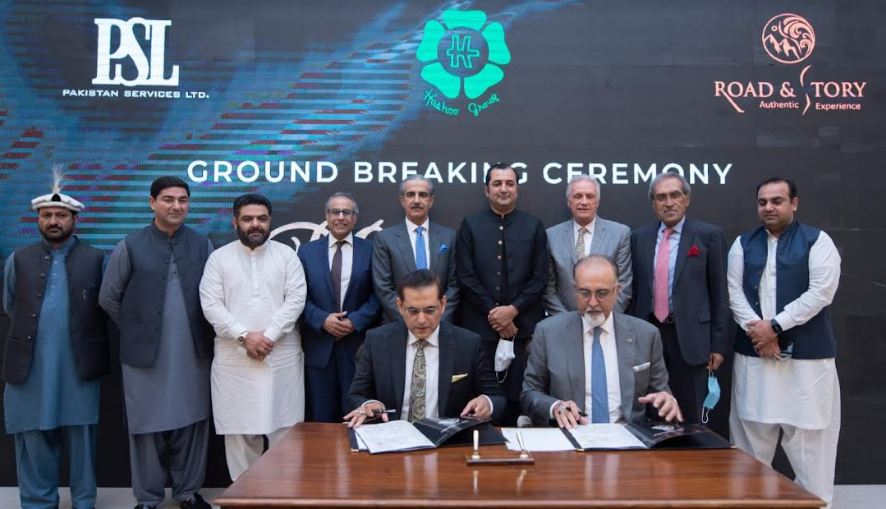
In this connection, a Memorandum of Understanding (MoU) was signed between Pakistan Services Limited and Road & Story at Islamabad Marriott Hotel on Friday, 3rd September.

At the launching ceremony, the Chief Operating Officer Hospitality and Education Division Hashoo Group, Mr. Haseeb A. Gardezi said: “With Attabad Lake being one of the wonders of Pakistan, we are pleased to bring our five-star brand, Pearl-Continental here for welcoming guests to an extraordinary lodging experience with the unparalleled service which is our trademark.”

Chief Minister of Gilgit-Baltistan, Mr. Khalid Khurshid said: “Following the Prime Minister’s Tourism vision, we can retire Pakistan’s debt through the revamping of infrastructure and building facilities for tourists across the country. Investors are encouraged to come and we will facilitate them. The government of GB is also focusing on the development of new cities while ensuring preservation of the environment.”

Hashoo Group is the leading chain of hotels, which owns and operates the five-star Pearl-Continental Hotels & Resorts, Marriott Hotels, PC Legacy Hotels, and the select-service Hotel One brand in Pakistan.

Director of Road & Story, Mr. Yasar Rashid said: “Our mission is to develop quality hotels and resorts while protecting the natural environment, uplifting local communities and helping to transfer latest construction technologies in the area.” He further added: “Besides developing quality resorts, Road & Story is also in the process of developing Pakistan’s 1st tourism city, amusement park, high altitude international training grounds and ski resorts in under developed northern areas.”

Road & Story is a tourism and travels firm, offering unique experiences tailored to let travel enthusiasts explore and enjoy Pakistan through its rich cultural heritage and beauty.

For their stay, guests can choose from a total of 112 standard rooms and 4 guest suites extending into a terrace and private dining facilities. They can also enjoy dining from a selection of cuisines in the all-day restaurant, mezzanine coffee, bar lounge, at the patio, on the roof, or by the poolside. 

Catering to a host of wellness and recreational facilities, the hotel will house a gym, fitness centre, spa, and swimming pool. The hotel will also host yoga retreats for yoga practitioners.

To keep up with their official assignments, business travellers can utilise the latest technology and services available at the Business Centre. From conferences to celebrations, the multiple Conference Rooms and halls can accommodate a wide range of private and corporate events.

Attabad Lake is one of the biggest tourist attractions in Gilgit-Baltistan, offering travel enthusiasts scores of exciting recreational activities such as boating, jet skiing, and fishing amongst others. 

Guests can travel to Attabad from Islamabad by first flying to Gilgit and then driving to the destination in around 2 hours, or they can fly to Skardu and drive forth in around 4 hours. Alternately, they can also enjoy a scenic road trip of about 598.7 kilometres within eight hours and 15 minutes from the capital city, with a reduced time to reach Hunza.

The lake-front hotel promises to provide a refreshing getaway for guests, families, and business professionals seeking a rejuvenating experience filled with northern charm and premium hospitality the Pearl-Continental brand is known for.

The event was also attended by high-profile dignitaries including the Gilgit-Baltistan Chief Minister Mr. Khalid Khurshid and the Bank Alfalah CEO Mr. Atif Bajwa.

Top EU diplomat names 5 conditions for engagement with Taliban

Without officially recognizing the regime, the European Union will operationally engage with the Taliban based on five criteria for the sake of the Afghan people, the EU foreign policy chief said on Friday.

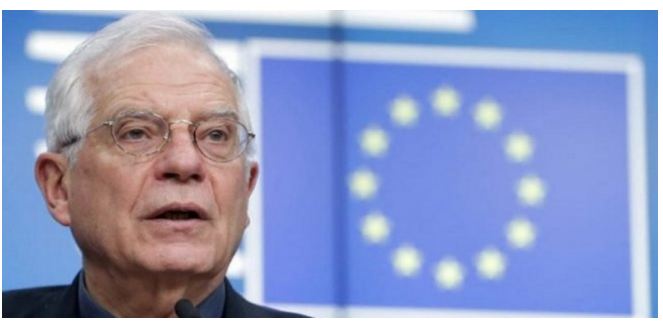
“The future of Afghanistan remains a key issue for us. It affects us, it affects the region, international stability and it has a direct impact on European security,” Josep Borrell told reporters after an informal meeting of EU foreign ministers in Brdo, Slovenia.

At the two-day conference, hosted by the Slovenian government, which currently holds the rotating presidency of the EU Council, EU defense and foreign ministers focused on lessons from last month’s crisis in Afghanistan and the bloc’s response to it.

According to Borrell, the ministers agreed that the bloc has to keep its commitment to support the Afghan people.

“In order to support the Afghan population, we will have to engage with the new government in Afghanistan, which does not mean recognition, it is an operational engagement,” he argued, adding that the engagement would grow deeper based on the Taliban’s actions.

Borrell named five criteria or “benchmarks” for the cooperation.

Firstly, he explained, it is crucial for the bloc to see that the Afghan government commits to preventing the country from serving as a basis for international terrorism.

The EU will also observe if the new regime respects the rule of law and human rights, especially women’s rights.

The bloc also sees the composition of the new government as an important criterion for further engagement, with “the establishment of an inclusive and representative transitional government through negotiations among political forces in Afghanistan,” Borrell explained.

The EU will also demand the regime provide free access for humanitarian aid, respecting the delivery and distribution conditions of the bloc and its international partners.

As a last benchmark, the EU expects the new Afghan government to stick to their promise on allowing the departure of foreign citizens and Afghans at risk.

“Some will say ‘oh, but the Taliban will not fulfill them.’ Let us see,” Borrell said, stressing that the EU’s engagement would depend on the fulfillment of these conditions.

Pak, UK vow to work for Afghan peace

Taliban have made some serious vows but we have to see how they fulfill their vows and commitments: Dominic Raab

Ansar Mahmood Bhatti

ISLAMABAD: Dominic Raab Secretary of State for Foreign, Commonwealth and Development Affairs of the United Kingdom has said that we do understand the problems created by Pakistan’s being on the red list and Britain is closely monitoring the way Pakistani authorities have been dealing with the pandemic. No one wants to see Pakistan on the red list including myself and therefore rest assured we will do everything to settle this issue.

He expressed these views during a news conference on Friday. Foreign Minister Shah Mahmood Qureshi also spoke on the occasion.

He said we have appointed a new envoy to Afghanistan as we accord importance to the country and the region. We have allocated a special grant especially for the neighboring countries as well so that they could handle the people coming from across the border efficiently.

He said Taliban have made some serious vows but we have to see who they fulfill their vows and commitment made to the international community. We may not fund directly the Taliban govt however we would continue supporting the humanitarian agencies engaged in Afghanistan.

Raab said the Taliban takeover took everybody by surprise by taking over the control at a very speed, no one was expecting. He added, Britain had a constructive dialogue with the Taliban and it was after this dialogue that we were able to get over 15000 people out of Afghanistan.

He said Britain, like the other countries, wants an inclusive government in Afghanistan. Likewise we hope there would not be any terrorist acts committed from the soil of Afghanistan.

Regarding Kashmir he said Britain maintains principled positions on Kashmir and wants both Pakistan and India to sit together and find a solution.

Foreign Minister Shah Mahmood Qureshi said Afghanistan is a country that represents various ethnicities. We have asked the Taliban to adopt an inclusive approach. When we deal with Afghanistan we have to deal with certain compulsions. For example we have to face a number of border crossings. Now the question is can we block these crossings. Certainly not. Then a bulk of trade goes through Pakistan. Should we close our borders and create a humanitarian crisis in Afghanistan. So recognizing these challenges, Pakistan told the Taliban that we have addressed these challenges head one.

Our focus is on the people of Afghanistan. We feel that people of Afghanistan have suffered a lot therefore now should be given an opportunity to choose a peaceful course. Qureshi said we are waiting for what happens in Afghanistan in the coming days.

The FM said he also took up Kashmir matters with the British foreign secretary, especially the way Geelani’s burial was not allowed to happen in a smooth manner.

Russia encourages Turkey and Armenia to improve bilateral ties

The end of the conflict in the Nagorno-Karabakh region paves the way for improvement in Turkish-Armenian relations, Russia’s foreign minister said on Friday.

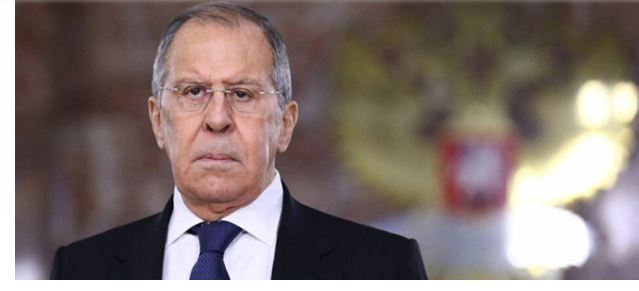
Speaking at the New Knowledge Forum in Moscow, Sergey Lavrov said Ankara and Yerevan should resume efforts towards normalization after Armenia and neighboring Azerbaijan signed an agreement on Nagorno-Karabakh last year.

“The parties saw the process of resolving the Nagorno-Karabakh issue differently. But now, when the war in Nagorno-Karabakh is over, there are grounds for unblocking the political process, transport, and economic ties, it would be logical if Armenia and Turkey resumed efforts to normalize relations,” the minister said.

Russia is ready to actively support this process, he added.

On Thursday Russian Foreign Ministry spokeswoman Maria Zakharova also said Russia always supported the normalization of Armenian-Turkish ties and has in the past participated in mediation efforts towards this end.

She noted that Russia welcomed the signing of the Zurich Protocols in 2009, which suggested a gradual improvement in relations between Armenia and Turkey without preliminary conditions.

“Along with the normalization of Azerbaijani-Armenian relations in the context of the implementation of the statements signed by the leaders of Russia, Azerbaijan, and Armenia on November 9, 2020, and January 11 this year, this (normalization between Armenia and Turkey) would work for peace, stability, and prosperity in the region,” she said.

Relations between the former Soviet republics of Azerbaijan and Armenia have been tense since 1991 when the Armenian military occupied Nagorno-Karabakh, also known as Upper Karabakh, a territory internationally recognized as part of Azerbaijan, and seven adjacent regions.

When new clashes erupted on Sept. 27, 2020, the Armenian army launched attacks on civilians and Azerbaijani forces and violated several humanitarian cease-fire agreements.

During the 44-day conflict, Azerbaijan liberated several cities and nearly 300 settlements and villages from the nearly three-decade occupation.

On Nov. 10, 2020, the two countries signed a Russian-brokered agreement to end the fighting and work toward a comprehensive resolution.

On Jan. 11, the leaders of Russia, Azerbaijan, and Armenia signed a pact to develop economic ties and infrastructure to benefit the entire region. It included the establishment of a trilateral working group on the Karabakh issue.

The cease-fire is seen as a victory for Azerbaijan and a defeat for Armenia, whose armed forces withdrew in line with the agreement.

Prior to this victory, about 20% of Azerbaijan’s territory had been under illegal occupation for nearly 30 years.

Taliban says China will be ‘main partner’ to rebuild Afghanistan

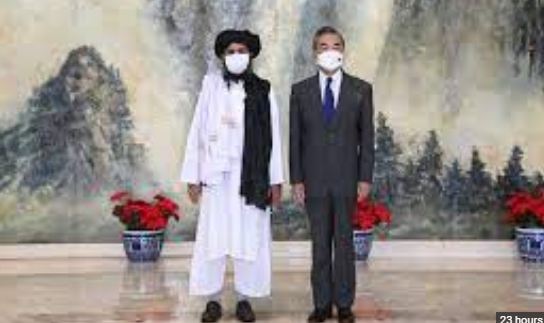
KABUL, SEP 03 (DNA) – The Taliban says China will maintain diplomatic relations with Afghanistan and the new rulers in Kabul will rely on Beijing for economic support after the withdrawal of U.S.-led international forces.

Taliban spokesman Zabihullah Mujahid told the Italian newspaper La Repubblica that China was the group’s “main partner” to halt an economic collapse and rebuild the country.

The Taliban has pledged to be more moderate since they toppled Afghanistan’s Western-backed government on August 15, promising to protect some human rights and refrain from reprisals against old enemies., Radio Free Europe reported

The United States and its allies have closed their diplomatic missions and conditioned any recognition of a Taliban government – as well as economic aid that propped up the previous government – on the group’s actions.

In particular, Western powers are calling on the Taliban to allow people to leave the country, enable access of humanitarian aid, make a complete break with international terrorist organizations, and respect human rights, especially for women.

Without aid, humanitarian organizations have warned of catastrophe as severe drought and war have forced tens of thousands of families to flee their homes. The U.S. government has also frozen Afghanistan’s Central Bank reserves, helping to fuel a banking and payments crisis.

China, however, is unlikely to make aid and political ties contingent on human rights issues, preferring instead hard economic, political, and security interests. “China is our main partner and represents a fundamental and extraordinary opportunity for us because it is ready to invest and rebuild our country,” Mujahid told La Repubblica.

Mujahid said the Taliban are interested in the Belt and Road Initiative, China’s global infrastructure and resource development plan designed to tighten economic and political ties across dozens of countries.

“We own rich copper mines, which, thanks to the Chinese, will be modernized. Finally, China represents our ticket to the markets around the world,” Mujahid. Another Taliban spokesman said on September 2 that China has promised to keep its embassy in Afghanistan open and “beef up” relations as well as increase humanitarian aid.

Abdul Salam Hanafi, a member of the Islamist group’s political office in Doha, Qatar, “held a phone conversation with Wu Jianghao, Deputy Foreign Minister of the People’s Republic of China,” spokesman Suhail Shaheen tweeted.

“The Chinese Deputy Foreign Minister said that they would maintain their embassy in Kabul, adding our relations would beef up as compared to the past… China will also continue and increase its humanitarian assistance especially for treatment of COVID-19,” he wrote.

Close ties between China and the Taliban could undermine the Western strategy of using economic leverage to pressure the new rulers in Kabul. Russia, as well, has maintained its diplomatic mission in Kabul.

Relations with Russia are “mainly political and economic. Russia continues to mediate for us and with us to create the conditions for international peace,” Mujahid said. In a report, Fitch Solutions said on September 2 that it expects Afghanistan’s economy to collapse as international money that funded the previous government dries up.

“The highly disruptive manner in which the U.S.’s security forces left the country and the Taliban takeover will mean that the economic pains for the country will be felt acutely over the short term,” said the research arm of credit ratings agency Fitch Group.

It expects the country’s real gross domestic product (GDP) to shrink by 9.7 percent this year, with a further drop of 5.2 percent next year. Foreign investment would be needed to support a more optimistic case, Fitch said.

“An alternative and more positive economic scenario would entail Afghanistan’s growth averaging around 2.2 percent in 2023-2030, which assumes that some major economies, namely China and potentially Russia, would accept the Taliban as the legitimate government of Afghanistan and begin major investment projects,” it said. = DNA

===========================

BRITISH FOREIGN SECRETARY MEETS PRIME MINISTER IMRAN KHAN

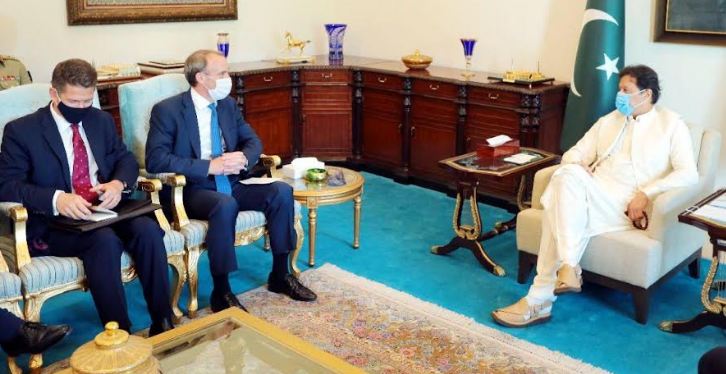
ISLAMABAD, SEPT 3 /DNA/ – British Foreign Secretary Dominic Raab called on Prime Minister Imran Khan. during the meeting ​views were exchanged on the latest developments in Afghanistan as well as bilateral matters and regional and international issues.   ​Recalling his telephonic conversation with Prime Minister Boris Johnson, the Prime Minister shared Pakistan’s perspective on the evolving situation in Afghanistan. 

  ​The Prime Minister underlined the importance of a peaceful, secure and stable Afghanistan for Pakistan and regional stability.   The Prime Minister noted that it was critical to stabilize the security situation in Afghanistan, take steps to consolidate peace, and preclude any mass exodus. In this context, preventing humanitarian crisis and stabilizing the economy were the urgent needs. 

The Prime Minister stressed that the international community should stand in solidarity with the Afghan people, undertake positive engagement, and create incentives for ensuring a peaceful, stable and inclusive polity. The Prime Minister also cautioned against the role of “spoilers”, both inside and outside Afghanistan, which could destabilize the situation. 

The Prime Minister further sensitized the UK side on the gross human rights violations in the Indian Illegally Occupied Jammu and Kashmir (IIOJK), including the inhuman snatching away of the mortal remains of Ali Shah Geelani, the senior Kashmiri leader. ​On the bilateral plane, the Prime Minister inter alia noted the long-standing relationship and strong people-to-people ties between the two countries.   ​The Prime Minister shared concerns on the retention of Pakistan on the Red List, causing inconvenience to dual nationals.   ​Matters relating to climate change, peace and stability in South Asia, and global geopolitical situation were also discussed.

AZERBAIJAN, KAZAKHSTAN AMBASSADOR’S DISCUSS MATTERS OF BILATERAL INTEREST

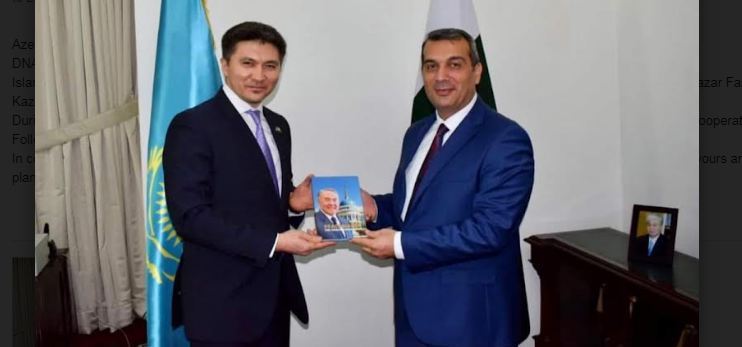
Islamabad, Sep 3 /DNA/ – The Ambassador of the Republic of Azerbaijan to the Islamic Republic of Pakistan, Khazar Farhadov called on the Ambassador of Kazakhstan Yerzhan Kistafin. During the conversation, the sides briefed each other on the state of play and topical issues of the bilateral agenda for cooperation with Following the meeting, the Heads of diplomatic missions  agreed to hold regular consultations.In conclusion, Y.Kistafin wished the new head of the Embassy of brotherly Azerbaijan every success in his noble endeavours and implementation of the outlined plans.

AIR CHIEF ZAHEER AHMED BABER ELECTED PRESIDENT PSF

AFZAL JAVED 
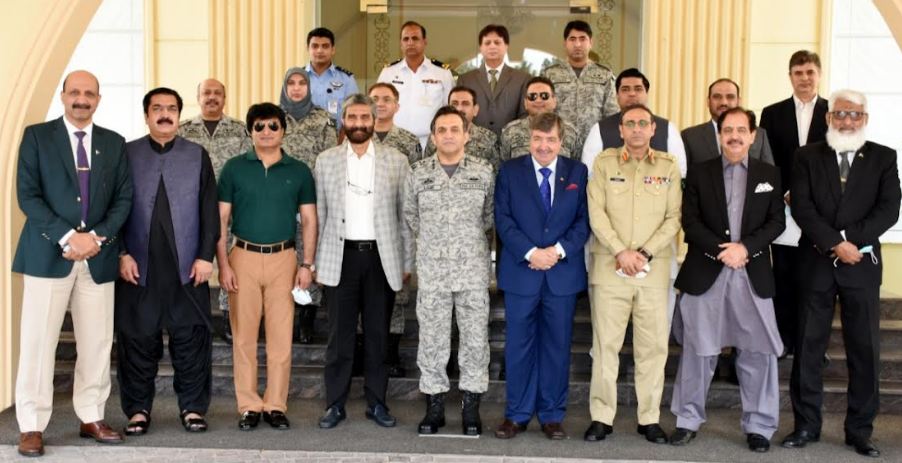
ISLAMABAD, Sep 03: Chief of the Air Staff Air Chief Marshal Zaheer Ahmed Baber has been elected as President of Pakistan Squash Federation (PSF) in the 48th Annual General Meeting of Pakistan Squash Federation was held here at Air Headquarters Islamabad on Friday. 
The 48th annual general meeting in which the election for President PSF was also conducted for next term in top slot of PSF. The house elected Chief of the Air Staff Air Chief Marshal Zaheer Ahmed Baber as President PSF who later on, presided over the meeting.
Besides squash legends, representatives from provincial squash associations, affiliated members and Pakistan Sports Board were also present during the meeting.
Addressing the general council members, President Pakistan Squash Federation thanked all participants for their participation and offered whole hearted support of the Pakistan Air Force (PAF) as well as PSF for the promotion of squash.
While showing his satisfaction over revival of international squash in Pakistan, he emphasized that there was still need of collective efforts by the provincial squash associations and affiliated departments like Pakistan Army, Navy, Wapda, SNGPL, PIA, etc to jointly work together and support the national cause of glorifying Pakistan squash at highest levels.
He urged the players to focus on the game and further improve on the physical and mental strength. Besides assuring support by PAF, the President PSF asked all member associations to generate further resources to meet the challenging tasks through an improved system.
He also directed the member associations to promote squash and increase the pool of players to thousands and also ensure age verification at association level.
He also stressed upon the implementation of a comprehensive training strategy to further groom the skills of our players. He emphasized on the role of associations and departments in generating adequate funds from Provincial Government and corporate sector to sponsor their players and events at national and international levels.
He also directed all associations and affiliated departments to conduct maximum number of tournaments events every year.
The performance evaluation of provincial association for the year 2020 was also carried out by the General Council. The Khyber Pakhtunkhwa Squash Association was awarded Winner’s Trophy for Pride of Performance by the General Council.
The President PSF presented trophy to the representative of provincial association and appreciated them for making their efforts despite the COVID-19 pandemic situation.
While he emphasized that PSF would continue to sponsor best men and women players in international events. He also directed the associations to generate adequate funds and sponsor all their respective players for national and international events to afford them adequate exposure.
He directed the associations to conduct open trials of all age categories and conduct league matches to generate healthy competition among players.
He urged the players to ensure their fitness and prove their worth in squash court by winning in every tournament at every level to glorify Pakistan in the game of Squash.The meeting concluded with the hope that Federal and provincial Governments would provide adequate financial and administrative support to revive Pakistan’s ascendancy in the international arena of squash.

GLOBAL COMMUNITY CAN AVERT HUMANITARIAN CRISES IN AFGHANISTAN: EXPERTS

ISLAMABAD, SEPT 3 /DNA/ – The war torn Afghanistan needs attention of the global community to play their role to avert humanitarian crises, and help people stabilize, recure livelihood and food and come out of extreme poverty, said the experts from diverse backgrounds while speaking at the webinar ‘Humanitarian Situation in Afghanistan Post US Evacuation’ organized by Sustainable Development Policy Institute (SDPI).   

The humanitarian institutions are warning against influx of the would-be Afghan refugees if their needs are not met within the country and circumstances force them to flee. Ms Tammi Sharpe, Deputy Representative UNHCR Pakistan, highlighted that currently, there are 1.4 million Afghans refugees in Pakistan and the number goes up to 3 million if we include unregistered refugees. Pakistan has been very generous in accepting the Afghan refugees. She said the situation related to displacement of the population continues to change and UNHCR is closely observing it to take right measures. It depends on how Taliban will act; will they be able to maintain peace and ensure protection of human rights of common people? She said that UNHCR is concerned about human right violations and thus, we need to see what is actually happening in the country in the post US withdrawal scenario.  

Senior Journalist and analyst Mr Zahid Hussain was of the view that people are focusing on what the Taliban will do, but we need to focus on Afghanistan in the context of alarming poverty and displacement of people. He said that the western countries should open their borders for these refugees. He emphasized that financial aid to Afghanistan must be continued as the people of Afghanistan will suffer otherwise.  Almost 70% of the population of the country is living below the poverty line and about 90% people live under 2 dollars per day. Therefore, if the international community pushes further without addressing the real issue, the situation will get worse and eventually will lead to another war.  

Dr Abid Qaiyum Suleri, Executive Director, SDPI, earlier stressed that instead of seeing the situation through the lens of just emotions, we need to analyse ground realities as well to understand the real picture of Afghanistan today. “No study has been even done on the situation of COVID-19 in Afghanistan and the situation of food security is also does not seem to be under any focused discussion,” he said adding that all these questions are critical to ascertain what has to be done to help people of Afghanistan.  

The Parliamentary Secretary for Foreign Affairs, Ms Andleeb Abbas, was of the view that peaceful takeover by Taliban by averting civil war has been a positive thing in Afghanistan. However, since the international community is still at the back foot, the economic situation may get worse and that must be avoided. She said that Pakistan has extended all assistance to aid providing authorities because the fate of both countries is tied together. This can be an opportunity to rebuild Afghanistan if international community does not shy away from its responsibilities.   

Senior Analyst, Brig (r) Mahmood Shah, highlighted that Afghanistan is a multi-ethnic country, and all these ethnicities should be included in the government. Taliban have already shown willingness to respect human rights, particularly women rights, which provide much needed optimism about the future stability of the country. However, measures should be taken to stop brain drain from Afghanistan.  

Stay Connected

64FansLike
60FollowersFollow

Latest Reviews

Exchange Rates

USD - United States Dollar
EUR
1.17
GBP
1.35
AUD
0.67
CAD
0.72