Home Blog Page 1519

Wattoo seeks ammendment in export proceeds rule and foreign currency deposits

DNA

Lahore: Pakistan Businesses Forum have demanded an amendment to the export proceeds rule to accelerate export payments. This would buttress foreign exchange reserves of the country and help prevent further volatility of the rupee against the dollar.

Vice President PBF JahanAra Wattoo said the State Bank of Pakistan (SBP) must amend the rules of export proceeds time which may have to be decreased to forty days maximum, so that exporters remittance well-timed hit before national exchequer and it also facilitates to assist the rupee dollar volatility. Unfortunately in the previous few months mostly exporters to seeking extra profits, they dealt their proceeds. 

She told that private dollar bank accounts have to be required with the new regulations, If the public need dollars they will get from the financial banks only however it should be not more than $2000 dollars in step with each day on one cnic. These steps are a bit tough for the regulator and the authorities, however with a view to enhance the rupee value for the coming times, we must regularize it as soon as for all. 

She quoted the example that in Bangladesh, individuals hardly to take $1000 for their use because Bangladesh authorised have a strict check and balance on foreign currency and it’s one of the factor of their strong currency even today; he added.

“We need your (government) out of box solutions, regardless maintaining market confidence will be crucial.”

Wattoo further proposes SBP to step in and offer to swap the dollar funds into the rupees cheaply for borrowing banks, and through this SBP could raise substantial funds to $5 billion dollars.

She even said currently real exchange rate is around 195. Dollar is over valued against rupee that’s why the necessary measures should be taken immediately by the regulator so that panic must end especially in the ongoing calamity because for the rehabilitation of the flood affecties strengthen of the rupee is vital. 

Pak vs Eng: Pakistan eye revenge against England in fourth T20I today

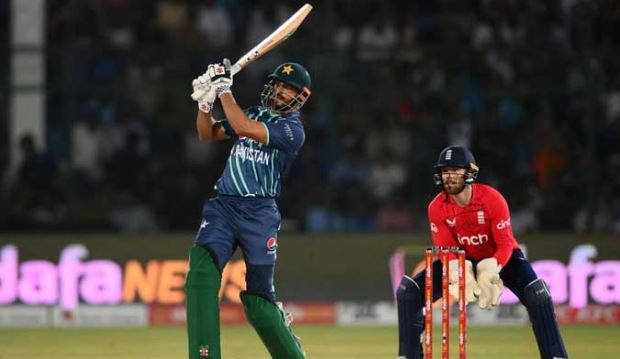
KARACHI: After losing the third T20I fixture by 63 runs, the Green Shirts are desperately looking to win the fourth game of the historic seven-match series against England today (Sunday).

The high-octane clash between Pakistan and England is scheduled to be played at the National Stadium in Karachi at 7:30pm.

The Pakistan team is eyeing a win to level the series as England is leading the series 2-1 with four games in hand. 

Pakistan face big issues both in their bowling and batting which is a big question mark over the team’s make-up ahead of the T20 World Cup which will begin in Australia next month.

While England continue to test their healthy bench, Pakistan are not being able to do so due to lack of top stuff on the bench and injuries to some key players.

In the third show on Friday, Pakistan went unchanged while England made three changes, bringing in pacers Reece Topley and Mark Wood, who both clicked.

Debutant Will Jacks left a big impact with the bat, scoring a 22-ball brisk 40 which set the momentum for Harry Brook (81*) and Ben Duckett (70*) who shared a 139-run unbroken partnership — the fourth highest stand for the fourth wicket in T20Is.

Pakistan’s bowling lacked discipline which helped the visitors post a huge total of 221-3 in the allotted 20 overs.

Then Pakistan lost four top-order wickets with only 28 on the board. Pakistan crumbled under pressure and managed only 158-8.

Shan, who made his debut in the opening game of the series, played a few superb strokes and his intent against the spinners was a great sign for the hosts who at least found someone who could carry the middle order burden in time of chaos. However, the team needs a few more to strengthen the middle order which has been exposed repeatedly in recent matches.

Khushdil showed some spine but Iftikhar Ahmed failed again when he was expected to carry the batting load.

Pakistan will need to test at least one uncapped player irrespective of the outcome as this is the only stage to finalise the chemistry of the brigade ahead of the big event.

Bowling always has been Pakistan’s strength and if such a huge score is set by the oppositions as was done on Friday then certainly the fragile batting will not be able to chase.

England, also battling injuries to some of their key exponents including skipper Jos Buttler, will be looking to extend the lead. England have proved in the series that they have strong back-up players who can fill the void.

Pakistan will need to do well with the ball if they are to win the game keeping in view the issues in their batting line-up.

A few players of Pakistan including stumper Mohammad Haris, Shan Masood, Asif Ali, Khushdil Shah, Naseem Shah, Abrar Ahmed, and Amir Jamal participated in an optional training session here at the NSK on Saturday.

It will be the last show on Sunday (today) of the Karachi leg. The teams will move to Lahore to engage in three final matches which will be held at the Gaddafi Stadium on September 28 and 30 and October 2.

Pakistan squad: Babar Azam (captain), Shadab Khan (vice-captain), Aamir Jamal, Abrar Ahmed, Asif Ali, Haider Ali, Haris Rauf, Iftikhar Ahmed, Khushdil Shah, Mohammad Haris, Mohammad Hasnain, Mohammad Nawaz, Mohammad Rizwan, Mohammad Wasim Junior, Naseem Shah, Shahnawaz Dahani, Shan Masood, Usman Qadir

England squad: Jos Buttler (captain), Moeen Ali (vice-captain), Harry Brook, Jordan Cox, Sam Curran, Ben Duckett, Liam Dawson, Richard Gleeson, Alex Hales, Tom Helm, Will Jacks, Dawid Malan, Adil Rashid, Phil Salt, Olly Stone, Reece Topley, David Willey, Chris Woakes, Luke Wood, Mark Wood.

Chairman Dubai Port World donates USD 2.5 mln for Army relief fund

DNA

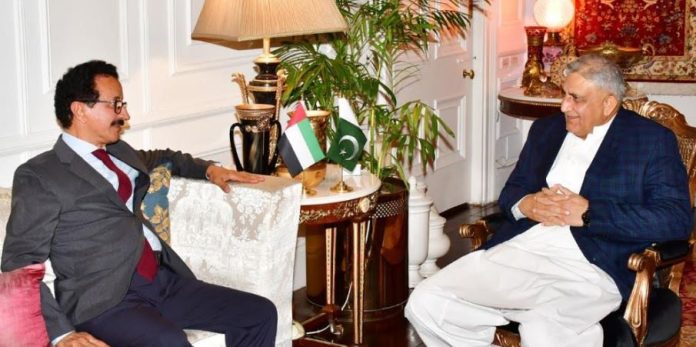
RAWALPINDI: Sheikh Ahmed Sultan Bin Sulayem, Chairman Dubai Port World (one of the largest port operators globally) called on the Chief of Army Staff (COAS) General Qamar Javed Bajwa.

Relief efforts in the wake of the devastating floods and all that can be done on the road to recovery for Pakistan was discussed.

Sheikh Sultan, who had earlier today visited flood affected areas in Sindh, made a donation of USD 2.5 Million for the Army relief fund.

The Excellency commended the relief efforts of Pakistan Army in the flood affected areas and said that UAE and its leadership stands with the people of Pakistan in this time of distress. The dignitary committed to raise the issue of climate justice for Pakistan at the world forums. COAS thanked Sheikh Sultan for his valuable and timely support to Pakistan.

Matters of economic development in Pakistan were also discussed. Sheikh Sultan apprised the Army Chief of DP World’s interest in investing further in Pakistan.

Sheikh Sultan offered to bring other donors for Flood Relief efforts in the days ahead.Sheikh Sultan also thanked Mr Fakhr Alam, Sitara e Imtiaz, for arranging this visit and creating awareness in UAE about the need for help in Pakistan.  DNA

Do we need a government of technocrats?

Comment

Ansar M Bhatti

Many interesting developments are likely to take place this week. Former Finance Minister Ishaq Dar is set to stage a comeback, as the court has barred security institutions from arresting him when he returns home. Then tomorrow the PML N Vice President Maryam Nawaz Sharif shall appear before the Lahore High Court seeking return of her passport. If she gets it then probably she will spare no time in flying to the UK for a rendezvous with her father – the PML N supremo – Nawaz Sharif.

 Pakistan happens to be a unique country. It has hitherto served as a paradise for the haves and an inferno for the have-nots. Regardless of the magnitude of the crime one has committed, he can still go scot free if he is well connected; well-entrenched in the system and has a hell of money at his or her disposal. Pakistan has been witnessing this situation ever since its inception. The first 26 years of independence were marred by instability, bad governance, and tug-of-war for power. That is why no head of state or government could sustain in power for a long time.  Such situations are quite ideal for military dictators to intervene and impose martial law. That is what the military leadership of the time did.

Nevertheless, right or wrong, it is an impression that Pakistan always progressed and prospered during the military rules. Field Marshal Ayub Khan is described as the best military leader under whose control Pakistan achieved a number of milestones such as infrastructural development and construction of dams. General Yahya Khan’s rule is widely regarded as a leading cause of the break-up of Pakistan. His tenure (1969-1971) was widely considered as a total disgrace to him and the country as well.

 General Zia Ul Haq’s Martial Law that remained in force for 11 years can be categorized as an era of missed opportunities. Realistically speaking, the military dictators only grab power when they are convinced that the majority of people are with them. Since they enjoy absolute power and public backing as well therefore they are very well poised to take the country to any direction. General Zia chose to bank upon  his narrative of islamisation of the country, which he never did. During his time, the spectre of sectarian violence emerged on the scene with full force thus triggering a number of killings of Shias and Sunnis. Ordinary people however were at ease as the dictator never allowed mafias to fleece the poor people. So, even with meager resources one could easily make his both ends meet in the Zia era.  After his death in a plane crash in 1988, Benazir Bhutto came to power. Her government was removed after two and half years on the charges of corruption. Then Nawaz Sharif jumped into the fray. His tenure as prime minister also could not last for long. He too was sent home on corruption charges. Of course, there were certain other factors as well that led to his downfall. He also could not complete his tenure. Again Benazir Bhutto was chosen to lead the country. But her government met with the same fate and was sent packing on the same charges. It was the time when powers-that- be decided to give Nawaz Sharif a two-thirds mandate so that his government could carry out reforms needed to steer the country out of crises. But the so-called ‘ heavy mandate’ in fact proved quite heavy for the masses. Nawaz Sharif, tried to become ‘ ‘Amir al-Mu’minin” (the godfather). During his tenure, he first sent home the Chief of Army Staff General Jehangir Karamat simply because he had floated an idea of establishing a national security council.

The military ranks were certainly not happy the way General Karamat was shown the door. General Mussharraf was posted in Mangla when Nawaz Sharif was advised to consider him for the top slot. As those who were privy to this development would put it, General Musharraf had met the Prime Minister without letting his Army Chief know. Anyhow, he was asked to lead the army. Soon after taking charge as the COAS, General Musharraf during one his interactions with the military officers had made it clear that he was not General Karamat, sending a loud and clear message to the political leadership that any misadventure may cost it dearly.

The Nawaz-Musharraf bonhomie could not last for long. Sharif was under the impression as if he were the ultimate authority since he had the two-thirds majority therefore he started locking horns with General Musharraf. The events led to a realization among the stakeholders that they could not co-exist. Now the each side was waiting for an opportune moment to strike. General Musharraf, before departing for Sri Lanka, had taken into confidence his close generals. A senior bureaucrat, who held a key position in the Prime Minister’s office at that time, said that the Army never wanted to impose martial law. General Musharraf had told his generals that he would only react if the prime minister takes any decision against the him.

In October 1999, Musharraf took over. The immediate support which General Musharraf received after take-over was from PTI Chairman Imran Khan. People ostensibly were also on his side that is why he could survive as a dictator for a good time. General Musharraf was at his best during his first two years during which he introduced a number of reforms; did a lot to improve a lot of the poor people and contributed greatly towards ridding the country of the menace of sectarian violence.  But also by the time he had developed a taste for power plus minions around him were able to sell the idea to him that he was a savior and without him country cannot survive. That was the time when downfall of Musharraf kick-started and ultimately he had to lose power, in a rather unceremonious way.

Then again the PPP and PML N got a chance to rule this country. PPP completed five years albeit their prime minister could not complete his term. Then came again Nawaz Sharif whose government was sent home through a judicial order. Imran Khan took charge in 2018 and ruled this country for around four years. His rule was also a mess like others. He could not deliver what he promised. Even the die-hard PTI workers had distanced them from the party because of the poor performance of his government. But then the no-trust move against him ultimately dislodged his government and brought in PML N, PPP and other allied parties. Imran Khan after his removal again became a hero from zero and now undoubtedly he happens to be the most popular leader of the country!!

A brief recap of Pakistan’s political history ostensibly provides a food for thought if our politicians or for that matter the military dictators can really lead this country to a developed, modern welfare state? In my view they simply can’t as long as the present system remains in vogue. This country needs a government of technocrats for at least three years that could undertake reforms in all sectors; streamline electoral systems in order to ensure free and fair elections. An effective anti-corruption mechanism will also have to be put in place besides carrying out across-the-board accountability. Without these measures any electoral drill will only be an exercise in futility and bring in the same old mindset that wants status quo to rule supreme in this country.  

Why was the AGP report on TBTTP leaked?

Mumtaz Ahmed Bhatti

ISLAMABAD: Scope and jurisdiction of AGP emanates from Article 170 (2) of the Constitution of Pakistan. The Constitution mandates Auditor General of Pakistan to audit the accounts of the Federal and of the Provincial Governments and the accounts of any authority or body established by, or under the control of, the Federal or a Provincial Government. This jurisdiction is further elaborated in AGP ordinance 2001 Section 08 and 09 that the Auditor General shall.

Audit all expenditures from the consolidated Fund and Public Accounts of the Federation and each Province. Audit all receipts which are payable into the Consolidated Fund or Public Accounts of the Federal Government and of each Province and in the accounts of each district; and to provide assurance that these were payable, have been properly and correctly deposited; and internal controls are in place for their proper assessment and collection; audit accounts of stores and stock kept in any office or department of the Federation or of a Province or of districts. Audit all trading, manufacturing, profit and loss accounts, balance sheets and other subsidiary accounts in any Federal or Provincial department and public-sector enterprises. Audit the accounts of anybody or authority substantially financed by loans or grants from the Consolidated Fund of the Federal or Provincial or District Government and to provide assurance as to the fulfillment of the conditions subject to which such grants or loans were given.

According to the law, this is the scope and jurisdiction of AGP. If the AGP works within this scope and jurisdiction, then it is in accordance with the law and if it works outside of this scope and jurisdiction, it will be a violation of the law. According to the leak audit report by AGP office which has been reported in the media, the audit team of AGP has exited the domain & exceeded the mandate. TBTTP was specially audited according to the audit paras. According to audit para it was astonishing to observe that some officials did fake reporting of the project achievements which were duly verified by the monitoring team of the PMU. The fake reporting was carried out in Chitral, Dir Kohistan, Lower Dir, Malakand, Kunhar Watershed and Unhar Watershed Forest Divisions.

The auditor is of the view that reporting fake areas was a fraudulent practice that might not be justified. After the test check, the auditor was of the view that fake monitoring reports were generated for the entire Mardan Division. There was a high chance of misappropriation of government resources utilized under the BTTP. Fake monitoring reports put a question mark on the transparency of plantation activities carried out in the division. The auditor recommended early recovery from the responsible. AGP’s audit team has the power to audit the receipt and expenditure of funds. AGP’s audit team has neither the authority to check and evaluate monitoring reports nor the training and education to check and evaluate monitoring reports. Then how did they make a paragraph on the monitoring reports? It is simply Exited the domain & exceeded the mandate. Look at another audit paragraph. It was noticed that different forest divisions showed plantation of eucalyptus in violation of the PC-1 allocation of 10% of the total plantation.

 The scrutiny of the record revealed that 36% eucalyptus plantation was made against the 10% provision of the PC-1. The irregularity was a violation of PC-1, resulting in a financial loss of Rs11.96 besides huge usurpation of water, leading to dryness of land and creating a threat to the environment. Different forest divisions had distributed 19,706,685 plants free of cost to locals, but the record revealed that only 15,981,000 plants were distributed. This indicated that either the distribution was not carried out or only paperwork was done. How did the audit team know that instead of ten percent, eucalyptus was planted thirty six percent? The audit team has checked the record, but there is no such information in the record. How can the audit team write that Eucalyptus uses more water? While there are many researches in this regard, in some it is written that Eucalyptus uses more water and in some it is written that it uses less water. The experts have not yet reached the conclusion regarding Eucalyptus, but the audit team has reached the conclusion that they have neither education nor training in this regard.

Another audit para report said that in Upper Kohistan it was noticed that  an expense of Rs 500,000 was incurred on a scheme, but no detail or record was available. Similarly, in Lower Kohistan, Rs 4.00 million was spent on developing rainwater, harvesting and water source schemes, but no detail or record was available.

Ostensibly, corruption happens but not in the way the audit team is describing. The details can be given only by the concerned DFOs. It is an audit para which the audit team makes to show its efficiency. And then the Para has to be withdrawn. It was noticed that Rs.25.97 million were incurred for the purchase of various materials, but no stock register as well as tender documents were shown for audit to authenticate the procurement, usage and issuance of the said material, which made the whole expenditure of Rs. 25.97 million doubtful.

It is not possible. No single department pockets all the funds. Some percentages can be eaten by manipulating the records. KP has a target of raising 1 billion plants at a cost of Rs 27.3 billion, equally shared by the PSDP and the ADP. However, up till now, only Rs 11 billion had been released to KP with approximately 50% from the ADP and the PSDP. Approximately Rs 3 billion have been released to Nigaihbans of enclosures while Rs 2 billion to Chowkidars of various interventions through crossed cheques. Furthermore, the procurement of about Rs 3 billion for 30 tractors, 30 water vehicles, plants, polythene bags, soil, etc. had been sought through a competitive tender process. Field employees have been paid through cross checks. All purchases are made through Tedders, payments are made through cross checks. If the audit team’s allegations are true, there have been Rs3.49bn irregularities. Does this mean that all the funds of the plantation have been misappropriated? Then even a single plant would not have been on ground . AGP’s own audit report has questioned the competence of the audit team. Will there be a similar report in Punjab, Sindh, Balochistan, AJK and GB also? It is clear that the audit report is biased. The Auditor General of Pakistan should conduct an inquiry and take action against those responsible. With a biased report, the audit team tried to damage the reputation of the Auditor General of Pakistan and tried to discredit TBTTP which is praised by the world.

Mian Anjum asks govt to convince IMF for softening of loan terms

DNA

Islamabad, Sep 25: The Federation of Pakistan Chambers of Commerce & Industry’s Businessmen Panel (BMP) has fully backed the call of the United Nations as well as the Prime Minister to ease debt pressure on Pakistan by suspending international debt repayments and restructuring loans with a view to provide immediate humanitarian support to the flood-hit country.

FPCCI former president and BMP Chairman Mian Anjum Nisar supported Prime Minister Shehbaz Sharif’s call to the international community to write off the debts of Pakistan, as the devastating flood has shattered the economy of the developing nation. The world community should think of some kind of a debt write-off for Pakistan, as its major chunk of income is being spent on debt servicing, making it very vulnerable, he said.

He said that the central bank’s foreign exchange reserves have declined stridently during last couple of months mainly owing to external debt servicing. He argued that the creditors should consider debt relief so that Pakistan could prioritize financing its disaster response over repaying loans. Pakistan’s payments could be suspended at the earliest to free up fiscal space for urgent disaster response and recovery, which have been aggravated by the catastrophic floods, he added. He also proposed some restructuring or debt swaps, whereby creditors would forgo repayments in return for Pakistan agreeing to invest in climate change-resilient infrastructure. Pakistan, whose external debts total about $100 billion, was struggling with a balance-of-payments crisis that strained its ability to repay loans even before unprecedented flooding recently. The country, which has been particularly hard hit by the global surge in commodity prices, received a $1.1 billion bailout from the IMF last month. The disaster has amplified the challenges, affecting more than 30 million people and causing an estimated $30 billion in damage. He argued the creditors to find a longer-term solution that would involve lowering Pakistan’s debts down to a sustainable level to enable the government to put people’s needs first.

“The BMP calls for an outright cancellation of debt payments, stating that the poor countries must be given debt relief by G20. We fully support the government which has already reached out to bilateral creditors to see if it can get some relief, as the country pays a large chunk of its tax money to foreign creditors.”

Last year, Pakistan paid $11.6 billion to lenders, which is more than its central bank has in its reserves at the moment, he added. “It is very welcome that Pakistan has called for a moratorium on interest payments, as most of their debt consist of loans, which are borrowed to pay off previous loans, trapping them in a vicious debt cycle.”

The FPCCI former president said that country’s reserves had been declining due to scheduled foreign debt payments. Although, during the last few weeks, the central bank also received some inflows, however, those inflows were less than the outflows, because of which the foreign exchange reserves posted a sharp decline. 

He asked the world community to think of full debt write-off for countries like Pakistan that will help them to cope with the post-flood sufferings. He observed that Pakistan lacks fiscal space and a proper health system. Therefore, the most appropriate response that the IMF, World Bank and G20 countries can give, at the moment, is abandoning the loan instead of a temporary relief, he said. 

He pointed out that there is no benefit of interim debt relief on principal and interest payments, as the suspension period for debt relief will remain only for few months and all debt service falling due in this period will be packaged into a new loan on which the repayments will again start after a short period, to be paid over three years. He asked them to extend grants to Pakistan instead of loans. He said that the debt servicing would eat up more than two-fifth of country’s total budget, as it is the top category in expenditures in FY23.

The FPCCI former chief said that the country’s economy is witnessing an unprecedented damage under the government’s controversial agreement with the International Monetary Fund, as it has wreaked havoc on the industry by unleashing a slew tsunami of unbearable hike in prices of utility. The government has also indebted Pakistan to the point of crisis, and has now taken us into a situation where the central bank is being made totally unaccountable to Pakistan’s parliament, which does not seem to be sound.

What the businessmen see today is a very worrying meltdown without any matching capacity for increasing direct taxation or actually widening the tax net. As a result, presently we are totally exposed to debt, impoverishment and miss-governance on an epic scale, he said.

PIDE issues report on 23rd IMF Program for Pakistan

Islamabad, Sep 25: /DNA/ – International Monetary Fund (IMF) issued a staff­ report on the seventh and eighth reviews of the extended arrangement under the Extended Fund Facility (EFF) on September 1, 2022. As per the review report, the authorities of Pakistan are allowed to draw USD 1.1 billion, keeping in view the measures taken by authorities to address fiscal and external challenges. The IMF board has also approved the extension of the EFF till June 2023 along with extra Special Drawing Rights (SDR) of 720 million, bringing the total access under the EFF to about USD 6.5 billion.

This was stated by Dr. Nadeem ul Haque, Vice Chancellor, and Dr. Durre Nayab Pro Vice Chancellor of Pakistan Institute of Development Economics (PIDE), during a meeting with a group of senior journalists here in Islamabad. They said that the review report has also identified some priority measures to be considered by the Pakistani authorities, such as the implementation of an approved budget, market-determined exchange rate policy, proactive and prudent monetary policy, the expansion of the social safety net, and structural reforms related to the performance of state-owned enterprises (SOEs) and governance. The set of measures that have been identified contains both short-term and medium-term measures to promote long-term growth. In this regard, the Pakistan Institute of Development Economics (PIDE) has also been working extensively to identify the measures that are necessary to remove the bottlenecks in the economy to improve productivity and increase growth. Therefore, the objective of the PIDE Report is twofold, i.e., a commentary on the measures suggested by the review report and what other measures should be part of the program.

Dr. Nadeem ul Haque said that the PIDE reform agenda (RAPID) noted that Pakistan needs a sustainable growth rate of around 8 percent over a long period, given the population pressure. However, the review report showed that the economy of Pakistan started overheating at a growth rate of around 6 percent. PIDE noted that this is primarily due to the economy’s low investment rate and a worsening long-term trend of investment as a percentage of GDP. Additionally, there are substantial regulatory and productivity constraints in the economy that the program should be addressing.

He said the review report also suggested that the State Bank of Pakistan (SBP) will continue a tight monetary policy per the standard prescription to restrain higher inflation expectations. According to the review, the SBP and the IMF staff­ agreed to a tight monetary policy to achieve a positive real interest rate. However, the real rate remains negative! And the real rate is likely to remain negative through the program period. This implies that the nominal interest rate should be 20 percent or even more. However, it would be challenging for the SBP to curtail inflation through monetary tightening due to the following facts:

  • The SBP began to tighten monetary policy in November 2021 but failed to achieve a positive real rate and control inflation.
  • The review report projects that the broad money growth will be around 12 percent during the FY-2023. Therefore, PIDE argues that the demand-side pressure will not be a major driver of inflation in the near future. The current wave of inflation may be more supply-side shock driven.
  • PIDE estimates suggest that supply-side pressures will contribute to inflation by more than 80 percent during FY-2023. Hence, further tightening of the monetary policy may not be desirable. Interestingly, the Risk Assessment Matrix of the review report also points out that several supply shocks, including the disruption of supply chains, higher energy prices, and higher commodity prices are more important for inflation. Nevertheless, further tightening the monetary policy may reduce the exchange rate pressures. The current external sector pressure is due to surging import demand. A tight monetary policy may reduce external sector pressure through e­ffective import demand management. The review report, however, did not take a clear stance on this issue.
  • We also agreed with IMF that all concessionary interest rates should be eliminated to ensure the policy rate has teeth. Unfortunately, we do not see the program recommending a time path to achieve this goal. There should be a sunset clause.

Speaking at the occasion, Dr. Nayab said that the PIDE has substantial work on tariffs and regulations, which should be included in future programs, and the real estate sector that goes far beyond the program document. Therefore, rather than trying to curb the sector’s activity and treat it as a pariah, the need is to create a real estate market.

She said that Pakistan has suff­ered for 75 years from a violent campaign against corruption, which is hard to disentangle from the ongoing power struggle. The National Accountability Bureau (NAB) and other investigative agencies have hurt more innocent people than caught criminals. Unfortunately, most of our anti-corruption campaigns have been political in nature. Such campaigns have also led to very intrusive officialdom and documentation. All of this has eroded our social capital and scared away investment. Due to this campaign, decision-making is paralyzed, and risk-taking has ceased.

Therefore PIDE noted that the inefficient incentive system fosters poor governance and facilitates corruption; the PIDE Sludge report noted that huge rents are available, and the protection policy also fosters poor results.

She further said that while the attention to financial sector health is welcome, financial sector reform finds little mention in the review report. PIDE noted that small banks would either close down or merge with larger banks, so the competitiveness of the banking system needs to be considered.

According to the PIDE’s report on IMF’s current program, the review report projects a 47 percent reduction in the current account deficit in FY-2023, with the deficit shrinking from USD 17.3 billion in FY-2022 to USD 9.3 billion in FY-2023. These projections are based on the assumed increase in the export bills by USD 3.2 billion and a USD 3.3 billion decreases in the import bills. Furthermore, the projections also assumed adherence to the ‘market-based’ exchange rate. Now the question arises, what will be the real eff­ective exchange rate (REER) given that we have imposed bans, regulatory duties, surcharges, extreme foreign exchange controls, and heavy foreign exchange interventions?

According to the press release issued from the PIDE Islamabad office, the circular debt first broke out in 2006. Since then, this is the third IMF program focusing on a deteriorating circular debt with little impact. We always emphasize increasing prices and passing on the burden to consumers without worrying about structural losses. PIDE notes that tariff­ increases without structural changes can increase inefficiencies and sector losses. Consumer-end tariffs are highly sensitive to the losses in the transmission and distribution systems and bill recoveries. Per unit increase in price by Rs. 1 adds to an additional loss of more than Rs. 10 billion.

While talking with the Senior Journalist in Islamabad, PIDE’s leadership said that only increasing tariff­s has not resolved circular debt or power sector inefficiencies. The power sector needs serious decentralization of decision-making and management overhaul. Technical issues, such as line losses and bill collection, need to be resolved locally by the local management.

State-owned distribution companies (DISCOs) are corporatized but only on paper; it is unclear under which law the DISCOs are governed. Over the years, the government’s footprint on the sector (power division) has become more significant instead of decentralizing power.

PIDE suggested that unless all companies are made responsible and accountable for all their decisions and finances, it would not be possible to bring efficiency to the power sector. These companies need independent boards with zero influence from bureaucracy.

The billing system has to be decentralized and carefully targeted with technology-based pre-paid smart meters. Pre-paid smart meters will also bring transparency to billing, eff­ective demand management, and commercial efficiency to distribution companies.

Furthermore, social protection has become a political instrument. The expenditures on social protection observe an increasing trend and stand at around Rs. 316 billion in the review report. While well-meaning, the program is seeking further expansion along with indexation.

PIDE estimates of poverty also suggest the poverty rate in Pakistan is around 21.5 percent. We note that BISP already covers people far more than the ultra-poor. Still, social protection is an expanding agenda in Pakistan, and the provinces also have social protection policies. Social protection is being done through utility stores, the provision of health cards, the National Rural Support Program (NRSP), the Pakistan Poverty Alleviation Fund (PPAF), micro-finance networks, fuel subsidies, public sector education provision, and a state-owned pension scheme.

Perhaps there is a need to undertake a critical review of this whole system and seek consolidation and productivity gains. In addition, these schemes have no concept of graduation or mobility. Conceivably this is indicative of the economic pessimism in the country. PIDE noted that the overlapping expenditures for social protection under different public schemes are not considered.

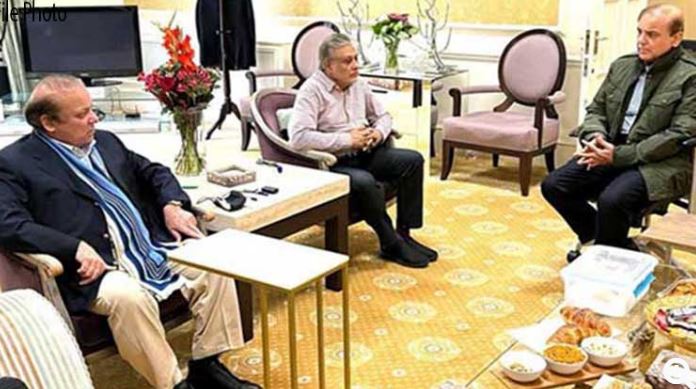
Ishaq Dar likely to return to Pakistan along with PM Shehbaz

LONDON – Former finance minister and Pakistan Muslim League-Nawaz (PML-N) leader Ishaq Dar is likely to return to Pakistan along with Prime Minister Shehbaz Sharif.

In London, PM Shehbaz met with PML-N supremo Nawaz Sharif and Ishaq Dar, and the two leaders discussed the ongoing situation in the country and measures taken by the sitting coalition government, while Ishaq Dar informed the premier about his plan to return to Pakistan.

According to sources, Ishaq Dar will return to the country next week and appear before the accountability court.

Dar will take oath as Senator, and after that he will also assume the charge of Finance Minister, sources added.

Gold extends losses to third day, price plunges Rs3,750 per tola in Pakistan

KARACHI: Gold extended losses into a third session on Saturday, closing slightly above the threshold of Rs150,000 per tola in line with price movement in the international market and expectations that economic recovery could sap inflationary pressure, curbing the metal’s appeal as a hedge.

Data released by the All Pakistan Sarafa Gems and Jewellers Association (APSGJA) showed that the price of the precious metal declined by Rs3,750 per tola and Rs3,216 per 10 grams to settle at Rs150,100 per tola and Rs128,686 per 10 grams, respectively.

Cumulatively, the precious commodity has lost around Rs5,000 per tola in the last three sessions. Meanwhile, it lost Rs6,100 per tola during the week ended September 24.

Pakistan is a small market for gold at the global level. It meets the commodity’s demand through imports as it does not produce the commodity locally.

Accordingly, the gold price for local markets is determined by keeping in view its prices in world markets, rupee-dollar exchange rate, and demand and supply in domestic markets.

The latest price for local markets was determined to keep in view the prices at which trade took place among buyers and sellers.

In the international market, the price of the yellow metal fell by $2 per ounce settling at $1,642 — its lowest since April 2020 — hurt by an unrelenting rally in the US dollar and Treasury yields as the Federal Reserve adopts a more aggressive stance to check surging inflation.

Analysts believe the economy is clearly heading towards a recession. The risks of a hard landing are elevated and this has been just continuing to drive flows into the dollar, which has been bad news for gold.

Gold rates in Pakistan are around Rs2,000 below the cost compared to the rate in the Dubai market.

Meanwhile, silver prices in the domestic market remained unchanged at Rs1,570 per tola and Rs1,346.02 per 10 grams.

It will remain PML-N’s desire to topple Punjab govt: CM Elahi

SIALKOT – Punjab Chief Minister Chaudhry Pervaiz Elahi on Saturday said that it will remain Pakistan Muslim League – Nawaz’s (PML-N) desire to topple the Punjab government.

Addressing a ceremony in Sialkot, Elahi said he is giving special attention to the education of girls in the province, adding that he feels sad that Shehbaz Sharif did not give a single penny of the aid received from foreign countries to the flood-hit people.

“It will remain Pakistan Muslim League – Nawaz’s (PML-N) desire to topple the Punjab government. Our priority is to give relief to the common man, those who want to topple the Punjab government should worry about themselves,” Pervaiz added.

Elahi while taking a jibe at the incumbent government said they have sunk the country’s ship due to their greed, adding that the Sharif family has been badly exposed.

Stay Connected

64FansLike
60FollowersFollow

Latest Reviews

Exchange Rates

USD - United States Dollar
EUR
1.17
GBP
1.35
AUD
0.67
CAD
0.72