Home Blog Page 147

Azerbaijani Interior Minister condemns Bannu terror attack

Azerbaijani Interior Minister condemns Bannu terror attack

ISLAMABAD, May 11 (DNA): Minister for Interior Mohsin Naqvi has received an official letter from his Azerbaijani counterpart, Colonel General Vilayat Eyvazov, expressing strong condemnation of the recent terrorist attack in Bannu, Khyber Pakhtunkhwa.

In the letter, the Ministry of Internal Affairs of Azerbaijan strongly condemned the tragic suicide attack and expressed deep sorrow and grief over the martyrdom of Pakistani police personnel. Minister Eyvazov conveyed heartfelt condolences to the families of the martyrs and expressed solidarity with the people of Pakistan.

“We are deeply saddened by the unfortunate incident in which police personnel embraced martyrdom and others were injured,” the Azerbaijani Interior Minister stated.

He reaffirmed that Azerbaijan firmly condemns all forms of terrorism and continuously supports global efforts aimed at eliminating the menace of terrorism.

Responding to the letter, Interior Minister Mohsin Naqvi expressed gratitude to the Azerbaijani government for its solidarity and condolences. “We express our heartfelt sympathy and condolences to the brotherly people of Pakistan over this tragic incident,” the message said.

Minister Eyvazov also prayed, “May Allah grant the highest place in His mercy to the martyrs and grant swift recovery to the injured.”

The Silent Struggle of TTS University Teachers: Educating a Nation While Fighting for Survival

The Silent Struggle of TTS University Teachers: Educating a Nation While Fighting for Survival

By: Prof Dr Shujaul Mulk Khan

Behind every successful graduate stands a teacher who devoted years of knowledge, patience, and sacrifice to shape young minds. Universities are often called the pillars of national progress, and teachers are the foundation of those pillars. Yet, in many countries, especially in public sector universities, the very educators responsible for building futures are themselves trapped in financial uncertainty and emotional exhaustion. Among the most affected are university teachers hired under the Tenure Track System (TTS), whose salaries have remained unchanged since 2021 despite rising inflation and increasing economic pressures.

At first glance, the term “Tenure Track System” sounds prestigious. It suggests stability, merit, and professional recognition. In reality, however, many TTS faculty members are silently struggling. They entered academia with dreams of contributing to research, inspiring students, and serving the nation through education. Instead, they now find themselves burdened with stress over basic living expenses, shrinking purchasing power, and a growing sense of neglect. The cost of living has increased dramatically over the past few years. Prices of food, fuel, electricity, rent, and healthcare continue to rise almost every month. While employees in several sectors have received salary revisions and inflation adjustments, TTS university teachers have been left behind. Since 2021, there has been no meaningful increase in their salaries. For professionals who spent years earning advanced degrees, conducting research, and dedicating themselves to academic excellence, this stagnation feels deeply unfair.

What makes the situation even more painful is the contradiction between expectations and reality. TTS faculty members are expected to publish research papers, supervise students, attend conferences, secure grants, and maintain international academic standards. Universities proudly showcase their faculty achievements in rankings and promotional campaigns. However, the same institutions often fail to provide financial security and emotional support to the people producing those achievements. Many people assume university teachers live comfortable lives. The truth is far different for many TTS faculty members. Some struggle to pay school fees for their own children while teaching students from privileged backgrounds. Others postpone medical treatments, avoid family gatherings due to financial embarrassment, or work extra jobs just to survive. It is heartbreaking that individuals responsible for educating future leaders are themselves forced to worry about grocery bills and monthly utility payments.

The emotional toll is equally serious. Teaching is not merely a job; it is a profession that demands passion, mental energy, and continuous learning. When teachers constantly feel undervalued, their motivation naturally declines. A teacher entering a classroom with financial anxiety cannot perform with the same peace of mind as someone who feels secure and respected. Over time, frustration replaces enthusiasm, and the academic environment suffers as a result. This issue is not just about salaries. It is about dignity. It is about recognizing that educators are human beings with families, dreams, responsibilities, and emotions. A nation that expects world-class education cannot ignore the welfare of its teachers. Governments and university administrations often speak about improving higher education standards, increasing research productivity, and competing globally. But such goals cannot be achieved while the very people carrying the academic system feel abandoned.

Another worrying consequence is the growing brain drain. Talented young scholars are increasingly leaving universities or moving abroad in search of better opportunities. When experienced researchers and dedicated teachers lose hope, universities lose valuable intellectual capital. The country then pays the price through weakened academic institutions and declining educational quality. Investing in teachers is not an expense; it is an investment in national development. Moreover, TTS teachers often face uncertainty regarding policies and promotions. Delays in policy decisions, unclear regulations, and inconsistent treatment create further stress. Instead of focusing fully on teaching and research, faculty members spend time worrying about administrative complications and financial survival. Such an environment discourages creativity and innovation – the very qualities universities should nurture. Society also has a role to play. Teachers deserve more than ceremonial praise on special occasions. Respect must be reflected through fair policies, timely salary revisions, and genuine appreciation. Students, parents, policymakers, and university leaders must understand that strong educational institutions cannot exist without motivated educators.

The voices of TTS university teachers are not loud because many continue to work with dignity despite their hardships. They continue teaching classes, guiding students, publishing research, and serving universities even when they feel unheard. Their silence should not be mistaken for satisfaction. Behind that silence lies exhaustion, disappointment, and a hope that one day their contributions will truly be valued. If nations genuinely want progress, innovation, and educated societies, they must start by taking care of their teachers. A university teacher should not have to choose between academic passion and financial survival. The people shaping the future deserve stability, respect, and justice today—not promises for tomorrow.

The struggle of TTS teachers is more than an employment issue; it is a moral question for society. How can a nation expect its educators to build bright futures when their own futures remain uncertain?

Pakistan Navy marks first anniversary of Marka-e-Haq

Pakistan Navy marks first anniversary of Marka-e-Haq

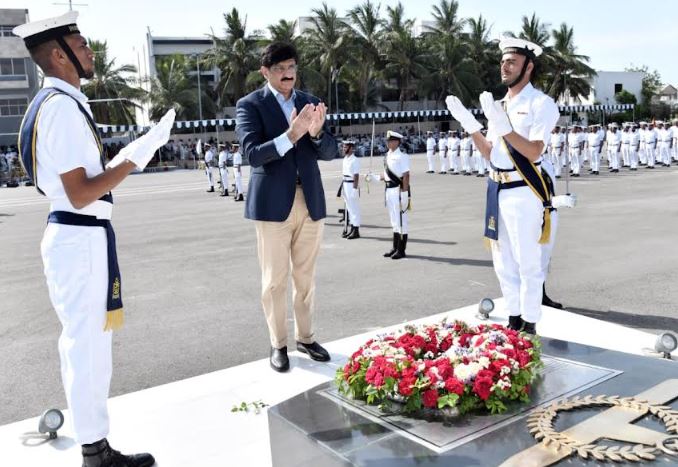
KARACHI, MAY 10 /DNA/ – Resonating with the spirit of courage, sacrifice and national unity, Pakistan Navy celebrated first anniversary of Marka-e-Haq – Victory Day with patriotic fervour. The celebrations reflect strong resolve of Pakistan Armed Forces to defend the motherland while paying tribute to the martyrs who stood like a wall of steel during Marka-e-Haq.

To mark the occasion, Pakistan Navy held a dignified ceremony at Pakistan Navy Dockyard, Karachi. Chief Minister Sindh, Syed Murad Ali Shah, graced the occasion as Chief Guest and laid wreath at Shuhada Monument. Vice Admiral Muhammad Faisal Abbasi, Commander Karachi, during his welcome address, paid tribute to the Shuhada & lauded the contributions of Pakistan Armed Forces in defending sovereignty of our motherland. A special message from Chief of the Army Staff and Chief of Defence Forces was read during the ceremony.

While addressing the gathering, Chief Minister Sindh acknowledged the courage, professionalism and sacrifices of Pakistan Armed Forces and emphasized that Marka-e-Haq stands as a symbol of national unity and military excellence.

The ceremony was attended by provincial ministers, senior government and Tri-Services officials, members of the business community, various dignitaries and a large number of civilians from all walks of life.

Ali Pervaiz Malik meets Barrick Chairman John L. Thornton

Ali Pervaiz Malik meets Barrick Chairman John L. Thornton

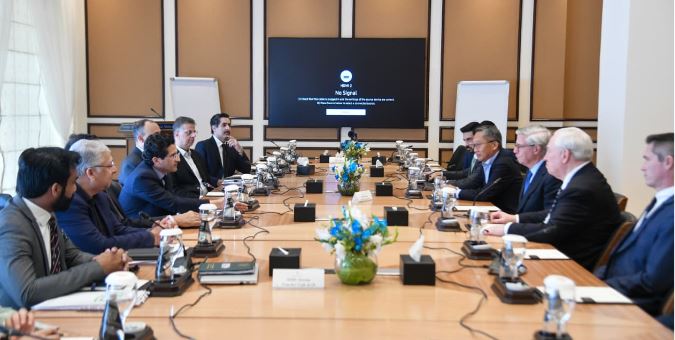
ISLAMABAD, MAY 10 /DNA/ – Federal Minister for Petroleum Ali Pervaiz Malik held a meeting with Chairman Barrick, Mr. John L. Thornton, to review progress and discuss future steps regarding the Reko Diq Copper-Gold Project.


During the meeting, both sides exchanged views on the development of the project and discussed ongoing efforts aimed at advancing work on Reko Diq, which is among the world’s largest undeveloped copper-gold projects.

Federal Minister Ali Pervaiz Malik highlighted the strategic significance of the project for Pakistan’s economic growth and mineral sector development. He stated that Reko Diq is a flagship national project that will play a key role in attracting investment, generating employment opportunities, and accelerating socio-economic development in Balochistan.

Mr. John L. Thornton reaffirmed Barrick’s commitment to the project and appreciated the Government of Pakistan’s continued support in advancing the initiative. Both sides agreed to maintain close coordination to achieve key milestones.

Reko Diq is owned 50% by Barrick, 25% by three federal state-owned enterprises, and 25% by the Government of Balochistan, reflecting a strong partnership framework for the development of the project.

The meeting concluded on a positive note, with both sides reiterating their resolve to work together for the development of the Reko Diq project.

Trump: US would need two weeks to hit Iran again

Trump says US military studying 'very strong options' for Iran

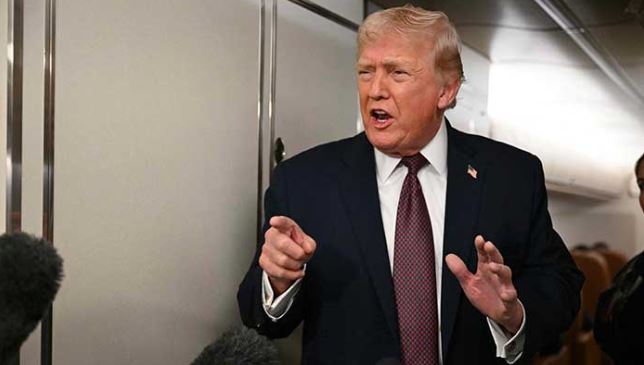
WASHINGTON, MAY 10 /DNA/ – US President Donald Trump stated that American forces could complete strikes on remaining Iranian targets within approximately two weeks if military operations resume. Speaking in recent interviews, Trump indicated that while significant progress has already been made, “another two weeks, maybe three weeks” would be needed to fully achieve US objectives against Iran.

 Prime Minister Benjamin Netanyahu declared that the with Iran is “not over,” emphasizing that Iran’s highly enriched uranium stockpile must still be removed. In recent remarks, Netanyahu stated that while substantial achievements have been made, remaining nuclear material, enrichment sites, and proxy threats require further action. He reiterated that the enriched uranium will leave Iran “by agreement or through resumed fighting,” noting alignment with the US on this core issue.

The developments reflect a delicate balance between diplomatic efforts — mediated by Pakistan — and persistent military posturing. The current two-week ceasefire framework remains in place, but key sticking points include Iran’s nuclear program, proxy forces in Lebanon, and guarantees for long-term peace. No immediate breakthrough has been announced, and markets continue to monitor the situation closely for signs of escalation or de-escalation in the region.

Marka-e-Haq ceremony: PM says historic military response forced India to seek ceasefire

Marka-e-Haq ceremony: PM says historic military response forced India to seek ceasefire

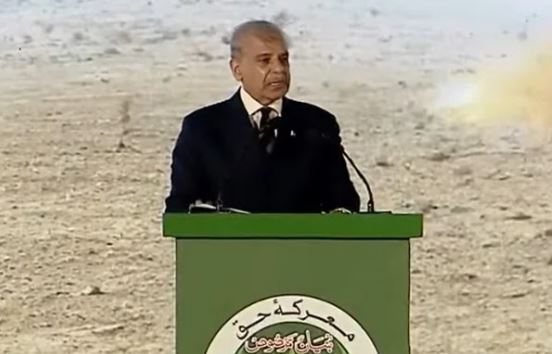
ISLAMABAD, MAY 10: Prime Minister Shehbaz Sharif on Sunday said that Pakistan’s strong response to Indian aggression in May last year forced it to seek a ceasefire, while praising the armed forces for their swift response during the conflict.

The prime minister made the remarks during a special ceremony marking the first anniversary of the Marka-e-Haq victory at the Pakistan Monument in Islamabad.

Participants of the event included President Asif Ali Zardari, services chief, and the political leadership of the country.

Marka-e-Haq (battle of truth) refers to the 19-day military conflict with India, spanning from April 22 to May 10, 2025.

Before beginning his address, PM Shehbaz observed a one-minute silence in honour of the martyrs who sacrificed their lives in defence of the country.

In his speech, the prime minister rejected India’s allegations regarding the Pahalgam incident, saying Pakistan was subjected to baseless accusations following the attack.

He said that Pakistan had repeatedly warned the adversary against any adventurism and had even offered a comprehensive investigation into the incident.

PM Shehbaz further said the situation escalated when the “cowardly enemy imposed war on Pakistan,” prompting a strong and historic response from the country’s armed forces.

“Everywhere our Shaheens dominated the skies and enemy aircraft were reduced to wreckage,” he said, adding that Pakistan’s response had forced the opposing side to seek a ceasefire.

He also stated that even after one year, India had not presented any evidence to substantiate its allegations.

Declaring May 10 as “Youm-e-Marka-e-Haq”, the premier announced that the day would be observed annually with national enthusiasm and renewed commitment.

The prime minister praised Chief of Army Staff (COAS) and Chief Defence Forces (CDF) Field Marshal Asim Munir for his leadership role in the conflict with India.

He also lauded the air force and naval chiefs for playing pivotal roles in defending the motherland.

“During Marka-e-Haq, 240 million people stood like a steel wall with their forces,” he said, while expressing gratitude to friendly countries for extending support to Pakistan.

He thanked Saudi Crown Prince Mohammed bin Salman, Turkish President Recep Tayyip Erdogan, and Chinese President Xi Jinping for their diplomatic and political support.

The prime minister also mentioned the crucial role played by US President Donald Trump to help end the war with India.

He also highlighted Pakistan’s mediation role, saying Islamabad continues its efforts to help mediate an end to the war in the Middle East.

In this regard, the premier said that he was briefed about Iran’s response to the US proposal to end the war.

“Right now, the Field Marshal [Asim Munir] informed me that [we have] received Iran’s response. I cannot go further into details,” the prime minister added.

‘Golden chapter’
Addressing the ceremony, President Zardari, recalling the historic response of Pakistan to India during Marka-e-Haq, said: “May 10 is a golden chapter in Pakistan’s history.”

The president paid rich tribute to the armed forces for giving a befitting response to India’s unprovoked aggression in May last year.

“Pakistan’s response to Indian aggression will be written in golden letters,” he added.

Slamming India, the president said that enemy forces had attacked Pakistan’s civilian population and places of worship.

“Our forces shot down eight Indian fighter jets,” he said, adding that the armed forces raised the nation’s heads with pride.

Reiterating Pakistan’s stance on the longstanding issue of Indian Illegally Occupied Jammu and Kashmir (IIOJK), the president said: “Pakistan will continue extending political, moral, and diplomatic support to the people of Kashmir.”

Referring to the cross-border terrorism backed by New Delhi, the president said: “India-sponsored terrorism in Pakistan via Afghanistan must end.”

Moving on to ongoing atrocities by Israeli forces in Gaza and the Occupied West Bank, the president said that Pakistan would continue its unconditional support to the Palestinian people.

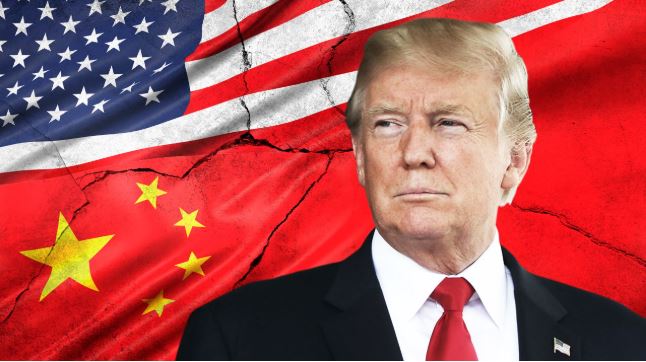
Trump is under pressure to end Iran war ahead of China visit

Trump is under pressure to end Iran war ahead of China visit

WASHINGTON, MAY 10: With US President Donald Trump due to visit China this week, there has been mounting pressure to draw a line under the war, which has ignited a global energy crisis and poses a growing threat to the world economy.

But, despite diplomatic efforts to break a deadlock between the two sides and the passage of the Qatari gas tanker, the threat to shipping lanes and the economies of the region remained high.

On Sunday, the UAE said it intercepted two drones coming from Iran, while Qatar condemned a drone attack that hit a cargo ship coming from Abu Dhabi in its waters. Kuwait said its air defenses had dealt with hostile drones that entered its airspace.

Tehran has largely blocked non-Iranian shipping through the narrow Strait of Hormuz, which before the war carried one-fifth of the world’s oil supply and which has emerged as one of the central pressure points in the war.

Qatari Prime Minister Mohammed bin Abdulrahman al-Thani, who discussed Pakistan’s mediation efforts to end the war with US Secretary of State Marco Rubio in Miami on Saturday, told Iran’s Foreign Minister Abbas Araghchi that using the Strait of Hormuz as a “pressure tool” would only deepen the crisis.

He told Araghchi in a phone call that freedom of navigation should not be compromised, the Qatari foreign ministry said on Sunday, without specifying the exact date of the call.

ICPG and Sante host thrilling Islamabad Club Open Polo Championship

ICPG and Sante host thrilling Islamabad Club Open Polo Championship

ISLAMABAD, MAY 10 /DNA/ – ICPG, in collaboration with Sante, proudly hosted the final match of the 7th Islamabad Club Open Polo Championship today at the Islamabad Club. The prestigious sporting event was attended by esteemed members of the Islamabad Club and honored by the presence of distinguished dignitaries and diplomats from Bulgaria ,the Chief Guest HE Ambassador Irena Gancheva ,Ambassador of Poland Macej Pisarski and Mrs Justyna Pisarki, the Amabassor of Belgium Idesbald van Graft and Mrs Lorrain , newly arrived Ambassador of Spain Carlos Aragon and Mrs Sabine Richter ,  the Embassy of Argentina Deputy Mrs Erica Lucero, underscoring the championship’s international appeal and stature.

The thrilling final saw Team HN/Diamond Paints emerge victorious HAIDER ,SHOAIB,SAQIB & JALAL  against Team BN/SQ  BABAR,SHIRAZ,IBRAHIM & ABELENDA in a closely contested and highly competitive match. Displaying exceptional skill, sportsmanship, and teamwork, both sides kept spectators on the edge of their seats, making the final a memorable highlight of the tournament.

The championship featured six coveted teams, bringing together top talent from the polo circuit and delivering a series of exciting matches throughout the tournament. Celebrated for its high standards of play and organization, the event once again reaffirmed the Islamabad Club Open Polo Championship as a key date on the country’s sporting calendar.

Islamabad club expressed their appreciation to all participating teams, guests, sponsors, and organizers for contributing to the success of the event, and reaffirmed their commitment to supporting polo and sporting events in islamabad.

Iraqi media shocked by reports of secret Israeli base as Baghdad hits critical juncture – analysis

Israel operated secret base in Iraq for attacks on Iran: WSJ

Iraqi media have recently been swept up by a report in the Wall Street Journal on Saturday regarding a secret Israeli base in Iraq. This comes at a particularly sensitive time in the country, as Baghdad is in the midst of forming a new government after finally tapping a new prime minister, Ali al-Zaidi, last week. As such, the new report comes at a critical juncture in Iraq.

Baghdad is seeking to respond to US pressure to rein in and disarm Iran-backed militias. Reports that Iraq’s sovereignty may have been undermined by a foreign force operating in the desert will cause controversy in Baghdad. Iraq is an implacable foe of Israel, and this will appear embarrassing to the new leadership.

Iraq’s media is also interested in the US role in the recent reports. Iraq has had a complex and rocky relationship with the US. The US invaded the country in 2003 and deposed Saddam Hussein. Although Kurds and Shi’ites backed the invasion, the Shi’ite community is generally closer to Iran today and is infiltrated by militias that are hostile to the US.


During the recent war with Iran, the militias carried out around 1,000 attacks on the Kurdistan region and on US diplomatic posts. As such, the militias may see the new report as evidence of the US and Israel collaborating.

One of the militias, Kataib Hezbollah, kidnapped a US journalist during the war. She was subsequently freed. The US has offered four $10 million rewards for information leading to the identification of militia leaders.

Shafaq News in Iraq is reporting that the US “blocked an investigation into the Israeli base.”

A separate report at Baghdad Today in Iraq notes that “the head of the Security Media Cell at the Joint Operations Command, Lieutenant General Saad Maan, denied on Sunday (May 10, 2026) reports of the presence of any unlicensed forces or military equipment in the deserts of Karbala and Najaf, following extensive search operations that included the region and other areas in Iraq.”

Iraqi media: Force did not coordinate with Iraq
The site +964 in Iraq also reported on the WSJ article. It noted “on March 5, 2026, the Deputy Commander of Joint Operations, Lieutenant General Qais al-Muhammadawi, revealed that one member of the security forces was killed and two others were wounded while investigating suspicious activity in the Najaf desert on the borders of Karbala, by air fire.

He pointed out that the force that arrived at the location did not coordinate with Iraq, and a protest note was submitted to the international coalition requesting clarification. He emphasized that ‘the force was reinforced with two counter-terrorism regiments to search the area and investigate the location, but they did not find anything.’”

Iraq now appears on edge, and is concerned about new incidents. “The Security Media Cell denied on Sunday the existence of a new airdrop in the Karbala desert, indicating that the incident dates back to last March and the necessary measures were taken regarding the unauthorized airdrop incident in the Al-Nukhaib desert,” the Iraq News Agency noted. The Iraqi website Hath al-Youm published several reports on the controversy.

Meanwhile, an Iraqi security source told Al-Arabiya and Al-Hadath in Saudi Arabia that military movements of “unknown origin” were observed in the Najaf desert in western Iraq during the Iran-Iraq War, “suggesting they might be related to a temporary airdrop operation in the area.” The source “added that the American side informed the Iraqi forces at the time of the need not to approach the area for security reasons.”

This report could feed distrust of the US. Iraq and others reading the Arabic report in the region may see this as the US enabling a violation of Iraqi sovereignty. In a sensitive time, when some Gulf states are also concerned about the conflict with Iran, this could have repercussions.

The issue of repercussions is important. A new article at Saudi Arabia’s Arab News by Saudi Arabia’s Prince Turki Al Faisal notes, “had the Israeli plan to ignite war between us and Iran succeeded, the region would have been plunged into ruin and destruction. Thousands of our sons and daughters would have been lost in a battle in which we had no stake. Israel would have succeeded in imposing its will.”

Riyadh is increasingly concerned about Israel’s more aggressive role in the region. News from Iraq may influence Saudi Arabia as well, and Arabic news coverage in Saudi media may have this effect.

Commentary in Iraq is incredulous about the report. Some have argued that it is surprising that Iraq, with all its security forces, couldn’t prevent this. “Once again, America’s goals from its occupation of Iraq in 2003 were all achieved, foremost among them making it a weak, dilapidated, and submissive country,” one commentator notes.

Meanwhile, the Faytuks Network Intelligence & Geo-Intelligence Teams claimed to have found the disused airstrip, which they call “Israeli” and say was “used to support combat operations against Iran in the Najaf Desert of southern Iraq. When an Iraqi military convoy approached, the Israeli Air Force attacked it, causing casualties and the loss of a vehicle.”

An Iraqi social media account also claimed to have found an image of a shepherd killed when he came upon the site. “Image of the martyr, the shepherd Awad Hadi Ali Al-Zarghouti, who was killed by Israeli forces in the Najaf desert, along with the burning of his car.” It also claims to have found footage from March near the site, captured during a night clash.

It’s possible this new cycle will blow over in Iraq. This is because Iraq has many issues to confront at the moment, including continued Iranian attacks on Kurdish opposition groups in northern Iraq, an oil and economic crisis, as well as relations with the US and jockeying among various groups for ministries in the new government. Dealing with a March controversy based on a single WSJ report may seem politically unhelpful to the new government.

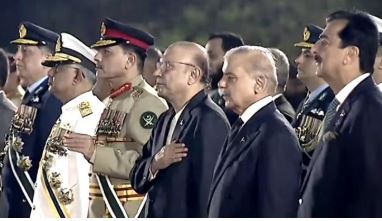
Main Marka-e-Haq ceremony gets underway at Pakistan Monument

Main Marka-e-Haq ceremony gets underway at Pakistan Monument

ISLAMABAD, MAY 10: A special ceremony marking the first anniversary of the Marka-e-Haq victory is being held at the Pakistan Monument in Islamabad, with the country’s top civil and military leadership attending the event.

Participants of the event include President Asif Ali Zardari, Prime Minister Shehbaz Sharif, and Chief of Army Staff (COAS) and Chief of Defence Forces (CDF) Field Marshal Asim Munir, among others.

Pakistan Air Force aircraft will perform an air show, while a laser show will also be held during the event being held at Shakarparian.

The event is part of the days-long celebrations being held across the country, marking Pakistan’s decisive victory over India in May last year.

On May 6-7 last year, India launched an unprovoked attack on Pakistan, following an attack on tourists in the Indian Illegally Occupied Jammu and Kashmir.

Pakistan, during the 87-hour conflict, downed eight Indian fighter jets, including French-made Rafale, and dozens of drones. The war between the two nuclear-armed nations ended on May 10 with a ceasefire agreement brokered by the US.

Stay Connected

64FansLike
60FollowersFollow

Latest Reviews

Exchange Rates

USD - United States Dollar
EUR
1.14
GBP
1.34
AUD
0.70
CAD
0.71