Home Blog Page 1463

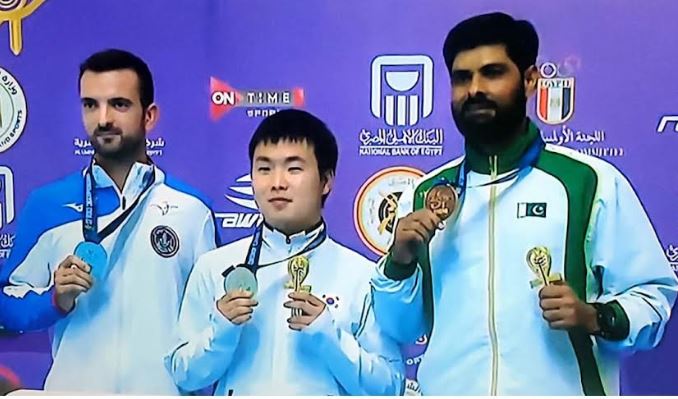
Pakistan Navy shooter wins bronze medal in maiden ISSF 2022 championship

Islamabad, OCT 26 /DNA/ – Pakistan Navy Ghulam Mustafa Bashir MCPO bagged Bronze Medal at 1st International Sports Shooting Federation (ISSF) Rifle/ Pistol shooting Championship held at Cairo, Egypt. This championship served as qualification event for Summer Olympics scheduled at Paris, France in 2024.

Ghulam Mustafa Bashir and RasamGul from Pakistan Navy participated in 25m Rapid Fire Pistol event and represented National Flag during said championship. Both shooters performed well and Ghulam Mustafa Bashir secured 3rd position. By securing Bronze Medal, Ghulam Mustafa Bashir not only qualified for participation in Paris Olympics 2024 but has reached to No. 07 at world ranking.

A total of 77 shooters from 37 countries participated in the championship. Upon return to Pakistan, both shooters were warmly received at Jinnah International Airport, Karachi. The medal winning performance of PN shooter is a testimony of Pakistan Navy efforts to promote shooting as a sports in Pakistan.

Chief of the Naval Staff being President of National Rifle Association of Pakistan (NRAP) has applauded efforts put in by Pakistani shooters and expressed hope to bring more laurels for the Nation in future.

Value the Biotic

Dr M Ali Hamza

The planet Earth is a beautiful place to live in. Thanks to our magnanimous Sun and vast oceans of water that helped lifetoflourish on the planet. No matter where we go on planet earth, the stunning life is surviving through plants, and animals that catch our attention. They are two very important aspects of any ecosystem or what we call nature.In this technological era, humans interact more with gadgets than ever, and it’s almost impossible to find time to interact with nature. When the vacation time knocks, we plan traveling to exotic locations to trek through natural trails or just drive to see herd of fearless animals. This is enabled by flora and fauna that are spread across different parts of the world.

Flora refers to the population of plant life whereas Fauna is the population of animal life in a certain location or time. Flora is also known as ‘Goddess of flower’ and Fauna ‘Goddess of Fertility’. They both regulate the amount of oxygen and carbon dioxide in the air and also provide us with a wide range of food, drink, fabrics and medicines.Flora and Fauna are the most fascinating of all biotic elements. As we appreciate the Abiotic: non-living substances, that are necessary for life to survive and enjoy, such as soil, water, minerals, diverse sights and climate, we need to equally take pride of biotic elements of one’s country.

Promoting biotic elements of one’s country, opens door to another captivating dimension of tourism called eco-tourism. Let’s take an example of Indonesia. They have promoted their Komodo Dragon: Indonesia’s endemic ancient species (that is also the world’s biggest lizard), by establishing Komodo National Park and people just visit one of the islands to only see these dragons. Raja Ampat; world-famous diving paradise, attracts the lovers of marine biodiversity and pristine nature. West Bali National Park is a treat for naturalists. The park has a popular birdwatching spot from where tourists are presented with a real chance to see the endangered Bali Starling. Moreover, places like Bunaken National Park, Sumba Island, Flora Island, Bangka Belitung Islands etc., in Indonesia invite every year a huge number of domestic and international tourists to satisfy their sense of Love for nature and desire of discovery. Other countries like Brazil, Mexico, Costa Rica, Peru, China, Australia, Thailand, Tanzania, Spain, USA, Ecuador, Italy, France, and even Kenya have seriously branded their Flora & Fauna and listed among the best tourists’ spots for ecotourism. There are many other countries blessed with natural treasury of Biotic & Abiotic elements but are poor in showcasing it, unable to offer variety of tourism and resultantly don’t in-cash the potentials. Pakistan is among those unfortunate ones.

Whenever we think of tourism and Pakistan together, generally we start visualizing the gigantic mountains, splendid valleys, and sparkling water streams. But we tend to completely ignorethe very existence of unique Flora & Fauna. Pakistan has lot to offer in this dimension. Beside the long list, lets focus on one of the least highlighted animals that is long-haired, short-legged oxlike domesticated mammal; the YAK – Beast of high altitudes. This specie of ox is only found in the Himalayan region of the Ladakh, the Tibetan Plateau, Northern Myanmar, Nepal, Mongolia,Siberia and Gilgit-Baltistan Pakistan. Few geographical locations that are lucky enough to have YAK, trying to make it worth selling through their eco and livestock tourism. Even some countries like Nepal have introduced Goth Stay, where tourist trailing on high altitudes can stay with families that are breeding YAK, offer friendly engagement with the small community, provide the interesting orientation, andmake the stay memorable through YAK ride, YAK polo, YAK wool, YAK stake etc. Are we in Pakistan taking any inventive steps? The answer is ‘Not Really’. The very next logical question is ‘why not’? and the simplest answer is that we are not valuing our biotic elements to an extent we should, and if we deceptively believe that we are, then at least we are not branding it.

Strangely, if you visit Gilgit-Baltistan in Pakistan, you won’t find any Statue of YAK. Check out the post cards, you won’t find a YAK post card. There are no YAK ornaments. Kids cannot find YAK t-shirts or YAK toys. There are no decorative YAK crowns or models. YAK mugs and cups are not in imagination. There is no YAK festivity or engagement of YAK in popular events like Sarfaranga Jeep Rally or Shandoor Polo Competition.

It is commendable that Virtual university of Pakistan took an initiative and held first and second international conference on Yak in Lahore and Baltistan respectively. The collaborative role of newly emerged University of Baltistan, Skardu deserves appreciation. This effort brought researchers together. The establishment of first ever Yak Association in Pakistan is the outcome of this conference.Speakers from Germany, China and Mongolia shared their work. Most of the talks in the conference were focused on area of research to improve YAK productivity. A talk on branding YAK, argued on the negligence of not promoting a unique breed and explained basic corrective measure to be taken.  It was an effort to create a ripple in the thought but we need to keep oaring to sustain the ripple to reach the goal.

274 wheat smugglers arrested

QAZI SHOAIB KHAN / District Correspondent, Attock

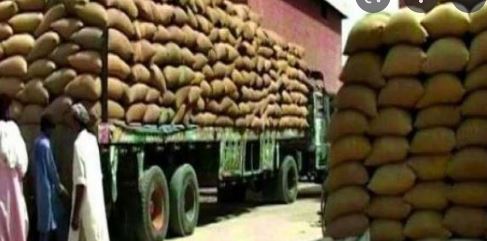
ATTOCK, OCT 26 /DNA/ – Punjab Food Department Rawalpindi arrested 274 wheat smugglers along with recovery of  5338 metric tons of wheat and wheat products  from their possession during the months of  August to October. This was told  by the  District Food Controller Rawalpindi Sufian Asif Awan while briefing newsmen about the anti wheat smuggling activities by the food department at Brahma-Bhattar toll plaza  near here on  Wednesday.

While, replying different questions, he said from August 1 to October 23, the food department has seized the bids of 274 vehicles including 32 wheels trailers, trucks and mini trucks to smuggle wheat and flour from the various parts of the Punjab to KP. He said that seven check posts were established at various points of the district to check the anti wheat smuggling activities. He said that bids were foiled at designated and un-designated routes especially Islamabad- Peshawar motorway (M-1), Rawalpindi- Peshawar GT road and link routes especially Taxila-Khanpur road and Taxila-Hattar road. He said that 274 persons were booked and send behind bars after registration of cases under food act for wheat and flour smuggling during this period.

District Food Controller Rawalpindi Sufian Asif Awan while narrating the details of confiscated 5338 metric ton of wheat and wheat products, he said that among this confiscated items,  as many as 3449.10 metric ton of wheat smuggling bids was foiled and subsequently confiscated. He added that 120 vehicles were also taken into custody  and as number of crew members were booked and arrested accordingly.

He further said that 154 vehicles of wheat products like flour, fine flour and maida smuggling bids were foiled during the period. He said that during the crackdown against the wheat products smuggling mafia, 1888.90 metric ton wheat products smuggling bids were foiled and 154 accused were booked under FoodAct, he added.

He further said that 80 truckers point were  established to supply flour to the masses on daily basis at their door steps in various markets and bazaars across the district.He said that the with the recommendation of the concerned assistant commissioners of the relevant tehsils, flour is being supplied to as many as 2200 shops on daily basis  across the district.

Muslim Americans donate more generously than their non-Muslim countrymen: Shariq Siddiqui

DNA

Islamabad, OCT 26: American Muslims, despite being merely 1% of the total US’ population and poorer than their native non-Muslim compatriots, donate around $4.5 billion annually, which is more than what the general population hands out. The conservative Muslims, moreover, also happen to be more open to diversity in their philanthropic practices. While their motivational factors may vary, including empathy and social welfare, a big reason behind this range of Muslim philanthropy is their religious beliefs and values.

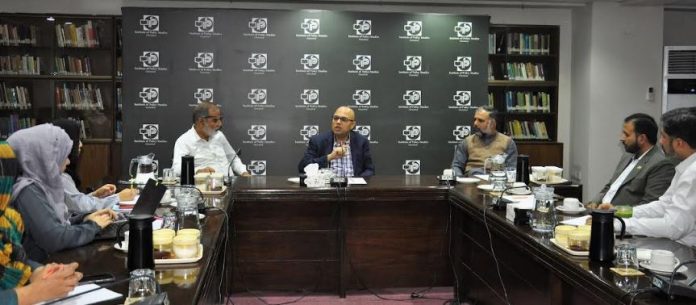
These were the research findings depicting the trends of Muslim philanthropy in the US, as put by Dr Shariq Siddiqui, assistant professor, Philanthropic Studies and director, Muslim Philanthropy Initiative at the Indiana University Lilly Family School of Philanthropy, who was visiting Institute of Policy Studies (IPS) to deliver a talk on ‘Trends in Muslim Philanthropy and Cooperation Models’.

Underscoring the significance of research on Muslim philanthropy, Dr Siddiqui shared that these research findings and philanthropic trends equip nonprofits and philanthropic leaders and organizations with the knowledge to educate people about Muslim philanthropy, and respond to the challenges of the society. This also gives way to more questions that should be made a priority by Muslim non-profit organizations to develop empirical research.

Dr Siddiqui also presented his views on cooperation models between organizations to conduct research on Muslim philanthropy. He upheld that independent research requires adequate resources, while Muslim non-profit organizations are resource constrained with extra mandates. This serves as one of the main reasons for the shutting down of Muslim organizations and their lack of collaboration with other Muslim and interfaith organizations.

Inter-faith foundations also don’t collaborate with Muslim organizations because of their lack of knowledge about the cooperation areas where Muslim organizations can help them as well as Islamophobia and fear of involvement in terrorism-funded activities. Moreover, Muslim organizations are not as visible as they should be.

Dr Siddiqui stressed the building of associations and collaborations between Muslim nonprofit entities. In this regard, he shared the Community Collaborative Initiative advanced by him as an example of a collaboration model between 25 Muslim organizations to stimulate research based on Islamic knowledge building with an approach that brings forward all kinds of philanthropic ideas.

Furthermore, he emphasized adopting a religious philanthropic approach in a way that indigenous informal philanthropy, cultural activities, and Islamic traditional values are incorporated into Muslim philanthropy as they can unlock the contemporary problems and improve the sustainability of the society.

It is particularly important in the future when governments would increase regularizations and see themselves as funder and director of private money. Though the formal sector would attain legitimacy and profit from regulations, the informal philanthropy would be at a disadvantage. 

PRGMEA, EU agree to work on promotion of SME sector

ISLAMABAD, OCT 26 /DNA/ – Ambassador of the European Union Dr. Riina Kionka has called for effective implementation of the 27 international conventions as the Pakistan’s present GSP Plus status is going to be reviewed in Dec 2023 and more labour and human rights conventions will be added for their implementation.

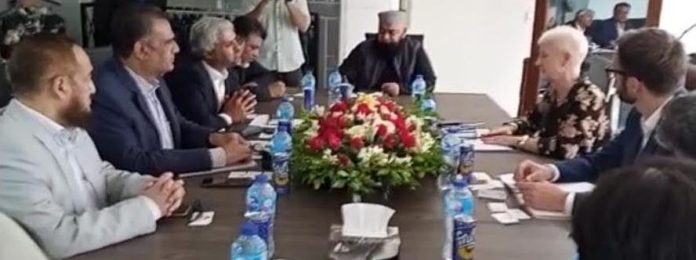
The European Union Ambassador stated this during her visit to a number of garments’ manufacturing units along with the PRGMEA executive committee members, Central Chairman Mubashar Naseer Butt and vice chairman Waseem Akhtar Khan where she also appreciated their performance, calling for product diversity and more value-addition to exploit the full potential of market access to the countries under GSP Plus present regime.

Later in a meeting held here at PRGMEA Office, both sides discussed in detail the role of SME sector in economic growth, technical education, skills development, EU support for Pakistan in TVET sector and promotion of women skilled force.

The PRGMEA and the EU agreed to work on women entrepreneurship, better labour laws and promotion of SME sector along with other projects. The ambassador discussed various ideas for providing support to the SME sector, with the focus on creating linkages within the EU to open new markets for the products.

Dr. Riina Kionka said that the EU is the biggest export market for Pakistani goods, as it accounts for about one-third of all Pakistani exports. She said the EU can assist Pakistan to expand its exports and uplift its industry through collaboration with the PRGMEA. The Ambassador appreciated the role of PRGMEA in boosting industrial activities in the region and added that her embassy would be in touch with the it to increase the bilateral ties.

Other participants of the meeting included PRGMEA ex-chairman Sajid Saleem Minhas, Dr. Mufeez ul Islam, Ahmad Hanif, Irfan Khurshid, Muhammad Ali and Hina Asif.

Addressing the meeting, PRGMEA Central Chairman Mubashar Naseer Butt and vice chairman Waseem Akhtar Khan said that Pakistan attaches great importance to its partnership with the European Union, as the European Union is one of the largest trading partners of Pakistan.

PRGMEA Central Chairman said that GSP+ has increased EU-Pakistan bilateral trade; valued at €12.2 billion 2021 as compared to €6.9 billion, representing an increase of 78%.

Mubashar Butt said that the GSP Plus status is very beneficial for the economy of Pakistan as it has played an important role in the expansion of bilateral trade. He said that trade with EU under GSP+ is of critical importance for Pakistan’s economic and social stability and prosperity. He said that GSP Plus is a constructive engagement for the betterment of our economy and promoting economic agenda. The scheme has a positive synergy with government’s social agenda. As a result of improved market access, Compound Annual Growth Rate (CAGR) for Pakistan’s exports to EU increased to 7% in the post GSP+ period as compared to 4% in the 5 years preceding GSP.

On this occasion, PRGMEA vice chairman Waseem Akhtar observed that the GSP Plus benefits to Pakistan are the tariff free access to the largest market for textile and apparel and a solid platform and incentive structure to drive further reforms in the industry and the country. In the same way, the benefits to EU are reliable, cost competitive supply of textiles to EU businesses and consumers and a sustainable, ethical and increasingly traceable textile value chain. EU-Pakistan GSP+ relationship has the power to transform Pakistan’s economy and society while delivering on EU goals, he added.

Mubashar Butt said that Pakistan’s textile and apparel industry is the backbone of the economy, constituting 8.5% of GDP, 40% of the industrial labor force and more than 60% of the country’s exports while it’s manufacturing share is 46%. The export of readymade garments exhibited an increase of 28.75% to $3.9 billion during fiscal year 2021-2022 compared with $3.03 billion in the preceding fiscal year. The Value-added Garments sector is the major tax payer, largest employment generator in the whole textile chain.

Turkiye-Glorious Past & Shining Future

By Syed Ali Nawaz Gilani

Turkiye marks its 99th anniversary this year. Mustafa Kemal Atatürk declared Turkiye as a republic on October 29, 1923, after the war of independence against allied powers resulted in abolishing the Sultanate on November 1, 1922. And the then Turkish parliament proclaimed the foundation of the republic of Turkey on October 29, 1923, formally ending the Ottoman Empire.

Turkiye is a country that never ceases to enchant with its long and rich history, which has seen civilizations, empires, diverse ethnicities and religions. From ancient sites that defy historical truths or the world’s second-oldest railway. In fact, Turkiye has a lot more to offer than just delicious food, lively marketplaces and of course Turkiye is one of the most visited countries in the world.

Turkiye is a country with 85million people and 700billion US $ plus GDP growing as the 19th-largest economy in the world. Türkiye pursued ambitious reforms and enjoyed high growth rates between 2002 and 2017 that propelled the country to the higher reaches of upper-middle-income status and reduced poverty. The share of people below the US$5.50 per day poverty line fell by three quarters to 8.5 percent between 2002 and 2018. It is a fact that Turkiye’s geography and membership in NATO have long given the country an influential voice in foreign policy.

The Turkiye President Erdogan has been trying to gather international muscle around the idea of reviving the Muslim Ummah, which other Islamic states like Pakistan and Malaysia have actively supported. At the UN General Assembly Erdogan raked up the issue of Kashmir and criticised the international community for not paying attention to the issue. This speech came just a month after the Indian government in 2019 revoked the special status of Jammu and Kashmir.

He also highlighted the issues of intervention in Yemen and Qatar and also the Israeli settlements in the West Bank. With the threat of facing complete isolation from the West, especially Europe and the US, Erdogan seems to be trying to mend relations with them. While addressing his party congress, Erdogan asserted that his government envisages ‘building our future together with Europe.’ Turkey’s role as a regional power has increased since the Justice and Development Party (AKP) came to power. AKP leadership not only aspired to become a regional power but also a global player. Turkey has, therefore, assumed different roles: the natural leader of the region; a historical big brother; and the protector of the Muslim minorities.

Turkey has also assumed a mediator and a facilitator role by trying to negotiate a deal with an emerging power such as Brazil in order to attempt to resolve the controversial Iranian nuclear issue. By making use of recent developments, Turkey tried to solidify its long desired role as a rising power by increasing its influence in its neighborhood and engaging with other emerging powers.

 Even before the Second World War, Turkey became a respected, modern and independent nation, no longer the “sick man of Europe”, able to give its educated elites at least, a feeling of “equality” with the citizens of the most advanced parts of the world. Turkey was not a colony. Turkey was not dominated by others. Turkey was respected and controlled its own destiny. Turkey participated in a “world civilization” which had succeeded in producing scientific, technological and economic progress, but it was not dominated by the countries who had been leading technological progress.

The world faces new, tremendous, global challenges. From climate change, to restoring solid and sustainable economic growth, from world trade and finance, to safety from terrorism or nuclear proliferation or to the control of infectious disease, many of the most difficult problems require strong global cooperation. In this day and age, nothing can be achieved any more by sheer force or be imposed from outside on other societies. Young people everywhere, however, are looking across borders, for examples of what works, what can bring happiness, freedom and prosperity. The next decade will not be an easy one, for Turkey, for the United States or for the World. We will have to work hard, whether our activities are primarily economic, political, civil society oriented or academic.

I do hope and trust however, that many of us, in 2023, will be able to celebrate, wherever we may be at the time, as citizens of, or friends of Turkiye, a 21st century republic and democracy, that looks forward, while cherishing the A word about Turkiye & Pakistan, the countries share historical Islamic ties, as the Muslims living under the British Raj deemed the Ottoman Sultan as their Caliph, and the Caliph of Islam and all Muslims.

As a result, Pakistan and Pakistanis have enjoyed a positive perception in Turkiye and amongst Turks for many decades, best features of its past. Turkiye was in the first few countries of the world who soon after independence officially recoganized Pakistan and this year is also the 75th Anniversary of Pak-Turkiya Diplomatic Relations. Long live Pakistan-Turkiye Friendship. ( The writer is senior media consultant his email [email protected] )

Rotary meeting held on Pak- German collaboration

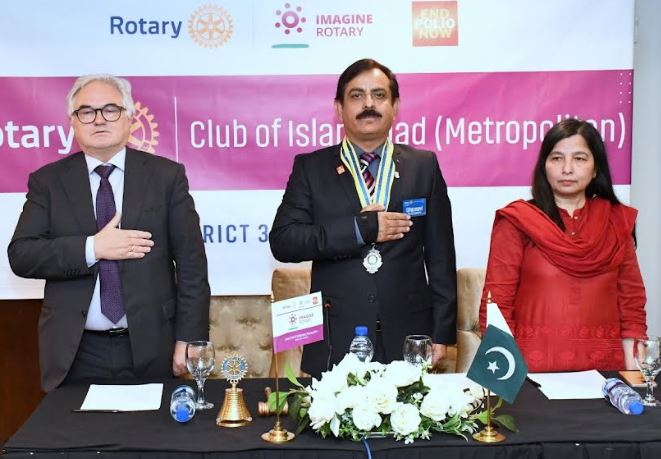
Islamabad, OCT 26 /DNA/ – Rotary Club of Islamabad Metropolitan arranged a special talk on “Pak German collaboration to help communities in need” at a local hotel. Alfred Grannas Ambassador Federal Republic of Germany was the guest speaker.

Mr. Imran Ghaznavi President RC Islamabad Metropolitan welcomed the guest speaker and emphasized the importance of international collaborations in helping the communities in need across Pakistan, specially in flood hit areas. The importance of clean drinking water was highlighted and efforts of the club in this regard were elaborated.

Former Ambassador Fouzia Nasreen introduced the German Ambassador, gave brief history of the club and elaborated the avenues of collaboration in the field of clean drinking water, health care and twining of German Rotary clubs with Pakistani Club to promote fellowship.

His Excellency the German Ambassador, Alfred Grannas spoke about Germany’s contribution to flood relief efforts in Pakistan. He revealed that 70 million euros have been given to Pakistan by Germany in the form of humanitarian aid. However, the reason why the German flag is not visible in the flood relief effort is because in the interest of efficiency, the assistance is given to professional and established humanitarian organizations as these have better coordination at the grassroots levels. “It is not important to be visible, it is important to be efficient,” he said.

His Excellency emphasized that this giving in times of need is not an act of charity, rather it is an obligation to those in need by those who have.  Pakistan’s floods, in particular, are a consequence of climate change which affects the whole world, and we are all in it together.

He noted that as Germany has been with Pakistan in Pakistan’s time of need during the floods, Germany will also be there for reconstruction. He emphasized, however, that it would be Pakistan and Pakistanis who will decide how to best prioritize their reconstruction effort.

His Excellency also noted that it has been 70 years of diplomatic relations for Germany, and the country has helped others in development for the last 60 years. He highlighted some areas of activity that Germany has prioritized, namely Polio eradication efforts which have been a priority of the German Development Corporation, and improvement of governance, especially with respect to public health insurance.

His Excellency recognized that the relationship between Pakistan and Germany has certainly not been one-sided. “We also go away with enhanced knowledge,” he said.  “We also go away enriched.”  He emphasized that the Pakistan-German cooperation is for mutual benefit, and there has always been a lot for Germany to learn from Pakistan, especially now since the challenge for all nations is to continue to industrialize and remain industrialized in a new age of energy.

The affable and cordial talk by His Excellency inspired many questions and comments from members of the host Rotary Club Islamabad Metropolitan.

 Secretary Of the Club Dr Azra Yasmin thanked the German Ambassdor for his candid talk.

German Ambassador was pin up and shield was presented to him by the President Imran Ghaznavi.

National Drug Use Survey Pakistan 2022-24 launched

The survey has been made possible with the support of U.S. Department of State’s Bureau of International Narcotics and Law

Mahnoor Ansar

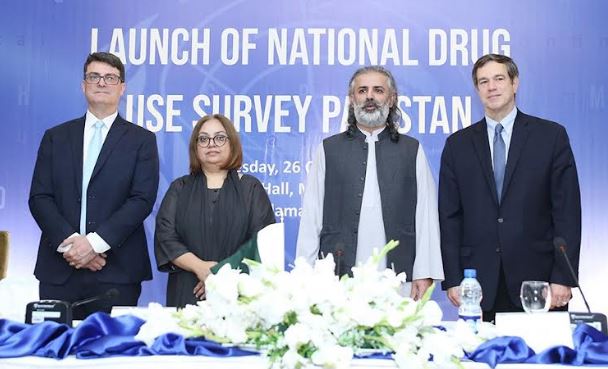
ISLAMABAD, OCT 26 /DNA/ – Today, the Ministry of Narcotics Control, Government of Pakistan, U.S. Department of State’s Bureau of International Narcotics and Law Enforcement Affairs (INL) and the United Nations Office on Drugs and Crime jointly launched the National Drug Use Survey Pakistan 2022-24 in Islamabad.

In 2012 and 2013, UNODC in collaboration with the Ministry of Narcotics Control, the U.S. Department of State’s Bureau of International Narcotics and Law Enforcement Affairs (INL), and other national stakeholders conducted a national survey on drug use to estimate the extent and patterns of drug use in Pakistan.

The overall results of the survey revealed that approximately 6 percent of the population – 9 percent of the adult male population and 2.9 percent of the adult female population – equivalent to 6.7 million people – had used a substance other than alcohol and tobacco in the preceding year.

This year the World Drug Report 2022 revealed an estimated 284 million people worldwide had used drugs in 2020. Cannabis remains by far the world’s most used drug, and the report also notes an increase in use of amphetamines.

Globally, the report estimates that 11.2 million people worldwide injected drugs during the period of the study. Around half of this number were living with hepatitis C, 1.4 million were living with HIV, and 1.2 million were living with both.

Since the previous survey, there have been changing trends of drug use in the region, especially anecdotal information of a rapid increase in the use of synthetic drugs such as methamphetamine. To have scientific data on the current situation of drug use in Pakistan, the national drug use survey 2022-24 will be conducted to provide reliable evidence of the extent to which the population is using drugs and suffering from drug use disorders.

This survey will be comprised of a household survey and high-risk drug use study that will have national coverage, including the major districts in each province.

This survey is being carried out jointly by the Ministry of Narcotics Control and UNODC with financial support from U.S. Department of State’s Bureau of International Narcotics and Law Enforcement Affairs.

Dr Jeremy Milsom Representative UNODC in his welcome remarks thanked Mr Nawabzada Shazain Bugti, Federal Minister for Narcotics Control, and his Ministry for their support in taking lead on the survey and U.S. Department of State’s Bureau of International Narcotics and Law Enforcement Affairs (INL) for their gracious financial support to conduct the national drug use survey and drug prevention and treatment interventions in the country, he also mentioned that the comprehensive data on drug use patterns and trends is key to developing effective prevention, treatment and rehabilitation programmes and the Survey report will serve to promote thoughtful discussions, inform policies and strengthen national cooperation.

Mr Andrew J. Schofer – Deputy Chief of Mission, U.S. Embassy Islamabad in his speech thanked the Federal Minister for Narcotics Control, UNODC, and other dignitaries for their partnership. DCM Schofer further stated that, “through this project, the U.S. Embassy’s International Narcotics and Law Enforcement Affairs (INL) will support the Government of Pakistan to provide evidence-based information to shed light on changing patterns of drug use and allow for stronger implementation of programs and refinement of policies.

The launch of the survey is an important milestone in the availability of evidence-based information on drug use in Pakistan, filling an often-overlooked gap.  The information and recommendations contained in the completed survey report will help to save lives by informing the development of drug prevention and treatment programs and suggesting needed policy or regulatory changes.

The United States is proud to partner with the Government of Pakistan on drug demand reduction efforts.  To date, INL has provided $24 million U.S. dollars – that’s 522 million Pakistani rupees – of support for drug treatment and prevention efforts in Pakistan.  I am also pleased to share with you that this year we celebrate the 75-year anniversary of the partnership between the United States and Pakistan.

The U.S. government, through INL, has invested more than $1 billion dollars over the last 40 years to improve citizen security and enhance law enforcement capacity across Pakistan.”

Ms Giovanna Campello Chief of prevention, treatment and rehabilitation section UNODC Vienna office in her speech thanked the Ministry of narcotics control, INL and the participants for showing their concern on the drug situation and importance of the national drug use survey in Pakistan, she talked about the importance of drug survey in understanding the on-ground drug situation, the gaps and challenges to address the drug prevention and treatment interventions.

She also talked about the efforts that are being made in collaboration with the government of Pakistan in developing a mechanism to ensure quality drug treatment services and also scaling up the capacity of drug treatment professionals to deliver quality drug treatment services that are in line with the international standards for drug treatment.

Ms Humaira Ahmed Federal Secretary Ministry of Narcotics Control in her speech appreciated UNODC for their technical assistance in conducting the national drug use survey and U.S. Department of State’s Bureau of International Narcotics and Law Enforcement Affairs for their generous support for the national drug use survey and drug prevention and treatment interventions in the country.

The Federal Secretary in her speech mentioned that drug use problem has emerged as a serious threat to health and security of the people of Pakistan especially the youth with tendency towards drug use emerging even in educational institutions.

She emphasized that the drug problem requires a comprehensive multisectoral response from various departments/sectors to address the drug problem.

Mr Nawabzada Shazain Bugti, Federal Minister for Narcotics Control, in his closing remarks

thanked UNODC for the technical support and the U.S. Department of State’s Bureau of International Narcotics and Law Enforcement Affairs for the financial support to carry out the National Drug Use Survey.

The Federal Minister emphasized on the need for being strategic in the drug prevention and treatment approaches and hoped that this Survey will help by providing information to take stock of drug situation in the country and facilitate in chalking out strategies to effectively combat the challenges of drug abuse.

He stressed upon the importance of cooperation across borders to counter the growing drug use problem and urged all stakeholders to remain steadfast in their efforts to achieve the goal for a ‘drug free’ nation.

The ceremony was attended by the dignitaries from Government Ministries, departments, foreign missions, UN organizations, Civil Society organizations etc.

The survey has been made possible with the kind support of U.S. Department of State’s Bureau of International Narcotics and Law Enforcement Affairs (INL).=DNA

=========

Stoinis blitz propels Australia to seven wicket win over Sri Lanka

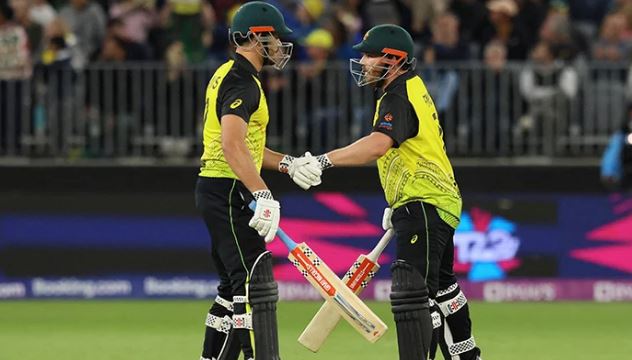
PERTH: Marcus Stoinis bludgeoned Australia’s fastest T20 half-century on Tuesday as his side crushed Sri Lanka by seven wickets to secure their first win at the T20 World Cup.

After being beaten by New Zealand in the opening match of the Super 12, Australia elected to field and restricted Sri Lanka to 157-6.

They had to make do without the services of leg-spinner Adam Zampa, who was ruled out at the 11th hour after testing positive for COVID-19.

The hosts replied with 158-3 in 16.3 overs, led by Stoinis who powerfully struck six sixes in his unbeaten 59 from 18 balls.

“It was good slogging,” man-of-the-match Stoinis told reporters.

“I was actually quite nervous, to be honest. The intention was to go and put an impact on the game and probably provide a bit of energy for the boys.”

The Perth Stadium deck could have been mistaken for a WACA pitch as Australia’s seamers combined for three wickets with a barrage of pace and bounce which set Sri Lanka back.

Top-order batsmen Pathum Nissanka (40) and Dhananjaya de Silva (26) found boundary-scoring difficult but showed urgency running between the wickets.

An outstanding flick-back on the boundary by David Warner in the 11th over deprived de Silva of a six, and five balls later the batsman departed after lofting a catch to the same fielder at long-off.

Mitchell Marsh ran out Nissanka and triggered a mini-collapse, only arrested by a late onslaught from Charith Asalanka (38 not out off 25 balls) in the final overs.

Fast bowler Lahiru Kumara made good use of the surface when Sri Lanka had their turn in the field, repeatedly beating Aaron Finch (31 not out) for pace.

It was off-spinner Maheesh Theekshana (1-23) who struck first though, inducing a false shot from Warner (11).

Innovative strokeplay from Glenn Maxwell (23) injected impetus into Australia’s response, but Stoinis delivered the knockout blow as spinner Wanindu Hasaranga, the third-ranked T20 bowler, conceded 53 runs in three wicketless overs. 

Defence Day of Romania celebrated: Romania, Pakistan Cooperation in defence expanding

Ambassador of Romania Nicolae Goia acknowledged the excellent professionalism of the Pakistani army

Asnar M Bhatti

ISLAMABAD:   Ambassador of Romania Nicolae Goia has said   Romanian Armed Forces, completely reformed and modernized up to the NATO and European Union standards are assigned to foreign missions, contributing alongside of the allied and partner countries to the common effort of keeping peace and stability worldwide.

 In compliance with the commitments deriving from the international treaties, agreements and memoranda whose signing party is, Romania had contingents of different sizes from all services – Army, Air and Naval Forces – available to multinational coalitions authorized to carry on peace support, humanitarian assistance, collective or individual operations in the framework of UN, NATO, OSCE and EU-led Observing, Monitoring, Liaison and Training teams.

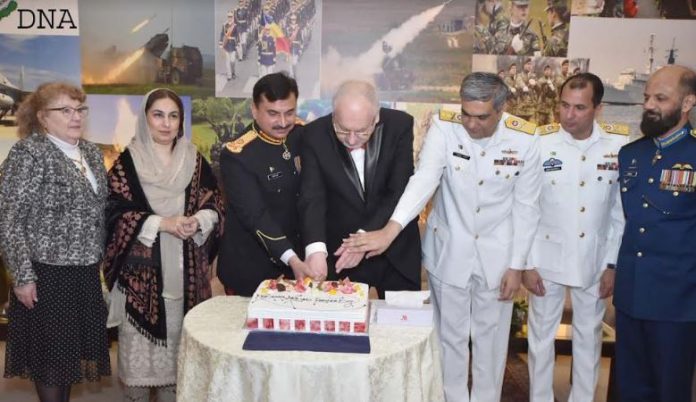
Ambassador Goia expressed these views while speaking on the occasion of the Armed Forces Day of Romania. He along with Defence Attache Col Cristian Raducu hosted a reception. Mal Gen Fiaz Hussain Shah was the chief guest.

The ambassador further said Romania celebrates each year, on October 25th, the Day of the Romanian Army. October 25, 1944, the Romanian Army Day, signifies the date of complete liberation of north-western Transylvania from foreign ruling and administration.

‘The liberation of the entire national territory of Romania was achieved by the heroic fights in the World War II of over 525,000 fully employed troops between August 23 and October 25, 1944. Nearly 58,000 of them were killed or injured. Losses incurred on the enemy stood at 89,934 troops, 76,275 of whom were taken prisoners. It is worth mentioning that after 25th of October the Romanian army had continued to fight until the end of the war contributing substantially to the liberation of Hungary and Czechoslovakia’.

Ambassador Goia said, the years of contribution to foreign missions meant for the Romanian Armed Forces the maintenance, almost continuously, of a military force of variable sizes, integrated into UN, OSCE, NATO and EU missions carried out in Africa and Asia, in the theatres of operations in Afghanistan, Iraq and Western Balkans. Almost 40,000 Romanian troops took part in different operations and missions out of national borders, gathering a valuable professional experience extremely useful in the transformation, operationalization and interoperability enhancement process of the Romanian Armed Forces with their NATO and EU counterparts.

Romanian Armed forces wisely and skilfully planned their combat forces to fight the war on terror far away from the national borders, proving their capability and determination to fully carry out their missions. Romania remained consistent with its commitments to support the international community in the fight against terror.

The contribution of the Romanian troops to the collective defence, peace keeping and restoration missions to enforce the stipulations of the UN Security Council Resolutions, of the international legislation and law reveals that the Romanian state complies consequently and in full faith with the commitments agreed with the allies and partners, according to the international legislation and treaties whose signing party is Romania. By performance and professionalism, dedication and determination, the Romanian Armed Forces are a true ambassador for Romania’s image worldwide!

He said, unfortunately, we are living in a very complicated security environment. The world of today, the security challenges we have to deal with every day, along with the war going on at NATO and EU borders, as well as Romania’s border with Ukraine – all these prove that we need to be ready to defend our common values and freedoms and grant security and stability. Moreover, Ukraine’s security means European and Euro-Atlantic security.

In line with the NATO and European Union’s policy, Romania stands in full solidarity with the people and government of Ukraine in the heroic defence of their country, helping Ukraine to uphold its fundamental right to self-defence with unprecedented levels of support as a response of Russia’s full-scale, brutal, unprovoked and unlawful invasion of Ukraine

 ‘I am very pleased to underline the excellent cooperation existing between Romanian and Pakistani armies which have developed over the years into a true and mutual beneficial partnership. Since there is not time to elaborate on the multifaceted and complex character of the cooperation, I will only mention that on October 12th this year, during his official visit in Romania, the Chief of Naval Staff Admiral Muhammad Amjad Khan Niazi performed symbolically the initial welding work on the keel of the third vessel built for Pakistani Navy at Damen Shipyard Galati and cut the first plates of steel for the construction of the second batch two Damen OPV 2600 multi mission patrol vessels’.

Ambassador Goia said those vessels will provide the Pakistan Navy with a highly effective search and rescue capability, and allow it to play an important role in safeguarding international trade routes from piracy and other threats like drugs and human trafficking and terrorism.

‘Also, between 10-12 November, the 3rd session of Joint Military Committee will take place in Bucharest and I am sure that during this activity new domains of cooperation will be identified’. 

He acknowledged the excellent professionalism of the Pakistani army, the deep patriotism of its men and women in uniforms, the sacrifices they made in fighting terrorism, their presence in multiple international coalitions authorized to participate in maintaining peace, humanitarian assistance and other operations meant to ease the sufferings of the people in different regions of the world, he added.

Stay Connected

64FansLike
60FollowersFollow

Latest Reviews

Exchange Rates

USD - United States Dollar
EUR
1.17
GBP
1.34
AUD
0.67
CAD
0.73