ISLAMABAD, APR 3: Chief Justice of Pakistan (CJP) Umar Ata Bandial on Monday once again ruled out the formation of a full court to hear PTI’s petition against the Election Commission of Pakistan’s (ECP) decision to postpone elections to the Punjab Assembly till Oct 8 and suggested that the government could instead request for a larger bench to hear the case.
He said he had discussed the matter with senior apex court judges in the past few days.
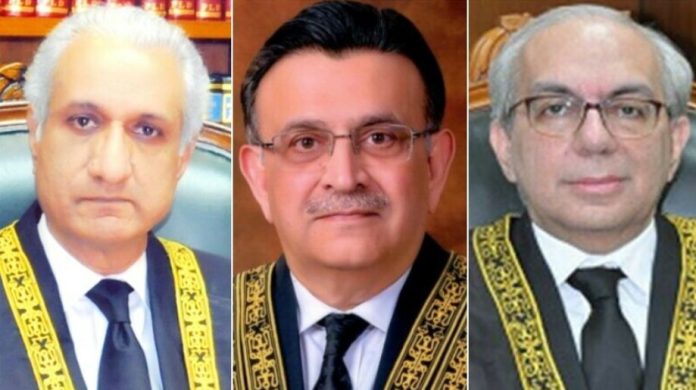
Justice Bandial passed these remarks as a diminished SC bench — comprising the CJP, Justice Ijazul Ahsan and Justice Munib Akhtar — took up the PTI petition.
Ahead of the crucial hearing today, the government submitted a statement through Attorney General of Pakistan (AGP) Mansoor Awan, requesting the formation of a full court to hear the case.
It also sought the dismissal of the PTI petition in the light of what it interpreted as a “4-3” order issued by the apex court on March 1.
The apex court, had in a 3-2 verdict, ruled on March 1 that elections in Khyber Pakhtunkhwa and Punjab — both of which have been under caretaker governments since the provincial assemblies were dissolved in January — should be held within 90 days.
The government, however, had disputed with the court directions, calling the verdict 4-3 instead after Justice Jamal Khan Mandokhail and Justice Syed Mansoor Ali Shah — who were among the four judges who had written additional notes in the Feb 23 order — raised objections on the constitution of the bench as well as the invocation of the apex court’s suo motu jurisdiction by the chief justice.
In its “concise statement” submitted before the court, the government sought to “object to the maintainability and hearing of the petition for being based on misreading and mistaken understanding of the March 1 order”.
The statement insisted: “In order to ascertain the true import of the March 1 judgment, it is imperative that the chronology of events leading up to that day must be taken into consideration.”
It also said the president’s announcement for Punjab polls on April 30 was “under a mistaken reading of the same judgment”.
The government also requested the current bench to recuse itself from the case and instead a new full court be formed to take up the case.
‘Government cannot boycott proceedings’
AGP Awan, ECP lawyers Irfan Qadir and Sajeel Swati, PTI lawyer Ali Zafar, and PPP counsel Farooq H. Naek were present in the courtroom as the hearing commenced today.
The secretaries of finance and interior ministries were also in attendance.
At the outset of the hearing, Naek came to the rostrum. Justice Bandial asked the lawyer if PPP had ended its boycott against the court hearing to which the latter replied that he had not boycotted the proceedings.
“How can you boycott [the hearing] on one side and also attend the hearing on the other hand,” Justice Akhtar wondered. “For the last 48 hours, the media has been saying that political parties have expressed no confidence in the bench.
“How will you present your arguments if you don’t have confidence in us?” the judge asked and then stated that the court would only hear Naek if he withdrew the statement — jointly issued by coalition leaders last week expressing “complete no-confidence” in the bench.
Justice Akhtar also asked Naek to read out the joint statement and expressed displeasure at the language used in it.
Here, the CJP asked the PPP lawyer if he wanted to become a part of the proceedings, to which Naek replied in the affirmative and said that “we never boycotted the hearing”.
“But something else was written in the newspapers,” Justice Bandial highlighted. Naek replied that his party had reservations on the maintainability of the petition.
However, the CJP insisted that Naek confirmed in writing that he had not boycotted the hearing.
Turning to the AGP, Justice Bandial then inquired about the directions he had received, to which Awan replied that the government worked under the Constitution and could not boycott the proceedings.
‘Only court has authority to delay polls’
Subsequently, AGP Awan began presenting his arguments. The lawyer highlighted that the PTI petition was based on the SC’s March 1 verdict, in which the apex court had instructed the president to select a date for elections in Punjab and the governor to pick a date for polls in KP.
“But the KP governor never selected a date until the petition was filed,” he pointed out.
“The question is how can the ECP give the date of Oct 8 for polls,” the CJP said here. “The law gives no one the authority to delay elections. Only the court can delay the date for polls.
“Even in 1988, elections were postponed on the orders of the court,” he recalled, adding that court orders were issued on the basis of “ground realities”.
“The order you are mentioning here [SC’s March 1 verdict] has already been executed,” Justice Bandial pointed out.
Justice Ahsan observed that the actual matter under consideration was the ECP’s decision to postpone elections, noting that the commission was bound to follow the court orders.
Here, AGP Awan recalled that during the first round of the hearings — the court’s suo motu proceedings on elections in Punjab and KP — a nine-member bench had conducted the proceedings.
“On Feb 21, we received the order of the court which included dissenting notes from two judges. The two judges had dismissed the case in the first hearing,” he said.
However, the CJP interjected and said that only one judge had dismissed the proceedings. “Justice Athar Minallah had not mentioned rejecting the request in his dissenting note,” he said.
“Justice Yahya Afridi had agreed with Justice Minallah in his note,” the AGP argued to which Justice Bandial stated that the court had understood Awan’s stance.
Justice Akhtar recalled that on February 27, a nine-member bench had forwarded the matter to the CJP for the reconstitution of the bench with Justice Ahsan adding that when the bench was reconstituted it consisted of five judges.
The AGP agreed to the judge’s observation.
Meanwhile, the CJP clarified that he was not obligated to select the previous members and pointed out that the order the AGP was referring to was a minority judgement.
For his part, the AGP argued that an order of the court was not issued on March 1 to which Justice Bandial asked if Awan believed that a five-member bench was never constituted.
‘Harmony among judges crucial for SC’
At one point during the hearing, the CJP noted that harmony among judges was crucial for the Supreme Court. He observed that while judicial proceedings were made public, consultations among judges were considered internal matters.
On the other hand, Justice Akhtar stated that if the “logic behind the 4-3 verdict” were accepted, the matter would be referred to the same nine-member bench that was first constituted to hear the elections suo motu proceedings.
He added that the decision then would either be of the five-member bench or the nine-member bench.
Justice Bandial pointed out that the detailed dissenting notes of the judges did not include any points about the reconstitution of the bench.
Here, the AGP — while quoting the notes — stated that the bench’s reformation was an administrative move, and Justices Ahsan and Mazahar Ali Akbar Naqvi had distanced themselves from the suo motu hearing.
The CJP clarified that four judges had recused themselves from the bench, adding that it would have been more accurate to mention in the note that they were removed from the bench.
Justice Bandial pointed out that the note did not specify which judges had voluntarily separated from the bench, adding that when a judge wanted to withdraw a bench, they had to submit a judicial note.
“There is no doubt in the fact that a judge can’t be thrown out of a bench,” he stated, adding that when the court ordered the reconstitution of a bench, it did not mean that other judges were being removed from the bench.
Justice Ahsan said here that forming a new bench was a judicial directive and not an administrative one.
But the AGP argued that the opinion of the two judges — Justices Mandokhail and Shah — could not be separated. Justice Akhtar responded by citing Justice Afridi’s statement which stated that he had left his inclusion in the bench to the chief justice’s discretion.
Justice Akhtar also pointed out that the absence of the two judges was not brought up during the two-day suo motu hearing conducted by the five-member bench.
The CJP stated that a new bench was formed and the hearing began again. Additionally, it was noted in a footnote that the opinion of the two judges was not part of the decision record.
He further stated that the AGP had not succeeded in convincing the court to separate the judges who previously heard the case from the current bench.
Here, the AGP mentioned a circular issued by the SC registrar’s office in response to a judgement issued by Justice Qazi Faez Isa and Justice Khan on March 29.
In the 12-page order, the judges had called for the postponement of suo motu matters until amendments were made to Supreme Court Rules 1980 regarding the country’s top judge’s discretionary powers to form benches.
Subsequently, in a circular issued on March 30, the CJP disregarded the judgement stating that the “unilateral assumption of judicial power in such a manner” was a violation of rules.
Referring to the circular during the hearing today, AGP Awan argued that a judicial order or judgment could not be overruled by an administrative circular to which the CJP replied that the circular did not overrule any decisions.
He clarified that the circular had instead issued administrative instructions for the judgement. Justice Bandial went on to mention another circular that halted proceedings for cases under Article 184(3) of the Constitution and clarified that the circular did not violate the decision of the five-member bench.
“There were no clear directives in the order issued by Justice Isa,” Justice Bandial added.
The AGP argued that rules regarding petitions were present in Article 184(3) of the Constitution and there was a five-member SC verdict available too on the mechanism of suo motu cases.
At that, the CJP said: “In the verdict, it is written that it would be better to stop the hearing of cases on 184(3). In the March 29 verdict, there was no directive rather a wish was expressed.
“Decisions on cases have to be taken in favour of the public, not by adjourning the hearing,” he stressed.
‘Govt can request for a larger bench, not full court’
At one point during the hearing, AGP requested the court to adjourn the hearing until rules for petitions under Article 184(3) were finalised. However, Justice Ahsan inquired: “How can proceedings be postponed when rules for constitutional petitions already exist?”
Despite that, Awan said here, a court order could not be dismissed through a circular.
At that, the CJP said that the court had always taken caution when it came to taking suo motu notice, recalling that the first such notice this year was taken when the SC received requests from the speakers of two assemblies.
The CJP disagreed with the argument that this case was different from other cases under Article 184(3) of the Constitution. He questioned how the court could stop action on cases whose rules had already been established and emphasised that the procedure for jurisdiction under Article 184(3) was very strict.
Justice Akhtar wondered over conflicting statements, as one side demanded a full court and the other side argued against holding a hearing at all. He asked the AGP to clarify whether a hearing could be held or not.
He further commented that if the AGP’s argument was accepted, even a full court could not go ahead with proceedings.
The CJP pointed out that the judge who signed Justice Isa’s order had recused himself from the bench. He questioned how it was possible for Justice Isa, who authored the verdict, to hear the case.
The CJP suggested that the government could request the formation of a larger bench, not a full court. He also said that he met senior judges in the past three days.
Addressing AGP Awan, he said: “If you want to give arguments for [constituting] a larger bench, then go ahead.”
Subsequently, the AGP requested the court that a bench be constituted — for hearing the PTI petition — comprising judges who were not included in the nine-member bench in the suo motu proceedings.
“Let the remaining two judges decide on the 3-2 and 4-3 verdicts,” he added.
As the hearing proceeded, the CJP remarked that one decision was given by a majority bench while the other was given by a minority bench comprising of two members.
He emphasised that the main purpose of the hearing was to ensure a fair trial, and stated that any decision taken without hearing all the concerned parties would have limited scope.
The CJP stressed that decisions made after a thorough hearing of the case were crucial, while Justice Ahsan noted that two benches had conducted separate proceedings in the case.
‘Help can be taken from navy, airforce for security during elections’
The CJP inquired about the presence of the secretaries of finance and defence, to which the attorney general responded that the secretary of finance was present with a report.
The AGP told the court that the matter was sensitive and required an in-camera hearing to which the CJP directed Awan to submit the relevant files in court, saying that the bench would analyse them.
Justice Bandial remarked that the matter concerning security was not just limited to the army but also the navy and the air force, saying that when the armed forces were busy, help could be sought from the other two.
“The ECP says 50pc of the polling stations are safe. Every unit or office in the army is not for battle. The court has to do what can be done in an open court,” he said, noting that if “any sensitive thing comes forward”, the judges will hear it in the chamber.
The CJP also inquired about the exact number of security personnel required during the polls, to which Awan responded that everything was “on record” and that the ECP had given reasons for its decision.
Here, Defence Secretary Lt Gen (retired) Hamooduz Zaman came to the rostrum.
The CJP subsequently said: “We will not ask for sensitive information. Tell us the overall situation. For now, give us [information] about Punjab because there is no [election] date for KP.
“Are the security conditions in Punjab serious?” he asked the defence secretary, to which the latter said yes.
“I cannot tell the details in an open court [as] we do not want the details to reach the enemy,” Gen Zaman said to which the CJP said that the report could be submitted in an envelope.
We will return the reports after analysing them, he stated, adding that if the court had a question, it would reach out to him for answers. “If you want to, written responses can be submitted as well.”
Justice Ahsan also said that the court understood that sensitive matters should not be made public. “We do not want to create difficulties for national security forces and the public.”
At that, the court invited PTI’s counsel Zafar to the rostrum and asked about his stance on an in-chambers hearing. The latter replied that the ECP had maintained that it would be ready to hold elections if adequate security was provided.
“But security personnel are available only for a day,” he highlighted, saying that the issue of security would hence stay the same. “The constitutional need [for security] is of 90 days.”
Meanwhile, the CJP inquired who would provide security for elections and asked if the ECP needed personnel with “combat abilities”. “The question also arises that how do we know everything will be fine on Oct 8?”
Here, the PTI lawyer said that “services of retired people can be availed” to which the defence secretary replied that “reserved forces are present which can be called in specific circumstances”.
“The method to call the reserved forces is present [in the law],” Gen Zaman said but added that time was required to call the reserved forces and train them.
“The elections are not to be held tomorrow — a whole schedule will be released,” the CJP said here. He added that a large number of the forces were positioned at the borders and combat forces were not needed for election duty.
The court then directed the defence secretary to submit a report to the court on the matter by tomorrow.
‘Increase revenue, cut down expenditures’
Subsequently, the finance secretary’s report was presented in court.
“Is this report sensitive too?” Justice Ahsan asked to which the AGP replied that the report was in line with the government’s agreements with the International Monetary Fund (IMF).
“The IMF programme is important in its place,” the CJP said. “The current account and fiscal deficits must be reduced.” He also suggested that the deficits could be minimised by increasing revenues and cutting down on expenditures.
“Which development project costs less than Rs20 billion?” Justice Bandial inquired, pointing out that the petition stated that a fund amounting to Rs170bn was being given to the members (of the assembly).
At that, the AGP replied: “This matter dates back to Oct 2022.”
Here, the additional finance secretary explained that the planning commission releases funds as per the Public Sector Development Programme (PDSP).
Talking about this fiscal year’s budget, he said that no cut was placed on the development funds. “New taxes were imposed to collect billions.”
Justice Akhtar here inquired about the increase in the percentage that could be witnessed in the budget by releasing Rs170bn. “Is it not possible to set aside Rs20bn out of a budget amounting to trillions?” he asked.
“The finance minister had given a statement that more than Rs500bn was collected as tax in February,” the judge recalled.
On the other hand, Justice Bandial highlighted that the government had faced a loss of Rs157bn due to petroleum products, asking what would have happened if the deficit had turned to Rs177bn.
The additional finance secretary replied that the deficit had been settled with the IMF.
“Can the salaries [of government officials] not be reduced?” the CJP asked. “Why don’t you start by reducing the salaries of the judges?”
The chief justice clarified if there was a legal impediment, the court would end it, suggesting that a five per cent salary cut could be made in three phases.
The top judge had made a similar remark during the hearing on March 28.
“The ECP would also be told to cut down their expenses,” CJP Bandial added. “Which financial expert will brief the court [on this]?”
At one point during the hearing, PTI Secretary General Asad Umar took the rostrum and said that the government had spent Rs5700bn in the first five months of the fiscal year, adding that the total budget consisted of Rs9500bn.
“The IMF sets the loss target according to the GDP (gross domestic product) … Rs20bn are not more than 0.02pc [of the GDP],” he contended, adding that the loss target was 4.97pc of the GDP.
“Rs20bn have nothing to do with the loss target,” Umar added.
CJP Bandial then asked if expenses could be reduced from any sector to which the PTI leader replied: “Developmental expenses amount to Rs700bn and Rs450bn are yet to be spent.”
He went on to say that the government had only spent Rs200bn in eight months, adding that the government had included another Rs8bn in development funds. “How is it possible that Rs20bn can’t be taken out from a budget of Rs700bn? Is the constitutional requirement important or building roads? There is no bigger joke than this.”
Here, the CJP observed that the government was “hesitating”.
“If such an example is set, elections would never be held due to financial constraints,” Justice Ahsan added.
‘Decision to announce polls date should rest with ECP’
After the security and finance reports were presented in court, ECP lawyer Qadir started presenting his arguments, assuring the court that he would be concise.
“How long will you present your arguments for?” the CJP asked here, to which Qadir said that he would try to finish his arguments within 30 minutes.
He started off by stating that when doubts arose about judges, they recused themselves from the hearing “On one side there is one party and on the other, there are the rest of the political parties.
“The perception of biasedness is coming from the bench,” he stated, saying that all the coalition parties had requested for a full court to hear the case but their plea was not accepted.
“Justice by the courts should be visible,” Qadir pressed, recalling that a decision of the court was already in dispute. “Right now, we can’t see justice being dispensed.”
He told the court that the decision to announce the election date should rest with the election commission. “There should be a discussion over if the decision was 3-2 or 4-3.”
Qadir mentioned that four out of nine judges — in the election suo motu hearing — had dismissed the case and three judges had issued orders. He added that the March 1 verdict was a minority judgement and called on the SC to resolve the differences.
The ECP lawyer argued that the dispute over the proportionality of the judgment was not an internal matter. “The four judges who dismissed the plea should be included in this bench as well.
“The effect of a judicial order cannot be undermined by a circular,” he demanded, adding that was “imperative for the public to trust the judiciary”.
Qadir further said the rights of a “minority group” should be given preference over the majority.
“The national interest falls in implementing the law and Constitution,” he highlighted, saying that elections within 90 days as mentioned in the Constitution was another matter.
The ECP lawyer further went on to shed light on how elections in the country were carried out at the same for years, emphasising that polls to all the assemblies should be held simultaneously.
He told the court that doing so will also save money.
“It is mandatory to have a caretaker government during the National Assembly elections. The provincial assemblies were dissolved two months ago and not two years ago,” Qadir added.
Security beefed up outside SC
Ahead of the hearing, security outside the top court’s building in Islamabad was beefed up. Videos from the site showed a large contingent of policemen clad in bullet-proof vests and helmets deployed outsides the premises.
Dawn.com has also learnt that the entry of any unauthorised person inside SC has been restricted.
In a statement, the Islamabad police said that there were threats of “terrorism” in the capital city. “There is a fear of entry of malicious elements in the clothes of lawyers.”
Resultantly, it requested lawyers to keep an eye out for unknown persons. The police further said that permission from the SC registrar was mandatory to attend the hearing, but added that there was no restriction on the entry of lawyers.
On the other hand, a number of lawyers including PTI’s Fawad Chaudhry have complained that roads leading to the apex court have been blocked.
Cracks in SC bench
Last week, the apex court witnessed high drama after the original five-member bench hearing the case was disbanded following the recusals of Justice Jamal Khan Mandokhail and Justice Aminuddin Khan. Thereafter, the CJP constituted a smaller bench comprising himself, Justice Ahsan and Justice Akhtar to proceed with the PTI petition.
During the previous hearing, the CJP rejected Attorney General for Pakistan (AGP) Mansoor Usman Awan’s request for the formation of a full court and directed him to bring the defence and finance secretaries in court along with him on Monday (today). He hinted that the court might even call the armed forces and issue directives for managing finances to hold elections in Punjab.
“The state of Pakistan cannot remain rudderless and has to reach its destination in accordance with the Constitution,” the CJP observed, adding that elections should be held to hand over the government to the people of Pakistan.
Justice Bandial also asked the top law officer to come up with good reasons that the court may accept, otherwise it was duty-bound to give a judgement.
Govt hoists flag of distrust against CJP-led bench
Last week, the ruling coalition at the centre, led by the PML-N, hinted that it would not accept the decision of the CJP-led bench hearing the case regarding provincial polls.
At a crucial huddle over the weekend, the federal coalition expressed “complete no-confidence” in the three-member bench, calling upon the court to discontinue the proceedings of the case forthwith.
A statement issued by PML-N after the meeting said “a complete distrust had been shown in the three-member bench of the SC comprising CJP Bandial, Justice Ijaz-ul-Ahsan and Justice Munib Akhtar”.
“The huddle demands wrapping up [of] the three-member bench’s proceedings regarding delay in elections to the Punjab Assembly forthwith and acceptance of the four-member majority decision in the suo motu case,” it said.
It pointed out that there had been a “clear division in the SC, therefore it should refrain from issuing controversial political decisions”.
PTI petition
PTI’s petition, moved by party’s Secretary General Asad Umar, former Punjab Assembly speaker Mohammad Sibtain Khan, former Khyber Pakhtunkhwa Assembly Speaker Mushtaq Ahmad Ghani and ex-lawmakers of Punjab Abdul Rehman and Mian Mahmoodur Rashid, pleaded that the ECP’s decision violated the Constitution and tantamount to amending and subverting it.
In the petition, PTI sought directions for the federal government to ensure law and order, provisions of funds and security personnel as per the ECP’s need to hold the elections.
It also requested the court to direct the Khyber Pakhtunkhwa governor to announce the date for elections to the provincial assembly. Last week, KP Governor Ghulam Ali also proposed Oct 8 as the date for elections in the province. Earlier, he had announced May 28 as the date for polls.
The PTI questioned the ECP’s authority to “amend the Constitution” and asked how it could decide to delay elections to any assembly beyond the period of 90 days from the date of dissolution of the said assembly as mandated by the Constitution.
The petition argued that the ECP was bound to obey and implement the judgments of the Supreme Court and had no power or jurisdiction to overrule or review them.
In its March 1 verdict, the Supreme Court ordered to hold the election to the Punjab Assembly within 90 days and that the date be announced by the president. It also directed the authorities to provide funds and security personnel to ECP for the elections, the petition recalled.
The ECP cannot act in defiance of the Supreme Court’s directions as it has done in this case which was illegal and liable to be set aside, the petition pleaded. By announcing Oct 8 as the date, the ECP has delayed the elections for more than 183 days beyond the 90-day limit as prescribed in the Constitution.
The petition said that if the excuse of unavailability of security personnel was accepted this time, it would set a precedent to delay any future elections.
The petition added that there was no assurance that these factors — financial constraints, security situation and non-availability of security personnel — would improve by Oct 8.
The “so-called excuse” would mean the Constitution could be held in abeyance every time elections were due, the petitioners feared adding that in the past similar situations have persisted, but elections were held despite them.
These situations can’t be used as excuses to “subvert” the Constitution and deny people their right to elect representatives.
“Not holding elections in case of threats by terrorists will amount to giving in to the threats, which is in fact the aim of all terrorist activities,” the petition explained.