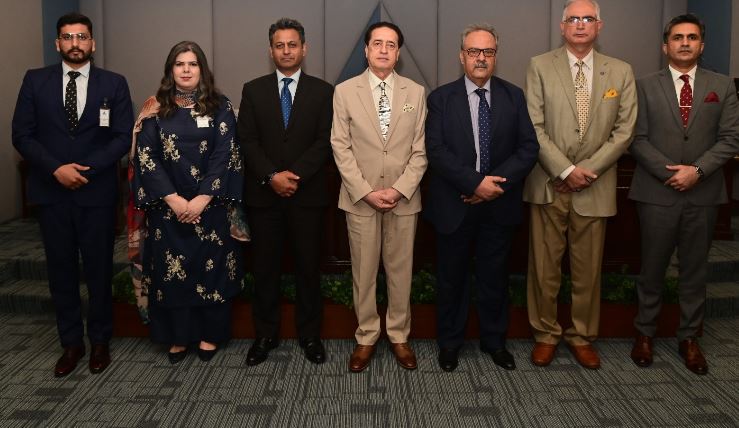
LAHORE, AUG 5 /DNA/ – The Centre for Aerospace and Security Studies Lahore organised a seminar
titled “One Conflict, Three Battlefields: Aerial, Geopolitical and
Cognitive Lessons from Iran-Israel-US Conflict” on 5 August 2026. The
event was attended by academics, intellectuals, serving and retired
officers, and domain experts. Ms Nidaa Shahid, Associate Director, CASS
Lahore, delivered the opening address.
The first speaker, Air Marshal Abdul Moeed Khan (Retd), VC Air
University, focused on the aerial and operational military lessons
emerging from the conflict. He emphasised that asymmetric capabilities,
including drones, missiles, and distributed air defence systems,
alongside artificial intelligence (AI), commercial technologies, and
networked sensors are transforming the future of aerial warfare. He
further underscored the growing significance of the low-altitude ‘air
littoral’ which was aptly utilised by Iran during the conflict. He
stressed that innovation, adaptability, and indigenous technological
development will be central to sustaining operational resilience in
future conflicts.
The second speaker, Ambassador Asif Ali Durrani (Retd), former
ambassador of Pakistan to Iran presented the geopolitical takeaways from
the conflict. He stressed that enduring peace cannot be achieved through
military means alone. It requires coherent political objectives,
effective diplomacy, and geopolitical manoeuvring. He further emphasised
the importance of energy security especially in light of Iranian
operations in the Strait of Hormuz. He also underscored the fragility of
external security guarantees and stressed the need for regional security
frameworks and confidence-building measures.
The third speaker, Mr Fahd Husain, Executive Director Express 24/7 TV,
elucidating on the cognitive lessons. He emphasised that the
Iran-Israel-US conflict was fought simultaneously in the physical and
cognitive domains, making information superiority a decisive component.
He also noted that AI-generated content, social media, OSINT, commercial
satellite imagery, and increasing use of smartphones by the general
population are transforming the information environment and making
public opinion the strategic centre of gravity in modern wars. Future
military effectiveness will thus, depend upon successful integration of
military operations with cognitive warfare.
In his concluding remarks, Air Marshal Asim Suleiman (Retd), President,
CASS Lahore, observed that the Iran-Israel-US conflict has emerged as a
defining example of the changing character of warfare in the 21st
century, challenging many of the assumptions that have shaped military
thinking since the end of the Cold War. He emphasised that victory
increasingly rests on integrating military capabilities with
intelligence, technology, doctrine and industry, while aligning
diplomacy, strategic communications and information with national
strategy. Drawing parallels with Pakistan’s experience during
Marka-e-Haq, he stated that Pakistan’s success reflected the effective
integration of airpower, intelligence, electronic warfare, precision
engagement and strategic communication into a coherent multi-domain
campaign. He emphasised that Air Chief Marshal Zaheer Ahmed Baber
Sidhu’s leadership, involvement and innovation was an overwhelming
factor in achieving victory during the 2025 war.
The seminar concluded with a lively interactive session, during which
participants highlighted the growing importance of technological
innovation, strategic communications, and indigenous capacity-building
in enhancing national resilience and ensuring effective responses to the
complex security challenges of the 21st century.