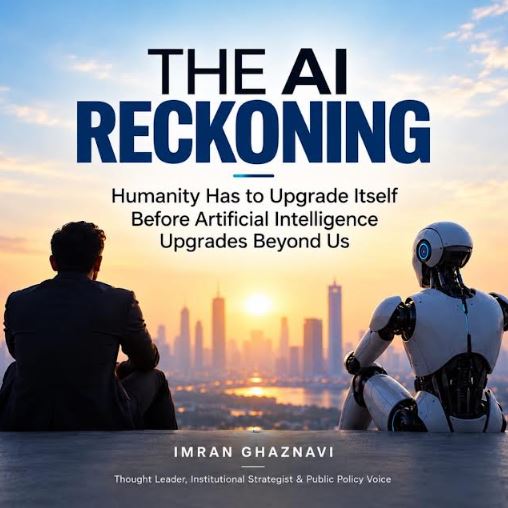
Humanity Has to Upgrade Itself Before Artificial Intelligence Upgrades Beyond Us
By Imran Ghaznavi
There is a point in the history of every transformative technology when the conversation changes.
At first, people ask what the technology can do.
Then they ask what it can do for them.
Eventually, if the technology is powerful enough, they must confront a much more uncomfortable question:
What will the technology do to us?
Artificial intelligence has reached that point.
For years, the AI conversation was dominated by fascination. Chatbots, image generators, automated coding, digital assistants, faster research, better analytics, productivity etc.
We were impressed by what machines could produce.
We are now beginning to understand something more profound.
The machine is not simply producing. It is learning, reasoning, adapting and increasingly performing the tasks that were once considered uniquely human.
Stanford’s 2026 AI Index reports that frontier AI capabilities continued to accelerate during 2025. Several models now meet or exceed human baselines on selected PhD-level science questions, multimodal reasoning and competition mathematics. The report also says organizational AI adoption reached 88%, while generative AI was used in at least one business function by 70% of surveyed organizations.
These are not predictions about some distant future. They are measurements of the present and yet the most consequential part of the AI revolution may still be ahead of us.
A warning, not a prediction
I have argued that artificial intelligence may be far more complex and consequential than most of us currently imagine.
My own concern is deliberately provocative:
Within the next 24 years i.e. by the year 2050, AI could become so capable that a large proportion of human beings may struggle to compete with it intellectually and economically. Perhaps only a relatively small group of exceptional human beings will remain consistently ahead of the machine in the capabilities that matter most.
I do not present the 24-year horizon as a scientific prediction. Nor do I claim that only 10 percent of humanity will literally survive or remain employable. There is no credible evidence today that allows anyone to calculate such a number.
The 10 percent is a way of expressing the scale of the possible disruption.
The underlying question is much more serious: What happens when the rate at which machines improve becomes greater than the rate at which human beings improve?
That is the question we should be preparing for.
The machine is accelerating. Are we?
The history of technology is, in many ways, a history of acceleration.
The printing press accelerated the distribution of knowledge, the industrial revolution accelerated production, the computer accelerated calculation and the internet accelerated information.
Artificial intelligence is beginning to accelerate something different: cognition itself.
A human researcher may spend days reading documents, an AI system can process enormous volumes of text in seconds, a human analyst may develop several scenarios, an AI system can generate dozens, a programmer may spend hours debugging code. AI can identify and propose solutions almost instantly.
The difference is not merely speed; it is scale and scale changes economics.
The International Labour Organization’s 2026 review of empirical evidence finds that productivity gains from generative AI are real but uneven, while large-scale job displacement remains limited so far. It identifies growing inequality, reduced employment opportunities for younger workers, and changes in work organization and autonomy as significant concerns.
The IMF’s analysis finds that nearly 40 percent of global employment is exposed to AI-driven change and emphasizes that workers will increasingly need to update skills or learn new ones.
The transformation, therefore, has already begun.
The first casualty may not be the job
There is a tendency to ask: Which jobs will AI eliminate?
I think this is the wrong question.
The more important question is: Which tasks will AI eliminate?
A lawyer may remain a lawyer, but AI may perform much of the initial legal research. A journalist may remain a journalist, but AI may conduct the first round of document analysis, transcription and background research. An accountant may remain an accountant, while increasingly sophisticated systems perform large parts of financial analysis. A communications professional may remain a communications professional, while AI generates content, analyses sentiment, identifies narratives and produces multiple versions of messages almost instantly.
The job title survives. The job changes.
And when enough tasks disappear, the economics of the profession change with them.
The rise of the AI-enhanced human
AI may not simply replace people; it may create an entirely new category of worker: the AI-enhanced human.
Consider two professionals with comparable education and experience. One uses AI occasionally; the other has redesigned an entire workflow around AI. The second professional can research faster, test more alternatives, analyse larger datasets, produce more content, simulate scenarios and make decisions with greater informational support.
This is why I do not believe the future belongs simply to people who understand artificial intelligence. It may belong to people who understand how to combine human judgment with machine capability.
That is a different skill and it is likely to become one of the defining competencies of the next generation.
The 10 percent problem
The idea that only 10 percent of people may ultimately be able to compete effectively with advanced AI should be understood as a warning about inequality rather than a statistical forecast.
The more plausible danger is a widening gap between those who develop the ability to work exceptionally well with AI, those whose jobs are partially transformed by AI but who adapt, and those whose skills become increasingly substitutable and who do not acquire new capabilities quickly enough.
This could produce a new form of inequality: inequality of cognitive leverage.
One person will use AI to multiply his or her capabilities, another will use it merely to make routine work easier and a third may eventually find that the machine can perform much of what he or she once did.
The economic consequences could be profound.
And then there is dependency
This is where I draw an analogy with something much older than artificial intelligence: opium.
The analogy is not pharmacological, it is psychological. The attraction comes first, the dependency comes later and the consequences may appear only after the habit has become established.
AI can produce a similar pattern of dependency. At first, we ask it to help us write, then to research, then to analyse, then to think and then to decide.
Eventually we may stop asking, “How can AI help me think?” and begin asking, “What does AI think?”
That is the dangerous transition.
The purpose of technology should be to extend human capability, not quietly replace human capability.
If we outsource our memory, analysis, writing, creativity and judgment without maintaining our own ability to perform those functions, we risk creating a population that is technologically connected but intellectually dependent.
The paradox of convenience
Technology has always made life easier but easier is not always better.
A calculator made arithmetic easier, it did not eliminate the need to understand mathematics. A navigation system made finding a destination easier but many people now struggle to navigate without it.
AI can make thinking easier. That is precisely why we should be careful.
Because thinking is not merely a task. “Thinking is a human capability”.
The more capable AI becomes, the more capable humans need to become. Not less. More.
Education is facing a fundamental test
Our education systems were designed for a world in which knowledge was scarce. The student who knew more had an advantage but information is no longer scarce.
AI can retrieve, summarise and organise enormous quantities of information. So what should a university teach?
Perhaps less emphasis should be placed on memorising information that machines can retrieve, and more on judgment, critical thinking, original research, problem formulation, ethical reasoning, creativity, leadership, communication and human behaviour.
The next generation should not simply learn how to use AI. They must learn how to interrogate AI.
An AI answer should never automatically become a human decision. The human being must remain accountable.
The institutional question
This is not merely an individual problem; it is an institutional problem.
Governments need AI strategies. Universities need curriculum strategies. Businesses need workforce strategies. Regulators need governance frameworks. Public institutions need to understand how AI will alter service delivery, regulation, decision-making and public trust.
The IMF emphasizes that AI’s consequences will depend not only on technological capability but also on the readiness of institutions, infrastructure and economies to absorb it.
The future will not be determined only by who builds the smartest machine. It will also be determined by who builds the smartest institutions around it.
The communicator’s dilemma
There is a particular challenge for those working in communication and public policy.
AI can now generate language at extraordinary speed but communication is not simply language, it is context, trust, timing, culture, psychology and institutional legitimacy.
AI can increasingly help us produce communication; it does not eliminate the need for judgment about communication.
When everyone can produce content instantly, the value shifts from producing more content to knowing what deserves to be communicated.
The geopolitical dimension
AI is not merely a technology race. It is becoming an economic, strategic and geopolitical competition.
Countries with advanced computing infrastructure, research institutions, capital, talent, energy and digital ecosystems will possess advantages that others may struggle to replicate.
Stanford’s 2026 AI Index reports that industry produced more than 90 percent of notable frontier models in 2025 and that global corporate AI investment more than doubled during the year. [1]
This means AI policy cannot be separated from economic policy, nor can it be separated from education, energy, telecommunications, data governance, national security or industrial policy.
For developing countries, including Pakistan, the question is particularly urgent: will we merely consume AI, or will we develop the human capital, institutions and infrastructure necessary to participate in the AI economy?
We should not fear AI. We should fear unpreparedness.
I do not believe the appropriate response to AI is panic, nor should we romanticise a future in which machines somehow become the enemy of humanity.
The more immediate threat is simpler: unpreparedness.
The person who refuses to learn AI may eventually compete against someone who has made AI an extension of his or her capabilities. The company that refuses to adapt may eventually compete against a company that has redesigned its operating model around AI. The university that refuses to change may graduate students for jobs that are already being transformed.
The choice before us is not between humans and machines. It is between prepared humans and unprepared humans.
Wake up. Prepare. Improve. Compete.
Wake up. AI is not coming. AI is already here.
Prepare. Understand what it can do, where it fails and where it is heading.
Improve. Build capabilities that become more valuable in an AI economy: judgment, creativity, leadership, empathy, ethics, strategic thinking and deep expertise.
Compete. Do not compete with machines by trying to become machines, compete by becoming better humans who know how to use machines.
The next twenty-four years
I do not know whether AI will “take over” humanity within 24 years. Nobody does. Anyone claiming certainty about such a timeline is making a prediction, not reporting a fact.
But I am increasingly convinced of something else.
The next twenty-four years could produce the most profound transformation in the relationship between humans, knowledge, work and intelligence since the beginning of industrial civilisation.
The speed of that transformation may surprise us. And the greatest mistake would be to wait for certainty before preparing.
AI will move forward. The question is whether we move forward with it.
The final warning
Never surrender the human capability you are asking the machine to perform.
Use AI to amplify your thinking. Do not allow it to replace your ability to think.
Use it to challenge your assumptions. Do not allow it to become the source of your assumptions.
Use it to accelerate your work. Do not allow acceleration to become dependency.
The greatest risk may not be that artificial intelligence becomes smarter than humanity. The greatest risk may be that humanity stops becoming smarter because it has artificial intelligence.
Wake up. Prepare. Improve. Compete.
Imran Ghaznavi is a thought leader, institutional strategist and public policy voice with extensive experience across regulation, public institutions, strategic communication and corporate affairs. His work focuses on institutional reputation, governance, strategic communication, public policy and the changing relationship between technology and institutions and can be reached at [email protected]