The agreements cover the Kushk and Tirpul Contract Area, spanning approximately 23,317 square kilometers, a natural gas utilization programme for Herat and a framework for the proposed “CentGas – Corridor of Prosperity” a 700-kilometer regional gas transmission pipeline, a Delta statement said
By Tahir Khan
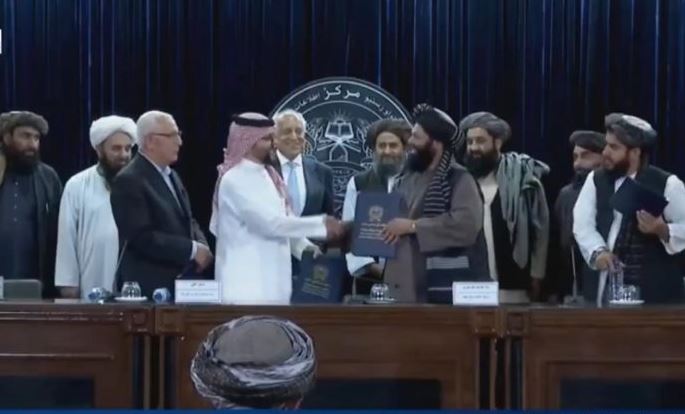
ISLAMABAD, Sept. 7 — Delta Energy Group, a Saudi Arabian energy group, Monday announced the signing of a series of agreements with Afghanistan’s Ministry of Mines and Petroleum covering hydrocarbon exploration and production, natural gas utilization in Herat and the potential development of a regional gas transmission pipeline, according to Delta Company.
The agreement was inked in Afghan capital Kabul and the ceremony was also attended by former American Special Envoy for Afghanistan Zalmay Khalilzad.
The agreements cover the Kushk and Tirpul Contract Area, spanning approximately 23,317 square kilometers, a natural gas utilization programme for Herat and a framework for the proposed “CentGas – Corridor of Prosperity” a 700-kilometer regional gas transmission pipeline, a Delta statement said.
The integrated programme represents a potential investment of approximately US$50 billion over twenty-five years, subject to exploration results, commercial viability, technical and economic studies, financing, regulatory approvals and subsequent investment decisions.
Three-Part Energy Programme Under the Exploration and Production Sharing Contract (EPSC), Delta Energy will undertake geological and geophysical studies, seismic work, exploration drilling and reservoir evaluation across the Kushk and Tirpul area to determine the scale and commercial potential of its hydrocarbon resources.
Separately, Delta Energy will finance and conduct an integrated study into the utilization of natural gas and related infrastructure serving Herat Industrial Park, Herat City and other approved areas, assessing potential applications including industrial activity, power generation and other energy requirements.
A supplementary agreement establishes a framework for evaluating the proposed 700-kilometre CentGas – Corridor of Prosperity pipeline, connecting a proposed receipt point near Guzara District in Herat Province with a proposed delivery point near Spin Boldak District in Kandahar Province.
The proposed pipeline is expected to involve an investment of approximately US$10 billion over a ten-year period, subject to technical and economic feasibility, regulatory approvals, financing and a final investment decision.
The pipeline is intended to be evaluated as a potential strategic energy corridor connecting Afghanistan’s emerging gas resources with domestic and regional markets. Any construction decision will depend on successful exploration, confirmation of sufficient reserves, technical and economic feasibility, approvals and project financing.
Sheikh Badr Mohammed Al-Aiban, Chairman of Delta International Holding Group, said: “This is much more than an oil and gas investment. It is an opportunity to help develop an integrated energy ecosystem that could have a lasting impact on Afghanistan and the wider region.
Chaher Altaki, President & Partner of Delta International Holding Group, said: “We are pleased to begin this partnership with the Ministry of Mines and Petroleum and to participate in Afghanistan’s next phase of energy development.
“At the same time, we are assessing the broader energy value chain. The Herat gas utilization programme examines how natural gas can support industry and local energy demand, while the proposed CentGas Corridor represents the longer-term regional dimension.
Afghanistan Ministry of Mines and Petroleum Mullah Hidayatullah Badri, Minister of Mines and Petroleum of Afghanistan, said: “This agreement represents an important step in the development of Afghanistan’s hydrocarbon resources. Cooperation with Delta Energy provides an opportunity to advance exploration, evaluate our natural gas potential and develop infrastructure that can support economic activity and energy security.
A Potential New Energy Corridor The programme is designed to connect upstream exploration and production with domestic gas utilization and regional infrastructure, supporting, subject to commercial viability, industrial development, energy availability, employment and regional connectivity.
The programme represents an estimated US$60 billion in potential investment across exploration, field development, gas utilization, pipeline infrastructure and related facilities over ten years, subject to technical and commercial feasibility, financing, regulatory approvals and final investment decisions.