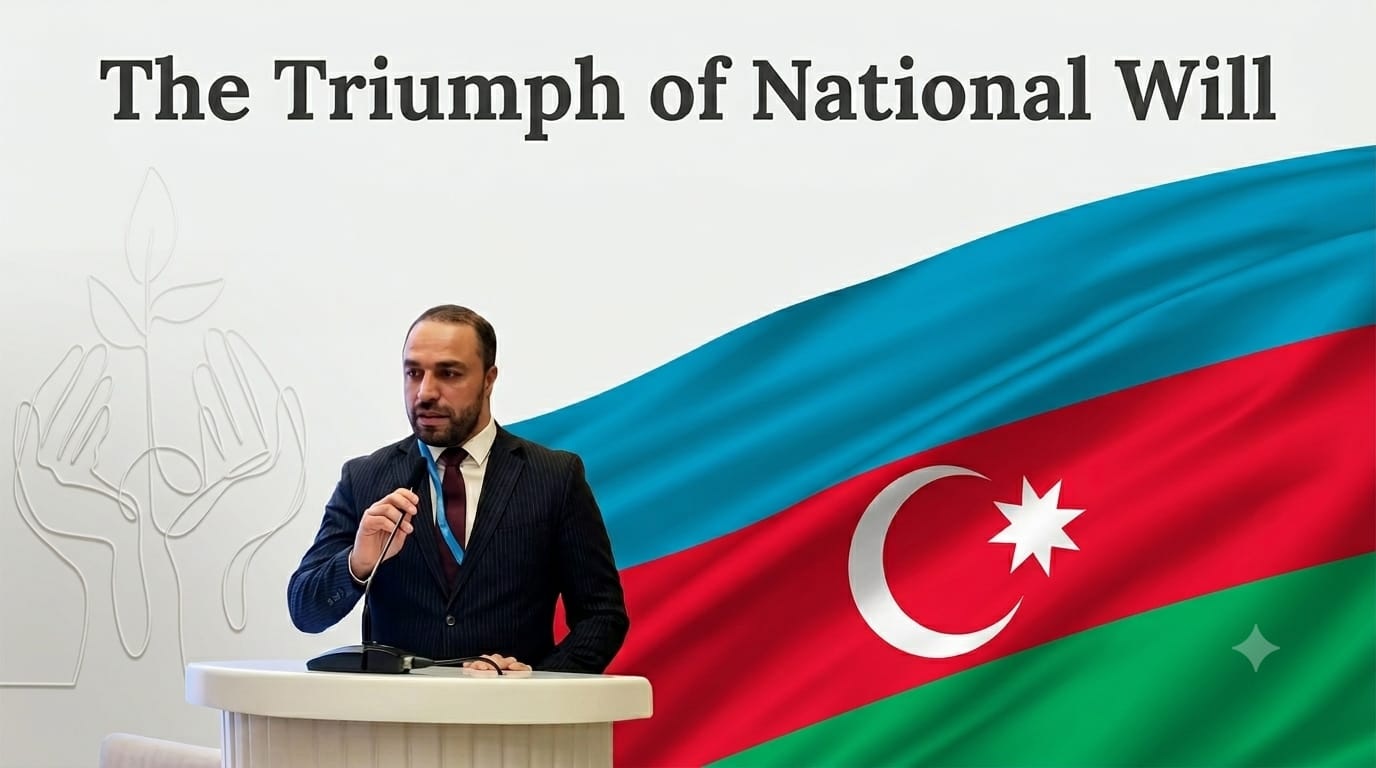
When we look at different periods of human history, one truth becomes evident: the fate of nations is not determined during calm and comfortable times. On the contrary, the most important decisions, the greatest turning points, and the events that shape the lives of future generations emerge during complex and uncertain periods. History books tell us much about great events, yet the fundamental factor behind them is often the same—responsibility toward statehood, national determination, and the ability to envision the future. There are certain dates that remain alive in the collective memory of nations and stand apart from ordinary days on the calendar. Such dates are not merely associated with a specific event; they embody the essence of an entire era. June 15 – National Salvation Day occupies exactly such a place in the historical memory of the Azerbaijani people. When reflecting on this date, the most important issue for me is not a simple chronology of events. More significant is understanding the challenges the state faced during that period, the trials endured by the people, and the choices upon which the future was built. The advantage of viewing history from a distance is that time reduces emotional influence and allows the true nature of events to become clearer. The early 1990s represented one of the most difficult periods in Azerbaijan’s history. Having only recently restored its independence, the country was confronted with serious political, economic, and military challenges. State institutions were still in the process of formation, uncertainty prevailed within the governance system, and tensions were escalating in various regions of the country. As a result of Armenia’s military aggression, Azerbaijani territories were occupied, and hundreds of thousands of people were forced to leave their native lands. Under such circumstances, concerns regarding the future of Azerbaijani statehood were becoming increasingly serious. History presents moments when the subsequent course of events depends on a single decision, a single step, or a single act of political will. Not everyone is capable of carrying such a burden of responsibility. Leadership during a crisis is fundamentally different from governance in times of stability. Decisions made in such moments do not merely address immediate challenges; they shape the development trajectory of entire decades.
June 15, 1993, became precisely such a turning point in Azerbaijan’s history. The return of National Leader Heydar Aliyev to political leadership at the call of the people played a crucial role in preventing the deepening crisis, restoring effective state governance, and ensuring stability throughout the country. The measures taken during that period helped preserve Azerbaijani statehood, strengthen national unity, and lay the foundation for a long-term development strategy. Today, with the benefit of historical perspective, it is clear that the achievements attained in subsequent years were built upon the political stability established during that critical period. The strengthening of state institutions, the implementation of economic reforms, the expansion of international relations, the successful realization of the country’s energy strategy, and Azerbaijan’s transformation into one of the leading states of the region were all logical outcomes of decisive historical choices. However, in my view, the significance of National Salvation Day cannot be measured solely by events of the past. This date carries a broader meaning. It serves as a reminder of how delicate, yet how invaluable, statehood truly is. The existence of a state is often taken for granted. As people live in conditions of security, stability, and development, they may not always consider the sacrifices and challenges through which these achievements were secured. History demonstrates, however, that preserving statehood requires great responsibility, political wisdom, and national solidarity.
In this sense, June 15 is also a day of national remembrance. Without understanding the path a nation has traveled, it is impossible to properly appreciate its future. Looking back at history should not be an exercise in nostalgia. The primary purpose of studying history is to build the future upon stronger foundations. History is a teacher in itself, and forgetting its lessons may lead to the repetition of past mistakes. In today’s world, where geopolitical dynamics are changing rapidly and the international system faces new challenges, the importance of statehood has become even more evident. The concept of a strong state can no longer be measured solely by military and economic indicators. A strong state is also defined by national unity, social solidarity, strategic thinking, and civic responsibility. These values do not emerge by chance; they are formed through years of experience and historical trials. One of the most important messages of June 15 is precisely this: the destiny of statehood is directly linked to the destiny of every citizen. A strong state creates a strong society, and a strong society ensures the resilience and sustainability of the state. This mutual relationship is one of the fundamental conditions for national development. Today, Azerbaijan is experiencing a new chapter in its history. The full restoration of territorial integrity and sovereignty, the large-scale reconstruction efforts in the liberated territories, the country’s growing international influence, and its position as a regional leader are the results of a long-term state-building strategy. Looking at these achievements, the significance of June 15 becomes even more apparent. Just as it is impossible to construct a magnificent building without a solid foundation, it is impossible to build a strong state without strong political foundations. National Salvation Day is not merely a tribute to the past; it is also a vision for the future. It reminds us that history is not simply a collection of events preserved in the memory of a nation. History is also the ability to bear responsibility for future generations. Statehood, in turn, is among the greatest moral treasures that each generation protects and passes on to the next. June 15 continues to live in Azerbaijan’s history as a symbol of salvation, political foresight, national unity, and the will of statehood. As the years pass, the value of this date becomes even clearer, while the lessons it offers remain as relevant as ever. For some days remain merely dates on a calendar, while others become the destiny of an entire nation.
Farid Mustafayev
“Progress” social and economic research public union deputy chairman , Member of the New Azerbaijan Party, Member Of The Western Azerbaijan Community, Board Member Of The Youth Anti-Drug Public Union