Ali Basit
The journey of Pakistan Navy (PN) began in 1947 with limited resources and a responsibility far greater than its size. At the time of independence, Pakistan inherited only a small fraction of the former Royal Navy’s assets, many of them outdated and insufficient for the enormous maritime obligations of a young state. Yet the newly formed Navy was immediately entrusted with safeguarding a coastline stretching over 1,000 kilometres, securing vital sea lines of communication and ensuring the smooth functioning of Karachi Port, which served as Pakistan’s economic lifeline. From the delivery of essential imports to the export of agricultural produce, Pakistan’s survival and early development depended heavily on maritime connectivity. This made the establishment of a competent and reliable naval force not just important but absolutely indispensable.
Despite starting from a position of numerical and material disadvantage, PN embarked on a path of steady growth and professional consolidation. In the decades that followed, it developed a reputation for discipline, tactical clarity, and the ability to optimize limited resources. While building a balanced fleet was a long-term aspiration, Pakistan’s strategic planners soon recognised that matching a larger adversary ship for ship was unrealistic. Instead, they focused on areas where Pakistan could establish a credible deterrence, most notably in submarine warfare. This decision had become a turning point in PN’s evolution.
Submarines offered Pakistan a capability that could offset numerical inferiority through stealth, surprise and sea-denial. Training standards were raised, underwater operations were refined and PN built a culture of professionalism where precision, endurance and calm decision-making became essential traits. This investment in undersea warfare had later proved decisive during one of the most critical moments in Pakistan’s maritime history, the 1971 war.
When war started in 1971, PN faced a formidable challenge. Indian Navy enjoyed numerical superiority, operated from multiple bases and launched aggressive operations on both eastern and western fronts. Pakistan, with fewer assets and stretched lines of defence, had to rely on skill, resolve and asymmetric strength. It was in this environment that PN submarine Hangor, a Daphne-class submarine under the command of Commander Ahmad Tasnim (later retired as Vice Admiral), embarked on a mission that had soon became legendary.
The submarine began tracking Indian naval movements, observing communication patterns and maintaining radio silence while manoeuvring deep in the Arabian Sea. Days passed in tense vigilance as Hangor monitored enemy formations. Meanwhile, Indian naval ships intensified their patrolling, fully aware that the presence of a Pakistani submarine threatened their operational plans.
Despite the constant danger, the crew of Hangor remained composed and focused, meticulously analysing sonar readings and maintaining stealth. On 9 December 1971, after shadowing Indian naval ships, the submarine detected what later proved to be the frigates INS Khukri and INS Kirpan. Indian navy ships were coordinating Anti Submarine Warfare operations, unaware that they were themselves being hunted.
Commander Tasnim made the decision to engage after confirming the target profile. It was a decision that required extraordinary courage and confidence as a single error may expose the submarine to immediate retaliation. Hangor fired a torpedo which struck INS Khukri, causing catastrophic damage. The ship sank within minutes, taking its crew with it. A second torpedo forced INS Kirpan to withdraw immediately from the area.
The sinking of INS Khukri was more than a tactical success. It was the first successful submarine kill since World War II and remains one of the most impactful submarine engagements in modern naval history. The action forced the Indian Navy to pull back its western fleet, reassess its operational plans and divert resources to track Hangor, which successfully evaded all pursuit and returned to Karachi safely. For Pakistan, this single engagement demonstrated the value of professionalism, rigorous training and investment in difficult but strategically vital capabilities.
The Hangor action quickly became a defining chapter in Pakistan’s naval consciousness. It symbolised what the Navy could accomplish through skill, courage and innovation. More importantly, it proved that even in moments of grave disadvantage, the right combination of doctrine, discipline and determination could alter the course of events at sea.
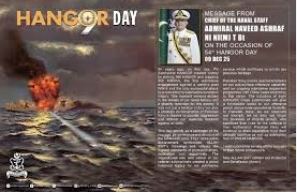
To commemorate the unmatched courage and unwavering commitment of PN submarine Hangor, Pakistan observes Hangor Day on every 9 December. This commemoration serves multiple purposes. It honours the bravery of the crew and it reinforces the importance of a strong maritime defence for a country whose economic future is deeply tied to the sea.
The journey of PN, from its modest beginnings to its defining moment in 1971, underscores a larger truth: maritime security is central to national security. In a region where strategic competition in the Indian Ocean continues to intensify, Pakistan cannot afford complacency. The legacy of Hangor offers a blueprint which means invest in capability, prioritise training, adapt intelligently and maintain the will to protect the nation’s maritime frontiers.
Hangor Day therefore stands not only as a tribute to a remarkable naval victory but as a reaffirmation of PN’s enduring commitment to safeguarding the country’s seas with professionalism and courage.