Home Blog Page 974

Govt to create enabling business environment

Govt to create enabling business environment

ISLAMABAD, APR 01 (DNA) — The Minister for Finance and Revenue, Muhammad Aurangzeb, was called on by Mr. Najy Benhassine, Country Director of the World Bank (WB) and Mr. Zeeshan Ahmed Sheikh, Country Manager of the International Finance Corporation (IFC), to discuss the collaborative development strategies and initiatives aimed at promoting economic growth, enhancing financial stability, and fostering sustainable development within the country.

During the meeting, the importance of strengthening partnerships with international financial institutions like IFC and WB was highlighted. Discussion was done to leverage their expertise and resources for the country’s development agenda. The Minister also highlighted the Government’s commitment to creating an enabling environment for private sector investment and ensuring transparency and accountability in financial matters.

Respective representatives from WB and IFC appreciated the efforts of the Government aimed at bringing reforms in economic and financial sectors to ensure sustained economic growth in terms of expanding the tax base, SOEs restructuring, and Privatization.

They also discussed potential areas of cooperation and investment opportunities in various sectors, including agriculture, power sector, and IT. The delegates expressed their organizations’ continued support for the country’s development goals and agendas for the welfare of the people of Pakistan. — DNA

The New ConservativeErain Iran

The New ConservativeErain Iran

Dr. Muhammad Akram Zaheer

A new group of leaders in Iran is coming up and they are stricterin their beliefs than those who have been in charge for the past 45 years. This change is happening because the government wants to stay in control, especially since many people in the country are losing faith in the system that has been run by religious leaders for a long time. In the 2024 elections, there is a big internal power struggle happening as the country prepares for a new top leader.

The elections on March 1 had the lowest voter turnout since the government was established in 1979. Only about 40% of eligible voters participated and some reports say it might be even lower. Key figures, like the speaker of the outgoing parliament, Mohammad Bagher Ghalibaf, did not do well in the elections. In Tehran, the capital, only 25% of people voted. In the Assembly of Experts, which is a group that helps choose the top leader, Sadegh Larijani lost his position.

Even former President Hassan Rouhani could not run for the Assembly of Experts. This manipulation of the elections has been going on since 2004, when the Guardian Council, a group that approves candidates, disqualified many reformists. Instead of solving political issues, this move made things worse over the next 20 years, leading to conflicts between different conservative groups. The struggle between more practical thinkers and strict ideologues continued during the presidencies of Mahmoud Ahmadinejad and Hassan Rouhani, who both served two terms from 2005 to 2021.

          Supreme Leader Ayatollah Ali Khamenei has been mediating between different groups trying to gain power and influence for a long time. In the past 20 years, this process, usually done in private, increasingly needed his direct involvement and became more public. This was most noticeable during the Ahmedinejad era (2005-13) when the then-president not only clashed with fellow conservatives but also opposed Khamenei in his second term.

This made divisions among conservatives more pronounced, especially when the U.S. imposed more sanctions. To address this, Khamenei allowed the return of pragmatic conservative forces. In the 2013 elections, Rouhani, a pragmatic conservative, won decisively. This move helped Khamenei in two ways. First, it restored public support for the regime, which had suffered from the controversial 2009 elections and the subsequent uprising. Second, it created room for Tehran to negotiate a nuclear agreement with the U.S. amid severe sanctions.

Despite serious financial difficulties and the need for domestic stability, talks with the U.S. caused divisions in the Iranian political establishment. Rouhani’s pragmatic approach clashed with the more ideologically driven clerics and the IRGC. The 2015 nuclear deal was a win for the pragmatists, but it didn’t last. The Trump administration’s 2018 decision to withdraw from the deal and reinstate sanctions undermined Iran’s pragmatic conservatives.

In response, Iran retaliated, leading to the U.S. killing Qassem Soleimani in early 2020, further strengthening the ideologues and weakening the pragmatic conservatives, who had already lost ground during Rouhani’s second term (2017-21). Before the 2021 presidential elections in Iran, the Guardian Council limited the candidates to ensure Ebrahim Raisi, a strict and influential figure, would win. This move also weakened the power of others, like Ali Larijani, who was disqualified despite attempts to reverse the decision. Over the years, Supreme Leader Khamenei’s influence declined and the IRGC-led security establishment gained strength. Raisi’s presidency marked a shift to a more conservative government.

To solidify control, especially after protests due to economic hardships, Raisi’s administration enforced stricter public restrictions, especially for women’s dress codes. This led to the death of Mahsa Amini in 2022, triggering widespread protests that lasted almost a year. The government faced criticism from within, with senior figures expressing concerns about the regime’s stability. Khamenei had to defend the government’s actions and there were promises to revise laws related to women’s dress codes, although no concrete actions followed.

The protests eventually subsided in mid-2023. Amidst public discontent, economic challenges, and internal power struggles, the upcoming elections were crucial. Ideologues aimed to secure a majority in the parliament and the Assembly of Experts, which plays a role in choosing the next supreme leader. While ideologues controlled the Guardian Council, runoffs for parliamentary seats were expected and the Assembly’s composition remained uncertain. With widespread dissatisfaction, economic issues and power struggles among elites, the future of the Iranian regime might hinge on the armed forces which are not immune to public sentiments.

SC takes suo motu notice of IHC judges’ letter

SC

ISLAMABAD: The Supreme Court on Monday took suo motu notice of the Islamabad High Court (IHC) judges’ letter alleging interference by intelligence agencies in judicial matters despite the government forming a commission to probe the matter.

A seven-member bench led by Chief Justice of Pakistan Qazi Faez Isa will hold the maiden hearing on the issue on Wednesday.

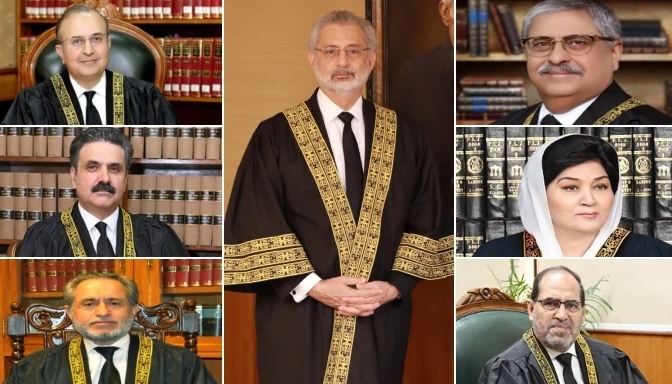
Apart from the CJP the bench also comprises Justice Syed Mansoor Ali Shah, Justice Yahya Afridi, Justice Athar Minallah, Justice Mussarat Hilali, Justice Jamal Khan Mandokhail and Justice Naeem Akhtar Afghan.

The explosive letter which surfaced last week triggered a crisis and the Supreme Court led by CJP Isa has been under pressure to hear the matter under Article 184(3) of the Constitution.

Just a day earlier, over 300 lawyers belonging to different bar associations across the country lauded the judges’ and called upon the apex court to hear the matter under its suo motu jurisdictions.

The IHC judges — Justice Mohsin Akhtar Kiyani, Justice Tariq Mehmood Jahangiri, Justice Babar Sattar, Justice Sardar Ejaz Ishaq Khan, Justice Arbab Muhammad Tahir, and Justice Saman Rafat Imtiaz — wrote the letter to the Supreme Judicial Council (SJC), urging the body to convene a judicial convention over the alleged interference of intelligence agencies in judicial affairs.

The development came days after the Supreme Court declared the removal of former IHC Justice Shaukat Aziz Siddiqui illegal, directing that he may now be considered as a retired judge.

The verdict noted that the SJC proceeded against Justice Siddiqui on the “assumption that the truth or falseness of the allegations levelled” by the former judge was “irrelevant”. It also noted that the SJC opined that Justice Siddiqui had failed to substantiate, independently corroborate, substantiate or prove the allegations levelled by him.

Following the emergence of the letter, on March 27, CJP Isa chaired a full court meeting of the Supreme Court to deliberate on the matter that sought guidance from the SJC “with regard to the duty of a judge to report and respond to actions on the part of members of the executive, including operatives of intelligence agencies, that seek to interfere with the discharge of his/her official functions and qualify as intimidation”.

The two-hour huddle, convened by CJP Isa, took place after bar associations of Sindh, Lahore, Islamabad and Khyber Pakhtunkhwa as well as senior lawyers demanded a probe into the allegations.

The next day CJP Isa met Prime Minister Shehbaz Sharif on the advice of the full court in the presence of the law minister, attorney general, senior puisne judge and the registrar of the apex court.

As a result of the meeting, the government decided to constitute a commission to probe into allegations levelled by the IHC judges.

Following the huddle, the federal cabinet on March 30 approved the constitution of an inquiry commission over allegations of the IHC judges and appointed former chief justice of Pakistan Justice (retired) Tassaduq Hussain Jillani as its head.

However, after the Supreme Court took suo motu notice it emerged that Justice (retd) Jillani has recused himself form heading the commission.

IHC suspends Imran Khan, Bushra Bibi’s sentence in Toshakhana case

IHC

ISLAMABAD: The Islamabad High Court (IHC) on Monday suspended sentence of Pakistan Tehreek-e-Insaf (PTI) founder Imran Khan and his spouse, Bushra Bibi, in the Toshakhana case.

IHC Chief Justice Aamer Farooq said appeal against the conviction would be fixed for hearing after Eid holidays.

Accountability court’s Judge Muhammad Bashir had sentenced Khan and Bushra to 14 years in prison with rigorous punishment in the Toshakhana reference in January.

The judge had also disqualified the former prime minister for 10 years while handing over a fine of Rs1.57 billion — Rs787 million each — to the couple.

Khan had told the court that his wife had nothing to do with the case and was being humiliated by being forcibly dragged into it.

IHC CJ Farooq, during the hearing, said the cipher case would be completed in a few days. “Also, we cannot fix the Toshakhana case for hearing the very next day after holding a hearing on it today.”

He said the cypher case was fixed for hearing the next day.

The court said arguments of the Federal Investigation Agency (FIA) had to begin in the cipher case and he did not know how long it would take. Hence, the Toshakhana case is being postponed till after Eid.

The couple was also sentenced to seven years in prison each in the case pertaining to their illegal marriage on February 1. Earlier on January 30, a court had sentenced Khan and PTI leader Shah Mahmood Qureshi to 10 years’ imprisonment in the cipher case.

All these back to back verdicts had come against Khan a few days prior to the February 8 general elections.

APNS President, Secy General nominate committee chairs for 2024-25

APNS President, Secy General nominate committee chairs for 2024-25

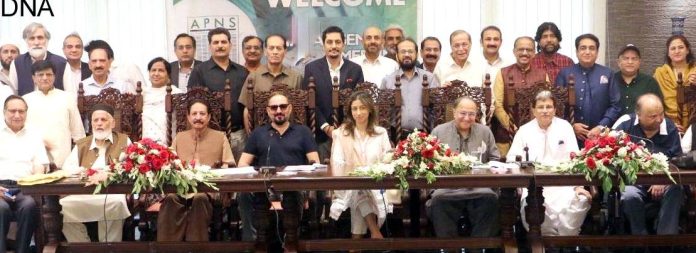
KARACHI, APR 1 /DNA/ – The President, Nazafreen Saigol Lakhani and the Secretary-General, Sarmad Ali of the All Pakistan Newspapers Society have nominated Mujib-ur-Rehman Shami to be Chairman of the Scrutiny-Cum-Enrollment Committee for the year 2024-25 and Mr. Faisal Zahid Malik to head the Small, Medium-Sized Metropolitan ‘B’ Publication Committee of the APNS for the year 2024-25 as Chairman. The members of the committees are here-under:

Scrutiny-Cum-Enrollment Committee

1​          Mr. Mujib-ur-Rehman Shami        Chairman                 Daily Pakistan

2          Mr. Jamil Ather                             Vice Chairman         Daily Tijarat

3          Mrs. Nazafreen Saigol Lakhani    Member                   President, APNS

4          Mr. Sarmad Ali                              Member                   Secretary General, APNS

5          Mr. Imtinan Shahid                       Member                   Sr. Vice President

6          Mr. Shahab Zuberi                        Member                   Finance Secretary/Business Recorder

7          Kazi Asad Abid                              Member                   Daily Ibrat, Hyderabad

Small, Medium – Sized Metropolitan ‘B’ Publications Committee

1          Mr. Faisal Zahid Malik                  Chairman                 Daily Pakistan Observer     

2          Mr. Bilal Farooqui                          Vice Chairman         Daily Aghaz

3          Syed Akbar Tahir                          Member                   Daily Jasarat

4​          Mr. Tahir Mughal ​                         Member​                   Daily Nawa-i-Pak

5          Mr. Faisal Shahjehan                    Member                   Daily Jiddat, Khi

6          Mr. Najamuddin Sheikh                Member                   Daily Deyanat

7          Syed Sajjad Bokhari                     Member                   Daily Abtak 

8​          Kazi Sajjad Akbar                         Member                   Daily Regional Times, Khi

9          Mr. Ali Bin Younus                        Member                   Daily Beopar

10        Dr. Jabbar Khattak                       Member                   Daily Awami Awaz

11        Mr. Ghulam Nabi Chandio            Member                   Daily Pak

12​        Ms. Zahida Abbasi​                        Member​                   Daily Nau Sijj

13​        Mr. Irfan Athar ​                             Member​                   Daily Tijarat

14        Mr. Aamir Malik                            Member                   Daily Mashriq Evening Special Khi

Ambassador Khalil Hashmi attends closing ceremony of Gandhara Art Exhibition

Ambassador Khalil Hashmi attends closing ceremony of Gandhara Art Exhibition

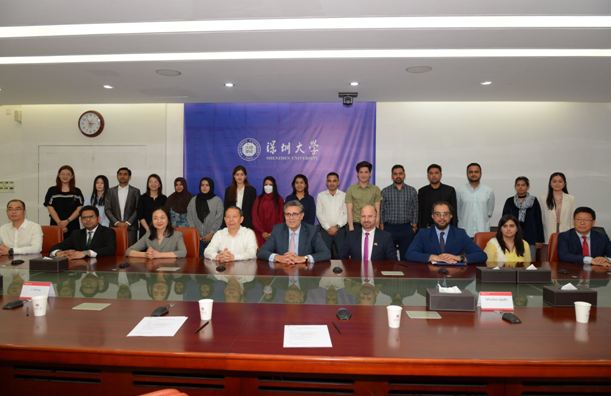
GUANGZHOU, APR 1 /DNA/ – Ambassador Khalil Hashmi paid an official visit to Shenzhen and Guangzhou in the Guangdong province of China on 23-29 March 2024. This was Ambassador’s inaugural visit to the province since assuming office.

Ambassador’s visit was scheduled to overlap with the closing ceremony of the year-long Gandhara Art Exhibition, jointly organized by Pakistan and China.  During the visit, Ambassador had diverse engagements meant to enhance relations with the two major cities on a political level, as well as cultural, academic and most importantly trade and investment ties.

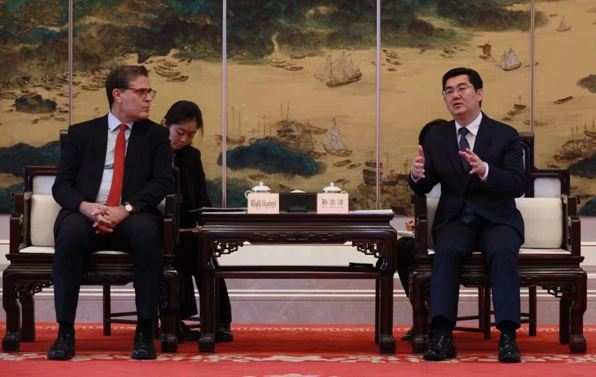
On the political level, Ambassador was received by Mr. Meng Fanli, Communist Party’s top leader in Shenzhen and by Mr.Sun Zhiyang, Mayor of Guangzhou city. In both these meetings, Ambassador paid tribute to the cities’ stellar economic performance in the past four decades and briefed them about the investment landscape of Pakistan and opportunities for investors from Guangdong to invest in diverse sectors. Both the Chinese leaders noted with satisfaction the growing ties between Pakistan and the respective cities, including through the presence of increasing number of Pakistani students, and expressed the desire to further enhance economic ties. The meetings saw a consensusto enhance cooperation in priority sectors through establishment of institutional mechanisms.

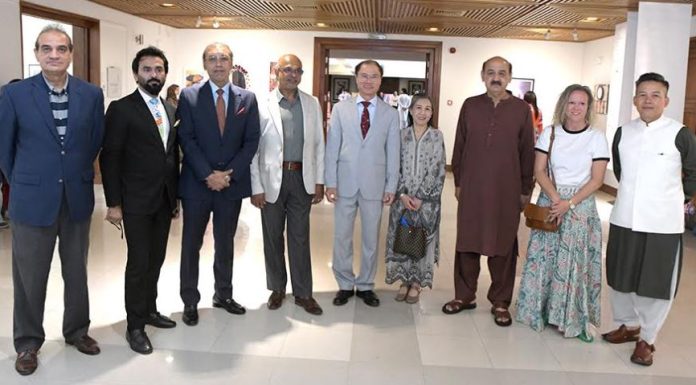
On the cultural front, Ambassador Hashmi attended the closing ceremony of Gandhara Art Exhibition, where he delivered remarks highlighting the importance of such initiatives in longstanding ties between Pakistan and China. On the sidelines, he also met Mr. Wang Xudong, Director of Palace Museum, where both sides positively noted the successful culmination of the event, and discussed ways to further enhance cultural cooperation.

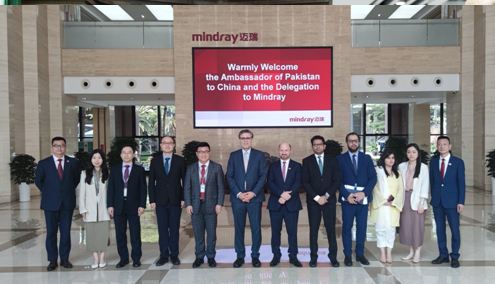
On the economic side, Ambassador Hashmi interacted with a number of prominent Chinese enterprises, both state-owned and private, including Amer International, Huawei, Shum Yip Group, BYD, BGI Economics, Mindray, Guangzhou Metro (the parent enterprise of Lahore Orange Line) and a number of other companies. Leadership of all these enterprises briefed the Ambassador about their engagement with Pakistan and their future plans. Ambassador Hashmi briefed the interlocutors about the investment policies of Pakistan and assured them of his full support. He also addressed a forum of technological enterprises based in Shenzhen.

For engaging with academia, Ambassador paid a visit to Shenzhen University and had a meeting with the President. The two sides discussed various areas of collaboration, including the possibility of setting up a Pakistan Research and Study Centre at the university. He also interacted with Pakistani students enrolled at Shenzhen University.Additionally, he visited Guangdong University of Foreign Studies in Guangzhou, where he interacted with the students learning Urdu. The students also displayed their affection towards Pakistan through a number of cultural performances, including a rendition of ‘Dil Dil Pakistan’.

Ambassador also had a number of community interactions during his visit, where he lauded the important role played by Pakistani Diaspora and assured them of full facilitation by the Embassy in Beijing and Consulate-General in Guangzhou.

Shenzhen city is known for being at the center of China’s reform and opening up four decades ago. The city has now established itself as a hub of innovation, entrepreneurship and emerging technologies in diverse sectors. Guangzhou, another major city in southern China, is renowned for its bustling trade and commerce, exemplified by the world-famous Canton Fair. The city is also celebrated for its pivotal role in China’s industrial and economic landscape as a manufacturing hub in the Pearl River Delta region.

KP govt contacts FBR to discuss arrears

KP govt contacts FBR to discuss arrears

PESHAWAR: Khyber Pakhtunkhwa Finance Adviser Muzamil Aslam on Sunday held a telephonic conversation with Federal Board of Revenue (FBR) Chairman to discuss arrears of KP Revenue Authority.

In a statement, Muzamil Aslam said that the telephonic conversation has been made for arrears of Khyber Pakhtunkhwa Revenue Authority.

A delegation meeting with FBR on the understanding of cross-input tax adjustment would be made soon, he added.

He said that Rs9.4 billion rupees pending agreement, of which Rs4.1 billion rupees have been received in February 2024 and Rs5.3 billion pending with FBR for reconciliation and settlement.

He said that the FBR officials are likely to meet Khyber Pakhtunkhwa Revenue Authority (KPRA) officials next week for reconciliation.

Earlier on March 13, KP CM Ali Amin Gandapur met Prime Minister (PM), Shehbaz Sharif belonging to rival Pakistan Muslim League-Nawaz (PML-N).

Addressing a press conference along with Planning Minister Ahsan Iqbal, the KP chief minister hailed his first engagement with PM Shehbaz Sharif ‘positive’ and said they discussed public and provincial issues, law and order and other matters.

“It was very positive and he [PM Shehbaz Sharif] assured of his full support, would fulfil his promise and would not lie,” CM Ali Amin Gandapur said.

He stressed the need for ‘collaborative efforts’ to solve public issues and the need for the federal and provincial governments to deliver.

Islamic Emirate confirms detention of two us citizens

Islamic Emirate confirms detention of two us citizens

KABUL, MAR 31: Zabihullah Mujahid, spokesperson for the Islamic Emirate, told TOLOnews that two American citizens and some other foreign nationals are currently detained by the caretaker government.

Zabihullah Mujahid said these foreign nationals have been arrested for legal violations in the country and he said that every foreign citizen wanting to travel to Afghanistan must consider the laws of the Islamic Emirate.

“I think there are two Americans, and the reasons for their visit are not clear yet; but whatever the reasons, anyone coming to Afghanistan is obliged to observe the laws of Afghanistan. Anyone who gets an Afghan visa means they agree to follow our laws,” he said.

Recently, two American national security officials told NBC News that two US citizens are being held by the caretaker government.
According to these officials, Ryan Corbett and another individual, whose details have not yet been disclosed, are being held “without reason” by the security forces of the Islamic Emirate.

“What are the charges against those who have been arrested? If the charges are very serious, it may necessitate their trial in Afghanistan, which is very unlikely. Another possibility is that these individuals might be exchanged for someone the Taliban wants,” said Rashid Qutbzada, an international relations analyst.

“American citizens detained in Afghanistan will be dealt with according to their crimes, and then it’s a matter of government to government,” said Hadi Qurishi, a military affairs expert.

Previously, the spokesperson for the U.S. State Department had stated in a press briefing that the detention of American citizens in Afghanistan is a significant obstacle to positive engagement with the Islamic Emirate.

RBISE takes strict action against ‘Botti’ Mafia

RBISE takes strict action against ‘Botti’ Mafia

RAWALPINDI, MAR 31 (DNA) — Rawalpindi Board of Intermediate and Secondary Education (RBISE) had taken strict action in accordance with the law against ‘Botti’ Mafia, said a RBISE spokesman.Talking to media, he informed that on the directives of the Chairman RBISE, the board was making all-out efforts to control cheating mafia.

The Chairman and the Controller of Examinations were also conducting surprise raids and visiting the examination centers across the division in connection with 9th First Annual Examination 2024. The Chairman and the Controller were reviewing all the arrangements made to facilitate the students.

The spokesman informed that foolproof arrangements were finalized for the Exams and the Board with the cooperation of the district administration had implemented Standard Operating Procedures issued by the board to prevent cheating and ensure fair conduct of the examinations.

Teams were formed to visit exam centers to discourage cheating and use of any unfair means, he added. DC Jhelum, Capt.(R) Samiullah Farooq had also visited various examination centers in Jhelum District in connection with the Ninth First Annual Examination 2024 and reviewed the security arrangements finalized for the examination centers.

Controller of Examinations, RBISE, Prof. Sajid Mahmood Farooqui said that strict monitoring of the examination centers was being conducted under zero tolerance policy against cheating.  In this regard, on the order of the Chief Minister Punjab, the police had also been given the authority to visit and check the examination centers along with the board officers concerned to discourage cheating.

He warned that strict action would be taken if cheating material is found in electronic devices during checking.  Action in accordance with the law would be taken without any discrimination, he added. — DNA

Pakistan, Canada pledge to explore economic prospects, skillful manpower

Pakistan, Canada pledge to explore economic prospects, skillful manpower

DNA

ISLAMABAD: The Pakistan and Canada have reaffirmed their commitment to remain constructively engaged to further reinforce bilateral relations, as there were a number of sectors that had a huge potential for cooperation, especially the export of skillful manpower to improve the national economy.

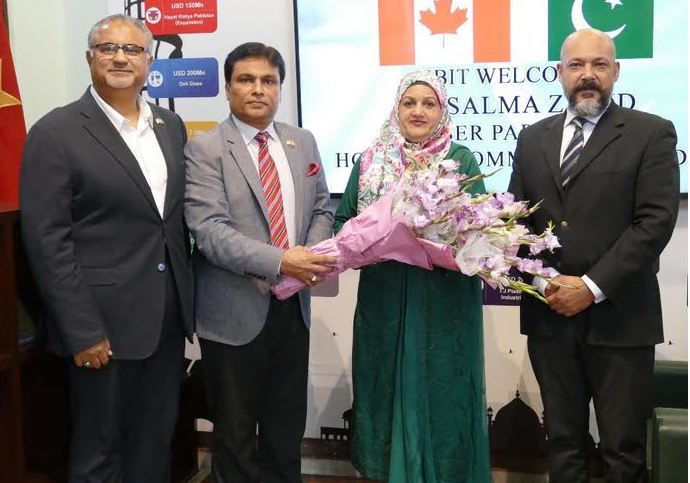
These views were discussed in a tripartite meeting of the All Pakistan Business Forum (APBF), Punjab Board of Investment & Trade (PBIT) and Member Parliament of the House of Commons of Canada Ms. Salma Zahid, held here today, to discuss various trade opportunities between Pakistan and Canada with major focus on export of skilled labour force from Pakistan.

Salma Zahid, who is also the Member Standing Committee of Immigration and Citizenship of Canada, has recently been awarded with the Pakistan civil award of ‘Sitara-e-Quaid-e-Azam’ for her remarkable services to enhance bilateral relations between the two countries.

The Member Parliament of the Canadian House of Commons emphasized Pakistan’s deep appreciation for its relationship with Canada and its commitment to fostering enduring and multifaceted bilateral relations. She stressed the importance of increasing trade between the two nations and called for closer collaboration among business communities. Promoting bilateral cooperation across public, commercial, and parliamentary spheres was highlighted as pivotal to strengthening the Pakistan-Canada partnership.

Ms. Salma Zahid expressed gratitude to APBF and PBIT for inviting her and said that Canada and Pakistan have all the resources for business collaboration and export of skilled workforce. She pledged to return with different new ideas of JVs, collaborations and export of demand base skilled workforce to boost the bilateral trade ties.

APBF President Maaz Mahmood added that business community of both the countries should collaborate with each other to force joint ventures in view of increasing bilateral trade and exploring new business opportunities. “We can start it through segment wise and APBF have all the resources to initiate it because we contain diverse kinds of members from different business sectors.”

He said that Pakistan is the 5th largest country of the world in terms of population with a large pool of human resource, pledging to equip its manpower with the latest skills and knowledge to improve their prospects of their export to potential markets.

Maaz Mahmood called for harnessing the potential of a substantial Pakistani workforce to realize the goal of fast economic revival. He proposed the Canadian government to employ a substantial number of Pakistani workers, as it has the ability to export one million workers every year to various potential markets and all possible efforts should be made to realize this goal to strengthen the economy.

The PBIT CEO Jalal Hassan, on this occasion, pointed out various trade opportunities which exist between Pakistan and Canada, asking the APBF to take lead from private sector, as it has huge membership from diverse sectors. He also asked the private sector and the government of Canada to engage with Pakistan to find the ways to increase the export of skilled workforce to Canada.

Calling for easing visa process for Pakistani students and business community, he said that Pakistan markets are competitive and, we have great potential for collaboration in all sectors especially textile, auto parts, skilled labor and manpower export etc. He said that the government has making strong efforts to explore new markets for increasing the export of manpower across the globe that would help improve the foreign exchange and the overall economy.

APBF Chairman Ibrahim Qureshi, expressed his best wishes, commenting that there is a huge opportunity between Canada and Pakistan which can be materialized through regular interaction and collaboration from both sides. He said that many countries, including Canada, are in high demand of skilled labor and the government would provide the demand-driven skills to its workforce that would increase their export and strengthen the economy.

APBF President, in the end, appreciated APBF Chairman Ibrahim Qureshi and CPBC President Samir Dossal for their great work to keep both the countries engaged in all kinds of cooperation. The meeting was also attended by APBF board member Amir Munir and senior officials of PBIT.

Stay Connected

64FansLike
60FollowersFollow

Latest Reviews

Exchange Rates

USD - United States Dollar
EUR
1.17
GBP
1.35
AUD
0.72
CAD
0.73