Home Blog Page 972

Ambassador Khalil Hashmi presents credentials to Mongolian President

Ambassador Khalil Hashmi presents credentials to Mongolian President

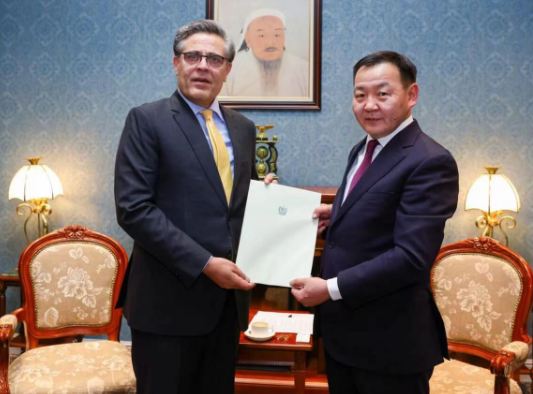
ULAANBAATAR, APR 3: /DNA/ – Ambassador Khalil Hashmi presented his credentials to President Ukhnaagiin Khürelsükh of Mongolia on 02 April 2024 in an elegant and impressive ceremony held at the State House in Ulaanbaatar, capital city of Mongolia.

During his ongoing visit, Ambassador Hashmi is also meeting with various ministerial and deputy ministerial level officials, academia and businesses. Notably, he had productive interactions with the Ms. Battsetseg Batmunkh, Foreign Minister and other senior officials of Mongolia’s Ministry of Foreign Affairs (MFA), in which both sides emphasized the need to build on their ancient civilizational linkages to foster goodwill among the younger generation of both countries.

Pakistan and Mongolia enjoy warm relations spanning over six decades, characterized by mutual respect, cultural similarities and robust cooperation at multilateral fora. Recently, there has been enhanced bilateral interactions as well.

Ambassador of Pakistan to China is also concurrently accredited as Pakistan’s non-resident Ambassador to Mongolia.

COMSTECH Pledges Five Thousand more Fellowships for Palestine in the Second Phase

Islamabad, Apr 2 /DNA/ – COMSTECH launches the second phase of COMSTECH-Palestine scholarships and fellowships program in collaboration with APSUP and member universities of COMSTECH Consortium of Excellence, on Tuesday at COMSTECH secretariat. The federal minister for science and technology, H. E. Dr. Khalid Maqbool Siddiqui honored the launching ceremony as chief guest.

Coordinator General COMSTECH, Prof. Dr. M. Iqbal Choudhary informed that in the first phase of COMSTECH-Palestine program 500 fully covered fellowships were announced in various fields of STEM, health and agriculture. He said that in the second phase, APSUP and CCoE universities have generously pledged 5,000 fellowships. He informed that this mega program will also be announced by the OIC Secretary General in Jeddah soon.

Prof. Choudhary said that the unparalleled sufferings of Palestinian people since last seven decades and recent genocide represent the demise of human values and global norms. He said that the world has miserably failed to stop atrocities of unprecedented magnitude in Palestine.

The federal minister for science and technology, Dr. Khalid Maqbool Siddiqui, said that as the Federal Minister for Science & Technology and Federal Education and Professional Education, I am extremely pleased to launch this timely and most important initiative, a gift of Pakistan to our brethren in Palestine. He appreciated this large scholarships program of COMSTECH with partner universities in Pakistan and other OIC countries.

Dr. Siddiqui said that this initiative is a reflection of inseparable relationship between Palestine and Pakistan at all levels, as per the vision of our founding Father Quid e Azam Muhammad Ali Jinnah. He congratulated OIC- COMSTECH, Palestinian Diplomatic Mission, Palestinian International Cooperation Agency (PICA), Association of Private Sector Universities of Pakistan (APSUP), OIC General secretariat and Vice chancellors of the COMSTECH Consortium of Excellence universities for their collaborative effort for collective mission.

Dr. Siddiqui said that the Ministry of S&T greatly values the central role that COMSTECH in playing not only in the capacity building of OIC countries through bilateral and multilateral linkages and exchanges, but also its pivotal role in presenting the best of Pakistan’s S&T capabilities for the promotion of exports. He said that we greatly appreciate large number of initiatives and programs, which have been launched under the leadership of Prof. Dr. M. Iqbal Choudhary.

H.E. Hissein Brahim Taha, Secretary General, Organization of Islamic Cooperation, said that this collaboration between COMSTECH and leading member universities of the Association of Private Sector Universities of Pakistan and the esteemed Embassy of the State of Palestine in Islamabad, constitutes an important step in our commitment to support Palestinian universities and researchers. He said that this program represents a beacon of hope amid the challenges being faced by the Palestinian people and we commend COMSTECH for its unwavering dedication to this cause.

He appreciated the leadership of Prof. Choudhary for launching numerous scientific programs for capacity building and development socio-economic development. He invited institutions from other OIC member states to join COMSTECH in expanding the program thereby encouraging a spirit of fraternal cooperation and assistance to the Palestinians. He assured strong support for this program.

The Ambassador of the State of Palestine, H. E. Mr. Ahmed Jawad Rabei said that on behalf of the Palestinian people, I am pleased and honored to join this launch ceremony of the COMSTECH program, in cooperation with private universities in Pakistan, which is providing 5,000 scholarships for Palestinian students.

He said that the Palestinian issue remains the most important issue in the conscience of the free people of the world, especially in our Islamic world, as the Palestinian blood continues to be shed on our blessed land, Palestine, as a result of the barbaric, fascist, terrorist attack carried out by the Israeli occupation forces, supported by countries – that falsely claim democracy, human rights, child and women’s rights – against our country and steadfast people in attempt to annihilate our people, displace them, abolish their national identity, take our land, and attempt to Judaize the blessed Al-Aqsa Mosque.

He informed that under the guidance of President Mahmoud Abbas, we seek to have an advanced and effective system for education, learning, and vocational and technical training. He said that the Palestinians need support from their Muslim brothers, as the children and students of Palestine, who are being killed by the occupants, need someone to support and sponsor their narratives. He extended his gratitude and appreciation to Pakistan for the continuous unwavering support.

The ceremony was also addressed by Dr. Awais Raoof, Chairman board of governors, university of Lahore and Justice Dr. Syed Muhammad Anwer. Both the speakers talked about the historical context of the land of Palestine, its culture and occupation history.

The launching ceremony was attended by the Ambassadors and diplomats of Algeria, Ethiopia, Kazakhstan, Malaysia, Maldives, Morocco, Oman, Russia, Somalia, Sudan, Syria, TRNC, Yemen, and Vice Chancellors of the CCoE member institutions, foreign fellows of COMSTECH programs, Palestine students enrolled in Pakistan.

PM Shehbaz Sharif chairs meeting to review foreign investment progress

Shehbaz Sharif

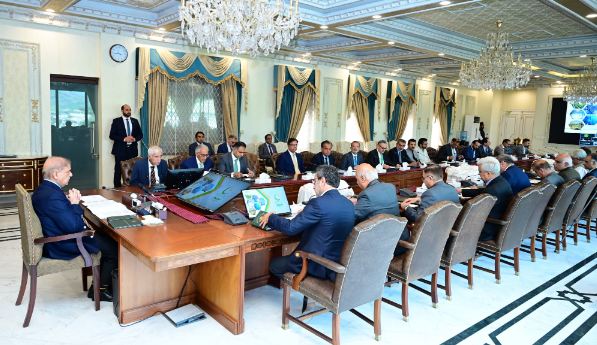
ISLAMABAD, APR 2 /DNA/ – Prime Minister Muhammad Shehbaz Sharif led a high-level meeting today to assess the progress on foreign investment initiatives. The meeting, held in Islamabad, aimed to evaluate the current status of foreign investment projects and discuss strategies to attract further investment into Pakistan.

KASB Institute of Technology hosts first

KASB

DNA

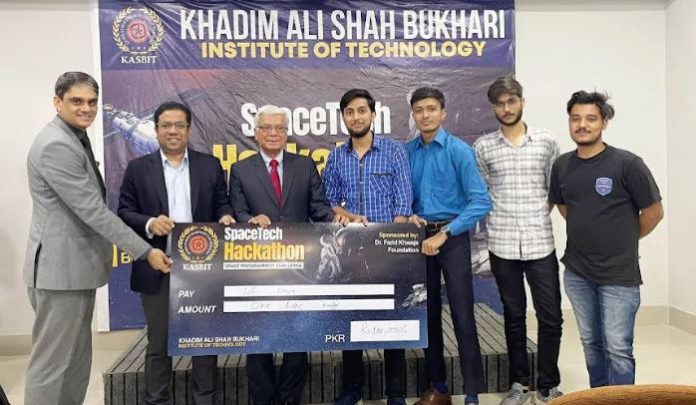
KARACHI: KASB Institute of Technology (KASBIT) hosted the award ceremony for its First Inter-University Space Technology Hackathon on Monday, 1st April, in Karachi. The competition was sponsored by the Dr. Farid A. Khwaja Foundation. Over 40 students, across eight teams from six universities participated in the competition. The teams made projects which solved problems and challenges in space tech.

The top prize went to the team from FAST, who designed a system to self-navigate a Lunar rover in a path which optimizes for energy efficiency. The second award was won by a team from the University of Karachi who built a track and navigate system to help satellites avoid space debris. The third winner was a team from NED, which made an interactive dashboard and chatbot for displaying anomalies on a space system. The KASBIT team got a special prize for diversity.

Prof. Dr. Farid Akhtar Khwaja, Aezaz-e-Kamal, was the Chief Guest at the ceremony. Dr. Khwaja spoke about the genesis of Pakistan’s space program and motivated the students by telling them about the rich history of Pakistanis in science and technology. Dr. Kashif, the Rector of KASBIT hosted the competition and highlighted why STEM education is critical for Pakistani youth.

The purpose of the competition was to inspire Pakistani students to dream big and aim to solve complex problems in technology. New advances in Artificial Intelligence create the challenge of making basic-level tech work redundant. It is imperative for Pakistani students to raise their level and get motivated and mentored on subjects in advanced technologies.

ALMS AND FOOD DONATION BY HIGH COMMISSION OF MALAYSIA’S CLUB AND PERWAKILAN ISLAMABAD TO ANJUMAN FAIZUL ISLAM ORPHANAGE

ALMS AND FOOD DONATION BY HIGH COMMISSION OF MALAYSIA’S CLUB AND PERWAKILAN ISLAMABAD TO ANJUMAN FAIZUL ISLAM ORPHANAGE

ISLAMABAD /DNA/ – On 2 April 2024, the High Commission of Malaysia in Islamabad under its club – Kelab Suruhanjaya Tinggi Malaysia Islamabad, in collaboration with the Ladies Association of the High Commission (PERWAKILAN Islamabad), handed over alms collection and food distribution to the Anjuman Faizul Islam Orphanage in Rawalpindi.

The Malaysian delegation, led by His Excellency Ambassador Azhar Mazlan, High Commissioner of Malaysia to Pakistan, was warmly received by the orphanage President, Prof. Dr. Riaz Ahmad, along with the centre’s administration team and over 300 orphanage residents. The High Commissioner also inspected the centre’s Boy Scouts guard of honour during his arrival.

At the handing over ceremony, President Dr. Riaz expressed heartfelt appreciation to the Malaysian High Commission for their generous contributions during the holy month of Ramadan. He highlighted the institution’s history, established in 1943 and sustained solely through public donations, providing a home and education to tens of thousands of orphans aged 3 to 16. Dr. Riaz emphasized the orphanage’s commitment to offering formal education and technical skills training in the fields of electrical, mechanical, tailoring, and woodworking, among others.

In his address, Ambassador Azhar commended the orphanage administration for nurturing its residents into successful adults despite their challenging backgrounds. He encouraged the orphans to remain resilient and diligent in pursuing their bright futures, underscoring that although they may not have their parents and come from humble beginnings, their potential remains limitless.

Madam Amelia Amani Lee Abdullah, Chairperson of PERWAKILAN Islamabad, echoed similar sentiments, expressing admiration for the orphanage’s discipline and

pledging continued support. She noted that the modest donation to the 300 orphanages was aimed to assist the administration in any way possible.

Following the formal proceedings, the High Commission delegation toured the orphanage’s facilities, including dormitories, kitchens, classrooms, and technical education centres.

Concluding the visit, the High Commissioner reiterated Malaysia’s commitment to continue supporting the orphanage and to explore providing vocational assistance to them as well as connecting the orphanage technical centre with Malaysian Technical and Vocational Education and Training (TVET) institutions.

On the same day, as part of its annual Ramadan tradition, the High Commission also distributed more than 350 packs of Malaysia’s traditional porridge the ‘Bubur Lambuk’ to the needy community at Bari Imam town and the security personnel at the Diplomatic Enclave.

Ambassador of Iran meets PM Shehbaz Sharif

Ambassador of Iran meets PM Shehbaz Sharif

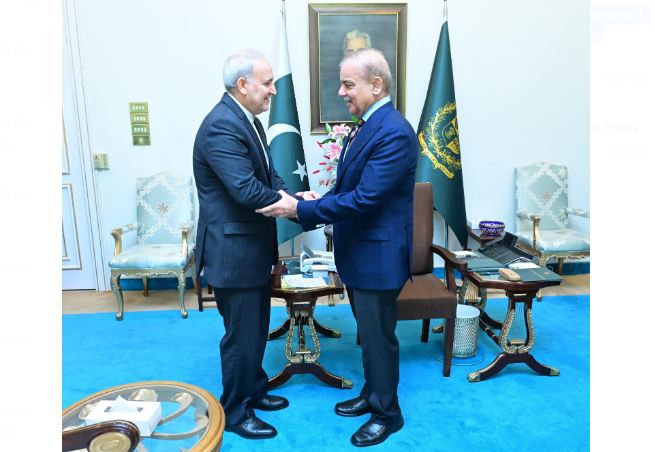
ISLAMABAD, APR 2 /DNA/ – Ambassador of Iran Reza Amiri Moghadam called on Prime Minister Muhammad Shehbaz Sharif today in Islamabad. During the meeting, both dignitaries discussed matters of mutual interest and explored avenues to strengthen bilateral relations between Iran and Pakistan.

The meeting underscored the importance of fostering cooperation and enhancing ties in various fields for the mutual benefit of both nations.

The visit highlights the continued efforts of Pakistan and Iran to deepen their friendship and promote regional stability and prosperity.

Results of elections on 30 Senate seats announced!

Results of elections on 30 Senate seats announced!

ISLAMABAD, APR 2: Polling has ended for the election of members on 30 seats of the Senate for six years. There are 59 candidates running in the Upper House election.

Foreign Minister Ishaq Dar was elected senator on the technocrat seat with 224 votes, while Raja Ansar got 81 votes. Moreover, five votes rejected, sources said.

PPP’s Rana Mahmoodul Hasan was also elected senator with 224 votes. His opponent, Farzand Hussain, got 79 votes. A total of 310 votes were cast, and seven were rejected.

Independent candidate Faisal Vawda was also elected senator on a general seat, as was MQM’s Aamir Chishti, PPP’s Ashraf Ali Jatoi, Dost Ali Jaisar, PPP’s Kazim Ali Shah, Masroor Hassan and Nadeem Bhutto.

Also successful were PPP’s Sarmad Ali and Zameer Ghamro on the two technocrat seats. Rubina Qaimkhani and Quratul Ain Marri were elected on the two women’s seats, PPP’s Poonjo Bheel won the minority seat.

In Punjab, Muhammad Aurangzeb and Dr Musadik Malik were elected on the technocrat seat from the Punjab Assembly. Finance Minister Aurangzeb got 128 votes and Malik 121 votes. Dr Yasmin Rashid of the opposition PTI got 106 votes.

In Sindh Assembly, the Pakistan Tehreek-e-Insaf-backed independent candidates, as well as the Jamaat-e-Islami boycotted the elections. Out of the 12 seats from Sindh, the PPP won 10 seats in the Senate, MQM and independent candidate one each.

The National Assembly as well as the Punjab, Sindh, and Khyber Pakhtunkhwa assemblies had been turned into polling stations. In the National and provincial assemblies, voting commenced at the scheduled time of 9am, with the first ballot cast in the NA by PML-N MNA Saad Wasim.

Returning Officer Saeed Gul issued strict directives prohibiting the entry of visitors into the gallery, as the House had been turned into a polling station. He emphasised that only media personnel were allowed to observe the electoral process from the galleries.

“If there is an irrelevant person, remove them from the gallery,” Gul instructed the assembly secretary.

Polling in all the assemblies ended at the designated time of 4pm. In the National Assembly, the presiding officer directed to close all the doors. Reportedly, 310 out of the 328 MNAs cast their votes.

The ballot papers for technocrat and general seats were then separated.

Punjab Assembly
Polling has ended in the Punjab Assembly hall to vote for four candidates for women’s seats, and three each for technocrat and ulema seats. Moreover, two candidates are contesting the minority seat in the province. The candidates on seven general seats from the Punjab Assembly were earlier declared elected unopposed.

Also Read: Preparations complete for Senate elections tomorrow; ECP issues list of contenders

Returning Officer Ijaz Anwar Chauhan oversaw the polling process, with MPA Bilal Yameen from PP-6 casting the first vote.

Sindh Assembly
Meanwhile, in Karachi, the Sindh Assembly witnessed a flurry of activities as 164 out of 168 members prepared to exercise their voting rights for the 12 Senate seats from the province being contested by 19 candidates.

Dr Azra Pechuho cast the first vote and the last was polled by Mukesh Kumar Chawla when polling time ended at 4pm.

A total of 154 members of the Sindh Assembly cast their votes.

There are 11 candidates for general seats and three for women’s seats from Sindh. There are four candidates for technocrat seats and two for minority seats.

The Pakistan Peoples Party (PPP) holding the lion’s share of 117 members in the House, followed by the Muttahida Qaumi Movement (MQM) Pakistan with 37. The Pakistan Tehreek-e-Insaf has announced a boycott of the Senate elections.

There are nine independent members of the Sindh Assembly, two from the Jamaat-e-Islami, while one member of the JI and three from the Grand Democratic Alliance have yet to take oath. The GDA members will not be able to cast their votes in the Senate elections, thus, the number of eligible voters in the Sindh Assembly is 164.

KP Assembly
Meanwhile, the provincial election commissioner has postponed the Senate elections in Khyber Pakhtunkhwa on the application of the opposition members.

Earlier in the day, the election commissioners had contacted the chief election commissioner on the request submitted by the opposition members in the KP Assembly seeking a postponement of the Senate elections.

Led by Ahmad Karim Kundi, the opposition highlighted concerns over the non-swearing-in of 25 members, asserting that this could impact the fairness of the electoral process.

Also Read: Here is how the Senate election voting process works

On the other hand, the Senate election in the Khyber Pakhtunkhwa Assembly could not begin at the scheduled time of 9am despite the arrangements being complete and the election staff present in the assembly.

The Peshawar High Court had on March 27 directed the KP Assembly speaker to take oaths from the elected members of the reserved seats. Instead of taking the oath, the speaker filed a review petition in the court.

The speaker adopted the stance that he did not have the authority to call a session, let alone administer the oath.

The Election Commission of Pakistan (ECP) has made the KP Senate elections subject to the oaths of the newly elected members in the reserved seats. Azam Swati has challenged the conditional decision of the ECP.

Balochistan Assembly
All 11 candidates from the Balochistan Assembly have been elected unopposed. The candidates vying for a spot in the Senate from Balochistan in the upcoming elections to the Upper House of parliament were elected unopposed on all the seats on March 29.

The election commission announced that the candidates from Balochistan were elected unopposed on all seats of the Senate. The seats up for grabs from Balochistan were seven general seats, two women’s seats, and two technocrat seats.

ECP’s guidelines for MNAs
The election commission has issued guidelines for members participating in the voting process in the National Assembly. From the method of marking preferences on the ballot papers to restrictions on mobile phones inside polling booths, these instructions aimed to ensure transparency and adherence to democratic norms.

As per the instructions, a voter would have to enter the preferences on ballot papers through a ballpoint, ‘1’ should be written in front of the name of the first preferred candidate, and ‘2’ next to the name of the second preference.

The preference number should be entered in English or Urdu numerals only, and writing in both Urdu and English together will result in rejection of the vote, the ECP guidelines state.

They further say that a vote will be rejected if a number is not entered in the preference box. If the digit ‘1’ is entered in front of more than one name, the vote will not be counted.

The MNAs have been prohibited from taking mobile phones inside the polling booth and have been instructed to submit their phones before entering the booth.

PTI voices concerns regarding serious threats to Bushra Bibi’s life

IHC

DNA

ISLAMABAD:  Pakistan Tehreek-e-Insaf (PTI) voiced grave concerns pertaining to serious threats to the life of PTI Founding Chairman Imran Khan’s spouse Bushra Bibi after mixing toxic and suspicious substance in her food while incarcerated at Bani Gala sub-jail.

PTI Spokesperson said that Bushra Bibi’s health and life were being seriously endangered by the denial of her constitutional right to medical examination.

He demanded for her medical check up by a trusted doctor from Shaukat Khanum hospital and urged to have an inquiry into the matter of Bushra’s poisoning to bring the culprits to justice.

PTI Spokesperson stressed that Bushra Bibi should be instantly released from jail and the court should order for her immediate medical examination.

He reiterated that the PTI Founding Chairman and his wife were languishing in jails in completely false, bogus, frivolous and politically motivated cases.

PTI Spokesperson alarmed that Imran Khan and his wife’s life was put at risk during imprisonment by usurping their fundamental and constitutional rights.

He went on to say that the sole purpose to target Bushra Bibi was to break the morale of Imran Khan and force him to yield.

PTI Spokesperson warned that if any harm came to Bushra, the jail administration, authorities and the state would be held responsible in this regard.

He paid tribute to PTI Founding Chairman and his wife for showing unprecedented perseverance for Haqeeqi Azadi movement of the nation, supremacy of the Constitution and rule of law in the country.

Assessment of Child Poverty in the Republic of Uzbekistan

Assessment of Child Poverty in the Republic of Uzbekistan

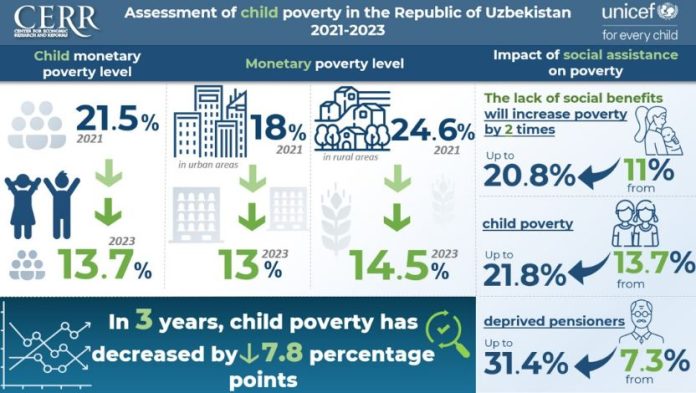
Center for Economic Research and Reforms (CERR), together with UNICEF, assessed the level of monetary child poverty in Uzbekistan. The study analyzed the impact of the social protection system on the poverty level. According to the calculations, in the absence of social payments, the child poverty rate in the country would have increased by 1.6 times.

April 1, 2024.The Center for Economic Research and Reforms (CERR), together with the United Nations Children’s Fund (UNICEF) in Uzbekistan, conducted an assessment of the level of poverty among the child population, as well as an analysis of the effectiveness of the social protection system.

The child poverty rate was calculated based on data from a Household Budget Survey data collected by the Statistics Agency in collaboration with the World Bank.

While 10,000 households were surveyed in 2021, more than 16,000 households were surveyed across the country in 2023.

Over the past three years, child poverty in Uzbekistan has decreased by 7.8 percentage points.

According to the results, the child poverty rate decreased from 21.5% in 2021 to 13.7% in 2023.

Poverty reduction trends vary markedly between urban and rural areas. In particular, in rural areas, the child poverty rate decreased from 24.6% to 14.5%, while in urban areas it decreased from 18% to 13%.

The study found that the regions with the lowest level of child poverty are Navoi region and Tashkent city, while a relatively high level of child poverty is observed in Syrdarya and Jizzakh regions.

Social benefits analysis

According to the National Agency of Social Protection, the total coverage of social benefits in Uzbekistan in 2023 amounted to 10.8 million people.

The coverage of low-income families with child benefits and financial aid amounted to 9 million people from 2.1 million low-income families and 72.5 thousand beneficiary families, with a total amount of payments of 12.3 trillion sums.

In order to increase the efficiency of investments in the social protection system, as well as the effectiveness and reforms, the CERR analyzed the distribution of social benefits among various groups of households.

The effectiveness and targeting of the social protection system was assessed by analyzing the distribution, coverage, and adequacy of social benefits, as well as their impact on the poverty level.

Experts note that the existing social protection system directs most of its resources to the least affluent segments of the population. However, according to the calculations, almost 6% of those receiving social assistance belong to the 20% most affluent households, including 4% of households receiving child benefits.

In contrast, old-age pensions are distributed relatively evenly among all population groups, reflecting a universal approach to ensuring the well-being of the elderly population.

Impact of social assistance on poverty level

The study analyzed the impact of the social protection system on the poverty level.

That way, in case of insufficient income, when incomes are below the poverty line, the absence of social payments would increase the poverty rate from 11% to 20.8%, child poverty from 13.7% to 21.8% and the share of deprived pensioners from 7.3% to 31.4%.

Overall, this analysis allows us to assess the effectiveness and targeting of the social protection system, identify its advantages and disadvantages, and propose measures for its improvement in order to ensure more equal access to social benefits and reduce the poverty level in society.

Hereby, Uzbekistan demonstrates its commitment to achieving the SDG 1 – to end poverty in all its forms by 2030. In this regard, measuring monetary child poverty is a significant step towards achieving this mission.

Shehbaz Sharif casts his vote in Senate election

Shehbaz Sharif casts his vote in Senate election

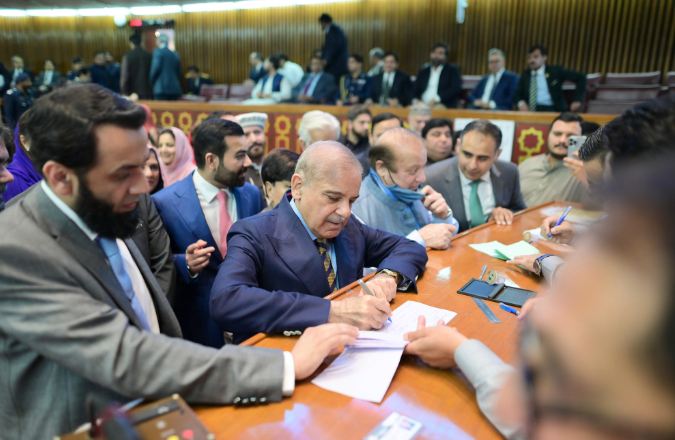
ISLAMABAD, APR 2 (APP/DNA): Prime Minister Mian Muhammad Shehbaz Sharif cast his vote on Tuesday in the Senate election held at the Parliament House.

Pakistan Muslim League leader Mian Muhammad Nawaz Sharif, Speaker of the National Assembly Sardar Ayaz Sadiq, and Deputy Speaker Syed Ghulam Mustafa Shah also cast their votes.

In the election, Mehmood-ul-Hassan of the Pakistan People’s Party is contesting for the general seat, while Muhammad Ishaq Dar of the PML-N is in the run for the technocrat seat.

Stay Connected

64FansLike
60FollowersFollow

Latest Reviews

Exchange Rates

USD - United States Dollar
EUR
1.17
GBP
1.35
AUD
0.72
CAD
0.73