Home Blog Page 97

PM aide meets NTU rector on KOICA collaboration

PM aide meets NTU rector on KOICA collaboration

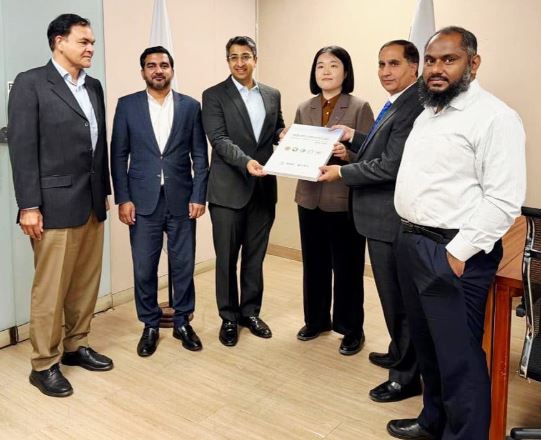
FAISALABAD, JUN 9 /DNA/ – Rana Ihsaan Afzal Khan, Coordinator to the Prime Minister on Commerce, held a meeting with Prof Dr Rashid Masood Rector National Textile University (NTU), Faisalabad and his team accompanied by representatives of the Korea International Cooperation Agency (KOICA), to discuss ongoing collaboration and future roadmap for joint initiatives.

During the meeting, the NTU delegation, including the Vice Chancellor/Rector, Registrar and Project Coordinator briefed the Advisor on the current status of cooperation with KOICA and shared progress on ongoing academic and technical initiatives.

The discussion focused on collaboration between KOICA-supported initiatives and NTU, particularly in strengthening the textile sector through capacity building, technical and technological support, applied research, and addressing pending issues of NTU.

The Coordinator to the Prime Minister reaffirmed the government’s commitment to facilitating international partnerships in the education and textile sectors and highlighted the importance of addressing outstanding issues.

The meeting concluded with a mutual understanding to further strengthen coordination mechanisms and address pending issues through sustained collaboration.

Commander Bahrain national guard calls on air chief

Commander Bahrain national guard calls on air chief

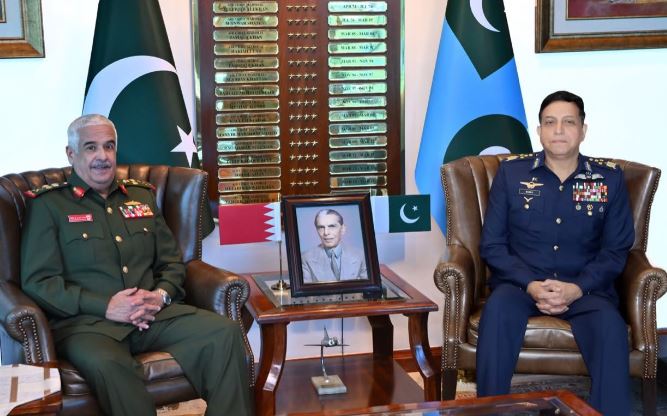
ISLAMABAD, JUN 9 /DNA/ – Commander Bahrain National Guard, General Shaikh Mohammed Bin Isa Bin Salman Al Khalifa, called on Air Chief Marshal Zaheer Ahmed Baber Sidhu, Chief of the Air Staff, Pakistan Air Force, during his visit to Air Headquarters, Islamabad. During the meeting, both dignitaries discussed matters of mutual interest, with a keen focus on enhancing bilateral defence cooperation and professional collaboration between the Armed Forces of the two brotherly countries.

The Air Chief highlighted Pakistan Air Force’s ongoing modernization drive, encompassing capability enhancement, infrastructure development, indigenization and transformation of training paradigms to meet the demands of contemporary warfare. He also underscored the deep-rooted fraternal ties between Pakistan and Bahrain as a strong foundation for enduring cooperation. A key focus of the discussions was the evolving domain of drone warfare, with both sides exchanging insights on the expanding role of unmanned systems in modern military operations and their transformative impact on future battlefields amid ongoing regional security challenges. Both Commanders also deliberated on emerging technologies, highlighting the transformative impact of artificial intelligence, autonomous systems, advanced sensors and digital innovation in shaping next-generation defence capabilities. Reaffirming PAF’s commitment to further expanding bilateral engagement, Chief of the Air Staff stated, “Pakistan deeply values its longstanding diplomatic, economic and defence relationship with the Kingdom of Bahrain. Our partnership is anchored in mutual trust, shared interests and a common commitment towards regional peace, security and stability.”

The visiting dignitary lauded the professionalism of PAF and commended its achievements in modernization, indigenous capability development and operational excellence under the leadership of Air Chief Marshal Zaheer Ahmed Baber Sidhu. Expressing keen interest in expanding Air Force-to-Air Force cooperation, he acknowledged PAF’s multi-domain capabilities and conveyed Bahrain’s interest in benefiting from PAF’s expertise in training and emerging warfare domains. Recognising the increasingly complex nature of modern aerial threats, both sides discussed the contemporary Air Defence environment, emphasizing the need for adaptive strategies and integrated defence architectures to counter evolving challenges. Commander Bahrain National Guard also lauded the advanced technological infrastructure of National Aerospace Science & Technology Park while expressing a strong desire to leverage PAF’s expertise in niche technologies in order to enhance futuristic aerospace and aviation capabilities of the Armed Forces of Bahrain.

The meeting between Chief of the Air Staff and Commander Bahrain National Guard reflects the shared commitment of Pakistan and Bahrain to strengthening defence ties and promoting regional peace & security through enhanced military cooperation.

Pakistan, Bahrain vow to boost military cooperation

Pakistan, Bahrain vow to boost military cooperation

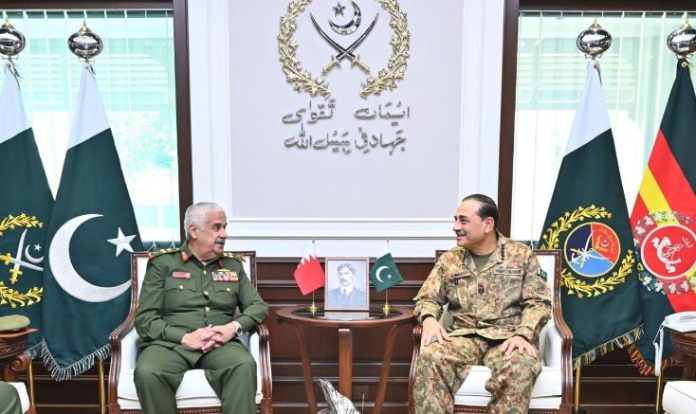
ISLAMABAD, JUN 9 /DNA/ – General Shaikh Mohammad Bin Isa Bin Salman Al Khalifa, Commander Bahrain National Guard, called on Field Marshal Syed Asim Munir, NI (M), HJ, COAS & CDF, at General Headquarters (GHQ), Rawalpindi today.

During the meeting, matters of mutual interest, regional security environment, and avenues for enhanced bilateral defence and security cooperation were discussed. Both dignitaries expressed satisfaction over the longstanding brotherly relations between Pakistan and Bahrain and underscored the importance of further strengthening military-to-military collaboration.

Pakistan, Bahrain Vow to Boost Military Cooperation

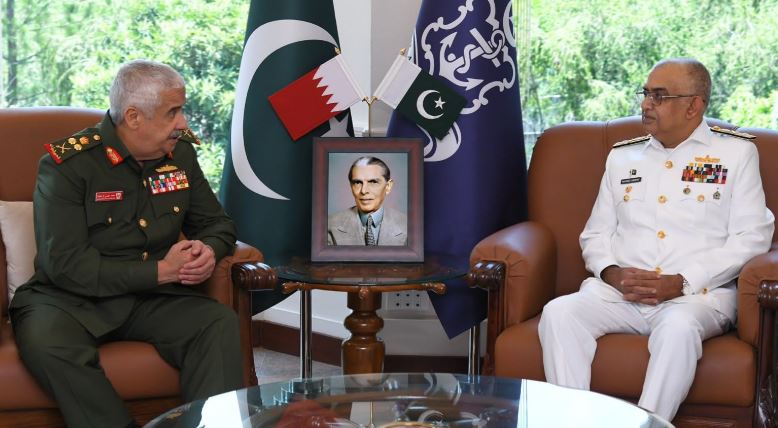
Earlier, Commander Bahrain National Guard, also called on Admiral Naveed Ashraf, NI, NI (M), T Bt, Chief of the Naval Staff and Air Chief Marshal Zaheer Ahmed Baber Sidhu, NI (M), HJ, Chief of the Air Staff separately.

At Naval Headquarters, meeting focussed on bilateral defence collaboration and regional security dynamics. Commander Bahrain National Guard commended Pakistan Navy’s constructive role in advancing cooperative maritime security across the region, expressing appreciation for its role as the regional maritime security stabilizer.

During the meeting at Air Headquarters, Chief of the Air Staff highlighted Pakistan Air Force’s modernization efforts, including capability enhancement, infrastructure development, indigenization, and advanced training reforms. Discussions focused on emerging defence technologies such as drones, artificial intelligence, autonomous systems, advanced sensors, and digital innovation, as well as evolving air defence challenges and integrated defence architectures.

The Bahraini commander appreciated the professionalism, operational readiness, and contributions of Pakistan’s Armed Forces towards regional peace and stability. He also praised the modernization initiatives and indigenous capabilities of the Pakistan Armed Forces, expressing interest in further cooperation in training, emerging technologies, and capacity-building initiatives.

The visit reflects the strong and enduring defence partnership between Pakistan and Bahrain and is expected to further advance bilateral military cooperation for the mutual benefit of both brotherly nations.=DNA

Chairperson NCSW condemns acid attack on Dr. Mah Noor

Chairperson NCSW condemns acid attack on Dr. Mah Noor

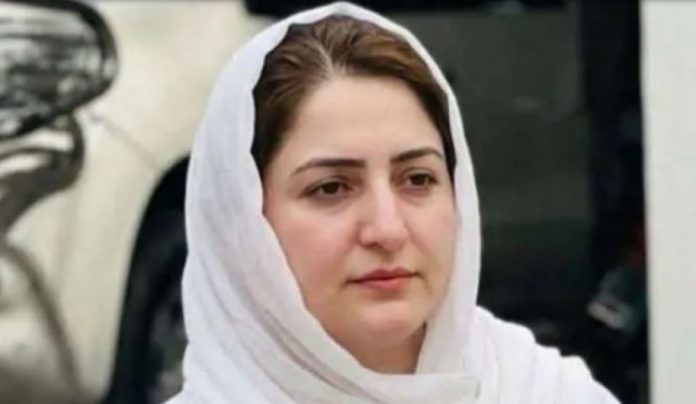
ISLAMABAD, Jun 9: Chairperson, National Commission on the Status of Women (NCSW), Noureen Bano Lehri, has strongly condemned the horrific acid attack on Dr. Mah Noor, describing it as a barbaric and cowardly act of violence that has no place in a civilized society.

Expressing deep concern over the incident, Lehri stated that the attack was not only a grave violation of human dignity and fundamental human rights but also a stark reminder of the threats and violence that women continue to face across the country.

“NCSW stands in complete solidarity with Dr. Mah Noor and her family during this difficult time. We pray for her swift recovery and commend her courage and resilience in the face of such a brutal crime,” said Lehri.

NCSW called upon the law enforcement agencies and provincial authorities to conduct a swift, transparent, and impartial investigation and ensure that all those responsible were brought to justice without delay.

“This heinous crime must not go unpunished. The perpetrators must be dealt with according to the full force of the law, and the punishment awarded should serve as a strong deterrent and an example for anyone who seeks to commit violence against women,” she emphasized.

Lehri further urged the Government of Pakistan and concerned authorities to strengthen regulations governing the sale, purchase, and distribution of acid and other corrosive substances. She stressed that such substances should not be freely available without proper licensing, documentation, and oversight mechanisms.

“The unchecked availability of acid has been posing a serious threat to public safety, particularly to women and girls. Stronger enforcement measures, regular inspections, and strict penalties for unauthorized sale and distribution are essential to prevent future tragedies,” she added.

Qazi Ali Raza inspects police preparedness across Islamabad

Qazi Ali Raza inspects police preparedness across Islamabad

ISLAMABAD, JUN 9 /DNA/ – Senior Superintendent of Police (SSP) Operations Qazi Ali Raza visited various security points in the federal capital and reviewed arrangements put in place to ensure protection of citizens and maintenance of law and order.

SSP Qazi Ali Raza reviews security arrangements across capital

An official told APP on Tuesday that the SSP Operations inspected security measures at different locations and assessed the preparedness of police personnel deployed on duty.

SSP Qazi Ali Raza reviews security arrangements across capital

 Qazi issued directions to officers to remain vigilant, ensure effective security coverage and respond promptly to any suspicious activity.

SSP Qazi Ali Raza reviews security arrangements across capital

 SSP emphasized the importance of maintaining a visible police presence and strengthening security measures at sensitive locations to safeguard public safety.

He directed officers to strictly implement security SOPs and ensure that all available resources were utilized for effective policing and public protection.

Qazi said protection of citizens’ lives and property remained the foremost priority of Islamabad Police and that no compromise would be made on security arrangements.

Italian ambassador bids farewell to Deputy PM Ishaq Dar

Italian ambassador bids farewell to Deputy PM Ishaq Dar

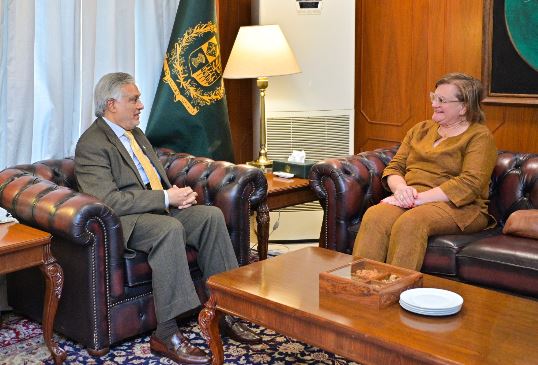
ISLAMABAD, JUN 9 /DNA/ – Italian Ambassador Marilina Armellin paid a farewell call on DPM/FM Senator Mohammad Ishaq Dar.

DPM/FM congratulated her on a successful tenure and appreciated her efforts to strengthen Pakistan–Italy relations. He noted growing cooperation in trade, investment, education, and labour mobility, and reaffirmed Pakistan’s commitment to further elevate bilateral ties.

Ambassador Armellin thanked DPM/FM for the support extended during her stay in Pakistan and appreciated the progress in bilateral relations.

DPM/FM wished the Ambassador well for her future endeavours.=DNA

===============

Marriott, Malik hold talks on climate deal execution

Marriott, Malik hold talks on climate deal execution

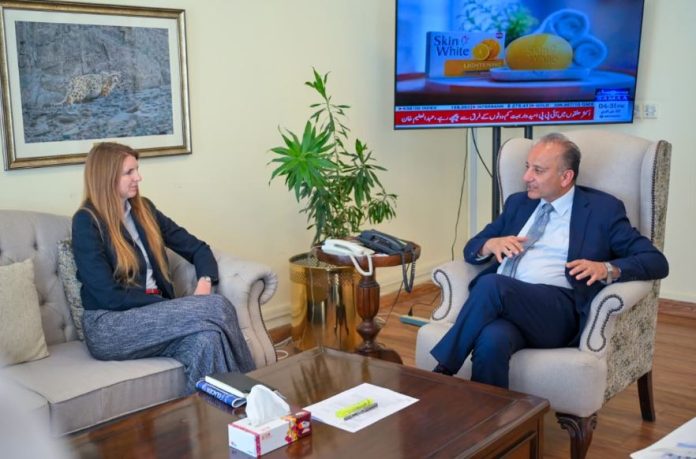
ISLAMABAD, JUN 9 /DNA/ – British High Commissioner Jane Marriott called on Federal Minister for Climate Change and Environmental Coordination Dr Musadik Malik on Tuesday to discuss the implementation of the Green Compact, a £35 million bilateral climate cooperation framework aimed at strengthening Pakistan’s resilience to climate change.

According to an official statement, the meeting reviewed progress under the initiative and discussed its future direction. The British high commissioner presented the Green Compact Action Plan and briefed the minister on its priorities and proposed areas of cooperation.

Dr Malik said the framework should focus on initiatives capable of delivering tangible and high-impact benefits for people affected by climate-related challenges in Pakistan.

British envoy, climate minister discuss implementation of Green Compact

The minister also briefed Marriott on efforts to establish a Green University in Islamabad, saying discussions were under way with international partners, including Italy, as well as stakeholders associated with the Arctic Circle initiative.

British envoy, climate minister discuss implementation of Green Compact

During the meeting, Dr Malik highlighted the establishment of a Green Tech Hub at the National University of Sciences and Technology (NUST) in collaboration with the Ministry of Climate Change and Environmental Coordination.

The initiative, he said, would support young entrepreneurs working on green technologies and sustainable business solutions while also promoting research and innovation to develop practical and scalable responses to environmental and climate challenges.

Marriott briefed the minister on the United Kingdom’s youth entrepreneurship programmes and climate-related projects being implemented in Pakistan in partnership with the British High Commission, particularly those aimed at enhancing climate resilience and supporting green solutions.

The two sides also discussed measures to strengthen early warning systems and improve preparedness for climate-related disasters, the statement said.=DNA

Iran says US revoked World Cup ticket allocation for supporters

Iran says US revoked World Cup ticket allocation for supporters

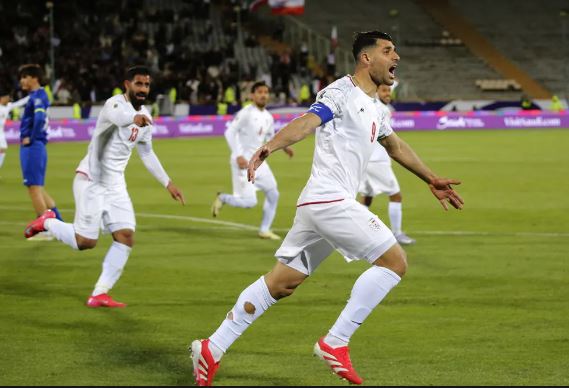
TEHRAN: Iran’s football federation on Tuesday said the United States has revoked its allocation of tickets for its World Cup group games, accusing the co-host of obstructing the attendance of Iranian supporters under the shadow of a bitter diplomatic row.

The US has presented a number of bureaucratic hurdles for Iran at the global football spectacle, including refusing to issue visas for some of its support staff, as the two countries remain at war after the US and Israel attacked the country in late February.

“With less than three days remaining until the start of the 2026 World Cup… the United States has once again acted to obstruct the presence of Iranian supporters at the stadiums hosting the national team’s three group stage matches,” the federation said in a statement.

The Iranian football body said FIFA regulations dictate that it should be allocated eight percent of tickets for each match, which are given to participating federations for distribution to their supporters through official channels.

According to the statement, Iran had already begun ticket sales for group stage matches against New Zealand, Belgium and Egypt — all to be held in the US — after receiving its quota, with some fans having already made necessary arrangements.

“However, in an unexpected move, the allocation granted to the Iranian Football Federation has been withdrawn, and under the current circumstances, the federation is unable to provide even a single ticket to supporters of the national team,” it said.

The federation described the move as “contrary to the spirit governing international competitions and the principle of equality among participating countries.”

It also called on FIFA and tournament organizers “to uphold the principles of neutrality, fairness, and established regulations, to provide the necessary conditions for Iranian supporters.”

Neither FIFA nor US organizers have publicly commented on the Iranian accusation.

The complaint is the latest dispute regarding Iran’s participation in the World Cup, following visa issues that Tehran says have prevented some 15 administrative and management staff in its delegation from entering the United States.

Rising tensions also prompted Iran to announce that it was moving its World Cup training base to the Mexican border city of Tijuana rather than Tuscon, Arizona, as originally planned.

Iran open their campaign against New Zealand in Los Angeles on June 15, before facing Belgium in the same city on June 21 and Egypt in Seattle on June 26.

Jota will be in Scotland skipper Robertson’s ‘heart’

PARIS: Diogo Jota’s widow said in a letter to Scotland captain Andy Robertson she is sure her late husband will be in his “heart” when he leads the side out for their opening match in the World Cup on Saturday.

Jota and Robertson became close friends during their time at Liverpool before the former’s spell there was cruelly cut short when he died, aged 28, in a car crash last July.

Robertson, who ended a trophy-laden nine year spell with Liverpool when he signed for Tottenham Hotspur last Friday, had paid tribute to Jota after the Scots secured their place at the finals for the first time since 1998.

“We spoke so much about going to the World Cup because he missed the last one with Portugal and I did with Scotland,” Robertson said last November after the play-off win over Denmark.

“I know he’ll be smiling over me today.”

Rute Cardoso, the mother of Jota’s three children, said in her letter — which FIFA published along with a video of Robertson reading it — his words that night had touched her deeply.

“When I heard your words and learnt what you felt on that day when Scotland qualified for the World Cup, after so many years of waiting, I realized that Diogo never truly left the pitch,” wrote Cardoso, who married Jota days before he died alongside his brother Andre Silva.

“By achieving that moment and securing your place at the World Cup, you won’t be going alone.

– ‘Full of emotion’ –

“You’ll be taking his dream with you too. And when you step on to the pitch, I know it won’t just be you walking out. Diogo will be with you in your thoughts, in your steps, in your heart.

“So today, I want to thank you. Thank you for not forgetting him.

“Thank you for taking him with you. Thank you for turning the pain of loss into strength and into something so beautiful.

“That’s how we do it here at home too. Every day. He would be, and is, incredibly proud of you.

“Cherish that dream, Andy. Live it for yourself and for him.”

Robertson said Cardoso’s letter would stay with him for a “very long time.”

“I’ll carry him in my heart and I know he’ll be with me come the first game, come the second game, come the third game and hopefully beyond that,” said Robertson.

“He’s always there. The memories are always something that we bring up and sometimes laugh, sometimes cry.

“And that will be no different, especially going into a tournament which is full of emotion. I know he’ll be right at the front of my mind.

“I’m not only just playing for me. I’m playing for both of us.”

Robertson will hope to honor the memory of Jota by becoming the first Scotland skipper to lead the side into the knock-out stages of the finals at the ninth attempt.

The Scots open their campaign against Haiti on June 13 in Boston, followed by tougher dates with African champions Morocco, also in Boston on June 19, and five-time winners Brazil on June 24 in Miami.

Brazil’s Neymar to continue World Cup prep

BRASILIA: Neymar’s recent MRI revealed ‌he’s making “good progress” in his recovery from a calf injury as he attempts to represent Brazil in his fourth World Cup, the Brazilian Football Confederation announced on Monday.

“The exam showed good progress in his treatment, within expected parameters,” the statement read. “He ‌will continue ‌the recovery and physical ‌preparation process ⁠planned by the ⁠Brazilian National Team’s medical staff.”

Neymar, who is Brazil’s all-time leading goal scorer (79) and second all-time in appearances (128), sustained a Grade 2 muscle tear in ⁠his calf in mid-May that ‌was expected ‌to sideline him for two ‌to three weeks.

That injury has ‌sidelined Neymar for Brazil’s two tune-up friendlies May 31 against Panama and June 6 against Egypt and ‌leaves him questionable for Brazil’s World Cup opener against Morocco ⁠on ⁠Saturday in East Rutherford, N.J.

Brazil has won the most World Cups in history (five) but has not won one — or even made a final — since 2002.After the Group C opener against Morocco, Brazil closes out group play against Haiti on June 19 in Philadelphia and against Scotland.

How Ukraine and Iran Rewrote the Rules of War

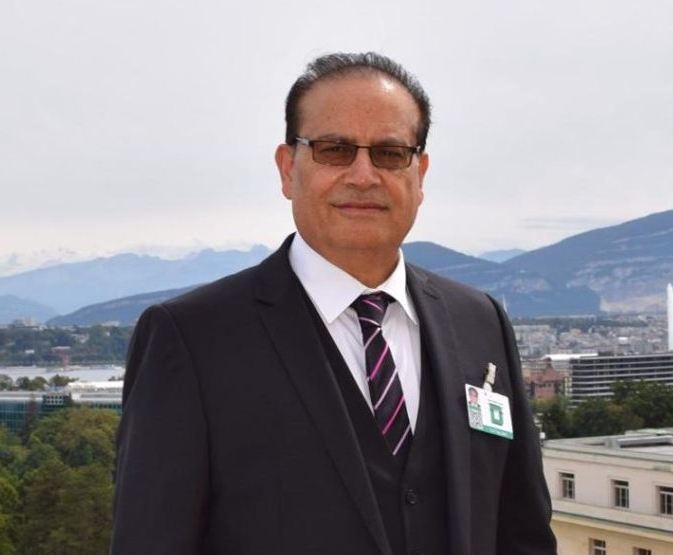
Qamar Bashir

Qamar Bashir

History is often written by great powers. Yet occasionally, history takes a different course and is rewritten by nations that refuse to surrender. The wars in Ukraine and Iran may ultimately be remembered as such moments. Though different in geography, culture and circumstances, both conflicts delivered the same strategic lesson: overwhelming military strength, economic dominance and technological superiority no longer guaranteed military and political victory.

For decades, the international system operated on an assumption that major powers could ultimately impose their will upon smaller states. The experiences of Ukraine and Iran have challenged that assumption. In doing so, they may have altered not only the nature of warfare but also the future direction of global politics.

Russia entered Ukraine in February 2022 believing that its superior military power, larger population, greater economic resources and vast nuclear arsenal would quickly force Kyiv into submission. Instead, it became one of the most costly military miscalculations of modern times.

Russia possesses approximately 16.4 million square kilometers of territory, making it the largest country in the world. Ukraine covers roughly 579,000 square kilometers. Russia’s economy before the conflict exceeded $2.4 trillion, while Ukraine’s economy was only a fraction of that size. Russia enjoyed superiority in military manpower, industrial capacity, missile forces and strategic reserves.

Yet Ukraine refused to collapse. With substantial support from Europe and the United States, combined with extraordinary national determination, Ukraine transformed itself into one of the most innovative military forces in modern history. Ukrainian engineers, military planners and scientists pioneered large-scale drone warfare, integrated battlefield intelligence and precision long-range strikes. They demonstrated that innovation could compensate for numerical inferiority.

As the war evolved, Ukraine carried the battlefield deep into Russian territory. Airfields, logistics centers, energy infrastructure and strategic military facilities once believed beyond reach became vulnerable. Russia discovered that military power alone could not guarantee security. This represented a profound strategic shock. A smaller nation had denied a much larger power the victory it expected.

The second shock came in the Middle East. Unlike Ukraine, Iran did not enjoy broad Western military support. For decades, Iran operated under sanctions, financial restrictions and diplomatic pressure. Its economy remained constrained compared to the overwhelming economic power of the United States and Israel. America’s economy exceeds $28 trillion annually. Israel possesses one of the world’s most technologically advanced military establishments. Iran’s economic and military resources are significantly smaller by comparison.

Yet Iran possessed advantages that could not be measured solely in GDP, military spending or advanced weapon systems. It possessed strategic depth, resilience and geography. Iran’s ability to absorb pressure while maintaining its military and political cohesion surprised many observers. Rather than relying on conventional parity, Tehran emphasized missiles, drones, asymmetric warfare and maritime leverage. It demonstrated that a state facing superior conventional military power could nevertheless impose significant costs on stronger adversaries.

Most importantly, Iran highlighted the strategic importance of geography. The Strait of Hormuz, through which approximately one-fifth of global oil consumption and more than one-quarter of seaborne oil trade passes, became a focal point of international concern. Suddenly, a regional conflict was no longer merely a regional conflict. It became a potential threat to the global economy.

History demonstrates that major powers often respond to resistance by increasing pressure rather than reassessing assumptions. What begins as a regional confrontation can gradually expand geographically and economically. Maritime competition can spread from one strategic corridor to another. Economic warfare can become a global phenomenon affecting billions of people who have no direct connection to the original conflict.

This is perhaps the most important lesson emerging from both Ukraine and Iran.

Modern warfare is no longer fought exclusively with tanks, aircraft and artillery. It is increasingly fought through drones, cyber capabilities, intelligence networks, financial systems, supply chains and strategic chokepoints. Geography itself has become a weapon.

The implications are profound.

Middle powers throughout the world are closely observing these developments. They see that drones costing thousands of dollars can threaten systems worth millions. They see that intelligence and innovation can offset numerical disadvantages. They see that geography can provide leverage against stronger opponents. Most importantly, they see that determined resistance can frustrate even the most powerful adversaries.

Yet this lesson contains a dangerous paradox. If asymmetric warfare allows smaller states to resist larger powers, what happens when larger powers become frustrated? The answer may lie in the world’s nuclear arsenals.

The experiences of Ukraine and Iran are likely to influence strategic thinking across the globe. Some major powers may conclude that conventional military superiority is no longer sufficient to guarantee desired outcomes. Some smaller powers may conclude that international law alone cannot guarantee security. Both conclusions risk producing the same result: increased reliance on nuclear weapons.

For nuclear-armed states, the temptation may arise to rely more heavily upon nuclear deterrence when conventional coercion proves insufficient. For non-nuclear states, the lesson may be that survival ultimately requires acquiring a nuclear capability of their own. Such a trend would be extraordinarily dangerous.

For this reason, the long-term lesson of these conflicts should not be nuclear expansion but renewed nuclear disarmament. A stable international system cannot permanently rest upon a hierarchy in which some states possess ultimate weapons while others do not. Lasting security requires moving toward a universally applied and verifiable framework that reduces and ultimately eliminates nuclear arsenals.

Equally important is the need to reform international governance. The wars in Ukraine and Iran have revived longstanding debates regarding the structure of the United Nations. Critics argue that the veto power enjoyed by the five permanent members of the Security Council frequently prevents effective collective action and allows geopolitical interests to override broader international consensus.

Many advocates of reform contend that decisions affecting international peace and security should more accurately reflect the collective judgment of the international community. They argue that the authority of the General Assembly should be strengthened and that mechanisms should be developed to reduce paralysis caused by competing vetoes.

Whether such reforms are politically achievable remains uncertain. Nevertheless, the debate itself reflects growing frustration with a system many view as increasingly disconnected from contemporary realities.

The fundamental challenge facing humanity today is therefore larger than any single war. The challenge is whether the international community can adapt its institutions, strengthen international law, preserve the freedom of global commerce and reduce reliance on military coercion before future crises become even more dangerous.

Ukraine and Iran have demonstrated that technology, geography, innovation and national determination can challenge even the strongest powers. They have shown that military superiority does not automatically translate into political success. They have revealed the vulnerability of global supply chains, maritime commerce and existing security structures. Above all, they have  reminded the world that the pursuit of dominance often produces resistance rather than submission.

The future now presents two possible paths. One path leads toward greater militarization, nuclear proliferation, expanding maritime confrontation and intensified geopolitical rivalry. The other leads toward institutional reform, collective security, strengthened international law and renewed commitment to diplomacy.

The choice between those paths will determine not merely the outcome of future conflicts but the future of international order itself.

Qamar Bashir

Press Secretary to the President (Rtd)

Former Press Minister, Embassy of Pakistan to France

Former Press Attaché to Malaysia

Former MD, SRBC | Michigan, USA

Field Marshal Munir, Lebanese army chief discuss evolving regional security environment

Field Marshal Munir, Lebanese army chief discuss evolving regional security environment

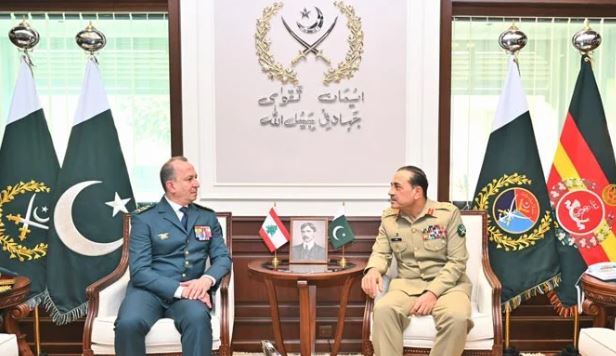
RAWALPINDI: Field Marshal Syed Asim Munir and Lebanese Armed Forces Commander-in-Chief General Rodolphe Haykal discussed the evolving regional security environment and defence cooperation during a meeting at General Headquarters (GHQ) on Tuesday.

Upon his arrival at GHQ, General Haykal was presented a guard of honour by a smartly turned-out tri-services contingent, according to a statement issued by the Inter-Services Public Relations (ISPR).

During the meeting, the two military leaders exchanged views on matters of mutual interest, the regional security situation, defence cooperation and prospects for enhancing bilateral military relations.

The discussions focused on strengthening professional interactions, training cooperation and institutional linkages between the armed forces of Pakistan and Lebanon.

Field Marshal Munir reaffirmed the importance Pakistan attaches to its longstanding and cordial relations with Lebanon and underscored the Pakistan Army’s commitment to expanding defence collaboration with the Lebanese Armed Forces.

General Haykal appreciated the professionalism and operational excellence of the Pakistan Armed Forces and acknowledged their contributions to regional peace, stability and international peacekeeping efforts.

According to the ISPR, the visit reflects the shared commitment of both armed forces to fostering closer military-to-military cooperation.

Stay Connected

64FansLike
60FollowersFollow

Latest Reviews

Exchange Rates

USD - United States Dollar
EUR
1.14
GBP
1.34
AUD
0.70
CAD
0.71