Home Blog Page 954

Japan, Pakistan emphasize mutual benefits in key sectors

Japan, Pakistan emphasize mutual benefits in key sectors

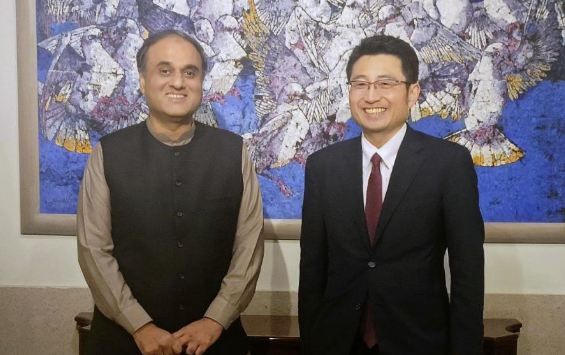
ISLAMABAD, APR 19 /DNA/ – Director General (Asian Affairs Department) of the Japanese Ministry of Foreign Affairs met with Additional Foreign Secretary (Asia & Pacific) Ambassador Imran Ahmed Siddiqui @AmbImranS, this afternoon at the Ministry of Foreign Affairs.

They discussed bilateral relations including collaboration in trade, investment, education, culture, defence and manpower export.

They also stressed the need to further enhance bilateral dialogue and engagement to further strengthen the mutually beneficial relationship.

Tehran plays down reported Israeli attacks

Tehran plays down reported Israeli attacks

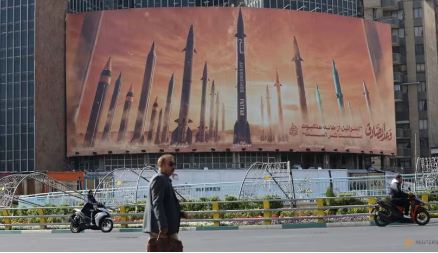
Iranian media and officials described a small number of explosions, which they said resulted from Iran’s air defences hitting three drones over the city of Isfahan. Notably, they referred to the incident as an attack by “infiltrators”

News Desk

Tehran: Explosions echoed the Iranian city of Isfahan on Friday in what sources described as an Israeli attack, but Tehran played down the incident and indicated it had no plans for retaliation — a response that appeared gauged towards averting region-wide war.

Israel had previously warned it would hit back after Iran fired hundreds of missiles and drones at Israel almost a week ago, in retaliation for a deadly strike — which Tehran blamed on its foe — that levelled Iran’s consular annex at its embassy in Syria.

While most of the Iranian strikes were intercepted, fears of a major regional spillover from Israel’s Gaza offensive have since soared.

The limited scale of the attack and Iran’s muted response both appeared to signal a successful effort by worldwide diplomats who have been working round the clock to avert all-out war since the Iranian move last weekend.

Iranian media and officials described a small number of explosions, which they said resulted from Iran’s air defences hitting three drones over the city of Isfahan. Notably, they referred to the incident as an attack by “infiltrators”, rather than by Israel, obviating the need for retaliation.

A senior Iranian official told media there were no plans to respond against Israel for the incident.

“The foreign source of the incident has not been confirmed. We have not received any external attack, and the discussion leans more towards infiltration than attack,” the official said.

Jonathan Lord, head of the Middle East security program at the Center for a New American Security, a US think tank, said Iran’s response “seems to indicate that Iran is seeking to step down off the ledge, minimise the impact of the attack, and perhaps walk back down the escalation ladder from here”.

Israel said nothing about the incident. It had said for days it was planning to retaliate against Iran for Saturday’s strikes, the first direct attack on Israel by Iran in decades of shadow war waged by proxies which has escalated throughout the Middle East during six months of battle in Gaza.

The two longstanding foes had been heading towards direct confrontation since a presumed Israeli airstrike on April 1 that destroyed a building in Iran’s embassy compound in Damascus and killed several Iranian officers including a top general.

Iran’s response, with a direct attack on Israel, was unprecedented but caused no deaths and only minor damage because Israel and its allies shot down hundreds of missiles and drones.

Following reports from the US media of Israeli strikes on Iran earlier today in the latest tit-for-tat exchange, countries around the world urged for de-escalation.

Earlier the day, Iran’s state media reported air defence systems over several Iranian cities were activated after the country’s official broadcaster said explosions were heard near the city of Isfahan.

Iran’s  news agency, citing “informed sources,” denied that Iran had been attacked from abroad.

“Contrary to the rumours and claims” made in foreign media, “there are no reports of an attack from abroad on Iran’s central city of Isfahan or any other part of the country”, Iranian news agency said.

Three Iranian officials told an American newspaper that small drones carried out the attack, possibly launched from inside Iran, and that its radar systems had not detected unidentified aircraft entering Iranian airspace.

Iranian news agency reported “three explosions” heard close to Qahjavarestan, near Isfahan airport and the 8th Shekari army airbase, while Iran’s space agency spokesman Hossein Dalirian said “several” drones had been “successfully shot down”.

Dalirian said on social media platform X there were “no reports of a missile attack”.

“Reports indicate there was no major damage or large explosions caused by the impact of any air threat,” the Iranian state news agency said.

A senior military officer in Isfahan, Brigadier General Siavash Mihandoost, told state television that the loud sound people heard was caused by defence systems shooting at a target in the air, not an explosion on the ground.

Nuclear facilities in Isfahan were reported to be “completely secure”, Tasnim said. Separately, the International Atomic Energy Agency (IAEA) confirmed there was no damage to Iran’s nuclear sites.

The agency continues to monitor the situation very closely and calls for extreme restraint from all sides, stressing that nuclear facilities should never be a target in military conflicts, it said.

US not involved in ‘any offensive operations’: Blinken

US Secretary of State Antony Blinken repeatedly declined to confirm the reported Israeli attack on Iran, saying Washington has not been involved in any offensive operations and it was committed to de-escalating tensions in the region.

“I’m not going to speak to that except to say that the United States has not been involved in any offensive operations,” Blinken said at a news conference capping a gathering of G7 foreign ministers on the southern Italian island of Capri.

“What we’re focused on, what the G7 is focused on, and again, it’s reflected in our statement, and in our conversation, is our work to de-escalate tensions, to de-escalate from any potential conflicts,” Blinken said.

The top US diplomat kept repeating the same response, almost verbatim, when he was asked about the issue several times at the news conference.

At a separate news conference moments before Blinken, Italy’s Foreign Minister Antonio Tajani said the United States was “informed at the last minute” but did not elaborate.

Washington pre-notified of strike: reports

Washington received advance notice of Israel’s reported strike, but did not endorse the operation or play any part in its execution, US media quoted officials as saying.

US President Joe Biden had promised “ironclad” support for Israel but also urged it to “think carefully and strategically” before launching a response against Iran that could trigger a wider war.

American media, citing sources familiar with the matter and a US official, respectively, said Israel had pre-notified Washington of the strike.

There was no immediate comment from the White House or Pentagon. The Israeli military had told media: “We don’t have a comment at this time.”

Following today’s development, countries around the world, including the G7, urged for de-escalation.

Israeli strikes on Friday also targeted a Syrian army position in the country’s south, Syria’s government and a monitor said.

In a statement, Syria’s defence ministry said “the Israeli enemy carried out an attack using missiles […] targeting our air defence sites in the southern region” and causing material damage.

The Syrian Observatory for Human Rights war monitor said Israel targeted an army radar position in the southern province of Daraa that had detected the entry of Israeli planes into Syria’s airspace.

Rami Abdel Rahman, head of the Britain-based Observatory, said the strikes took place “at a time when the Israeli air force was flying intensively over the Daraa region” without Syrian air defences taking any action.

Rayan Maarouf, who runs the Suwayda24 anti-government new website, had earlier told media there had been strikes on a Syrian army radar position in Sweida province, without specifying their origin.

US embassy in Israel tells employees to limit movement

The United States embassy in Israel told its employees and their families to restrict their movements.

“Out of an abundance of caution following reports that Israel conducted a retaliatory strike inside Iran, US government employees and their family members are restricted from personal travel outside the greater Tel Aviv” area as well as the Jerusalem and Beersheva areas “until further notice,” a security advisory issued by the mission on its website said.

Due to a “complex” security environment that “can change quickly,” the embassy “may further restrict or prohibit” the concerned people from travelling to parts of Israel, Jerusalem’s Old City, and the occupied West Bank, the advisory read.

Airlines changed flight paths over Iran, cancelled some flights, diverted others to alternate airports or returned planes to their departure points in response to airspace and airport closures after the attack on Iran, flight tracking data showed.

Iran closed its airports in Tehran, Shiraz and Isfahan and cleared flights from the western portion of its airspace for a few hours after the attack, according to flight tracking website FlightRadar24.

By 4:45am GMT, the airports and airspace had reopened, and closure notices posted on a US Federal Aviation Administration database had been removed.

Before the airports reopened, Flydubai said it had cancelled its Friday flights to Iran. One of its earlier flights turned back to Dubai, it said.

An Iran Air flight from Rome to Tehran was diverted to Ankara, Turkiye, Flightradar 24 showed.

Germany’s Lufthansa cancelled all flights to Tel Aviv and Erbil until Saturday and said it would fly around Iraqi airspace during the same period. “The safety of passengers and crews is always the top priority,” it said.

Emirates, Flydubai, Turkish Air, Wizz Air Abu Dhabi and Belavia were among the carriers continuing to fly over the part of Iran’s airspace that remained open in the initial hours after the attack early on Friday, the tracking website showed.

“We are monitoring the situation closely and will make changes to our flight paths in consultation with the relevant authorities,” Flydubai said in a statement.

The airspace and airport closures in Iran compounded a difficult week for Dubai-based carriers after record rainfall in the United Arab Emirates.

Since Tuesday, 1,478 flights have been cancelled to and from Dubai, approximately 30 per cent of all flights, according to FlightRadar24. Many Western and Asian airlines had already been steering clear of Iran and its airspace before the Israeli attack, which came days after Iran’s missile and drone attack on Israel.

10-stick Cigarette Pack: Health activists fear increase in consumption

10-stick Cigarette Pack: Health activists fear increase in consumption

ISLAMABAD, April 19 (DNA): Health activists have expressed their fear that introduction of 10-stick cigarette packs will increase consumption especially among vulnerable groups like youth and low-income individuals.

Country Head of Campaign for Tobacco Free Kids (CTFK), Malik Imran Ahmed emphasized that such packs would inevitably find their way back into the local market, directly undermining efforts to discourage smoking among young people and other at-risk demographics.

The tobacco industry had made similar attempts in the past but Ministry of Health did not issue the NOC, he said adding the application for 10-stick packs by the tobacco industry was deeply troubling.

Citing past attempts by tobacco companies of circumventing regulations, Malik Imran said that these companies would once again violate the rules.

He said that excise rules do not allow manufacturers or importer of cigarettes can introduce or sell a new variant of a cigarette brand at a price lower than the lowest actual price within the same brand family.

Despite this regulation, the Pakistan Tobacco Company (PTC) has launched a new brand, Capstan International, priced at Rs 164, substantially lower than its existing family brand, Capstan by Pall Mall, which was priced at Rs 212.

Similarly, the ban on sale of single sticks, a measure crucial in deterring vulnerable populations, was being flouted, he said.

Program Manager at the Society for the Protection of the Rights of the Child (SPARC), Dr. Khalil Ahmad Dogar pointed out the potential damage to public health initiatives if these 10-stick packs are permitted.

Dogar warned that such a move would roll back progress in reducing tobacco use and awareness of its harmful effects.

The health activists’ concerns align with broader recommendations from the International Monetary Fund (IMF), which has advised Pakistan to overhaul its tax system by increasing taxes on non-essential items like cigarettes.

In addition to advocating for increased taxes on traditional cigarettes, the IMF has also urged the government to impose uniform excise rates on both local and foreign cigarette manufacturers, ensuring a level playing field and discouraging practices that could lead to increased tobacco use.

PM commends UAE’s leadership response to recent rains in telephone call with President Mohamed bin Zayed

PM commends UAE's leadership response to recent rains

ISLAMABAD, APR 19 /DNA/ – Prime Minister of Pakistan Muhammad Shehbaz Sharif held a telephone conversation with Sheikh Mohamed bin Zayed Al Nahyan, President of the United Arab Emirates (UAE) this evening.

The Prime Minister’s call was centered on his admiration for the strong resolve and impeccable efficiency with which the UAE leadership had confronted the challenges that had emerged from the recent rains in the country. He lauded the UAE President, who had once again demonstrated his outstanding leadership qualities and proven his strong commitment to ensuring the welfare of the Emirati people.

The Prime Minister said that Pakistan has also witnessed heavy rains in recent days, resulting in loss of many precious lives. The Prime Minister called for collective actions to combat the challenge of climate change and suggested that both countries strengthen their collaboration in this field. The President of UAE expressed appreciation for the Prime Minister’s good wishes and reciprocated the warm sentiments for the people affected from rains and flooding in Pakistan. Both leaders reaffirmed their commitment to enhance bilateral cooperation in multifaceted areas.

Turkish Chief of General Staff receives prestigious award from President Zardari

Turkish Chief of General Staff receives prestigious award from President Zardari

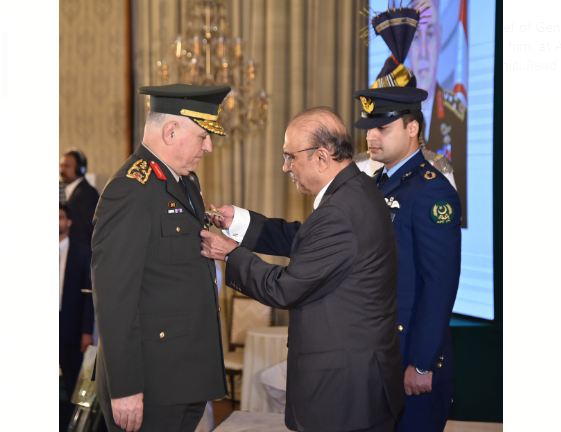
ISLAMABAD, APR 19 /DNA/ – President Asif Ali Zardari conferring the award of Nishan-i-Imtiaz (Military) upon the Turkish Chief of General Staff, Republic of Turkiye, General Metin Gurak, in recognition of his services in strengthening defence relations between Pakistan and Turkiye, at Aiwan-e-Sadr, on 19-04-2024.

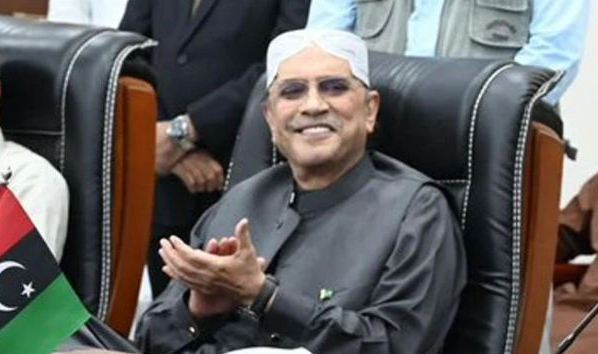
 President Asif Ali Zardari meeting with the Turkish Chief of General Staff, Republic of Turkiye, General Metin Gurak, who called on him, at Aiwan-e-Sadr, on 19-04-2024.

President for enhancing road, railway connectivity with Turkiye

Zardari forms committee for talks with electables

ISLAMABAD, APR 19 /DNA/ – President Asif Ali Zardari has called for enhancing road and railway connectivity between Pakistan and Turkiye to further promote people-to-people contacts between the two brotherly countries. He said that overland transport was cost-effective, which would not only lead to increased interactions between the two nations but would also enhance bilateral economic ties.

The President expressed these views while talking to the Turkish Chief of General Staff, General Metin Gurak, who along with his delegation, called on him, at Aiwan-e-Sadr, today. Chairman Joint Chiefs of Staff Committee, General Sahir Shamshad Mirza, and Ambassador of Turkiye to Pakistan, Dr Mehmet Pacaci, also attended the meeting.

Welcoming the delegation, the President said that Pakistan was committed to further deepening mutually beneficial cooperation with Turkiye in all areas of common interest. He urged the need to increase bilateral cultural exchanges, particularly in the areas of literature and poetry, to bring the people of two brotherly countries further closer.

The President highlighted that Turkiye was a sincere friend of Pakistan and both countries had enjoyed deep fraternal ties, which needed to be further strengthened for the mutual benefit of the two sides. He expressed satisfaction over the existing level of bilateral cooperation between the two countries, adding that Pak-Turkiye relations were on an upward trajectory marked by increased high-level exchanges.

Earlier, President Asif Ali Zardari conferred Nishan-i-Imtiaz (Military) on the Turkish Chief of General Staff, General Metin Gurak, in recognition of his outstanding services in strengthening and promoting defence ties between Pakistan and Turkiye, at a special investiture ceremony, held, at Aiwan-e-Sadr today.

President applauds PN’s professionalism in safeguarding maritime interests

President applauds PN's professionalism in safeguarding maritime interests

Islamabad, APR 19 /DNA/ – Chief of the Naval Staff, Admiral Naveed Ashraf, called on President Asif Ali Zardari, at Aiwan-e-Sadr today, and congratulated him on assuming the office of the President.

The Naval Chief briefed the President about the operational readiness of the Pakistan Navy in safeguarding the maritime interests of the country.

He highlighted that the Pakistan Navy had the capability to defend the national sea frontiers.

The President commended the professionalism of the Pakistan Navy in protecting the maritime interests of the country.

AZAL’s direct flights usher in new era of connectivity between Azerbaijan, Pakistan

AZAL's direct flights

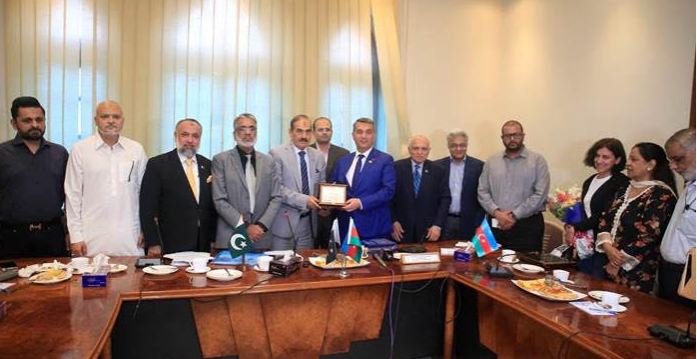
KARACHI, APR 19 /DNA/ – The Ambassador of the Republic of Azerbaijan to the Islamic Republic of Pakistan Khazar Farhadov has stressed that although Azerbaijan and Pakistan have strong relations at the political and defense levels in addition to close historical bonds but there was a dire need to further develop economic and business relations also by providing more facilitations to the private sector. The private sector should be engaged in the Joint Working Groups, the establishment of which have been agreed between the Parties at the seventh session of the Azerbaijan-Pakistan Intergovernmental Joint Commission which was held on December 01-02, 2021, in Baku. The Joint Working Groups are for trade, agriculture, banking, energy, tourism, information and communication technologies, transport, youth, health, military-technical and labor fields wherein the private entities should also be invited to become part of these Joint Working Groups to achieve the desired level of trade and economic cooperation, he added while speaking at a meeting during his visit to the Karachi Chamber of Commerce & Industry (KCCI).

President KCCI Iftikhar Ahmed Sheikh, Vice President Tanveer Barry, Former Presidents Majyd Aziz and Junaid Makda along with KCCI Managing Committee Members attended the meeting.

Azerbaijani Ambassador informed that work was currently underway on a Transit Trade Agreement and Preferential Trade Agreement between the two countries, which would lead to improved trade ties. Ambassador added that according to the Decision of the Cabinet of Ministers of the Republic of Azerbaijan on November 22, 2022, rice imported from the Islamic Republic of Pakistan was exempted from import customs duty until December 31, 2027.

He especially stressed that the successful official visit of the highly esteemed Prime Minister of the Islamic Republic of Pakistan Shehbaz Sharif to the Republic of Azerbaijan on June 14-15, 2023, gave a strong impetus to the comprehensive and rapid development of strategic partnership between the two brotherly countries. Thus, on the basis of the tasks given by the leaders of both countries during the said visit regarding the expansion of mutually beneficial cooperation in the fields of the information communication technologies, transport, defense industry, energy and trade, relevant visits were carried out and achievements were reached.

Ambassador stressed that the resumption of LNG supplies by the State Oil Company of the Republic of Azerbaijan (SOCAR) to the Islamic Republic of Pakistan and the perspectives of mutual investments in respective fields, including the energy and IT, will not only contribute to the both countries’ economies, but also raise cooperation between two brotherly states to a new level.

According to the opinion of the Ambassador taking into account the fact that Azerbaijan supplies LNG to Pakistan on the basis of the “Framework Agreement on the purchase and sale of LNG cargoes between “SOCAR Trading” Company of the Republic of Azerbaijan and “Pakistan LNG Limited” Company”, the signing ceremony of which was held in Lahore city of Pakistan on July 24, 2023, with the participation of the Prime Minister of Pakistan, the volume of total trade transactions between the two countries, carried out directly, as well as with the participation of “SOCAR Trading” Company in 2023, exceeded US$100 million increasing more than 3 times in 2023, comparing to 2022 figures which also tripled 2021’s records. Accordingly, there are 9 times of increase in last 2 years.

Additionally, Khazar Farhadov stated that given the easy visa obtaining condition for Pakistani citizen and AZAL (Azerbaijan Airlines) direct flights starting in 2023, more than 50,000 Pakistani citizens visited Azerbaijan in 2023 (including ordinary citizens and representatives of public and private business circles). The works done have great contribution to the establishment of connectivity between Azerbaijan and Pakistan, as well as people to people contacts. Thus, AZAL has started direct flights Baku-Lahore-Baku (since September 22 2023), Baku-Islamabad-Baku (since November 1, 2023), Baku-Karachi-Baku (since April 18, 2024), twice a week in each direction.

Underscoring the need to focus on improving linkages between the business communities of the two countries, he said that participation in each other’s exhibitions and frequent visits would open up more avenues of trade cooperation by bringing people closer to each other. “Without private sector’s participation, we will never be possible to achieve what we are looking for.”

He said, “Pakistan has continued to extend full support to Azerbaijan at all international levels which the people of Azerbaijan highly admire and we consider Pakistan as a brotherly country.

Earlier, President KCCI Iftikhar Sheikh, while welcoming the Ambassador, stated that Pakistan and Azerbaijan have a long-standing historical relationship, reinforced by regular high-level interactions. The bilateral social, cultural and economic cooperation between the two countries reflects the depth and strength of these relationships.

He mentioned that in FY23, Pakistan’s exports to Azerbaijan amounted to approximately $6.8 million, falling short of their potential, hence, efforts have to be made to elevate these exports to a reasonable level by eliminating trade barriers, streamlining customs procedures, improving the business environment, and assisting SMEs of both countries.

He said that Pakistan’s acute energy crisis, compounded by its heavy reliance on expensive imported fuels, pose affordability challenges, hence, Azerbaijan, with its abundant energy resources, could assist Pakistan in dealing with these challenges. “Keeping in view the agricultural potential of both countries, it’s vital to explore opportunities in areas like agricultural research, advanced irrigation techniques, livestock management, seed exchange programs, disease diagnostics and risk management. This can deepen bilateral economic integration and boost agro-food trade and exports between the two countries”, he added.

He opined that Azerbaijan’s companies can explore Joint Ventures and investments in SEZs under the CPEC, which can further strengthen our economic relations. The investors from Azerbaijan should capitalize on the opportunities provided by SIFC and pursue joint ventures in potential sectors such as agriculture & livestock, energy, IT & telecom, energy, industry, trade & tourism.

President KCCI stressed that both countries should explore available opportunities to expand their trade in textiles, cotton, ready-made garments, rice, chemicals, and pharmaceutical products. “We should also consider diversifying our trade and boosting exports for further economic cooperation. Establishing academic linkages between agrarian institutions may strengthen bilateral relations and economic cooperation between the two countries.” He also invited Azerbaijan to participate in the upcoming My Karachi-Oasis of Harmony International Exhibition scheduled to be staged from 2nd to 4th August 2024, which has always been an excellent platform for promotion of trade and economic activities.

Eid Joy Overflows at Malaysian High Commission: A showcase of friendship and cooperation

Eid Joy Overflows at Malaysian High Commission: A showcase of friendship and cooperation

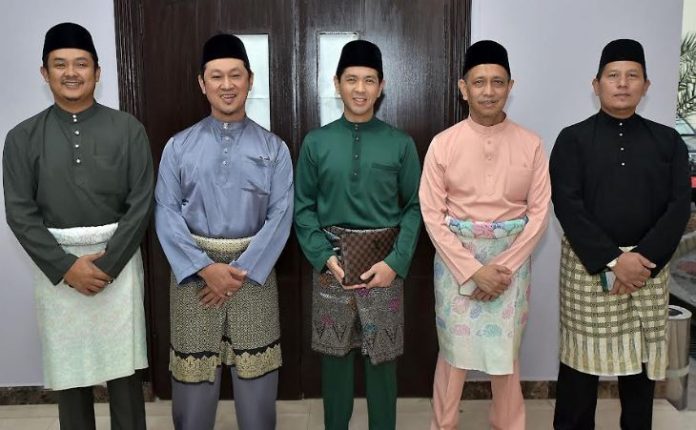
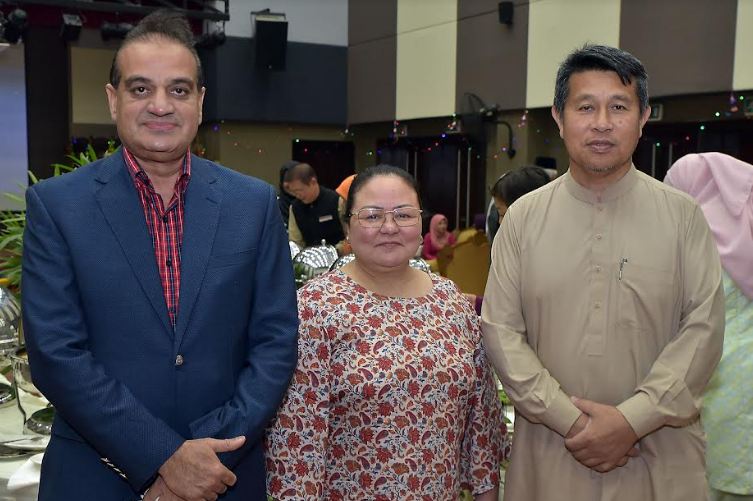
ISLAMABAD, APR 19 /DNA/ – The High Commissioner of Malaysia to Pakistan, Ambassador Mohammad Azhar Mazlan and spouse, Madam Amelia Amani Azhar hosted an Eid-Ul-Fitr Open House at the Malaysian High Commission. The invited guests represented a cross section of the society from the diplomatic corps, senior government officials, Pakistani captains of industry, friends of the media as well as the Malaysian diaspora were among those present to celebrate the joyous occasion of Eid-Ul-Fitr.

Donning their national customes, the host-hostess with his team and families at the High Commission welcomed the guests with renowned Malaysian Hospitality. The guests were served with a delightful array of traditional Malaysian and Pakistani cuisines such as mee goreng, mutton curry, nasi goreng, satay with peanut sauce and traditional Eid cookies.

Such a gathering reflects the true spirit of friendship and peaceful co-existence amongst nations especially with the host nation, Pakistan. Addressing the gathering, Ambassador Azhar underscored the importance of cultural understanding and mutual respect in strengthening bilateral ties, emphasizing the commonalities and traditions that bind the people of Malaysia and Pakistan.

In his remarks, Ambassador Azhar expressed gratitude to the guests for joining in the celebration and reiterated Malaysia’s commitment to advancing cooperation with Pakistan in various fields, including trade, investment, education, and tourism, among others. Considering the candid remarks and feedback from those present, the gathering was a success, exemplifying the strong brotherly ties and cooperation between Malaysia and Pakistan.

ISSI hosts Int’l Conference next week on “Pakistan in the Emerging Geopolitical Landscape” Curtain Raiser

ISSI hosts Int’l Conference next week on “Pakistan in the Emerging Geopolitical Landscape” Curtain Raiser

ISLAMABAD, APR 19 /DNA/ – The Institute of Strategic Studies Islamabad (ISSI) and the Friedrich-Ebert-Stiftung (FES) Pakistan Office will be co-hosting a one-day International Conference, titled “Pakistan in the Emerging Geopolitical Landscape,” at ISSI on 24 April 2024.

Building on the success of last year’s International Conference – “Pakistan’s Strategic Frontiers”, this year’s event will delve into the relationship between Pakistan’s strategic position and the rapidly shifting dynamics of West and Central Asia. The Conference agenda focuses on three key themes. The first working session, titled “Unraveling Afghanistan’s Shifting Landscape,” will examine the evolving situation in Afghanistan, particularly its impact on Pakistan’s security and foreign policy considerations.  The second session, titled “From Dependency to Diversity: The Evolution of the Middle East,” will analyze the changing environment within the Middle East and its influence on Pakistan’s regional partnerships and economic interests. The third and final session, titled “Rising Non-Conventional Security Threats in Afghanistan, Central Asia, and the Middle East,” will seek to address the growing challenges posed by non-traditional threats like cyberwarfare, pandemics, and climate change, emphasizing the necessity of regional collaboration to mitigate these threats.

Through in-depth discussions and expert insights, the Conference aims to achieve a broad set of objectives.  It will analyze the impact of the evolving regional landscape on Pakistan’s foreign policy, security concerns, and economic opportunities.  The Conference will also explore the changing nature of security threats and their implications for regional stability.  Furthermore, the discussions will emphasize the importance of fostering regional connectivity and economic cooperation for sustainable development.  Ultimately, the Conference seeks to generate valuable knowledge on how Pakistan can effectively navigate its changing regional environment, enhance its diplomatic space, and promote economic development.

By bringing together renowned international and Pakistani scholars, academics, practitioners, policymakers, and diplomats, the Conference seeks to create a platform for constructive dialogue and contribute to deeper understanding of Pakistan’s role in the emerging geopolitical landscape. The Conference aims to foster a comprehensive and more nuanced appreciation of the complex challenges and opportunities Pakistan faces in the evolving global environment.

Stay Connected

64FansLike
60FollowersFollow

Latest Reviews

Exchange Rates

USD - United States Dollar
EUR
1.17
GBP
1.35
AUD
0.72
CAD
0.73