Home Blog Page 899

To raise extensive consultation, joint contribution, shared benefits to new heights

To raise extensive consultation, joint contribution, shared benefits to new heights

By He Yin, People’s Daily

The State Council Information Office of China on Oct. 10 issued a white paper titled “The Belt and Road Initiative: A Key Pillar of the Global Community of Shared Future.”

The white paper was released ahead of the third Belt and Road Forum for International Cooperation to introduce the achievements of the Belt and Road Initiative (BRI) in the past 10 years. This will help enhance the international community’s understanding of the initiative, facilitate high-quality development of Belt and Road cooperation, and bring the benefits of the initiative to more countries and peoples.

Only by placing the BRI under the grand coordinates of history can its significance for the times and the world be better understood.

In today’s world, as technological revolution and productive forces develop, economic globalization has become a historical trend. However, the economic globalization dominated by a few countries failed to achieve inclusive and shared development.

The world is moving ever closer towards greater multipolarity, economic globalization, and cultural diversity, and becoming increasingly information-orientated in the process. It is increasingly clear that humanity is a global community of shared future in which everyone’s interests are inseparably entwined.

However, the deficits in peace, development, security and governance continue to grow rather than shrink. At the critical crossroads of history, building a global community of shared futureis where the hope lies for the progress of human society.

The BRI takes the building of a global community of shared future as its overarching goal, creating a platform for action and offering approaches to realizing this goal. It turns visions into reality, and is an important public good for improving global governance.

In the 10 years that have passed since the launch of the BRI, cooperation under the BRI framework has brought remarkable and profound change to the world and become a major milestone in the history of humanity. The BRI has boosted China’s development and benefited the rest of the world.

The initiative boosts development and builds poverty reduction capacity in participating countries. It delivers notable results in projects that improve people’s lives, bringing tangible benefits to participating countries.

The BRI boosts the momentum for global development, encourages deeper regional economic cooperation, promotes global trade, and maintains the stability of global supply chains, thus adding vitality to economic globalization.

It follows the principles of extensive consultation, joint contribution, and shared benefits, promotes and activates authentic multilateralism, and strengthens the position and role of developing countries and emerging economies in the world market system. It marks a significant improvement in global governance.

The BRI boosts people-to-people exchanges and mutual learning among civilizations, garnering strength for the progress of human civilization. Facts have proven that BRI cooperation responds to the call of the times and benefits the peoples in participating countries. It thus enjoys popular support. It is a path for all participating countries to achieve modernization and a path of hope leading to a bright future. It is resilient and vigorous, and offers broad prospects.

The reason for the BRI to have gathered world-changing strength in the past decade is that it always adheres to the principles of extensive consultation, joint contribution, and shared benefits, and advocates win-win cooperation in pursuit of the greater good and shared interests. It emphasizes that all countries are equal participants, contributors and beneficiaries, and encourages economic integration, interconnected development, and the sharing of achievements.

The principle of extensive consultation signifies that the BRI is not a solo endeavor by China, but a collaborative effort involving all stakeholders. From the making of blueprints to specific project design and implementation, the BRI emphasizes equal participation, effective communication, collective wisdom, and freedom from any political or economic preconditions.

The principle of joint contribution highlights that the BRI is not one of China’s international aid programs or geopolitical tool, but a collaborative effort for shared development. It aims to align with existing regional mechanisms rather than becoming their substitute and leverage complementary strengths.

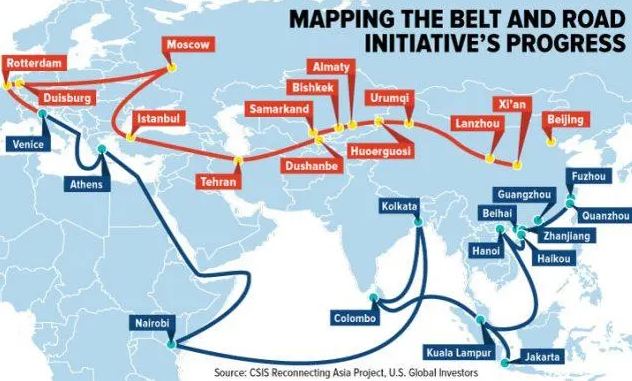
China has signed more than 200 BRI cooperation agreements with more than 150 countries and 30 international organizations across five continents, to strengthen strategic synergy and promote interconnected development.

The principle of shared benefits underscores the importance of win-win cooperation. It aims to identify common interests and grounds for cooperation, meet the development needs of all parties, and address the real concerns of the people. This principle emphasizes sharing development opportunities and outcomes among all participating countries, ensuring that none of them is left behind.

Most participants are developing countries, all seeking to leverage collective strengths to address challenges such as inadequate infrastructure, lagging industrial development, limited industrialization, insufficient capital and technology, and a shortage of skilled workers, to promote their own economic and social development.

It is based on the principles of extensive consultation, joint contribution, and shared benefits that the BRI has achieved authentic win-win cooperation.

In a world full of uncertainties and instabilities, all countries should urgently bridge differences through dialogue, oppose rifts with unity, and promote development through cooperation. Against this backdrop, the BRI becomes more meaningful and is an initiative to be welcomed.

China is willing to work with all other parties to take the third Belt and Road Forum for International Cooperation to strengthen confidence, maintain resolve, raise extensive consultation, joint contribution, and shared benefits to new heights. Cooperation will thrive, and the BRI can look forward to an even brighter future.
Belt and Road Initiative leads to China’s development, global wellbeing

Belt and Road Initiative leads to China's development, global wellbeing

By Qiang Wei, People’s Daily

China’s State Council Information Office on Oct. 10 issued a white paper titled “The Belt and Road Initiative: A Key Pillar of the Global Community of Shared Future.”

The white paper will give the international community a better understanding of the value of the Belt and Road Initiative (BRI), facilitate high-quality cooperation under it, and ultimately deliver benefits to more countries and peoples.

The white paper says to promote greater connectivity through BRI cooperation, China has continued to facilitate policy coordination, infrastructure connectivity, unimpeded trade, financial integration, and closer people-to-people ties, by orienting towards “hard connectivity” in infrastructure, bolstering “soft connectivity” through harmonized rules and standards, and strengthening people-to-people bonds.

As its scope expands, the BRI has become the world’s largest platform for international cooperation, with the broadest coverage.

Over the past decade, BRI cooperation has witnessed remarkable results. It has opened up new space for world economic growth, built a new platform for international trade and investment, reinforced the development capacity of relevant countries and improved people’s lives, sought ways to improve the global governance system, and brought greater certainty and stability to a world fraught with turbulence and change. The initiative has contributed to addressing global development imbalance and advancing modernization in all countries.

The BRI has brought tangible benefits to participating countries. A large number of infrastructure projects have been built, with significant progress for participating countries in the construction of railways, highways, pipelines, shipping, energy, communications and other basic public service facilities. This has improved local living and working conditions and the development environment, and boosted these countries’ capacity for independent economic development.

The World Bank has estimated that by 2030, BRI-related investments could lift 7.6 million out of extreme poverty and 32 million out of moderate poverty.

The BRI has added vitality to economic globalization. World Bank study – “Belt and Road Economics: Opportunities and Risks of Transport Corridors” – noted that transport infrastructure projects under the BRI would reduce trade costs for the world by 1.8 percent, and reduce trade costs along the China-Central Asia-West Asia economic corridor by 10 percent. This has greatly facilitated global trade and boosted economic growth. The study projects that trade growth would range between 2.8 and 9.7 percent for corridor economies and between 1.7 and 6.2 percent worldwide, and global real income is expected to increase by 0.7 to 2.9 percent.

The BRI has provided new solutions for improving global governance. According to the China’s National Image Global Survey released by the Academy of Contemporary China and World Studies in 2020, the BRI is the Chinese proposal with the highest level of acceptance overseas, with more than 70 percent of respondents recognizing the positive impact of the BRI on individuals, states and global governance.

European think tank Bruegel released a paper titled “Global Trends in Countries’ Perceptions of the Belt and Road Initiative” in April 2023, which noted that the BRI is generally positively received in the world, and Central Asia and sub-Saharan Africa, in particular, exhibit strongly positive sentiment towards the BRI.

The BRI has garnered strength for the progress of human civilization. The global influence of various multilateral and bilateral political party exchange mechanisms has increased with the creation of mechanisms such as the CPC and World Political Parties Summit, and the CPC in Dialogue with World Political Parties High-level Meeting.

Various BRI cooperation mechanisms have emerged, including the Silk Road Think Tank Association, the Belt and Road Initiative Tax Administration Cooperation Mechanism, the Alliance of International Science Organizations, the Belt and Road Health Professionals Development Alliance, the Silk Road International League of Theaters, and the Silk Road International Museum Alliance. The emergence of such mechanisms has facilitated people-to-people exchanges in diverse forms, promoting mutual understanding, mutual respect, and mutual appreciation among the peoples of all countries.

China to make greater contributions to healthy development of international human rights

China to make greater contributions to healthy development of international human rights

By He Yin, People’s Daily

China was recently re-elected as a member of the Human Rights Council at the 78th session of the United Nations(UN) General Assembly for the term 2024 to 2026.

This is the sixth time that China has been elected to the Human Rights Council since its establishment in 2006, which fully demonstrates the international community’s full recognition of China’s achievements in the field of human rights and its active participation in international human rights cooperation.

As a founding member of the UN and a permanent member of the UN Security Council, China has always participated in UN human rights affairs with a responsible attitude, actively integrating into the global human rights governance system, and striving to promote the healthy development of international human rights undertakings.

China upholds the purposes and principles of the UN Charter and abides by the Universal Declaration of Human Rights, earnestly fulfills its obligations to international human rights conventions and has ratified or joined 29 international human rights instruments, including six core UN human rights treaties. China has successfully participated in three rounds of Universal Periodic Review of the UN Human Rights Council, becoming a role model of compliance.

Besides, the country also actively expands cooperation with the UN High Commissioner for Human Rights and the High Commissioner’s office, as well as the special procedures of theHuman Rights Council, demonstrating the image of a responsible major country.

China holds a people-centered human rights philosophy and believes that a happy life for the people is the most important human right. It has found a path towards better human rights that follows the trend of the times and fits its national realities. It has made historic progress in its human rights cause.

China aims at increasing people’s benefits, ensuring the people are their own masters and supporting development in an all-round way, and ensures that people enjoy a full range of human rights that are genuine, specific, effective, and functional.

China has built a moderately prosperous society in all respects, and established the world’s largest education, social security, and medical and health care systems. It has made continuous efforts to develop whole-process people’s democracy, and enhanced protection for the rights and interests of specific groups such as ethnic groups, women, children, older people, and those with disabilities. It has made the sky bluer, the mountains greener and the waters more lucid, increasing people’s sense of fulfillment, happiness and security.

A European journalist said that each country can follow a human rights path that suits its national conditions, realizing the people’s aspirations for a better life and instilling confidence in future development. “China has set a very good example in this regard,” the journalist noted.

China has always attached importance to participating in the reform of the global human rights governance system, advocating for bigger voice and rights of developing countries, and steering global human rights governance toward greater fairness, equity and inclusiveness.

China is a vigorous proponent of reform of the UN special mechanisms for protecting human rights; it played a significant role in the negotiations and final vote on establishing the UN Human Rights Council. Its proposals were recognized by most countries.

China supports the establishment of specialized mechanisms within the UN Human Rights Council, such as those addressing the right to development, the right to food, and unilateral coercive measures.

China advocates for special conferences on food security and global financial crisis, actively promotes international mechanisms for protecting human rights.

China has facilitated the adoption of Human Rights Council resolutions on “the contribution of development to the enjoyment of all human rights,””promoting mutually beneficial cooperation in the field of human rights” and “promoting and protecting economic, social and cultural rights within the context of addressing inequalities.”

China practices true multilateralism, holds dear humanity’s common values of peace, development, fairness, justice, democracy, and freedom, and works to build a global community of shared future, providing new ideas for global governance, including human rights governance.

China’s proposal to build a global community of shared future has been incorporated into more than 10 resolutions of the UN Human Rights Council, becoming an important part of the international discourse on human rights. Foreign scholars said this vision has brought hope to global human rights governance in challenging times.

China has put forward the Global Development Initiative, Global Security Initiative, and Global Civilization Initiative, promoting human rights with development, safeguarding human rights with security, advancing human rights with cooperation, and contributing wisdom and solutions to building a world featuring “human rights for all.”

Human rights are a symbol of human progress. Mankind shares a common goal to enjoy human rights. China views the re-election as a good opportunity to continue its active participation in global human rights governance, and extensive exchanges and cooperation with other countries to contribute even more to the sound advancement of the international human rights cause and the building of a global community of shared future.

Gas crisis likely to aggravate amid delay in ECC’s gas pricing reforms

Gas crisis likely to aggravate amid delay in ECC’s gas pricing reforms

ISLAMABAD: The delay in the implementation of gas pricing reforms, intended to standardise gas tariffs for all fertiliser manufacturers likely to aggravate the gas crisis and pose a threat to the sector’s long-term sustainability.

This delay in the Economic Coordination Committee (ECC) meeting comes as the circular debt of the gas sector has increased to Rs2.9 trillion.

Both subsidised and regular plants sell their products at the same price, which is why certain industry players have been placed at a disadvantage with the application of varying tariffs on them and the ongoing practice of supplying gas to the fertiliser sector.

Interestingly, the government had initiated the process of gas sector reforms to unify the tariff to win over the ballooning gas sector circular debt, a senior official of the Energy Ministry said.

The Energy Ministry has been actively working to introduce gas pricing reforms over the past few weeks. The reforms aimed to unify feed gas prices for the fertiliser industry, aligning them with the industrial rate of Rs1,260/MMBTU.

The fertiliser industry is a key consumer of both fuel and feedstock source gas. This move would have stabilised urea prices, optimised gas reserves and ensured a surplus in the Gas Development Surcharge (GDS) — crucial for gas infrastructure development and addressing gas shortages.

However, the ECC’s recent decision to form an inter-ministerial committee, comprising representatives from various ministries (including finance, planning, commerce, food security, industries, power, and petroleum), to recommend gas allocation and pricing for the fertiliser industry has caused a delay. The next ECC meeting is scheduled after the return of Finance Minister Dr Shamshad Akhtar from China.

The gas circular debt has reached Rs2.9 trillion, as disclosed by caretaker Federal Energy Minister Muhammad Ali in a recent media briefing.

An analyst of the sector highlighted disparities in input costs for various producers, causing distortions in urea market prices for farmers. Some manufacturers are disadvantaged as they are supplied gas under the Petroleum Policy 2012 pricing, which is linked to USD and is affected by rupee devaluation and crude oil rate fluctuations.

To maintain business viability, these manufacturers must adjust urea prices. Gas price unification is seen as the only permanent solution to stabilise fertiliser prices, curbing excessive profiteering and black-market activities.

Over the past five years, feed gas tariffs under the Petroleum Policy 2012 have surged by over 235%, from Rs518/MMBTU to Rs1,745/MMBTU. The fuel gas tariff under the Petroleum Policy now surpasses the Fertiliser Policy tariff.

An industrial expert proposed that the fertiliser sector should contribute positively to the GDS by unifying gas prices across all manufacturers. Unifying gas rates at Rs1,260/MMBTU for feed gas could generate a GDS pool of approximately Rs90 billion for gas-producing provinces, serving as a targeted subsidy for small farmers.

He suggested that gas prices for the fertiliser sector should be subject to a bi-annual review to address changes in revenue requirements due to shifts in crude oil prices and exchange rates.

Palestine diplomat lauds Chinese role in easing tensions

Palestine diplomat lauds Chinese role in easing tensions

The webinar was jointly hosted by the Center of South Asia & International Studies (CSAIS) Islamabad and the Institute of Legal Studies

DNA

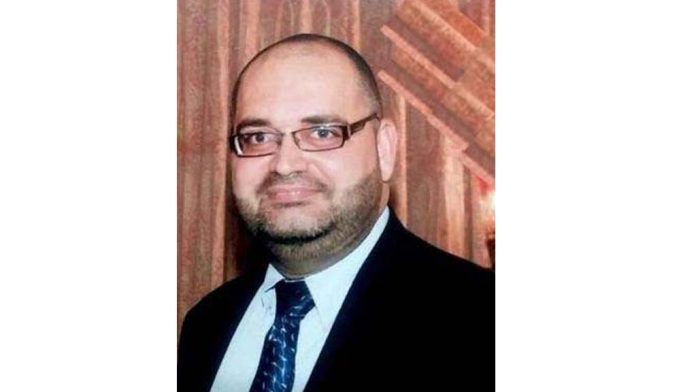
ISLAMABAD: Deputy Head of Mission of Palestine Nader Al Turk has lauded China for showing its readiness to play a constructive role in easing tensions between Palestine and Israel and promoting peace talks.

Addressing a webinar titled, “War Crimes Gaza: The impact, consequences, and international response & responsibility”, the envoy called out the “double standards” of the so-called civilised world and international organisations responsible of ruthless killings of innocent children, women and elderly men living in Gaza.

The webinar was jointly hosted by the Center of South Asia & International Studies (CSAIS) Islamabad and the Institute of Legal Studies Lahore.

Nader shared the perpetual miseries of Palestinians and called for immediate justice in terms of two state solution, guarantor of durable peace and stability in the Middle East a rest of the world.

He urged to regional countries and the Muslim world to come forward to stop Israel from state terrorism and indiscriminate bombardment on civilian society and installations in Gaza. Interestingly he maintained that his country did not have any religious or ethnic issue with Jews but facing lots of onslaughts from the fanatic Zionists, creating serious issues for humans and humanity.

He rightly highlighted the biased stance of the USA, UK and some western countries strongly supporting Israelis and ironically honoring their false, fake and fabricated propaganda and tall claims like assignation of children and attack on hospital in Gaza by Palestinians themselves. Furthermore, he shared that in persuasions of naked aggression Israeli forces attacked on Orthodox Church showing no respect to other religions.

Nader the DHM was confident that patience, determination, and plight of Palestinians will be awarded very soon and they will be free in their actions and homes.

Dr Mehmood Ul Hassan Khan in his well drafted and articulated speech elaborated the historic miseries of Palestinians people starting from 1947. Dr Khan was of the opinion that the land of unlimited prophesies, holy personalities and places was under fire again because of indiscriminate bombardment of Israel air force even on civilian population. Unfortunately Gaza has become the biggest modern day jail for the 2.6 million helpless Palestinians he added.

While mentioning the sufferings of Palestinians he said that “Gaza is besieged and bleeding and more than 4500 people have so far been killed. Immense collateral damage has been done converting buildings and apartments into debris”.

“The Israel forces have been wagging unstoppable human siege, brutality, drastic demographic decomposition, social and political marginalization, alienation, and ruthless killing” he further said.

He labeled the so-called Century Deal or Abraham Peace Deal as total disasters. It has undermined the basis of a two-state solution and to cut off the continuity of the old state of Palestine he added.

Dr Khan was of the view that ongoing war between Israel and Hamas would further start a new end game in the region and power struggle through deadly proxies toppling states, societies and systems in the Middle East, MENA and even in South East Asia.

“It fears that recently inked peace agreement between Iran and Saudi Arabia with the help of China may also confront with some serious irritants in the region” dr khan added.

“The expected pace dividends of Saudi Arabia and Israel would also be delayed. Even eight other prospective Muslim countries could not dare the have friendly ties with Israel”.

Dr Khan summarized that the Chinese One Belt One Road Initiative (BRI) in the Middle East would also be in the line of fire because of deteriorating law & order situation in the region. The same would also be replicated on the recently announced India-US-Middle East and EU trans-regional economic corridor connecting India with Middle East including Israel and EU.

He concluded that the Chinese diplomatic wisdom showed the right way of achieving the desired goal of conflict resolution through Two-State solution. He maintained that fundamental reason for the current situation is the failure to safeguard the legitimate national rights of the Palestinian people.

ICC World Cup 2023: South Africa outclass defending champions England

ICC World Cup 2023: South Africa outclass defending champions England

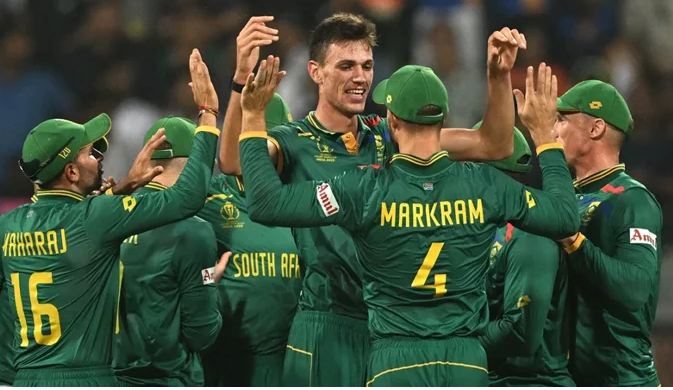
Mumbai: South Africa absolutely bamboozled England by 229 runs in the 20th match of the ICC World Cup 2023 at the Wankhede Stadium, Mumbai, India on Saturday.

The massive victory has surely made things easy for the Proteas in terms of net run rate (NRR) while the defending champions will need to do something unique to still think about seeing themselves in the event’s semi-finals.

Not a single English batter could hold their nerves and fell badly in front of the devastating African bowling attack as three of their four top-order batters — Dawid Malan, Joe Root and Ben Stokes — failed to score in double digits.

England were on their way to suffering a 300-run defeat but a valiant effort by their tailenders, Gus Atkinson and Mark Wood, saved them as both batters built a 70-run partnership with the latter scoring an unbeaten 43 runs on 17 deliveries.

Wood top scored for England with 43 runs as the entire English batting lineup was all out for just 170 runs after losing wickets in quick succession.

All of the Proteas’ bowlers — Lungi Ngidi, Marco Jensen, Kagiso Rabada, Keshav Maharaj and Gerald Coetzee — wreaked havoc on the English batters and sent them all back to the pavilion.

Batting first, South Africa posted a massive 400-run target courtesy of a formidable batting display of their top and middle order.

Despite losing an early wicket of Quinton de Kock for just four runs in the first over, the Proteas did not falter and continued to play with the attacking mindset as Reeza Hendricks and Russie van der Dussen built an important 121-run partnership.

The remaining damage to the English bowlers was done by the 151-run stand between Heinrich Klaasen and Marco Jensen.

Klaasen scored a rapid century, scoring 109 runs off just 67 delivers with 16 boundaries while Jensen contributed 75 runs off just 42 delivers, which included a blistering knock of nine boundaries.

For England, Reece Topley picked three wickets while Gus Atkinson and Adil Rashid bagged two each but it was not enough in front of the destructive Proteas batting.

South Africa will now play Bangladesh on October 24 at the same venue while England will take on Sri Lanka in Bengaluru on October 26.

Cairo Peace Summit ends without Gaza breakthrough

Cairo Peace Summit ends without Gaza breakthrough

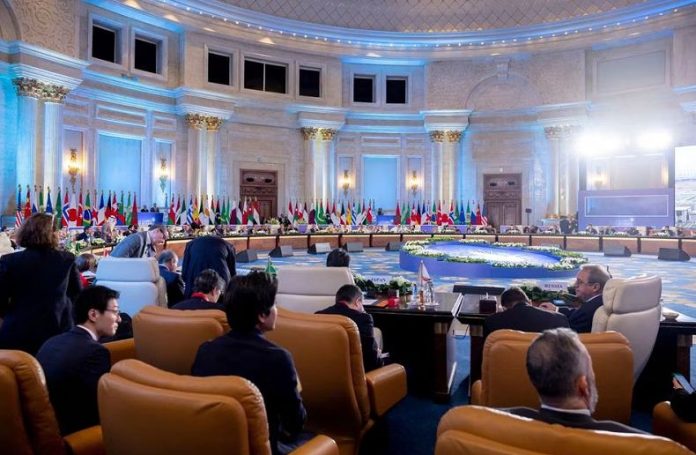
CAIRO: Arab leaders at a Cairo summit on Saturday condemned Israeli bombardment of Gaza as Europeans said civilians should be shielded, but with Israel and senior US officials absent there was no agreement towards containing the violence.

Egypt, which called the meeting and hosted it, said it had hoped participants would call for peace and resume efforts to resolve the decades-long Palestinian quest for statehood.

But the meeting ended without leaders and foreign ministers agreeing a joint statement, two weeks into a conflict that has killed thousands and visited a humanitarian catastrophe on the blockaded Gaza enclave of 2.3 million people.

Diplomats attending the talks had not been optimistic of a breakthrough, with Israel preparing a ground invasion of Gaza aimed at wiping out the Palestinian group Hamas that rampaged through its towns on Oct. 7, killing 1,400 people.

Gaza’s Health Ministry said on Saturday Israel’s air and missile strikes had killed at least 4,385 Palestinians since the Hamas attack.

While Arab and Muslim states called for an immediate end to Israel’s offensive, Western countries mostly voiced more modest goals such as humanitarian relief for civilians.

Jordan’s King Abdullah denounced what he termed global silence about Israel’s attacks, which have killed thousands in Hamas-ruled Gaza and made over a million homeless, and urged an even-handed approach to the Israeli-Palestinian conflict.

“The message the Arab world is hearing is that Palestinian lives matter less than Israeli ones,” he said, adding he was outraged and grieved by acts of violence waged against innocent civilians in Gaza, the Israeli-occupied West Bank, and Israel.

Read also: Jordan’s King Abdullah: Displacement of Palestinians would be a war crime

Palestinian President Mahmoud Abbas said Palestinians would not be displaced or driven off their land.

“We won’t leave, we won’t leave,” he told the summit.

France called for a humanitarian corridor into Gaza that it said could lead to a ceasefire. Britain and Germany both urged Israel’s military to show restraint and Italy said it was important to avoid escalation.

The United States, Israel’s closest ally and a vital player in all past peace efforts in the region, only sent its Cairo charge d’affaires who did not address the meeting in public.

European Council President Charles Michel said the main goal of the summit was “to listen to each other”.

However, “we understand that we need to work more together” on issues including the humanitarian situation, avoiding a regional escalation and a Palestinian-Israeli peace process, he added.

Israel has vowed to wipe the Iranian-backed Hamas group “off the face of the earth” over the shock Oct. 7 assault, the deadliest Palestinian attack in Israel’s 75-year history.

It has said it told Palestinians to move south within Gaza for their own safety, although the coastal strip is only 45 km (28 miles) long and Israeli air strikes have also hit the south.

Ceasefire

The meeting was meant to explore how to head off a wider regional war. But diplomats knew public agreement would be hard because of sensitivities around calls for a ceasefire, whether to include mention of Hamas’ attack and Israel’s right to defend itself.

Arab states fear the offensive could drive Gaza residents permanently from their homes and even into neighbouring states – as happened when Palestinians fled or were forced from their homes in the 1948 war following Israel’s creation.

Egyptian President Abdel Fattah al-Sisi said his country opposed what he called the displacement of Palestinians into Egypt’s largely desert Sinai region, adding the only solution was an independent Palestinian state.

Read: Jordan cancels summit with Biden, Sisi and Abbas in Amman

Egypt fears insecurity near the border with Gaza in northeastern Sinai, where it faced an Islamist insurgency that peaked after 2013 and has now largely been suppressed.

Jordan, home to many Palestinian refugees and their descendants, fears a wider conflagration would give Israel the chance to expel Palestinians en masse from the West Bank.

King Abdullah said forced displacement “is a war crime according to international law, and a red line for all of us.”

Shortly before the summit opening, trucks loaded with humanitarian aid began entering the Rafah crossing into Gaza. Egypt has been trying for days to channel humanitarian relief to Gaza through the crossing, the one access point not controlled by Israel.

Return of Nawaz Sharif, a day of hope..

Return of Nawaz Sharif, a day of hope..

By Qamar Bashir

The tables turned swiftly and unexpectedly against Imran Khan and the PTI. Nawaz Sharif, who had been in self-imposed exile in London for over four years, was transformed from a declared absconder and disqualified for life from electoral contests into a free man.

His arrival was marked with grand receptions by associates, loyal followers, and the public, symbolizing a night of celebration and a day of hope across the country. In a remarkable public address, he assured the establishment that he harbors no intentions of seeking political revenge. While outlining his economic agenda, he pledged to continue with his prior policies, likely with the same team.

When discussing foreign policy, he emphasized the futility of maintaining an antagonistic stance toward neighboring nations. Instead, he advocated for breaking the cycle of dependency and harnessing Pakistan’s abundant natural, divine, and human resources for progress and prosperity.

Although not explicitly stated, he alluded to the consequences of those responsible for his downfall three times and warned against a repeat scenario for the fourth time. His confident demeanor, the warm reception at the airport, official protocols, and exuberance conveyed a resounding message: Nawaz Sharif has returned to the political arena with renewed vigor, especially with his potential challengers neutralized.

In a remarkable turn of events, a fate that appeared nearly impossible just a few months ago was transformed into a potential reality. The same strategy that was once employed to turn the judiciary, laws, and constitution against Nawaz Sharif was now used in reverse, effectively altering the constitutional landscape and institutions to his advantage. This remarkable shift allowed him to return from exile, fully exonerated and free of any charges, akin to a rebirth.

Nawaz Sharif, who had been a vocal and staunch opponent of the Establishment, had consistently held them responsible for engineering his removal in 2017. He accused them of colluding with the judiciary to convict him in multiple corruption cases, leading to his lifetime disqualification from politics and subsequent exile in London. Surprisingly, the enduring animosity was set aside, and both sides forgave and forgot. The Establishment, despite its longstanding enmity, became Nawaz Sharif’s proponents, facilitators, and supporters in his journey back to power. This once again exemplifies that, much like in international relations, in domestic politics, there are no permanent friends or permanent enemies.

This seemingly implausible turn of events was achieved through the unwavering determination, resilience, intelligence, and leadership of Maryam Nawaz, and none other. Her steadfast narrative, echoed by all PML(N) leaders without exception, maintained that their leader had been innocent from the very outset. They contended that during Nawaz Sharif’s tenure, the country had made significant progress and was poised for remarkable growth. They argued that a dubious plan was concocted as an experiment to elevate Imran Khan to power. To pave the way for his ascent, baseless and frivolous cases were fabricated against Nawaz Sharif. Ultimately, through collusion and subjugation of the judiciary, he was unseated, imprisoned, and disqualified for life on charges that belied constitutional and legal principles, effectively casting aside the foundations of justice.

Their demand is straightforward: the reversal of all unconstitutional, unlawful, and arbitrary actions that had been used to remove Nawaz Sharif from power. They seek to rectify the injustices committed against him and the nation, restoring him to the same position from which he was ousted. Moreover, they call for an examination of all omissions and commissions that facilitated the rise of the PTI and the placement of Imran Khan in power.

This once seemingly impossible and unattainable narrative was gradually woven into reality through the sheer merit of Maryam Nawaz Sharif, who displayed remarkable grit, tenacity, courage, and determination even in the face of daunting and formidable adversity. She orchestrated the political landscape with exceptional finesse, strategically positioning her power players and leveraging them effectively and intelligently. Her moves were marked by mastery, precision, and creativity, all executed at the right moments with strength and meticulous calibration to achieve the desired outcomes.

First, she succeeded in fully exonerating her father, Nawaz Sharif, while confining Imran Khan to a political cage, dismantling his party, removing him from the mainstream media, ensnaring him in numerous legal entanglements, and rendering his return seemingly impossible—much like how Nawaz Sharif’s return appeared infeasible just days ago.

Once she had silenced Imran Khan, she adeptly shaped public opinion, maintained the core party leadership largely intact with a few notable exceptions, managed to keep the establishment content, curtailed her father’s outbursts against the establishment, adroitly manipulated the media landscape, and kept potential contenders for the premiership at bay.

Maryam Nawaz Sharif was well aware that her father’s once-impossible return to Pakistan was riddled with uncertainties and complicated by legal issues, with a looming risk of his arrest shortly after setting foot in the country. This apprehension was explicitly articulated by the caretaker interior minister, who initially stated that Nawaz Sharif, being a convicted individual, was likely to be apprehended upon his return. However, following a stern rebuke from PML(N) leadership and reprimand from the establishment, the minister promptly retracted his initial statement.

One of the primary challenges Maryam Nawaz Sharif faced was gaining the support of a truncated parliament, which consisted of numerous parties, some of which had a history of intense rivalry with the PML(N), particularly the PPP. Maryam strategically utilized parliament to pass crucial laws, including the Supreme Court Practices and Procedure Act of 2023, which provided her father with an opportunity to appeal his conviction and lifetime disqualification. She was well aware that these laws could not supersede or bypass the constitution, but this was a necessary step to pave the way for Nawaz Sharif’s return. Collaborating closely with the establishment, Maryam secured a safe return for her father, facilitated his protective bail, and set the stage for his reentry into politics and a potential fourth term as Prime Minister.

In exchange for this favor, the PML(N) granted the establishment an extensive range of powers, legitimizing their involvement in civilian matters. This involved appointing both active and retired military officers to key civilian positions and providing legal cover for their roles in financial and economic disciplines.

The Official Secrets (Amendment) Act, 2023 broadens the definition of national security breaches and grants intelligence agencies the authority to conduct raids and detain individuals. The Pakistan Army (Amendment) Act, 2023 allows the military’s intelligence agencies to search individuals or places without a warrant and criminalizes defamation of the armed forces. The National Security Act, 2023 establishes a National Security Council and provides the government with the power to detain those deemed threats to national security. The amendments to the Board of Investment Act, 2023 include involving the army chief in trade and investment decisions, and the National Logistics Corporation Act, 2023 gives the army a monopoly on logistical support. The E-Safety Bill, 2023 addresses online offenses, while the Cantonments (Amendment) Bill, 2023 refines existing frameworks.

In tandem with these efforts, Maryam successfully lobbied for a significant softening of the Accountability Law, leading to the dismissal of numerous NAB cases against her family, including allegations of financial corruption, money laundering, and misuse of public funds. This led to the exoneration of Prime Minister Shehbaz Sharif, the dismissal of a seven-year prison sentence and a substantial fine for Maryam herself, and the clearance of Suleman Shehbaz in a money laundering case. A reinvestigation by the FIA also found Shehbaz Sharif and his son Hamza “innocent” in another money laundering case. These calculated moves were instrumental in achieving her objectives.

Simultaneously, while skillfully negotiating with the establishment, Maryam engaged in a determined campaign against a non-compliant judiciary. She openly defied the Supreme Court’s directive to hold Punjab Assembly elections within 90 days of dissolution, effectively sowing divisions among Supreme Court judges and emboldening other stakeholders to disregard the court’s orders. This strategic maneuver created a pretext for delaying the elections, ensuring that the PML(N) could participate when fully prepared and in a position of strength, aligning with Maryam’s political objectives.

The Pakistani government employed a multi-faceted approach to manipulate the media landscape in favor of the Pakistan Muslim League (N) (PML-N) and against Imran Khan. This strategy included media censorship through various coercive tactics, offering financial incentives to compliant outlets, appointing PML-N sympathizers to key media positions, legally harassing critical journalists, and even resorting to violence and intimidation. As a result, the media’s bias in favor of the PML-N was palpable in their coverage of Imran Khan, often depicting him negatively while downplaying or ignoring stories critical of the PML-N.

Having brought her father back safely, Maryam has now set the stage for Nawaz Sharif to make his move. However, the path ahead is riddled with complexities, and the outcome remains uncertain. Nawaz Sharif, who has had a tumultuous history with the Pakistani military, having been ousted from power on three occasions, will need to tread carefully and find common ground with the military if he aims to secure a fourth term as Prime Minister.

Addressing Pakistan’s pressing economic challenges, including high inflation and a growing debt burden, will be paramount in improving the lives of ordinary citizens. The deeply divided political landscape in Pakistan necessitates Sharif to build a broad coalition, reaching out to opposition parties and finding consensus on a range of issues.

Moreover, considering his age and past health issues, Sharif’s physical well-being will be a critical factor in managing the demands of the office.

In the face of these multifaceted challenges, Nawaz Sharif’s future as Prime Minister hinges on his ability to unite the nation and effectively navigate these complexities. Failure to do so could once again lead to his removal from office by the military, mirroring his past experiences.

By Qamar Bashir

Press Secretary to the President (Rtd)

Former Press Minister at Embassy of Pakistan to France

Former MD, SRBC

Proclaimed offender’s return under covert deal a murder of justice: PTI spokesperson

PTI

Terms wastage of billions of rupees on reception of a certified thief an insult to nation

Says attaching hope of economic recovery to those built palaces abroad on plundered wealth a joke

ISLAMABAD, OCT 21 /DNA/ – Pakistan Tehreek-e-Insaf (PTI) Spokesperson dubbed the homecoming of the convicted proclaimed offender under a covert and clandestine deal as a “murder of justice” and “humiliation of the nation”.

PTI spokesperson said that the national criminal, who should have been in jail, got bail within few minutes by trampling the justice system.

He said that the convicted fugitive was given special concession to materialize the notorious London plan, as neither any judge had any health issue nor had any urgency to go on leave.

PTI spokesperson said that fragility of our judicial system could be judged from the fact that a convicted person who escaped to London on a Rs 50 stamp paper was granted bail without court’s appearance.

However, he recalled that, contrary to it, the country’s most popular leader, implicated in nearly 200 false cases, was denied bail sans appearing in person in the court despite being injured.

PTI spokesperson contended that the mothers and daughters of the nation, who have been imprisoned in the jails for the last 4 months in fabricated and bogus cases, were looking towards honorable judges for justice against unjustified delay in the proceedings of their cases.

He called the wastage of the state resources worth billions of rupees on reception of a certified thief was an insult to the nation, adding that the warrant of the person who stole vehicles from Toshakhana was canceled without any objection.

PTI Spokesman stated that it would be a joke with the country and the nation to pin hope of economic revival from those who build properties, palaces and factories abroad with the nation looted money.

He made it clear that the person, who was responsible for the country’s economic catastrophe during his three stints of rule including the last 17-month-long devastating government, was actually a national criminal.

PTI spokesperson stated that the clique of bandits that befooled the masses for the last three tenures under false and misleading promises would not succeed in any of its new tricks this time around as the nation was well-aware now about their loot and plunder.

Nawaz Sharif says ‘no wish to take revenge’, seeks support of all ‘constitutional institutions’

Nawaz Sharif says ‘no wish to take revenge’, seeks support of all ‘constitutional institutions’

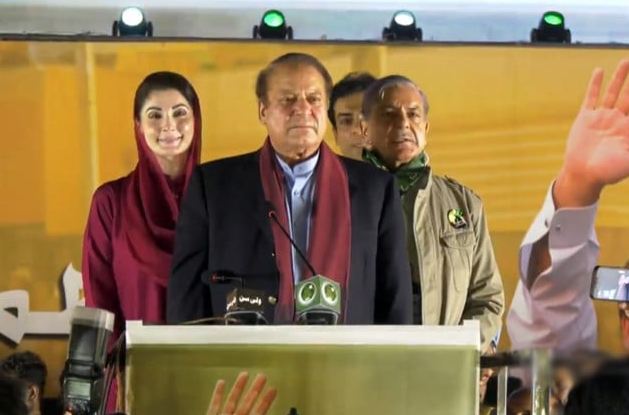
Lahore, OCT 21: Nawaz Sharif says ‘no wish to take revenge’, seeks support of all ‘constitutional institutions’. Deposed prime minister and proclaimed offender Nawaz Sharif, who returned to Pakistan today after spending four years in self-imposed exile, is addressing a massive crowd of supporters at the Minar-i-Pakistan in Lahore.

The PML-N supremo began his much awaited speech with a verse.

“I am meeting you today after several years, but my relationship of love with you is the same. There is no difference in this relationship,” he said. “The love I am seeing in your eyes, I am proud of it.”

Nawaz said he never betrayed his supporter nor did he shy from any kind of sacrifice. He recalled how fake cases were framed against him and his party leaders. “But no one abandoned the PML-N flag.”

“Tell me, who are they who separate Nawaz Sharif from his nation? We are those who built Pakistan. We made Pakistan an atomic power. We brought an end to loadshedding,” he said, highlighting how he produced and provided cheap electricity to the people.

Responding to the crowd cheering, Nawaz said: “I know you want to hear that I love you too.”

“Today, trust me, after seeing your love, I have forgotten all my grief and pain. I don’t even want to remember. But, there are some wounds that can’t ever heal.”

Nawaz, in a quivering voice, said how he had lost his mother and wife “to politics”. He recalled how he couldn’t pay the final respects to his mother, father or wife.

Earlier upon arrival, a visibly emotional PML-N supremo embraced his daughter Maryam and greeted other party leaders on stage. Before his address, the national anthem was played followed by recitation of the Holy Quran.

Meanwhile, PML-N’s Khawaja Saad Rafique read out his party’s resolution condemning Israeli atrocities on Palestinians.

The elder Sharif arrived in Islamabad in the afternoon, where he completed legal and biometric formalities. His chartered plane landed in the capital city with more than 150 people from his party and media organisations, the PML-N said.

Observers say the reason Nawaz arrived in Islamabad first was that his touchdown in the capital was necessary to make bail, earlier granted by the Islamabad High Court on Oct 19.

After completing the formalities, Nawaz left for Lahore and reached his hometown a little after 5pm. He was welcomed by his younger brother Shehbaz Sharif and other party leaders at the airport.

He then offered Maghreb prayers at the Lahore Fort with Shehbaz, Ishaq Dar and other party leaders before making his way to the Minar-i-Pakistan.

Earlier, a visibly emotional Maryam Nawaz mobilised supporters at Minar-i-Pakistan. Her namesake, Marriyum Aurangzeb, could also be seen wiping tears from her face.

Addressing the rally, Maryam said people from across Pakistan had gathered at Minar-i-Pakistan today. “I will not deliver a speech, only Nawaz Sharif will speak to you today.”

“I thought Minar-i-Pakistan was a huge venue, but I didn’t know it would turn out to be small for PML-N supporters,” she said, urging supporters to give Nawaz a historic welcome when he reached Minar-i-Pakistan.

Alongside Maryam, former Punjab chief minister Hamza Shehbaz described how streets in Lahore were packed with supporters. “This is the Pakistan of 2018,” he said.

Rallies from various regions of the country poured into Lahore today, a party spokesperson said. Heavy police contingents were deployed to guard the rally’s venue, said police officer Ali Nasir Rizvi.

Nawaz speaks to media at Dubai airport
“I’m going back to Pakistan after four years today,” Nawaz said today while speaking to the media at Dubai Airport. “When I was leaving Pakistan and going abroad I had no feeling of happiness but today I am happy.”

The ousted premier said he wished the country was in a better state than it was in 2017.

“I get very worried and disappointed seeing the situation in the country. The country that had to move forward is going backwards now economically and unity-wise.”

Terming the situation as “worrisome”, Nawaz said there was still hope and “we should not let it slip from our hands as we are capable of fixing it because we spoilt it ourselves”.

He said the country had to get back on its feet as “nobody else will lift us up”.

“When I remember Pakistan back then, I get hurt, we had said goodbye to the International Monetary Fund, electricity was cheap, the rupee was stable, there was employment, roti cost Rs4, a poor family’s child went to school and medicines were also cheap.”

Nawaz said only the Election Commission of Pakistan (ECP) can decide when polls will be held, adding that it was the only competent authority and a fair election commission.

“Whatever date the ECP announces, everyone will [abide by it]. My priority is whatever the ECP says. Pakistan has a fair ECP today and I feel it will make the best decision with regards to the election.

“The process takes time. Some work is left. A census has been done. Delimitations have to be carried out. ECP has an eye on all these things.

“We are completely ready for elections,” he added.

Lamenting the treatment meted out to him in the past, Nawaz said he was the person who had gone through 150 court hearings. “Not just me but also my daughter. She even got a clean chit. She had to get it. She didn’t have a position during my government, not even an office.”

He said fake cases were not just filed against his family including former prime minister and his brother Shehbaz Sharif but also ex-interior minister Rana Sanaullah Khan and PML-N leader Hanif Abbasi.

“I even said before leaving that I leave everything to Allah and I still continue doing that.”

Nawaz smirked and said “We are the May 28 ones” when asked about the May 9 violence allegedly carried out by the PTI.

Pakistan conducted nuclear tests on May 28, 1998, under the leadership of the then prime minister Nawaz.

PTI laments ‘two Constitutions’
Reacting to Nawaz’s arrival, PTI Secretary General Omar Ayub Khan called out the “two Constitutions”, comparing the manner in which Nawaz’s biometrics were verified to that of in which PTI Chairman Imran Khan were verified in the past.

He said, “This picture is not only of Nawaz Sharif’s biometrics, but of the funeral of Pakistan’s judicial system. The whole world has seen the coercion and treatment meted out to Imran Khan for the same biometrics.”

PTI leader Khurram Sher Zaman also criticised the judiciary for “facilitating the return of a convicted figure”.

In a post on X, he said, “By facilitating the return of a convicted fugitive, the justice system has given a slap to the faces of the people of Pakistan and sadly, they have no hesitations or shame in doing it.”

Stay Connected

64FansLike
60FollowersFollow

Latest Reviews

Exchange Rates

USD - United States Dollar
EUR
1.18
GBP
1.35
AUD
0.67
CAD
0.73