Home Blog Page 890

Afghanistan defeat Pakistan by 8 wickets in World Cup match

Afghanistan defeat Pakistan by 8 wickets in World Cup match

Afghanistan defeat Pakistan by 8 wickets in world cup match. it is considered another big upset in this world cup. Afghanistan had already defeated another world champion team England.

Pakistan gave a target of 282 to Afghanistan which they chased with 8 wickets in hand.

This is Afghanistan’s first ever win against Pakistan in one day cricket.

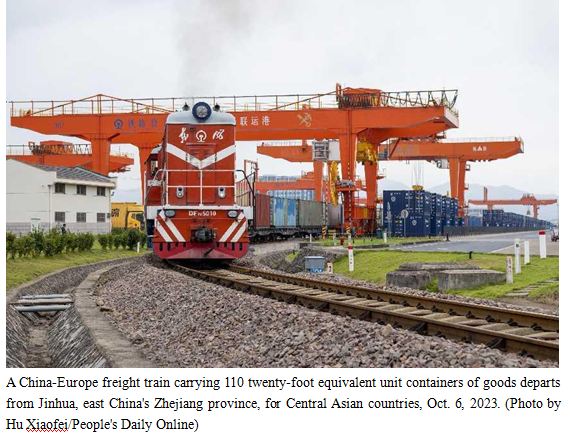
China-Europe freight trains write new chapters of Silk Road cooperation

China-Europe freight trains write new chapters of Silk Road cooperation

By Li Xinping, Lu Zehua, People’s Daily

Across the vast Eurasian continent, the tinkling of camel bells once rang along the ancient Silk Road. Today, the rumbling “steel camels” are running along tirelessly.

After 10 years of development, the China-Europe freight train service has accumulated 77,000 trips, transporting 7.31 million twenty-foot equivalent unit (TEU) containers of goods worth over $340 billion. It has become an important bridge for international economic and trade cooperation.

Up to now, the China-Europe freight trains connect 112 cities in China and reach over 200 cities in 25 European countries and regions, as well as over 100 cities in 11 Asian countries and regions along the route. It opens up new channels for land transportation between Asia and Europe.

At the China-Kazakhstan (Lianyungang) logistics cooperation base in east China’s Jiangsu province, cargos are transferred from freight trains to vessels, waiting to be shipped overseas.

At a cargo consolidation hub for the China-Europe freight trains in Shenyang, northeast China’s Liaoning province, cranes are hoisting containers marked “CHINA Railway” onto trains.

At the Erenhot Port in north China’s Inner Mongolia autonomous region, China-Europe freight trains stand ready to depart after inspections and load switching.

According to the data from China Railway, the China-Europe freight train service has three main corridors – western corridor, eastern corridor and middle corridor – through six border crossings. There are now 86 routes operating on a routine basis at 120 km/h, forming the network of international intermodal transport between Asia and Europe.

Ports are important nodes along the China-Europe freight train routes, where trains complete procedures such as load switching, customs declaration, customs clearance, and exit.

Over the past 10 years, countries along the China-Europe freight train routes have strengthened the capacity expansion of existing ports, opened new ports, and continuously improved international intermodal transport capabilities to meet the growing demand.

The Manzhouli railway port in northeast China’s Heilongjiang province, after going through multiple upgrades, has doubled its daily loading capacity to 840 TEUs from the number in 2020, making international intermodal transport more efficient and convenient.

According to data from China Railway, in 2022, the numbers of China-Europe freight trains passing through Alashankou, Horgos, Manzhouli, Erenhot, and Suifenhe ports reached 5,141, 3,150, 4,838, 2,549 and 884, respectively, up by 3,981, 3,080, 4,527, 2,388, and 884 compared to 2016.

Over the past decade, China-Europe freight trains have built an all-weather, high-capacity, green and low-carbon logistics channel, creating a new landscape for international transportation cooperation.

Statistics show that the China-Europe freight train service offers a cost advantage of approximately 1/5 compared to air transportation for shipping goods from China to Europe. Additionally, the transportation time is approximately 1/4 of that of sea transportation.

The service boasts high stability, and thus remains a reliable choice for meeting specific logistics needs that prioritize factors such as high value-added services and strict adherence to delivery timelines.

“Not only that, the average carbon emission of China-Europe freight trains is 1/15 of air transportation and 1/7 of road transportation. This plays a positive role in responding to global climate change and achieving sustainable transportation development,” said an executive with the freight transportation department of China Railway.

Multimodal transportation of rail-sea, rail-road, and rail-air will better unleash the efficiency of China-Europe freight trains.

According to the National Development and Reform Commission, currently there are 29 routes of China-Europe freight trains starting from coastal ports such as Dalian, Tianjin, Qingdao, and Lianyungang. Cities like Guangzhou and Chengdu have built new rail-air cross-border e-commerce export models relying on the China-Europe freight train service, promoting integrated logistics development.

The range of goods transported between China and Europe via the China-Europe freight trains continues to expand. Starting from China, the trains now carry 53 major categories of goods, expanding from mobile phones and computers initially to vehicles, mechanical equipment, electronic products, and more. From Europe to China, the categories have grown from timber, automobiles and spare parts to electromechanical products, food, and medical devices.

The China-Europe freight train service is seeing robust growth. In the first eight months of this year, 11,638 trips were made, carrying over 1.26 million TEUs of goods, up 10 percent and 23 percent respectively compared to the same period last year. With this momentum, the “steel camels” will bring even more opportunities for international economic and trade cooperation.

China sees fruitful outcomes in international space cooperation

China sees fruitful outcomes in international space cooperation

By Liu Yao

Through in-depth space cooperation, China and many countries in the world have jointly built a broad and magnificent “space silk road,” contributing to the development and utilization of space resources and the progress of human civilization.

The constellation of the Beidou Navigation Satellite System (BDS) is working around the clock in the space. Since the system’s commissioning more than three years ago, the application models of the BDS has been enriched, with its fields of application getting wider and wider.

According to statistics, the BDS-3 has provided accelerated positioning and high-precision service to more than 1.5 billion users in more than 230 countries and regions, winning more and more recognition from the international community.

In Xai-Xai, Gaza Province of Mozambique, there is a 20,000-hectare rice farm, the largest rice planting cooperation project in Africa. To plough the fields, and plant, manage and harvest crops on such a huge farmland was once a big challenge for local rice growers.

It was the innovation in agricultural technologies utilizing the BDS that benefited local rice growers. They can now control sprayer drones via mobile applications, thanks to the geographical positioning enabled by the Chinese positioning system.

Obtaining real-time geographical information through the BDS, sprayer drones are able to apply pesticides according to preset flight paths. Compared with traditional spraying methods, which rely on manual effort and can only cover a couple mu (667 square meters) each hour, BDS-enabled sprayer drones can treat over 100 mu of land every hour. Moreover, the drones can operate at night, dramatically improving efficiency.

The Sarez Lake in eastern Tajikistan is the world’s highest quake lake. It houses the highest and biggest natural dam in the world. Monitoring the deformation of the dam situated in a seismically active zone and thus protecting the safety of local residents remains an important issue.

A Chinese research team developed a deformation monitoring service platform for the dam based on the BDS, with a millimeter-level precision. With this platform, researchers can remotely monitor the deformation of the dam and send science-based warnings. The system has also been employed to monitor expressway side slopes in Kyrgyzstan and snow slides in Tajikistan.

According to Chen Gucang, deputy director of the China Satellite Navigation Office, the BDS is applied in a wide range of fields, and has played a significant role in the construction of the China-Kyrgyzstan-Uzbekistan highway as well as the operation of China-Kazakhstan crude oil pipeline and the China-Europe freight trains.

Two China-funded prototype satellites of the MisrSat II satellite project were delivered to the Egyptian side in June this year, making Egypt the first African country with the capacity to assemble, integrate and test satellites.

In December 2014, China and Egypt signed an agreement to carry out cooperation on the development of remote-sensing satellites. According to the agreement, China would build Egypt’s first satellite assembly, integration and test center.

The two countries signed an agreement for the MisrSat II satellite project in January 2019, based on which China would provide the Egyptian side with a small remote-sensing satellite, a ground measurement and control station and a ground application system. Besides, China would also train Egyptian aerospace experts.

Prior to that, Egypt did not have its own satellite assembly, integration and test center, nor satellite development capabilities. It could only import complete foreign satellites. The completion of the China-funded center has provided Egypt with world-leading aerospace infrastructure.

Egyptian Minister of International Cooperation Rania Al-Mashat noted that these advanced technologies and equipment are important to not only Egypt, but also entire Africa.

China has established cooperation with many countries and regions in jointly developing and launching communication or remote-sensing satellites, as well as constructing satellite ground receiving stations and other space infrastructure. These efforts have played a positive role in the development of local sectors such as communication, agriculture, culture, environmental protection, and meteorology.

The China National Space Administration said that China is committed to promoting global technological progress and the sharing of innovative achievements, with an aim to enhance the capabilities of people around the world to explore and utilize space.

China always follows the principles of “peaceful use, equality, mutual benefit and common development.” It is committed to transforming the Chinese space station into an open platform for international scientific and technological cooperation and exchanges.

Lin Xiqiang, a spokesperson and deputy director of the China Manned Space Agency, stated that the first batch of China’s international cooperation projects in collaboration with the United Nations Office for Outer Space Affairs will soon conduct experiments on the space station. Additionally, the implementation of 10 space application projects in collaboration with the European Space Agency is also progressing in an orderly manner.

China’s lunar exploration program has opened up opportunities for international cooperation on Chang’e-8 to the international society. It welcomes countries and international organizations to join and carry out multilevel collaboration together to achieve more major original scientific discoveries.

CIIE a public good for whole world

CIIE a public good for whole world

By Liao Ruiling

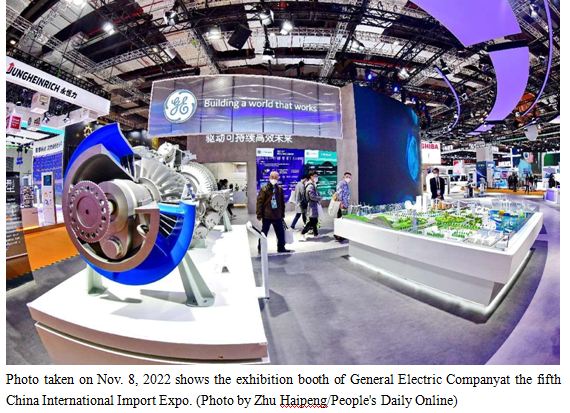
The sixth China International Import Expo (CIIE) is scheduled to be held at the National Exhibition and Convention Center (Shanghai) from Nov. 5 to 10.

As the world’s first import-themed national-level expo, the CIIE has become a showcase of China’s new development paradigm, a platform for high-standard opening-up, and a public good for the whole world.

The first CIIE was held in Shanghai in November 2018. Since then, the CIIE has been held annually in November, becoming an important platform for promoting exchanges and cooperation among enterprises and various parties.

In the previous five editions, 131 countries and international organizations participated in country exhibitions, with nearly 2,000 new products, technologies, and services making their debuts and a total intended turnover reaching nearly $350 billion.

The sixth CIIE will resume offline country exhibition and invite guest countries of honor. So far, over 60 countries have officially announced their participation in this year’s country exhibition. Notably, prominent international organizations, including the World Trade Organization, the United Nations Industrial Development Organization, and the International Trade Center, have also confirmed their attendance. Approximately 3,000 enterprises will attend the sixth CIIE, too, with total exhibition areas surpassing 360,000 square meters.

According to preliminary statistics, at least dozens of executives from Fortune Global 500 and industry-leading companies will attend the exhibition. Over 330 guests from some 30 countries and regions are expected to join the Hongqiao International Economic Forum.

This year’s CIIE will welcome both new friends that are about to make their debut at the event and old friends that have joined the exhibition before. Among the 3,000 global companies participating this year, approximately 200 companies have been signing up for six consecutive years, and around 400 companies are returning to the expo after a gap of more than two years.

“GE HealthCare is one of the earliest multinational corporations to participate in the CIIE. We’ve joined every year since the first edition,” said Zhong Luyin, chief communications officer of GE HealthCare China.

She noted that the CIIE is a place where cutting edge technologies are showcased, and has become a platform for many healthcare enterprises to debut their new products, frontier technologies and services.

“This year we will launch 10 products and services, in hope to strengthen communication with our partners through this platform,” Zhong added.

Many exhibitors havealready booked exhibition booths for the 7th CIIE. At a signing ceremony for exhibitors of the 7th CIIE held on Sept. 15, 25 enterprises including GE HealthCare and Panasonic signed contracts or MoUs concerning the exhibition at the 7th CIIE. So far, contracted exhibition area for the CIIE next year has exceeded 40,000 square meters.

As a member of the delegation of centrally-administered state-owned enterprises to the CIIE, China Construction Second Engineering Bureau Co.,Ltd. will attend the CIIE for a fifth time this year.

“The CIIE provides us with a platform to purchase global products without leaving the country. The elevators, electrical equipment and other imported products we procured at the CIIE were intelligent and environmentally friendly, providing strong support for our efforts in promoting green and smart construction,” said Zhao Guozheng, deputy general manager of East China Branch of China Construction Second Engineering Bureau Co., Ltd.

A range of significant opening-up measures have been introduced for the CIIE, which showcases China’s confidence and determination in opening up.

According to Sun Chenghai, deputy director of the CIIE Bureau, these measures announced during the expo to facilitate the entry of exhibitors and buyers, to provide tax incentives for retained exhibits, and to strengthen intellectual property right protection, have optimized the domestic business environment.

This July, the General Administration of Customs issued 17 measures to facilitate the 6th CIIE. These measures cover the entire process from exhibitor admission to customs clearance and post-exhibition disposal of exhibits.

The 6th CIIE will also expand its scope of exhibition, allowing animal and plant products and food that have not completed inspection and quarantine procedures from countries or regions that are free from animal and plant epidemics to join the exhibition after obtaining special approvals.

Sheng Qiuping, China’s vice minister of commerce, said that in the future, China will work to rationally reduce the negative list of foreign investment in pilot free trade zones, and at the same time, promote the introduction of a negative list for cross-border trade in services, and lead the country to continue to expand opening up.

Jiangxi province drives innovation, development in VR Industry

Jiangxi province drives innovation, development in VR Industry

By Zheng Shaozhong, Zhou Huan, People’s Daily

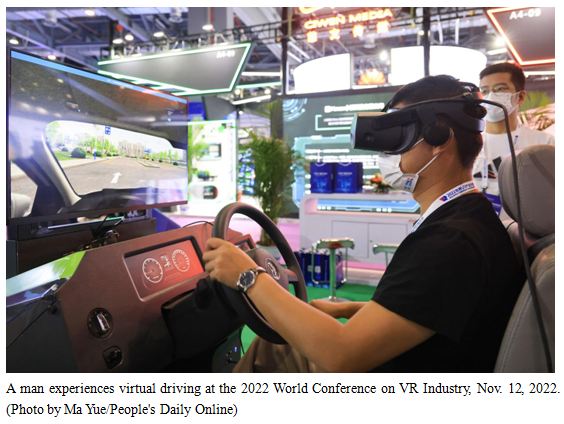
The 2023 World Conference on VR (virtual reality) Industry opened in Nanchang, east China’s Jiangxi province on Oct. 19.

Since its first edition in 2018, the VR industry conference has been held annually in Nanchang.During the past five editions of the conference, 562 projects were signed with a total amount of 336.6 billion yuan ($46.05 billion). A national vocational education virtual simulation demonstration training base and the National Virtual Reality Innovation Center have been set up in Jiangxi.

In recent years, with the continuous convergence of quality resources such as VR projects, technologies, talents, and funds, Jiangxi province has been emerging as a prominent hub for the VR industry.

Now, the province is home to more than 400 VR enterprises, and the revenue of VR and relevant industries surged from 4.2 billion yuan in 2018 to 81.2 billion last year.

Jiangxi-based automobile manufacturer Jiangling Motors Corporation Limited, or JMC, has an intelligent 5G factory that produces special purpose vehicles.

“Through innovative applications such as VR inspections, we have achieved automatic equipment failure warnings and reduced inspection time by approximately 30 percent,” said Yan Zongming, general manager of the company that retrofitted the factory.

According to Yan, China Unicom, one of the largest telecommunications operators in China, landed a VR/AR (augmented reality) base in Jiangxi province in 2020, which attracted over 10 relevant companies to settle in. These enterprises are engaged in various fields including software and hardware development, big data analysis and digital twin.

Thanks to this strong ecosystem, the revenue of Yan’s company jumped from around a million yuan when it just started to 21.54 million yuan in 2022.

Jiangxi takes VR as a key industry. It not only promotes integrated development of the industry’s capital chain, innovation chain, and industrial chain, but also strives to promote complementary development between the VR industry and other advantageous sectors, such as electronic information, the Internet of Things (IoT), and big data.

In a workshop of Pimax Nanchang, mainly engaged in the production and manufacture of VR headsets, three production line were seen working simultaneously.

Li Jie, vice president of the company, said that optical modules needed by the company are supplied by the Nanchang production base of Ofilm Group, and the company’s VR contents come from Nanchang-based Tellhow Creative Technology Group.

According to him, Pimax Nanchang is thriving thanks to the local VR industry cluster and the sound collaboration among relevant enterprises. The revenue of the company stood at 11.31 million yuan in 2022 and is expected to reach 20 million this year.

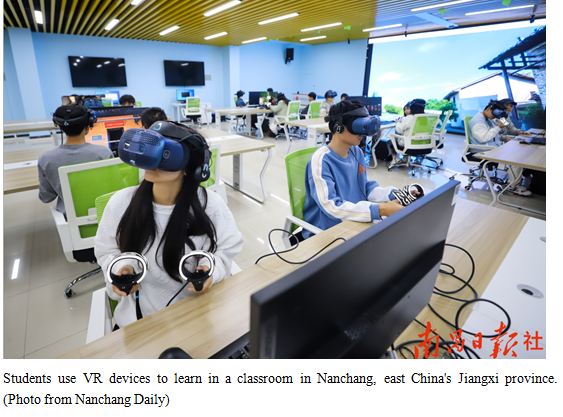
In Jiangxi province, VR and relevant technologies are now applied in a number of scenarios, boosting the development of various industries. For instance, students can “repair” a vehicle with VR controllers, and with VR equipment, R&D personnel can significantly improve their work performance and efficiency.

“Learning a skill well requires a lot of practice, and simulation training helps us make up for the lack of hands-on experience,” said Zhou Tao, a student majoring in urban rail transit operation and management at Jiangxi Modern Polytechnic College, who joined a half-month training at the national vocational education virtual simulation demonstration training base in Nanchang.

“Through VR technology, we can familiarize ourselves with the structures of vehicle equipment components in the classroom,” he added.

At present, the base provides training for 26 vocational education courses in nine major categories including equipment manufacturing, transportation, and healthcare. Upon full operation, the base will be able to train 100,000 people each year and bring an enormous market of at least 200 million yuan.

A demonstration agriculture base in Jiangxi province has developed a metaverse online shop that allows customers to “pick” fruits and vegetables on their mobile phones. After customers enter a virtual version of the farm on a mobile application and select the fruits and vegetables they want, robots would pick, pack and then mail them to customers.

“The majority of the research, production, and management for the base’s over 300 mu (20 hectares) of agricultural projects now utilize the metaverse technology,” said Meng Fanming, general manager of the base.

“VR is considered an important gateway technology for the metaverse. After years of development, Jiangxi has initially established a complete VR industry chain with a solid industrial ecology foundation,” said Liao Guoqiong, dean of the VR Modern Industrial College of Jiangxi University of Finance and Economics.

He added that multiple key VR R&D platforms including the Jiangxi Research Institute of Beihang University, Huawei Nanchang Institute, and a VR innovation center of China Mobile have settled in Jiangxi, and this will build more new momentums for Jiangxi’s development.

Chili pepper industry thrives in China

Chili pepper industry thrives in China

By Qiu Haifeng

In many regions across China, food is characterized by spicy flavor. According to statistics released by a recent conference on China’s chili pepper industry development, China is the world’s largest producer and consumer of chili peppers, and grows this plant in 28 provinces, autonomous regions and municipalities. The chili pepper industry is constantly expanding in the country.

“Since the introduction of chili peppers to China over 400 years ago when it was originally used for ornamental purposes, people have discovered the diverse values of the plant, including edible and medicinal properties, and the planting scale has expanded accordingly,” said Lin Qiao, associate research fellow at the Agricultural Information Institute of the Chinese Academy of Agricultural Sciences (CAAS).

Chili peppers are nutrient-rich, offer a wide range of flavors and feature a strong growth ability. They can be consumed fresh or processed into chili sauce, dried chili or chili oil. Besides, chili peppers also have significant economic and social value. Compounds like capsaicin and capsanthin found in chilies are utilized in medicine, food, and industry.

Both planting areas and production of chili peppers have been on a steady growth worldwide in recent years, and China’s chili pepper industry has also embraced rapid development.

Statistics from the Food and Agriculture Organization of the United Nations showed that 36.72 percent of the world’s chili peppers were grown in China in 2021.

A significant rise has been observed in both the global and Chinese production of chili peppers in recent years. In particular, the output of chili peppers in China accounts for nearly half of the global total, making the country the world’s largest producer of chili peppers.

The Chinese people’s demand for chili peppers also expanded as the country’s chili pepper production grew. Lin noted that owing to a spicy food craze in recent years, over 500 million people in China eat spicy food, with Jiangxi, Guizhou, Hunan and Sichuan provinces as well as Chongqing municipality as the main consuming regions of chili peppers.

Apart from satisfying domestic demand, Chinese chili peppers are also getting onto the dining tables of consumers around the world. Statistics indicate that China’s chili pepper exports reached $1.7 billion in 2022, a year-on-year increase of 11.6 percent. The United States, Japan and Spain remained the largest three importers of China’s chili peppers, consuming 41.1 percent of the total chili pepper exports from China.

The growing chili pepper industry, while meeting the market demand, has become a pivotal driver for farmer’s income growth in many regions.

“This year our chili pepper harvest was good, with a yield of over 3,000 kilograms per mu (667 square meters),” said chili farmer Tan Baohui in Fuxing village, Yihetala township, Kailu county, Tongliao, north China’s Inner Mongolia autonomous region.

“With the high yield and increased prices, this year I earned 0.2 yuan ($0.03) more per kilogram compared to last year, netting over 5,000 yuan per mu,” Tan noted.

According to an official with the local agricultural and animal husbandry bureau, Kailu county is the county with the largest planting area of red chili peppersin China. The average annual output of red chili peppers in the county is around 1.5 billion kilograms.

More than 60,000 farming households in the county are engaged in chili pepper cultivation, while over 50,000 people work in the chili pepper industry. They generate 360 million yuan in labor income each year.

In Xiaoxian county, Suzhou, east China’s Anhui province, the majority of income of local farmers doesn’t come from the sales of chili peppers, but the seeds of the plant.

“We have a standard greenhouse base for seed breeding, which covers over 300 mu, and we are mainly engaged in the propagation, processing, sales and technological promotion of chili pepper seeds,” said Mu Keli, who heads a demonstration base of scientific research of a seed company in Xiaoxian county.

According to Mu, the standard greenhouse base helps over 100 farming households earn extra income of over 10 million yuan per year through chili pepper seed breeding. This year, the seeds bred at the base were all sold out, and the base is preparing to plant new seedlings, Mu added.

The chili pepper seeds produced in Xiaoxian county are sold throughout China and exported to Japan, South Korea, and Southeast Asia. According to an official with the county’s agricultural and animal husbandry bureau, the county currently produces over 350,000 kilograms of high-quality chili pepper seeds annually, with a revenue close to 1 billion yuan, which directly increases income for over 6,000 farming households.

“From cultivation, seed production, primary processing to advanced processing, the continuous extension of the chili industrial chain has steadily increased the added value of products, further broadening channels for farmers to increase income,” said Lin.

To promote the development the chili pepper industry, regions across China are continuing their efforts.

Guizhou province recently made clear that it will focus on building an “ecological Guizhou chili”brand, and strongly support the applications for local brands, corporate brands and national geographical indication products.

Inner Mongolia autonomous region proposed supports for the development of intensive seed breeding companies, continues to advance large-scale, mechanized development of open cultivation of chili peppers.

Hunan province is integrating cultural resources related to chili pepper, striving to build a new signature for its tourism industry.

To write new chapters of modern Chinese civilization

To write new chapters of modern Chinese civilization

By Wen Hongyan, Yang Xuebo, Xu Qing, Song Jingsi, People’s Daily

The Chinese civilization has weathered vicissitudes and been passed down from generation to generation. It remains the only great ancient civilization that has developed in an unbroken line while retaining a coherent national identity down to the present day.

The five prominent features of continuity, innovativeness, unity, inclusiveness, and peaceful nature together shape the Chinese civilization, forming its profound values and systems.

The Chinese civilization, which has stretched for more than 5,000 years, provides strong cultural-ethical support for Chinese modernization. 

Chinese modernization represents the renewal, not the destruction, of the country’s ancient civilization. It is a modernization originating from China’s own land, not one mimicking other nations. It stems from the continuous development of the Chinese civilization, not from any rupture in its cultural heritage.

Modernization is a comprehensive development process that includes economic, political, cultural, social, and ecological aspects. It is a significant symbol of the development and progress of human civilization.

“As we have upheld and developed socialism with Chinese characteristics and driven coordinated progress in material, political, cultural-ethical, social, and ecological terms, we have pioneered a new and uniquely Chinese path to modernization, and created a new model for human advancement,” said Chinese President Xi Jinping at a ceremony marking the centenary of the Communist Party of China (CPC).

Today, China’s economy is shifting towards high-quality development, and there is a continuous emergence of material achievements, which lays a solid material foundation for Chinese modernization.

Democracy is a common value of all humanity and a distinctive feature of modern political civilization.

When visiting the Gubei civic center in Changning District of Shanghai in November 2019, Xi talked to Chinese and foreign residents attending a consultation meeting on a draft law. He said China is on the path of socialist political advancement with Chinese characteristics, and people’s democracy is a type of whole-process democracy. His remarks revealed the features and advantages of socialist democracy.

The CPC initiated the National People’s Congress and the Chinese People’s Political Consultative Conference, which has a close relation to the Chinese civilization’s people-oriented philosophy, idea of collective governance, political tradition of “republic” and “deliberation,” and political wisdom of “inclusiveness, mutual learning, and seeking common ground while reserving differences.”

China has a unitary state structure and a regional national autonomy system. It conforms to the general trend of cohesion within the Chinese nation and unity in diversity.

China did not follow the old Western path, but rather has created its own modernization path suited to itself. China did not directly copy Western democratic models, but has created its own form of democracy with Chinese characteristics.

Democracy takes different forms, and there is no one-size-fits-all model. It would be totally undemocratic to measure the diverse political systems in the world with a single yardstick or examine different political civilizations from a single perspective.

In today’s China, democracy has turned from a value into an institution and governance mechanism. The 1.4 billion Chinese people are enjoying rights and dignity like never before.

The essence of modernization is the modernization of people. Replacing backwardness with progress and eliminating poverty with prosperity aligns with the historical trend and represents the moral imperative of human progress.

People-centered development philosophy has introduced a series of pioneering initiatives to promote common prosperity and realize fairness and justice, doing everything to resolve the most practical problems that are of the greatest and most direct concern to the people, and making active efforts to solve the most pressing difficulties of high concern to the people. As a result, the people’s sense of gain, fulfillment, and security has become more substantial, better assured, and more sustainable.

China abandons the Western path of modernization that is capital-centered, polarized, full of materialism, expansion and pillage. It represents the direction of the progress of human civilization.

While pursuing happiness for the Chinese people and rejuvenation of the Chinese nation, the CPC has also contributed to human progress and world harmony.

“Hegemonism is not in China’s DNA; nor does China have any motivation to engage in major-power competition. China stands firmly on the right side of history, and believes that a just cause should be pursued for the common good,” said Xi at the closing ceremony of the BRICS Business Forum 2023 on Aug. 22. He once again explained China’s unwavering commitment to the path of peaceful development from the perspective of civilization.

Facing the changes of the world, of the times and of history, the CPC always uphold humanity’s common values of peace, development, equity, justice, democracy and freedom. It is committed to promoting mutual learning among civilizations and advancing human progress.

Chinese modernization, as a new form of human advancement, will draw upon the merits of other civilizations and make the garden of world civilizations more vibrant.

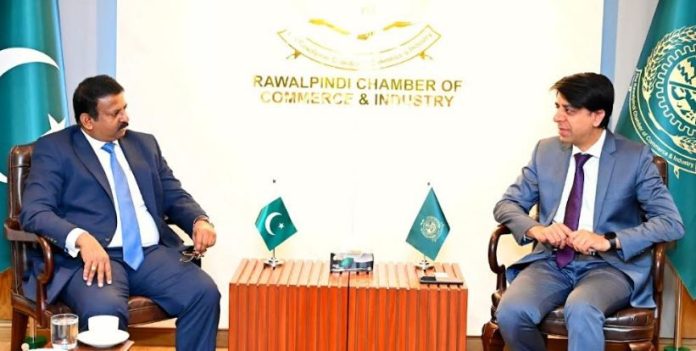
Acting HC Sri Lanka calls on RCCI President Saqib Rafiq

Acting HC Sri Lanka calls on RCCI President Saqib Rafiq

Rawalpindi, OCT 23 /DNA/ – Charge De Affair Augustine Christy Ruban, Sri Lankan High Commission called on Saqib Rafiq, President Rawalpindi Chamber of Commerce and Industry (RCCI) here on Monday.

Matters related to the enhancement of trade relations, close cooperation in various sectors including Pharmaceutical and Tourism, information sharing, chamber to chamber networking and strengthening of cooperation in all the sectors of investment of both countries were discussed during the meeting.

RCCI President Saqib Rafiq gave a summary of current activities and future programs of the chamber. He said that trade relations between Pakistan and Sri Lanka are historic and there is a historical partnership between the two countries. In addition, there is a need to provide a platform for the two countries to forge important trade links. People-to-people contact and religious tourism provide excellent platforms to further expand bilateral cooperation between Pakistan and Sri Lanka, he added.

Charge De Affair Augustine Christy Ruban, in his remarks said that Sri Lanka considers Pakistan an important trade partner in the region. Both countries have close and historical relations and there was wide scope to expand bilateral trade between Sri Lanka and Pakistan, he further added.

Mr. U.L Niyas, Minister Counselor Sri Lanka, Senior Vice President Muhammad Hamza Sarosh, Vice President Mr. Faisal Shahzad and Executive Member Mudassir Maqbool, among others, were also present on the occasion.

Pak vs Afg: Babar leads Pakistan to 282-7 in match against Afghanistan

Pak vs Afg: Babar leads Pakistan to 282-7 in match against Afghanistan

CHENNAI: Pakistan skipper Babar Azam hit a stylish half century to guide his team to a fighting 282-7 in their World Cup match against Afghanistan in Chennai on Monday.

Prolific batter’s 92-ball 74 was ably supported by opener Abdullah Shafique’s 75-ball 58 while Shadab Khan and Iftikhar Ahmed then scored a valuable 40 runs apiece.

On a spin-friendly Chidambaram Stadium pitch, Afghanistan fielded four slow bowlers with 18-year-old left-armer Noor Ahmad grabbing a career best 3-49 on his World Cup debut.

Shadab added a rapid 73 runs with Iftikhar for the sixth wicket as Pakistan added 61 in the last five overs, with Shadab falling off the last delivery.

Iftikhar cracked four sixes and two boundaries while Shadab´s innings featured a six and a four.

Pakistan enjoyed a strong start with a 56-run stand before Azmatullah Omarzai dismissed Imam-ul-Haq for 17 in the 11th over.

Ahmad struck his first blow when he trapped opener Abdullah Shafique for 58 in the 23rd over.

Shafique hit two sixes and five boundaries in his third half century of the World Cup.

Ahmad then dismissed Pakistan´s top scorer in the World Cup Mohammad Rizwan, caught sweeping in his next over to leave Pakistan on 120-3.

Babar also fell to Ahmad when the Pakistan skipper played a tennis-like shot to a delivery that was seemingly out of his reach, ending up straight into the hands of Mohammad Nabi at extra cover.

Babar hit four boundaries and a six and added 43 with Saud Shakeel who made 25.

Afghan spinner Rashid Khan went wicket-less in his ten overs, conceding 41 runs while pacer Naveen-ul-Haq took 2-52.

Afghanistan´s highest successful ODI chase is the 274 they achieved against the United Arab Emirates in Dubai nine years ago.

Pakistan brought in Shadab in place of Mohammad Nawaz who went down with a fever on the morning of the game while Ahmad came for Afghanistan in place of fast bowler Fazalhaq Farooqi.

Pakistan went into the game with two wins and two defeats from four matches while Afghanistan had win against three losses.

Playing XI
Pakistan: Abdullah Shafique, Imam-ul-Haq, Babar Azam (capt), Mohammad Rizwan (wk), Saud Shakeel, Iftikhar Ahmed, Shadab Khan, Usama Mir, Hasan Ali, Shaheen Shah Afridi, Haris Rauf

Afghanistan: Rahmanullah Gurbaz, Ibrahim Zadran, Rahmat Shah, Hashmatullah Shahidi (capt), Azmatullah Omarzai, Ikram Alikhil (wk), Mohammad Nabi, Rashid Khan, Mujeeb Ur Rahman, Naveen-ul-Haq, Noor Ahmad.

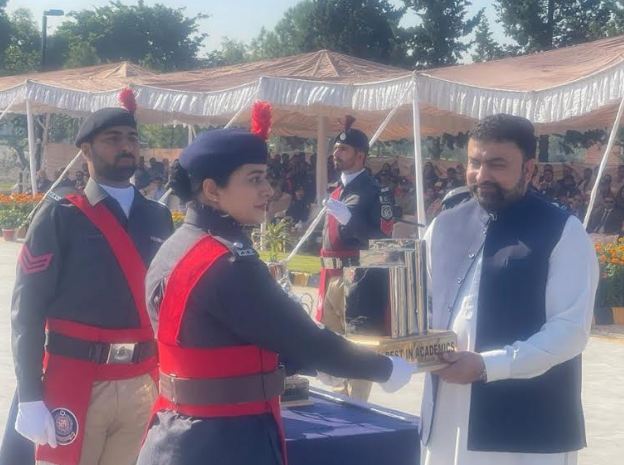
Passing out parade of ASSP held at National Police Academy

Passing out parade of ASSP held at National Police Academy

DNA

ISLAMABAD: An impressive Passing out Parade of the ASsP (UT) of 25th ICC/49th STP was held at National Police Academy (NPA) Islamabad. Honorable Minister for Interior, Mr. Sarfaraz Ahmed Bugti, was the chief guest on the occasion. The chief Guest congratulated all the graduating officers on the successful completion of their basic training. He appreciated the role of NPA in training the officers of Police Service of Pakistan.

He said that the role and duties of law enforcing agencies is of pivotal importance for the stability and socio-economic advancement of our country. He also said that the whole nation is indebted to police for its sacrifices in the war against terrorism. He reiterated government’s commitment to fulfill the requirements of police and promised to meet demands of NPA at earliest. Earlier, Mr. Salah-ud-Din Khan, Commandant NPA in his welcome address expressed his gratitude to the Chief Guest for sparing time for NPA and the graduating officers and said that the passing out batch consisted of 35 officers, including 08 lady officers and one PAF Officer.

This occasion marks the culmination of a rigorous 18 month calendar which incorporates extensive academic syllabi including various aspects of police management, criminal justice administration, law enforcement, community policing, crime management and policing by objective, physical training as well as acquainting the officers with real time policing. It has been the endeavour of the National Police Academy to incorporate the latest research in its curriculum so that the officers are abreast of latest policing trends.

The officers have also been sensitized about the subjects of public dealing, police media relations and security and safety of vulnerable groups. The course also includes anti-terrorism training for Assistant Superintendents of Police. The Commandant also stated that the NPA’s mission is to impart best possible training not only to the Assistant Superintendents of Police but to all segments of law enforcement irrespective of the fact that they belong to Police or not. This is done keeping in view the complex developments and challenges being faced in the context of the overall crime picture as well as law and order.

 We have developed capacity building courses for all law enforcement agencies including Frontier Constabulary, FIA, Intelligence Bureau, Punjab and Sindh Rangers etc. He also expressed his extreme gratitude to the International Criminal Investigation and Training Assistance Program (ICITAP) run by the Government of The United States, British High Commission, ICRC, UNODC, NCA, Islamabad based N.G.O in the finalization of these courses. He said that these agencies have supported us generously and there is no hesitation in saying that they are true friends of National Police Academy.

The Commandant in his concluding remarks said that the officers graduating today were selected on absolute merit by the Federal Public Service Commission and surely they are the best persons for the assigned job. He was confident to say that they will be a source of pride for the nation and would contribute positively to its well being. The Chief Guest reviewed the smartly turned out parade and awarded trophies to the best in different categories. 1. Mr. Muhammad Saad Bin Ubaid Best in Parade 2. Mr. Ali Abdullah Khalid Best in Firing 3. Capt. (R) Abdullah Shaheryar (Male) Best in Physical (Male) 4. Ms. Shazia Ishaq (Female) Best in Physical (Female) 5. Mr. Tayyab Wazir Best in Riding 6. Ms. Nayyab Ramzan Best in Academics 7. Mr. Adnan Gul Best in Discipline 8. Ms. Nayyab Ramzan All Round Best A large number of serving and retired police officers, representatives from other government departments, foreign diplomats, and relatives of the passing out officers witnessed the parade.

Stay Connected

64FansLike
60FollowersFollow

Latest Reviews

Exchange Rates

USD - United States Dollar
EUR
1.17
GBP
1.34
AUD
0.67
CAD
0.73