Home Blog Page 887

US donates 100 birthing stations to Sindh

US donates 100 birthing stations to Sindh

U.S. Ambassador Donald Blome at a Ceremony to Present Healthcare Equipment to Community Midwives

Sindh Rural Support Organization Office, Sukkur

KARACHI, OCT 11: /DNA/ – Thank you so much for your kind invitation to be here today.  This is my fourth trip to Sindh since last year’s floods.  Health care services were hit hard, with disproportionate effects on women and children.  Despite the progress that has been made to rebuild the affected areas, many people are still feeling the effects of those devastating floods.

My message today is this:  the United States is still here, still working.  We are committed to you and the work you do to improve the health of women and children.

And I in particular want to commend the heroic work of community midwives.  Your expertise saves lives.  You are the reason we’ve seen a reduction in maternal and infant mortality here in the province.

Many of you had your clinics, service rooms, equipment, and supplies damaged or destroyed in the floods.  We all owe it to you – and the women, families, and communities you serve — to ensure that you have the facilities and equipment you need to conduct this vital work.

Too often, the provision of maternal and child health services is concentrated in urban areas, leaving rural communities underserved. Today I’m announcing that the United States is providing 100 birthing stations and essential equipment to communities affected by last year’s devastating floods.

My hope is that these new birthing stations will improve access to skilled birthing attendants, maternal healthcare, and delivery services.

Thank you for the critical, lifesaving work that you do.  The United States supports you in your efforts to build a brighter and healthier future for the women and children of Sindh.

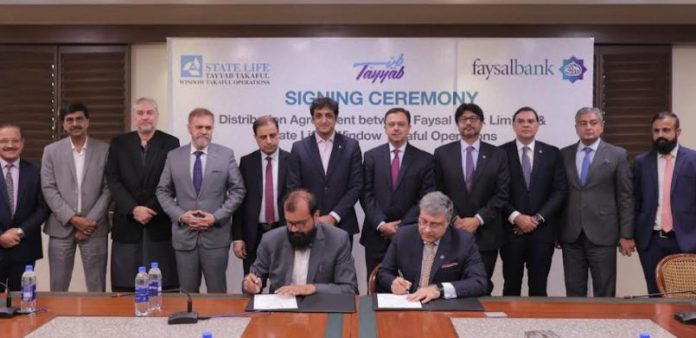
Faysal Bank to offer State Life Window Takaful Operations at its branches

DNA

Islamabad, OCT 11: In a recent ceremony hosted at the State Life Insurance Corporation of Pakistan (SLIC) Head Office – Window Takaful Operations of SLIC formalized a Distribution Agreement with Faysal Bank Limited (FBL). The agreement signing ceremony was witnessed by Mr. Yousaf Hussain, President and CEO of FBL, and Mr. Shoaib Javed Hussain, CEO of SLIC. Mr. Ahmed Anwar Hemani, Head of Institutional Sales & Wealth Management of FBL, and Mr. Tariq Saeed Chaudhry, Chief Takaful Officer of SLIC, signed the agreement while Mr. Jaudat Hussain, Head of Retail Banking FBL, and Mr. Muhammad Izqar Khan Executive Director of SLIC and senior officials from both organizations were also present. 

This Distribution Agreement signifies that State Life’s Takaful product, particularly the State Life Tayyab Takaful Endowment Plan, will now be accessible to all FBL customers at every FBL branch across the country.

Mr. Yousuf Hussain, the CEO of FBL, stated at the ceremony, “Our partnership with State Life for their Takaful Endowment Plan is, in fact, an important addition to our long list of initiatives. Moreover, this Agreement will provide yet another benefit to our valued customers who are an integral part of our rapidly growing Bank. This Agreement will also enable our business community to know about the products, services, and opportunities we keep on tailoring for them”.

Mr. Shoaib Javed Hussain, the CEO of SLIC, stated at the ceremony, “I am pleased to announce this partnership between two prominent organizations in Pakistan. This joint effort reflects a shared commitment to enhancing inclusive financial protection across diverse segments of Pakistani society, aligning the common vision of fostering economic activities and promoting a savings culture in the country. The collaboration brings benefits of best-in-class savings and protection products to Faysal Bank’s valued customers and represents a significant step towards offering Shariah-compliant Takaful solutions to the people of Pakistan.”

‘Live and let live’: CJP Isa says SC and Parliament not enemies, can co-exist as proceedings wrap up

CJP

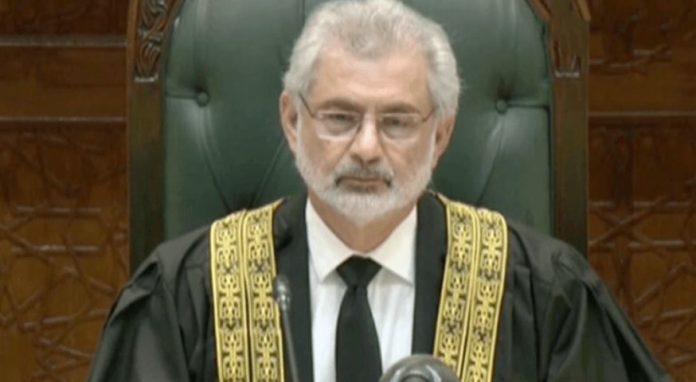
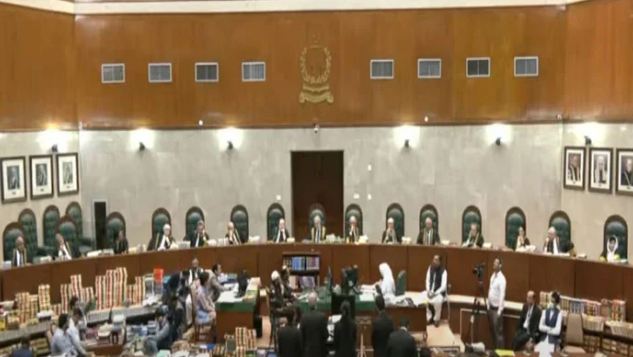
ISLAMABAD, OCT 11: Chief Justice of Pakistan (CJP) Qazi Faez Isa on Wednesday said the Parliament was not an enemy of the Supreme Court and both institutions could function simultaneously, citing the phrase “live and let live”.

“The world moves forward together, not antagonistically,” the apex judge said.

He passed these remarks while heading the full court bench, consisting of all 15 judges of the top court, hearing a set of petitions challenging the Supreme Court (Practice & Procedure) Act, 2023. The proceedings, like all the previous times, are being streamed live on television.

Headed by CJP Isa, the bench consists Justice Sardar Tariq Masood, Justice Ijazul Ahsan, Justice Syed Mansoor Ali Shah, Justice Munib Akhtar, Justice Yahya Afridi, Justice Aminuddin Khan, Justice Sayyed Mazahar Ali Akbar Naqvi, Justice Jamal Khan Mandokhel, Justice Muhammad Ali Mazhar, Justice Ayesha A. Malik, Justice Athar Minallah, Justice Syed Hasan Azhar Rizvi, Justice Shahid Waheed and Justice Musarrat Hilali.

The practice and procedure law, which was passed by parliament in April, requires a committee of three senior judges to form benches for constitutional matters and suo motu notices.

It has been seen by the petitioners as an attempt by the government to curtail the chief justice’s powers.

In April, the Supreme Court, then led by former chief justice Umar Ata Bandial, barred the government from implementing the law until the petitions challenging it were decided.

At the previous hearing, an exchange between judges and counsel hinted at the disquiet among judges over the court’s workings.

Justice Ijazul Ahsan observed that when the parliament makes a law to interfere in the internal workings of the apex court, the insulation provided to the Supreme Court by being empowered to manage its inner workings goes away, and it opens gates for interference.

Besides, no law can be struck down on the grounds of the floodgates argument, but by the exclusion of cases and in view of the very small number of Article 184(3) cases, the dangers of the floodgates argument are substantially reduced, he said.

After the proceedings adjourned, Advocate Uzair Bhandari requested the CJP to include the names of the associates in the attendance sheet. “Only on condition that the lawyer furnishes an affidavit stating his associates have been remunerated appropriately,” said CJP Isa.

The hearing
At the outset of the hearing today, Attorney General for Pakistan (AGP) Mansoor Usman Awan presented his submissions. He said his arguments would be based on the government’s written response submitted in court.

“You are saying you not repeat the arguments but will highlight them,” the CJP said here, to which Awan stated that he would talk about the independence of the judiciary and Article 191 of the Constitution.

Article 191 (Rules of procedure) states: “Subject to the Constitution and law, the Supreme Court may make rules regulating the practice and procedure of the Court.”

The AGP added that three questions were raised during the proceedings on the matter in discussion and he would respond to them. He said Article 191 did not take away the Parliament’s right to legislate.

“Parliament has given the judiciary its independence but has also not limited its right to legislate,” Awan said.

Here, Justice Akhtar recalled that before 1973, changes to SC rules were conditional to the permission of the governor general or president.

For his part, the AGP said there were no restrictions on the Parliament amending rules under Article 191.

“Are you saying that there are no restrictions on the Parliament amending rules formulated by the SC?” Justice Ahsan asked. “So are there no restrictions on SC amending laws created by the Parliament?”

Awan replied that the Parliament was the institution that created laws. He further stated that if the number of pending cases in the apex court crossed 70,000 a need may arise to create another law.

Meanwhile, Justice Naqvi asked if the AGP had brought the record of the number of parliamentarians who had debated on the practice and procedure law. “It is present on the website,” Awan replied.

At one point, CJP Isa said institutions should be “pitted against each other” and there should be mutual respect among them.

“In my opinion, the Parliament respected the SC. If it wanted, the Parliament could have taken another step which it did not. I believe that step was not taken because the Parliament trusts us,” he said.

The top judge further stated that the scope of the matter should not be widened. “Parliament is not our enemy neither does it consider us enemies. Both can be run simultaneously,” he said.

“The world is moving forward while we are going backwards. There are a number of challenges that we are seeing, including climate change,” Justice Isa added and cited the phrase “live and let live”.

He then instructed the AGP to focus on the attack on the Constitution.

Resuming his submissions, Awan said the Constitution did not recognise any convention but didn’t recognise customs or usages having the force of law.

However, Justice Akhtar stressed that the Constitution has to be read on the premise that there have to be constitutional conventions.

For his part, the AGP said the Constitution never acknowledged the CJP as the “master of the roster”. Here, Justice Isa interjected and asked about the genesis of the term and whether it was even used today. Awan replied that the term came from the colonial British times.

The CJP again questioned if such a term existed in Islamic history and criticised the dependence on “colonial masters”.

At one point, Justice Akhtar said that the master of the roster committee, under the new law, would do the same work that the CJP used to do. If you don’t want to give the power to one judge, why give it to three judges, he asked.

“If any CJP has not given the power to full court in the past, then you do it,” the judge remarked.

On the other hand, Justice Ahsan said the foremost question was whether the Parliament was competent and the second was that if the Parliament was competent, some provision of the law inconsistent with the Constitution could be struck down.

“You would have to take us to each provision and justify that it is not in conflict with any provision of the Constitution,” he added, asking the AGP to proceed.

Meanwhile, the CJP said that it wasn’t acceptable that the Parliament was restricted while the SC kept taking decisions, recalling that orders have been passed in the past where judges were restrained from being a part of benches.

Justice Isa expressed displeasure that this was, however, not being discussed by anyone from the petitioners’ side.

“The time has come for the country to move forward. The way courts are used, as they say, ‘misuse of due process’. Guns are being fired from our shoulders and martial laws have been endorsed,” the top judge said.

Institutions, Justice Isa continued, were not perfect but they should be developed and respected. “But anyone who talks about betterment, they are reprimanded,” he said.

“Keep a balanced approach, you are the Attorney General for Pakistan. At the moment, you are an officer of the court, not just representing the government’s approach, because there is no government in the sense that there is a caretaker government and a neutral set-up now,” the CJP told Awan.

The judge added that there was a difference between the government and Parliament.

During the hearing, the AGP revealed the details of judgments taken under Article 184(3) and their outcomes. He said Steel Mills had record losses of Rs206 billion since June 2022.

“Are you trying to say that all this happened because of SC’s action?” CJP Isa asked while Justice Naqvi stated a chargesheet should not be made against the apex court.

“Why are we so scared of listening to the truth?” the top judge said.

On the other hand, Justice Afridi asked what the AGP wanted from the chargesheet. “Do you want us to call the practice and procedure law lawful through the doctrine of necessity?”

Here, the CJP once again questioned, “Why are we scared of criticism”.

Separately, Justice Akhtar reprimanded the AGP and said: “This is not a debate society neither are we sitting here to listen to your lectures.”

Success of gems and jewelry show 2024 can boost our exports: FPCCI-TDAP

FPCCI

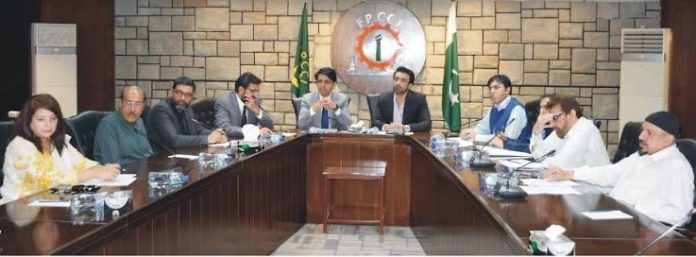
Islamabad (DNA) – The Core Committee meeting on Gems and Jewelry Show 2024 was held at FPCCI Capital Office Islamabad yesterday led by Mr. Umar Masudur Rahman Vice President FPCCI. The meeting was attended by Mr. Saqib Rafiq President Rawalpindi Chamber, Petron Chief APCEA Haji Mamoor Khan, Chairman Syed Minhaj ud Din Bacha, Chairman Mining Association, Farukh Alvi, RCCI Members Akhtar Amin, Muhammad Fayaz Qureshi, member Islamabad CCI Ayesha Asif, and Trade Development Authority Islamabad representatives Ishaq Shinwari and Moin Ahmed.

Mr. Umar Masood ur Rehman Vice President FPCCI said that he believed the Gems and Jewelry Show 2024 would go a long way to showcasing gemstones in the international market. He appreciated the role of TDAP Islamabad to bring all related trade bodies on our platform under the patronage of TDAP and FPCCI to organize a befitting show to attract foreign buyers. The Gems expo will be jointly organized by TDAP & FPCCI, ICCI, RCCI, APCEA, PAGJTEA, PGMA. He further said that this event aims to promote the mineral and mining section of Pakistan which is enriched with 80% of Pakistan’s mineral base, and this exhibition is expected to play a major role in exploring the mineral potential of this land. This event should design to facilitate gemstone and mineral businesses in Pakistan, and it will also provide an opportunity for local businesses to expand their business potential around the country and beyond.

Vice President FPCCI further said that the current economic challenges can be countered with our exports for which he appreciated the Director General TDAP on his efforts for planning various events not only in international markets but also in local rural markets of KP and Gilgit Baltistan. It’s time to give special attention to African and central Asian markets to enhance our exports through various means. The FPCCI and TDAP are working for the same goal to enhance Pakistan’s trade and exports, therefore, close liaison between both entities is essential and obligatory to achieve the goals more effectively. The success of Gems and Jewelry Show 2024 can bring economic stability. He added.

During the meeting, the participants also appreciated the role of FPCCI and Trade Development Authority while presenting various suggestions regarding the success of the show and increase exports of this sector.

Mr. Saqib Rafiq President Rawalpindi Chamber, Petron Chief APCEA Haji Mamoor Khan, Chairman syed Minhaj ud Din Bacha, Chairman Mining Association, Farukh Alvi, RCCI Members Akhtar Amin, Muhammad Fayaz Qureshi, member Islamabad CCI Ayesha Asif, and TDAP representatives Ishaq Shinwari said that Pakistan’s gemstone and jewelry sector is currently suffering due to low exports, undergoing a massive fall in the last five years. In 2016-17, the exports of the industry stood at $5.8 million, down 99% compared with $921.8 million in 2011-12. “With the help of foreign investment and machinery, we can increase our gemstone and jewelry exports to $5 billion in just 3 years, Pakistan have the finest craftsmanship and other Countries have technology. Together, we can promote exports of the industry,”

The Participation of the meeting said that we believe on working jointly with the private sector to boost our country’s export and assured that TDAP Islamabad will facilitate the business community of KP Province and Gilgit Baltistan. He shared various proposals for necessary collaboration with FPCCI to push the trade and economic activities to boost the exports. They further said that African market is our priority and TDAP was striving hard for increasing exports in ASEAN, African and Central Asian regions that can bring economic stability to the country. He further shared that TDAP is also supports the women entrepreneurs to uplift their local business activities and prepare them to export their products.

People-centric governance is key to a peaceful society

People-centric governance is key to a peaceful society

DNA

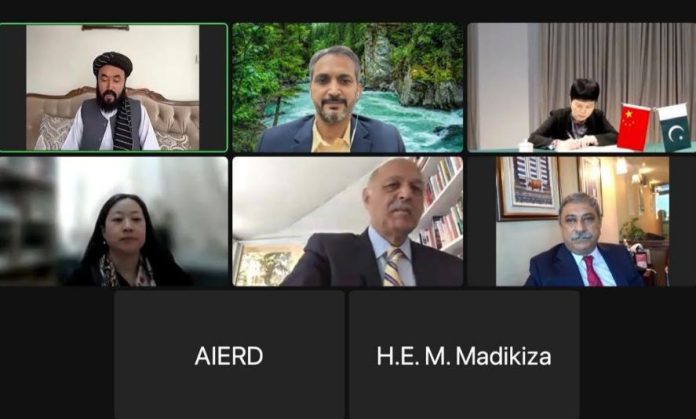
ISLAMABAD: Speakers at a webinar on Wednesday said that people-centric governance should primarily focus on serving the interests of the people with an aim to uplift their social and economic situation. The webinar titled ‘Dialogue For People Centric Governance’ was organized by Asian Institute of Eco-Civilization Research and Development (AIERD), which was attended by a number of academics, diplomats, students, and senior government officials.

Governance is the art of satisfying the needs of the people and serving the interests of the people, said Shakeel Ahmad Ramay, CEO, of AIERD, while opening the webinar. 

Speaking at the event, Senate Defence Committee Chairman Syed Mushahid Hussain Syed said the Belt and Road Initiative (BRI) was a very important element to understand people-centric governance. “China had advanced a Chinese solution to global development issues based on inclusivity, respect for diversity and equality and based on the concept of win-win cooperation and mutual benefit,” he said.

Mr Syed went on to say that the State Council of the Peoples Republic of China had recently issued a white paper on BRI, in which it had said that the initiative was one of the key pillars of the shared community for the future, adding that its living example was the China Pakistan Economic Corridor (CPEC). He said the people centric governance in China was based on the ethos of the Communist Party of China and Chinese historical context. Under the Chinese leadership, the key bottom line has been that the party springs from the people as it has 95 million members, he said, adding that Chairman Mao Zedong had stressed on serving people in different capacities.

ith people. 

Deputy Head of Mission and minister at the Chinese embassy in Islamabad Pang Chunxue said people-centric governance was important in Chinese philosophy.

China had always adhered to this philosophy which was rooted in Chinese history, she said.

Pang Chunxue said people were the foundation of a country, and that people-centered governance served as a guiding compass for China’s overall development.

She added that improvement in social security, health and education systems were vital for efficient public service. Speaking about CPEC, she said China had injected $25.4 billion in direct investment in Pakistan.

Deputy Dean, Institute of Community with Shared Future, Communication, University of China, Prof Zhang Yanqiu, in her presentation, said it was not feasible for China to copy the political systems of other countries.

She referred to China’s whole-process people’s democracy, saying that democracy was not an ornament to be used for decorations rather it was meant to solve the problems that people wanted to be solved. She said the whole-process people’s democracy served the interests of the people, and quoted Chinese President Xi Jinping as saying, “China’s people’s democracy is a type of whole-process democracy”. She said the whole-process people’s democracy, including democratic election, consultation, decision-making, management and scrutiny, operated across all of China’s governance mechanisms and that consultative democracy was a distinctive feature of China’s socialist democracy.

Prof Zhang Yanqiu said since 2016, more than one billion registered voters had elected close to 2.5 million deputies to county and township level people’s congresses.

She said China was the second largest economy in the world and had a clear view of the future by constantly thinking about the long-term.

South African High Commissioner Mthuthuzeli Madikiza said the World Bank defined good governance as the one epitomized by predictable, open and enlightened policy making. Good governance is a pivot and pillar of human prosperity but yet elusive. It swings like a pendulum, he said. He said in South Africa, the notion of good governance through representatives of the majority was new and young in practice but mature in conceptualization.

He said he could say without fear of contradiction that good governance in South Africa was routine. “It is not a matter of half empty glass but half full,” he said, adding that progress was being made in good governance. Academics and students of good governance generally agreed that good governance was discernable when it showed the following characteristics: accountability, transparency, rule of law, responsive, effective governance, consensus and orientation, the South African envoy said.

Afghan Deputy Minister of Economy Abdul Latif Nazari said Afghanistan was in an important and historic situation. He said people stood with the Islamic Emirate and did not support war mongers. The Afghan government was striving to serve its people, and therefore the ministry of economy invited all countries to play an active role in development projects in Afghanistan. He assured them that the ministry was committed to the safety of all investors and was ready to attract domestic and foreign investors.

“We expect investment in trade, agriculture and social sector as it would help reduce poverty and food insecurity in Afghanistan,” Mr Nazari said. “Sanctions have led to an increase in poverty, he said, adding that he hoped that they would be lifted and interaction between Afghanistan and the world would increase. He further added that Afghanistan had a geo-strategic, geo-politics and geo-economic position in the region.

“It has always attracted the attention of great world powers, and has been a connecting link between South and Central Asia. A stable Afghanistan can lead to economic growth and development in the region,” Mr Nazari said.

Inspector General of Police Islamabad Akbar Nasir Khan said progress in governance was a long haul.

He said history had seen many models of governance, of which democracy was one way of governing people.  He stressed on the value of service to people and counted many aspects of it. “Acceptance of the diversity of the people and their ideas was probably one of the biggest values of the democracy which we know today,” he said.

He said the purpose of democracy was to meet the needs of the people, address their concerns and improve the quality of their lives.

He, however, said public concerns kept on changing but values remained constant.

“I believe values like transparency, participation, consultation, diversity and inclusiveness should be adhered to, as they guarantee progress, human development and certified models,” he added.

In the end, AIERD Chairman Zahid Latif Khan thanked all the participants. He said there was unawareness about Chinese governance system and stressed on shedding light on it.

He said people-centric governance was the wellbeing of our entire community and revolved around the health and welfare of individuals. In our interconnected world, policies can often affect people’s lives, therefore upholding of human rights, ensuring government responsive, promoting social justice, empowering marginalized section of the society and encouraging people’s engagement in decision-making process are important factors, which we need to focus on, Mr Khan concluded.

France to hold education tour in Lahore, Karachi

Study Abroad

DNA

ISLAMABAD: France is to organise the 2nd edition of “Choose France Pakistan – Education Tour” in Lahore on October 17 and Karachi on October 19 Following the success of the First edition in Lahore and Islamabad, the “Choose France Pakistan – Education Tour” is back in 2023 to explore Lahore and Karachi. The programme includes wide range of fields such as management, engineering, humanities, finance, business and sciences.

Eleven top-notch French universities are part of the delegation, such as Sciences Po Paris, Centrale Nantes and EDHEC. “Choose France Pakistan – Education Tour” is a government initiative from France, organised by the French Embassy in Pakistan, Campus France Pakistan and their local partners, in order to promote studying in France.

The 2 Education fairs to be organised in Lahore (October 17) and Karachi (October 19) will give the opportunity to students to interact directly with the French universities, learn more about the 1700 programmes taught in English at the Bachelor and Master levels, and get details about the 183 scholarship programmes available for Pakistani students.

This year, 4 French business schools are part of the delegation. According to the latest Financial Times’ world rankings, French business schools are still topping the ranking.

For example, the four best Masters in Finance pre-experience 2023 are French; among the five best Masters in Management 2023, three are French, including the one ranked #1. For MBA and Executive education, a French institution is ranked in top position: INSEAD, an institution with a large alumni network in Pakistan.

During this “Choose France Pakistan – Education Tour”, French delegates will also visit Pakistani universities to discuss partnership opportunities to strengthen the academic cooperation between France and Pakistan in the area of business & management, sciences & engineering and social & political sciences.

Pakistan outclass Sri Lank in crucial World Cup match

Pak vs SL: Pakistan snatch victory from jaws of defeat

Rizwan’s 100 knock does it for Pakistan; highest ever run chase in any world cup match

Hyderabad, OCT 10: Pakistan roared to a second successive win at the World Cup as they beat Sri Lanka by six wickets in Hyderabad on Tuesday, with Mohammad Rizwan and Abdullah Shafique starring impressing with the bat.

The Green Shirts also created history by chasing down 345 against Sri Lanka, overtaking Ireland to claim the record of the highest-ever run chase in the history of ODI World Cups.

Playing XIs

Sri Lanka: Pathum Nissanka, Kusal Perera, Kusal Mendis (wk), Sadeera Samarawickrama, Charith Asalanka, Dhananjaya de Silva, Dasun Shanaka (c), Dunith Wellalage, Maheesh Theekshana, Matheesha Pathirana, Dilshan Madushanka

Pakistan: Abdullah Shafique, Imam-ul-Haq, Babar Azam (c), Mohammad Rizwan (wk), Saud Shakeel, Iftikhar Ahmed, Mohammad Nawaz, Shadab Khan, Hasan Ali, Shaheen Shah Afridi, Haris Rauf

SC law interfered in court’s independence, observes Justice Ijaz

SC law interfered in court's independence, observes Justice Ijaz

CJP Justice Isa says we should not doubt intention of the Parliament

Special Correspondent

ISLAMABAD: Justice Ijaz Ul Ahsan of the Supreme Court on Tuesday remarked that an attempt was made to interfere in the independence of the apex court by enacting the Supreme Court (Practice and Procedure) Act 2023.

The observation from the top court judge came during the hearing of pleas challenging the SC law seeking to regulate the discretionary powers of the country’s chief judge.

Chief Justice of Pakistan (CJP) Qazi Faez Isa-led full-court bench consisting of all 15 judges of the Supreme Court including Justice Sardar Tariq Masood, Justice Ijaz Ul Ahsan, Justice Syed Mansoor Ali Shah, Justice Munib Akhtar, Justice Yahya Afridi, Justice Aminuddin Khan, Justice Sayyed Mazahar Ali Akbar Naqvi, Justice Jamal Khan Mandokhel, Justice Muhammad Ali Mazhar, Justice Ayesha A. Malik, Justice Athar Minallah, Justice Syed Hasan Azhar Rizvi, Justice Shahid Waheed and Justice Musarrat Hilali is hearing the case.

The hearing was broadcast live on state-run PTV.

In yesterday’s hearing, CJP Isa had observed that parliament passed the law with “good intentions”.

Today’s hearing began with Muttahida Qaumi Movement-Pakistan’s (MQM-P) lawyer Faisal Siddiqi’s arguments.

The counsel stated that he would base his arguments on two cases — the Baz Kakar case and the top court’s verdict on the Supreme Court (Review of Judgements and Orders) Act 2023.

He also shared that he would respond to Justice Malik’s query on the use of word law in Article 191.

However, when the lawyer tried responding to Justice Malik’s point he was intervened by Justice Ahsan which led to an exchange of words with CJP Isa.

Justice Ahsan had stated that he wanted to ask a question but CJP intervened and asked the lawyer to continue with his arguments which led to a smirk from Siddiqi.

“There is nothing to laugh about on this matter, we have been listening to the case for four full days and multiple cases are lined up for a hearing,” remarked CJP Isa.

“Everyone on the bench wants to ask questions but let the lawyer complete his arguments.”

The lawyer then stated that when the SC rules were being formulated the definition of law was written, adding that there was no ambiguity about what the word law meant.

“You want to say that the definition of law is written in the Supreme Court Rules,” asked Justice Akhtar.

However, this irked CJP Isa, who then asked the bench members to stop the questions and let the counsel complete the arguments first.

“Just explain what law means in Article 191,” persisted Justice Akhtar.

At this point, CJP Isa told Justice Akhtar that if he has already made up his mind then he can write it in the judgment.

However, Justice Akhtar responded that as a member of the bench, it was his “right to ask questions”.

“Obviously, you can ask questions, but first let the lawyer complete the arguments,” said CJP Isa.

“Sorry but my problem is my questions,” Justice Akhtar responded and asked the lawyer to answer his queries.

Interjecting the proceedings, CJP Isa turned to Siddiqi and told him that he was ignoring his directions and asked him to respond to questions after completing his arguments.

Moving on, Justice Ahsan asked the counsel to explain the word law, to which, the lawyer stated that it meant an act of parliament.

However, Justice Ahsan wondered why the Constitution states that the judiciary, executive and legislature are separate. He added that the law in question interfered with the independence of the Supreme Court.

“Was this act an interference in the matters of the Supreme Court yes or no?” asked Justice Ahsan.

Siddiqi stated in the negative and said that parliament cannot make laws that bar the Supreme Court from making its own rules.

“Parliament can supervise the Supreme Court,” said the lawyer.

But Justice Ahsan was of the view that supervision meant “controlling” the Supreme Court. But the lawyer responded by saying even that supervisory role is limited.

Moving on, Justice Minallah observed that the SC’s jurisdiction can be extended in line with a law and added that the only limitation related to the top court’s jurisidction was mentioned in “entry 55”.

Justice Shah asked the lawyer to explain as to how “entries” allowed to increase scope of Article 184(3) of the Constitution.

Responding to the judges’ queries, lawyer Siddiqui cited Lahore High Court (LHC) verdict saying parliament can legislate on increasing jurisdiction of the top court.

To which, the CJP inquired whether the LHC verdict on top jurisdiction was challenged in the Supreme Court.

The lawyer responded saying that the Competition Commission Act was challenged in the court and the verdict was also announced on the matter.

“This matter is currently pending before the Supreme Court,” the counsel added.

However, Justice Malik said the act in question was related to a provincial law and not a federal one.

After the hearing resumed following a brief break, MQM-P’s counsel continued his arguments.

Siddiqui said he wanted to present arguments on whether rules can be devised using an act of Parliament.

Justice Naqvi asked about the parliamentary record of the legislation on the act, which the court had sought from Attorney General Mansoor Usman Awan. Siddiqui said Awan himself could only respond regarding the record.

Addressing the MQM-P counsel, Justice Ahsan asked if it is possible to give the right to appeal under the Constitution.

“Right to appeal cannot be conferred by sub-constitutional legislation. I’m talking about the procedure because two wrongs don’t make a right,” he remarked.

Responding to the SC judge, Siddiqui said: “It has to be checked whether there is any restriction on giving the right to appeal in the Constitution or not.”

Justice Malik remarked that the word law has been used 400 times in the Constitution.

“Does Article 191 require the power to legislate and is different from the rest of the clauses?” she asked.

The apex court judge said that the Constitutional interpretation has to rely on some principle. “On which principle are you relying,” she inquired from Siddiqui.

In his response, the MQM-P lawyer suggested that the court should look into whether there can be an intra-court appeal in the Supreme Court or not, instead of delving into the details.

“[Right to] appeal has already been given in the Constitution,” Justice Madokhail said.

“Where in the Constitution is the Parliament given direct authority?” Justice Ahsan remarked.

The chief justice inquired if any political party had voted against the SC law.

Justice Minallah then questioned the principle of separation of powers pertaining to when the top court interferes with the parliament’s authority.

Justice Akhtar asked Siddiqui about the principle adopted regarding Article 191, which states that “subject to the Constitution and law, the Supreme Court may make rules regulating the practice and procedure of the court”.

Justice Shah said as long as a law does not affect fundamental rights, it can operate and added that a watchdog was present to check if any law is enacted against the Constitution.

Justice Akhtar inquired as to why parliament cannot repeal the Supreme Court’s rules.

“Parliament can completely abolish the SC rules if they are against the Constitution and the law,” Justice Shah remarked.

Justice Hilali said there are very limited Articles of the Constitution in which the word subject to law is used. “Whenever Article 184 (3) was invoked, the foundations of the entire country were shaken.”

She also questioned whether the SC rules should have changed over time.

“Is it not a constitutional mandate that the SC make its own practice and procedure?” Justice Malik asked.

She added that the apex court has created a system in which it regulates itself. “Why can’t all these issues be discussed by summoning a full court meeting?” Justice Malik raised the point.

Responding to a question posed by Justice Malik, the MQM-P counsel said: “No one is stopping the Supreme Court from making rules.”

After the MQM-P counsel concluded his arguments, Pakistan Bar Council (PBC) lawyer Haroon-ur-Rashid adopted arguments presented in favour of the law.

“Elevating Education: The Pursuit of Quality in Schools”

Sabahat Ali

Introduction

In an age characterized by rapid educational transformation, maintaining the highest standards of quality in schools becomes paramount. This article explores the critical aspects of ensuring quality education, drawing inspiration from the wisdom of great scholars and education experts.

The Holistic Approach to Quality

Scholars like Dr. Howard Gardner, renowned for his theory of multiple intelligences, have emphasized that true quality in education goes beyond mere academic achievements. Gardner asserts that schools should strive to foster a diverse range of intelligences and skills in students, such as creativity, empathy, and problem-solving abilities. This holistic approach ensures that students develop into well-rounded individuals equipped to thrive in an ever-changing world.

Teacher Well-Being and Professional Growth

Education luminaries such as Dr. Linda Darling-Hammond have long championed the cause of teacher well-being and professional development. They argue that teachers are the backbone of the education system and must be supported through continuous learning opportunities, adequate resources, and fair compensation. When educators are motivated and empowered, they can deliver the highest quality of education to their students.

Engaging Parents and Communities

Dr. James P. Comer, a prominent child psychiatrist and educator, has advocated for the involvement of parents and communities in the educational process. He believes that building strong partnerships between schools, parents, and local communities is essential for creating a nurturing and enriching learning environment. When parents and communities actively participate in education, students benefit from a network of support that extends beyond the classroom.

Real-Life Success Stories

Throughout history, countless success stories validate the importance of quality education. Individuals like Dr. Mae Jemison, the first African American woman in space, attribute their achievements to the exceptional education they received. Dr. Jemison’s journey from a small-town school to the stars exemplifies how quality education can unlock limitless potential.

Collective Responsibility for Excellence

Scholars and educators alike stress that ensuring quality education is a collective responsibility. Dr. Paulo Freire, known for his work in critical pedagogy, believed that education should be a collaborative effort between teachers, students, and society. This shared responsibility extends to policymakers, who must create an enabling environment that supports educational excellence.

Conclusion

In an ever-evolving educational landscape, the pursuit of quality in schools remains a timeless mission. Great scholars and education experts have illuminated the path forward, emphasizing the holistic nature of education, the well-being of teachers, the engagement of parents and communities, and the shared responsibility of all stakeholders. By drawing inspiration from their insights and success stories, we can continue to elevate education, nurturing generations of well-rounded, empowered, and globally-minded individuals who will shape the future.

[email protected]

Workers’ remittances to Pakistan plunges 11.3% on YoY basis

Workers’ remittances to Pakistan plunges 11.3% on YoY basis

KARACHI, Oct 10 (DNA): In a positive turn of events for Pakistan, the
country has witnessed a significant increase in workers’ remittances
during September 2023.

According to the latest data released by the State Bank of Pakistan
(SBP), remittances surged by 5.34% on a month-on-month (MoM) basis,
reaching a total of $2.21 billion, compared to $2.09 billion in the
previous month.

This boost in remittances is attributed to several key factors,
including improved transparency and the implementation of stringent
measures against dollar smuggling. These initiatives have helped create
a more secure and regulated environment for remittance transactions.

However, on a year-on-year (YoY) basis, there has been an 11.3% decline
in workers’ remittances for September, compared to $2.49 billion
received in the same month last year. This decline is indicative of the
challenges faced by the Pakistani diaspora and the evolving economic
landscape.

The majority of remittances during this period originated from various
source countries. Saudi Arabia led the way, contributing $538.16
million, followed by the UAE with $399.77 million, the U.K. with $311.06
million, EU countries with $269.25 million, and the USA with $263.42
million. These source countries continue to play a pivotal role in
supporting Pakistan’s economy through remittance inflows.

Looking at the cumulative figures for the first three months of the
fiscal year 2023-24 (3MFY24), Pakistan received a total of $6.33 billion
in remittances.

While this is a significant amount, it represents a 19.85% decrease
compared to the $7.9 billion received during the same period in the
previous fiscal year (3MFY23). The decline underscores the ongoing
challenges and fluctuations in remittance trends.

It’s worth noting that the drop in remittances during the previous month
was primarily due to a growing disparity between official and unofficial
exchange rates. Many non-resident Pakistanis opted to use unofficial
channels, which offered a higher exchange rate per dollar, contributing
to this decline.

In response to these challenges, the Pakistani authorities, led by the
army, initiated crackdowns against speculators, hoarders, and smugglers
to curb illegal dollar outflows. This has led to a strengthening of the
Pakistani Rupee (PKR) against the U.S. Dollar (USD) in the official
market.

Furthermore, the State Bank of Pakistan (SBP) introduced reforms aimed
at consolidating and transforming various types of exchange companies
into a single category with stricter regulations and higher capital
requirements. These reforms are enhancing transparency within the
remittance industry and strengthening regulatory oversight.

As part of these measures, SBP suspended the authorization of four
exchange companies in September, underscoring the central bank’s
commitment to enforcing regulatory standards and ensuring the security
of remittance transactions. DNA

Stay Connected

64FansLike
60FollowersFollow

Latest Reviews

Exchange Rates

USD - United States Dollar
EUR
1.17
GBP
1.34
AUD
0.67
CAD
0.73